About the Report
Base Year 2024Global Glutaraldehyde Market Overview
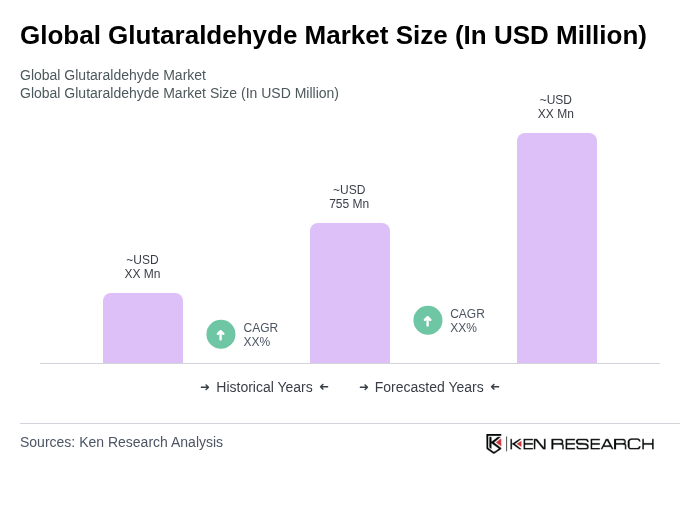
- The Global Glutaraldehyde Market is valued at USD 755 million, based on recent analysis. Growth is driven by strong demand for highly effective disinfectants and sterilization agents in healthcare settings, where glutaraldehyde is trusted for sterilizing non-autoclavable instruments and controlling microbial contamination in water treatment systems. Expanding applications in leather tanning, oil and gas, and laboratory processes are also contributing to this growth.
- Key regions dominating the market include North America and Europe, attributed to their advanced healthcare infrastructure and stringent hygiene standards. Meanwhile, the Asia-Pacific region is emerging as a fast-growing market due to rapid industrialization and the expansion of healthcare and water treatment sectors, which are increasing the demand for glutaraldehyde.
- In regulatory terms, the European Commission under Regulation (EU) 2015/1759 approved glutaraldehyde as an active substance in multiple biocidal product categories, including healthcare and veterinary hygiene, subject to strict purity criteria and conditions for non-professional uses to manage health and environmental risks.
Global Glutaraldehyde Market Segmentation
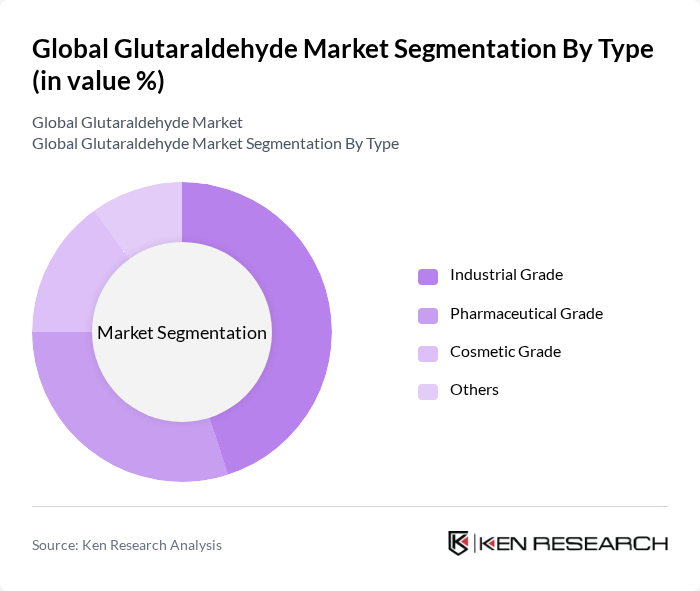
By Type:The market is segmented into Industrial Grade, Pharmaceutical Grade, Cosmetic Grade, and Others. Among these, the Industrial Grade segment is the most dominant due to its extensive use in various industrial applications, including leather tanning and oil and gas extraction. The Pharmaceutical Grade segment is also significant, driven by the increasing demand for sterilization in healthcare settings. The Cosmetic Grade and Others segments, while smaller, are growing as consumer awareness of hygiene and safety increases.
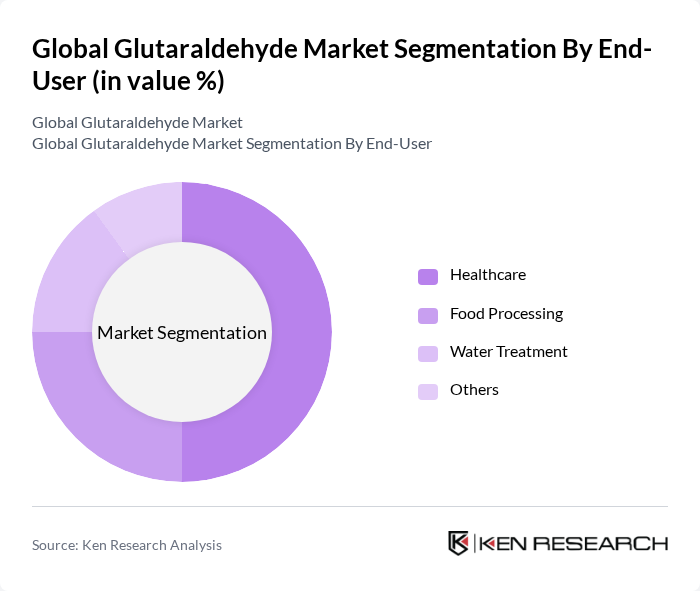
By End-User:The end-user segmentation includes Healthcare, Food Processing, Water Treatment, and Others. The Healthcare sector is the largest consumer of glutaraldehyde, primarily for sterilization and disinfection purposes. The Food Processing segment follows, utilizing glutaraldehyde for its preservative properties. Water Treatment is also a significant end-user, as glutaraldehyde is effective in controlling microbial growth in water systems. The Others segment includes various industrial applications that contribute to the overall market.
Global Glutaraldehyde Market Competitive Landscape
The Global Glutaraldehyde Market is characterized by a dynamic mix of regional and international players. Leading participants such as BASF SE, The Dow Chemical Company, Johnson & Johnson, Merck KGaA, Sigma-Aldrich Corporation, Aqualon Company, Afton Chemical Corporation, Aurochemicals, Aegis Chemical Solutions, Aqualife, Chemtex Speciality Limited, Hubei Xinjing Chemical Co., Ltd., Jiangsu Shunfeng Chemical Co., Ltd., Kanto Chemical Co., Inc., TCI Chemicals contribute to innovation, geographic expansion, and service delivery in this space.
Global Glutaraldehyde Market Industry Analysis
Growth Drivers
- Healthcare Sterilization Demand:The global glutaraldehyde market size reached USD 779.14 million in future, driven by the increasing need for high-level disinfectants in healthcare settings. This demand is particularly strong for sterilizing heat-sensitive medical equipment, such as endoscopes, which require effective biocides to ensure patient safety. The healthcare sector's growth, alongside rising surgical procedures, is expected to further boost glutaraldehyde consumption in this critical application area.
- Industrial & Municipal Water Treatment:In future, numerous water treatment facilities adopted glutaraldehyde-based biocides to combat biofilm formation and microbial contamination. This trend is crucial as water quality regulations tighten globally, necessitating effective disinfection methods. The increasing focus on maintaining safe drinking water standards and improving wastewater treatment processes is expected to significantly enhance the demand for glutaraldehyde in both industrial and municipal applications.
- Environmental Sustainability Initiatives:Approximately 21% of industrial users are actively seeking eco-friendly glutaraldehyde alternatives, reflecting a growing trend towards sustainability. In future, 27% of producers introduced low-odor or low-emission formulations, while advancements in production processes led to an 18% improvement in batch consistency. These initiatives are driven by regulatory pressures and consumer demand for safer, environmentally responsible products, positioning glutaraldehyde as a viable option in sustainable practices.
Market Challenges
- Health & Safety/Toxicity Concerns:Approximately 24% of end-users report increased operational costs due to compliance measures related to glutaraldehyde's irritant nature and toxicity. These safety concerns necessitate protective gear and proper ventilation, which can deter smaller facilities from adopting glutaraldehyde. The need for stringent safety protocols can limit market penetration, particularly in regions with less regulatory enforcement, impacting overall growth.
- Competition from Alternative Biocides:The glutaraldehyde market faces significant pressure from alternative disinfectants, with around 19% of industrial consumers shifting to options like hydrogen peroxide and peracetic acid. These alternatives are often perceived as safer and more convenient, which can erode glutaraldehyde's market share. The increasing availability of effective substitutes poses a challenge for glutaraldehyde producers, necessitating innovation and differentiation to maintain competitiveness.
Global Glutaraldehyde Market Future Outlook
The future of the glutaraldehyde market appears promising, driven by innovations in eco-friendly formulations and advancements in digital dosing systems. Producers are increasingly focusing on developing biodegradable and low-emission products to meet stringent environmental regulations. Additionally, the integration of digital monitoring technologies in industrial applications is enhancing efficiency and reducing waste, positioning glutaraldehyde as a key player in sustainable practices. Emerging markets, particularly in Asia-Pacific and Latin America, are expected to provide significant growth opportunities as healthcare and industrial sectors expand.
Market Opportunities
- Emerging Economies in Asia-Pacific & Latin America:The Asia-Pacific region holds over 38% of the glutaraldehyde market share, with rapid industrialization and healthcare infrastructure expansion creating untapped demand. Countries like India and Brazil are witnessing significant growth in their healthcare sectors, presenting opportunities for glutaraldehyde producers to establish a strong presence in these emerging markets.
- Green Chemistry & Sustainable Products:With approximately 21% of the market showing a preference for eco-friendly formulations, there is a clear opportunity for innovation in sustainable glutaraldehyde products. The introduction of low-emission variants by 27% of producers indicates a shift towards environmentally safe alternatives, allowing companies to differentiate themselves and capture a growing segment of environmentally conscious consumers.
Scope of the Report
| Segment | Sub-Segments |
|---|---|
| By Type | Industrial Grade Pharmaceutical Grade Cosmetic Grade Others |
| By End-User | Healthcare Food Processing Water Treatment Others |
| By Application | Disinfectants Preservatives Sterilization Agents Others |
| By Formulation | Liquid Powder Others |
| By Distribution Channel | Direct Sales Online Sales Distributors Others |
| By Geography | North America Europe Asia-Pacific Latin America Middle East & Africa |
| By Regulatory Compliance | FDA Compliance EPA Standards ISO Certifications Others |
Key Target Audience
Investors and Venture Capitalist Firms
Government and Regulatory Bodies (e.g., Environmental Protection Agency, Food and Drug Administration)
Manufacturers and Producers
Distributors and Retailers
Pharmaceutical Companies
Healthcare Facilities and Hospitals
Industrial Users (e.g., Water Treatment Facilities)
Chemical Supply Chain Stakeholders
Players Mentioned in the Report:
BASF SE
The Dow Chemical Company
Johnson & Johnson
Merck KGaA
Sigma-Aldrich Corporation
Aqualon Company
Afton Chemical Corporation
Aurochemicals
Aegis Chemical Solutions
Aqualife
Chemtex Speciality Limited
Hubei Xinjing Chemical Co., Ltd.
Jiangsu Shunfeng Chemical Co., Ltd.
Kanto Chemical Co., Inc.
TCI Chemicals
Table of Contents
Market Assessment Phase
1. Executive Summary and Approach
2. Global Glutaraldehyde Market Overview
2.1 Key Insights and Strategic Recommendations
2.2 Global Glutaraldehyde Market Overview
2.3 Definition and Scope
2.4 Evolution of Market Ecosystem
2.5 Timeline of Key Regulatory Milestones
2.6 Value Chain & Stakeholder Mapping
2.7 Business Cycle Analysis
2.8 Policy & Incentive Landscape
3. Global Glutaraldehyde Market Analysis
3.1 Growth Drivers
3.1.1 Increasing demand in healthcare and sterilization
3.1.2 Rising applications in the chemical industry
3.1.3 Expanding use in water treatment processes
3.1.4 Growing awareness of environmental safety
3.2 Market Challenges
3.2.1 Regulatory compliance and safety concerns
3.2.2 Fluctuating raw material prices
3.2.3 Competition from alternative disinfectants
3.2.4 Limited awareness in emerging markets
3.3 Market Opportunities
3.3.1 Expansion in emerging economies
3.3.2 Innovations in product formulations
3.3.3 Increasing demand for eco-friendly products
3.3.4 Strategic partnerships and collaborations
3.4 Market Trends
3.4.1 Shift towards sustainable and biodegradable alternatives
3.4.2 Technological advancements in production processes
3.4.3 Growing focus on healthcare infrastructure
3.4.4 Rising demand for glutaraldehyde in research laboratories
3.5 Government Regulation
3.5.1 Strict guidelines on chemical usage in healthcare
3.5.2 Environmental regulations on waste disposal
3.5.3 Safety standards for chemical manufacturing
3.5.4 Compliance requirements for import/export
4. SWOT Analysis
5. Stakeholder Analysis
6. Porter's Five Forces Analysis
7. Global Glutaraldehyde Market Market Size, 2019-2024
7.1 By Value
7.2 By Volume
7.3 By Average Selling Price
8. Global Glutaraldehyde Market Segmentation
8.1 By Type
8.1.1 Industrial Grade
8.1.2 Pharmaceutical Grade
8.1.3 Cosmetic Grade
8.1.4 Others
8.2 By End-User
8.2.1 Healthcare
8.2.2 Food Processing
8.2.3 Water Treatment
8.2.4 Others
8.3 By Application
8.3.1 Disinfectants
8.3.2 Preservatives
8.3.3 Sterilization Agents
8.3.4 Others
8.4 By Formulation
8.4.1 Liquid
8.4.2 Powder
8.4.3 Others
8.5 By Distribution Channel
8.5.1 Direct Sales
8.5.2 Online Sales
8.5.3 Distributors
8.5.4 Others
8.6 By Geography
8.6.1 North America
8.6.2 Europe
8.6.3 Asia-Pacific
8.6.4 Latin America
8.6.5 Middle East & Africa
8.7 By Regulatory Compliance
8.7.1 FDA Compliance
8.7.2 EPA Standards
8.7.3 ISO Certifications
8.7.4 Others
9. Global Glutaraldehyde Market Competitive Analysis
9.1 Market Share of Key Players
9.2 Cross Comparison of Key Players
9.2.1 Company Name
9.2.2 Group Size (Large, Medium, or Small as per industry convention)
9.2.3 Revenue Growth Rate
9.2.4 Market Penetration Rate
9.2.5 Customer Retention Rate
9.2.6 Pricing Strategy
9.2.7 Product Diversification
9.2.8 Operational Efficiency
9.2.9 Brand Recognition
9.2.10 Innovation Rate
9.3 SWOT Analysis of Top Players
9.4 Pricing Analysis
9.5 Detailed Profile of Major Companies
9.5.1 BASF SE
9.5.2 The Dow Chemical Company
9.5.3 Johnson & Johnson
9.5.4 Merck KGaA
9.5.5 Sigma-Aldrich Corporation
9.5.6 Aqualon Company
9.5.7 Afton Chemical Corporation
9.5.8 Aurochemicals
9.5.9 Aegis Chemical Solutions
9.5.10 Aqualife
9.5.11 Chemtex Speciality Limited
9.5.12 Hubei Xinjing Chemical Co., Ltd.
9.5.13 Jiangsu Shunfeng Chemical Co., Ltd.
9.5.14 Kanto Chemical Co., Inc.
9.5.15 TCI Chemicals
10. Global Glutaraldehyde Market End-User Analysis
10.1 Procurement Behavior of Key Ministries
10.1.1 Government procurement policies
10.1.2 Budget allocation for healthcare
10.1.3 Compliance with safety standards
10.1.4 Supplier evaluation criteria
10.2 Corporate Spend on Infrastructure & Energy
10.2.1 Investment in healthcare facilities
10.2.2 Expenditure on water treatment plants
10.2.3 Budget for research and development
10.2.4 Spending on environmental compliance
10.3 Pain Point Analysis by End-User Category
10.3.1 Healthcare sector challenges
10.3.2 Industrial application issues
10.3.3 Regulatory compliance difficulties
10.3.4 Cost management concerns
10.4 User Readiness for Adoption
10.4.1 Awareness of glutaraldehyde benefits
10.4.2 Training and education needs
10.4.3 Infrastructure readiness
10.4.4 Financial readiness for investment
10.5 Post-Deployment ROI and Use Case Expansion
10.5.1 Measurement of effectiveness
10.5.2 Long-term cost savings
10.5.3 Expansion into new applications
10.5.4 User feedback and improvement
11. Global Glutaraldehyde Market Future Size, 2025-2030
11.1 By Value
11.2 By Volume
11.3 By Average Selling Price
Go-To-Market Strategy Phase
1. Whitespace Analysis + Business Model Canvas
1.1 Market gaps identification
1.2 Value proposition development
1.3 Revenue model exploration
1.4 Customer segmentation analysis
1.5 Competitive landscape overview
1.6 Key partnerships identification
1.7 Risk assessment
2. Marketing and Positioning Recommendations
2.1 Branding strategies
2.2 Product USPs
2.3 Target market identification
2.4 Communication strategy
2.5 Digital marketing approach
2.6 Customer engagement tactics
2.7 Performance metrics
3. Distribution Plan
3.1 Urban retail strategies
3.2 Rural NGO tie-ups
3.3 Online distribution channels
3.4 Direct sales approach
3.5 Logistics and supply chain management
3.6 Partnership with distributors
3.7 Performance evaluation
4. Channel & Pricing Gaps
4.1 Underserved routes
4.2 Pricing bands analysis
4.3 Competitor pricing strategies
4.4 Customer willingness to pay
4.5 Value-based pricing model
4.6 Discount strategies
4.7 Pricing optimization
5. Unmet Demand & Latent Needs
5.1 Category gaps identification
5.2 Consumer segments analysis
5.3 Product development opportunities
5.4 Market entry strategies
5.5 Customer feedback incorporation
5.6 Future trends anticipation
5.7 Competitive advantage development
6. Customer Relationship
6.1 Loyalty programs
6.2 After-sales service
6.3 Customer feedback mechanisms
6.4 Relationship management strategies
6.5 Community engagement initiatives
6.6 Customer education programs
6.7 Performance tracking
7. Value Proposition
7.1 Sustainability initiatives
7.2 Integrated supply chains
7.3 Cost-effectiveness
7.4 Quality assurance
7.5 Customer-centric approach
7.6 Innovation focus
7.7 Market differentiation
8. Key Activities
8.1 Regulatory compliance
8.2 Branding efforts
8.3 Distribution setup
8.4 Market research
8.5 Training and development
8.6 Performance monitoring
8.7 Stakeholder engagement
9. Entry Strategy Evaluation
9.1 Domestic Market Entry Strategy
9.1.1 Product mix considerations
9.1.2 Pricing band analysis
9.1.3 Packaging strategies
9.2 Export Entry Strategy
9.2.1 Target countries selection
9.2.2 Compliance roadmap development
10. Entry Mode Assessment
10.1 Joint Ventures
10.2 Greenfield investments
10.3 Mergers & Acquisitions
10.4 Distributor Model
10.5 Risk assessment
10.6 Market entry feasibility
10.7 Strategic alignment
11. Capital and Timeline Estimation
11.1 Capital requirements
11.2 Timelines for market entry
11.3 Budget allocation
11.4 Financial projections
11.5 Resource planning
11.6 Risk management strategies
11.7 Performance metrics
12. Control vs Risk Trade-Off
12.1 Ownership considerations
12.2 Partnerships evaluation
12.3 Risk mitigation strategies
12.4 Control mechanisms
12.5 Long-term sustainability
12.6 Strategic flexibility
12.7 Performance tracking
13. Profitability Outlook
13.1 Breakeven analysis
13.2 Long-term sustainability
13.3 Financial health assessment
13.4 Revenue growth projections
13.5 Cost management strategies
13.6 Market share growth
13.7 Investment returns
14. Potential Partner List
14.1 Distributors
14.2 Joint Ventures
14.3 Acquisition targets
14.4 Strategic alliances
14.5 Supplier partnerships
14.6 Research collaborations
14.7 Community engagement partners
15. Execution Roadmap
15.1 Phased Plan for Market Entry
15.1.1 Market Setup
15.1.2 Market Entry
15.1.3 Growth Acceleration
15.1.4 Scale & Stabilize
15.2 Key Activities and Milestones
15.2.1 Activity planning
15.2.2 Milestone tracking
15.2.3 Performance evaluation
Research Methodology
Phase 1: Approach1
Desk Research
- Analysis of market reports from industry associations such as the American Chemical Society
- Review of academic journals and publications focusing on glutaraldehyde applications and market trends
- Examination of trade statistics and import-export data from government databases
Primary Research
- Interviews with key opinion leaders in the chemical manufacturing sector
- Surveys conducted with end-users in healthcare and industrial sectors utilizing glutaraldehyde
- Focus group discussions with regulatory bodies and environmental agencies
Validation & Triangulation
- Cross-verification of data from multiple sources including trade publications and market surveys
- Triangulation of findings from primary interviews with secondary data insights
- Sanity checks through expert panels comprising industry veterans and market analysts
Phase 2: Market Size Estimation1
Top-down Assessment
- Estimation of market size based on global chemical industry growth rates and glutaraldehyde's market share
- Segmentation analysis by application areas such as healthcare, water treatment, and industrial uses
- Incorporation of regional market dynamics and demand forecasts
Bottom-up Modeling
- Collection of production data from major glutaraldehyde manufacturers
- Estimation of consumption rates based on end-user demand across various sectors
- Cost analysis based on production, distribution, and pricing strategies of key players
Forecasting & Scenario Analysis
- Utilization of time-series analysis to project future market trends based on historical data
- Scenario modeling based on potential regulatory changes and market disruptions
- Development of multiple forecast scenarios including best-case, worst-case, and most likely outcomes through 2030
Phase 3: CATI Sample Composition1
| Scope Item/Segment | Sample Size | Target Respondent Profiles |
|---|---|---|
| Healthcare Sector Usage | 100 | Hospital Administrators, Infection Control Specialists |
| Water Treatment Applications | 80 | Environmental Engineers, Water Quality Managers |
| Industrial Manufacturing Insights | 70 | Production Managers, Quality Assurance Officers |
| Research and Development Feedback | 60 | R&D Scientists, Product Development Managers |
| Regulatory Compliance Perspectives | 50 | Compliance Officers, Regulatory Affairs Managers |
Frequently Asked Questions
What is the current value of the Global Glutaraldehyde Market?
The Global Glutaraldehyde Market is valued at approximately USD 755 million, driven by the demand for effective disinfectants and sterilization agents, particularly in healthcare settings and various industrial applications.
What are the primary applications of glutaraldehyde?
Which regions dominate the Global Glutaraldehyde Market?
What are the key growth drivers for the glutaraldehyde market?
Other Regional/Country Reports
Indonesia Glutaraldehyde Market
Malaysia Glutaraldehyde Market
KSA Glutaraldehyde Market
APAC Glutaraldehyde Market
SEA Glutaraldehyde Market
Vietnam Glutaraldehyde Market
Other Adjacent Reports
Germany Disinfectant Market
Kuwait sterilization equipment market size, share, growth drivers, trends, opportunities & forecast 2025–2030United States Water Treatment Chemicals Market Outlook to 2030: Size, Share, Growth and TrendsKuwait Leather Chemicals Market Size, Share, Growth Drivers, Trends, Opportunities & Forecast 2025–2030Philippines Oil and Gas Chemicals Market
Japan Laboratory Chemicals Market
Malaysia Healthcare Chemicals Market
Qatar Cosmetic Chemicals Market
Malaysia Food Safety Testing Market
Vietnam Industrial Biocides Market
Why Buy From Us?

What makes us stand out is that our consultants follow Robust, Refine and Result (RRR) methodology. Robust for clear definitions, approaches and sanity checking, Refine for differentiating respondents' facts and opinions, and Result for presenting data with story.

We have set a benchmark in the industry by offering our clients with syndicated and customized market research reports featuring coverage of entire market as well as meticulous research and analyst insights.

While we don't replace traditional research, we flip the method upside down. Our dual approach of Top Bottom & Bottom Top ensures quality deliverable by not just verifying company fundamentals but also looking at the sector and macroeconomic factors.

With one step in the future, our research team constantly tries to show you the bigger picture. We help with some of the tough questions you may encounter along the way: How is the industry positioned? Best marketing channel? KPI's of competitors? By aligning every element, we help maximize success.

Our report gives you instant access to the answers and sources that other companies might choose to hide. We elaborate each steps of research methodology we have used and showcase you the sample size to earn your trust.

If you need any support, we are here! We pride ourselves on universe strength, data quality, and quick, friendly, and professional service.