About the Report
Base Year 2024Global Gps Bike Computers Market Overview
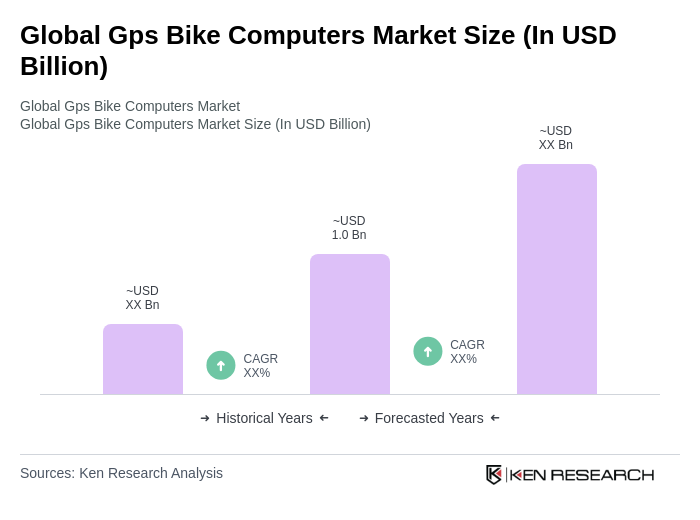
- The Global GPS Bike Computers Market is valued at USD 1.0 billion, based on a five-year historical analysis. This growth is primarily driven by the increasing popularity of cycling as a fitness activity, the rising demand for advanced navigation and tracking features among cyclists, and the integration of smart technology and connectivity features in bike computers. These advancements have further fueled market expansion, catering to both recreational and professional cyclists. The adoption of features such as real-time ride analytics, seamless device integration, and enhanced durability are key trends shaping the market’s evolution .
- Key players in this market are concentrated in regions such as North America and Europe, particularly in countries like the United States, Germany, and the Netherlands. These regions dominate the market due to a high number of cycling enthusiasts, robust infrastructure for cycling, and a strong presence of leading manufacturers. The cultural significance of cycling in these areas, combined with government initiatives to promote cycling and investments in smart city infrastructure, also contributes to their market leadership .
- In 2023, the European Union implemented regulations aimed at enhancing the safety and performance standards of electronic devices, including GPS bike computers. This regulation mandates that all GPS devices must comply with specific technical standards to ensure accuracy and reliability, thereby promoting consumer confidence and encouraging innovation within the industry .
Global Gps Bike Computers Market Segmentation
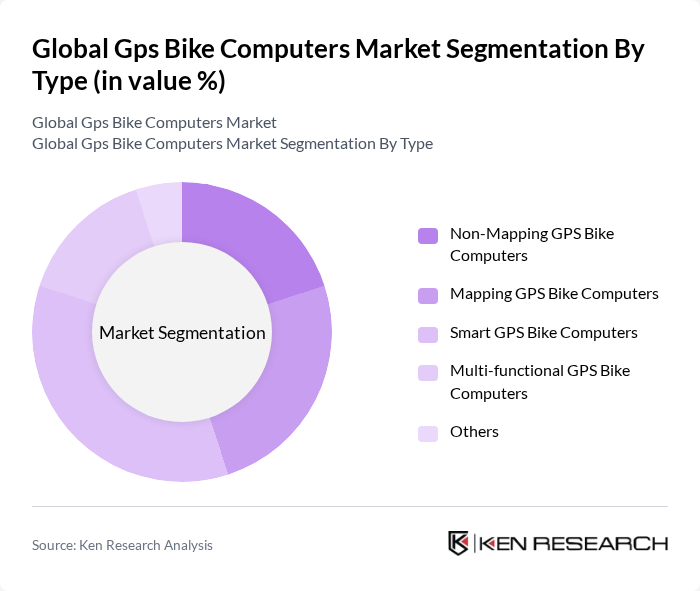
By Type:The market is segmented into various types of GPS bike computers, including Non-Mapping GPS Bike Computers, Mapping GPS Bike Computers, Smart GPS Bike Computers, Multi-functional GPS Bike Computers, and Others. Among these, Smart GPS Bike Computers are currently leading the market due to their advanced features such as real-time tracking, connectivity with mobile applications, and enhanced user interfaces. The growing trend of integrating technology into cycling gear, including artificial intelligence and IoT-enabled features, has significantly influenced consumer preferences, making smart devices more appealing to both casual and serious cyclists .
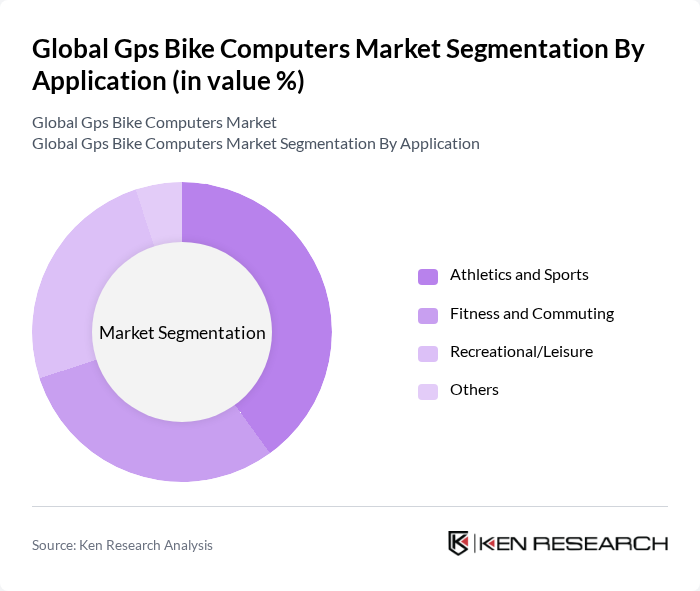
By Application:The applications of GPS bike computers are diverse, including Athletics and Sports, Fitness and Commuting, Recreational/Leisure, and Others. The Athletics and Sports segment is currently the most dominant, driven by the increasing number of competitive cycling events, the growing awareness of fitness among the general population, and the demand for advanced performance tracking and data analysis tools. Athletes and fitness enthusiasts are increasingly relying on these devices for real-time ride analytics, route optimization, and training enhancement, which improves their competitive edge and overall cycling experience .
Global Gps Bike Computers Market Competitive Landscape
The Global GPS Bike Computers Market is characterized by a dynamic mix of regional and international players. Leading participants such as Garmin Ltd., Wahoo Fitness LLC, Sigma Sport GmbH, CatEye Co., Ltd., Lezyne USA, Inc., Polar Electro Oy, Mio Technology Corporation, Bryton Inc., Magellan (MiTAC Digital Corporation), Giant Manufacturing Co. Ltd., Xplova Inc., Hammerhead Navigation, Inc., Stages Cycling LLC, SRM GmbH, iGPSPORT contribute to innovation, geographic expansion, and service delivery in this space.
Global Gps Bike Computers Market Industry Analysis
Growth Drivers
- Increasing Popularity of Cycling as a Fitness Activity:The global fitness market is projected to reach $96 billion in future, with cycling being a significant contributor. In future, approximately 50% of adults in the U.S. engaged in cycling for fitness, reflecting a growing trend. This surge in cycling participation drives demand for GPS bike computers, as users seek to track performance metrics and enhance their fitness experience. The rise in cycling events, such as gran fondos, further fuels this growth, creating a robust market for bike technology.
- Advancements in GPS Technology:The GPS technology market is expected to grow to $150 billion in future, with innovations enhancing accuracy and functionality. Features such as real-time navigation, route planning, and performance analytics are becoming standard in bike computers. In future, 70% of consumers reported that advanced GPS features influenced their purchasing decisions. This technological evolution not only improves user experience but also attracts tech-savvy cyclists, expanding the market for GPS bike computers significantly.
- Rising Demand for Real-Time Data Tracking:The global wearable technology market, which includes GPS bike computers, is projected to reach $60 billion in future. Cyclists increasingly seek devices that provide real-time data on speed, distance, and heart rate. In future, 65% of cyclists indicated that data tracking was a critical factor in their purchasing decisions. This demand for immediate feedback enhances training efficiency and performance, driving the growth of GPS bike computers in the cycling community.
Market Challenges
- High Competition Among Established Brands:The GPS bike computer market is saturated with key players like Garmin, Wahoo, and Sigma, leading to intense competition. In future, these brands collectively held over 75% of the market share. This competitive landscape pressures new entrants to innovate and differentiate their products, often resulting in increased marketing costs. As a result, smaller companies may struggle to gain traction, limiting overall market growth potential in the region.
- Price Sensitivity Among Consumers:Economic conditions in future indicate that consumer spending growth will be modest, with an expected increase of only 2.5%. This economic climate leads to heightened price sensitivity, particularly among budget-conscious cyclists. In future, 55% of consumers reported that price was a significant factor in their purchasing decisions for bike accessories. Consequently, brands must balance quality and affordability to attract a broader customer base, impacting profit margins and market dynamics.
Global Gps Bike Computers Market Future Outlook
The future of the GPS bike computer market appears promising, driven by technological advancements and a growing cycling culture. As more consumers prioritize health and fitness, the demand for innovative bike accessories will likely increase. Additionally, the integration of IoT technology will enhance user experience, providing seamless connectivity and data sharing. Companies that adapt to these trends and focus on sustainability will be well-positioned to capture market share and meet evolving consumer expectations in the coming years.
Market Opportunities
- Expansion into Emerging Markets:Emerging markets, particularly in Asia and Latin America, present significant growth opportunities. With increasing disposable incomes and a rising interest in cycling, these regions are expected to see a surge in demand for GPS bike computers. In future, the cycling population in Asia grew by 20%, indicating a ripe market for expansion and tailored product offerings.
- Development of Smart Bike Accessories:The trend towards smart technology in cycling is gaining momentum. By 2024, the smart bike accessory market is projected to reach $10 billion. Companies can capitalize on this trend by developing integrated systems that combine GPS functionality with smart features, such as health monitoring and connectivity with fitness apps, enhancing the overall cycling experience for users.
Scope of the Report
| Segment | Sub-Segments |
|---|---|
| By Type | Non-Mapping GPS Bike Computers Mapping GPS Bike Computers Smart GPS Bike Computers Multi-functional GPS Bike Computers Others |
| By Application | Athletics and Sports Fitness and Commuting Recreational/Leisure Others |
| By Sales Channel | Online Retail Offline Retail Direct Sales Others |
| By Price Range | Budget Mid-range Premium Others |
| By Brand | Established Brands Emerging Brands Private Labels Others |
| By Features | Navigation & Mapping Performance Tracking & Analytics Connectivity (Bluetooth, ANT+, Wi-Fi) Battery Life & Durability Others |
| By Distribution Mode | Direct Distribution Indirect Distribution E-commerce Platforms Others |
Key Target Audience
Investors and Venture Capitalist Firms
Government and Regulatory Bodies (e.g., Federal Communications Commission, National Highway Traffic Safety Administration)
Manufacturers and Producers
Distributors and Retailers
Technology Providers
Industry Associations (e.g., International Mountain Bicycling Association)
Financial Institutions
Logistics and Supply Chain Companies
Players Mentioned in the Report:
Garmin Ltd.
Wahoo Fitness LLC
Sigma Sport GmbH
CatEye Co., Ltd.
Lezyne USA, Inc.
Polar Electro Oy
Mio Technology Corporation
Bryton Inc.
Magellan (MiTAC Digital Corporation)
Giant Manufacturing Co. Ltd.
Xplova Inc.
Hammerhead Navigation, Inc.
Stages Cycling LLC
SRM GmbH
iGPSPORT
Table of Contents
Market Assessment Phase
1. Executive Summary and Approach
2. Global Gps Bike Computers Market Overview
2.1 Key Insights and Strategic Recommendations
2.2 Global Gps Bike Computers Market Overview
2.3 Definition and Scope
2.4 Evolution of Market Ecosystem
2.5 Timeline of Key Regulatory Milestones
2.6 Value Chain & Stakeholder Mapping
2.7 Business Cycle Analysis
2.8 Policy & Incentive Landscape
3. Global Gps Bike Computers Market Analysis
3.1 Growth Drivers
3.1.1 Increasing popularity of cycling as a fitness activity
3.1.2 Advancements in GPS technology
3.1.3 Rising demand for real-time data tracking
3.1.4 Growth in e-commerce and online sales channels
3.2 Market Challenges
3.2.1 High competition among established brands
3.2.2 Price sensitivity among consumers
3.2.3 Rapid technological changes
3.2.4 Limited awareness in emerging markets
3.3 Market Opportunities
3.3.1 Expansion into emerging markets
3.3.2 Development of smart bike accessories
3.3.3 Collaborations with fitness apps
3.3.4 Customization options for consumers
3.4 Market Trends
3.4.1 Integration of IoT in bike computers
3.4.2 Increasing focus on sustainability
3.4.3 Growth of subscription-based services
3.4.4 Rise in community cycling events
3.5 Government Regulation
3.5.1 Safety standards for electronic devices
3.5.2 Environmental regulations on manufacturing
3.5.3 Incentives for promoting cycling
3.5.4 Data privacy regulations for user data
4. SWOT Analysis
5. Stakeholder Analysis
6. Porter's Five Forces Analysis
7. Global Gps Bike Computers Market Market Size, 2019-2024
7.1 By Value
7.2 By Volume
7.3 By Average Selling Price
8. Global Gps Bike Computers Market Segmentation
8.1 By Type
8.1.1 Non-Mapping GPS Bike Computers
8.1.2 Mapping GPS Bike Computers
8.1.3 Smart GPS Bike Computers
8.1.4 Multi-functional GPS Bike Computers
8.1.5 Others
8.2 By Application
8.2.1 Athletics and Sports
8.2.2 Fitness and Commuting
8.2.3 Recreational/Leisure
8.2.4 Others
8.3 By Sales Channel
8.3.1 Online Retail
8.3.2 Offline Retail
8.3.3 Direct Sales
8.3.4 Others
8.4 By Price Range
8.4.1 Budget
8.4.2 Mid-range
8.4.3 Premium
8.4.4 Others
8.5 By Brand
8.5.1 Established Brands
8.5.2 Emerging Brands
8.5.3 Private Labels
8.5.4 Others
8.6 By Features
8.6.1 Navigation & Mapping
8.6.2 Performance Tracking & Analytics
8.6.3 Connectivity (Bluetooth, ANT+, Wi-Fi)
8.6.4 Battery Life & Durability
8.6.5 Others
8.7 By Distribution Mode
8.7.1 Direct Distribution
8.7.2 Indirect Distribution
8.7.3 E-commerce Platforms
8.7.4 Others
9. Global Gps Bike Computers Market Competitive Analysis
9.1 Market Share of Key Players
9.2 Cross Comparison of Key Players
9.2.1 Company Name
9.2.2 Company Size (Large, Medium, Small)
9.2.3 Revenue Growth Rate (YoY %)
9.2.4 Global Market Share (%)
9.2.5 Product Portfolio Breadth
9.2.6 R&D Investment (% of Revenue)
9.2.7 Distribution Network Strength
9.2.8 Average Selling Price (ASP)
9.2.9 Customer Satisfaction (NPS or Equivalent)
9.2.10 After-Sales Service Coverage
9.2.11 Brand Recognition Index
9.2.12 Digital Integration/Connectivity Features
9.2.13 Warranty & Return Policy Terms
9.3 SWOT Analysis of Top Players
9.4 Pricing Analysis
9.5 Detailed Profile of Major Companies
9.5.1 Garmin Ltd.
9.5.2 Wahoo Fitness LLC
9.5.3 Sigma Sport GmbH
9.5.4 CatEye Co., Ltd.
9.5.5 Lezyne USA, Inc.
9.5.6 Polar Electro Oy
9.5.7 Mio Technology Corporation
9.5.8 Bryton Inc.
9.5.9 Magellan (MiTAC Digital Corporation)
9.5.10 Giant Manufacturing Co. Ltd.
9.5.11 Xplova Inc.
9.5.12 Hammerhead Navigation, Inc.
9.5.13 Stages Cycling LLC
9.5.14 SRM GmbH
9.5.15 iGPSPORT
10. Global Gps Bike Computers Market End-User Analysis
10.1 Procurement Behavior of Key Ministries
10.1.1 Government cycling initiatives
10.1.2 Budget allocation for cycling infrastructure
10.1.3 Partnerships with cycling organizations
10.2 Corporate Spend on Infrastructure & Energy
10.2.1 Investment in cycling infrastructure
10.2.2 Sponsorship of cycling events
10.2.3 Corporate wellness programs
10.3 Pain Point Analysis by End-User Category
10.3.1 Lack of awareness about GPS benefits
10.3.2 High costs of advanced models
10.3.3 Complexity of features
10.4 User Readiness for Adoption
10.4.1 Familiarity with technology
10.4.2 Willingness to invest in technology
10.4.3 Interest in fitness tracking
10.5 Post-Deployment ROI and Use Case Expansion
10.5.1 Increased cycling frequency
10.5.2 Enhanced performance tracking
10.5.3 Community engagement through data sharing
11. Global Gps Bike Computers Market Future Size, 2025-2030
11.1 By Value
11.2 By Volume
11.3 By Average Selling Price
Go-To-Market Strategy Phase
1. Whitespace Analysis + Business Model Canvas
1.1 Market gaps and opportunities
1.2 Business model components
2. Marketing and Positioning Recommendations
2.1 Branding strategies
2.2 Product USPs
3. Distribution Plan
3.1 Urban retail vs rural NGO tie-ups
4. Channel & Pricing Gaps
4.1 Underserved routes
4.2 Pricing bands
5. Unmet Demand & Latent Needs
5.1 Category gaps
5.2 Consumer segments
6. Customer Relationship
6.1 Loyalty programs
6.2 After-sales service
7. Value Proposition
7.1 Sustainability
7.2 Integrated supply chains
8. Key Activities
8.1 Regulatory compliance
8.2 Branding
8.3 Distribution setup
9. Entry Strategy Evaluation
9.1 Domestic Market Entry Strategy
9.1.1 Product mix
9.1.2 Pricing band
9.1.3 Packaging
9.2 Export Entry Strategy
9.2.1 Target countries
9.2.2 Compliance roadmap
10. Entry Mode Assessment
10.1 JV
10.2 Greenfield
10.3 M&A
10.4 Distributor Model
11. Capital and Timeline Estimation
11.1 Capital requirements
11.2 Timelines
12. Control vs Risk Trade-Off
12.1 Ownership vs Partnerships
13. Profitability Outlook
13.1 Breakeven analysis
13.2 Long-term sustainability
14. Potential Partner List
14.1 Distributors
14.2 JVs
14.3 Acquisition targets
15. Execution Roadmap
15.1 Phased Plan for Market Entry
15.1.1 Market Setup
15.1.2 Market Entry
15.1.3 Growth Acceleration
15.1.4 Scale & Stabilize
15.2 Key Activities and Milestones
15.2.1 Milestone tracking
15.2.2 Activity scheduling
Research Methodology
Phase 1: Approach1
Desk Research
- Analysis of industry reports from cycling associations and market research firms
- Review of sales data from major bike computer manufacturers and retailers
- Examination of consumer behavior studies and cycling trends published in journals
Primary Research
- Interviews with product managers at leading bike computer brands
- Surveys conducted with cycling enthusiasts and professional cyclists
- Focus groups with retailers specializing in cycling equipment
Validation & Triangulation
- Cross-validation of findings through multiple data sources, including sales and survey data
- Triangulation of insights from industry experts and market analysts
- Sanity checks through feedback from a panel of cycling industry veterans
Phase 2: Market Size Estimation1
Top-down Assessment
- Estimation of total addressable market based on global cycling participation rates
- Segmentation of market size by geographic regions and consumer demographics
- Incorporation of growth trends in e-commerce and smart cycling technology
Bottom-up Modeling
- Volume estimates derived from sales data of bike computers across various price segments
- Analysis of average selling prices and unit sales from key distribution channels
- Calculation of market share based on retailer and manufacturer data
Forecasting & Scenario Analysis
- Multi-variable forecasting using historical sales data and cycling trends
- Scenario analysis based on potential impacts of technological advancements and consumer preferences
- Development of baseline, optimistic, and pessimistic market growth projections through 2030
Phase 3: CATI Sample Composition1
| Scope Item/Segment | Sample Size | Target Respondent Profiles |
|---|---|---|
| Consumer Bike Computer Usage | 120 | Cyclists, Fitness Enthusiasts |
| Retail Insights on Bike Computers | 80 | Store Managers, Sales Representatives |
| Professional Cyclist Feedback | 40 | Professional Cyclists, Coaches |
| Market Trends in Cycling Technology | 60 | Industry Analysts, Product Managers |
| Consumer Preferences and Buying Behavior | 100 | Casual Cyclists, Tech-savvy Consumers |
Frequently Asked Questions
What is the current value of the Global GPS Bike Computers Market?
The Global GPS Bike Computers Market is valued at approximately USD 1.0 billion, reflecting a significant growth trend driven by the increasing popularity of cycling and advancements in technology, particularly in navigation and tracking features.
What factors are driving the growth of the GPS bike computers market?
Which regions dominate the GPS bike computers market?
What types of GPS bike computers are available in the market?
Other Regional/Country Reports
Indonesia Gps Bike Computers Market
Malaysia Gps Bike Computers Market
APAC Gps Bike Computers Market
SEA Gps Bike Computers Market
Why Buy From Us?

What makes us stand out is that our consultants follow Robust, Refine and Result (RRR) methodology. Robust for clear definitions, approaches and sanity checking, Refine for differentiating respondents' facts and opinions, and Result for presenting data with story.

We have set a benchmark in the industry by offering our clients with syndicated and customized market research reports featuring coverage of entire market as well as meticulous research and analyst insights.

While we don't replace traditional research, we flip the method upside down. Our dual approach of Top Bottom & Bottom Top ensures quality deliverable by not just verifying company fundamentals but also looking at the sector and macroeconomic factors.

With one step in the future, our research team constantly tries to show you the bigger picture. We help with some of the tough questions you may encounter along the way: How is the industry positioned? Best marketing channel? KPI's of competitors? By aligning every element, we help maximize success.

Our report gives you instant access to the answers and sources that other companies might choose to hide. We elaborate each steps of research methodology we have used and showcase you the sample size to earn your trust.

If you need any support, we are here! We pride ourselves on universe strength, data quality, and quick, friendly, and professional service.