About the Report
Base Year 2024Global Healthcare Compliance Software Market Overview
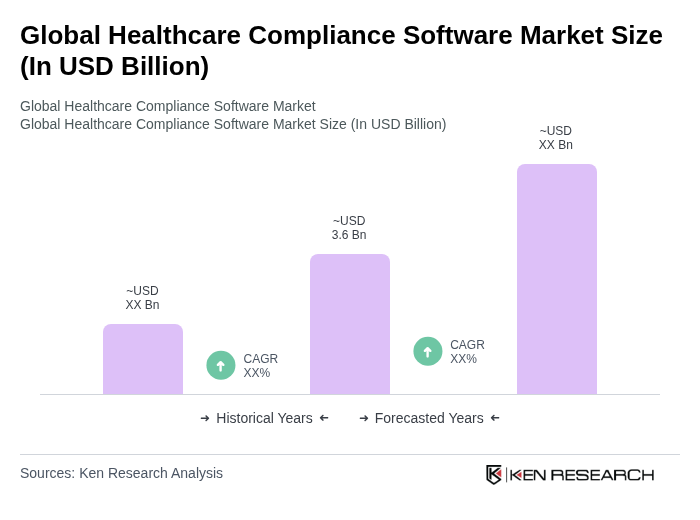
- The Global Healthcare Compliance Software Market is valued at USD 3.6 billion, based on a five-year historical analysis of major syndicated sources. This growth is primarily driven by the increasing need for healthcare organizations to adhere to regulatory requirements, improve operational efficiency, and enhance patient safety. The rising complexity of healthcare regulations and the growing emphasis on data privacy and security, particularly around HIPAA, GDPR, and other data protection frameworks, have further propelled the demand for compliance software solutions, including tools for automated policy management, auditing, incident reporting, and billing and coding accuracy.
- Key players in this market are predominantly located in North America and Europe, with the United States being a significant contributor due to its advanced healthcare infrastructure and stringent regulatory environment. North America holds the largest share of the global healthcare compliance software market, supported by frequent changes in healthcare laws, strong enforcement of billing, coding, and privacy rules, and high adoption of healthcare IT. Countries like Germany and the United Kingdom also play a crucial role, driven by their robust healthcare systems, national digitization programs, and increasing investments in healthcare technology and compliance management platforms.
- The 21st Century Cures Act, enacted by the U.S. Congress and signed into law in 2016, includes key provisions on interoperability and information blocking that have been operationalized through regulations such as the “21st Century Cures Act: Interoperability, Information Blocking, and the ONC Health IT Certification Program” Final Rule issued by the Office of the National Coordinator for Health Information Technology (ONC) in 2020. These rules require certified health IT developers and healthcare providers to support standardized, interoperable electronic health records (EHRs) and prohibit information blocking, thereby enforcing compliance with data sharing requirements and patient access rights. This regulatory framework is driving increased adoption of healthcare compliance software to manage data governance, audit trails, access controls, and policy enforcement across healthcare organizations.
Global Healthcare Compliance Software Market Segmentation
By Type:
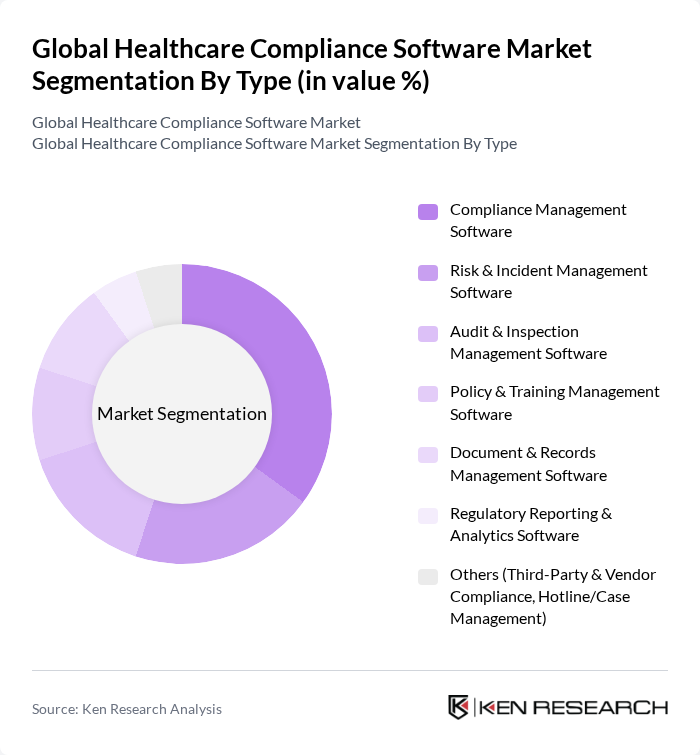
The market is segmented into various types of compliance software, including Compliance Management Software, Risk & Incident Management Software, Audit & Inspection Management Software, Policy & Training Management Software, Document & Records Management Software, Regulatory Reporting & Analytics Software, and Others (Third-Party & Vendor Compliance, Hotline/Case Management). Among these, Compliance Management Software is the leading segment, driven by the increasing need for organizations to centrally manage policies, procedures, attestations, and corrective actions, and to mitigate risks associated with regulatory violations across multiple compliance domains (clinical, billing, data privacy, and accreditation). The growing focus on operational efficiency, automation of routine compliance tasks (such as training tracking and document version control), and the need for real-time compliance monitoring and reporting to internal and external auditors are key factors contributing to its dominance.
By End-User:
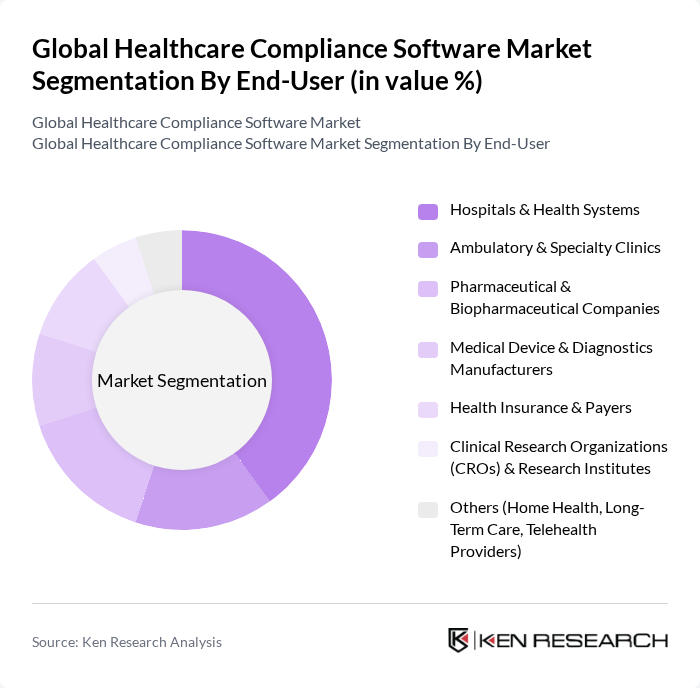
The end-user segmentation includes Hospitals & Health Systems, Ambulatory & Specialty Clinics, Pharmaceutical & Biopharmaceutical Companies, Medical Device & Diagnostics Manufacturers, Health Insurance & Payers, Clinical Research Organizations (CROs) & Research Institutes, and Others (Home Health, Long-Term Care, Telehealth Providers). Hospitals & Health Systems dominate this segment due to their extensive compliance requirements across clinical care, billing and reimbursement, quality reporting, and data protection, and the need for integrated solutions to manage large volumes of patient data and regulatory obligations effectively. The increasing focus on patient safety, value-based care programs, external accreditation (such as Joint Commission), and prevention of fraud, waste, and abuse further drives the demand for compliance software in this sector, alongside growing adoption of telehealth and remote care models that require robust privacy and security controls.
Global Healthcare Compliance Software Market Competitive Landscape
The Global Healthcare Compliance Software Market is characterized by a dynamic mix of regional and international players. Leading participants such as HealthStream, Inc., RLDatix, Compliancy Group, Healthicity, LLC, ConvergePoint Inc., Panacea Healthcare Solutions, LLC, Beacon Healthcare Systems, Radar Healthcare, Sprinto, Complinity Technologies Pvt. Ltd., Accountable HQ, Atlantic.Net, Inc., ByteChek, Wolters Kluwer N.V., Cerner Corporation (Oracle Health) contribute to innovation, geographic expansion, and service delivery in this space, with many vendors expanding cloud-based offerings, integrating artificial intelligence and analytics, and enhancing capabilities for policy management, incident reporting, training, and audit readiness.
Global Healthcare Compliance Software Market Industry Analysis
Growth Drivers
- Increasing Regulatory Requirements:The healthcare sector is experiencing a surge in regulatory requirements, with over 1,000 new regulations introduced globally in future alone. This increase necessitates robust compliance software solutions to ensure adherence. The World Health Organization reported that non-compliance can lead to fines exceeding $1 million for healthcare organizations, driving the demand for effective compliance software. As regulations become more stringent, the need for comprehensive compliance solutions is expected to rise significantly.
- Rising Demand for Data Security:With cyberattacks on healthcare organizations increasing by 45% in future, the demand for data security solutions is paramount. The global cost of data breaches in healthcare reached $6.45 billion in future, highlighting the urgent need for compliance software that ensures data protection. As healthcare providers prioritize safeguarding patient information, the adoption of compliance software that integrates advanced security features is expected to grow, driven by both regulatory pressures and consumer expectations.
- Adoption of Cloud-Based Solutions:The shift towards cloud-based solutions in healthcare is accelerating, with the cloud computing market projected to reach $64 billion in future. This transition allows healthcare organizations to implement compliance software that is scalable and cost-effective. According to a report by Gartner, 70% of healthcare organizations are expected to adopt cloud solutions in future, facilitating easier updates and compliance management, thus driving the growth of the compliance software market.
Market Challenges
- High Implementation Costs:The initial costs associated with implementing healthcare compliance software can be prohibitive, often exceeding $500,000 for larger organizations. This financial burden can deter smaller healthcare providers from adopting necessary compliance solutions. A survey by the Healthcare Information and Management Systems Society indicated that 60% of small practices cite cost as a significant barrier to compliance software adoption, limiting market growth potential in this segment.
- Complexity of Compliance Regulations:The complexity of compliance regulations poses a significant challenge for healthcare organizations. In future, the average healthcare provider had to navigate over 300 different compliance regulations, making it difficult to maintain adherence. The intricate nature of these regulations often leads to confusion and misinterpretation, resulting in potential penalties. This complexity can hinder the effective implementation of compliance software, as organizations struggle to keep pace with evolving requirements.
Global Healthcare Compliance Software Market Future Outlook
The future of healthcare compliance software is poised for significant transformation, driven by technological advancements and evolving regulatory landscapes. As organizations increasingly adopt automated compliance solutions, the integration of artificial intelligence and machine learning will enhance efficiency and accuracy. Furthermore, the emphasis on continuous compliance monitoring will become critical, ensuring that healthcare providers can swiftly adapt to regulatory changes while maintaining patient safety and data security. This dynamic environment presents numerous opportunities for innovation and growth in the compliance software sector.
Market Opportunities
- Expansion in Emerging Markets:Emerging markets, particularly in Asia and Africa, are witnessing rapid healthcare sector growth, with healthcare spending projected to reach $1 trillion in future. This expansion presents a significant opportunity for compliance software providers to enter these markets, offering tailored solutions that address local regulatory needs and enhance compliance capabilities.
- Integration of AI and Machine Learning:The integration of AI and machine learning into compliance software is expected to revolutionize the industry. In future, it is estimated that 40% of compliance processes will be automated through AI technologies, improving efficiency and reducing human error. This trend will create opportunities for software developers to innovate and provide advanced solutions that streamline compliance management.
Scope of the Report
| Segment | Sub-Segments |
|---|---|
| By Type | Compliance Management Software Risk & Incident Management Software Audit & Inspection Management Software Policy & Training Management Software Document & Records Management Software Regulatory Reporting & Analytics Software Others (Third-Party & Vendor Compliance, Hotline/Case Management) |
| By End-User | Hospitals & Health Systems Ambulatory & Specialty Clinics Pharmaceutical & Biopharmaceutical Companies Medical Device & Diagnostics Manufacturers Health Insurance & Payers Clinical Research Organizations (CROs) & Research Institutes Others (Home Health, Long-Term Care, Telehealth Providers) |
| By Deployment Model | On-Premises Cloud-Based (SaaS) Hybrid Others |
| By Region | North America Europe Asia-Pacific Latin America Middle East & Africa |
| By Compliance Area | Billing & Coding / Financial Compliance Operational & Quality Compliance Clinical & Regulatory Compliance (GxP, FDA, EMA) Data Privacy & Security Compliance (HIPAA, GDPR, etc.) Fraud, Waste & Abuse / Anti-Kickback & Stark Compliance |
| By Customer Organization Size | Large Enterprises Medium Enterprises Small Enterprises Others (Startups, Single-Provider Practices) |
| By Pricing Model | Subscription-Based (Per User / Per Facility) One-Time License Fee Usage-Based / Pay-Per-Use Enterprise / Custom Pricing |
Key Target Audience
Investors and Venture Capitalist Firms
Government and Regulatory Bodies (e.g., Food and Drug Administration, Centers for Medicare & Medicaid Services)
Healthcare Providers and Institutions
Pharmaceutical Companies
Health Insurance Companies
Compliance and Risk Management Professionals
Technology Providers and Software Developers
Healthcare Industry Associations
Players Mentioned in the Report:
HealthStream, Inc.
RLDatix
Compliancy Group
Healthicity, LLC
ConvergePoint Inc.
Panacea Healthcare Solutions, LLC
Beacon Healthcare Systems
Radar Healthcare
Sprinto
Complinity Technologies Pvt. Ltd.
Accountable HQ
Atlantic.Net, Inc.
ByteChek
Wolters Kluwer N.V.
Cerner Corporation (Oracle Health)
Table of Contents
Market Assessment Phase
1. Executive Summary and Approach
2. Global Healthcare Compliance Software Market Overview
2.1 Key Insights and Strategic Recommendations
2.2 Global Healthcare Compliance Software Market Overview
2.3 Definition and Scope
2.4 Evolution of Market Ecosystem
2.5 Timeline of Key Regulatory Milestones
2.6 Value Chain & Stakeholder Mapping
2.7 Business Cycle Analysis
2.8 Policy & Incentive Landscape
3. Global Healthcare Compliance Software Market Analysis
3.1 Growth Drivers
3.1.1 Increasing Regulatory Requirements
3.1.2 Rising Demand for Data Security
3.1.3 Adoption of Cloud-Based Solutions
3.1.4 Growing Focus on Patient Safety
3.2 Market Challenges
3.2.1 High Implementation Costs
3.2.2 Complexity of Compliance Regulations
3.2.3 Resistance to Change in Organizations
3.2.4 Limited Awareness Among Healthcare Providers
3.3 Market Opportunities
3.3.1 Expansion in Emerging Markets
3.3.2 Integration of AI and Machine Learning
3.3.3 Development of Mobile Compliance Solutions
3.3.4 Partnerships with Healthcare Organizations
3.4 Market Trends
3.4.1 Shift Towards Automated Compliance Solutions
3.4.2 Increasing Use of Analytics in Compliance
3.4.3 Focus on User-Friendly Interfaces
3.4.4 Emphasis on Continuous Compliance Monitoring
3.5 Government Regulation
3.5.1 HIPAA Compliance Requirements
3.5.2 GDPR Implications for Healthcare Data
3.5.3 FDA Regulations on Software as a Medical Device
3.5.4 State-Specific Healthcare Compliance Laws
4. SWOT Analysis
5. Stakeholder Analysis
6. Porter's Five Forces Analysis
7. Global Healthcare Compliance Software Market Market Size, 2019-2024
7.1 By Value
7.2 By Volume
7.3 By Average Selling Price
8. Global Healthcare Compliance Software Market Segmentation
8.1 By Type
8.1.1 Compliance Management Software
8.1.2 Risk & Incident Management Software
8.1.3 Audit & Inspection Management Software
8.1.4 Policy & Training Management Software
8.1.5 Document & Records Management Software
8.1.6 Regulatory Reporting & Analytics Software
8.1.7 Others (Third-Party & Vendor Compliance, Hotline/Case Management)
8.2 By End-User
8.2.1 Hospitals & Health Systems
8.2.2 Ambulatory & Specialty Clinics
8.2.3 Pharmaceutical & Biopharmaceutical Companies
8.2.4 Medical Device & Diagnostics Manufacturers
8.2.5 Health Insurance & Payers
8.2.6 Clinical Research Organizations (CROs) & Research Institutes
8.2.7 Others (Home Health, Long-Term Care, Telehealth Providers)
8.3 By Deployment Model
8.3.1 On-Premises
8.3.2 Cloud-Based (SaaS)
8.3.3 Hybrid
8.3.4 Others
8.4 By Region
8.4.1 North America
8.4.2 Europe
8.4.3 Asia-Pacific
8.4.4 Latin America
8.4.5 Middle East & Africa
8.5 By Compliance Area
8.5.1 Billing & Coding / Financial Compliance
8.5.2 Operational & Quality Compliance
8.5.3 Clinical & Regulatory Compliance (GxP, FDA, EMA)
8.5.4 Data Privacy & Security Compliance (HIPAA, GDPR, etc.)
8.5.5 Fraud, Waste & Abuse / Anti-Kickback & Stark Compliance
8.6 By Customer Organization Size
8.6.1 Large Enterprises
8.6.2 Medium Enterprises
8.6.3 Small Enterprises
8.6.4 Others (Startups, Single-Provider Practices)
8.7 By Pricing Model
8.7.1 Subscription-Based (Per User / Per Facility)
8.7.2 One-Time License Fee
8.7.3 Usage-Based / Pay-Per-Use
8.7.4 Enterprise / Custom Pricing
9. Global Healthcare Compliance Software Market Competitive Analysis
9.1 Market Share of Key Players
9.2 Cross Comparison of Key Players
9.2.1 Company Name
9.2.2 Company Size (Revenue Tier / Employee Count)
9.2.3 Healthcare Compliance Software Revenue
9.2.4 Geographic Revenue Mix (Domestic vs International)
9.2.5 Installed Base (Number of Healthcare Clients / Facilities)
9.2.6 Average Deal Size (Annual Contract Value)
9.2.7 Customer Acquisition Cost (CAC)
9.2.8 Customer Retention / Renewal Rate
9.2.9 Annual Recurring Revenue (ARR) Growth Rate
9.2.10 Average Revenue Per Customer (ARPC) in Healthcare Segment
9.2.11 Pricing Strategy (Tiering, Bundling, Discounting)
9.2.12 Product Breadth (Modules per Suite / Coverage of Compliance Areas)
9.2.13 Cloud vs On-Premises Revenue Mix
9.2.14 Implementation Time & Professional Services Intensity
9.2.15 Net Promoter Score (NPS) / User Satisfaction Score
9.3 SWOT Analysis of Top Players
9.4 Pricing Analysis
9.5 Detailed Profile of Major Companies
9.5.1 HealthStream, Inc.
9.5.2 RLDatix
9.5.3 Compliancy Group
9.5.4 Healthicity, LLC
9.5.5 ConvergePoint Inc.
9.5.6 Panacea Healthcare Solutions, LLC
9.5.7 Beacon Healthcare Systems
9.5.8 Radar Healthcare
9.5.9 Sprinto
9.5.10 Complinity Technologies Pvt. Ltd.
9.5.11 Accountable HQ
9.5.12 Atlantic.Net, Inc.
9.5.13 ByteChek
9.5.14 Wolters Kluwer N.V.
9.5.15 Cerner Corporation (Oracle Health)
10. Global Healthcare Compliance Software Market End-User Analysis
10.1 Procurement Behavior of Key Ministries
10.1.1 Budget Allocation Trends
10.1.2 Decision-Making Processes
10.1.3 Compliance Priorities
10.1.4 Vendor Selection Criteria
10.2 Corporate Spend on Infrastructure & Energy
10.2.1 Investment Trends in Compliance Solutions
10.2.2 Budgeting for Compliance Software
10.2.3 Cost-Benefit Analysis
10.2.4 Long-Term Financial Commitments
10.3 Pain Point Analysis by End-User Category
10.3.1 Common Compliance Challenges
10.3.2 Technology Adoption Barriers
10.3.3 Resource Allocation Issues
10.3.4 Training and Support Needs
10.4 User Readiness for Adoption
10.4.1 Awareness of Compliance Software
10.4.2 Training Requirements
10.4.3 Change Management Strategies
10.4.4 Feedback Mechanisms
10.5 Post-Deployment ROI and Use Case Expansion
10.5.1 Measuring Compliance Effectiveness
10.5.2 User Experience Feedback
10.5.3 Expansion of Use Cases
10.5.4 Long-Term Value Realization
11. Global Healthcare Compliance Software Market Future Size, 2025-2030
11.1 By Value
11.2 By Volume
11.3 By Average Selling Price
Go-To-Market Strategy Phase
1. Whitespace Analysis + Business Model Canvas
1.1 Market Gaps Identification
1.2 Business Model Development
2. Marketing and Positioning Recommendations
2.1 Branding Strategies
2.2 Product USPs
3. Distribution Plan
3.1 Urban Retail Strategies
3.2 Rural NGO Tie-Ups
4. Channel & Pricing Gaps
4.1 Underserved Routes
4.2 Pricing Bands Analysis
5. Unmet Demand & Latent Needs
5.1 Category Gaps
5.2 Consumer Segments
6. Customer Relationship
6.1 Loyalty Programs
6.2 After-Sales Service
7. Value Proposition
7.1 Sustainability Initiatives
7.2 Integrated Supply Chains
8. Key Activities
8.1 Regulatory Compliance
8.2 Branding Efforts
8.3 Distribution Setup
9. Entry Strategy Evaluation
9.1 Domestic Market Entry Strategy
9.1.1 Product Mix Considerations
9.1.2 Pricing Band Strategy
9.1.3 Packaging Options
9.2 Export Entry Strategy
9.2.1 Target Countries Identification
9.2.2 Compliance Roadmap Development
10. Entry Mode Assessment
10.1 Joint Ventures
10.2 Greenfield Investments
10.3 Mergers & Acquisitions
10.4 Distributor Model Evaluation
11. Capital and Timeline Estimation
11.1 Capital Requirements
11.2 Timelines for Implementation
12. Control vs Risk Trade-Off
12.1 Ownership Considerations
12.2 Partnerships Evaluation
13. Profitability Outlook
13.1 Breakeven Analysis
13.2 Long-Term Sustainability Strategies
14. Potential Partner List
14.1 Distributors
14.2 Joint Ventures
14.3 Acquisition Targets
15. Execution Roadmap
15.1 Phased Plan for Market Entry
15.1.1 Market Setup
15.1.2 Market Entry
15.1.3 Growth Acceleration
15.1.4 Scale & Stabilize
15.2 Key Activities and Milestones
15.2.1 Milestone Planning
15.2.2 Activity Tracking
Research Methodology
Phase 1: Approach1
Desk Research
- Analysis of industry reports from healthcare compliance organizations and regulatory bodies
- Review of published white papers and case studies on compliance software adoption
- Examination of market trends and forecasts from healthcare IT journals and databases
Primary Research
- Interviews with compliance officers in healthcare organizations and hospitals
- Surveys targeting IT managers and software developers in healthcare compliance firms
- Focus groups with end-users of compliance software to gather qualitative insights
Validation & Triangulation
- Cross-validation of findings through multiple data sources including market reports and expert opinions
- Triangulation of quantitative data from surveys with qualitative insights from interviews
- Sanity checks conducted through expert panel reviews and feedback sessions
Phase 2: Market Size Estimation1
Top-down Assessment
- Estimation of market size based on overall healthcare IT spending trends
- Segmentation of the market by software type, deployment model, and end-user demographics
- Incorporation of regulatory impacts and compliance requirements on market growth
Bottom-up Modeling
- Collection of firm-level data from leading healthcare compliance software providers
- Estimation of market penetration rates based on user adoption statistics
- Calculation of revenue projections based on average pricing models and subscription rates
Forecasting & Scenario Analysis
- Multi-variable regression analysis incorporating factors such as regulatory changes and technological advancements
- Scenario modeling based on varying levels of compliance enforcement and healthcare spending
- Development of baseline, optimistic, and pessimistic forecasts through 2030
Phase 3: CATI Sample Composition1
| Scope Item/Segment | Sample Size | Target Respondent Profiles |
|---|---|---|
| Healthcare Providers Compliance Software | 120 | Compliance Officers, IT Managers |
| Pharmaceutical Industry Compliance Solutions | 90 | Regulatory Affairs Specialists, Quality Assurance Managers |
| Health Insurance Compliance Tools | 80 | Compliance Analysts, Risk Management Directors |
| Clinical Trials Compliance Software | 70 | Clinical Research Coordinators, Data Managers |
| Telehealth Compliance Solutions | 60 | Telehealth Program Managers, Legal Advisors |
Frequently Asked Questions
What is the current value of the Global Healthcare Compliance Software Market?
The Global Healthcare Compliance Software Market is valued at approximately USD 3.6 billion, driven by the increasing need for healthcare organizations to comply with regulatory requirements, enhance operational efficiency, and improve patient safety.
What factors are driving the growth of the healthcare compliance software market?
Which regions dominate the healthcare compliance software market?
What are the main types of healthcare compliance software?
Other Regional/Country Reports
Indonesia Healthcare Compliance Software Market
Malaysia Healthcare Compliance Software Market
KSA Healthcare Compliance Software Market
APAC Healthcare Compliance Software Market
SEA Healthcare Compliance Software Market
Other Adjacent Reports
Indonesia Healthcare IT Security Software Market
Belgium Electronic Health Records Software Market
Philippines Healthcare Analytics Software Market
Qatar Medical Billing Software Market Report Size, Share, Growth Drivers, Trends, Opportunities & Forecast 2025–2030Qatar Patient Data Management Software Market
South Africa Telemedicine Compliance Software Market
Thailand Regulatory Reporting Software Market
Singapore Healthcare Risk Management Software Market
Philippines Audit and Inspection Software Market
Philippines Policy Management Software Market
Why Buy From Us?

What makes us stand out is that our consultants follow Robust, Refine and Result (RRR) methodology. Robust for clear definitions, approaches and sanity checking, Refine for differentiating respondents' facts and opinions, and Result for presenting data with story.

We have set a benchmark in the industry by offering our clients with syndicated and customized market research reports featuring coverage of entire market as well as meticulous research and analyst insights.

While we don't replace traditional research, we flip the method upside down. Our dual approach of Top Bottom & Bottom Top ensures quality deliverable by not just verifying company fundamentals but also looking at the sector and macroeconomic factors.

With one step in the future, our research team constantly tries to show you the bigger picture. We help with some of the tough questions you may encounter along the way: How is the industry positioned? Best marketing channel? KPI's of competitors? By aligning every element, we help maximize success.

Our report gives you instant access to the answers and sources that other companies might choose to hide. We elaborate each steps of research methodology we have used and showcase you the sample size to earn your trust.

If you need any support, we are here! We pride ourselves on universe strength, data quality, and quick, friendly, and professional service.