About the Report
Base Year 2024Global Heterogeneous Catalyst Market Overview
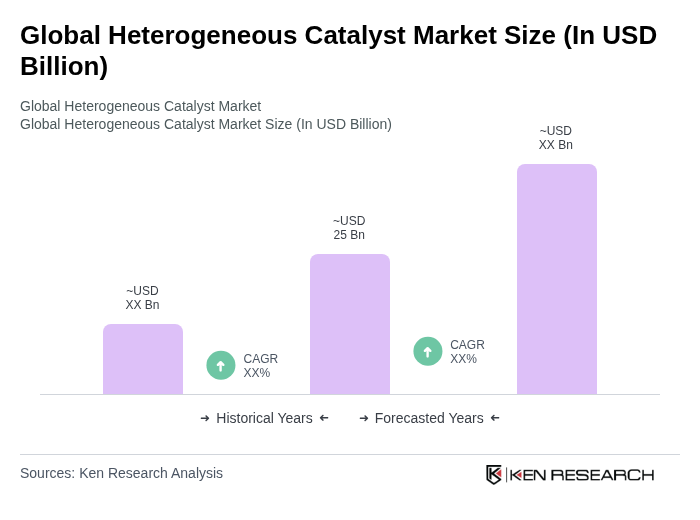
- The Global Heterogeneous Catalyst Market is valued at USD 25 billion, based on a five-year historical analysis. Growth is primarily driven by increasing demand for catalysts in applications such as petroleum refining, chemical synthesis, and environmental remediation, as industries pursue greater efficiency and sustainability. The adoption of stringent environmental regulations and the push for cleaner production processes are further accelerating market expansion .
- Key players in this market include the United States, Germany, and China, which dominate due to their advanced industrial sectors and significant investments in research and development. The presence of major chemical and petrochemical companies in these regions fosters innovation and enhances the competitive landscape, making them pivotal in the global market .
- In 2023, the European Union adopted the Industrial Emissions Directive (Directive 2010/75/EU, amended in 2023 by Directive (EU) 2023/2413 of the European Parliament and of the Council), which mandates stricter emission limits for industrial installations and requires the use of best available techniques, including advanced heterogeneous catalysts, in sectors such as chemicals, refining, and energy. This regulatory framework is a core component of the EU Green Deal, supporting the transition toward climate neutrality by 2050 and driving demand for efficient catalytic solutions .
Global Heterogeneous Catalyst Market Segmentation
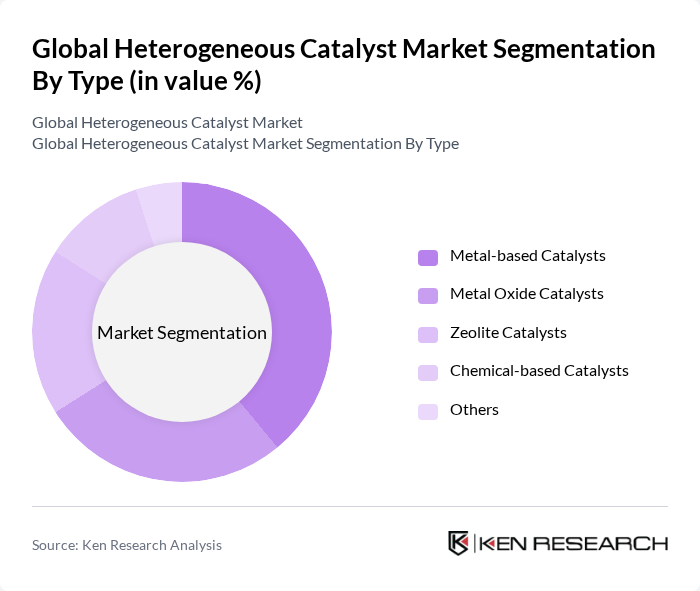
By Type:The market is segmented into Metal-based Catalysts, Metal Oxide Catalysts, Zeolite Catalysts, Chemical-based Catalysts, and Others. Metal-based Catalysts lead the market due to their high efficiency and versatility in facilitating key chemical reactions, particularly in petroleum refining, chemical synthesis, and environmental applications. Their widespread adoption is driven by their ability to significantly enhance reaction rates, product yields, and process selectivity .
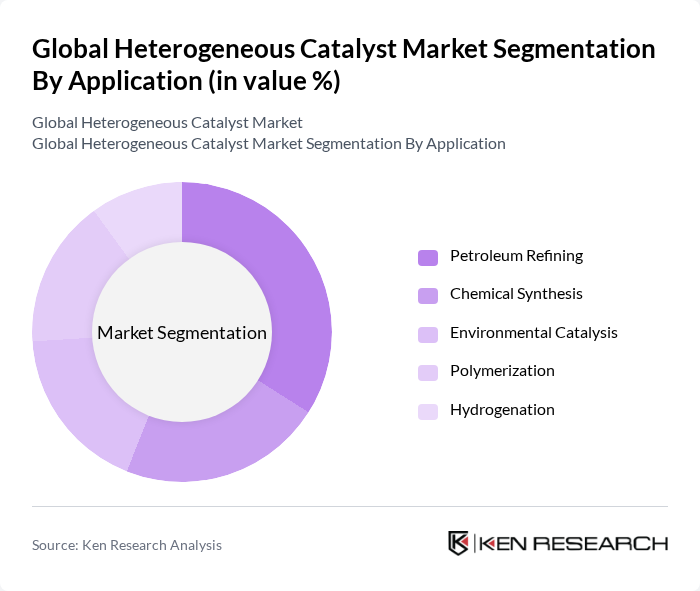
By Application:The heterogeneous catalyst market is segmented by application into Petroleum Refining, Chemical Synthesis, Environmental Catalysis, Polymerization, Hydrogenation, and Others. Petroleum Refining remains the dominant application, driven by the need for efficient conversion of crude oil into high-value products and the growing demand for cleaner fuels. Stringent environmental regulations and the shift toward sustainable refining processes are key factors supporting the growth of this segment .
Global Heterogeneous Catalyst Market Competitive Landscape
The Global Heterogeneous Catalyst Market is characterized by a dynamic mix of regional and international players. Leading participants such as BASF SE, Johnson Matthey Plc, Clariant AG, Haldor Topsoe A/S, Albemarle Corporation, W.R. Grace & Co., Evonik Industries AG, Honeywell UOP, Axens S.A., LyondellBasell Industries N.V., Mitsubishi Chemical Corporation, China Petroleum & Chemical Corporation (Sinopec), Shell Catalysts & Technologies, CRI Catalyst Company, Katalco, Inc. contribute to innovation, geographic expansion, and service delivery in this space.
Global Heterogeneous Catalyst Market Industry Analysis
Growth Drivers
- Increasing Demand for Cleaner Production Processes:The global push for sustainability has led to a significant increase in demand for cleaner production processes. In future, the global green chemistry market is projected to reach $13.5 billion, reflecting a compound growth driven by industries seeking to reduce emissions. This trend is particularly evident in the chemical manufacturing sector, where the adoption of heterogeneous catalysts can reduce waste and enhance efficiency, aligning with the global commitment to lower carbon footprints.
- Technological Advancements in Catalyst Formulations:Innovations in catalyst formulations are propelling market growth, with R&D investments expected to exceed $3.5 billion in future. These advancements include the development of more efficient and selective catalysts that can operate under milder conditions, thus reducing energy consumption. For instance, the introduction of nanostructured catalysts has shown to improve reaction rates significantly, making processes more economically viable and environmentally friendly, which is crucial for industries like petrochemicals.
- Rising Environmental Regulations:Stringent environmental regulations are driving the adoption of heterogeneous catalysts across various industries. In future, the global market for emission control technologies is anticipated to reach $22 billion, with regulations mandating lower emissions from industrial processes. This regulatory landscape compels manufacturers to invest in advanced catalytic solutions that comply with these standards, thereby fostering market growth and encouraging innovation in catalyst technologies.
Market Challenges
- High Cost of Catalyst Development:The development of advanced heterogeneous catalysts involves significant financial investment, often exceeding $1.2 million per project. This high cost can deter smaller companies from entering the market, limiting competition and innovation. Additionally, the lengthy development cycles, which can take several years, further exacerbate the financial burden, making it challenging for firms to keep pace with rapidly evolving market demands and technological advancements.
- Limited Availability of Raw Materials:The heterogeneous catalyst market faces challenges due to the limited availability of critical raw materials, such as precious metals. In future, the price of platinum is projected to remain above $1,200 per ounce, impacting the cost structure of catalyst production. This scarcity not only drives up costs but also poses risks to supply chains, potentially leading to production delays and increased prices for end-users, thereby affecting market stability.
Global Heterogeneous Catalyst Market Future Outlook
The future of the heterogeneous catalyst market appears promising, driven by ongoing technological advancements and increasing regulatory pressures. As industries continue to prioritize sustainability, the demand for innovative catalyst solutions is expected to rise. Furthermore, the integration of digital technologies and AI in catalyst design will enhance efficiency and customization, allowing for tailored solutions that meet specific industry needs. This evolution will likely foster a more competitive landscape, encouraging collaboration and investment in research and development.
Market Opportunities
- Expansion in Emerging Markets:Emerging markets, particularly in Asia-Pacific, are witnessing rapid industrialization, creating substantial opportunities for heterogeneous catalysts. With a projected GDP growth rate of 6.5% in future, these regions are increasingly adopting cleaner technologies, driving demand for advanced catalytic solutions that enhance production efficiency and reduce environmental impact.
- Development of Bio-Based Catalysts:The shift towards bio-based catalysts presents a significant opportunity for market players. With the global bio-based chemicals market expected to reach $25 billion in future, there is a growing interest in developing catalysts derived from renewable resources. This trend not only aligns with sustainability goals but also opens new avenues for innovation and product differentiation in the catalyst market.
Scope of the Report
| Segment | Sub-Segments |
|---|---|
| By Type | Metal-based Catalysts Metal Oxide Catalysts Zeolite Catalysts Chemical-based Catalysts Others |
| By Application | Petroleum Refining Chemical Synthesis Environmental Catalysis Polymerization Hydrogenation Others |
| By End-User Industry | Petrochemical Industry Oil & Gas Refining Chemical Manufacturing Automotive Industry Pharmaceutical Industry Environmental Applications |
| By Catalyst Form | Powdered Catalysts Pellets Granules Others |
| By Region | Asia-Pacific North America Europe Latin America Middle East & Africa |
| By Production Method | Sol-gel Method Co-precipitation Method Hydrothermal Synthesis Others |
| By Regulatory Compliance | ISO Standards REACH Compliance EPA Regulations Others |
Key Target Audience
Investors and Venture Capitalist Firms
Government and Regulatory Bodies (e.g., Environmental Protection Agency, Department of Energy)
Manufacturers and Producers of Catalysts
Petrochemical and Chemical Processing Companies
Energy Sector Companies (e.g., Renewable Energy Firms)
Automotive Manufacturers and Suppliers
Pharmaceutical Companies
Industrial Equipment Suppliers
Players Mentioned in the Report:
BASF SE
Johnson Matthey Plc
Clariant AG
Haldor Topsoe A/S
Albemarle Corporation
W.R. Grace & Co.
Evonik Industries AG
Honeywell UOP
Axens S.A.
LyondellBasell Industries N.V.
Mitsubishi Chemical Corporation
China Petroleum & Chemical Corporation (Sinopec)
Shell Catalysts & Technologies
CRI Catalyst Company
Katalco, Inc.
Table of Contents
Market Assessment Phase
1. Executive Summary and Approach
2. Global Heterogeneous Catalyst Market Overview
2.1 Key Insights and Strategic Recommendations
2.2 Global Heterogeneous Catalyst Market Overview
2.3 Definition and Scope
2.4 Evolution of Market Ecosystem
2.5 Timeline of Key Regulatory Milestones
2.6 Value Chain & Stakeholder Mapping
2.7 Business Cycle Analysis
2.8 Policy & Incentive Landscape
3. Global Heterogeneous Catalyst Market Analysis
3.1 Growth Drivers
3.1.1 Increasing demand for cleaner production processes
3.1.2 Technological advancements in catalyst formulations
3.1.3 Rising environmental regulations
3.1.4 Growth in the petrochemical industry
3.2 Market Challenges
3.2.1 High cost of catalyst development
3.2.2 Limited availability of raw materials
3.2.3 Stringent regulatory compliance
3.2.4 Market volatility and price fluctuations
3.3 Market Opportunities
3.3.1 Expansion in emerging markets
3.3.2 Development of bio-based catalysts
3.3.3 Increasing investments in R&D
3.3.4 Collaborations and partnerships for innovation
3.4 Market Trends
3.4.1 Shift towards sustainable and green chemistry
3.4.2 Digitalization in catalyst manufacturing
3.4.3 Customization of catalysts for specific applications
3.4.4 Integration of AI and machine learning in catalyst design
3.5 Government Regulation
3.5.1 Emission control regulations
3.5.2 Safety and handling guidelines
3.5.3 Incentives for green technology adoption
3.5.4 International trade regulations affecting catalyst materials
4. SWOT Analysis
5. Stakeholder Analysis
6. Porter's Five Forces Analysis
7. Global Heterogeneous Catalyst Market Market Size, 2019-2024
7.1 By Value
7.2 By Volume
7.3 By Average Selling Price
8. Global Heterogeneous Catalyst Market Segmentation
8.1 By Type
8.1.1 Metal-based Catalysts
8.1.2 Metal Oxide Catalysts
8.1.3 Zeolite Catalysts
8.1.4 Chemical-based Catalysts
8.1.5 Others
8.2 By Application
8.2.1 Petroleum Refining
8.2.2 Chemical Synthesis
8.2.3 Environmental Catalysis
8.2.4 Polymerization
8.2.5 Hydrogenation
8.2.6 Others
8.3 By End-User Industry
8.3.1 Petrochemical Industry
8.3.2 Oil & Gas Refining
8.3.3 Chemical Manufacturing
8.3.4 Automotive Industry
8.3.5 Pharmaceutical Industry
8.3.6 Environmental Applications
8.4 By Catalyst Form
8.4.1 Powdered Catalysts
8.4.2 Pellets
8.4.3 Granules
8.4.4 Others
8.5 By Region
8.5.1 Asia-Pacific
8.5.2 North America
8.5.3 Europe
8.5.4 Latin America
8.5.5 Middle East & Africa
8.6 By Production Method
8.6.1 Sol-gel Method
8.6.2 Co-precipitation Method
8.6.3 Hydrothermal Synthesis
8.6.4 Others
8.7 By Regulatory Compliance
8.7.1 ISO Standards
8.7.2 REACH Compliance
8.7.3 EPA Regulations
8.7.4 Others
9. Global Heterogeneous Catalyst Market Competitive Analysis
9.1 Market Share of Key Players
9.2 Cross Comparison of Key Players
9.2.1 Company Name
9.2.2 Company Size (Large, Medium, or Small)
9.2.3 Revenue Growth Rate (CAGR %)
9.2.4 Market Share (%)
9.2.5 Geographic Presence (Number of Regions)
9.2.6 Product Portfolio Breadth
9.2.7 R&D Investment as % of Revenue
9.2.8 Production Capacity Utilization Rate
9.2.9 Supply Chain Resilience Score
9.2.10 Customer Satisfaction Rating
9.3 SWOT Analysis of Top Players
9.4 Pricing Analysis
9.5 Detailed Profile of Major Companies
9.5.1 BASF SE
9.5.2 Johnson Matthey Plc
9.5.3 Clariant AG
9.5.4 Haldor Topsoe A/S
9.5.5 Albemarle Corporation
9.5.6 W.R. Grace & Co.
9.5.7 Evonik Industries AG
9.5.8 Honeywell UOP
9.5.9 Axens S.A.
9.5.10 LyondellBasell Industries N.V.
9.5.11 Mitsubishi Chemical Corporation
9.5.12 China Petroleum & Chemical Corporation (Sinopec)
9.5.13 Shell Catalysts & Technologies
9.5.14 CRI Catalyst Company
9.5.15 Katalco, Inc.
10. Global Heterogeneous Catalyst Market End-User Analysis
10.1 Procurement Behavior of Key End-Users
10.1.1 Procurement policies and criteria
10.1.2 Budget allocation for catalyst technologies
10.1.3 Supplier evaluation and selection process
10.1.4 Long-term contracts and partnerships
10.2 Corporate Spend on Catalyst Technologies
10.2.1 Investment trends in catalyst technologies
10.2.2 Budgeting for R&D in catalysts
10.2.3 Spending on sustainability initiatives
10.2.4 Partnerships with technology providers
10.3 Pain Point Analysis by End-User Category
10.3.1 Challenges in catalyst performance and durability
10.3.2 Cost-related issues and price volatility
10.3.3 Regulatory compliance difficulties
10.3.4 Supply chain disruptions
10.4 User Readiness for Adoption
10.4.1 Awareness of catalyst benefits
10.4.2 Training and support needs
10.4.3 Financial readiness for investment
10.4.4 Technological infrastructure
10.5 Post-Deployment ROI and Use Case Expansion
10.5.1 Measurement of ROI post-implementation
10.5.2 Case studies of successful deployments
10.5.3 Opportunities for scaling use cases
10.5.4 Feedback mechanisms for continuous improvement
11. Global Heterogeneous Catalyst Market Future Size, 2025-2035
11.1 By Value
11.2 By Volume
11.3 By Average Selling Price
Go-To-Market Strategy Phase
1. Whitespace Analysis + Business Model Canvas
1.1 Market gaps identification
1.2 Value proposition development
1.3 Revenue model exploration
1.4 Customer segmentation analysis
1.5 Competitive landscape overview
1.6 Key partnerships identification
1.7 Resource allocation strategy
2. Marketing and Positioning Recommendations
2.1 Branding strategies
2.2 Product USPs
2.3 Target audience identification
2.4 Communication strategy
2.5 Digital marketing initiatives
2.6 Trade show participation
2.7 Customer engagement tactics
3. Distribution Plan
3.1 Direct sales to industrial customers
3.2 Distribution partnerships with chemical distributors
3.3 Regional sales offices in key markets
3.4 Online B2B platforms
3.5 Partnership with equipment manufacturers
3.6 Logistics and supply chain management
3.7 Inventory management strategies
4. Channel & Pricing Gaps
4.1 Underserved application segments
4.2 Pricing bands analysis
4.3 Competitor pricing strategies
4.4 Customer willingness to pay
4.5 Volume-based discounting strategies
4.6 Bundling opportunities
4.7 Price elasticity considerations
5. Unmet Demand & Latent Needs
5.1 Category gaps identification
5.2 End-user segments analysis
5.3 Emerging trends exploration
5.4 Feedback from current users
5.4.1 Performance improvement needs
5.4.2 Cost reduction requirements
5.5 Future needs forecasting
5.6 Innovation opportunities
5.7 Market entry barriers
6. Customer Relationship
6.1 Technical support programs
6.2 After-sales service
6.3 Customer feedback mechanisms
6.4 Relationship management strategies
6.5 Industry collaboration initiatives
6.6 Customer training and education programs
6.7 Retention strategies
7. Value Proposition
7.1 Sustainability and environmental benefits
7.2 Integrated supply chains
7.3 Cost-saving measures
7.4 Quality assurance and performance guarantees
7.5 Innovation in product offerings
7.6 Customer-centric approach
7.7 Competitive differentiation
8. Key Activities
8.1 Regulatory compliance
8.2 Branding efforts
8.3 Distribution setup
8.4 Training and development
8.5 Market research activities
8.6 Partnership development
Research Methodology
Phase 1: Approach1
Desk Research
- Industry reports from chemical and catalyst associations
- Market analysis publications from research firms specializing in catalysis
- Government publications on environmental regulations affecting catalyst usage
Primary Research
- Interviews with R&D heads at major catalyst manufacturing companies
- Surveys with end-users in the petrochemical and automotive sectors
- Focus groups with industry experts and academic researchers in catalysis
Validation & Triangulation
- Cross-validation of data from multiple industry sources and reports
- Triangulation of findings from primary interviews and secondary data
- Sanity checks through expert panels comprising industry veterans
Phase 2: Market Size Estimation1
Top-down Assessment
- Analysis of global catalyst market size based on revenue from major regions
- Segmentation by application areas such as refining, chemical synthesis, and emissions control
- Incorporation of trends in sustainable and green chemistry initiatives
Bottom-up Modeling
- Volume estimates based on production capacities of leading catalyst manufacturers
- Cost analysis derived from pricing models of various catalyst types
- Estimation of market share based on sales data from key players
Forecasting & Scenario Analysis
- Multi-variable forecasting using economic indicators and technological advancements
- Scenario modeling based on regulatory changes and market demand shifts
- Development of baseline, optimistic, and pessimistic market growth projections through 2030
Phase 3: CATI Sample Composition1
| Scope Item/Segment | Sample Size | Target Respondent Profiles |
|---|---|---|
| Petrochemical Catalysts | 120 | Process Engineers, Plant Managers |
| Automotive Catalysts | 90 | Product Development Engineers, Quality Assurance Managers |
| Catalysts for Fine Chemicals | 60 | Research Scientists, Production Supervisors |
| Environmental Catalysts | 50 | Environmental Compliance Officers, Sustainability Managers |
| Industrial Catalysts | 70 | Operations Managers, Supply Chain Analysts |
Frequently Asked Questions
What is the current value of the Global Heterogeneous Catalyst Market?
The Global Heterogeneous Catalyst Market is valued at approximately USD 25 billion, based on a five-year historical analysis. This valuation reflects the increasing demand for catalysts in various applications, including petroleum refining and environmental remediation.
What are the primary drivers of growth in the Heterogeneous Catalyst Market?
Which regions dominate the Global Heterogeneous Catalyst Market?
What are the main applications of heterogeneous catalysts?
Other Regional/Country Reports
Indonesia Heterogeneous Catalyst Market
Malaysia Heterogeneous Catalyst Market
KSA Heterogeneous Catalyst Market
APAC Heterogeneous Catalyst Market
SEA Heterogeneous Catalyst Market
Vietnam Heterogeneous Catalyst Market
Other Adjacent Reports
Malaysia Petroleum Refining Market
Indonesia Chemical Synthesis Market
Bahrain Environmental Catalysis Market
Japan Polymerization Market
Indonesia Hydrogenation Market
Malaysia Green Chemistry Market
Japan Emission Control Technology Market
Philippines Bio-based Chemicals Market
Belgium Petrochemical Market
Malaysia Specialty Chemicals Market
Why Buy From Us?

What makes us stand out is that our consultants follow Robust, Refine and Result (RRR) methodology. Robust for clear definitions, approaches and sanity checking, Refine for differentiating respondents' facts and opinions, and Result for presenting data with story.

We have set a benchmark in the industry by offering our clients with syndicated and customized market research reports featuring coverage of entire market as well as meticulous research and analyst insights.

While we don't replace traditional research, we flip the method upside down. Our dual approach of Top Bottom & Bottom Top ensures quality deliverable by not just verifying company fundamentals but also looking at the sector and macroeconomic factors.

With one step in the future, our research team constantly tries to show you the bigger picture. We help with some of the tough questions you may encounter along the way: How is the industry positioned? Best marketing channel? KPI's of competitors? By aligning every element, we help maximize success.

Our report gives you instant access to the answers and sources that other companies might choose to hide. We elaborate each steps of research methodology we have used and showcase you the sample size to earn your trust.

If you need any support, we are here! We pride ourselves on universe strength, data quality, and quick, friendly, and professional service.