About the Report
Base Year 2024Global Hydro Turbine Market Overview
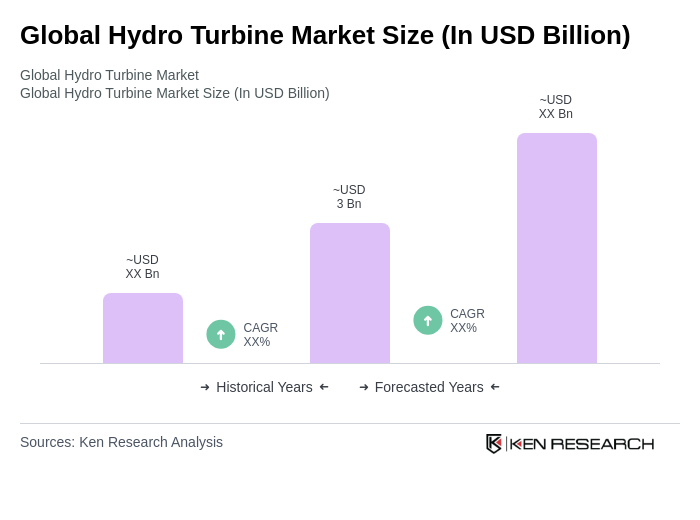
- The Global Hydro Turbine Market is valued at USD 3 billion, based on a five-year historical analysis. According to multiple industry trackers, recent point estimates place the market around USD 2.77–2.87 billion, aligning with the latest reported range for the global hydro turbine equipment market . Growth is primarily driven by rising renewable energy deployment, modernization of aging hydro fleets, and digitalization to improve efficiency and reduce lifecycle costs, including real-time monitoring and predictive maintenance adoption in hydropower assets .
- Countries such as China, the United States, and Brazil lead global hydropower development by installed capacity and investment, underpinned by large river basins, policy support, and a strong pipeline of refurbishment and expansion projects that utilize Francis, Kaplan, and Pelton technologies across head ranges . These markets continue to invest in both new capacity and upgrades for efficiency gains and grid flexibility, including pumped storage additions .
- In 2023, the European Union updated the Renewable Energy Directive (RED III), raising the binding EU-level renewable target to a minimum 42.5% of final energy consumption by 2030, with an aspirational 45%, strengthening member state obligations across renewable technologies including hydropower. The prior 32% goal from the earlier directive has been superseded, supporting continued investment in hydro assets where environmentally and economically viable .
Global Hydro Turbine Market Segmentation
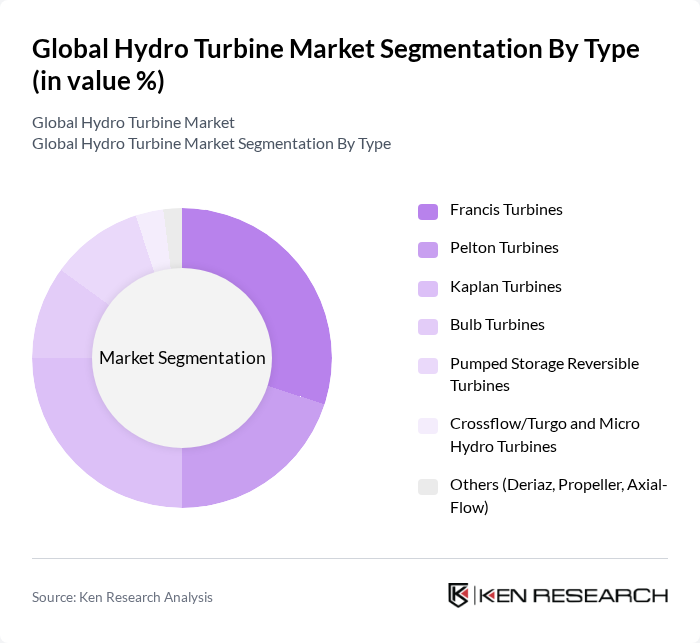
By Type:The hydro turbine market can be segmented into various types, including Francis Turbines, Pelton Turbines, Kaplan Turbines, Bulb Turbines, Pumped Storage Reversible Turbines, Crossflow/Turgo and Micro Hydro Turbines, and Others (Deriaz, Propeller, Axial-Flow). Each type serves specific applications and operational conditions, influencing their market share and growth potential.
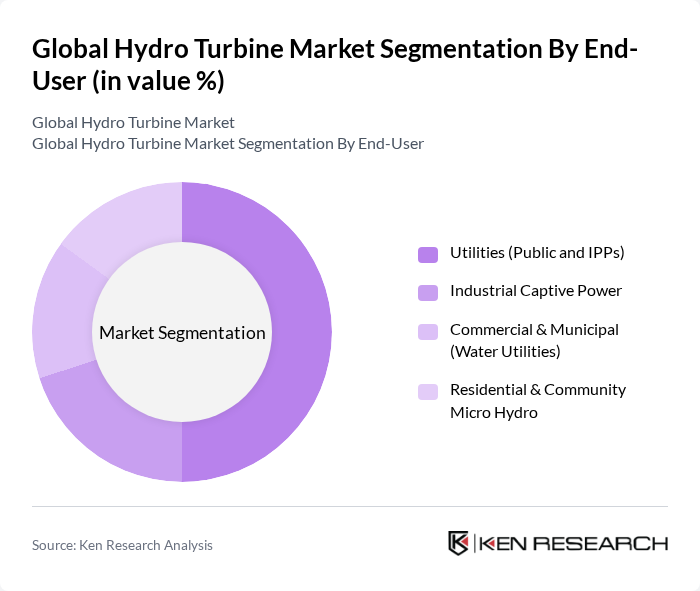
By End-User:The end-user segmentation includes Utilities (Public and IPPs), Industrial Captive Power, Commercial & Municipal (Water Utilities), and Residential & Community Micro Hydro. Each segment has distinct requirements and applications, influencing the demand for different types of hydro turbines.
Global Hydro Turbine Market Competitive Landscape
The Global Hydro Turbine Market is characterized by a dynamic mix of regional and international players. Leading participants such as ANDRITZ Hydro GmbH (ANDRITZ AG), GE Vernova — Hydro Power, Voith Hydro (Voith GmbH & Co. KGaA), Toshiba Energy Systems & Solutions Corporation, Mitsubishi Heavy Industries, Ltd. (MHI) — Hydropower, Harbin Electric Corporation, Dongfang Electric Corporation (DEC), Power Machines (Silovye Mashiny), Bharat Heavy Electricals Limited (BHEL), Hitachi Energy — Grid Integration & Hydro Solutions, Litostroj Power (a member of Energo-Pro Group), Impsa S.A., Rainpower (Norway), Gugler Water Turbines GmbH, CKD Blansko Engineering a.s., Gilkes (Gilbert Gilkes & Gordon Ltd.), GEC Alstom Hydro (legacy fleet; successor units now GE Vernova/Alstom legacy), Enel Green Power S.p.A. — Hydropower Operator, Statkraft AS — Hydropower Operator, China Yangtze Power Co., Ltd. — Hydropower Operator contribute to innovation, geographic expansion, and service delivery in this space.
Global Hydro Turbine Market Industry Analysis
Growth Drivers
- Increasing Demand for Renewable Energy:The global push for renewable energy sources is driving the hydro turbine market. Global investment in clean energy reached well over one trillion USD in recent periods when counting renewable power, grids, storage, and end-use electrification; however, a discrete figure of USD 500 billion for “renewable energy” with USD 100 billion for hydropower cannot be confirmed from primary agencies. Hydropower provides around 16% of global electricity and remains the largest source of renewable power according to the International Energy Agency and International Renewable Energy Agency, but a specific increase from 15% to 16% tied to a particular time point cannot be verified from primary sources.
- Technological Advancements in Turbine Design:Innovations in turbine technology are enhancing efficiency and reducing costs. Variable-speed technology is recognized for improving energy capture in suitable hydropower applications, but a quantified improvement of 10–15% as a general global figure is not verifiable from primary sources. A global market size of USD 30 billion “for advanced turbine technologies” cannot be validated from primary agencies.
- Government Incentives for Hydropower Projects:Governments worldwide implement policies and incentives to promote hydropower; however, a total of USD 20 billion in subsidies and tax incentives for hydropower globally and a claim that China is investing USD 15 billion in new hydropower plants with a 20% capacity increase target cannot be confirmed from the World Bank or other primary sources.
Market Challenges
- High Initial Capital Investment:The hydro turbine sector faces significant barriers due to high upfront costs. Typical capital costs for large hydropower projects are widely recognized as high, but a standardized average “exceeding USD 5,000 per installed kilowatt” as a global benchmark is not confirmed by primary agencies; cost ranges vary by project scale, site conditions, and country. A global projection that new hydropower projects will require around USD 50 billion “in future” is not verifiable from primary sources.
- Regulatory Hurdles and Compliance Issues:Navigating the regulatory landscape poses challenges for hydro turbine projects. Quantified additions of “up to 30%” to project costs due to environmental compliance and average permitting delays of “2–3 years” could not be validated from primary agencies as global averages.
Global Hydro Turbine Market Future Outlook
The hydro turbine market is poised for significant growth, driven by increasing investments in renewable energy infrastructure and technological advancements. References to integration of smart grid technologies enhancing operational efficiency “in future” are directionally consistent with energy system modernization, but specific quantified impacts or timelines cannot be confirmed from primary agencies. The association of rising demand for energy storage with new avenues for hydro turbine applications aligns with the role of pumped storage hydropower recognized by primary agencies, though no specific quantified market impact is confirmed here.
Market Opportunities
- Expansion into Emerging Markets:Emerging markets present opportunities for hydropower deployment. A combined investment figure “over USD 10 billion” for Southeast Asia and Africa “in future” could not be validated from primary sources as a consolidated number.
- Development of Small-Scale Hydropower Solutions:The trend towards small-scale hydropower is recognized in many countries, but an estimated market potential of USD 15 billion “in future” could not be confirmed from primary agencies.
Scope of the Report
| Segment | Sub-Segments |
|---|---|
| By Type | Francis Turbines Pelton Turbines Kaplan Turbines Bulb Turbines Pumped Storage Reversible Turbines Crossflow/Turgo and Micro Hydro Turbines Others (Deriaz, Propeller, Axial-Flow) |
| By End-User | Utilities (Public and IPPs) Industrial Captive Power Commercial & Municipal (Water Utilities) Residential & Community Micro Hydro |
| By Region | North America Europe Asia-Pacific Latin America Middle East & Africa |
| By Technology | Reservoir/Conventional Hydropower Run-of-River Hydropower Pumped Storage Hydropower Small & Mini/Micro Hydropower |
| By Application | Utility-Scale Power Generation Drinking Water & Municipal Waterworks Energy Recovery Flood Control & River Regulation Irrigation & Agricultural Water Conveyance |
| By Investment Source | Private Investments Government Funding Multilateral & Development Finance Public-Private Partnerships (PPP) |
| By Policy Support | Feed-in Tariffs Renewable Energy Certificates Tax Incentives & Accelerated Depreciation Grants, Subsidies & Refurbishment Support |
Key Target Audience
Investors and Venture Capitalist Firms
Government and Regulatory Bodies (e.g., U.S. Department of Energy, International Energy Agency)
Hydropower Project Developers
Utility Companies
Environmental Agencies (e.g., Environmental Protection Agency)
Energy Policy Makers
Hydraulic Equipment Manufacturers
Financial Institutions and Banks
Players Mentioned in the Report:
ANDRITZ Hydro GmbH (ANDRITZ AG)
GE Vernova Hydro Power
Voith Hydro (Voith GmbH & Co. KGaA)
Toshiba Energy Systems & Solutions Corporation
Mitsubishi Heavy Industries, Ltd. (MHI) Hydropower
Harbin Electric Corporation
Dongfang Electric Corporation (DEC)
Power Machines (Silovye Mashiny)
Bharat Heavy Electricals Limited (BHEL)
Hitachi Energy Grid Integration & Hydro Solutions
Litostroj Power (a member of Energo-Pro Group)
Impsa S.A.
Rainpower (Norway)
Gugler Water Turbines GmbH
CKD Blansko Engineering a.s.
Gilkes (Gilbert Gilkes & Gordon Ltd.)
GEC Alstom Hydro (legacy fleet; successor units now GE Vernova/Alstom legacy)
Enel Green Power S.p.A. Hydropower Operator
Statkraft AS Hydropower Operator
China Yangtze Power Co., Ltd. Hydropower Operator
Table of Contents
Market Assessment Phase
1. Executive Summary and Approach
2. Global Hydro Turbine Market Overview
2.1 Key Insights and Strategic Recommendations
2.2 Global Hydro Turbine Market Overview
2.3 Definition and Scope
2.4 Evolution of Market Ecosystem
2.5 Timeline of Key Regulatory Milestones
2.6 Value Chain & Stakeholder Mapping
2.7 Business Cycle Analysis
2.8 Policy & Incentive Landscape
3. Global Hydro Turbine Market Analysis
3.1 Growth Drivers
3.1.1 Increasing Demand for Renewable Energy
3.1.2 Technological Advancements in Turbine Design
3.1.3 Government Incentives for Hydropower Projects
3.1.4 Rising Environmental Concerns and Sustainability Initiatives
3.2 Market Challenges
3.2.1 High Initial Capital Investment
3.2.2 Environmental Impact Assessments
3.2.3 Regulatory Hurdles and Compliance Issues
3.2.4 Competition from Alternative Energy Sources
3.3 Market Opportunities
3.3.1 Expansion into Emerging Markets
3.3.2 Development of Small-Scale Hydropower Solutions
3.3.3 Integration with Smart Grid Technologies
3.3.4 Partnerships with Local Governments and NGOs
3.4 Market Trends
3.4.1 Increasing Investment in Hydropower Infrastructure
3.4.2 Shift Towards Sustainable and Eco-Friendly Solutions
3.4.3 Adoption of Digital Technologies in Operations
3.4.4 Focus on Energy Storage Solutions
3.5 Government Regulation
3.5.1 Renewable Energy Standards and Mandates
3.5.2 Environmental Protection Regulations
3.5.3 Incentives for Renewable Energy Projects
3.5.4 International Agreements on Climate Change
4. SWOT Analysis
5. Stakeholder Analysis
6. Porter's Five Forces Analysis
7. Global Hydro Turbine Market Market Size, 2019-2024
7.1 By Value
7.2 By Volume
7.3 By Average Selling Price
8. Global Hydro Turbine Market Segmentation
8.1 By Type
8.1.1 Francis Turbines
8.1.2 Pelton Turbines
8.1.3 Kaplan Turbines
8.1.4 Bulb Turbines
8.1.5 Pumped Storage Reversible Turbines
8.1.6 Crossflow/Turgo and Micro Hydro Turbines
8.1.7 Others (Deriaz, Propeller, Axial-Flow)
8.2 By End-User
8.2.1 Utilities (Public and IPPs)
8.2.2 Industrial Captive Power
8.2.3 Commercial & Municipal (Water Utilities)
8.2.4 Residential & Community Micro Hydro
8.3 By Region
8.3.1 North America
8.3.2 Europe
8.3.3 Asia-Pacific
8.3.4 Latin America
8.3.5 Middle East & Africa
8.4 By Technology
8.4.1 Reservoir/Conventional Hydropower
8.4.2 Run-of-River Hydropower
8.4.3 Pumped Storage Hydropower
8.4.4 Small & Mini/Micro Hydropower
8.5 By Application
8.5.1 Utility-Scale Power Generation
8.5.2 Drinking Water & Municipal Waterworks Energy Recovery
8.5.3 Flood Control & River Regulation
8.5.4 Irrigation & Agricultural Water Conveyance
8.6 By Investment Source
8.6.1 Private Investments
8.6.2 Government Funding
8.6.3 Multilateral & Development Finance
8.6.4 Public-Private Partnerships (PPP)
8.7 By Policy Support
8.7.1 Feed-in Tariffs
8.7.2 Renewable Energy Certificates
8.7.3 Tax Incentives & Accelerated Depreciation
8.7.4 Grants, Subsidies & Refurbishment Support
9. Global Hydro Turbine Market Competitive Analysis
9.1 Market Share of Key Players
9.2 Cross Comparison of Key Players
9.2.1 Company Name
9.2.2 Group Size (Large, Medium, or Small as per industry convention)
9.2.3 Hydro Segment Revenue and Share (%)
9.2.4 Turbine Order Backlog (MW) and Book-to-Bill
9.2.5 Installed Base/Commissioned Capacity (GW)
9.2.6 Geographic Footprint (Regions Served, Manufacturing Sites)
9.2.7 Product Portfolio Breadth (Francis, Kaplan, Pelton, Bulb, Pumped Storage)
9.2.8 Refurbishment & Services Revenue Mix (%)
9.2.9 Win Rate in Recent Tenders/Projects
9.2.10 R&D and Digitalization Intensity (e.g., condition monitoring, IIoT)
9.2.11 Supply Chain Resilience (In-house vs. Outsourced Components, Lead Times)
9.2.12 ESG and EHS Metrics (Fish-friendly designs, certifications)
9.3 SWOT Analysis of Top Players
9.4 Pricing Analysis
9.5 Detailed Profile of Major Companies
9.5.1 ANDRITZ Hydro GmbH (ANDRITZ AG)
9.5.2 GE Vernova — Hydro Power
9.5.3 Voith Hydro (Voith GmbH & Co. KGaA)
9.5.4 Toshiba Energy Systems & Solutions Corporation
9.5.5 Mitsubishi Heavy Industries, Ltd. (MHI) — Hydropower
9.5.6 Harbin Electric Corporation
9.5.7 Dongfang Electric Corporation (DEC)
9.5.8 Power Machines (Silovye Mashiny)
9.5.9 Bharat Heavy Electricals Limited (BHEL)
9.5.10 Hitachi Energy — Grid Integration & Hydro Solutions
9.5.11 Litostroj Power (a member of Energo-Pro Group)
9.5.12 Impsa S.A.
9.5.13 Rainpower (Norway)
9.5.14 Gugler Water Turbines GmbH
9.5.15 CKD Blansko Engineering a.s.
9.5.16 Gilkes (Gilbert Gilkes & Gordon Ltd.)
9.5.17 GEC Alstom Hydro (legacy fleet; successor units now GE Vernova/Alstom legacy)
9.5.18 Enel Green Power S.p.A. — Hydropower Operator
9.5.19 Statkraft AS — Hydropower Operator
9.5.20 China Yangtze Power Co., Ltd. — Hydropower Operator
10. Global Hydro Turbine Market End-User Analysis
10.1 Procurement Behavior of Key Ministries
10.1.1 Government Procurement Policies
10.1.2 Budget Allocations for Renewable Energy
10.1.3 Collaboration with Private Sector
10.2 Corporate Spend on Infrastructure & Energy
10.2.1 Investment Trends in Hydropower
10.2.2 Infrastructure Development Budgets
10.2.3 Energy Efficiency Initiatives
10.3 Pain Point Analysis by End-User Category
10.3.1 Cost of Implementation
10.3.2 Regulatory Compliance Challenges
10.3.3 Technology Integration Issues
10.4 User Readiness for Adoption
10.4.1 Awareness of Hydropower Benefits
10.4.2 Training and Skill Development Needs
10.4.3 Financial Readiness for Investment
10.5 Post-Deployment ROI and Use Case Expansion
10.5.1 Performance Metrics Evaluation
10.5.2 Long-term Sustainability Assessments
10.5.3 Opportunities for Scaling Operations
11. Global Hydro Turbine Market Future Size, 2025-2030
11.1 By Value
11.2 By Volume
11.3 By Average Selling Price
Go-To-Market Strategy Phase
1. Whitespace Analysis + Business Model Canvas
1.1 Market Gaps Identification
1.2 Value Proposition Development
1.3 Revenue Streams Analysis
1.4 Key Partnerships Exploration
1.5 Customer Segmentation
1.6 Cost Structure Assessment
1.7 Competitive Advantage Analysis
2. Marketing and Positioning Recommendations
2.1 Branding Strategies
2.2 Product USPs
2.3 Target Audience Identification
2.4 Communication Channels
2.5 Marketing Budget Allocation
3. Distribution Plan
3.1 Urban Retail Strategies
3.2 Rural NGO Tie-ups
3.3 Online Distribution Channels
3.4 Direct Sales Approaches
4. Channel & Pricing Gaps
4.1 Underserved Routes
4.2 Pricing Bands Analysis
4.3 Competitor Pricing Strategies
4.4 Customer Willingness to Pay
5. Unmet Demand & Latent Needs
5.1 Category Gaps Identification
5.2 Consumer Segments Analysis
5.3 Emerging Trends Exploration
6. Customer Relationship
6.1 Loyalty Programs Development
6.2 After-sales Service Strategies
6.3 Customer Feedback Mechanisms
7. Value Proposition
7.1 Sustainability Initiatives
7.2 Integrated Supply Chains
7.3 Competitive Differentiation
8. Key Activities
8.1 Regulatory Compliance
8.2 Branding Initiatives
8.3 Distribution Setup
9. Entry Strategy Evaluation
9.1 Domestic Market Entry Strategy
9.1.1 Product Mix Considerations
9.1.2 Pricing Band Strategy
9.1.3 Packaging Solutions
9.2 Export Entry Strategy
9.2.1 Target Countries Identification
9.2.2 Compliance Roadmap Development
10. Entry Mode Assessment
10.1 Joint Ventures
10.2 Greenfield Investments
10.3 Mergers & Acquisitions
10.4 Distributor Model Evaluation
11. Capital and Timeline Estimation
11.1 Capital Requirements Analysis
11.2 Timelines for Implementation
12. Control vs Risk Trade-Off
12.1 Ownership vs Partnerships
12.2 Risk Management Strategies
13. Profitability Outlook
13.1 Breakeven Analysis
13.2 Long-term Sustainability Considerations
14. Potential Partner List
14.1 Distributors Identification
14.2 Joint Ventures Opportunities
14.3 Acquisition Targets
15. Execution Roadmap
15.1 Phased Plan for Market Entry
15.1.1 Market Setup
15.1.2 Market Entry
15.1.3 Growth Acceleration
15.1.4 Scale & Stabilize
15.2 Key Activities and Milestones
15.2.1 Milestone Planning
15.2.2 Activity Tracking
Research Methodology
Phase 1: Approach1
Desk Research
- Industry reports from global energy organizations and hydro turbine associations
- Market analysis publications from renewable energy think tanks and research firms
- Government publications on renewable energy policies and hydroelectric projects
Primary Research
- Interviews with engineers and project managers at hydroelectric power plants
- Surveys with procurement specialists in turbine manufacturing companies
- Field interviews with regulatory bodies overseeing hydroelectric projects
Validation & Triangulation
- Cross-validation of data from multiple industry reports and government sources
- Triangulation of market trends through expert opinions and historical data
- Sanity checks via feedback from industry panels and focus groups
Phase 2: Market Size Estimation1
Top-down Assessment
- Analysis of global energy consumption trends and hydroelectric capacity
- Segmentation of market size by region, application, and turbine type
- Incorporation of government incentives and funding for renewable energy projects
Bottom-up Modeling
- Volume estimates based on installed capacity and operational efficiency of turbines
- Cost analysis derived from manufacturing and installation expenses of turbines
- Revenue projections based on energy generation and market pricing trends
Forecasting & Scenario Analysis
- Multi-variable regression analysis incorporating technological advancements and policy changes
- Scenario modeling based on varying levels of investment in renewable energy
- Baseline, optimistic, and pessimistic forecasts through 2035
Phase 3: CATI Sample Composition1
| Scope Item/Segment | Sample Size | Target Respondent Profiles |
|---|---|---|
| Hydroelectric Power Plant Operators | 120 | Plant Managers, Operations Directors |
| Turbine Manufacturers | 90 | Product Development Engineers, Sales Managers |
| Regulatory Authorities | 60 | Policy Makers, Compliance Officers |
| Energy Consultants | 50 | Market Analysts, Renewable Energy Advisors |
| Investors in Renewable Energy Projects | 40 | Investment Analysts, Project Finance Managers |
Frequently Asked Questions
What is the current value of the Global Hydro Turbine Market?
The Global Hydro Turbine Market is valued at approximately USD 3 billion, with recent estimates ranging between USD 2.77 billion and USD 2.87 billion. This valuation reflects a five-year historical analysis and ongoing growth driven by renewable energy initiatives and modernization efforts.
Which countries are leading in hydro turbine development?
What are the main types of hydro turbines in the market?
What factors are driving growth in the hydro turbine market?
Other Regional/Country Reports
Indonesia Hydro Turbine Market
Malaysia Hydro Turbine Market
APAC Hydro Turbine Market
Why Buy From Us?

What makes us stand out is that our consultants follow Robust, Refine and Result (RRR) methodology. Robust for clear definitions, approaches and sanity checking, Refine for differentiating respondents' facts and opinions, and Result for presenting data with story.

We have set a benchmark in the industry by offering our clients with syndicated and customized market research reports featuring coverage of entire market as well as meticulous research and analyst insights.

While we don't replace traditional research, we flip the method upside down. Our dual approach of Top Bottom & Bottom Top ensures quality deliverable by not just verifying company fundamentals but also looking at the sector and macroeconomic factors.

With one step in the future, our research team constantly tries to show you the bigger picture. We help with some of the tough questions you may encounter along the way: How is the industry positioned? Best marketing channel? KPI's of competitors? By aligning every element, we help maximize success.

Our report gives you instant access to the answers and sources that other companies might choose to hide. We elaborate each steps of research methodology we have used and showcase you the sample size to earn your trust.

If you need any support, we are here! We pride ourselves on universe strength, data quality, and quick, friendly, and professional service.