About the Report
Base Year 2024Global Juicers Market Overview
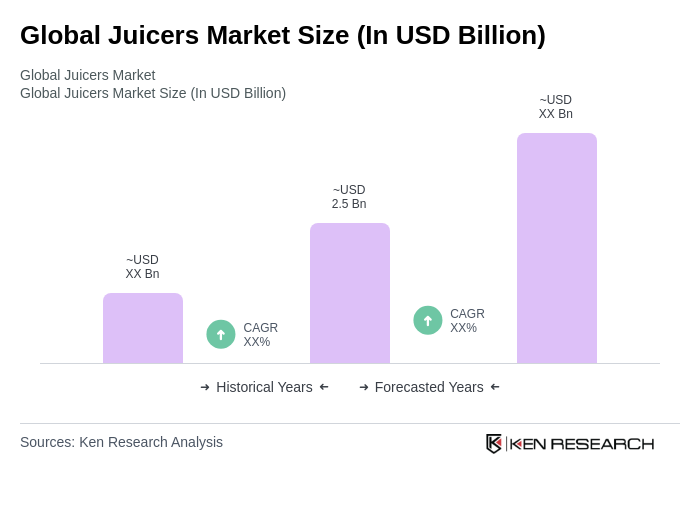
- The Global Juicers Market is valued at USD 2.5 billion, based on a five-year historical analysis. Growth is driven by rising health consciousness, at-home consumption trends, and sustained product innovation such as noise reduction, easier cleaning, and cold-press technologies that preserve nutrients.
- Leading demand stems from mature appliance markets and major manufacturing hubs, with strong brand presence and retail distribution supporting category scale in the United States, Germany, and China. The presence of established brands and a robust distribution network further enhance their market position, making these countries pivotal in the global juicers market.
- In the European Union, ecodesign and energy labelling rules for household appliances are in force, but there is no specific 2023 EU regulation mandating energy-efficiency standards uniquely for juicers; rather, broader eco-design policies encourage efficiency and reparability across small appliances.
Global Juicers Market Segmentation
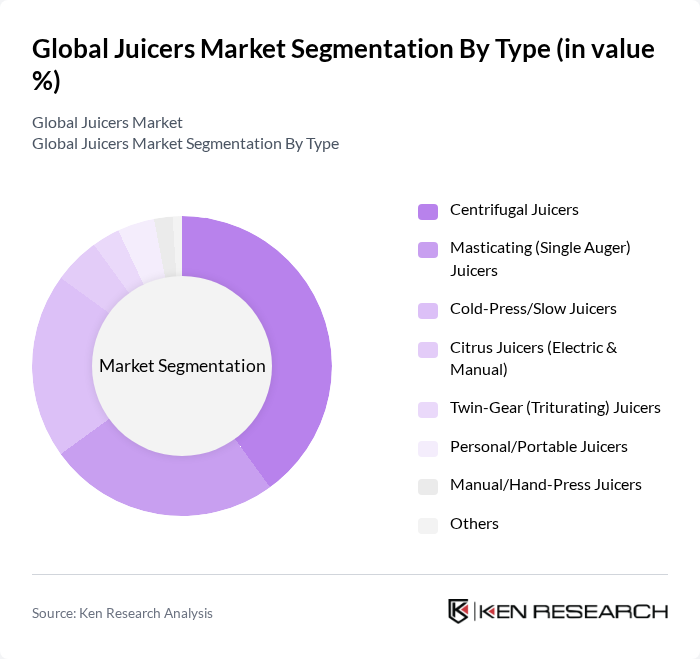
By Type:The market is segmented into various types of juicers, including Centrifugal Juicers, Masticating (Single Auger) Juicers, Cold-Press/Slow Juicers, Citrus Juicers (Electric & Manual), Twin-Gear (Triturating) Juicers, Personal/Portable Juicers, Manual/Hand-Press Juicers, and Others. Centrifugal Juicers remain the most popular for speed and convenience in home use. Masticating/Cold-Press types continue to gain traction among health-focused consumers for higher juice yield and nutrient retention and due to quieter operation and easier cleanup in newer designs. Citrus juicers retain a stable niche for single-fruit use in both home and HORECA settings.
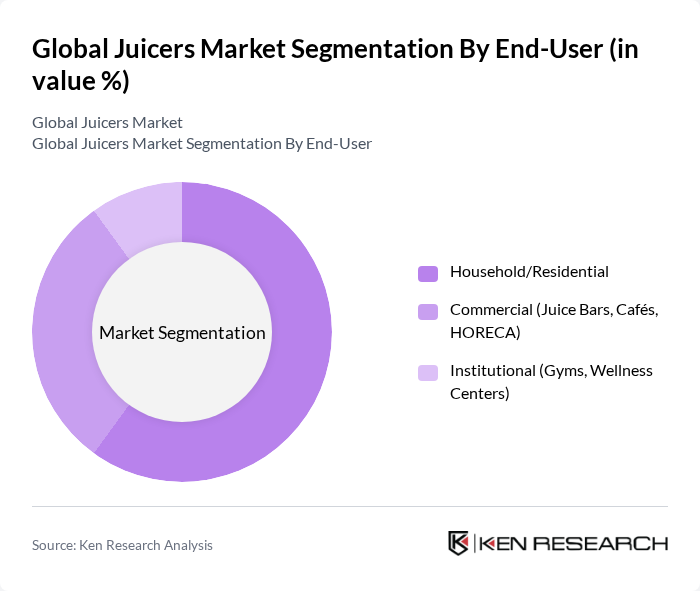
By End-User:The market is segmented into Household/Residential, Commercial (Juice Bars, Cafés, HORECA), and Institutional (Gyms, Wellness Centers). Household adoption leads, supported by healthy living trends and e-commerce availability of small kitchen appliances. Commercial demand reflects café/juice bar menu expansion and preference for durable, high-yield machines, while Institutional uptake grows with wellness programs and fitness-focused offerings.
Global Juicers Market Competitive Landscape
The Global Juicers Market is characterized by a dynamic mix of regional and international players. Leading participants such as Breville Group Limited, Hurom Co., Ltd., Omega Juicers (Omega Products, Inc.), Cuisinart (Conair LLC), Philips Domestic Appliances (Versuni), Hamilton Beach Brands Holding Company, BLACK+DECKER (Stanley Black & Decker), Kuvings (NUC Electronics Co., Ltd.), Braun Household (De’Longhi Group), SharkNinja (Ninja), Smeg S.p.A., Tefal (Groupe SEB), Tribest Corporation, NutriBullet (De’Longhi Group), Panasonic Corporation contribute to innovation, geographic expansion, and service delivery in this space.
Global Juicers Market Industry Analysis
Growth Drivers
- Increasing Health Consciousness:The global trend towards healthier lifestyles is driving the juicers market, with 68% of consumers actively seeking nutritious options. According to the World Health Organization, non-communicable diseases, which can be mitigated by healthy diets, account for 71% of global deaths. This awareness has led to a surge in demand for juicers, with sales in the health and wellness sector projected to reach $1.6 billion, reflecting a robust consumer shift towards fresh juice consumption.
- Rising Demand for Fresh Juices:The fresh juice market is expected to grow significantly, with a projected value of $3.5 billion. This growth is fueled by consumers' preference for natural beverages over processed ones, as evidenced by a 27% increase in fresh juice sales in the last year alone. The increasing availability of fresh produce and the trend towards home juicing are key factors contributing to this demand, as consumers prioritize quality and freshness in their dietary choices.
- Technological Advancements in Juicing:Innovations in juicer technology, such as cold press and smart juicers, are enhancing user experience and efficiency. The introduction of smart juicers, which can connect to mobile apps for personalized recipes, is expected to increase market penetration. In future, it is estimated that 42% of juicer sales will come from technologically advanced models, reflecting a shift towards convenience and customization in the juicing process, appealing to tech-savvy consumers.
Market Challenges
- High Competition:The juicers market is characterized by intense competition, with over 160 brands vying for market share. This saturation leads to price wars, which can erode profit margins. In future, it is anticipated that the top five brands will account for only 32% of the market, indicating a fragmented landscape. Companies must differentiate their products through innovation and marketing to maintain a competitive edge in this challenging environment.
- Price Sensitivity Among Consumers:Economic fluctuations have made consumers increasingly price-sensitive, particularly in emerging markets. In future, it is projected that 62% of consumers will prioritize affordability over brand loyalty when purchasing juicers. This trend poses a challenge for premium brands, which may struggle to maintain sales volumes. Companies must adapt their pricing strategies to cater to budget-conscious consumers while ensuring product quality remains uncompromised.
Global Juicers Market Future Outlook
The future of the juicers market appears promising, driven by ongoing health trends and technological advancements. As consumers increasingly prioritize health and wellness, the demand for innovative juicing solutions is expected to rise. Additionally, the integration of e-commerce platforms will facilitate broader market access, allowing brands to reach a wider audience. Companies that leverage these trends and invest in sustainable practices will likely gain a competitive advantage in the evolving landscape of the juicers market.
Market Opportunities
- Growth in E-commerce Sales:The shift towards online shopping presents a significant opportunity for juicer brands. E-commerce sales in the kitchen appliance sector are projected to reach $2.3 billion, driven by convenience and a wider product selection. Brands that enhance their online presence and optimize user experience can capitalize on this trend, attracting tech-savvy consumers seeking easy access to juicing products.
- Introduction of Smart Juicers:The rise of smart home technology offers a unique opportunity for juicer manufacturers. By integrating IoT capabilities, brands can create juicers that provide personalized recipes and nutritional tracking. This innovation is expected to attract a younger demographic, with smart juicer sales projected to increase by 35%. Companies that invest in this technology can differentiate themselves and capture a growing market segment.
Scope of the Report
| Segment | Sub-Segments |
|---|---|
| By Type | Centrifugal Juicers Masticating (Single Auger) Juicers Cold-Press/Slow Juicers Citrus Juicers (Electric & Manual) Twin-Gear (Triturating) Juicers Personal/Portable Juicers Manual/Hand-Press Juicers Others |
| By End-User | Household/Residential Commercial (Juice Bars, Cafés, HORECA) Institutional (Gyms, Wellness Centers) |
| By Distribution Channel | Online Retail (Marketplaces, D2C) Supermarkets/Hypermarkets Specialty & Kitchen Appliance Stores Direct Sales/B2B Others |
| By Price Range | Budget (Sub-$100) Mid-Range ($100–$300) Premium ($300+) |
| By Material | Plastic (ABS/Polycarbonate) Stainless Steel Glass & Tritan Components Others |
| By Brand | Established Brands Emerging/D2C Brands Private Labels/Store Brands |
| By Application | Home Use Commercial Use Health & Wellness Programs Others |
Key Target Audience
Investors and Venture Capitalist Firms
Government and Regulatory Bodies (e.g., Food and Drug Administration, European Food Safety Authority)
Manufacturers and Producers
Distributors and Retailers
Health and Wellness Organizations
Food and Beverage Industry Stakeholders
Market Analysts and Industry Experts
Importers and Exporters
Players Mentioned in the Report:
Breville Group Limited
Hurom Co., Ltd.
Omega Juicers (Omega Products, Inc.)
Cuisinart (Conair LLC)
Philips Domestic Appliances (Versuni)
Hamilton Beach Brands Holding Company
BLACK+DECKER (Stanley Black & Decker)
Kuvings (NUC Electronics Co., Ltd.)
Braun Household (DeLonghi Group)
SharkNinja (Ninja)
Smeg S.p.A.
Tefal (Groupe SEB)
Tribest Corporation
NutriBullet (DeLonghi Group)
Panasonic Corporation
Table of Contents
Market Assessment Phase
1. Executive Summary and Approach
2. Global Juicers Market Overview
2.1 Key Insights and Strategic Recommendations
2.2 Global Juicers Market Overview
2.3 Definition and Scope
2.4 Evolution of Market Ecosystem
2.5 Timeline of Key Regulatory Milestones
2.6 Value Chain & Stakeholder Mapping
2.7 Business Cycle Analysis
2.8 Policy & Incentive Landscape
3. Global Juicers Market Analysis
3.1 Growth Drivers
3.1.1 Increasing Health Consciousness
3.1.2 Rising Demand for Fresh Juices
3.1.3 Technological Advancements in Juicing
3.1.4 Expansion of Retail Channels
3.2 Market Challenges
3.2.1 High Competition
3.2.2 Price Sensitivity Among Consumers
3.2.3 Supply Chain Disruptions
3.2.4 Regulatory Compliance Issues
3.3 Market Opportunities
3.3.1 Growth in E-commerce Sales
3.3.2 Introduction of Smart Juicers
3.3.3 Expansion into Emerging Markets
3.3.4 Collaborations with Health Brands
3.4 Market Trends
3.4.1 Increasing Popularity of Cold Press Juicers
3.4.2 Sustainable and Eco-friendly Products
3.4.3 Customization and Personalization in Juicing
3.4.4 Integration of IoT in Juicing Appliances
3.5 Government Regulation
3.5.1 Food Safety Standards
3.5.2 Environmental Regulations
3.5.3 Import Tariffs on Juicing Equipment
3.5.4 Labeling Requirements for Juices
4. SWOT Analysis
5. Stakeholder Analysis
6. Porter's Five Forces Analysis
7. Global Juicers Market Market Size, 2019-2024
7.1 By Value
7.2 By Volume
7.3 By Average Selling Price
8. Global Juicers Market Segmentation
8.1 By Type
8.1.1 Centrifugal Juicers
8.1.2 Masticating (Single Auger) Juicers
8.1.3 Cold-Press/Slow Juicers
8.1.4 Citrus Juicers (Electric & Manual)
8.1.5 Twin-Gear (Triturating) Juicers
8.1.6 Personal/Portable Juicers
8.1.7 Manual/Hand-Press Juicers
8.1.8 Others
8.2 By End-User
8.2.1 Household/Residential
8.2.2 Commercial (Juice Bars, Cafés, HORECA)
8.2.3 Institutional (Gyms, Wellness Centers)
8.3 By Distribution Channel
8.3.1 Online Retail (Marketplaces, D2C)
8.3.2 Supermarkets/Hypermarkets
8.3.3 Specialty & Kitchen Appliance Stores
8.3.4 Direct Sales/B2B
8.3.5 Others
8.4 By Price Range
8.4.1 Budget (Sub-$100)
8.4.2 Mid-Range ($100–$300)
8.4.3 Premium ($300+)
8.5 By Material
8.5.1 Plastic (ABS/Polycarbonate)
8.5.2 Stainless Steel
8.5.3 Glass & Tritan Components
8.5.4 Others
8.6 By Brand
8.6.1 Established Brands
8.6.2 Emerging/D2C Brands
8.6.3 Private Labels/Store Brands
8.7 By Application
8.7.1 Home Use
8.7.2 Commercial Use
8.7.3 Health & Wellness Programs
8.7.4 Others
9. Global Juicers Market Competitive Analysis
9.1 Market Share of Key Players
9.2 Cross Comparison of Key Players
9.2.1 Company Name
9.2.2 Company Scale (Global, Regional, Niche)
9.2.3 Juicer Segment Mix (% Centrifugal / Masticating / Citrus / Twin-Gear)
9.2.4 Revenue from Small Kitchen Appliances (USD, latest FY)
9.2.5 Juicer ASP (Average Selling Price) by Region
9.2.6 3-Year CAGR in Juicer Sales Volume
9.2.7 Installed Base/Units-in-Use (estimate)
9.2.8 Distribution Reach (No. of Countries/Key Retail Partners)
9.2.9 Product Innovation Velocity (New Models/Year; Patents)
9.2.10 Warranty & Service Coverage (Years/Service Centers)
9.2.11 Online Ratings/CSAT (Avg. rating across top marketplaces)
9.2.12 Pricing Positioning (Budget/Mid/Premium)
9.3 SWOT Analysis of Top Players
9.4 Pricing Analysis
9.5 Detailed Profile of Major Companies
9.5.1 Breville Group Limited
9.5.2 Hurom Co., Ltd.
9.5.3 Omega Juicers (Omega Products, Inc.)
9.5.4 Cuisinart (Conair LLC)
9.5.5 Philips Domestic Appliances (Versuni)
9.5.6 Hamilton Beach Brands Holding Company
9.5.7 BLACK+DECKER (Stanley Black & Decker)
9.5.8 Kuvings (NUC Electronics Co., Ltd.)
9.5.9 Braun Household (De’Longhi Group)
9.5.10 SharkNinja (Ninja)
9.5.11 Smeg S.p.A.
9.5.12 Tefal (Groupe SEB)
9.5.13 Tribest Corporation
9.5.14 NutriBullet (De’Longhi Group)
9.5.15 Panasonic Corporation
10. Global Juicers Market End-User Analysis
10.1 Procurement Behavior of Key Ministries
10.1.1 Budget Allocation for Health Initiatives
10.1.2 Preference for Local Suppliers
10.1.3 Compliance with Health Standards
10.1.4 Evaluation of Product Efficacy
10.2 Corporate Spend on Infrastructure & Energy
10.2.1 Investment in Health and Wellness Programs
10.2.2 Budget for Kitchen Equipment
10.2.3 Focus on Sustainable Products
10.3 Pain Point Analysis by End-User Category
10.3.1 High Maintenance Costs
10.3.2 Limited Product Knowledge
10.3.3 Availability of Spare Parts
10.4 User Readiness for Adoption
10.4.1 Awareness of Health Benefits
10.4.2 Accessibility of Products
10.4.3 User Training and Support
10.5 Post-Deployment ROI and Use Case Expansion
10.5.1 Measurement of Health Outcomes
10.5.2 Customer Feedback Mechanisms
10.5.3 Opportunities for Upselling
11. Global Juicers Market Future Size, 2025-2030
11.1 By Value
11.2 By Volume
11.3 By Average Selling Price
Go-To-Market Strategy Phase
1. Whitespace Analysis + Business Model Canvas
1.1 Market Gaps Identification
1.2 Value Proposition Development
1.3 Revenue Streams Analysis
1.4 Customer Segmentation
1.5 Key Partnerships
1.6 Cost Structure Evaluation
1.7 Channels of Distribution
2. Marketing and Positioning Recommendations
2.1 Branding Strategies
2.2 Product USPs
2.3 Target Audience Identification
2.4 Communication Strategy
2.5 Digital Marketing Tactics
2.6 Customer Engagement Approaches
3. Distribution Plan
3.1 Urban Retail Strategies
3.2 Rural NGO Tie-ups
3.3 E-commerce Partnerships
3.4 Direct-to-Consumer Channels
3.5 Logistics and Supply Chain Management
4. Channel & Pricing Gaps
4.1 Underserved Routes
4.2 Pricing Bands Analysis
4.3 Competitor Pricing Strategies
4.4 Consumer Price Sensitivity
4.5 Value-Based Pricing Models
5. Unmet Demand & Latent Needs
5.1 Category Gaps Identification
5.2 Consumer Segments Analysis
5.3 Product Development Opportunities
5.4 Market Entry Barriers
6. Customer Relationship
6.1 Loyalty Programs
6.2 After-sales Service
6.3 Customer Feedback Mechanisms
6.4 Community Engagement
7. Value Proposition
7.1 Sustainability Initiatives
7.2 Integrated Supply Chains
7.3 Customer-Centric Innovations
7.4 Competitive Differentiation
8. Key Activities
8.1 Regulatory Compliance
8.2 Branding Initiatives
8.3 Distribution Setup
8.4 Market Research Activities
9. Entry Strategy Evaluation
9.1 Domestic Market Entry Strategy
9.1.1 Product Mix Considerations
9.1.2 Pricing Band Strategy
9.1.3 Packaging Innovations
9.2 Export Entry Strategy
9.2.1 Target Countries Identification
9.2.2 Compliance Roadmap Development
10. Entry Mode Assessment
10.1 Joint Ventures
10.2 Greenfield Investments
10.3 Mergers & Acquisitions
10.4 Distributor Model Evaluation
11. Capital and Timeline Estimation
11.1 Capital Requirements Analysis
11.2 Timelines for Market Entry
12. Control vs Risk Trade-Off
12.1 Ownership vs Partnerships
13. Profitability Outlook
13.1 Breakeven Analysis
13.2 Long-term Sustainability Strategies
14. Potential Partner List
14.1 Distributors
14.2 Joint Ventures
14.3 Acquisition Targets
15. Execution Roadmap
15.1 Phased Plan for Market Entry
15.1.1 Market Setup
15.1.2 Market Entry
15.1.3 Growth Acceleration
15.1.4 Scale & Stabilize
15.2 Key Activities and Milestones
15.2.1 Milestone Planning
15.2.2 Activity Tracking
Research Methodology
Phase 1: Approach1
Desk Research
- Industry reports from market research firms focusing on the juicer market
- Trade publications and articles detailing trends in consumer preferences for juicers
- Statistical data from government agencies on appliance sales and household consumption
Primary Research
- Interviews with product managers at leading juicer manufacturers
- Surveys conducted with retail managers in appliance stores
- Focus groups with consumers to understand juicer usage and preferences
Validation & Triangulation
- Cross-validation of findings with sales data from major retailers
- Triangulation of consumer insights with expert opinions from industry analysts
- Sanity checks through feedback from a panel of culinary experts and nutritionists
Phase 2: Market Size Estimation1
Top-down Assessment
- Analysis of overall kitchen appliance market size to estimate juicer market share
- Segmentation by product type (centrifugal, masticating, and citrus juicers)
- Incorporation of demographic trends influencing juicer adoption rates
Bottom-up Modeling
- Volume estimates based on sales data from major juicer brands
- Price point analysis across different juicer categories
- Estimation of market penetration rates in various geographic regions
Forecasting & Scenario Analysis
- Multi-variable regression analysis incorporating health trends and lifestyle changes
- Scenario modeling based on economic conditions and consumer spending behavior
- Projections for market growth through 2030 under different market conditions
Phase 3: CATI Sample Composition1
| Scope Item/Segment | Sample Size | Target Respondent Profiles |
|---|---|---|
| Consumer Household Juicer Usage | 150 | Homeowners, Health Enthusiasts |
| Retail Sales Insights | 100 | Store Managers, Sales Associates |
| Product Development Feedback | 80 | Product Designers, R&D Managers |
| Market Trend Analysis | 60 | Market Analysts, Industry Experts |
| Health and Wellness Consumer Insights | 90 | Nutritionists, Fitness Coaches |
Frequently Asked Questions
What is the current value of the Global Juicers Market?
The Global Juicers Market is valued at approximately USD 2.5 billion, reflecting a five-year historical analysis. This growth is attributed to increasing health consciousness and trends in at-home consumption, alongside continuous product innovations.
What factors are driving the growth of the juicers market?
Which countries are leading in the juicers market?
What types of juicers are available in the market?
Other Regional/Country Reports
Indonesia Juicers Market
Malaysia Juicers Market
APAC Juicers Market
SEA Juicers Market
Why Buy From Us?

What makes us stand out is that our consultants follow Robust, Refine and Result (RRR) methodology. Robust for clear definitions, approaches and sanity checking, Refine for differentiating respondents' facts and opinions, and Result for presenting data with story.

We have set a benchmark in the industry by offering our clients with syndicated and customized market research reports featuring coverage of entire market as well as meticulous research and analyst insights.

While we don't replace traditional research, we flip the method upside down. Our dual approach of Top Bottom & Bottom Top ensures quality deliverable by not just verifying company fundamentals but also looking at the sector and macroeconomic factors.

With one step in the future, our research team constantly tries to show you the bigger picture. We help with some of the tough questions you may encounter along the way: How is the industry positioned? Best marketing channel? KPI's of competitors? By aligning every element, we help maximize success.

Our report gives you instant access to the answers and sources that other companies might choose to hide. We elaborate each steps of research methodology we have used and showcase you the sample size to earn your trust.

If you need any support, we are here! We pride ourselves on universe strength, data quality, and quick, friendly, and professional service.