About the Report
Base Year 2024Global Licorice Extract Market Overview
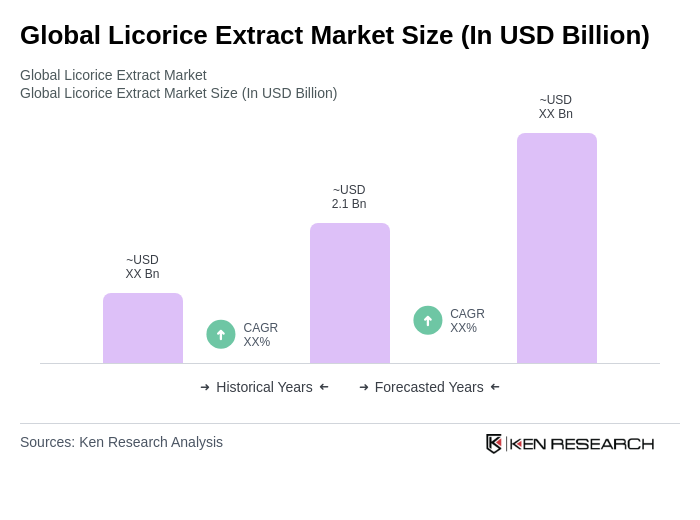
- The Global Licorice Extract Market is valued at USD 2.1 billion, based on a five-year historical analysis. This growth is primarily driven by the increasing demand for natural sweeteners and flavoring agents in the food and beverage industry, alongside rising awareness of health-related functions of licorice constituents (e.g., glycyrrhizin and flavonoids) with anti-inflammatory and antioxidant activity that support applications in nutraceuticals and pharmaceuticals .
- Key players in this market are concentrated in regions such as Europe and North America, where demand is bolstered by strong food, beverage, and nutraceutical sectors and a growing trend toward natural and clean-label botanicals. Europe holds a leading share, supported by robust herbal medicine usage and mature F&B processing in countries including Germany and the Netherlands, while the United States remains an important consumer market for confectionery, dietary supplements, and OTC remedies .
- In 2023, the European Union implemented or updated measures governing the safe use and labeling of licorice in foods, including requirements to declare glycyrrhizin/glycyrrhizic acid when levels exceed specified thresholds and general food information and additives compliance to protect consumers and ensure transparency; these obligations derive from established EU frameworks such as Regulation (EU) No 1169/2011 on food information and associated guidance for “contains licorice” statements on products with notable glycyrrhizin content .
Global Licorice Extract Market Segmentation
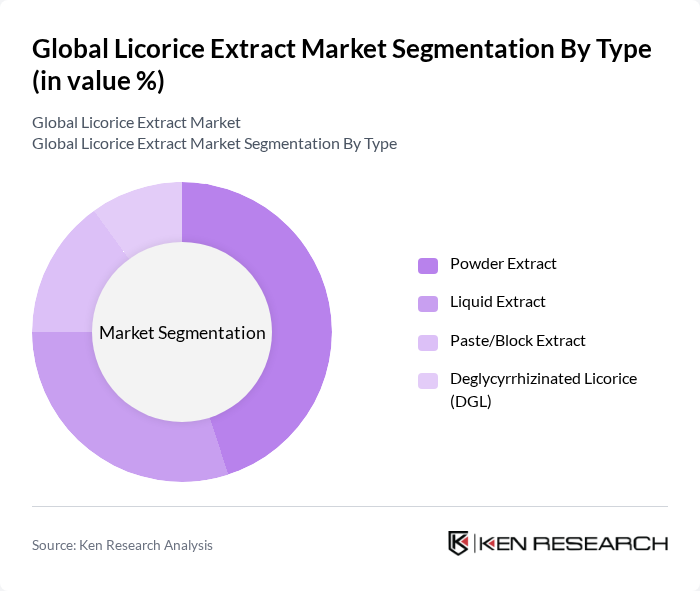
By Type:The licorice extract market is segmented into four main types: Powder Extract, Liquid Extract, Paste/Block Extract, and Deglycyrrhizinated Licorice (DGL). Among these, the Powder Extract segment is currently leading the market due to its versatility and ease of use in various applications, particularly in food and beverages. The demand for powdered forms is driven by their convenience in formulation and alignment with clean-label and standardized botanical ingredient trends across food, nutraceutical, and pharmaceutical applications .
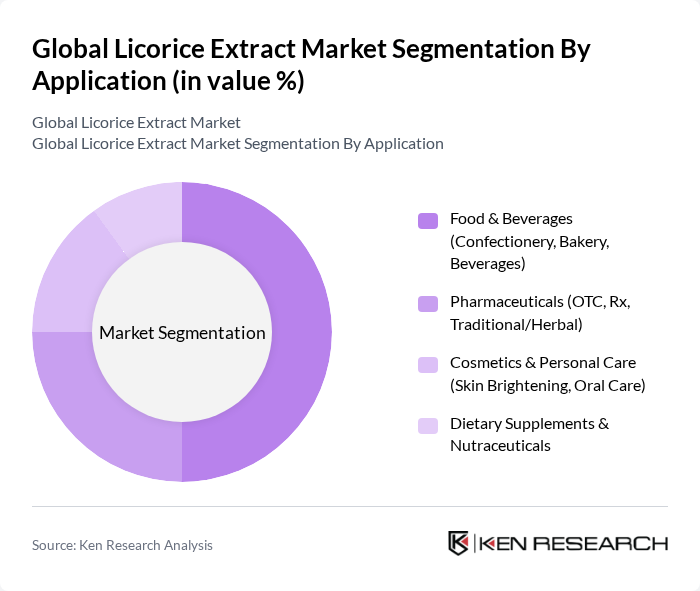
By Application:The applications of licorice extract are diverse, including Food & Beverages, Pharmaceuticals, Cosmetics & Personal Care, and Dietary Supplements & Nutraceuticals. The Food & Beverages segment dominates the market, driven by the increasing use of licorice as a natural sweetener and flavor enhancer in confectionery and bakery products. Rising consumer preference for clean-label ingredients, as well as continued use of licorice in cough/soothing syrups, digestive aids, and skin-brightening products, further supports demand across pharmaceuticals, nutraceuticals, and cosmetics .
Global Licorice Extract Market Competitive Landscape
The Global Licorice Extract Market is characterized by a dynamic mix of regional and international players. Leading participants such as MAFCO Worldwide LLC, Norevo GmbH, FC Licorice, Sepidan Osareh Jonoob Co., Zagros Licorice Co., Ransom Naturals Ltd, Naturex S.A. (Givaudan), Symrise AG, Maruzen Pharmaceuticals Co., Ltd., Alchem International Pvt. Ltd., Aushadh Industries, Mafco Worldwide Japan Co., Ltd., Nans Products (India), Aushadhi Herbal, The Natural Gum Company Ltd. contribute to innovation, geographic expansion, and service delivery in this space.
Global Licorice Extract Market Industry Analysis
Growth Drivers
- Increasing Demand for Natural Sweeteners:The global market for natural sweeteners is projected to reach $25 billion in future, driven by a shift towards healthier alternatives. Licorice extract, known for its natural sweetness, is gaining traction among consumers seeking to reduce sugar intake. The World Health Organization's recommendation to limit added sugars to less than 10% of total energy intake further supports this trend, as consumers increasingly opt for natural options in their diets.
- Rising Health Consciousness Among Consumers:A significant increase in health awareness has been observed, with 75% of consumers actively seeking healthier food options. This trend is reflected in the growing demand for licorice extract, which is recognized for its potential health benefits, including anti-inflammatory and antioxidant properties. The global health and wellness market is expected to reach $4.5 trillion in future, indicating a robust environment for natural ingredients like licorice extract.
- Expanding Applications in Food and Beverage Industry:The food and beverage sector is projected to grow to $8 trillion in future, with licorice extract being increasingly utilized in various products, including candies, beverages, and baked goods. Its unique flavor profile and natural sweetness make it a preferred ingredient among manufacturers. The rise of innovative product formulations that incorporate licorice extract is expected to further enhance its market presence in this sector.
Market Challenges
- Fluctuating Raw Material Prices:The licorice root market is subject to price volatility, with costs fluctuating between $2,500 to $4,000 per ton due to supply chain disruptions and climatic conditions. This unpredictability poses a challenge for manufacturers, impacting profit margins and pricing strategies. The reliance on specific regions for sourcing, such as China, exacerbates this issue, making it difficult for companies to maintain stable pricing.
- Stringent Regulatory Frameworks:The licorice extract industry faces rigorous regulatory scrutiny, particularly in the European Union and North America, where compliance with food safety standards is mandatory. For instance, the EU's Novel Food Regulation requires extensive safety assessments for new food ingredients, which can delay product launches. Companies must navigate these complex regulations, which can hinder market entry and increase operational costs.
Global Licorice Extract Market Future Outlook
The future of the licorice extract market appears promising, driven by increasing consumer demand for natural and organic products. As health trends continue to evolve, the market is likely to witness a surge in innovative applications across various sectors, including functional foods and beverages. Additionally, the focus on sustainability and ethical sourcing will shape product development, encouraging companies to adopt environmentally friendly practices that resonate with health-conscious consumers.
Market Opportunities
- Expansion in Emerging Markets:Emerging markets, particularly in Asia-Pacific and Latin America, present significant growth opportunities for licorice extract. With a rising middle class and increasing disposable incomes, the demand for natural ingredients in food and beverages is expected to grow. This trend is supported by a projected 7% annual growth rate in these regions, creating a favorable environment for market expansion.
- Innovations in Product Development:The licorice extract market can benefit from innovations in product formulations, particularly in functional foods and dietary supplements. With the global functional food market expected to reach $300 billion in future, companies that invest in research and development to create unique licorice-based products can capture a larger share of this lucrative segment, appealing to health-conscious consumers.
Scope of the Report
| Segment | Sub-Segments |
|---|---|
| By Type | Powder Extract Liquid Extract Paste/Block Extract Deglycyrrhizinated Licorice (DGL) |
| By Application | Food & Beverages (Confectionery, Bakery, Beverages) Pharmaceuticals (OTC, Rx, Traditional/Herbal) Cosmetics & Personal Care (Skin Brightening, Oral Care) Dietary Supplements & Nutraceuticals |
| By End-User | Food & Confectionery Manufacturers Beverage Producers Pharmaceutical & Herbal Medicine Companies Cosmetics, Personal Care & Oral Care Brands |
| By Distribution Channel | Direct/B2B (Manufacturers to Brands) Distributors & Wholesalers Online B2B Marketplaces Retail/Private Label |
| By Region | North America Europe Asia-Pacific Latin America Middle East & Africa |
| By Price Range | Conventional Organic/Certified Pharmaceutical-Grade/High-Purity |
| By Packaging Type | Bulk (Drums, IBC, Bags) Retail Packs (Pouches, Jars) Custom/Contract Packs |
Key Target Audience
Investors and Venture Capitalist Firms
Government and Regulatory Bodies (e.g., Food and Drug Administration, European Food Safety Authority)
Manufacturers and Producers
Distributors and Retailers
Food and Beverage Companies
Pharmaceutical Companies
Cosmetic and Personal Care Product Manufacturers
Health and Wellness Product Companies
Players Mentioned in the Report:
MAFCO Worldwide LLC
Norevo GmbH
FC Licorice
Sepidan Osareh Jonoob Co.
Zagros Licorice Co.
Ransom Naturals Ltd
Naturex S.A. (Givaudan)
Symrise AG
Maruzen Pharmaceuticals Co., Ltd.
Alchem International Pvt. Ltd.
Aushadh Industries
Mafco Worldwide Japan Co., Ltd.
Nans Products (India)
Aushadhi Herbal
The Natural Gum Company Ltd.
Table of Contents
Market Assessment Phase
1. Executive Summary and Approach
2. Global Licorice Extract Market Overview
2.1 Key Insights and Strategic Recommendations
2.2 Global Licorice Extract Market Overview
2.3 Definition and Scope
2.4 Evolution of Market Ecosystem
2.5 Timeline of Key Regulatory Milestones
2.6 Value Chain & Stakeholder Mapping
2.7 Business Cycle Analysis
2.8 Policy & Incentive Landscape
3. Global Licorice Extract Market Analysis
3.1 Growth Drivers
3.1.1 Increasing Demand for Natural Sweeteners
3.1.2 Rising Health Consciousness Among Consumers
3.1.3 Expanding Applications in Food and Beverage Industry
3.1.4 Growth in Pharmaceutical and Herbal Products
3.2 Market Challenges
3.2.1 Fluctuating Raw Material Prices
3.2.2 Stringent Regulatory Frameworks
3.2.3 Competition from Synthetic Alternatives
3.2.4 Limited Awareness in Emerging Markets
3.3 Market Opportunities
3.3.1 Expansion in Emerging Markets
3.3.2 Innovations in Product Development
3.3.3 Increasing Use in Functional Foods
3.3.4 Collaborations with Health and Wellness Brands
3.4 Market Trends
3.4.1 Growing Popularity of Plant-Based Ingredients
3.4.2 Shift Towards Clean Label Products
3.4.3 Rising Demand for Organic Licorice Extracts
3.4.4 Increased Focus on Sustainable Sourcing
3.5 Government Regulation
3.5.1 Food Safety Standards Compliance
3.5.2 Labeling Requirements for Natural Products
3.5.3 Import and Export Regulations
3.5.4 Environmental Regulations on Harvesting
4. SWOT Analysis
5. Stakeholder Analysis
6. Porter's Five Forces Analysis
7. Global Licorice Extract Market Market Size, 2019-2024
7.1 By Value
7.2 By Volume
7.3 By Average Selling Price
8. Global Licorice Extract Market Segmentation
8.1 By Type
8.1.1 Powder Extract
8.1.2 Liquid Extract
8.1.3 Paste/Block Extract
8.1.4 Deglycyrrhizinated Licorice (DGL)
8.2 By Application
8.2.1 Food & Beverages (Confectionery, Bakery, Beverages)
8.2.2 Pharmaceuticals (OTC, Rx, Traditional/Herbal)
8.2.3 Cosmetics & Personal Care (Skin Brightening, Oral Care)
8.2.4 Dietary Supplements & Nutraceuticals
8.3 By End-User
8.3.1 Food & Confectionery Manufacturers
8.3.2 Beverage Producers
8.3.3 Pharmaceutical & Herbal Medicine Companies
8.3.4 Cosmetics, Personal Care & Oral Care Brands
8.4 By Distribution Channel
8.4.1 Direct/B2B (Manufacturers to Brands)
8.4.2 Distributors & Wholesalers
8.4.3 Online B2B Marketplaces
8.4.4 Retail/Private Label
8.5 By Region
8.5.1 North America
8.5.2 Europe
8.5.3 Asia-Pacific
8.5.4 Latin America
8.5.5 Middle East & Africa
8.6 By Price Range
8.6.1 Conventional
8.6.2 Organic/Certified
8.6.3 Pharmaceutical-Grade/High-Purity
8.7 By Packaging Type
8.7.1 Bulk (Drums, IBC, Bags)
8.7.2 Retail Packs (Pouches, Jars)
8.7.3 Custom/Contract Packs
9. Global Licorice Extract Market Competitive Analysis
9.1 Market Share of Key Players
9.2 Cross Comparison of Key Players
9.2.1 Company Name
9.2.2 Scale (Global, Regional, Niche)
9.2.3 Licorice Extract Revenue (USD, latest FY)
9.2.4 3-Year Revenue CAGR (%)
9.2.5 Geographic Footprint (No. of production sites/regions served)
9.2.6 Capacity & Sourcing (Annual tonnage, origin countries, organic share %)
9.2.7 Product Portfolio Mix (Powder/Liquid/Paste, DGL vs. glycyrrhizin-rich %)
9.2.8 Key Certifications (ISO, GMP, FSSC 22000, Halal, Kosher, Organic)
9.2.9 Top End-Markets Served (F&B, Pharma, Cosmetics, Supplements)
9.2.10 Innovation Pipeline (standardized actives, purity grades, new formats)
9.2.11 Supply Chain Resilience (lead times, inventory days, diversification)
9.2.12 Compliance & Quality (residue limits, heavy metals, REACH/Prop 65)
9.2.13 Sustainability Metrics (traceability %, fair-wild, regenerative sourcing)
9.2.14 Strategic Partnerships (distributors, OEM, pharma alliances)
9.3 SWOT Analysis of Top Players
9.4 Pricing Analysis
9.5 Detailed Profile of Major Companies
9.5.1 MAFCO Worldwide LLC
9.5.2 Norevo GmbH
9.5.3 FC Licorice
9.5.4 Sepidan Osareh Jonoob Co.
9.5.5 Zagros Licorice Co.
9.5.6 Ransom Naturals Ltd
9.5.7 Naturex S.A. (Givaudan)
9.5.8 Symrise AG
9.5.9 Maruzen Pharmaceuticals Co., Ltd.
9.5.10 Alchem International Pvt. Ltd.
9.5.11 Aushadh Industries
9.5.12 Mafco Worldwide Japan Co., Ltd.
9.5.13 Nans Products (India)
9.5.14 Aushadhi Herbal
9.5.15 The Natural Gum Company Ltd.
10. Global Licorice Extract Market End-User Analysis
10.1 Procurement Behavior of Key Ministries
10.1.1 Government Procurement Policies
10.1.2 Budget Allocations for Natural Ingredients
10.1.3 Supplier Selection Criteria
10.2 Corporate Spend on Infrastructure & Energy
10.2.1 Investment in Sustainable Sourcing
10.2.2 Budget for R&D in Natural Products
10.2.3 Expenditure on Quality Assurance
10.3 Pain Point Analysis by End-User Category
10.3.1 Supply Chain Disruptions
10.3.2 Quality Control Issues
10.3.3 Cost Management Challenges
10.4 User Readiness for Adoption
10.4.1 Awareness of Licorice Benefits
10.4.2 Training and Support Needs
10.4.3 Adoption Barriers
10.5 Post-Deployment ROI and Use Case Expansion
10.5.1 Measurement of ROI Metrics
10.5.2 Case Studies of Successful Implementations
10.5.3 Future Use Case Opportunities
11. Global Licorice Extract Market Future Size, 2025-2030
11.1 By Value
11.2 By Volume
11.3 By Average Selling Price
Go-To-Market Strategy Phase
1. Whitespace Analysis + Business Model Canvas
1.1 Market Gaps Identification
1.2 Business Model Components
1.3 Value Proposition Canvas
1.4 Competitive Landscape Analysis
2. Marketing and Positioning Recommendations
2.1 Branding Strategies
2.2 Product USPs
2.3 Target Audience Segmentation
2.4 Communication Strategies
3. Distribution Plan
3.1 Urban Retail Strategies
3.2 Rural NGO Tie-Ups
3.3 E-commerce Strategies
3.4 Distribution Partnerships
4. Channel & Pricing Gaps
4.1 Underserved Routes
4.2 Pricing Bands Analysis
4.3 Competitor Pricing Strategies
5. Unmet Demand & Latent Needs
5.1 Category Gaps
5.2 Consumer Segments Analysis
5.3 Emerging Trends Identification
6. Customer Relationship
6.1 Loyalty Programs
6.2 After-sales Service
6.3 Customer Feedback Mechanisms
7. Value Proposition
7.1 Sustainability Initiatives
7.2 Integrated Supply Chains
7.3 Customer-Centric Innovations
8. Key Activities
8.1 Regulatory Compliance
8.2 Branding Initiatives
8.3 Distribution Setup
9. Entry Strategy Evaluation
9.1 Domestic Market Entry Strategy
9.1.1 Product Mix Considerations
9.1.2 Pricing Band Analysis
9.1.3 Packaging Strategies
9.2 Export Entry Strategy
9.2.1 Target Countries Identification
9.2.2 Compliance Roadmap Development
10. Entry Mode Assessment
10.1 Joint Ventures
10.2 Greenfield Investments
10.3 Mergers & Acquisitions
10.4 Distributor Model Evaluation
11. Capital and Timeline Estimation
11.1 Capital Requirements
11.2 Timelines for Implementation
12. Control vs Risk Trade-Off
12.1 Ownership vs Partnerships
13. Profitability Outlook
13.1 Breakeven Analysis
13.2 Long-term Sustainability Strategies
14. Potential Partner List
14.1 Distributors
14.2 Joint Ventures
14.3 Acquisition Targets
15. Execution Roadmap
15.1 Phased Plan for Market Entry
15.1.1 Market Setup
15.1.2 Market Entry
15.1.3 Growth Acceleration
15.1.4 Scale & Stabilize
15.2 Key Activities and Milestones
15.2.1 Milestone Planning
15.2.2 Activity Tracking
Research Methodology
Phase 1: Approach1
Desk Research
- Industry reports from global trade associations focused on licorice extract
- Market analysis publications from agricultural and food science journals
- Regulatory documents and guidelines from food safety authorities and herbal product regulators
Primary Research
- Interviews with key stakeholders in the licorice extract supply chain, including farmers and processors
- Surveys targeting product development managers in the food and beverage industry
- Field visits to licorice cultivation sites and extraction facilities for firsthand insights
Validation & Triangulation
- Cross-validation of data through multiple industry sources and expert opinions
- Triangulation of market size estimates using sales data, production volumes, and consumption patterns
- Sanity checks conducted through expert panel discussions and feedback loops
Phase 2: Market Size Estimation1
Top-down Assessment
- Analysis of global licorice extract market size based on historical growth rates and trends
- Segmentation by application areas such as food, pharmaceuticals, and cosmetics
- Incorporation of regional market dynamics and consumer preferences
Bottom-up Modeling
- Estimation of production capacities and output from major licorice extract manufacturers
- Cost analysis based on raw material prices and extraction processes
- Volume estimates derived from end-user demand across various sectors
Forecasting & Scenario Analysis
- Multi-variable forecasting models incorporating market drivers such as health trends and natural product demand
- Scenario planning based on potential regulatory changes and market entry of new players
- Development of baseline, optimistic, and pessimistic market projections through 2030
Phase 3: CATI Sample Composition1
| Scope Item/Segment | Sample Size | Target Respondent Profiles |
|---|---|---|
| Food and Beverage Manufacturers | 120 | Product Development Managers, Quality Assurance Specialists |
| Pharmaceutical Companies | 90 | Regulatory Affairs Managers, R&D Directors |
| Cosmetic and Personal Care Brands | 70 | Formulation Chemists, Brand Managers |
| Licorice Cultivators and Processors | 60 | Farm Owners, Production Supervisors |
| Market Research Analysts | 50 | Industry Analysts, Market Strategists |
Frequently Asked Questions
What is the current value of the Global Licorice Extract Market?
The Global Licorice Extract Market is valued at approximately USD 2.1 billion, driven by the increasing demand for natural sweeteners and flavoring agents in the food and beverage industry, as well as the health benefits associated with licorice constituents.
What are the main types of licorice extract available in the market?
Which regions are the key players in the licorice extract market concentrated?
What are the primary applications of licorice extract?
Other Regional/Country Reports
Indonesia Licorice Extract Market
Malaysia Licorice Extract Market
APAC Licorice Extract Market
SEA Licorice Extract Market
Why Buy From Us?

What makes us stand out is that our consultants follow Robust, Refine and Result (RRR) methodology. Robust for clear definitions, approaches and sanity checking, Refine for differentiating respondents' facts and opinions, and Result for presenting data with story.

We have set a benchmark in the industry by offering our clients with syndicated and customized market research reports featuring coverage of entire market as well as meticulous research and analyst insights.

While we don't replace traditional research, we flip the method upside down. Our dual approach of Top Bottom & Bottom Top ensures quality deliverable by not just verifying company fundamentals but also looking at the sector and macroeconomic factors.

With one step in the future, our research team constantly tries to show you the bigger picture. We help with some of the tough questions you may encounter along the way: How is the industry positioned? Best marketing channel? KPI's of competitors? By aligning every element, we help maximize success.

Our report gives you instant access to the answers and sources that other companies might choose to hide. We elaborate each steps of research methodology we have used and showcase you the sample size to earn your trust.

If you need any support, we are here! We pride ourselves on universe strength, data quality, and quick, friendly, and professional service.