About the Report
Base Year 2024Global Liquid Lens Modules Market Overview
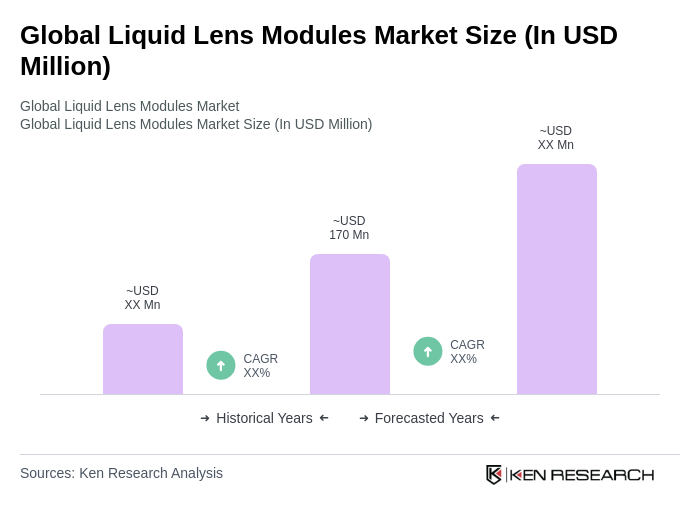
- The Global Liquid Lens Modules Market is valued at USD 170 million, based on a five-year historical analysis. This growth is primarily driven by advancements in optical technologies, increasing demand for high-quality imaging in consumer electronics, and the rising adoption of liquid lenses in medical and industrial machine vision applications. The market has witnessed investments aimed at enhancing product performance (faster autofocus, wider optical power range, miniaturization) and expanding application areas across smartphones, automation, and healthcare imaging.
- Key players in this market include countries like the United States, Germany, and Japan, which dominate due to their strong technological infrastructure, significant investments in research and development, and a robust manufacturing base. These regions are home to leading companies that drive innovation and cater to the growing demand for liquid lens modules across various sectors.
- In 2023, the European Union implemented regulations aimed at promoting the use of advanced optical technologies, including liquid lens modules, in consumer electronics and automotive applications. This regulation mandates that all new electronic devices must incorporate energy-efficient optical systems, thereby encouraging manufacturers to adopt liquid lens technologies that offer improved performance and lower energy consumption.
Global Liquid Lens Modules Market Segmentation
By Type:The market is segmented into various types of liquid lens modules, including Electrowetting Liquid Lenses, Liquid Crystal Lenses, Piezoelectric/Acoustic Tunable Lenses, and Others. Each type serves distinct applications and industries, contributing to the overall market dynamics.
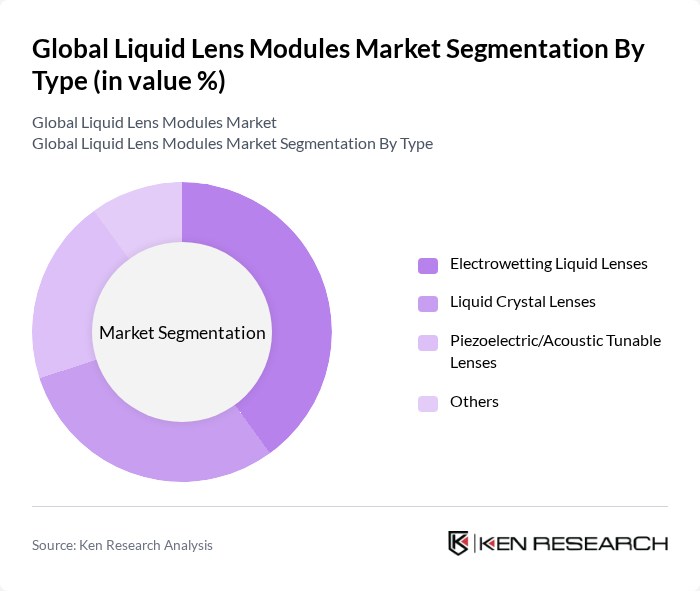
The Electrowetting Liquid Lenses segment is currently leading the market due to their superior performance in terms of response time and adaptability in various applications, particularly in consumer electronics and medical imaging. The growing trend towards miniaturization and the demand for high-resolution imaging systems have further propelled the adoption of this technology. Liquid Crystal Lenses are also gaining traction, especially in display or optical modulation-related applications, but they are not as widely adopted as Electrowetting solutions in autofocus modules.
By End-User:The market is segmented based on end-users, including Consumer Electronics (Smartphones, Tablets, Cameras), Automotive (ADAS, In-cabin Monitoring), Medical & Life Sciences (Endoscopy, Ophthalmology, Microscopy), and Industrial & Robotics (Machine Vision, Code Readers, Drones). Each end-user segment has unique requirements and applications for liquid lens modules.
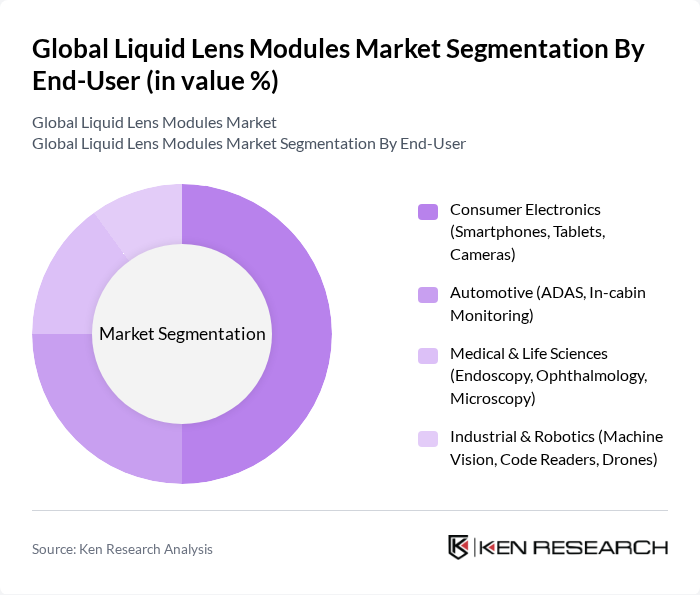
The Consumer Electronics segment dominates the market, driven by the increasing demand for high-quality cameras in smartphones and tablets, along with fast autofocus and compact optics. The trend towards enhanced imaging capabilities and the integration of advanced optical technologies in consumer devices have significantly boosted this segment. The Automotive sector is also witnessing growth, particularly with the rise of advanced driver-assistance systems (ADAS) and in-cabin monitoring that require high-performance optical solutions with rapid focusing and robustness.
Global Liquid Lens Modules Market Competitive Landscape
The Global Liquid Lens Modules Market is characterized by a dynamic mix of regional and international players. Leading participants such as Optotune AG, Corning Incorporated, Huawei Technologies Co., Ltd., Varioptic (BIVITEC, formerly Varioptic by Parrot), Edmund Optics Inc., Opticon Sensors Europe B.V., Canon Inc., Samsung Electronics Co., Ltd., Sony Group Corporation, FLIR Systems, Inc. (Teledyne FLIR), Schneider Kreuznach (Jos. Schneider Optische Werke GmbH), Thorlabs, Inc., Hamamatsu Photonics K.K., Jenoptik AG, Hikrobot (Hikvision Robotics) contribute to innovation, geographic expansion, and service delivery in this space.
Global Liquid Lens Modules Market Industry Analysis
Growth Drivers
- Increasing Demand for Compact Optical Devices:The global market for compact optical devices is projected to reach $45 billion, driven by the surge in mobile device usage. As consumers increasingly prefer smaller, multifunctional devices, the demand for liquid lens modules, which offer superior optical performance in a compact form, is expected to rise significantly. This trend is particularly evident in smartphones, where manufacturers are integrating advanced optical technologies to enhance camera capabilities, thus propelling market growth.
- Advancements in Liquid Lens Technology:Technological innovations in liquid lens systems, such as improved electro-wetting techniques, are enhancing performance and reliability. For instance, the introduction of lenses with faster response times, now averaging 10 milliseconds, is attracting interest from various sectors. These advancements are crucial for applications in high-speed imaging and augmented reality, which are projected to grow at a rate of 20% annually, further driving the adoption of liquid lens modules in diverse applications.
- Rising Adoption in Consumer Electronics:The consumer electronics sector is witnessing a significant shift towards integrating liquid lens modules, with an estimated 30% increase in adoption rates expected. This growth is fueled by the demand for enhanced imaging capabilities in devices such as smartphones, tablets, and wearables. As manufacturers seek to differentiate their products through superior optical performance, the liquid lens market is positioned to benefit from this trend, leading to increased sales and innovation in the sector.
Market Challenges
- High Manufacturing Costs:The production of liquid lens modules involves complex processes and materials, leading to high manufacturing costs, which can exceed $10 per unit. This financial barrier limits accessibility for smaller manufacturers and startups, hindering market penetration. As a result, many companies may opt for traditional lens technologies, which are more cost-effective, thereby posing a significant challenge to the growth of the liquid lens market in the short term.
- Limited Awareness Among End-Users:Despite the advantages of liquid lens technology, there remains a significant knowledge gap among end-users, particularly in emerging markets. A survey indicated that over 60% of potential consumers are unaware of the benefits of liquid lenses compared to traditional options. This lack of awareness can slow adoption rates, as consumers may hesitate to invest in new technologies without understanding their advantages, thus presenting a challenge for market growth.
Global Liquid Lens Modules Market Future Outlook
The future of the liquid lens modules market appears promising, driven by ongoing technological advancements and increasing integration into consumer electronics. As manufacturers continue to innovate, the focus will shift towards enhancing lens performance and reducing costs. Additionally, the growing trend of smart devices and augmented reality applications will likely create new avenues for liquid lens adoption. Companies that invest in research and development will be well-positioned to capitalize on these emerging opportunities, ensuring sustained growth in the coming years.
Market Opportunities
- Expansion in Emerging Markets:Emerging markets, particularly in Asia-Pacific, are expected to see a surge in demand for liquid lens modules, driven by increasing smartphone penetration, projected to reach 1.5 billion units. This growth presents a significant opportunity for manufacturers to establish a foothold in these regions, catering to the rising consumer demand for advanced optical technologies.
- Integration with Augmented Reality Devices:The integration of liquid lens modules in augmented reality (AR) devices is a burgeoning opportunity, with the AR market expected to exceed $198 billion. As AR applications become more mainstream, the demand for high-quality optical solutions will increase, positioning liquid lenses as a critical component in delivering enhanced user experiences in this rapidly evolving sector.
Scope of the Report
| Segment | Sub-Segments |
|---|---|
| By Type | Electrowetting Liquid Lenses Liquid Crystal Lenses Piezoelectric/Acoustic Tunable Lenses Others |
| By End-User | Consumer Electronics (Smartphones, Tablets, Cameras) Automotive (ADAS, In-cabin Monitoring) Medical & Life Sciences (Endoscopy, Ophthalmology, Microscopy) Industrial & Robotics (Machine Vision, Code Readers, Drones) |
| By Application | Camera & Imaging Modules Code Readers & Barcode Scanners Medical Imaging & Diagnostics AR/VR and Head-Mounted Displays |
| By Distribution Channel | Direct OEM/ODM Sales Online/Direct E-commerce Authorized Distributors & Value-Added Resellers Others |
| By Region | North America Europe Asia-Pacific Latin America |
| By Price Range | Entry-Level (Cost-optimized Modules) Mid-Range (Balanced Performance Modules) Premium (High-Performance/Medical-Grade Modules) |
| By Technology | Electrowetting Actuation Liquid Crystal Refraction Control Piezoelectric/Voice-Coil Assisted Hybrid Others |
Key Target Audience
Investors and Venture Capitalist Firms
Government and Regulatory Bodies (e.g., U.S. Food and Drug Administration, European Medicines Agency)
Manufacturers and Producers
Distributors and Retailers
Optical Equipment Suppliers
Technology Providers
Industry Associations (e.g., Optical Society of America, International Society for Optics and Photonics)
Financial Institutions
Players Mentioned in the Report:
Optotune AG
Corning Incorporated
Huawei Technologies Co., Ltd.
Varioptic (BIVITEC, formerly Varioptic by Parrot)
Edmund Optics Inc.
Opticon Sensors Europe B.V.
Canon Inc.
Samsung Electronics Co., Ltd.
Sony Group Corporation
FLIR Systems, Inc. (Teledyne FLIR)
Schneider Kreuznach (Jos. Schneider Optische Werke GmbH)
Thorlabs, Inc.
Hamamatsu Photonics K.K.
Jenoptik AG
Hikrobot (Hikvision Robotics)
Table of Contents
Market Assessment Phase
1. Executive Summary and Approach
2. Global Liquid Lens Modules Market Overview
2.1 Key Insights and Strategic Recommendations
2.2 Global Liquid Lens Modules Market Overview
2.3 Definition and Scope
2.4 Evolution of Market Ecosystem
2.5 Timeline of Key Regulatory Milestones
2.6 Value Chain & Stakeholder Mapping
2.7 Business Cycle Analysis
2.8 Policy & Incentive Landscape
3. Global Liquid Lens Modules Market Analysis
3.1 Growth Drivers
3.1.1 Increasing Demand for Compact Optical Devices
3.1.2 Advancements in Liquid Lens Technology
3.1.3 Rising Adoption in Consumer Electronics
3.1.4 Growth in Automotive Applications
3.2 Market Challenges
3.2.1 High Manufacturing Costs
3.2.2 Limited Awareness Among End-Users
3.2.3 Competition from Traditional Lens Technologies
3.2.4 Regulatory Hurdles in Different Regions
3.3 Market Opportunities
3.3.1 Expansion in Emerging Markets
3.3.2 Integration with Augmented Reality Devices
3.3.3 Development of Customizable Lens Solutions
3.3.4 Collaborations with Tech Startups
3.4 Market Trends
3.4.1 Miniaturization of Optical Components
3.4.2 Increased Focus on Sustainable Manufacturing
3.4.3 Growth of Smart Wearable Devices
3.4.4 Advancements in AI-Driven Optical Systems
3.5 Government Regulation
3.5.1 Standards for Optical Device Safety
3.5.2 Environmental Regulations on Manufacturing
3.5.3 Import Tariffs on Optical Components
3.5.4 Incentives for R&D in Optical Technologies
4. SWOT Analysis
5. Stakeholder Analysis
6. Porter's Five Forces Analysis
7. Global Liquid Lens Modules Market Market Size, 2019-2024
7.1 By Value
7.2 By Volume
7.3 By Average Selling Price
8. Global Liquid Lens Modules Market Segmentation
8.1 By Type
8.1.1 Electrowetting Liquid Lenses
8.1.2 Liquid Crystal Lenses
8.1.3 Piezoelectric/Acoustic Tunable Lenses
8.1.4 Others
8.2 By End-User
8.2.1 Consumer Electronics (Smartphones, Tablets, Cameras)
8.2.2 Automotive (ADAS, In-cabin Monitoring)
8.2.3 Medical & Life Sciences (Endoscopy, Ophthalmology, Microscopy)
8.2.4 Industrial & Robotics (Machine Vision, Code Readers, Drones)
8.3 By Application
8.3.1 Camera & Imaging Modules
8.3.2 Code Readers & Barcode Scanners
8.3.3 Medical Imaging & Diagnostics
8.3.4 AR/VR and Head-Mounted Displays
8.4 By Distribution Channel
8.4.1 Direct OEM/ODM Sales
8.4.2 Online/Direct E-commerce
8.4.3 Authorized Distributors & Value-Added Resellers
8.4.4 Others
8.5 By Region
8.5.1 North America
8.5.2 Europe
8.5.3 Asia-Pacific
8.5.4 Latin America
8.6 By Price Range
8.6.1 Entry-Level (Cost-optimized Modules)
8.6.2 Mid-Range (Balanced Performance Modules)
8.6.3 Premium (High-Performance/Medical-Grade Modules)
8.7 By Technology
8.7.1 Electrowetting Actuation
8.7.2 Liquid Crystal Refraction Control
8.7.3 Piezoelectric/Voice-Coil Assisted Hybrid
8.7.4 Others
9. Global Liquid Lens Modules Market Competitive Analysis
9.1 Market Share of Key Players
9.2 Cross Comparison of Key Players
9.2.1 Company Name
9.2.2 Core Technology Focus (Electrowetting, Liquid Crystal, Piezo/Hybrid)
9.2.3 Liquid Lens Module Revenue (latest FY)
9.2.4 YoY Revenue Growth in Liquid Lens Modules
9.2.5 Design Wins/OEM Programs (smartphone, automotive, industrial)
9.2.6 Average Selling Price (ASP) per Module
9.2.7 Patent Portfolio Strength (granted patents related to liquid lenses)
9.2.8 Product Performance KPIs (response time, focus range, power consumption)
9.2.9 Production Capacity/Scalability (units per year)
9.2.10 Supply Chain Depth (materials, in-house vs. outsourced assembly)
9.2.11 Geographic Footprint (manufacturing, R&D, sales)
9.2.12 Certification & Qualification (automotive, medical, industrial)
9.2.13 Strategic Partnerships (OEMs, sensor vendors, module integrators)
9.3 SWOT Analysis of Top Players
9.4 Pricing Analysis
9.5 Detailed Profile of Major Companies
9.5.1 Optotune AG
9.5.2 Corning Incorporated
9.5.3 Huawei Technologies Co., Ltd.
9.5.4 Varioptic (BIVITEC, formerly Varioptic by Parrot)
9.5.5 Edmund Optics Inc.
9.5.6 Opticon Sensors Europe B.V.
9.5.7 Canon Inc.
9.5.8 Samsung Electronics Co., Ltd.
9.5.9 Sony Group Corporation
9.5.10 FLIR Systems, Inc. (Teledyne FLIR)
9.5.11 Schneider Kreuznach (Jos. Schneider Optische Werke GmbH)
9.5.12 Thorlabs, Inc.
9.5.13 Hamamatsu Photonics K.K.
9.5.14 Jenoptik AG
9.5.15 Hikrobot (Hikvision Robotics)
10. Global Liquid Lens Modules Market End-User Analysis
10.1 Procurement Behavior of Key Ministries
10.1.1 Government Contracts for Optical Devices
10.1.2 Budget Allocations for Technology Upgrades
10.1.3 Evaluation Criteria for Suppliers
10.2 Corporate Spend on Infrastructure & Energy
10.2.1 Investment in Optical Technologies
10.2.2 Budget Trends in R&D
10.2.3 Spending on Upgrades and Maintenance
10.3 Pain Point Analysis by End-User Category
10.3.1 Quality and Performance Issues
10.3.2 Supply Chain Disruptions
10.3.3 Cost Management Challenges
10.4 User Readiness for Adoption
10.4.1 Awareness of Liquid Lens Benefits
10.4.2 Training and Support Needs
10.4.3 Integration with Existing Systems
10.5 Post-Deployment ROI and Use Case Expansion
10.5.1 Measurement of Performance Improvements
10.5.2 Case Studies of Successful Implementations
10.5.3 Future Expansion Opportunities
11. Global Liquid Lens Modules Market Future Size, 2025-2030
11.1 By Value
11.2 By Volume
11.3 By Average Selling Price
Go-To-Market Strategy Phase
1. Whitespace Analysis + Business Model Canvas
1.1 Market Gaps Identification
1.2 Value Proposition Development
1.3 Revenue Streams Analysis
1.4 Cost Structure Evaluation
1.5 Key Partnerships Exploration
1.6 Customer Segmentation
1.7 Channels and Customer Relationships
2. Marketing and Positioning Recommendations
2.1 Branding Strategies
2.2 Product USPs
2.3 Target Market Identification
2.4 Communication Strategies
2.5 Digital Marketing Approaches
3. Distribution Plan
3.1 Urban Retail Strategies
3.2 Rural NGO Tie-Ups
3.3 E-commerce Integration
3.4 Direct Sales Force Development
4. Channel & Pricing Gaps
4.1 Underserved Routes
4.2 Pricing Bands Analysis
4.3 Competitor Pricing Strategies
4.4 Customer Willingness to Pay
5. Unmet Demand & Latent Needs
5.1 Category Gaps Identification
5.2 Consumer Segments Analysis
5.3 Emerging Trends Exploration
5.4 Feedback Mechanisms
6. Customer Relationship
6.1 Loyalty Programs
6.2 After-sales Service
6.3 Customer Feedback Loops
6.4 Community Engagement
7. Value Proposition
7.1 Sustainability Initiatives
7.2 Integrated Supply Chains
7.3 Customer-Centric Innovations
7.4 Competitive Differentiation
8. Key Activities
8.1 Regulatory Compliance
8.2 Branding Initiatives
8.3 Distribution Setup
8.4 Training and Development
9. Entry Strategy Evaluation
9.1 Domestic Market Entry Strategy
9.1.1 Product Mix
9.1.2 Pricing Band
9.1.3 Packaging
9.2 Export Entry Strategy
9.2.1 Target Countries
9.2.2 Compliance Roadmap
10. Entry Mode Assessment
10.1 Joint Ventures
10.2 Greenfield Investments
10.3 Mergers & Acquisitions
10.4 Distributor Model
11. Capital and Timeline Estimation
11.1 Capital Requirements
11.2 Timelines
12. Control vs Risk Trade-Off
12.1 Ownership vs Partnerships
13. Profitability Outlook
13.1 Breakeven Analysis
13.2 Long-term Sustainability
14. Potential Partner List
14.1 Distributors
14.2 Joint Ventures
14.3 Acquisition Targets
15. Execution Roadmap
15.1 Phased Plan for Market Entry
15.1.1 Market Setup
15.1.2 Market Entry
15.1.3 Growth Acceleration
15.1.4 Scale & Stabilize
15.2 Key Activities and Milestones
15.2.1 Milestone Planning
15.2.2 Activity Tracking
Research Methodology
Phase 1: Approach1
Desk Research
- Industry reports from leading market research firms focusing on liquid lens technology
- Technical papers and patents related to liquid lens innovations and applications
- Market analysis from trade associations and industry publications on optical components
Primary Research
- Interviews with product managers at optical device manufacturers
- Surveys with end-users in sectors such as consumer electronics and automotive
- Field interviews with R&D teams specializing in optical technologies
Validation & Triangulation
- Cross-validation of findings through multiple expert interviews
- Triangulation of data from market reports, sales figures, and expert opinions
- Sanity checks through feedback from industry panels and focus groups
Phase 2: Market Size Estimation1
Top-down Assessment
- Analysis of global optical component market size to estimate liquid lens share
- Segmentation by application areas such as smartphones, cameras, and automotive
- Incorporation of growth trends in augmented reality and virtual reality sectors
Bottom-up Modeling
- Volume estimates based on production data from leading liquid lens manufacturers
- Cost analysis derived from component pricing and manufacturing expenses
- Estimation of market size based on projected sales volumes and average selling prices
Forecasting & Scenario Analysis
- Multi-variable forecasting using trends in consumer electronics and automotive markets
- Scenario analysis based on technological advancements and regulatory impacts
- Development of baseline, optimistic, and pessimistic market growth projections through 2030
Phase 3: CATI Sample Composition1
| Scope Item/Segment | Sample Size | Target Respondent Profiles |
|---|---|---|
| Consumer Electronics Manufacturers | 120 | Product Development Managers, Procurement Specialists |
| Automotive Lens Suppliers | 90 | Engineering Managers, Supply Chain Directors |
| Optical Component Distributors | 60 | Sales Managers, Market Analysts |
| Research Institutions in Optical Technologies | 40 | Research Scientists, Lab Managers |
| Augmented and Virtual Reality Developers | 50 | Product Managers, Technical Leads |
Frequently Asked Questions
What is the current value of the Global Liquid Lens Modules Market?
The Global Liquid Lens Modules Market is valued at approximately USD 170 million, driven by advancements in optical technologies and increasing demand for high-quality imaging in consumer electronics and medical applications.
What are the main types of liquid lens modules?
Which regions dominate the Global Liquid Lens Modules Market?
What are the key growth drivers for the liquid lens modules market?
Other Regional/Country Reports
Indonesia Liquid Lens Modules Market
Malaysia Liquid Lens Modules Market
APAC Liquid Lens Modules Market
SEA Liquid Lens Modules Market
Why Buy From Us?

What makes us stand out is that our consultants follow Robust, Refine and Result (RRR) methodology. Robust for clear definitions, approaches and sanity checking, Refine for differentiating respondents' facts and opinions, and Result for presenting data with story.

We have set a benchmark in the industry by offering our clients with syndicated and customized market research reports featuring coverage of entire market as well as meticulous research and analyst insights.

While we don't replace traditional research, we flip the method upside down. Our dual approach of Top Bottom & Bottom Top ensures quality deliverable by not just verifying company fundamentals but also looking at the sector and macroeconomic factors.

With one step in the future, our research team constantly tries to show you the bigger picture. We help with some of the tough questions you may encounter along the way: How is the industry positioned? Best marketing channel? KPI's of competitors? By aligning every element, we help maximize success.

Our report gives you instant access to the answers and sources that other companies might choose to hide. We elaborate each steps of research methodology we have used and showcase you the sample size to earn your trust.

If you need any support, we are here! We pride ourselves on universe strength, data quality, and quick, friendly, and professional service.