CHAPTER 1 - MARKET SUMMARY
Market Overview
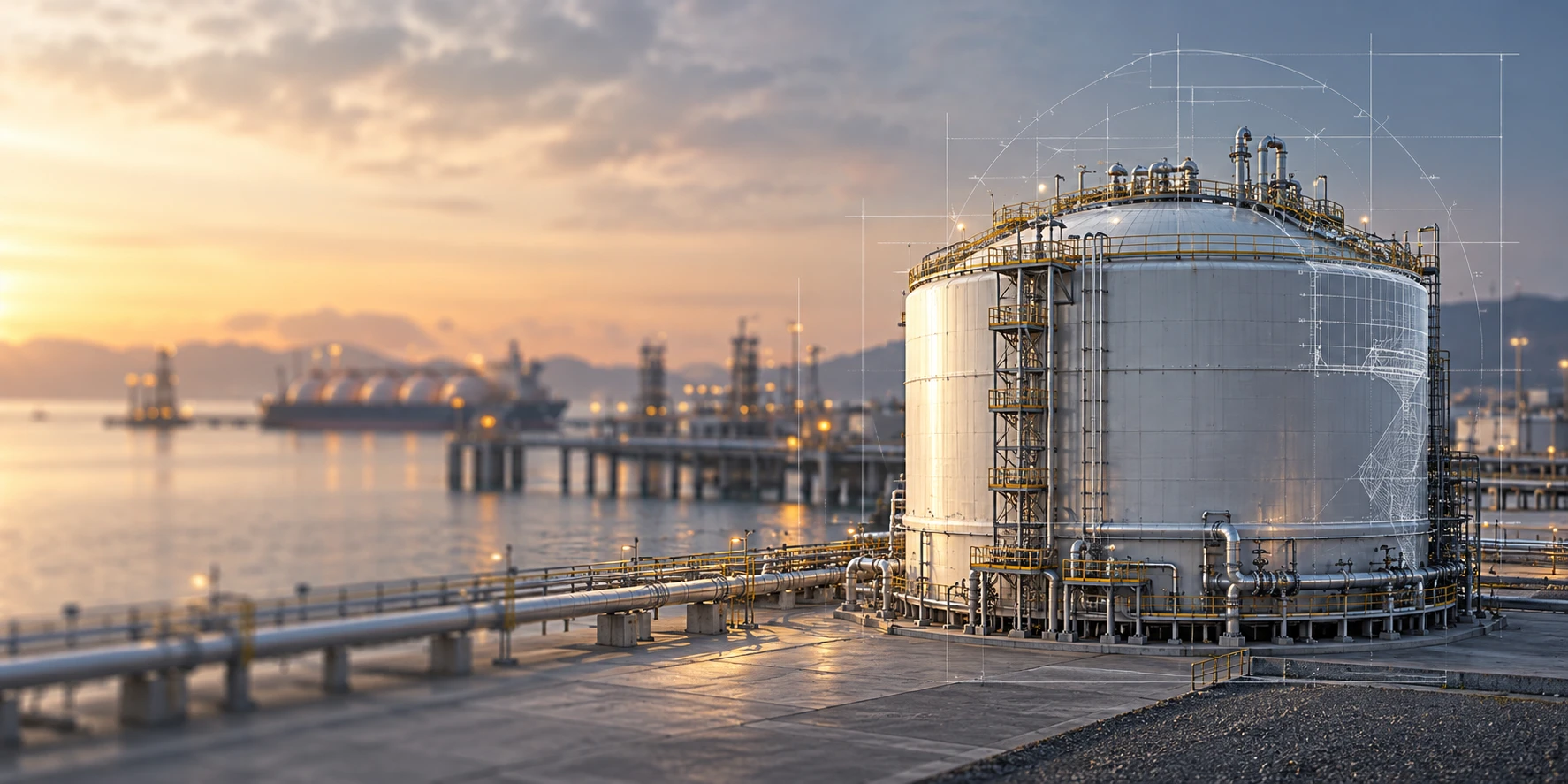
The Global LNG Infrastructure Market connects gas-producing regions with geographically dispersed utility, industrial and power-sector demand through liquefaction, storage, marine loading, receiving and regasification assets. Global LNG imports reached 428 MT in 2025, increasing 5% year on year. This throughput creates recurring requirements for terminal expansions, storage availability, maintenance services and pipeline send-out capacity, making infrastructure utilization a central determinant of asset economics.
Infrastructure investment is increasingly concentrated in North America, Qatar and selected Asian import hubs. North American export capacity is projected to increase from 11.4 Bcf/d in early 2024 to 28.7 Bcf/d by 2029, while Qatar plans to raise production capacity from 77 MTPA to 142 MTPA by 2030. These clusters offer shared pipelines, ports, contractors and skilled labor, lowering marginal expansion costs for brownfield developers.
Market Value
USD 72 billion
2025
Dominant Region
North America
2025
Dominant Segment
Liquefaction Facilities
fastest growing, 2026-2031
Total Number of Players
180
Future Outlook
The Global LNG Infrastructure Market is projected to increase from USD 72 billion in 2025 to USD 122 billion by 2031, representing a forecast CAGR of 9.17%. The acceleration from the historical CAGR of 5.15% reflects a larger construction pipeline in North America, Qatar and Africa, alongside import-terminal additions across Europe and Asia. Liquefaction capacity additions will require parallel investment in storage tanks, jetties, feedgas pipelines, power generation and marine loading systems. Brownfield expansions should retain a cost and schedule advantage because existing sites can reuse utilities, port infrastructure, permitting records and experienced operating teams.
Growth will remain uneven across project types. Greenfield export terminals will generate the largest individual EPC awards, while floating storage and regasification units will provide faster market access for countries unable to justify permanent onshore terminals. Market value is expected to grow faster than LNG throughput because construction intensity, low-emission equipment, automation and financing costs are raising revenue per MTPA of commissioned capacity. By 2031, developers with secured feedgas, long-term offtake, modular execution capabilities and credible methane-reduction plans should obtain better financing terms and utilization outcomes than speculative projects dependent on uncontracted spot demand.
9.17%
Forecast CAGR
$122,000 Mn
2030 Projection
Base Year
2025
Historical Period
2020-2025
Forecast Period
2026-2031
Historical CAGR
5.15%
CHAPTER 2 - SCOPE OF REPORT
Scope of the Market
CHAPTER 3 - Key Stakeholders
Key Target Audience
Key stakeholders who can leverage from this market analysis for investment, strategy and operational planning.
Investors
CAGR, project returns, capex intensity, utilization, risk
Corporates
capacity access, tolling fees, feedgas, contracting, emissions
Government
energy security, permitting, resilience, methane compliance, trade
Operators
throughput, reliability, boil-off control, maintenance, turnaround performance
Financial institutions
project finance, covenants, offtake quality, completion risk
CHAPTER 4 - Market Size & Growth
Market Size, Growth Forecast and Trends
This section evaluates the historical market size, analyzes year-over-year growth dynamics, and presents forecast projections supported by market performance indicators and demand-side drivers.
Historical & Projected Market Size ($ Million)
Year-over-Year Growth Rate (%)
Market Value vs Volume Growth (%)
Historical Market Performance (2020-2025)
Historical growth reached its low point in 2021 as pandemic-related construction disruption delayed equipment deliveries, contractor mobilization and terminal commissioning. The market recovered through 2022-2025 as European energy-security investment accelerated, US export projects advanced and Asian buyers added receiving capacity. The strongest annual growth occurred in 2024 at 6.25%, reflecting the combined effect of higher engineering activity, storage expansion and early works for projects reaching final investment decisions. LNG trade volume increased from 356 MT in 2020 to 428 MT in 2025, supporting higher terminal utilization and brownfield service demand.
Forecast Market Outlook (2026-2031)
Forecast growth accelerates as committed liquefaction projects enter their construction-intensive phases. Market value is projected to expand at 9.17% annually through 2031, faster than projected LNG trade-volume growth of approximately 4-6% per year. This divergence reflects higher infrastructure intensity per tonne of capacity, including low-emission compression, electrified drives, carbon capture interfaces, digital monitoring and larger storage configurations. The terminal value reaches USD 122 billion in 2031, with the strongest spending concentrated in US Gulf Coast expansions, Qatari mega-trains, floating projects and emerging-market regasification terminals.
CHAPTER 5 - Market Data
Market Breakdown
Infrastructure revenue is shifting toward export-capacity construction, storage expansion and flexible receiving assets. For CEOs and investors, the primary strategic variables are capacity commissioning, project utilization, trade throughput and the ability to deliver complex projects within contracted budgets and schedules.
Year | Market Size (USD Mn) | YoY Growth (%) | Liquefaction Capacity (MTPA) | Regasification Capacity (MTPA) | LNG Trade Volume (MT) | Period |
|---|---|---|---|---|---|---|
| 2020 | $56,000 Mn | +- | 452 | 947 | Forecast | |
| 2021 | $58,000 Mn | +3.57% | 459 | 993 | Forecast | |
| 2022 | $61,000 Mn | +5.17% | 478 | 1,068 | Forecast | |
| 2023 | $64,000 Mn | +4.92% | 488 | 1,143 | Forecast | |
| 2024 | $68,000 Mn | +6.25% | 494 | 1,188 | Forecast | |
| 2025 | $72,000 Mn | +5.88% | 524 | 1,247 | Forecast | |
| 2026 | $79,000 Mn | +9.72% | 560 | 1,290 | Forecast | |
| 2027 | $86,000 Mn | +8.86% | 600 | 1,330 | Forecast | |
| 2028 | $94,000 Mn | +9.30% | 640 | 1,370 | Forecast | |
| 2029 | $102,000 Mn | +8.51% | 680 | 1,400 | Forecast | |
| 2030 | $112,000 Mn | +9.80% | 710 | 1,430 | Forecast | |
| 2031 | $122,000 Mn | +8.93% | 730 | 1,460 | Forecast |
Liquefaction Capacity
524 MTPA, 2025, global. Capacity deployment determines equipment demand, contractor backlogs and future LNG availability. Approximately 345 bcm per year of committed export capacity is scheduled to enter service between 2025 and 2030, representing the largest addition wave in LNG-market history.
Regasification Capacity
1,247 MTPA, 2025, global. High receiving capacity provides trade flexibility but can dilute utilization in mature markets. European Union import capacity reached 242 bcm per year in 2025, with a further 100 bcm expected to become operational between 2025 and 2030.
LNG Trade Volume
428 MT, 2025, global. Throughput supports terminal fees, maintenance demand and downstream pipeline utilization. Spot and short-term transactions represented 35% of global imports, increasing the value of flexible berths, reload services, multi-user storage and destination-flexible terminal access.
CHAPTER 6 - Segmentation
Market Segmentation Framework
Comprehensive analysis across key dimensions providing insights into market structure, customer requirements, project economics and infrastructure-delivery patterns.
No of Segments
7
Dominant Segment
Asset Type
Fastest Growing Segment
Technology
Project Type
Asset Type
End-Use Sector
Ownership Model
Contracting Model
Technology
Geography
Key Segmentation Takeaways
Comprehensive analysis across all extracted segmentation dimensions provides insights into asset allocation, contract structures, customer requirements and competitive positioning.
Asset Type
Asset type is the dominant segmentation dimension because liquefaction trains, regasification systems, tanks and marine interfaces have distinct capital intensity, supplier ecosystems and utilization economics. Liquefaction facilities represent the largest expenditure pool, driven by compression, pretreatment, cryogenic heat exchangers, storage and site utilities. Investors therefore benchmark projects using revenue per MTPA, construction cost per tonne and contracted utilization.
Technology
Technology is the fastest-growing segmentation dimension because floating, modular and electrified solutions reduce construction lead times and adapt infrastructure to uncertain demand. FSRU-based regasification is expanding where governments require rapid import access, while modular liquefaction reduces single-train execution exposure. Electrified drives, methane monitoring and carbon-capture interfaces are also becoming procurement differentiators for projects targeting regulated buyers and sustainability-linked financing.
CHAPTER 7 - Regional Analysis
Regional Analysis
North America ranked as the largest regional infrastructure revenue pool in 2025, reflecting simultaneous construction of liquefaction trains, feedgas pipelines, storage tanks and marine facilities. Asia Pacific remained the largest LNG-import demand center, while the Middle East retained the greatest concentration of installed liquefaction capacity.
Regional Ranking, North America
1st
North America Share vs Global
36.1%
Global CAGR (2026-2031)
9.17%
Regional Ranking, North America
1st
North America Share vs Global
36.1%
Global CAGR (2026-2031)
9.17%
Regional Analysis (Current Year)
Market Position
North America ranked first with USD 26 billion in 2025 infrastructure revenue, supported by US Gulf Coast export projects and planned regional capacity growth to 28.7 Bcf/d by 2029.
Growth Advantage
North America's 11.2% projected CAGR exceeds Asia Pacific's 8.8% and Europe's 7.5%, reflecting a larger committed construction pipeline and multiple expansions already supported by long-term offtake contracts.
Competitive Strengths
Established Gulf Coast pipelines, brownfield terminal sites and deep contractor capacity support rapid scaling; proposed US pipeline additions reached 18.2 Bcf/d during 2025, including 6.2 Bcf/d serving LNG facilities.
CHAPTER 8 - INDUSTRY ANALYSIS
Growth Drivers, Challenges & Opportunities
Comprehensive analysis of key factors shaping the Global LNG Infrastructure Market, including growth catalysts, operational challenges and emerging opportunities across liquefaction, storage, terminal services and downstream connectivity.
Growth Drivers
Record Liquefaction Capacity Build-Out
- New liquefaction trains require coordinated investment in pretreatment, compression, storage, power generation and marine loading, enabling EPC contractors and equipment suppliers to capture multi-year backlogs from a single project sanction. More than 300 bcm per year of capacity is concentrated in projects already under construction (2025, global).
- North America is expected to provide more than half of near-term global export-capacity additions, increasing demand for Gulf Coast pipeline connections, construction labor and modular fabrication. Regional capacity is projected at 28.7 Bcf/d by 2029.
- Qatar's staged expansion creates demand for mega-trains, storage, carbon management and new shipping interfaces. Production capacity is scheduled to rise from 77 MTPA to 142 MTPA by 2030, supporting contractors with proven large-train delivery capabilities.
Energy Security and Import Diversification
- European capacity additions broaden supplier access and reduce dependency on individual pipeline corridors. EU LNG capacity increased by 76 bcm per year between 2021 and 2025, benefiting FSRU operators, terminal owners and interconnector developers.
- Receiving terminals are increasingly integrated with storage and cross-border gas networks, improving seasonal balancing and regional resilience. Twelve new European terminals and six expansions added about 82 bcm per year between 2021 and 2025.
- Emerging importers can deploy floating terminals before committing to permanent onshore assets, reducing initial capital exposure. Nine new terminals and nine expansions entered service during 2025 globally, demonstrating continued demand for modular receiving infrastructure.
Flexible LNG Trade and Terminal Utilization
- Flexible cargo trading increases the value of terminals able to receive multiple vessel classes, provide reloads and offer interruptible capacity. Spot and short-term purchases represented 35% of global imports in 2025, widening the merchant-service revenue pool.
- Higher fleet availability supports more frequent cargo movements and terminal calls. The global LNG carrier fleet reached 899 vessels in 2025, an 8% annual increase, benefiting port, berth, loading-arm and vessel-interface service providers.
- US exports increased faster than any other major source during 2025, raising utilization across liquefaction and marine systems. US LNG exports increased 26% to 15.1 Bcf/d in 2025, strengthening the case for debottlenecking and storage expansion.
Market Challenges
Capital Intensity and Schedule Overruns
- Fixed-price EPC contracts transfer execution risk to contractors but can increase bid contingencies and supplier conservatism. Port Arthur Phase 2 includes an estimated USD 9.2 billion EPC contract for approximately 13 MTPA, requiring disciplined interface and change-order control.
- Projects compete for specialized welders, cryogenic equipment, compressors and construction management teams. More than 345 bcm per year of export capacity is scheduled during 2025-2030, creating simultaneous demand across multiple project clusters.
- Commissioning delays postpone tolling revenue and can trigger liquidated damages or replacement-cargo exposure. Seven mid-scale Corpus Christi Stage 3 trains provide more than 10 MTPA of capacity, illustrating the sequencing complexity of multi-train developments.
Demand Volatility and Capacity Imbalance
- Price-sensitive emerging markets can reduce cargo purchases when delivered LNG prices exceed competing fuels, weakening terminal utilization and downstream gas demand. Infrastructure developers therefore require diversified buyers and capacity contracts rather than relying solely on spot throughput.
- Regasification capacity already substantially exceeds annual trade volume in aggregate. Global regasification capacity reached 1,247 MTPA against 428 MT of imports in 2025, creating low utilization for terminals without storage, pipeline access or strategic-security value.
- Regional trade shifts can strand capacity at facilities optimized for a narrow destination or supply source. US LNG exports to Asia fell to 2.5 Bcf/d in 2025 from 4.0 Bcf/d in 2024, demonstrating the need for flexible contracting and shipping economics.
Methane and Carbon Compliance Costs
- Buyers increasingly evaluate lifecycle emissions, requiring operators to measure upstream methane, liquefaction energy use and shipping intensity. Methane-leak reductions could avoid close to 90 Mt CO2-equivalent annually, making measurement quality commercially relevant.
- Electrified compression, carbon capture and boil-off-gas recovery increase upfront project cost but protect market access. QatarEnergy reported 7.5 million tonnes of CO2 captured and stored from 2019 through 2024, indicating the scale expected from lower-emission projects.
- Operators without verified emissions data may face contract discounts or additional compliance costs. Cheniere established a methane-intensity target of 0.03% per tonne of LNG produced, illustrating the shift toward asset-level performance disclosure.
Market Opportunities
Floating and Modular LNG Infrastructure
- FSRUs allow importing countries to convert charter payments and terminal fees into earlier energy-security benefits than permanent terminals, creating opportunities for vessel owners, port developers and gas utilities.
- Floating liquefaction can commercialize offshore or remote gas resources without full onshore infrastructure. Developers with standardized hull, topside and mooring designs can replicate projects and improve engineering margins.
- Opportunity realization requires bankable gas supply, protected marine locations and long-term capacity commitments. Modular execution must also demonstrate reliable integration, commissioning and maintenance performance under local environmental conditions.
Brownfield Debottlenecking and Digital Optimization
- Brownfield expansions monetize existing land, pipelines, tanks, utilities and permits, producing higher incremental returns than comparable greenfield projects when site constraints are manageable.
- Equipment suppliers, automation vendors and maintenance contractors benefit from compressor upgrades, advanced process control, predictive maintenance and heat-exchanger optimization that increase throughput without constructing complete new terminals.
- Asset owners must maintain shutdown discipline, validate feedgas availability and avoid disrupting contracted production. Digital upgrades create value only when operating data, cybersecurity and process-control governance are integrated.
Low-Emission LNG and Carbon Management
- Operators can monetize lower emissions through preferred offtake agreements, sustainability-linked financing and improved access to regulated markets that scrutinize methane and carbon intensity.
- Engineering companies benefit from electrified-drive systems, carbon capture, vapor recovery, leak detection and digital emissions verification, expanding the addressable equipment and service pool per MTPA.
- Commercial scaling requires standardized lifecycle-emissions methodologies and credible third-party verification. Developers must align upstream, liquefaction, shipping and receiving data to demonstrate reductions across the full cargo pathway.
CHAPTER 9 - Competitive Landscape
Competitive Landscape Overview
The Global LNG Infrastructure Market is moderately concentrated among large asset developers, integrated energy companies and specialized engineering firms. Entry barriers include multibillion-dollar capital requirements, long permitting cycles, feedgas access, complex EPC execution and long-term capacity contracting.
Market Share Distribution
Top 5 Players
Market Dynamics
8 new entrants in the past 5 years, indicating strong market attractiveness and growth potential.
Company Name | Market Share | Headquarters | Founding Year | Core Market Focus |
|---|---|---|---|---|
QatarEnergy | - | Doha, Qatar | 1974 | Integrated LNG production, liquefaction expansion, storage and shipping infrastructure |
Shell plc | - | London, United Kingdom | 1907 | Integrated LNG supply, liquefaction, regasification, shipping and portfolio optimization |
Cheniere Energy, Inc. | - | Houston, United States | 1983 | US LNG liquefaction, export terminals, mid-scale trains and tolling services |
Venture Global, Inc. | - | Arlington, United States | 2013 | Modular US liquefaction terminals and long-term LNG export capacity |
Sempra Infrastructure | - | San Diego, United States | 1998 | North American liquefaction terminals, pipelines, storage and marine export assets |
TotalEnergies SE | - | Courbevoie, France | 1924 | Integrated LNG projects, terminal capacity, shipping and portfolio supply |
Exxon Mobil Corporation | - | Spring, United States | 1999 | Large-scale liquefaction projects, upstream integration and LNG marketing |
Korea Gas Corporation | - | Daegu, South Korea | 1983 | Large-scale LNG import terminals, storage, regasification and gas-network integration |
Golar LNG Limited | - | Hamilton, Bermuda | 1946 | Floating liquefaction infrastructure and long-term FLNG service contracts |
Technip Energies N.V. | - | Nanterre, France | 2021 | LNG engineering, modularization, EPC delivery and liquefaction technology integration |
Cross Comparison Parameters
The report provides detailed cross-comparison of key players across 10 performance parameters to identify competitive strengths and weaknesses.
Installed Liquefaction and Regasification Capacity
Project Delivery Schedule Adherence
LNG Infrastructure Revenue Growth
EBITDA Margin
Analysis Covered
Market Share Analysis:
Compares sector revenue, capacity control and contracted terminal utilization.
Cross Comparison Matrix:
Benchmarks capacity, execution, growth and profitability across leading players.
SWOT Analysis:
Assesses asset quality, pipeline exposure, contracting and execution vulnerabilities.
Pricing Strategy Analysis:
Evaluates tolling fees, capacity charges and contract indexation structures.
Company Profiles:
Reviews geographic footprint, asset pipeline, capabilities and strategic priorities.
CHAPTER 10 - REPORT TOC
Table of Contents
Market Assessment Phase
Supply-side and competitive intelligence covering market sizing, segmentation, competitive dynamics, regulatory landscape and future forecasts.
Go-To-Market Strategy Phase
15 chapters
Entry strategy evaluation, execution roadmap, partner recommendations and profitability outlook.
Survey Phase
8 chapters
Demand-side primary research conducted through structured interviews and online surveys with end users across priority metros and Tier 2/3 cities to capture consumption behavior, unmet needs and purchase drivers.
Complete Report Coverage
201+ detailed sections covering every aspect of the market
143
Assessment Sections
58
Strategy Sections
CHAPTER 11 - Our Approach
Research Methodology
Desk Research
- Mapped global liquefaction capacity additions
- Reviewed regasification terminal operating data
- Analyzed LNG trade-flow statistics
- Assessed project sanction and permitting
Primary Research
- Interviewed LNG terminal commercial directors
- Consulted liquefaction project development managers
- Engaged cryogenic equipment procurement heads
- Surveyed regasification operations executives
Validation and Triangulation
- Validated assumptions through 328 respondents
- Reconciled capacity and revenue benchmarks
- Cross-checked throughput and utilization trends
- Tested project-cost sensitivity scenarios
CHAPTER 12 - FAQ
FAQs
Still have questions?
Our research team is here to help you find the right solution
CHAPTER 13 - Related Research
Explore Related Reports
Expand your market intelligence with complementary research across regions and adjacent markets.
Regional/Country ReportsRelated market analysis across key regions
Related market analysis across key regions
- UAE Lng Infrastructure Market
- KSA Lng Infrastructure Market
- Indonesia LNG Infrastructure Market
- Vietnam LNG Infrastructure Market
- Thailand LNG Infrastructure Market
Adjacent ReportsRelated markets and complementary research
Related markets and complementary research
- Qatar LNG Shipping Market
- Vietnam Energy Storage Solutions Market
- Japan Natural Gas Distribution Market
- South Korea Marine Loading Systems Market
- Malaysia Pipeline Infrastructure Market
500+
Market Research Reports
50+
Countries Covered
15+
Industry Verticals