About the Report
Base Year 2024Global Low Voc Paint Market Overview
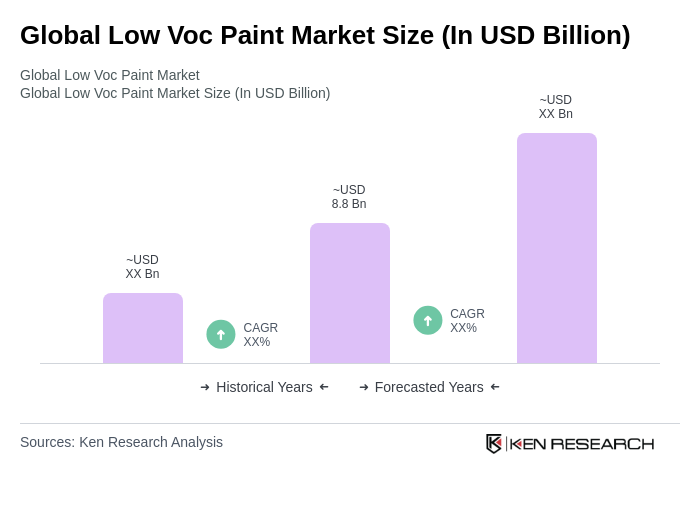
- The Global Low VOC Paint Market is valued at USD 8.8 billion, based on a five-year historical analysis. This growth is primarily driven by increasing consumer awareness regarding environmental sustainability, stringent regulations on VOC emissions, and a rising demand for eco-friendly products in both residential and commercial sectors.
- Key players in this market include the United States, Germany, and China. The U.S. leads due to stringent environmental regulations (e.g., EPA and state-level VOC limits in architectural coatings) and a strong focus on sustainable building practices; Germany follows given its leadership in green building standards and eco-label adoption; China is rapidly expanding due to urbanization, industrial growth, and tightening national VOC policies for coatings.
- In 2023, the European Union continued enforcing REACH alongside sector-specific VOC restrictions under the Paints Directive (2004/42/EC) and CLP, which set strict VOC content limits for decorative paints and varnishes placed on the EU market; these regulatory frameworks aim to protect health and the environment and promote low/zero-VOC paints.
Global Low Voc Paint Market Segmentation
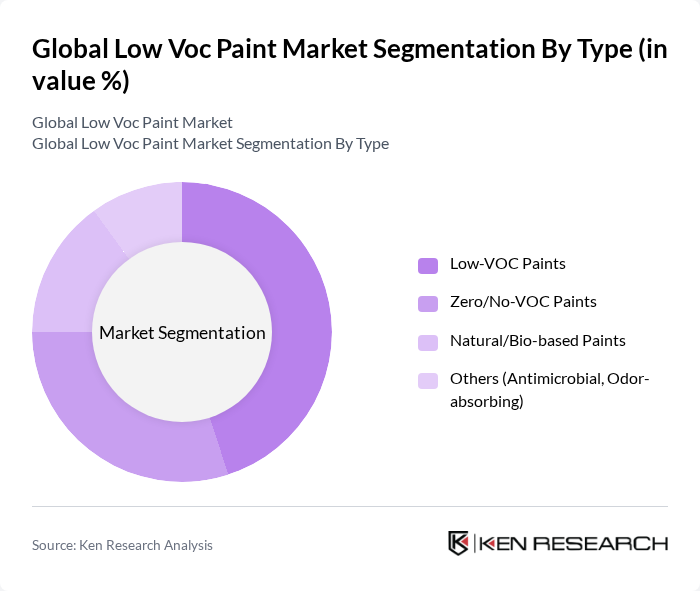
By Type:The market is segmented into Low-VOC Paints, Zero/No-VOC Paints, Natural/Bio-based Paints, and Others (Antimicrobial, Odor-absorbing). Among these, Low-VOC Paints dominate the market due to their balance of performance and reduced environmental impact, appealing to both consumers and professionals. Zero/No-VOC Paints are gaining traction, especially in residential applications, as consumers increasingly prioritize health and sustainability. Natural/Bio-based Paints are also emerging, driven by a niche market focused on organic and sustainable materials.
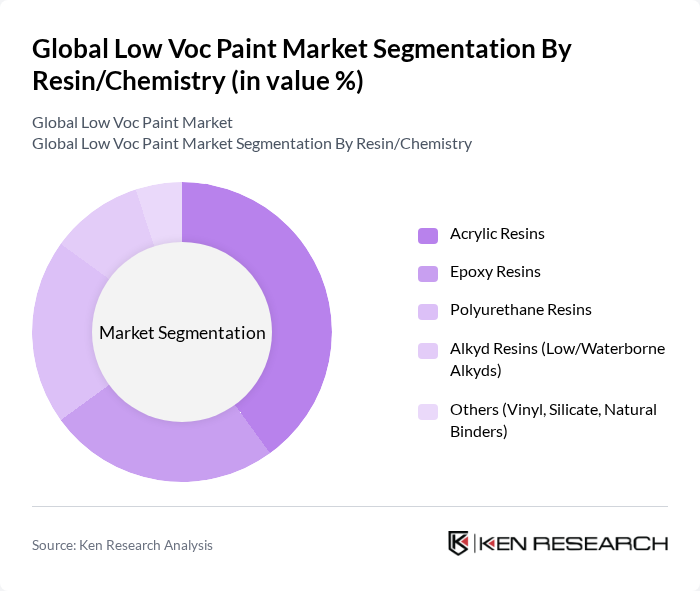
By Resin/Chemistry:The segmentation includes Acrylic Resins, Epoxy Resins, Polyurethane Resins, Alkyd Resins (Low/Waterborne Alkyds), and Others (Vinyl, Silicate, Natural Binders). Acrylic Resins are the leading segment due to versatility and adhesion across architectural applications. Epoxy Resins are significant in industrial uses for durability and chemical resistance. Polyurethane Resins are valued for flexibility and finish quality, while Low/Waterborne Alkyds remain relevant in decorative paints as lower-VOC alternatives to solvent-borne alkyds.
Global Low Voc Paint Market Competitive Landscape
The Global Low Voc Paint Market is characterized by a dynamic mix of regional and international players. Leading participants such as The Sherwin-Williams Company, PPG Industries, Inc., AkzoNobel N.V., Benjamin Moore & Co., Behr Process Corporation (Masco Corporation), Valspar (A Sherwin-Williams Brand), RPM International Inc., Asian Paints Limited, Nippon Paint Holdings Co., Ltd., BASF SE, DuluxGroup Limited (Nippon Paint Group), Hempel A/S, Jotun A/S, Kansai Paint Co., Ltd., Tikkurila Oyj (an AkzoNobel company), Axalta Coating Systems Ltd., Berger Paints India Limited, Jotun Powder Coatings (Jotun Group), Teknos Group Oy, DAW SE (Caparol, Alpina) contribute to innovation, geographic expansion, and service delivery in this space.
Global Low Voc Paint Market Industry Analysis
Growth Drivers
- Increasing Environmental Regulations:The global push for stricter environmental regulations is a significant driver for the low VOC paint market. In the future, over 50 countries are expected to implement new VOC emission standards, impacting approximately 1.6 billion liters of paint produced annually. This regulatory environment encourages manufacturers to innovate and develop low VOC alternatives, aligning with global sustainability goals and reducing harmful emissions, thus fostering market growth.
- Rising Consumer Awareness of Health Impacts:Consumer awareness regarding the health impacts of traditional paints is increasing, with studies indicating that VOCs can contribute to respiratory issues and other health problems. In the future, it is estimated that 75% of consumers prioritize low VOC products when making purchasing decisions. This shift in consumer behavior is driving demand for safer, eco-friendly paint options, significantly influencing market dynamics and encouraging manufacturers to adapt their product lines accordingly.
- Demand for Sustainable Building Materials:The construction industry is increasingly focused on sustainability, with a projected 35% growth in demand for eco-friendly building materials in the future. Low VOC paints are integral to this trend, as they contribute to healthier indoor environments and lower environmental impact. This demand is further supported by initiatives such as LEED certification, which incentivizes the use of sustainable materials, thereby driving the adoption of low VOC paints in both residential and commercial projects.
Market Challenges
- High Production Costs:The production of low VOC paints often involves higher costs due to the use of specialized raw materials and advanced formulations. In the future, the average production cost for low VOC paints is projected to be 25% higher than traditional paints. This cost disparity can deter manufacturers from fully transitioning to low VOC options, limiting market growth and making it challenging for smaller companies to compete effectively in the market.
- Limited Availability of Raw Materials:The availability of raw materials necessary for low VOC paint production is a significant challenge. In the future, it is estimated that the supply of key ingredients, such as bio-based solvents, will be constrained, affecting approximately 45% of manufacturers. This limitation can lead to production delays and increased costs, ultimately impacting the overall market supply and hindering the growth of low VOC paint adoption in various sectors.
Global Low Voc Paint Market Future Outlook
The future of the low VOC paint market appears promising, driven by ongoing innovations and a heightened focus on sustainability. As environmental regulations tighten and consumer preferences shift towards healthier options, manufacturers are likely to invest in research and development. Additionally, the integration of smart technologies in paint formulations is expected to enhance product performance. These trends will create a dynamic landscape, fostering growth and encouraging the adoption of low VOC solutions across various applications.
Market Opportunities
- Expansion in Emerging Markets:Emerging markets present significant opportunities for low VOC paint manufacturers. With urbanization rates projected to reach 65% in the future in regions like Asia-Pacific, the demand for sustainable building materials, including low VOC paints, is expected to surge, providing a lucrative avenue for growth and market penetration.
- Innovations in Product Offerings:Continuous innovations in product formulations, such as the development of water-based and bio-based paints, are creating new market opportunities. In the future, it is anticipated that innovative product lines will capture an additional 20% of the market share, appealing to environmentally conscious consumers and enhancing competitive positioning for manufacturers.
Scope of the Report
| Segment | Sub-Segments |
|---|---|
| By Type | Low-VOC Paints Zero/No-VOC Paints Natural/Bio-based Paints Others (Antimicrobial, Odor-absorbing) |
| By Resin/Chemistry | Acrylic Resins Epoxy Resins Polyurethane Resins Alkyd Resins (Low/Waterborne Alkyds) Others (Vinyl, Silicate, Natural Binders) |
| By Formulation | Water-borne High-Solids/Solvent-borne (Low-VOC) Powder Coatings |
| By Application | Architectural & Decorative General Industrial Automotive OEM Automotive Refinish Marine Consumer Durables Other Applications (Pharma, Electronics, etc.) |
| By End-User | Residential Commercial Industrial Government & Institutional |
| By Surface/Use Area | Interior Surfaces Exterior Surfaces Wood Surfaces Metal Surfaces |
| By Sheen Level | Matte/Flat Eggshell Satin Semi-Gloss Gloss |
| By Distribution Channel | Direct/Project Sales Retail/DIY Stores Online/E-commerce |
| By Price Tier | Budget Mid-Range Premium |
Key Target Audience
Investors and Venture Capitalist Firms
Government and Regulatory Bodies (e.g., Environmental Protection Agency, European Chemicals Agency)
Manufacturers and Producers
Distributors and Retailers
Architectural and Interior Design Firms
Construction Companies
Paint and Coatings Industry Associations
Environmental NGOs and Advocacy Groups
Players Mentioned in the Report:
The Sherwin-Williams Company
PPG Industries, Inc.
AkzoNobel N.V.
Benjamin Moore & Co.
Behr Process Corporation (Masco Corporation)
Valspar (A Sherwin-Williams Brand)
RPM International Inc.
Asian Paints Limited
Nippon Paint Holdings Co., Ltd.
BASF SE
DuluxGroup Limited (Nippon Paint Group)
Hempel A/S
Jotun A/S
Kansai Paint Co., Ltd.
Tikkurila Oyj (an AkzoNobel company)
Axalta Coating Systems Ltd.
Berger Paints India Limited
Jotun Powder Coatings (Jotun Group)
Teknos Group Oy
DAW SE (Caparol, Alpina)
Table of Contents
Market Assessment Phase
1. Executive Summary and Approach
2. Global Low Voc Paint Market Overview
2.1 Key Insights and Strategic Recommendations
2.2 Global Low Voc Paint Market Overview
2.3 Definition and Scope
2.4 Evolution of Market Ecosystem
2.5 Timeline of Key Regulatory Milestones
2.6 Value Chain & Stakeholder Mapping
2.7 Business Cycle Analysis
2.8 Policy & Incentive Landscape
3. Global Low Voc Paint Market Analysis
3.1 Growth Drivers
3.1.1 Increasing Environmental Regulations
3.1.2 Rising Consumer Awareness of Health Impacts
3.1.3 Demand for Sustainable Building Materials
3.1.4 Technological Advancements in Paint Formulation
3.2 Market Challenges
3.2.1 High Production Costs
3.2.2 Limited Availability of Raw Materials
3.2.3 Competition from Traditional Paints
3.2.4 Regulatory Compliance Complexity
3.3 Market Opportunities
3.3.1 Expansion in Emerging Markets
3.3.2 Innovations in Product Offerings
3.3.3 Collaborations with Eco-Friendly Brands
3.3.4 Growth in Renovation and Remodeling Activities
3.4 Market Trends
3.4.1 Shift Towards Water-Based Paints
3.4.2 Increasing Use of Smart Coatings
3.4.3 Growth of E-commerce in Paint Sales
3.4.4 Focus on Customization and Aesthetics
3.5 Government Regulation
3.5.1 VOC Emission Standards
3.5.2 Incentives for Eco-Friendly Products
3.5.3 Labeling Requirements for Low VOC Products
3.5.4 Compliance with International Standards
4. SWOT Analysis
5. Stakeholder Analysis
6. Porter's Five Forces Analysis
7. Global Low Voc Paint Market Market Size, 2019-2024
7.1 By Value
7.2 By Volume
7.3 By Average Selling Price
8. Global Low Voc Paint Market Segmentation
8.1 By Type
8.1.1 Low-VOC Paints
8.1.2 Zero/No-VOC Paints
8.1.3 Natural/Bio-based Paints
8.1.4 Others (Antimicrobial, Odor-absorbing)
8.2 By Resin/Chemistry
8.2.1 Acrylic Resins
8.2.2 Epoxy Resins
8.2.3 Polyurethane Resins
8.2.4 Alkyd Resins (Low/Waterborne Alkyds)
8.2.5 Others (Vinyl, Silicate, Natural Binders)
8.3 By Formulation
8.3.1 Water-borne
8.3.2 High-Solids/Solvent-borne (Low-VOC)
8.3.3 Powder Coatings
8.4 By Application
8.4.1 Architectural & Decorative
8.4.2 General Industrial
8.4.3 Automotive OEM
8.4.4 Automotive Refinish
8.4.5 Marine
8.4.6 Consumer Durables
8.4.7 Other Applications (Pharma, Electronics, etc.)
8.5 By End-User
8.5.1 Residential
8.5.2 Commercial
8.5.3 Industrial
8.5.4 Government & Institutional
8.6 By Surface/Use Area
8.6.1 Interior Surfaces
8.6.2 Exterior Surfaces
8.6.3 Wood Surfaces
8.6.4 Metal Surfaces
8.7 By Sheen Level
8.7.1 Matte/Flat
8.7.2 Eggshell
8.7.3 Satin
8.7.4 Semi-Gloss
8.7.5 Gloss
8.8 By Distribution Channel
8.8.1 Direct/Project Sales
8.8.2 Retail/DIY Stores
8.8.3 Online/E-commerce
8.9 By Price Tier
8.9.1 Budget
8.9.2 Mid-Range
8.9.3 Premium
9. Global Low Voc Paint Market Competitive Analysis
9.1 Market Share of Key Players
9.2 Cross Comparison of Key Players
9.2.1 Company Name
9.2.2 Group Size (Global, Regional, or Niche)
9.2.3 Revenue from Low/Zero-VOC Coatings (USD)
9.2.4 CAGR in Low/Zero-VOC Portfolio (3–5 years)
9.2.5 Geographic Footprint (Regions Served)
9.2.6 Market Penetration in Architectural vs. Industrial
9.2.7 Product Mix by Formulation (Water-borne, Powder, Low-solvent)
9.2.8 R&D Intensity (% of Sales)
9.2.9 Green Certifications (e.g., GREENGUARD, Green Seal, EU Ecolabel)
9.2.10 Average VOC Content by Key Lines (g/L)
9.2.11 Distribution Strength (Own Stores, Pro Dealers, Online)
9.2.12 Key Partnerships (Builders, OEMs, Retail)
9.2.13 Price Positioning (Budget/Mid/Premium)
9.2.14 Sustainability Metrics (Scope 1–3 intensity, recycled content)
9.3 SWOT Analysis of Top Players
9.4 Pricing Analysis
9.5 Detailed Profile of Major Companies
9.5.1 The Sherwin-Williams Company
9.5.2 PPG Industries, Inc.
9.5.3 AkzoNobel N.V.
9.5.4 Benjamin Moore & Co.
9.5.5 Behr Process Corporation (Masco Corporation)
9.5.6 Valspar (A Sherwin-Williams Brand)
9.5.7 RPM International Inc.
9.5.8 Asian Paints Limited
9.5.9 Nippon Paint Holdings Co., Ltd.
9.5.10 BASF SE
9.5.11 DuluxGroup Limited (Nippon Paint Group)
9.5.12 Hempel A/S
9.5.13 Jotun A/S
9.5.14 Kansai Paint Co., Ltd.
9.5.15 Tikkurila Oyj (an AkzoNobel company)
9.5.16 Axalta Coating Systems Ltd.
9.5.17 Berger Paints India Limited
9.5.18 Jotun Powder Coatings (Jotun Group)
9.5.19 Teknos Group Oy
9.5.20 DAW SE (Caparol, Alpina)
10. Global Low Voc Paint Market End-User Analysis
10.1 Procurement Behavior of Key Ministries
10.1.1 Budget Allocation Trends
10.1.2 Preferred Suppliers
10.1.3 Compliance Requirements
10.2 Corporate Spend on Infrastructure & Energy
10.2.1 Investment Trends
10.2.2 Project Prioritization
10.2.3 Sustainability Goals
10.3 Pain Point Analysis by End-User Category
10.3.1 Quality Concerns
10.3.2 Availability Issues
10.3.3 Cost Sensitivity
10.4 User Readiness for Adoption
10.4.1 Awareness Levels
10.4.2 Training Needs
10.4.3 Adoption Barriers
10.5 Post-Deployment ROI and Use Case Expansion
10.5.1 Performance Metrics
10.5.2 Case Studies
10.5.3 Future Investment Plans
11. Global Low Voc Paint Market Future Size, 2025-2030
11.1 By Value
11.2 By Volume
11.3 By Average Selling Price
Go-To-Market Strategy Phase
1. Whitespace Analysis + Business Model Canvas
1.1 Market Gaps Identification
1.2 Value Proposition Development
1.3 Revenue Streams Analysis
1.4 Cost Structure Evaluation
1.5 Key Partnerships Exploration
1.6 Customer Segmentation
1.7 Channels of Distribution
2. Marketing and Positioning Recommendations
2.1 Branding Strategies
2.2 Product USPs
2.3 Target Audience Identification
2.4 Communication Strategies
2.5 Digital Marketing Approaches
3. Distribution Plan
3.1 Urban Retail Strategies
3.2 Rural NGO Tie-ups
3.3 Online Distribution Channels
3.4 Direct Sales Approaches
4. Channel & Pricing Gaps
4.1 Underserved Routes
4.2 Pricing Bands Analysis
4.3 Competitor Pricing Comparison
5. Unmet Demand & Latent Needs
5.1 Category Gaps
5.2 Consumer Segments Analysis
5.3 Product Development Opportunities
6. Customer Relationship
6.1 Loyalty Programs
6.2 After-sales Service
6.3 Customer Feedback Mechanisms
7. Value Proposition
7.1 Sustainability Initiatives
7.2 Integrated Supply Chains
7.3 Competitive Advantages
8. Key Activities
8.1 Regulatory Compliance
8.2 Branding Efforts
8.3 Distribution Setup
9. Entry Strategy Evaluation
9.1 Domestic Market Entry Strategy
9.1.1 Product Mix Considerations
9.1.2 Pricing Band Strategy
9.1.3 Packaging Innovations
9.2 Export Entry Strategy
9.2.1 Target Countries Identification
9.2.2 Compliance Roadmap Development
10. Entry Mode Assessment
10.1 Joint Ventures
10.2 Greenfield Investments
10.3 Mergers & Acquisitions
10.4 Distributor Model Evaluation
11. Capital and Timeline Estimation
11.1 Capital Requirements
11.2 Timelines for Implementation
12. Control vs Risk Trade-Off
12.1 Ownership Considerations
12.2 Partnerships Evaluation
13. Profitability Outlook
13.1 Breakeven Analysis
13.2 Long-term Sustainability Strategies
14. Potential Partner List
14.1 Distributors
14.2 Joint Ventures
14.3 Acquisition Targets
15. Execution Roadmap
15.1 Phased Plan for Market Entry
15.1.1 Market Setup
15.1.2 Market Entry
15.1.3 Growth Acceleration
15.1.4 Scale & Stabilize
15.2 Key Activities and Milestones
15.2.1 Milestone Planning
15.2.2 Activity Tracking
Research Methodology
Phase 1: Approach1
Desk Research
- Industry reports from leading market research firms focusing on low VOC paint trends
- Government publications and environmental regulations related to VOC emissions
- Market analysis from trade associations such as the American Coatings Association
Primary Research
- Interviews with product managers at major paint manufacturers
- Surveys with contractors and builders regarding their preferences for low VOC products
- Field interviews with retailers specializing in eco-friendly building materials
Validation & Triangulation
- Cross-validation of data from multiple sources including sales figures and market reports
- Triangulation of insights from industry experts and market participants
- Sanity checks through feedback from a panel of environmental scientists and industry analysts
Phase 2: Market Size Estimation1
Top-down Assessment
- Analysis of overall paint market size and segmentation by VOC levels
- Estimation of market share for low VOC paints based on regulatory impacts
- Incorporation of growth trends in green building initiatives and sustainable construction
Bottom-up Modeling
- Volume estimates based on production data from leading low VOC paint manufacturers
- Cost analysis of low VOC formulations compared to traditional paints
- Sales data from retail channels focusing on eco-friendly products
Forecasting & Scenario Analysis
- Multi-variable forecasting using trends in consumer preferences and regulatory changes
- Scenario analysis based on potential shifts in environmental policies and market dynamics
- Baseline, optimistic, and pessimistic projections through 2030
Phase 3: CATI Sample Composition1
| Scope Item/Segment | Sample Size | Target Respondent Profiles |
|---|---|---|
| Residential Paint Purchases | 120 | Homeowners, DIY Enthusiasts |
| Commercial Building Projects | 100 | Project Managers, Architects |
| Retail Distribution Channels | 80 | Store Managers, Product Buyers |
| Industrial Applications | 60 | Facility Managers, Procurement Specialists |
| Eco-Friendly Product Adoption | 90 | Sustainability Coordinators, Environmental Consultants |
Frequently Asked Questions
What is the current value of the Global Low VOC Paint Market?
The Global Low VOC Paint Market is valued at approximately USD 8.8 billion, driven by increasing consumer awareness of environmental sustainability and stringent regulations on VOC emissions in both residential and commercial sectors.
What are the main types of low VOC paints available in the market?
Which countries are leading in the Low VOC Paint Market?
What are the growth drivers for the Low VOC Paint Market?
Other Regional/Country Reports
Indonesia Low Voc Paint Market
Malaysia Low Voc Paint Market
APAC Low Voc Paint Market
SEA Low Voc Paint Market
Why Buy From Us?

What makes us stand out is that our consultants follow Robust, Refine and Result (RRR) methodology. Robust for clear definitions, approaches and sanity checking, Refine for differentiating respondents' facts and opinions, and Result for presenting data with story.

We have set a benchmark in the industry by offering our clients with syndicated and customized market research reports featuring coverage of entire market as well as meticulous research and analyst insights.

While we don't replace traditional research, we flip the method upside down. Our dual approach of Top Bottom & Bottom Top ensures quality deliverable by not just verifying company fundamentals but also looking at the sector and macroeconomic factors.

With one step in the future, our research team constantly tries to show you the bigger picture. We help with some of the tough questions you may encounter along the way: How is the industry positioned? Best marketing channel? KPI's of competitors? By aligning every element, we help maximize success.

Our report gives you instant access to the answers and sources that other companies might choose to hide. We elaborate each steps of research methodology we have used and showcase you the sample size to earn your trust.

If you need any support, we are here! We pride ourselves on universe strength, data quality, and quick, friendly, and professional service.