About the Report
Base Year 2024Global Maize Corn Seed Market Overview
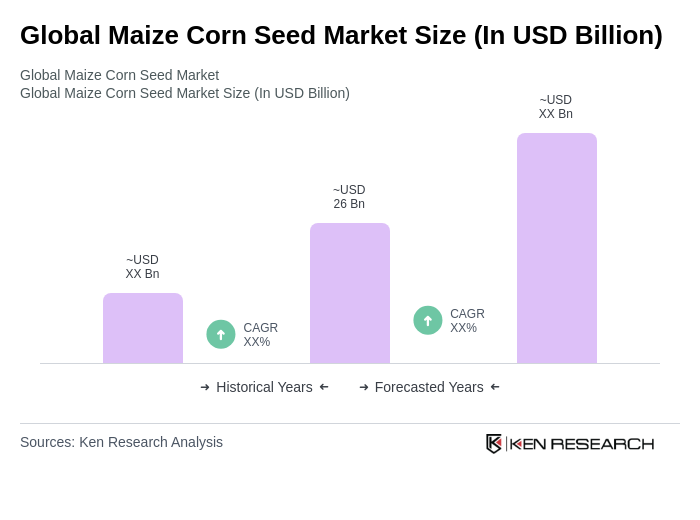
- The Global Maize Corn Seed Market is valued at approximately USD 26 billion, based on a five-year analysis. This level aligns with multiple industry trackers that place the market in the mid?twenties billion range and reflect broad demand from food, feed, and industrial uses as key drivers .
- The United States, Brazil, and China are among the leading countries in maize production and seed adoption, supported by large cultivated areas, advanced technologies, and investment in seed R&D these markets anchor global demand for improved hybrids and traits .
- The most recent U.S. farm bill enacted prior to 2023 was the Agricultural Improvement Act of 2018, which authorized research, plant breeding, and innovation programs relevant to crop and seed development; a new farm bill was not enacted in 2023, with extensions maintaining key authorities for R&D and conservation programs that underpin seed innovation and resilience objectives .
Global Maize Corn Seed Market Segmentation
By Type:The maize corn seed market can be segmented into various types, including hybrid seeds, open-pollinated varieties, genetically modified traits, organic and non-GMO certified seeds, and specialty corn types. Each of these subsegments caters to different agricultural needs and consumer preferences. Hybrids and GM traits remain widely adopted due to yield, pest resistance, and stress tolerance advantages, including climate-resilient and stacked-trait offerings .
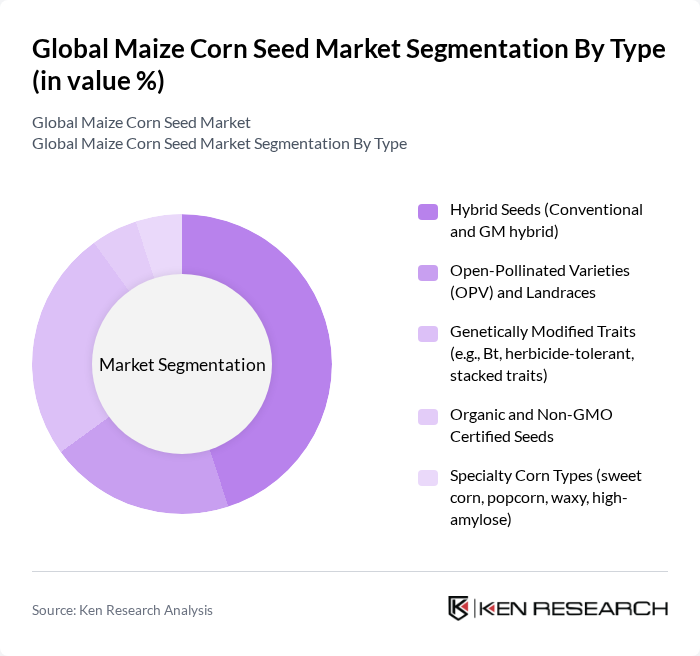
The hybrid seeds segment, particularly conventional and GM hybrids, dominates the maize corn seed market due to their higher yield potential and resistance to pests and diseases. Farmers increasingly prefer these seeds as they offer better returns on investment and are supported by extensive research and development. The growing trend towards sustainable agriculture has also led to innovations in hybrid seed technology, further solidifying their market leadership. Recent industry updates emphasize climate-resilient, disease-resistant, and higher-density hybrids to manage weather variability and pest pressures .
By End-User:The end-user segmentation includes commercial farmers and agribusinesses, smallholder and subsistence farmers, agricultural cooperatives and farmer producer organizations, and public research institutions and seed programs. Each of these groups plays a crucial role in the demand for maize corn seeds. Large-scale commercial users typically prioritize hybrids and traited seeds for yield and risk management, while smallholders and public programs emphasize affordability, adaptability, and extension support .
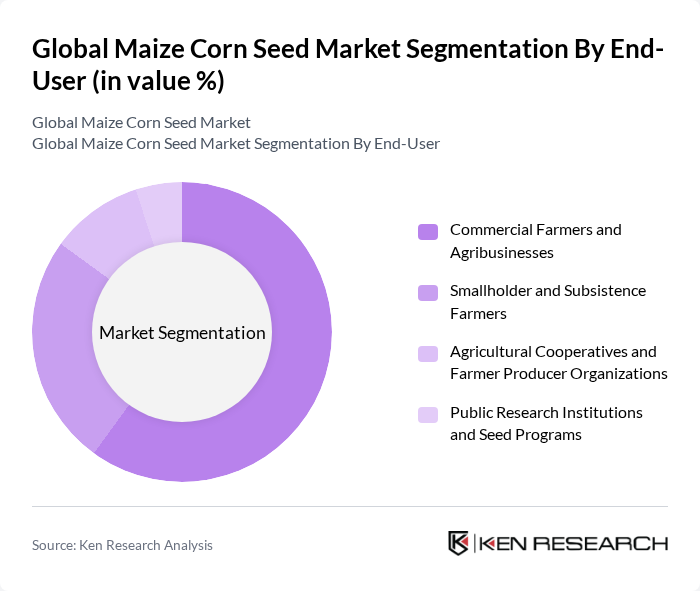
Commercial farmers and agribusinesses are the leading end-users in the maize corn seed market, accounting for a significant share due to their large-scale operations and ability to invest in high-quality seeds. These entities often seek seeds that maximize yield and profitability, driving demand for hybrid and genetically modified varieties. The increasing focus on food security and sustainable farming practices further enhances their role in the market, with ongoing demand for stress-tolerant and stacked-trait hybrids to improve resilience .
Global Maize Corn Seed Market Competitive Landscape
The Global Maize Corn Seed Market is characterized by a dynamic mix of regional and international players. Leading participants such as Bayer CropScience AG (DEKALB, Channel), Corteva Agriscience (Pioneer), Syngenta AG (NK Seeds, Golden Harvest), KWS SAAT SE & Co. KGaA, Groupe Limagrain (LG Seeds), AgReliant Genetics, LLC (AgriGold, LG Seeds US), RAGT Semences, Rijk Zwaan (sweet corn), East-West Seed (sweet corn), Sakata Seed Corporation (sweet corn), Seed Co Limited, Land O’Lakes, Inc. (WinField United), Nuziveedu Seeds Ltd., UPL Limited (Advanta Seeds), Origin Agritech Ltd. contribute to innovation, geographic expansion, and service delivery in this space. Industry reporting highlights continued investment in high?yielding, disease?resistant, and climate?resilient hybrids and traits across major portfolios .
Global Maize Corn Seed Market Industry Analysis
Growth Drivers
- Increasing Demand for Biofuels:The global biofuel market is projected to reach $218.7 billion in the future, driven by the need for renewable energy sources. Maize corn is a primary feedstock for ethanol production, with the U.S. producing approximately 15 billion gallons of ethanol annually. This rising demand for biofuels is expected to significantly boost maize corn seed consumption, as farmers increase planting to meet the growing energy needs and government mandates for renewable fuel usage.
- Advancements in Seed Technology:The global seed technology market is anticipated to grow to $25.5 billion in the future, with innovations such as genetically modified organisms (GMOs) and hybrid seeds enhancing yield potential. In the future, the average maize yield in the U.S. is expected to reach 178 bushels per acre, a direct result of these advancements. Enhanced seed traits, including pest resistance and drought tolerance, are driving farmers to adopt new maize varieties, thereby increasing the demand for high-quality maize corn seeds.
- Rising Global Population:The world population is projected to reach 8.5 billion in the future, increasing the demand for food production. In the future, global maize consumption is expected to exceed 1.2 billion metric tons, necessitating higher maize production levels. This surge in population drives the need for efficient agricultural practices and high-yield maize corn seeds, as farmers strive to meet the food security challenges posed by a growing demographic and changing dietary preferences.
Market Challenges
- Climate Change Impact:Climate change poses significant risks to maize production, with the World Bank estimating that crop yields could decline by up to 25% in some regions in the future due to extreme weather events. In the future, drought conditions are expected to affect over 30% of maize-growing areas in the U.S., leading to reduced yields and increased production costs. These challenges necessitate the development of resilient maize varieties, but they also create uncertainty in the market for maize corn seeds.
- Pest and Disease Resistance:The increasing prevalence of pests and diseases threatens maize production, with the Food and Agriculture Organization reporting that crop losses due to pests can reach 40% in some regions. In the future, the fall armyworm infestation is expected to affect over 20 million hectares of maize in Africa, leading to significant yield losses. This challenge compels seed producers to invest in research and development for resistant seed varieties, impacting market dynamics and pricing strategies.
Global Maize Corn Seed Market Future Outlook
The future of the maize corn seed market appears promising, driven by technological advancements and increasing sustainability efforts. As farmers adopt precision agriculture techniques, the demand for high-quality seeds that enhance productivity will rise. Additionally, the shift towards sustainable farming practices will encourage the development of environmentally friendly seed options. With the global focus on food security and renewable energy, the maize corn seed market is poised for growth, adapting to meet the evolving needs of agriculture and consumers alike.
Market Opportunities
- Expansion into Emerging Markets:Emerging markets, particularly in Asia and Africa, present significant growth opportunities for maize corn seed producers. With increasing agricultural investments and a rising middle class, these regions are expected to see a surge in maize demand, creating a favorable environment for seed companies to expand their operations and product offerings.
- Development of Drought-Resistant Varieties:The development of drought-resistant maize varieties is crucial in addressing climate change challenges. With an estimated 1.5 billion people living in drought-prone areas, the demand for such seeds is expected to rise. Companies focusing on innovative breeding techniques can capture market share by providing solutions that enhance resilience and ensure food security in vulnerable regions.
Scope of the Report
| Segment | Sub-Segments |
|---|---|
| By Type | Hybrid Seeds (Conventional and GM hybrid) Open-Pollinated Varieties (OPV) and Landraces Genetically Modified Traits (e.g., Bt, herbicide-tolerant, stacked traits) Organic and Non-GMO Certified Seeds Specialty Corn Types (sweet corn, popcorn, waxy, high-amylose) |
| By End-User | Commercial Farmers and Agribusinesses Smallholder and Subsistence Farmers Agricultural Cooperatives and Farmer Producer Organizations Public Research Institutions and Seed Programs |
| By Region | North America Latin America Europe Asia-Pacific Middle East & Africa |
| By Application | Animal Feed (feed grain, silage) Food Products (starch, sweeteners, cereals) Industrial Uses (starch derivatives, bioplastics) Biofuel and Ethanol Production |
| By Sales Channel | Direct Sales (company/dealer network) Distributors and Agro-Dealers Online and E-commerce Government and NGO Programs |
| By Distribution Mode | Wholesale Retail E-commerce |
| By Price Range | Value Segment Mid-Range Segment Premium Segment |
| By Growth Type | Field Corn (dent, flint) Sweet Corn Popcorn Specialty/Waxy Corn |
Key Target Audience
Investors and Venture Capitalist Firms
Government and Regulatory Bodies (e.g., USDA, FAO)
Seed Manufacturers and Producers
Agrochemical Companies
Distributors and Retailers
Farmers' Cooperatives
Biotechnology Firms
Financial Institutions
Players Mentioned in the Report:
Bayer CropScience AG (DEKALB, Channel)
Corteva Agriscience (Pioneer)
Syngenta AG (NK Seeds, Golden Harvest)
KWS SAAT SE & Co. KGaA
Groupe Limagrain (LG Seeds)
AgReliant Genetics, LLC (AgriGold, LG Seeds US)
RAGT Semences
Rijk Zwaan (sweet corn)
East-West Seed (sweet corn)
Sakata Seed Corporation (sweet corn)
Seed Co Limited
Land OLakes, Inc. (WinField United)
Nuziveedu Seeds Ltd.
UPL Limited (Advanta Seeds)
Origin Agritech Ltd.
Table of Contents
Market Assessment Phase
1. Executive Summary and Approach
2. Global Maize Corn Seed Market Overview
2.1 Key Insights and Strategic Recommendations
2.2 Global Maize Corn Seed Market Overview
2.3 Definition and Scope
2.4 Evolution of Market Ecosystem
2.5 Timeline of Key Regulatory Milestones
2.6 Value Chain & Stakeholder Mapping
2.7 Business Cycle Analysis
2.8 Policy & Incentive Landscape
3. Global Maize Corn Seed Market Analysis
3.1 Growth Drivers
3.1.1 Increasing Demand for Biofuels
3.1.2 Advancements in Seed Technology
3.1.3 Rising Global Population
3.1.4 Government Support for Agriculture
3.2 Market Challenges
3.2.1 Climate Change Impact
3.2.2 Pest and Disease Resistance
3.2.3 Fluctuating Commodity Prices
3.2.4 Regulatory Compliance Issues
3.3 Market Opportunities
3.3.1 Expansion into Emerging Markets
3.3.2 Development of Drought-Resistant Varieties
3.3.3 Organic and Non-GMO Seed Demand
3.3.4 Technological Innovations in Agriculture
3.4 Market Trends
3.4.1 Increasing Adoption of Precision Agriculture
3.4.2 Shift Towards Sustainable Farming Practices
3.4.3 Growth of E-commerce in Seed Distribution
3.4.4 Rising Interest in Seed Coating Technologies
3.5 Government Regulation
3.5.1 Seed Quality Standards
3.5.2 Intellectual Property Rights on Seed Varieties
3.5.3 Environmental Regulations
3.5.4 Subsidies for Seed Production
4. SWOT Analysis
5. Stakeholder Analysis
6. Porter's Five Forces Analysis
7. Global Maize Corn Seed Market Market Size, 2019-2024
7.1 By Value
7.2 By Volume
7.3 By Average Selling Price
8. Global Maize Corn Seed Market Segmentation
8.1 By Type
8.1.1 Hybrid Seeds (Conventional and GM hybrid)
8.1.2 Open-Pollinated Varieties (OPV) and Landraces
8.1.3 Genetically Modified Traits (e.g., Bt, herbicide-tolerant, stacked traits)
8.1.4 Organic and Non-GMO Certified Seeds
8.1.5 Specialty Corn Types (sweet corn, popcorn, waxy, high-amylose)
8.2 By End-User
8.2.1 Commercial Farmers and Agribusinesses
8.2.2 Smallholder and Subsistence Farmers
8.2.3 Agricultural Cooperatives and Farmer Producer Organizations
8.2.4 Public Research Institutions and Seed Programs
8.3 By Region
8.3.1 North America
8.3.2 Latin America
8.3.3 Europe
8.3.4 Asia-Pacific
8.3.5 Middle East & Africa
8.4 By Application
8.4.1 Animal Feed (feed grain, silage)
8.4.2 Food Products (starch, sweeteners, cereals)
8.4.3 Industrial Uses (starch derivatives, bioplastics)
8.4.4 Biofuel and Ethanol Production
8.5 By Sales Channel
8.5.1 Direct Sales (company/dealer network)
8.5.2 Distributors and Agro-Dealers
8.5.3 Online and E-commerce
8.5.4 Government and NGO Programs
8.6 By Distribution Mode
8.6.1 Wholesale
8.6.2 Retail
8.6.3 E-commerce
8.7 By Price Range
8.7.1 Value Segment
8.7.2 Mid-Range Segment
8.7.3 Premium Segment
8.8 By Growth Type
8.8.1 Field Corn (dent, flint)
8.8.2 Sweet Corn
8.8.3 Popcorn
8.8.4 Specialty/Waxy Corn
9. Global Maize Corn Seed Market Competitive Analysis
9.1 Market Share of Key Players(Micro, Small, Medium, Large Enterprises)
9.2 Cross Comparison of Key Players
9.2.1 Company Name (brand and legal entity)
9.2.2 Group Size (Large, Medium, or Small as per industry convention)
9.2.3 Seed Revenue Growth Rate (YoY, maize-specific where disclosed)
9.2.4 Market Share / Acres Planted with Company Hybrids (by region)
9.2.5 Customer Retention / Dealer Repeat-Purchase Rate
9.2.6 Average Realized Price per Unit (50k kernel bag) and Discounting
9.2.7 Product Portfolio Breadth (hybrid maturity zones, trait stacks, specialty types)
9.2.8 Supply Chain Fill Rate and In-Season Availability
9.2.9 R&D Intensity (% of sales; pipeline trials, trait licensing)
9.2.10 Brand Equity and Agronomist Coverage Score (farmer NPS, field support)
9.3 SWOT Analysis of Top Players
9.4 Pricing Analysis(By Class and Payload)
9.5 Detailed Profile of Major Companies
9.5.1 Bayer CropScience AG (DEKALB, Channel)
9.5.2 Corteva Agriscience (Pioneer)
9.5.3 Syngenta AG (NK Seeds, Golden Harvest)
9.5.4 KWS SAAT SE & Co. KGaA
9.5.5 Groupe Limagrain (LG Seeds)
9.5.6 AgReliant Genetics, LLC (AgriGold, LG Seeds US)
9.5.7 RAGT Semences
9.5.8 Rijk Zwaan (sweet corn)
9.5.9 East-West Seed (sweet corn)
9.5.10 Sakata Seed Corporation (sweet corn)
9.5.11 Seed Co Limited
9.5.12 Land O’Lakes, Inc. (WinField United)
9.5.13 Nuziveedu Seeds Ltd.
9.5.14 UPL Limited (Advanta Seeds)
9.5.15 Origin Agritech Ltd.
10. Global Maize Corn Seed Market End-User Analysis
10.1 Procurement Behavior of Key Ministries
10.1.1 Government Procurement Policies
10.1.2 Budget Allocations for Agriculture
10.1.3 Collaboration with Private Sector
10.2 Corporate Spend on Infrastructure & Energy
10.2.1 Investment in Agricultural Infrastructure
10.2.2 Energy Consumption Patterns
10.2.3 Funding for Sustainable Practices
10.3 Pain Point Analysis by End-User Category
10.3.1 Access to Quality Seeds
10.3.2 Price Volatility
10.3.3 Technical Support and Training
10.4 User Readiness for Adoption
10.4.1 Awareness of New Technologies
10.4.2 Financial Capability
10.4.3 Willingness to Change Practices
10.5 Post-Deployment ROI and Use Case Expansion
10.5.1 Measurement of Yield Improvements
10.5.2 Long-term Cost Savings
10.5.3 Expansion into New Markets
11. Global Maize Corn Seed Market Future Size, 2025-2030
11.1 By Value
11.2 By Volume
11.3 By Average Selling Price
Go-To-Market Strategy Phase
1. Whitespace Analysis + Business Model Canvas
1.1 Market Gaps Identification
1.2 Value Proposition Development
1.3 Revenue Streams Analysis
1.4 Cost Structure Evaluation
1.5 Key Partnerships Exploration
1.6 Customer Segmentation
1.7 Channels of Distribution
2. Marketing and Positioning Recommendations
2.1 Branding Strategies
2.2 Product USPs
2.3 Target Market Identification
2.4 Communication Strategies
2.5 Digital Marketing Approaches
3. Distribution Plan
3.1 Urban Retail Strategies
3.2 Rural NGO Tie-ups
3.3 Direct-to-Consumer Models
3.4 Partnerships with Distributors
4. Channel & Pricing Gaps
4.1 Underserved Routes
4.2 Pricing Bands Analysis
4.3 Competitor Pricing Strategies
4.4 Customer Willingness to Pay
5. Unmet Demand & Latent Needs
5.1 Category Gaps Identification
5.2 Consumer Segments Analysis
5.3 Emerging Trends Exploration
5.4 Feedback Mechanisms
6. Customer Relationship
6.1 Loyalty Programs
6.2 After-sales Service
6.3 Customer Engagement Strategies
6.4 Feedback and Improvement Loops
7. Value Proposition
7.1 Sustainability Initiatives
7.2 Integrated Supply Chains
7.3 Customer-Centric Innovations
7.4 Competitive Differentiation
8. Key Activities
8.1 Regulatory Compliance
8.2 Branding Initiatives
8.3 Distribution Setup
8.4 Training and Development
9. Entry Strategy Evaluation
9.1 Domestic Market Entry Strategy
9.1.1 Product Mix Considerations
9.1.2 Pricing Band Strategy
9.1.3 Packaging Innovations
9.2 Export Entry Strategy
9.2.1 Target Countries Identification
9.2.2 Compliance Roadmap Development
10. Entry Mode Assessment
10.1 Joint Ventures
10.2 Greenfield Investments
10.3 Mergers & Acquisitions
10.4 Distributor Model Evaluation
11. Capital and Timeline Estimation
11.1 Capital Requirements
11.2 Timelines for Implementation
12. Control vs Risk Trade-Off
12.1 Ownership vs Partnerships
12.2 Risk Mitigation Strategies
13. Profitability Outlook
13.1 Breakeven Analysis
13.2 Long-term Sustainability Strategies
14. Potential Partner List
14.1 Distributors
14.2 Joint Ventures
14.3 Acquisition Targets
15. Execution Roadmap
15.1 Phased Plan for Market Entry
15.1.1 Market Setup
15.1.2 Market Entry
15.1.3 Growth Acceleration
15.1.4 Scale & Stabilize
15.2 Key Activities and Milestones
15.2.1 Milestone Planning
15.2.2 Activity Tracking
Research Methodology
Phase 1: Approach1
Desk Research
- Analysis of global maize corn seed market reports from agricultural organizations and trade associations
- Review of academic journals and publications focusing on maize genetics and seed technology
- Examination of government agricultural policies and regulations impacting maize seed production and distribution
Primary Research
- Interviews with seed company executives and product managers to gather insights on market trends
- Surveys with farmers and agricultural cooperatives to understand seed preferences and purchasing behavior
- Field visits to research institutions and seed production facilities for firsthand observations
Validation & Triangulation
- Cross-validation of data from multiple sources including market reports, expert interviews, and field observations
- Triangulation of findings through comparison of qualitative insights and quantitative data
- Sanity checks conducted with industry experts to ensure the reliability of the gathered data
Phase 2: Market Size Estimation1
Top-down Assessment
- Estimation of market size based on global agricultural output and maize production statistics
- Segmentation of the market by seed type, including hybrid and genetically modified seeds
- Incorporation of regional demand variations and climatic factors affecting maize cultivation
Bottom-up Modeling
- Collection of sales data from leading maize seed producers to establish baseline figures
- Analysis of distribution channels and their impact on market penetration and growth
- Volume estimates based on seed usage per hectare and total cultivated area for maize
Forecasting & Scenario Analysis
- Utilization of historical growth rates to project future market trends through 2030
- Scenario modeling based on potential changes in agricultural policies and technological advancements
- Development of best-case, worst-case, and most-likely scenarios to assess market resilience
Phase 3: CATI Sample Composition1
| Scope Item/Segment | Sample Size | Target Respondent Profiles |
|---|---|---|
| Maize Seed Producers | 120 | Product Managers, R&D Directors |
| Agricultural Cooperatives | 100 | Cooperative Managers, Procurement Officers |
| Farmers and Growers | 150 | Maize Farmers, Agronomists |
| Research Institutions | 80 | Research Scientists, Agronomy Professors |
| Government Agricultural Agencies | 70 | Policy Makers, Agricultural Advisors |
Frequently Asked Questions
What is the current value of the Global Maize Corn Seed Market?
The Global Maize Corn Seed Market is valued at approximately USD 26 billion, reflecting strong demand driven by food, feed, and industrial uses. This valuation is consistent with various industry trackers that indicate a stable market in the mid-twenties billion range.
Which countries are the leading producers of maize?
What types of maize corn seeds are available in the market?
What are the main drivers of growth in the maize corn seed market?
Other Regional/Country Reports
Indonesia Maize Corn Seed Market
Malaysia Maize Corn Seed Market
APAC Maize Corn Seed Market
SEA Maize Corn Seed Market
Why Buy From Us?

What makes us stand out is that our consultants follow Robust, Refine and Result (RRR) methodology. Robust for clear definitions, approaches and sanity checking, Refine for differentiating respondents' facts and opinions, and Result for presenting data with story.

We have set a benchmark in the industry by offering our clients with syndicated and customized market research reports featuring coverage of entire market as well as meticulous research and analyst insights.

While we don't replace traditional research, we flip the method upside down. Our dual approach of Top Bottom & Bottom Top ensures quality deliverable by not just verifying company fundamentals but also looking at the sector and macroeconomic factors.

With one step in the future, our research team constantly tries to show you the bigger picture. We help with some of the tough questions you may encounter along the way: How is the industry positioned? Best marketing channel? KPI's of competitors? By aligning every element, we help maximize success.

Our report gives you instant access to the answers and sources that other companies might choose to hide. We elaborate each steps of research methodology we have used and showcase you the sample size to earn your trust.

If you need any support, we are here! We pride ourselves on universe strength, data quality, and quick, friendly, and professional service.