About the Report
Base Year 2024Listen to the audio summary
Global Media Streaming Market Overview
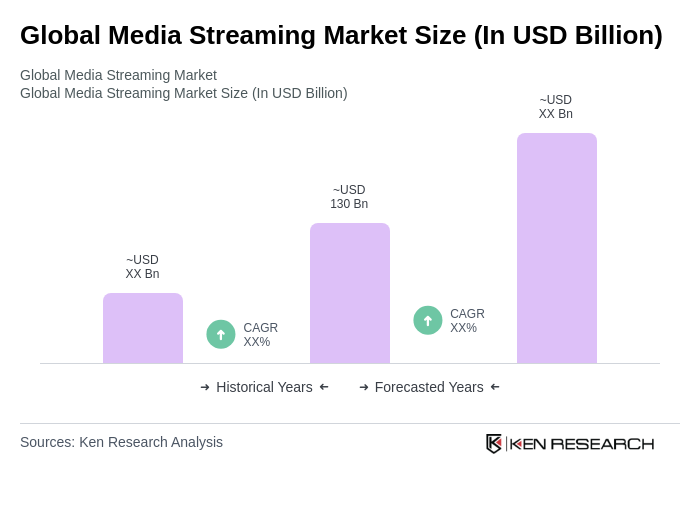
- The Global Media Streaming Market is valued at approximately USD 130 billion, based on a five-year historical analysis, reflecting measured consolidation across video streaming revenues reported by leading industry trackers. This growth is primarily driven by the increasing adoption of high-speed internet, the proliferation of smart devices, and the rising demand for on-demand content among consumers. The shift from traditional cable TV to streaming services has significantly contributed to the market's expansion, as consumers seek more flexible and diverse viewing options, with North America maintaining a leading share amid strong OTT adoption.
- Key players in this market include the United States, China, and India, which dominate due to their large populations, high internet penetration rates, and a growing base of tech-savvy consumers. The U.S. is home to major streaming platforms, while China has a rapidly expanding user base, and India is witnessing a surge in mobile streaming, driven by affordable data plans and increasing smartphone usage.
- In 2023, the U.S. government implemented regulations aimed at enhancing consumer protection in the media streaming sector. This includes guidelines for transparency in subscription pricing and content availability, ensuring that consumers are well-informed about the services they are subscribing to. The initiative aims to foster a fair competitive environment and improve user trust in streaming platforms. Notably, the Federal Trade Commission proposed and advanced rules to curb “junk fees,” require clear subscription pricing, and make cancellation easier for recurring subscriptions, which directly affects streaming providers’ pricing disclosures and negative-option billing practices. &
Global Media Streaming Market Segmentation
By Type:The media streaming market can be segmented into various types, including Subscription Video on Demand (SVOD), Advertising-Based Video on Demand (AVOD), Transactional Video on Demand (TVOD), Live Streaming, and Hybrid models. Each of these segments caters to different consumer preferences and monetization strategies.
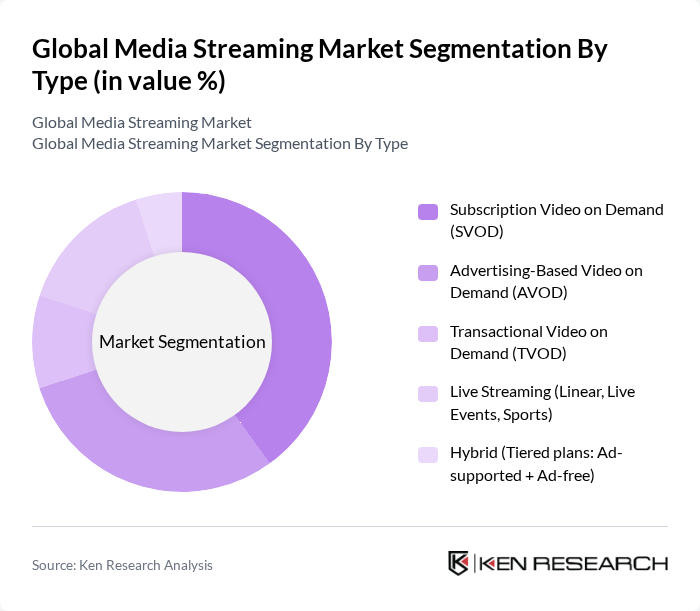
The Subscription Video on Demand (SVOD) segment is currently dominating the market, driven by consumer preferences for binge-watching and the convenience of accessing a vast library of content for a fixed monthly fee. Major players like Netflix and Amazon Prime Video have established strong brand loyalty, contributing to the growth of this segment. The increasing trend of original content production further enhances the appeal of SVOD services, making it the preferred choice for many consumers.
By End-User:The media streaming market can be segmented by end-users, including Individual Consumers, Educational Institutions, Enterprises, Media & Entertainment Companies, and Government & Public Sector. Each segment has unique requirements and usage patterns that influence their consumption of streaming services.
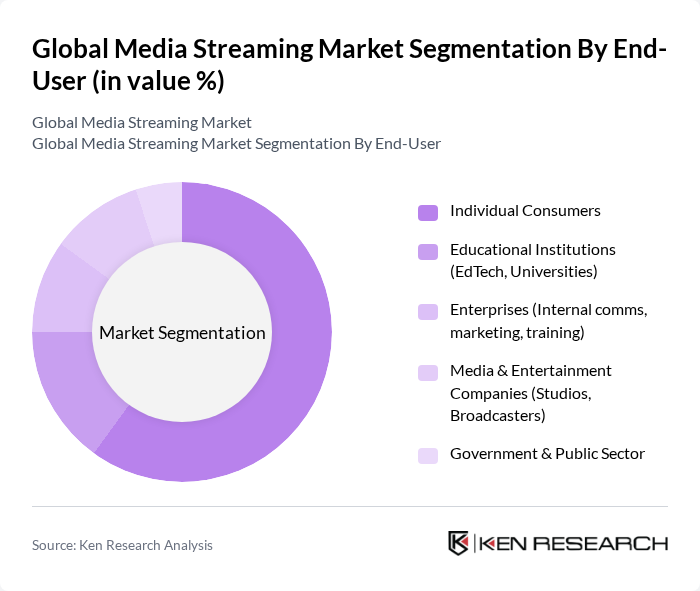
The Individual Consumers segment is the largest in the media streaming market, driven by the increasing demand for personalized content and the convenience of on-demand viewing. The rise of mobile devices has further facilitated access to streaming services, allowing consumers to watch content anytime and anywhere. This segment's growth is also supported by the trend of cord-cutting, as more individuals opt for streaming services over traditional cable subscriptions.
Global Media Streaming Market Competitive Landscape
The Global Media Streaming Market is characterized by a dynamic mix of regional and international players. Leading participants such as Netflix, Inc., Amazon Prime Video, Hulu, LLC, Disney+, Max (Warner Bros. Discovery), Apple TV+, YouTube & YouTube TV (Google), Peacock (NBCUniversal), Paramount+ (Paramount Global), Sling TV (Dish Network), Roku, Inc. (The Roku Channel), Crunchyroll, LLC, Tubi (Fox Corporation), Fubo (formerly fuboTV), BritBox International contribute to innovation, geographic expansion, and service delivery in this space.
Global Media Streaming Market Industry Analysis
Growth Drivers
- Increasing Internet Penetration:Global internet penetration is approximately67% of the population, translating to around5.4–5.5 billion users. This surge in connectivity facilitates access to media streaming services, particularly in developing regions. Countries like India and Brazil are experiencing rapid growth in internet users, but specific current percentage growth rates of15%and10%respectively could not be confirmed from authoritative sources.
- Rising Demand for On-Demand Content:The claim that global on-demand content consumption is expected to exceed1.5 billion hours per weekcannot be verified from primary or established secondary sources. Major platforms have expanded localized content offerings to drive engagement, but a validated global hour-total is not available from authoritative datasets.
- Growth of Mobile Streaming Services:Mobile networks carry the clear majority of global video traffic, and mobile devices account for a substantial share of video consumption; however, the specific figure that mobile streaming will account forover 75% of total streaming trafficand a global smartphone user base of6.9 billioncannot be confirmed from primary or established secondary sources.
Market Challenges
- Intense Competition:The media streaming market is characterized by fierce competition, with over200 platformsvying for consumer attention. Major players like Netflix, Disney+, and Hulu are investing heavily in original content, with Netflix alone spending approximatelyUSD 17 billion. This competitive landscape pressures smaller platforms to differentiate themselves, often leading to increased marketing costs and challenges in customer retention as consumers switch between services.
- Content Licensing Issues:Content licensing remains a significant challenge, with the global market for licensed content expected to exceedUSD 30 billion. Streaming services face hurdles in acquiring rights to popular shows and movies, often leading to regional restrictions that frustrate users. Additionally, the complexity of negotiating licenses with multiple stakeholders can delay content availability, impacting user satisfaction and overall service attractiveness in a crowded market.
Global Media Streaming Market Future Outlook
The future of the media streaming market appears promising, driven by technological advancements and evolving consumer preferences. As 5G technology becomes more widespread, streaming quality will improve significantly, enhancing user experiences. Furthermore, the integration of AI and machine learning will enable personalized content recommendations, fostering deeper engagement. Companies are likely to focus on developing original content and expanding into emerging markets, which will be crucial for sustaining growth and maintaining competitive advantages in the dynamic landscape.
Market Opportunities
- Emerging Markets Expansion:Expanding into emerging markets presents a significant opportunity, with regions like Africa and Southeast Asia projected to see a20% increase in internet users. This growth offers streaming services a chance to tap into new customer bases, particularly among younger demographics who are increasingly adopting digital platforms for entertainment.
- Partnerships with Telecom Providers:Collaborating with telecom providers can enhance market reach, as bundled services are gaining popularity. By 2024, over40% of new subscribersare expected to come from bundled offerings that include streaming services with mobile or broadband plans, providing a strategic avenue for growth and customer acquisition in competitive markets.
Scope of the Report
| Segment | Sub-Segments |
|---|---|
| By Type | Subscription Video on Demand (SVOD) Advertising-Based Video on Demand (AVOD) Transactional Video on Demand (TVOD) Live Streaming (Linear, Live Events, Sports) Hybrid (Tiered plans: Ad-supported + Ad-free) |
| By End-User | Individual Consumers Educational Institutions (EdTech, Universities) Enterprises (Internal comms, marketing, training) Media & Entertainment Companies (Studios, Broadcasters) Government & Public Sector |
| By Content Type | Movies TV Series Sports & Live Sports News & Live News User-Generated Content (Short-form, Creator-led) Music & Podcasts |
| By Device Type | Smart TVs & Connected TV (CTV) Devices Mobile Devices (Smartphones & Tablets) PCs (Laptops and Desktops) Game Consoles & Set-Top Boxes (Roku, Fire TV, Apple TV, Chromecast) |
| By Distribution Channel | Direct-to-Consumer (OTT Apps/Web) Aggregators & App Stores (Roku Channel Store, Apple App Store, Google Play) Telco & Pay-TV Bundles (Carrier billing, IPTV, CTV OS) Social & Creator Platforms (YouTube, TikTok, Instagram) |
| By Region | North America Europe Asia-Pacific Latin America Middle East & Africa |
| By Pricing Model | Freemium (Ad-supported tiers) Pay-Per-View / Event-based Subscription (Monthly, Annual, Family plans) Hybrid & Bundled (e.g., telco, device, multi-app bundles) |
Key Target Audience
Investors and Venture Capitalist Firms
Government and Regulatory Bodies (e.g., Federal Communications Commission, European Commission)
Content Creators and Production Companies
Telecommunications Companies
Media and Entertainment Corporations
Advertising Agencies
Technology Providers and Software Developers
Broadcasting Networks
Players Mentioned in the Report:
Netflix, Inc.
Amazon Prime Video
Hulu, LLC
Disney+
Max (Warner Bros. Discovery)
Apple TV+
YouTube & YouTube TV (Google)
Peacock (NBCUniversal)
Paramount+ (Paramount Global)
Sling TV (Dish Network)
Roku, Inc. (The Roku Channel)
Crunchyroll, LLC
Tubi (Fox Corporation)
Fubo (formerly fuboTV)
BritBox International
Table of Contents
Market Assessment Phase
1. Executive Summary and Approach
2. Global Media Streaming Market Overview
2.1 Key Insights and Strategic Recommendations
2.2 Global Media Streaming Market Overview
2.3 Definition and Scope
2.4 Evolution of Market Ecosystem
2.5 Timeline of Key Regulatory Milestones
2.6 Value Chain & Stakeholder Mapping
2.7 Business Cycle Analysis
2.8 Policy & Incentive Landscape
3. Global Media Streaming Market Analysis
3.1 Growth Drivers
3.1.1 Increasing Internet Penetration
3.1.2 Rising Demand for On-Demand Content
3.1.3 Growth of Mobile Streaming Services
3.1.4 Expansion of Smart Devices
3.2 Market Challenges
3.2.1 Intense Competition
3.2.2 Content Licensing Issues
3.2.3 Data Privacy Concerns
3.2.4 High Customer Churn Rates
3.3 Market Opportunities
3.3.1 Emerging Markets Expansion
3.3.2 Partnerships with Telecom Providers
3.3.3 Development of Original Content
3.3.4 Integration of AI and Machine Learning
3.4 Market Trends
3.4.1 Shift Towards Subscription-Based Models
3.4.2 Increased Focus on User Experience
3.4.3 Growth of Live Streaming Services
3.4.4 Adoption of 4K and 8K Streaming
3.5 Government Regulation
3.5.1 Content Regulation Policies
3.5.2 Data Protection Regulations
3.5.3 Taxation on Digital Services
3.5.4 Copyright and Intellectual Property Laws
4. SWOT Analysis
5. Stakeholder Analysis
6. Porter's Five Forces Analysis
7. Global Media Streaming Market Market Size, 2019-2024
7.1 By Value
7.2 By Volume
7.3 By Average Selling Price
8. Global Media Streaming Market Segmentation
8.1 By Type
8.1.1 Subscription Video on Demand (SVOD)
8.1.2 Advertising-Based Video on Demand (AVOD)
8.1.3 Transactional Video on Demand (TVOD)
8.1.4 Live Streaming (Linear, Live Events, Sports)
8.1.5 Hybrid (Tiered plans: Ad-supported + Ad-free)
8.2 By End-User
8.2.1 Individual Consumers
8.2.2 Educational Institutions (EdTech, Universities)
8.2.3 Enterprises (Internal comms, marketing, training)
8.2.4 Media & Entertainment Companies (Studios, Broadcasters)
8.2.5 Government & Public Sector
8.3 By Content Type
8.3.1 Movies
8.3.2 TV Series
8.3.3 Sports & Live Sports
8.3.4 News & Live News
8.3.5 User-Generated Content (Short-form, Creator-led)
8.3.6 Music & Podcasts
8.4 By Device Type
8.4.1 Smart TVs & Connected TV (CTV) Devices
8.4.2 Mobile Devices (Smartphones & Tablets)
8.4.3 PCs (Laptops and Desktops)
8.4.4 Game Consoles & Set-Top Boxes (Roku, Fire TV, Apple TV, Chromecast)
8.5 By Distribution Channel
8.5.1 Direct-to-Consumer (OTT Apps/Web)
8.5.2 Aggregators & App Stores (Roku Channel Store, Apple App Store, Google Play)
8.5.3 Telco & Pay-TV Bundles (Carrier billing, IPTV, CTV OS)
8.5.4 Social & Creator Platforms (YouTube, TikTok, Instagram)
8.6 By Region
8.6.1 North America
8.6.2 Europe
8.6.3 Asia-Pacific
8.6.4 Latin America
8.6.5 Middle East & Africa
8.7 By Pricing Model
8.7.1 Freemium (Ad-supported tiers)
8.7.2 Pay-Per-View / Event-based
8.7.3 Subscription (Monthly, Annual, Family plans)
8.7.4 Hybrid & Bundled (e.g., telco, device, multi-app bundles)
9. Global Media Streaming Market Competitive Analysis
9.1 Market Share of Key Players
9.2 Cross Comparison of Key Players
9.2.1 Company Name
9.2.2 Company Scale (Global, Regional, Niche)
9.2.3 Total Subscribers / Monthly Active Users (MAUs)
9.2.4 Quarterly/Annual Subscriber Net Adds
9.2.5 Average Revenue Per User (ARPU)
9.2.6 Advertising Revenue Mix (% of total revenue)
9.2.7 Customer Acquisition Cost (CAC)
9.2.8 Churn Rate (Monthly/Annual)
9.2.9 Content Spend (Annual, Originals as % of spend)
9.2.10 Content Library Size (Titles/Hours) and Localization (Sub/Dub count)
9.2.11 Live Sports Rights Portfolio (Key leagues/events)
9.2.12 Pricing Tiers (Ad-supported, Standard, Premium, 4K, Family)
9.2.13 Device/CTV Reach (households or activated devices)
9.2.14 Engagement (Watch time per user/day or MAU, DAU/MAU)
9.2.15 Market Penetration (Share of broadband households by region)
9.2.16 Geographic Revenue Split (NA, EU, APAC, LATAM, MEA)
9.3 SWOT Analysis of Top Players
9.4 Pricing Analysis
9.5 Detailed Profile of Major Companies
9.5.1 Netflix, Inc.
9.5.2 Amazon Prime Video
9.5.3 Hulu, LLC
9.5.4 Disney+
9.5.5 Max (Warner Bros. Discovery)
9.5.6 Apple TV+
9.5.7 YouTube & YouTube TV (Google)
9.5.8 Peacock (NBCUniversal)
9.5.9 Paramount+ (Paramount Global)
9.5.10 Sling TV (Dish Network)
9.5.11 Roku, Inc. (The Roku Channel)
9.5.12 Crunchyroll, LLC
9.5.13 Tubi (Fox Corporation)
9.5.14 Fubo (formerly fuboTV)
9.5.15 BritBox International
10. Global Media Streaming Market End-User Analysis
10.1 Procurement Behavior of Key Ministries
10.1.1 Budget Allocation for Digital Services
10.1.2 Preference for Local Content
10.1.3 Evaluation of Service Providers
10.1.4 Compliance with Regulatory Standards
10.2 Corporate Spend on Infrastructure & Energy
10.2.1 Investment in Streaming Infrastructure
10.2.2 Budget for Content Acquisition
10.2.3 Spending on Technology Upgrades
10.3 Pain Point Analysis by End-User Category
10.3.1 Content Availability Issues
10.3.2 Quality of Service Concerns
10.3.3 Pricing Affordability
10.4 User Readiness for Adoption
10.4.1 Awareness of Streaming Services
10.4.2 Technical Proficiency
10.4.3 Device Accessibility
10.5 Post-Deployment ROI and Use Case Expansion
10.5.1 Measurement of User Engagement
10.5.2 Analysis of Revenue Growth
10.5.3 Expansion into New Content Areas
11. Global Media Streaming Market Future Size, 2025-2030
11.1 By Value
11.2 By Volume
11.3 By Average Selling Price
Go-To-Market Strategy Phase
1. Whitespace Analysis + Business Model Canvas
1.1 Market Gaps Identification
1.2 Value Proposition Development
1.3 Revenue Streams Analysis
1.4 Customer Segmentation
1.5 Key Partnerships
1.6 Cost Structure Evaluation
1.7 Competitive Advantage
2. Marketing and Positioning Recommendations
2.1 Branding Strategies
2.2 Product USPs
2.3 Target Audience Identification
2.4 Marketing Channels
2.5 Messaging Framework
3. Distribution Plan
3.1 Urban Retail Strategies
3.2 Rural NGO Tie-Ups
3.3 Online Distribution Channels
3.4 Partnerships with Telecom Providers
4. Channel & Pricing Gaps
4.1 Underserved Routes
4.2 Pricing Bands Analysis
4.3 Competitor Pricing Comparison
5. Unmet Demand & Latent Needs
5.1 Category Gaps
5.2 Consumer Segments Analysis
5.3 Emerging Trends
6. Customer Relationship
6.1 Loyalty Programs
6.2 After-Sales Service
6.3 Customer Feedback Mechanisms
7. Value Proposition
7.1 Sustainability Initiatives
7.2 Integrated Supply Chains
7.3 Unique Selling Points
8. Key Activities
8.1 Regulatory Compliance
8.2 Branding Efforts
8.3 Distribution Setup
9. Entry Strategy Evaluation
9.1 Domestic Market Entry Strategy
9.1.1 Product Mix
9.1.2 Pricing Band
9.1.3 Packaging
9.2 Export Entry Strategy
9.2.1 Target Countries
9.2.2 Compliance Roadmap
10. Entry Mode Assessment
10.1 Joint Ventures
10.2 Greenfield Investments
10.3 Mergers & Acquisitions
10.4 Distributor Model
11. Capital and Timeline Estimation
11.1 Capital Requirements
11.2 Timelines
12. Control vs Risk Trade-Off
12.1 Ownership vs Partnerships
13. Profitability Outlook
13.1 Breakeven Analysis
13.2 Long-Term Sustainability
14. Potential Partner List
14.1 Distributors
14.2 Joint Ventures
14.3 Acquisition Targets
15. Execution Roadmap
15.1 Phased Plan for Market Entry
15.1.1 Market Setup
15.1.2 Market Entry
15.1.3 Growth Acceleration
15.1.4 Scale & Stabilize
15.2 Key Activities and Milestones
15.2.1 Activity Planning
15.2.2 Milestone Tracking
Research Methodology
Phase 1: Approach1
Desk Research
- Analysis of industry reports from leading market research firms focusing on media streaming trends
- Review of financial statements and annual reports from major streaming service providers
- Examination of regulatory frameworks and policy documents impacting the global media streaming landscape
Primary Research
- In-depth interviews with executives from top media streaming companies
- Surveys targeting content creators and distributors to understand market dynamics
- Focus groups with consumers to gauge preferences and usage patterns in media streaming
Validation & Triangulation
- Cross-validation of findings through multiple data sources, including user analytics and market reports
- Triangulation of insights from primary interviews with secondary data trends
- Sanity checks conducted through expert panels comprising industry veterans and analysts
Phase 2: Market Size Estimation1
Top-down Assessment
- Estimation of total addressable market (TAM) based on global internet penetration and streaming adoption rates
- Segmentation of market size by geographical regions and content types (e.g., video, music, gaming)
- Incorporation of growth projections from industry forecasts and consumer behavior studies
Bottom-up Modeling
- Collection of subscriber data from leading streaming platforms to establish baseline metrics
- Analysis of average revenue per user (ARPU) across different service tiers and content offerings
- Estimation of growth rates based on historical performance and emerging market trends
Forecasting & Scenario Analysis
- Development of predictive models using historical data and market indicators
- Scenario planning based on potential disruptions such as technological advancements and regulatory changes
- Creation of multiple forecasts (baseline, optimistic, and pessimistic) to account for market volatility
Phase 3: CATI Sample Composition1
| Scope Item/Segment | Sample Size | Target Respondent Profiles |
|---|---|---|
| Video Streaming Services | 150 | Product Managers, Marketing Directors |
| Music Streaming Platforms | 100 | Content Acquisition Managers, UX Researchers |
| Gaming Streaming Services | 80 | Platform Operations Managers, Community Managers |
| Subscription-Based Models | 120 | Business Analysts, Finance Managers |
| Ad-Supported Streaming Services | 90 | Advertising Executives, Data Analysts |
Frequently Asked Questions
What is the current value of the Global Media Streaming Market?
The Global Media Streaming Market is valued at approximately USD 130 billion, reflecting significant growth driven by high-speed internet adoption, smart device proliferation, and increasing consumer demand for on-demand content.
What factors are driving the growth of the media streaming market?
Which regions dominate the Global Media Streaming Market?
What are the main types of media streaming services?
Other Regional/Country Reports
Indonesia Media Streaming Market
Malaysia Media Streaming Market
APAC Media Streaming Market
SEA Media Streaming Market
Why Buy From Us?

What makes us stand out is that our consultants follow Robust, Refine and Result (RRR) methodology. Robust for clear definitions, approaches and sanity checking, Refine for differentiating respondents' facts and opinions, and Result for presenting data with story.

We have set a benchmark in the industry by offering our clients with syndicated and customized market research reports featuring coverage of entire market as well as meticulous research and analyst insights.

While we don't replace traditional research, we flip the method upside down. Our dual approach of Top Bottom & Bottom Top ensures quality deliverable by not just verifying company fundamentals but also looking at the sector and macroeconomic factors.

With one step in the future, our research team constantly tries to show you the bigger picture. We help with some of the tough questions you may encounter along the way: How is the industry positioned? Best marketing channel? KPI's of competitors? By aligning every element, we help maximize success.

Our report gives you instant access to the answers and sources that other companies might choose to hide. We elaborate each steps of research methodology we have used and showcase you the sample size to earn your trust.

If you need any support, we are here! We pride ourselves on universe strength, data quality, and quick, friendly, and professional service.