About the Report
Base Year 2024Global Microplastics Removal Technologies Market Overview
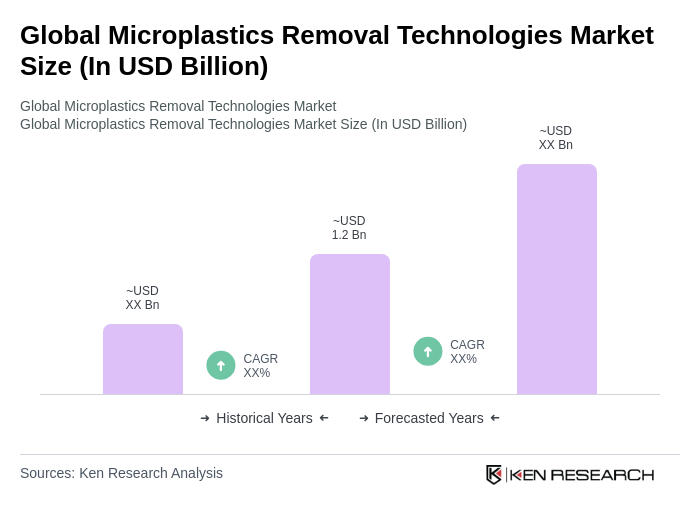
- The Global Microplastics Removal Technologies Market is valued at USD 1.2 billion, based on a five-year historical analysis. This growth is primarily driven by increasing awareness of environmental pollution, stringent regulations on plastic waste management, and advancements in filtration and membrane technologies. Escalating regulatory pressure, such as the US Federal Microplastic Research Strategy and the European Union’s Chemical Strategy for Sustainability, alongside heightened public concern over microplastics in water and food, are key market drivers. The rising demand for clean water and the need to protect marine ecosystems have further propelled investments in innovative microplastics removal solutions.
- Key players in this market include the United States, Germany, and Japan, which dominate due to their strong technological capabilities, significant investments in research and development, and robust regulatory frameworks. Asia Pacific, particularly China and Japan, has emerged as the largest regional market, driven by rapid industrialization and government-led water quality initiatives. These countries have established themselves as leaders in environmental technology, fostering innovation and attracting global partnerships to combat microplastic pollution.
- In 2021, the European Union implemented the Single-Use Plastics Directive (Directive (EU) 2019/904, issued by the European Parliament and Council), which aims to reduce the impact of certain plastic products on the environment. This regulation mandates the reduction of single-use plastics and encourages the development of alternative materials and technologies, thereby driving the demand for microplastics removal technologies across member states. The Directive requires member states to take measures such as consumption reduction targets, product bans, and extended producer responsibility schemes, directly impacting the adoption of advanced water treatment solutions.
Global Microplastics Removal Technologies Market Segmentation
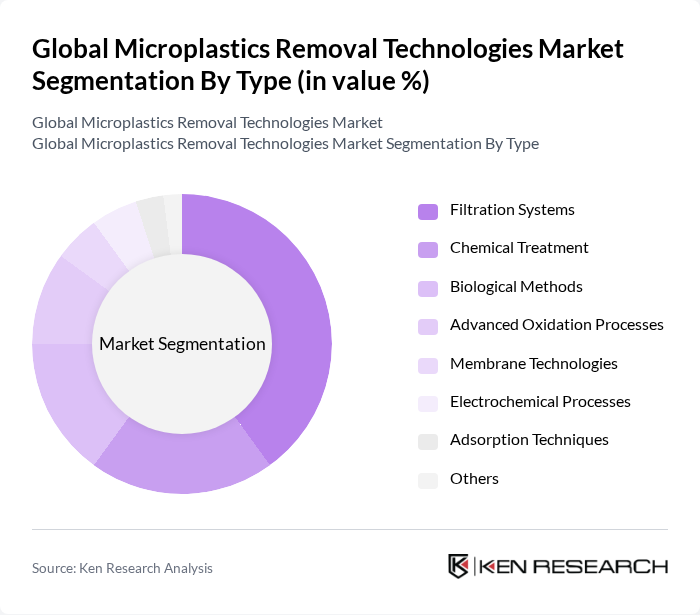
By Type:The market is segmented into various types of technologies used for microplastics removal. The dominant sub-segment is Filtration Systems, which are widely adopted due to their effectiveness in capturing microplastics from water sources. Chemical Treatment and Biological Methods are also gaining traction, with Biological Methods projected to see the fastest growth due to increasing research and adoption of eco-friendly solutions. Filtration Systems remain the preferred choice for many municipalities and industries due to their reliability, scalability, and efficiency.
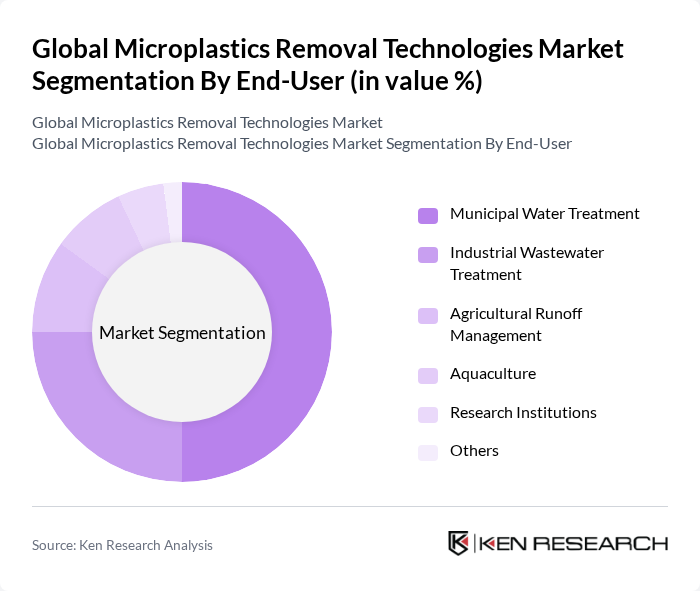
By End-User:The end-user segment includes various industries and sectors utilizing microplastics removal technologies. Municipal Water Treatment is the leading sub-segment, driven by the increasing need for clean drinking water and wastewater management. Industrial Wastewater Treatment and Agricultural Runoff Management are also significant contributors, with the municipal sector's demand for effective filtration solutions remaining the highest due to regulatory pressures and public health concerns. Marine and environmental protection initiatives are also expanding, reflecting growing attention to ocean health and biodiversity.
Global Microplastics Removal Technologies Market Competitive Landscape
The Global Microplastics Removal Technologies Market is characterized by a dynamic mix of regional and international players. Leading participants such as Wasser 3.0, CLEANR, PolyGone Systems, IADYS & ECOFARIO, CyFract, SATOORNIK, Matter Industries, PlanetCare, The Ocean Cleanup, GENeco, Veolia Environnement S.A., SUEZ S.A., Xylem Inc., Aquatech International LLC, Ecolab Inc., Dow Inc., BASF SE, 3M Company, Alfa Laval AB, Pentair plc, Aqualia S.A., IDEXX Laboratories, Inc., Danaher Corporation, Thermo Fisher Scientific Inc., EnviroChemie GmbH contribute to innovation, geographic expansion, and service delivery in this space.
Global Microplastics Removal Technologies Market Industry Analysis
Growth Drivers
- Increasing Environmental Awareness:The global push for environmental sustainability has led to heightened awareness regarding microplastics pollution. In future, approximately 70% of consumers in developed nations are expected to prioritize eco-friendly products, according to a report by the World Economic Forum. This shift is driving demand for microplastics removal technologies, as municipalities and industries seek solutions to mitigate environmental impact, thereby fostering a market growth environment that aligns with consumer values and regulatory expectations.
- Stringent Regulatory Frameworks:Governments worldwide are implementing stricter regulations to combat microplastics pollution. For instance, the European Union's new directive mandates a 50% reduction in microplastics in water bodies in future. This regulatory pressure is expected to increase investments in microplastics removal technologies, with an estimated $1.5 billion allocated for compliance initiatives in future. Such frameworks not only enhance market demand but also encourage innovation in removal technologies, creating a robust growth trajectory.
- Technological Advancements in Filtration:Innovations in filtration technologies are significantly enhancing the efficiency of microplastics removal. In future, advancements such as nanotechnology and advanced membrane filtration are projected to improve removal rates by up to 90%. This technological evolution is attracting investments, with an estimated $800 million earmarked for R&D in filtration technologies. As these technologies become more effective and cost-efficient, they are likely to drive widespread adoption across various sectors, including water treatment and industrial applications.
Market Challenges
- High Initial Investment Costs:The implementation of microplastics removal technologies often requires substantial upfront capital. In future, the average cost for advanced filtration systems is projected to be around $500,000 per facility, which can deter smaller enterprises from investing. This financial barrier limits market penetration and slows the adoption of necessary technologies, particularly in regions with constrained budgets for environmental initiatives, thereby hindering overall market growth.
- Limited Awareness Among End-Users:Despite the growing environmental concerns, many end-users remain unaware of the benefits of microplastics removal technologies. A survey by the International Water Association indicated that only 30% of water treatment facilities are familiar with advanced removal options. This lack of awareness can lead to underutilization of available technologies, stalling market growth and delaying the implementation of effective solutions to combat microplastics pollution.
Global Microplastics Removal Technologies Market Future Outlook
The future of microplastics removal technologies is poised for significant transformation, driven by increasing environmental regulations and technological innovations. As governments enforce stricter standards, the demand for effective removal solutions will rise, particularly in emerging markets where industrial growth is accelerating. Additionally, advancements in AI and machine learning are expected to enhance monitoring and efficiency, creating a more responsive and adaptive market landscape. This convergence of regulatory pressure and technological progress will likely shape the industry's trajectory in the coming years.
Market Opportunities
- Expansion in Emerging Markets:Emerging economies are increasingly recognizing the need for sustainable water management solutions. In future, countries like India and Brazil are projected to invest over $300 million in microplastics removal technologies, driven by urbanization and industrialization. This presents a significant opportunity for companies to establish a foothold in these markets, catering to the growing demand for effective water treatment solutions.
- Development of Innovative Removal Technologies:The ongoing research into novel materials and methods for microplastics removal presents a lucrative opportunity. In future, an estimated $200 million is expected to be invested in developing biodegradable filtration materials. This innovation not only addresses environmental concerns but also aligns with consumer preferences for sustainable products, positioning companies at the forefront of the market as they introduce cutting-edge solutions.
Scope of the Report
| Segment | Sub-Segments |
|---|---|
| By Type | Filtration Systems Chemical Treatment Biological Methods Advanced Oxidation Processes Membrane Technologies Electrochemical Processes Adsorption Techniques Others |
| By End-User | Municipal Water Treatment Industrial Wastewater Treatment Agricultural Runoff Management Aquaculture Research Institutions Others |
| By Application | Wastewater Treatment Drinking Water Purification Marine & Environmental Protection Industrial Process Water Research & Development Others |
| By Distribution Channel | Direct Sales Online Sales Distributors Retail Outlets Others |
| By Region | North America Europe Asia-Pacific Latin America Middle East & Africa Others |
| By Technology | Filtration Technologies Chemical Treatment Technologies Biological Treatment Technologies Hybrid Technologies Others |
| By Investment Source | Private Investments Government Grants Public-Private Partnerships International Funding Others |
Key Target Audience
Investors and Venture Capitalist Firms
Government and Regulatory Bodies (e.g., Environmental Protection Agency, European Chemicals Agency)
Manufacturers and Producers of Microplastics Removal Technologies
Waste Management Companies
Environmental NGOs and Advocacy Groups
Water Treatment Facilities
Marine Conservation Organizations
Public Health Agencies
Players Mentioned in the Report:
Wasser 3.0
CLEANR
PolyGone Systems
IADYS & ECOFARIO
CyFract
SATOORNIK
Matter Industries
PlanetCare
The Ocean Cleanup
GENeco
Veolia Environnement S.A.
SUEZ S.A.
Xylem Inc.
Aquatech International LLC
Ecolab Inc.
Dow Inc.
BASF SE
3M Company
Alfa Laval AB
Pentair plc
Aqualia S.A.
IDEXX Laboratories, Inc.
Danaher Corporation
Thermo Fisher Scientific Inc.
EnviroChemie GmbH
Table of Contents
Market Assessment Phase
1. Executive Summary and Approach
2. Global Microplastics Removal Technologies Market Overview
2.1 Key Insights and Strategic Recommendations
2.2 Global Microplastics Removal Technologies Market Overview
2.3 Definition and Scope
2.4 Evolution of Market Ecosystem
2.5 Timeline of Key Regulatory Milestones
2.6 Value Chain & Stakeholder Mapping
2.7 Business Cycle Analysis
2.8 Policy & Incentive Landscape
3. Global Microplastics Removal Technologies Market Analysis
3.1 Growth Drivers
3.1.1 Increasing Environmental Awareness
3.1.2 Stringent Regulatory Frameworks
3.1.3 Technological Advancements in Filtration
3.1.4 Rising Demand from Water Treatment Facilities
3.2 Market Challenges
3.2.1 High Initial Investment Costs
3.2.2 Limited Awareness Among End-Users
3.2.3 Technological Limitations in Removal Efficiency
3.2.4 Regulatory Compliance Complexity
3.3 Market Opportunities
3.3.1 Expansion in Emerging Markets
3.3.2 Development of Innovative Removal Technologies
3.3.3 Partnerships with Environmental Organizations
3.3.4 Government Funding for Research and Development
3.4 Market Trends
3.4.1 Adoption of Biodegradable Materials
3.4.2 Integration of AI in Monitoring Systems
3.4.3 Growth of Circular Economy Initiatives
3.4.4 Increased Focus on Sustainable Practices
3.5 Government Regulation
3.5.1 Implementation of Plastic Waste Management Policies
3.5.2 Introduction of Standards for Microplastics in Water
3.5.3 Incentives for Companies Adopting Green Technologies
3.5.4 International Agreements on Marine Pollution
4. SWOT Analysis
5. Stakeholder Analysis
6. Porter's Five Forces Analysis
7. Global Microplastics Removal Technologies Market Market Size, 2019-2024
7.1 By Value
7.2 By Volume
7.3 By Average Selling Price
8. Global Microplastics Removal Technologies Market Segmentation
8.1 By Type
8.1.1 Filtration Systems
8.1.2 Chemical Treatment
8.1.3 Biological Methods
8.1.4 Advanced Oxidation Processes
8.1.5 Membrane Technologies
8.1.6 Electrochemical Processes
8.1.7 Adsorption Techniques
8.1.8 Others
8.2 By End-User
8.2.1 Municipal Water Treatment
8.2.2 Industrial Wastewater Treatment
8.2.3 Agricultural Runoff Management
8.2.4 Aquaculture
8.2.5 Research Institutions
8.2.6 Others
8.3 By Application
8.3.1 Wastewater Treatment
8.3.2 Drinking Water Purification
8.3.3 Marine & Environmental Protection
8.3.4 Industrial Process Water
8.3.5 Research & Development
8.3.6 Others
8.4 By Distribution Channel
8.4.1 Direct Sales
8.4.2 Online Sales
8.4.3 Distributors
8.4.4 Retail Outlets
8.4.5 Others
8.5 By Region
8.5.1 North America
8.5.2 Europe
8.5.3 Asia-Pacific
8.5.4 Latin America
8.5.5 Middle East & Africa
8.5.6 Others
8.6 By Technology
8.6.1 Filtration Technologies
8.6.2 Chemical Treatment Technologies
8.6.3 Biological Treatment Technologies
8.6.4 Hybrid Technologies
8.6.5 Others
8.7 By Investment Source
8.7.1 Private Investments
8.7.2 Government Grants
8.7.3 Public-Private Partnerships
8.7.4 International Funding
8.7.5 Others
9. Global Microplastics Removal Technologies Market Competitive Analysis
9.1 Market Share of Key Players
9.2 Cross Comparison of Key Players
9.2.1 Company Name
9.2.2 Group Size (Large, Medium, or Small as per industry convention)
9.2.3 Revenue Growth Rate (CAGR, 2021-2024, 2025-2030)
9.2.4 Market Penetration Rate (Installations, Contracts, or Market Share %)
9.2.5 Microplastics Removal Efficiency (%)
9.2.6 R&D Investment as % of Revenue
9.2.7 Product Innovation Rate (New Patents/Products per Year)
9.2.8 Regulatory Compliance (Certifications, Approvals)
9.2.9 Operational Cost per m³ Treated
9.2.10 Customer Segments Served (Municipal, Industrial, Marine, etc.)
9.2.11 Sustainability/ESG Score
9.2.12 Customer Satisfaction Score
9.3 SWOT Analysis of Top Players
9.4 Pricing Analysis
9.5 Detailed Profile of Major Companies
9.5.1 Wasser 3.0
9.5.2 CLEANR
9.5.3 PolyGone Systems
9.5.4 IADYS & ECOFARIO
9.5.5 CyFract
9.5.6 SATOORNIK
9.5.7 Matter Industries
9.5.8 PlanetCare
9.5.9 The Ocean Cleanup
9.5.10 GENeco
9.5.11 Veolia Environnement S.A.
9.5.12 SUEZ S.A.
9.5.13 Xylem Inc.
9.5.14 Aquatech International LLC
9.5.15 Ecolab Inc.
9.5.16 Dow Inc.
9.5.17 BASF SE
9.5.18 3M Company
9.5.19 Alfa Laval AB
9.5.20 Pentair plc
9.5.21 Aqualia S.A.
9.5.22 IDEXX Laboratories, Inc.
9.5.23 Danaher Corporation
9.5.24 Thermo Fisher Scientific Inc.
9.5.25 EnviroChemie GmbH
10. Global Microplastics Removal Technologies Market End-User Analysis
10.1 Procurement Behavior of Key Ministries
10.1.1 Government Procurement Policies
10.1.2 Budget Allocations for Environmental Technologies
10.1.3 Collaboration with Private Sector
10.2 Corporate Spend on Infrastructure & Energy
10.2.1 Investment in Water Treatment Facilities
10.2.2 Funding for Research and Development
10.2.3 Expenditure on Sustainable Practices
10.3 Pain Point Analysis by End-User Category
10.3.1 Cost of Implementation
10.3.2 Technical Expertise Requirements
10.3.3 Regulatory Compliance Challenges
10.4 User Readiness for Adoption
10.4.1 Awareness of Microplastics Issues
10.4.2 Availability of Funding
10.4.3 Training and Support Needs
10.5 Post-Deployment ROI and Use Case Expansion
10.5.1 Measurement of Environmental Impact
10.5.2 Cost Savings from Efficient Technologies
10.5.3 Opportunities for Scaling Solutions
11. Global Microplastics Removal Technologies Market Future Size, 2025-2030
11.1 By Value
11.2 By Volume
11.3 By Average Selling Price
Go-To-Market Strategy Phase
1. Whitespace Analysis + Business Model Canvas
1.1 Market Gaps Identification
1.2 Value Proposition Development
1.3 Revenue Streams Analysis
1.4 Cost Structure Evaluation
1.5 Key Partnerships Exploration
1.6 Customer Segmentation
1.7 Channels of Distribution
2. Marketing and Positioning Recommendations
2.1 Branding Strategies
2.2 Product USPs
2.3 Target Market Identification
2.4 Communication Strategies
2.5 Digital Marketing Approaches
3. Distribution Plan
3.1 Urban Retail Strategies
3.2 Rural NGO Tie-Ups
3.3 Online Distribution Channels
3.4 Partnerships with Local Distributors
4. Channel & Pricing Gaps
4.1 Underserved Routes
4.2 Pricing Bands Analysis
4.3 Competitor Pricing Strategies
4.4 Customer Willingness to Pay
5. Unmet Demand & Latent Needs
5.1 Category Gaps Identification
5.2 Consumer Segments Analysis
5.3 Emerging Trends Exploration
6. Customer Relationship
6.1 Loyalty Programs
6.2 After-Sales Service
6.3 Customer Feedback Mechanisms
7. Value Proposition
7.1 Sustainability Initiatives
7.2 Integrated Supply Chains
7.3 Competitive Advantages
8. Key Activities
8.1 Regulatory Compliance
8.2 Branding Efforts
8.3 Distribution Setup
9. Entry Strategy Evaluation
9.1 Domestic Market Entry Strategy
9.1.1 Product Mix Considerations
9.1.2 Pricing Band Strategy
9.1.3 Packaging Innovations
9.2 Export Entry Strategy
9.2.1 Target Countries Identification
9.2.2 Compliance Roadmap Development
10. Entry Mode Assessment
10.1 Joint Ventures
10.2 Greenfield Investments
10.3 Mergers & Acquisitions
10.4 Distributor Model Evaluation
11. Capital and Timeline Estimation
11.1 Capital Requirements Analysis
11.2 Timelines for Implementation
12. Control vs Risk Trade-Off
12.1 Ownership Considerations
12.2 Partnerships Evaluation
13. Profitability Outlook
13.1 Breakeven Analysis
13.2 Long-Term Sustainability Strategies
14. Potential Partner List
14.1 Distributors Identification
14.2 Joint Ventures Opportunities
14.3 Acquisition Targets
15. Execution Roadmap
15.1 Phased Plan for Market Entry
15.1.1 Market Setup
15.1.2 Market Entry
15.1.3 Growth Acceleration
15.1.4 Scale & Stabilize
15.2 Key Activities and Milestones
15.2.1 Milestone Planning
15.2.2 Activity Tracking
Research Methodology
Phase 1: Approach1
Desk Research
- Analysis of published studies on microplastics and their environmental impact
- Review of market reports from environmental agencies and NGOs focused on plastic pollution
- Examination of patents and technological advancements in microplastics removal technologies
Primary Research
- Interviews with technology developers specializing in microplastics filtration systems
- Surveys with environmental scientists and researchers in marine biology
- Field interviews with waste management professionals and municipal authorities
Validation & Triangulation
- Cross-validation of findings through multiple expert interviews and literature reviews
- Triangulation of data from environmental studies, market trends, and regulatory frameworks
- Sanity checks through feedback from a panel of industry experts and stakeholders
Phase 2: Market Size Estimation1
Top-down Assessment
- Estimation of the global microplastics pollution levels and their economic implications
- Analysis of government spending on environmental cleanup initiatives
- Incorporation of international regulations and agreements on plastic waste management
Bottom-up Modeling
- Data collection from leading manufacturers of microplastics removal technologies
- Operational cost analysis based on technology deployment and maintenance
- Volume estimates based on the scale of microplastics generated in various sectors
Forecasting & Scenario Analysis
- Multi-factor regression analysis considering technological adoption rates and environmental policies
- Scenario modeling based on potential regulatory changes and public awareness campaigns
- Baseline, optimistic, and pessimistic forecasts through 2030 based on market dynamics
Phase 3: CATI Sample Composition1
| Scope Item/Segment | Sample Size | Target Respondent Profiles |
|---|---|---|
| Microplastics Filtration Technology Providers | 60 | Product Managers, R&D Directors |
| Environmental NGOs and Advocacy Groups | 50 | Policy Analysts, Program Directors |
| Waste Management Companies | 40 | Operations Managers, Environmental Compliance Officers |
| Academic Researchers in Environmental Science | 40 | Professors, Research Fellows |
| Government Regulatory Bodies | 40 | Environmental Policy Makers, Compliance Officers |
Frequently Asked Questions
What is the current value of the Global Microplastics Removal Technologies Market?
The Global Microplastics Removal Technologies Market is valued at approximately USD 1.2 billion, driven by increasing environmental awareness, stringent regulations, and advancements in filtration technologies aimed at addressing microplastics pollution in water and food sources.
What are the main drivers of growth in the microplastics removal technologies market?
Which regions are leading in the microplastics removal technologies market?
What types of technologies are used for microplastics removal?
Other Regional/Country Reports
Indonesia Microplastics Removal Technologies Market
Malaysia Microplastics Removal Technologies Market
KSA Microplastics Removal Technologies Market
APAC Microplastics Removal Technologies Market
SEA Microplastics Removal Technologies Market
Vietnam Microplastics Removal Technologies Market
Other Adjacent Reports
UAE Water Filtration Systems Market
KSA Wastewater Treatment Market
Mexico Environmental Monitoring Market
Indonesia Plastic Waste Management Market
UAE Marine Pollution Control Market
UAE Nanofiltration Technology Market
Germany Biodegradable Plastics Market
Germany Sustainable Packaging Market
Thailand Ocean Cleanup Technologies Market
Philippines Pollution Control Equipment Market
Why Buy From Us?

What makes us stand out is that our consultants follow Robust, Refine and Result (RRR) methodology. Robust for clear definitions, approaches and sanity checking, Refine for differentiating respondents' facts and opinions, and Result for presenting data with story.

We have set a benchmark in the industry by offering our clients with syndicated and customized market research reports featuring coverage of entire market as well as meticulous research and analyst insights.

While we don't replace traditional research, we flip the method upside down. Our dual approach of Top Bottom & Bottom Top ensures quality deliverable by not just verifying company fundamentals but also looking at the sector and macroeconomic factors.

With one step in the future, our research team constantly tries to show you the bigger picture. We help with some of the tough questions you may encounter along the way: How is the industry positioned? Best marketing channel? KPI's of competitors? By aligning every element, we help maximize success.

Our report gives you instant access to the answers and sources that other companies might choose to hide. We elaborate each steps of research methodology we have used and showcase you the sample size to earn your trust.

If you need any support, we are here! We pride ourselves on universe strength, data quality, and quick, friendly, and professional service.