About the Report
Base Year 2024Global Military Gas Mask Market Overview
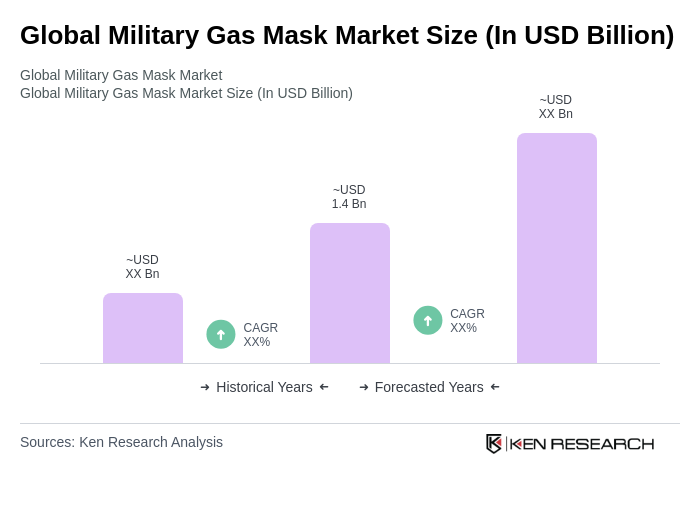
- The Global Military Gas Mask Market is valued at USD 1.4 billion, based on a five-year historical analysis. This growth is primarily driven by increasing geopolitical tensions, the rise in terrorist activities, and the need for enhanced personal protective equipment among military and law enforcement agencies. The demand for advanced filtration technologies, such as powered respirators and improved ergonomic designs, as well as enhanced comfort features in gas masks, has further propelled market expansion. Key trends include the introduction of new and improved versions of military gas masks and rising demand from developing regions .
- Key players in this market include the United States, Russia, and China, which dominate due to their significant military expenditures and ongoing modernization programs. The presence of established defense contractors and a focus on research and development in these countries also contribute to their market leadership, ensuring the availability of advanced gas mask technologies .
- In 2023, the U.S. Department of Defense issued the “CBRN Respiratory Protection Program Requirements, 2023” under the authority of the Department of Defense Instruction (DoDI) 6055.05. This regulation mandates the use of advanced gas masks for all military personnel deployed in high-risk environments, specifying minimum performance standards, fit testing, and training requirements. The regulation aims to enhance the safety and effectiveness of troops in chemical, biological, radiological, and nuclear (CBRN) scenarios, thereby increasing the demand for compliant gas mask products .
Global Military Gas Mask Market Segmentation
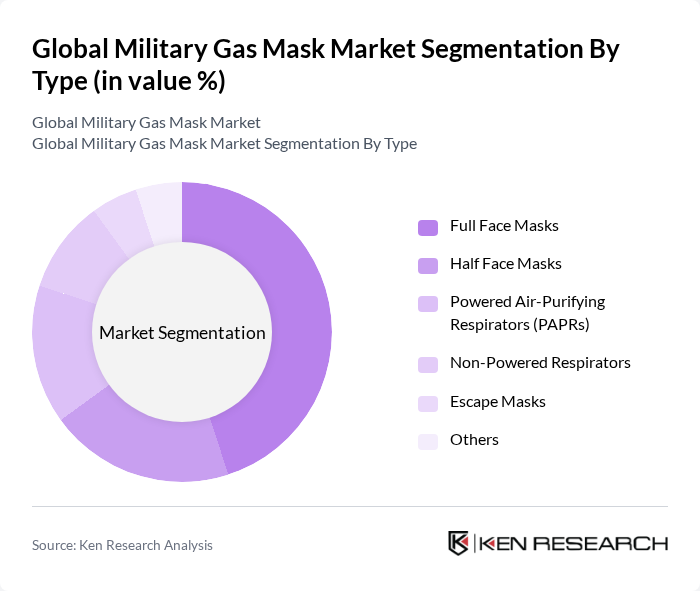
By Type:The market is segmented into various types of gas masks, including Full Face Masks, Half Face Masks, Powered Air-Purifying Respirators (PAPRs), Non-Powered Respirators, Escape Masks, and Others. Among these, Full Face Masks are the most dominant due to their comprehensive protection against a wide range of hazardous agents. They are preferred by military and law enforcement agencies for their ability to provide a secure seal and integrated communication systems, which are essential in operational scenarios. The increasing focus on soldier safety and the need for effective respiratory protection in combat situations further bolster the demand for Full Face Masks. Powered respirators are gaining popularity for long-duration missions due to enhanced comfort, while non-powered respirators remain widely used for their simplicity and reliability .
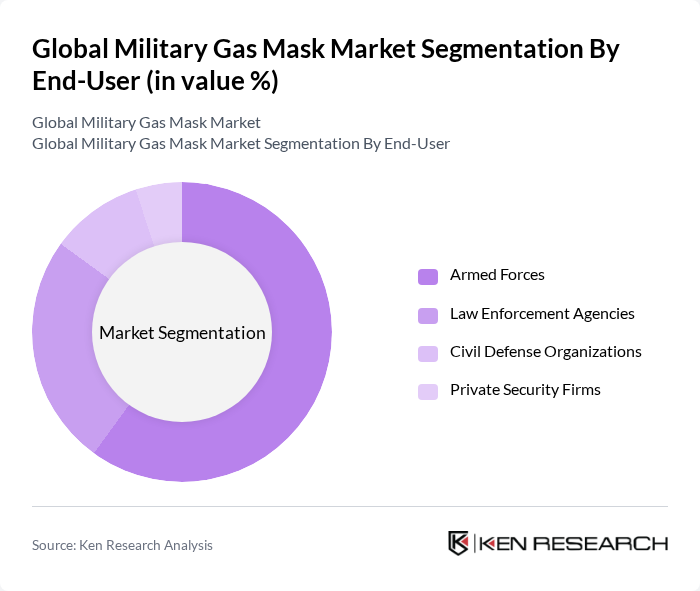
By End-User:The market is segmented by end-users, including Armed Forces, Law Enforcement Agencies, Civil Defense Organizations, and Private Security Firms. The Armed Forces segment holds the largest share, driven by the continuous need for advanced protective gear in military operations. The increasing focus on soldier survivability and the integration of modern technologies into military equipment have led to a surge in demand for military-grade gas masks. Law enforcement agencies also contribute significantly to the market, particularly in urban areas where chemical threats are a concern. Civil defense organizations and private security firms are emerging as notable end-users due to heightened preparedness initiatives .
Global Military Gas Mask Market Competitive Landscape
The Global Military Gas Mask Market is characterized by a dynamic mix of regional and international players. Leading participants such as 3M Company, Honeywell International Inc., Avon Protection plc, MSA Safety Incorporated, Drägerwerk AG & Co. KGaA, Scott Safety (now part of 3M), Safariland, LLC, Shalon Chemical Industries Ltd., JSP Limited, Bullard, CBRN Protection GmbH, Trelleborg AB, Martech Services Company, CBRN Defense (Division of Avon Protection), TSI Incorporated contribute to innovation, geographic expansion, and service delivery in this space .
Global Military Gas Mask Market Industry Analysis
Growth Drivers
- Increasing Military Expenditure:Global military expenditure reached approximately $2.1 trillion in future, with a projected increase to $2.3 trillion in future, according to the Stockholm International Peace Research Institute (SIPRI). This rise in defense budgets is primarily driven by nations enhancing their military capabilities amid rising threats. As countries invest more in advanced military equipment, the demand for high-quality military gas masks is expected to grow significantly, supporting the overall market expansion.
- Rising Geopolitical Tensions:The ongoing geopolitical tensions, particularly in regions like Eastern Europe and the South China Sea, have led to increased military readiness. The Global Peace Index reported a 10% rise in military conflicts in future, prompting nations to prioritize protective gear for their armed forces. This heightened focus on defense preparedness is expected to drive demand for military gas masks, as they are essential for soldier safety in hostile environments.
- Technological Advancements in Protective Gear:The military gas mask sector is witnessing rapid technological advancements, with innovations such as integrated communication systems and enhanced filtration technologies. The U.S. Department of Defense allocated $500 million in future for research and development in personal protective equipment. These advancements not only improve the effectiveness of gas masks but also increase their appeal to military organizations, thereby driving market growth.
Market Challenges
- High Manufacturing Costs:The production of military gas masks involves advanced materials and technologies, leading to high manufacturing costs. For instance, the cost of high-grade filtration materials can exceed $100 per unit. As manufacturers strive to maintain quality while managing expenses, the financial burden may hinder market growth. This challenge is particularly pronounced for smaller companies lacking the economies of scale enjoyed by larger manufacturers.
- Stringent Regulatory Requirements:Compliance with military standards and safety regulations poses a significant challenge for manufacturers. In the U.S., the National Institute for Occupational Safety and Health (NIOSH) mandates rigorous testing and certification processes for gas masks. The time and resources required to meet these standards can delay product launches and increase operational costs, potentially limiting market entry for new players and stifling innovation.
Global Military Gas Mask Market Future Outlook
The future of the military gas mask market appears promising, driven by ongoing advancements in technology and increasing military budgets. As nations continue to invest in defense capabilities, the demand for innovative protective gear will likely rise. Additionally, the integration of smart technologies and enhanced filtration systems will further enhance the functionality of gas masks, making them indispensable in modern warfare. The focus on sustainability will also shape product development, aligning with global environmental goals.
Market Opportunities
- Expansion into Emerging Markets:Emerging markets, particularly in Asia and Africa, are increasing their defense budgets. For example, Asia's military spending is projected to reach $500 billion in future. This growth presents significant opportunities for gas mask manufacturers to establish a presence in these regions, catering to the rising demand for advanced military equipment.
- Development of Smart Gas Mask Technologies:The development of smart gas masks equipped with sensors and communication capabilities is gaining traction. The global market for smart wearable technology is expected to reach $100 billion in future. This trend offers manufacturers the chance to innovate and differentiate their products, meeting the evolving needs of modern military forces.
Scope of the Report
| Segment | Sub-Segments |
|---|---|
| By Type | Full Face Masks Half Face Masks Powered Air-Purifying Respirators (PAPRs) Non-Powered Respirators Escape Masks Others |
| By End-User | Armed Forces Law Enforcement Agencies Civil Defense Organizations Private Security Firms |
| By Application | Chemical Defense Biological Defense Radiological Defense Nuclear Defense Industrial Hazards |
| By Distribution Channel | Direct Sales Online Retail Distributors Government Contracts |
| By Region | North America Europe Asia-Pacific Latin America Middle East & Africa |
| By Price Range | Low-End Masks Mid-Range Masks High-End Masks |
| By Brand | Established Brands Emerging Brands Private Labels |
Key Target Audience
Investors and Venture Capitalist Firms
Government and Regulatory Bodies (e.g., Department of Defense, Environmental Protection Agency)
Manufacturers and Producers
Distributors and Retailers
Military Procurement Agencies
Defense Contractors
Research and Development Organizations
Non-Governmental Organizations (NGOs) focused on defense and safety
Players Mentioned in the Report:
3M Company
Honeywell International Inc.
Avon Protection plc
MSA Safety Incorporated
Dragerwerk AG & Co. KGaA
Scott Safety (now part of 3M)
Safariland, LLC
Shalon Chemical Industries Ltd.
JSP Limited
Bullard
CBRN Protection GmbH
Trelleborg AB
Martech Services Company
CBRN Defense (Division of Avon Protection)
TSI Incorporated
Table of Contents
Market Assessment Phase
1. Executive Summary and Approach
2. Global Military Gas Mask Market Overview
2.1 Key Insights and Strategic Recommendations
2.2 Global Military Gas Mask Market Overview
2.3 Definition and Scope
2.4 Evolution of Market Ecosystem
2.5 Timeline of Key Regulatory Milestones
2.6 Value Chain & Stakeholder Mapping
2.7 Business Cycle Analysis
2.8 Policy & Incentive Landscape
3. Global Military Gas Mask Market Analysis
3.1 Growth Drivers
3.1.1 Increasing military expenditure
3.1.2 Rising geopolitical tensions
3.1.3 Technological advancements in protective gear
3.1.4 Growing demand for personal protective equipment
3.2 Market Challenges
3.2.1 High manufacturing costs
3.2.2 Stringent regulatory requirements
3.2.3 Competition from alternative protective solutions
3.2.4 Supply chain disruptions
3.3 Market Opportunities
3.3.1 Expansion into emerging markets
3.3.2 Development of smart gas mask technologies
3.3.3 Collaborations with defense contractors
3.3.4 Increasing focus on environmental sustainability
3.4 Market Trends
3.4.1 Integration of advanced filtration systems
3.4.2 Customization of gas masks for specific threats
3.4.3 Adoption of lightweight materials
3.4.4 Growth in online sales channels
3.5 Government Regulation
3.5.1 Compliance with military standards
3.5.2 Environmental regulations on materials
3.5.3 Import/export restrictions
3.5.4 Safety certifications for protective equipment
4. SWOT Analysis
5. Stakeholder Analysis
6. Porter's Five Forces Analysis
7. Global Military Gas Mask Market Market Size, 2019-2024
7.1 By Value
7.2 By Volume
7.3 By Average Selling Price
8. Global Military Gas Mask Market Segmentation
8.1 By Type
8.1.1 Full Face Masks
8.1.2 Half Face Masks
8.1.3 Powered Air-Purifying Respirators (PAPRs)
8.1.4 Non-Powered Respirators
8.1.5 Escape Masks
8.1.6 Others
8.2 By End-User
8.2.1 Armed Forces
8.2.2 Law Enforcement Agencies
8.2.3 Civil Defense Organizations
8.2.4 Private Security Firms
8.3 By Application
8.3.1 Chemical Defense
8.3.2 Biological Defense
8.3.3 Radiological Defense
8.3.4 Nuclear Defense
8.3.5 Industrial Hazards
8.4 By Distribution Channel
8.4.1 Direct Sales
8.4.2 Online Retail
8.4.3 Distributors
8.4.4 Government Contracts
8.5 By Region
8.5.1 North America
8.5.2 Europe
8.5.3 Asia-Pacific
8.5.4 Latin America
8.5.5 Middle East & Africa
8.6 By Price Range
8.6.1 Low-End Masks
8.6.2 Mid-Range Masks
8.6.3 High-End Masks
8.7 By Brand
8.7.1 Established Brands
8.7.2 Emerging Brands
8.7.3 Private Labels
9. Global Military Gas Mask Market Competitive Analysis
9.1 Market Share of Key Players
9.2 Cross Comparison of Key Players
9.2.1 Company Name
9.2.2 Company Size (Large, Medium, Small)
9.2.3 Military Gas Mask Segment Revenue
9.2.4 Revenue Growth Rate (Military Gas Mask Segment)
9.2.5 Market Share (Military Gas Mask Segment)
9.2.6 Geographic Presence (Number of Countries/Regions Served)
9.2.7 Number of Military Contracts Secured (Last 3 Years)
9.2.8 Product Portfolio Breadth (Number of Military Gas Mask Models)
9.2.9 R&D Investment as % of Revenue
9.2.10 Compliance Certifications (e.g., NATO, NIOSH, CE)
9.2.11 Delivery Lead Time (Average, in Weeks)
9.2.12 Customer Satisfaction Score (Defense Sector)
9.3 SWOT Analysis of Top Players
9.4 Pricing Analysis
9.5 Detailed Profile of Major Companies
9.5.1 3M Company
9.5.2 Honeywell International Inc.
9.5.3 Avon Protection plc
9.5.4 MSA Safety Incorporated
9.5.5 Drägerwerk AG & Co. KGaA
9.5.6 Scott Safety (now part of 3M)
9.5.7 Safariland, LLC
9.5.8 Shalon Chemical Industries Ltd.
9.5.9 JSP Limited
9.5.10 Bullard
9.5.11 CBRN Protection GmbH
9.5.12 Trelleborg AB
9.5.13 Martech Services Company
9.5.14 CBRN Defense (Division of Avon Protection)
9.5.15 TSI Incorporated
10. Global Military Gas Mask Market End-User Analysis
10.1 Procurement Behavior of Key Ministries
10.1.1 Defense Ministries
10.1.2 Interior Ministries
10.1.3 Emergency Services
10.2 Corporate Spend on Infrastructure & Energy
10.2.1 Budget Allocations for Safety Equipment
10.2.2 Investment in R&D for Protective Gear
10.3 Pain Point Analysis by End-User Category
10.3.1 Cost Constraints
10.3.2 Availability of Advanced Features
10.3.3 Compliance with Safety Standards
10.4 User Readiness for Adoption
10.4.1 Training and Familiarization Needs
10.4.2 Feedback on Existing Products
10.5 Post-Deployment ROI and Use Case Expansion
10.5.1 Performance Metrics
10.5.2 Long-term Cost Savings
11. Global Military Gas Mask Market Future Size, 2025-2030
11.1 By Value
11.2 By Volume
11.3 By Average Selling Price
Go-To-Market Strategy Phase
1. Whitespace Analysis + Business Model Canvas
1.1 Market Gaps Identification
1.2 Value Proposition Development
1.3 Revenue Streams Analysis
1.4 Customer Segmentation
1.5 Key Partnerships
1.6 Cost Structure Analysis
1.7 Competitive Advantage
2. Marketing and Positioning Recommendations
2.1 Branding Strategies
2.2 Product USPs
3. Distribution Plan
3.1 Urban Retail vs Rural NGO Tie-ups
4. Channel & Pricing Gaps
4.1 Underserved Routes
4.2 Pricing Bands
5. Unmet Demand & Latent Needs
5.1 Category Gaps
5.2 Consumer Segments
6. Customer Relationship
6.1 Loyalty Programs
6.2 After-sales Service
7. Value Proposition
7.1 Sustainability
7.2 Integrated Supply Chains
8. Key Activities
8.1 Regulatory Compliance
8.2 Branding
8.3 Distribution Setup
9. Entry Strategy Evaluation
9.1 Domestic Market Entry Strategy
9.1.1 Product Mix
9.1.2 Pricing Band
9.1.3 Packaging
9.2 Export Entry Strategy
9.2.1 Target Countries
9.2.2 Compliance Roadmap
10. Entry Mode Assessment
10.1 JV
10.2 Greenfield
10.3 M&A
10.4 Distributor Model
11. Capital and Timeline Estimation
11.1 Capital Requirements
11.2 Timelines
12. Control vs Risk Trade-Off
12.1 Ownership vs Partnerships
13. Profitability Outlook
13.1 Breakeven Analysis
13.2 Long-term Sustainability
14. Potential Partner List
14.1 Distributors
14.2 JVs
14.3 Acquisition Targets
15. Execution Roadmap
15.1 Phased Plan for Market Entry
15.1.1 Market Setup
15.1.2 Market Entry
15.1.3 Growth Acceleration
15.1.4 Scale & Stabilize
15.2 Key Activities and Milestones
15.2.1 Milestone Planning
15.2.2 Activity Tracking
Research Methodology
Phase 1: Approach1
Desk Research
- Analysis of global military gas mask market reports from defense industry publications
- Review of government defense procurement data and military expenditure reports
- Examination of academic journals and white papers on chemical and biological defense technologies
Primary Research
- Interviews with military procurement officers and defense contractors
- Surveys with experts in military safety and protective equipment
- Field interviews with end-users, including military personnel and first responders
Validation & Triangulation
- Cross-validation of findings through multiple expert interviews and industry reports
- Triangulation of data from procurement trends, market demand, and technological advancements
- Sanity checks through feedback from a panel of military and defense experts
Phase 2: Market Size Estimation1
Top-down Assessment
- Estimation of market size based on global military spending and defense budgets
- Segmentation by geographical regions and military branches (Army, Navy, Air Force)
- Incorporation of trends in defense modernization and procurement strategies
Bottom-up Modeling
- Volume estimates based on historical sales data from leading military gas mask manufacturers
- Cost analysis derived from production and operational expenses of gas mask units
- Calculation of market size based on unit sales and average selling prices
Forecasting & Scenario Analysis
- Multi-factor regression analysis considering geopolitical tensions and defense policy changes
- Scenario modeling based on potential increases in military budgets and emerging threats
- Baseline, optimistic, and pessimistic forecasts through 2030, reflecting market dynamics
Phase 3: CATI Sample Composition1
| Scope Item/Segment | Sample Size | Target Respondent Profiles |
|---|---|---|
| Military Procurement Departments | 60 | Procurement Officers, Defense Acquisition Managers |
| Defense Contractors and Manufacturers | 55 | Product Development Managers, Sales Directors |
| Military End-Users | 75 | Active Duty Personnel, Training Officers |
| First Responder Organizations | 45 | Emergency Response Coordinators, Safety Officers |
| Regulatory and Compliance Bodies | 40 | Policy Analysts, Compliance Managers |
Frequently Asked Questions
What is the current value of the Global Military Gas Mask Market?
The Global Military Gas Mask Market is valued at approximately USD 1.4 billion, reflecting a significant growth driven by geopolitical tensions, terrorist activities, and the demand for advanced personal protective equipment among military and law enforcement agencies.
What factors are driving the growth of the military gas mask market?
Which countries are the leading players in the military gas mask market?
What types of gas masks are available in the market?
Other Regional/Country Reports
Indonesia Military Gas Mask Market
Malaysia Military Gas Mask Market
APAC Military Gas Mask Market
SEA Military Gas Mask Market
Why Buy From Us?

What makes us stand out is that our consultants follow Robust, Refine and Result (RRR) methodology. Robust for clear definitions, approaches and sanity checking, Refine for differentiating respondents' facts and opinions, and Result for presenting data with story.

We have set a benchmark in the industry by offering our clients with syndicated and customized market research reports featuring coverage of entire market as well as meticulous research and analyst insights.

While we don't replace traditional research, we flip the method upside down. Our dual approach of Top Bottom & Bottom Top ensures quality deliverable by not just verifying company fundamentals but also looking at the sector and macroeconomic factors.

With one step in the future, our research team constantly tries to show you the bigger picture. We help with some of the tough questions you may encounter along the way: How is the industry positioned? Best marketing channel? KPI's of competitors? By aligning every element, we help maximize success.

Our report gives you instant access to the answers and sources that other companies might choose to hide. We elaborate each steps of research methodology we have used and showcase you the sample size to earn your trust.

If you need any support, we are here! We pride ourselves on universe strength, data quality, and quick, friendly, and professional service.