About the Report
Base Year 2024Global Non Destructive Testing In Aerospace Defense Market Overview
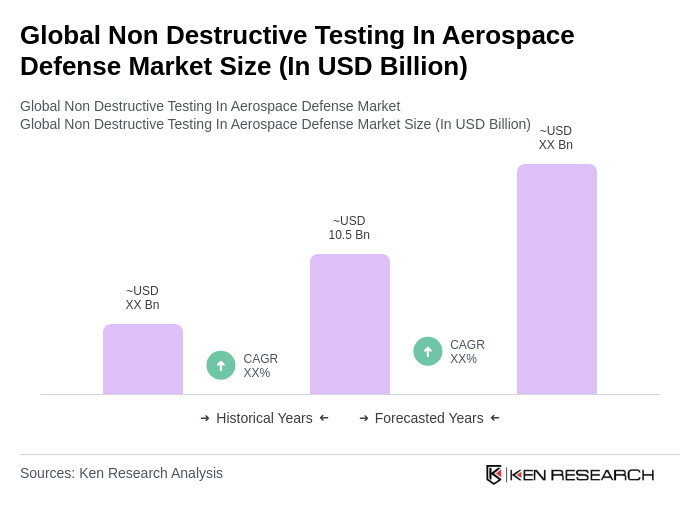
- The Global Non Destructive Testing in Aerospace Defense Market is valued at USD 10.5 billion, based on a five-year historical analysis. This value aligns with recent industry assessments that place the aerospace and defense NDT market size around ten billion United States dollars, reflecting robust demand across services and equipment as airframe and engine OEMs and MROs intensify inspection requirements .
- Key players in this market include the United States, Germany, and the United Kingdom, which dominate due to their robust aerospace industries and significant investments in defense technologies. These countries host leading airframe and engine OEMs, extensive MRO networks, and defense primes, driving early adoption of advanced NDT, including digital radiography, phased array ultrasonics, and eddy current modalities .
- In 2023, the Federal Aviation Administration (FAA) implemented new regulations mandating the use of advanced NDT methods for critical aerospace components. While the FAA continuously issues Airworthiness Directives and updates maintenance and inspection guidance that effectively require specific NDT methods for critical structures, there was no single omnibus rule in that year mandating “advanced NDT” across all components; instead, enforcement occurs via type design, maintenance programs, and directives governing NDT techniques and personnel qualifications (e.g., ASTM/ASNT, NAS-410) within FAA-approved programs .
Global Non Destructive Testing In Aerospace Defense Market Segmentation
By Type:The market is segmented into various types of non-destructive testing methods, each serving specific inspection needs within the aerospace defense sector. The primary types include Ultrasonic Testing (UT), Radiographic Testing (X-ray, Digital RT, CT), Magnetic Particle Testing (MT), Liquid Penetrant Testing (PT), Eddy Current & Electromagnetic Testing (ET), Visual Testing & Remote Visual Inspection (VT/RVI), and Acoustic Emission & Thermography (AE/IR). Each method has unique advantages, making them suitable for different applications in aerospace components .
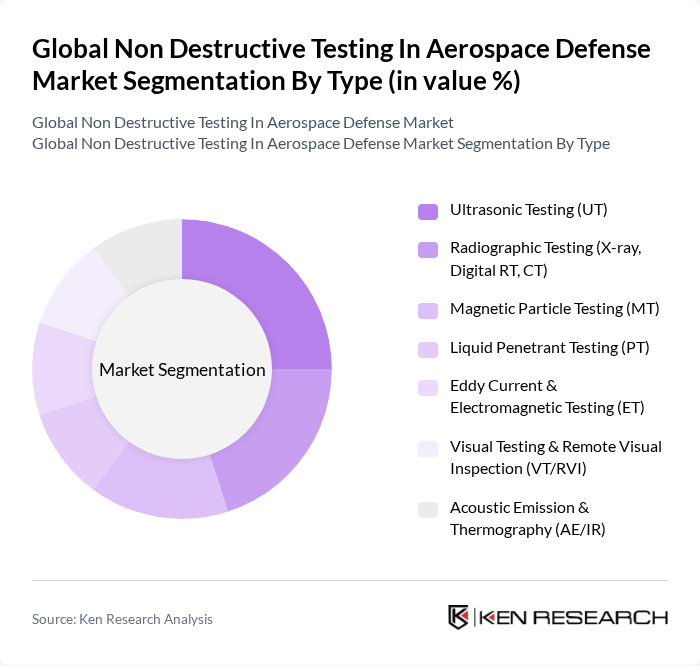
The Ultrasonic Testing (UT) segment is currently dominating the market due to its versatility and effectiveness in detecting internal flaws in metals and composites, with phased array UT and guided waves widely used on airframes, engine disks, and blades in OEM and MRO settings .
By End-User:The market is segmented based on end-users, which include Commercial Aviation (Airframers, MROs, Airlines), Military Aviation (Air Forces, Depots, OEM sustainment), Space Systems (Launch vehicles, Satellites, Spacecraft), and Defense OEMs & Tier Suppliers (Airframe/Engine/Systems). Each end-user segment has distinct requirements and applications for NDT, influencing the overall market dynamics .
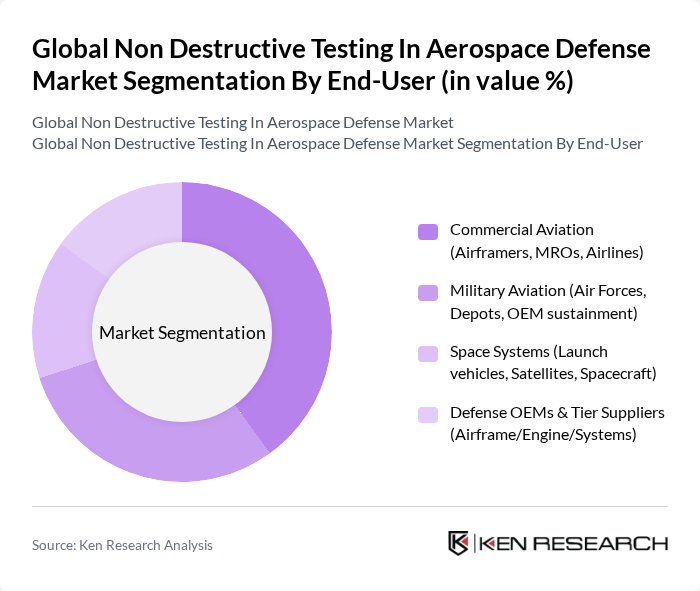
The Commercial Aviation segment leads the market, supported by sustained recovery in passenger traffic and record OEM backlogs that drive manufacturing inspections, as well as heavy maintenance checks that require extensive NDT across fuselage, wings, landing gear, and engines in airline and MRO operations .
Global Non Destructive Testing In Aerospace Defense Market Competitive Landscape
The Global Non Destructive Testing In Aerospace Defense Market is characterized by a dynamic mix of regional and international players. Leading participants such as Waygate Technologies (Baker Hughes), Olympus Corporation (Evident Scientific), Eddyfi Technologies, Zetec, Inc. (Eddyfi/NDT), MISTRAS Group, Inc., Acuren Group Inc., SGS S.A., Intertek Group plc, TÜV Rheinland AG, Applus+ (Applus Services, S.A.), NDT Global (Eddyfi/NDT), Sonatest Ltd., Hexagon AB (Inserts for metrology-based NDT/inspection), Magnaflux (ITW), TE Connectivity – CWT (Cables/Wire Testing & Sensors) contribute to innovation, geographic expansion, and service delivery in this space.
Global Non Destructive Testing In Aerospace Defense Market Industry Analysis
Growth Drivers
- Increasing Demand for Safety and Quality Assurance:The aerospace defense sector is projected to allocate approximately $1.5 billion in future towards enhancing safety and quality assurance measures. This investment is driven by the need to comply with stringent safety regulations and to ensure the reliability of aircraft components. The global focus on reducing accidents and improving operational efficiency is expected to further boost the demand for non-destructive testing (NDT) methods, which are critical for maintaining high safety standards.
- Technological Advancements in NDT Methods:The introduction of advanced NDT technologies, such as ultrasonic testing and eddy current testing, is expected to enhance inspection capabilities significantly. In future, the market for advanced NDT technologies is anticipated to reach $2 billion, driven by innovations that improve accuracy and reduce inspection times. These advancements are crucial for meeting the evolving demands of the aerospace defense industry, where precision and reliability are paramount for operational success.
- Rising Investments in Aerospace Defense Sector:Global investments in the aerospace defense sector are projected to exceed $2 trillion in future, reflecting a robust growth trajectory. This surge in funding is primarily attributed to geopolitical tensions and the need for modernization of defense capabilities. As a result, the demand for NDT services is expected to rise, as manufacturers seek to ensure the integrity and performance of critical aerospace components amidst increasing production rates and technological complexity.
Market Challenges
- High Initial Investment Costs:The implementation of advanced NDT technologies often requires significant upfront capital investment, which can exceed $500,000 for small to medium-sized enterprises. This financial barrier can deter companies from adopting necessary NDT solutions, particularly in a competitive market where cost efficiency is crucial. As a result, many organizations may struggle to keep pace with technological advancements, limiting their operational capabilities and market competitiveness.
- Lack of Skilled Workforce:The aerospace defense sector faces a critical shortage of skilled NDT professionals, with estimates indicating a gap of over 20,000 qualified technicians in future. This shortage is exacerbated by the rapid evolution of NDT technologies, which require specialized training and expertise. Consequently, companies may experience delays in project timelines and increased operational risks, as the lack of skilled personnel hampers effective implementation of NDT processes.
Global Non Destructive Testing In Aerospace Defense Market Future Outlook
The future of non-destructive testing in the aerospace defense sector appears promising, driven by ongoing technological innovations and increasing regulatory pressures. As companies adopt automation and artificial intelligence, the efficiency and accuracy of NDT processes are expected to improve significantly. Furthermore, the integration of IoT technologies will facilitate real-time monitoring and predictive maintenance, enhancing operational reliability. These trends indicate a shift towards more sophisticated and efficient NDT practices, positioning the industry for sustainable growth in the coming years.
Market Opportunities
- Expansion in Emerging Markets:Emerging markets, particularly in Asia-Pacific, are expected to witness a surge in aerospace defense spending, projected to reach $300 billion in future. This growth presents significant opportunities for NDT service providers to establish a foothold in these regions, catering to the increasing demand for safety and quality assurance in aerospace manufacturing.
- Development of Advanced NDT Technologies:The continuous development of advanced NDT technologies, such as digital radiography and thermography, is anticipated to create new market opportunities. With an estimated investment of $150 million in R&D for future, companies that innovate and adopt these technologies can enhance their service offerings, thereby gaining a competitive edge in the aerospace defense sector.
Scope of the Report
| Segment | Sub-Segments |
|---|---|
| By Type | Ultrasonic Testing (UT) Radiographic Testing (X-ray, Digital RT, CT) Magnetic Particle Testing (MT) Liquid Penetrant Testing (PT) Eddy Current & Electromagnetic Testing (ET) Visual Testing & Remote Visual Inspection (VT/RVI) Acoustic Emission & Thermography (AE/IR) |
| By End-User | Commercial Aviation (Airframers, MROs, Airlines) Military Aviation (Air Forces, Depots, OEM sustainment) Space Systems (Launch vehicles, Satellites, Spacecraft) Defense OEMs & Tier Suppliers (Airframe/Engine/Systems) |
| By Application | Airframe & Structural Integrity Inspection Engine & Propulsion Component Inspection Maintenance, Repair & Overhaul (Line/Heavy MRO) Production Quality Control & Certification |
| By Component | Primary/Secondary Structures (Wings, Fuselage, Composites) Engines & Rotating Parts (Disks, Blades, Vanes) Avionics & Wiring Harnesses Landing Gear & Critical Hardware |
| By Sales Channel | Direct to OEM/MRO/Defense Authorized Distributors & System Integrators Online/Inside Sales |
| By Distribution Mode | On-site Services (Field/Depot) In-house Labs & Test Facilities Mobile/Portable NDT Units |
| By Price Range | Entry-Level Portable Instruments Mid-Range Systems & Software Suites High-End Automated/Robotic Systems |
Key Target Audience
Investors and Venture Capitalist Firms
Government and Regulatory Bodies (e.g., Federal Aviation Administration, European Union Aviation Safety Agency)
Aerospace Manufacturers
Defense Contractors
Quality Assurance and Inspection Agencies
Non-Destructive Testing Equipment Suppliers
Aerospace and Defense Industry Associations
Military Procurement Agencies
Players Mentioned in the Report:
Waygate Technologies (Baker Hughes)
Olympus Corporation (Evident Scientific)
Eddyfi Technologies
Zetec, Inc. (Eddyfi/NDT)
MISTRAS Group, Inc.
Acuren Group Inc.
SGS S.A.
Intertek Group plc
TUV Rheinland AG
Applus+ (Applus Services, S.A.)
NDT Global (Eddyfi/NDT)
Sonatest Ltd.
Hexagon AB (Inserts for metrology-based NDT/inspection)
Magnaflux (ITW)
TE Connectivity CWT (Cables/Wire Testing & Sensors)
Table of Contents
Market Assessment Phase
1. Executive Summary and Approach
2. Global Non Destructive Testing In Aerospace Defense Market Overview
2.1 Key Insights and Strategic Recommendations
2.2 Global Non Destructive Testing In Aerospace Defense Market Overview
2.3 Definition and Scope
2.4 Evolution of Market Ecosystem
2.5 Timeline of Key Regulatory Milestones
2.6 Value Chain & Stakeholder Mapping
2.7 Business Cycle Analysis
2.8 Policy & Incentive Landscape
3. Global Non Destructive Testing In Aerospace Defense Market Analysis
3.1 Growth Drivers
3.1.1 Increasing Demand for Safety and Quality Assurance
3.1.2 Technological Advancements in NDT Methods
3.1.3 Rising Investments in Aerospace Defense Sector
3.1.4 Stringent Regulatory Standards
3.2 Market Challenges
3.2.1 High Initial Investment Costs
3.2.2 Lack of Skilled Workforce
3.2.3 Integration of NDT with Existing Systems
3.2.4 Variability in Regulatory Compliance
3.3 Market Opportunities
3.3.1 Expansion in Emerging Markets
3.3.2 Development of Advanced NDT Technologies
3.3.3 Collaborations and Partnerships
3.3.4 Increased Focus on Sustainable Practices
3.4 Market Trends
3.4.1 Adoption of Automation and AI in NDT
3.4.2 Growth of Digital Twin Technology
3.4.3 Shift Towards Predictive Maintenance
3.4.4 Integration of IoT in NDT Processes
3.5 Government Regulation
3.5.1 FAA Regulations on Aircraft Safety
3.5.2 ISO Standards for NDT Practices
3.5.3 Military Standards for Aerospace Components
3.5.4 Environmental Regulations Impacting NDT Methods
4. SWOT Analysis
5. Stakeholder Analysis
6. Porter's Five Forces Analysis
7. Global Non Destructive Testing In Aerospace Defense Market Market Size, 2019-2024
7.1 By Value
7.2 By Volume
7.3 By Average Selling Price
8. Global Non Destructive Testing In Aerospace Defense Market Segmentation
8.1 By Type
8.1.1 Ultrasonic Testing (UT)
8.1.2 Radiographic Testing (X-ray, Digital RT, CT)
8.1.3 Magnetic Particle Testing (MT)
8.1.4 Liquid Penetrant Testing (PT)
8.1.5 Eddy Current & Electromagnetic Testing (ET)
8.1.6 Visual Testing & Remote Visual Inspection (VT/RVI)
8.1.7 Acoustic Emission & Thermography (AE/IR)
8.2 By End-User
8.2.1 Commercial Aviation (Airframers, MROs, Airlines)
8.2.2 Military Aviation (Air Forces, Depots, OEM sustainment)
8.2.3 Space Systems (Launch vehicles, Satellites, Spacecraft)
8.2.4 Defense OEMs & Tier Suppliers (Airframe/Engine/Systems)
8.3 By Application
8.3.1 Airframe & Structural Integrity Inspection
8.3.2 Engine & Propulsion Component Inspection
8.3.3 Maintenance, Repair & Overhaul (Line/Heavy MRO)
8.3.4 Production Quality Control & Certification
8.4 By Component
8.4.1 Primary/Secondary Structures (Wings, Fuselage, Composites)
8.4.2 Engines & Rotating Parts (Disks, Blades, Vanes)
8.4.3 Avionics & Wiring Harnesses
8.4.4 Landing Gear & Critical Hardware
8.5 By Sales Channel
8.5.1 Direct to OEM/MRO/Defense
8.5.2 Authorized Distributors & System Integrators
8.5.3 Online/Inside Sales
8.6 By Distribution Mode
8.6.1 On-site Services (Field/Depot)
8.6.2 In-house Labs & Test Facilities
8.6.3 Mobile/Portable NDT Units
8.7 By Price Range
8.7.1 Entry-Level Portable Instruments
8.7.2 Mid-Range Systems & Software Suites
8.7.3 High-End Automated/Robotic Systems
9. Global Non Destructive Testing In Aerospace Defense Market Competitive Analysis
9.1 Market Share of Key Players
9.2 Cross Comparison of Key Players
9.2.1 Company Name
9.2.2 Group Size (OEM, Tier-1, Tier-2, or Specialist Service Provider)
9.2.3 Aerospace & Defense NDT Revenue (latest FY, USD)
9.2.4 Revenue Growth Rate (CAGR, 3–5 years)
9.2.5 Installed Base/Deployments in A&D (units or sites)
9.2.6 Certification Footprint (NADCAP/AS9100/ISO 17025 counts)
9.2.7 Technology Breadth (number of NDT modalities offered)
9.2.8 R&D Intensity (R&D as % of revenue)
9.2.9 Digital/Automation Adoption (robots, digital RT, PAUT, AI features)
9.2.10 Contract Wins in A&D (recent OEM/MRO/defense awards)
9.2.11 Global Service Coverage (regions, number of labs/depots)
9.2.12 Average Deal Size in A&D (USD)
9.3 SWOT Analysis of Top Players
9.4 Pricing Analysis
9.5 Detailed Profile of Major Companies
9.5.1 Waygate Technologies (Baker Hughes)
9.5.2 Olympus Corporation (Evident Scientific)
9.5.3 Eddyfi Technologies
9.5.4 Zetec, Inc. (Eddyfi/NDT)
9.5.5 MISTRAS Group, Inc.
9.5.6 Acuren Group Inc.
9.5.7 SGS S.A.
9.5.8 Intertek Group plc
9.5.9 TÜV Rheinland AG
9.5.10 Applus+ (Applus Services, S.A.)
9.5.11 NDT Global (Eddyfi/NDT)
9.5.12 Sonatest Ltd.
9.5.13 Hexagon AB (Inserts for metrology-based NDT/inspection)
9.5.14 Magnaflux (ITW)
9.5.15 TE Connectivity – CWT (Cables/Wire Testing & Sensors)
10. Global Non Destructive Testing In Aerospace Defense Market End-User Analysis
10.1 Procurement Behavior of Key Ministries
10.1.1 Defense Procurement Policies
10.1.2 Budget Allocation Trends
10.1.3 Supplier Selection Criteria
10.1.4 Contracting Processes
10.2 Corporate Spend on Infrastructure & Energy
10.2.1 Investment in Aerospace Infrastructure
10.2.2 Funding for R&D in NDT Technologies
10.2.3 Budgeting for Maintenance and Upgrades
10.3 Pain Point Analysis by End-User Category
10.3.1 Compliance with Safety Standards
10.3.2 Cost Management in NDT Processes
10.3.3 Technology Integration Challenges
10.4 User Readiness for Adoption
10.4.1 Training and Skill Development Needs
10.4.2 Awareness of NDT Benefits
10.4.3 Infrastructure Readiness
10.5 Post-Deployment ROI and Use Case Expansion
10.5.1 Measurement of NDT Effectiveness
10.5.2 Expansion into New Applications
10.5.3 Long-term Cost Savings Analysis
11. Global Non Destructive Testing In Aerospace Defense Market Future Size, 2025-2030
11.1 By Value
11.2 By Volume
11.3 By Average Selling Price
Go-To-Market Strategy Phase
1. Whitespace Analysis + Business Model Canvas
1.1 Market Gaps Identification
1.2 Value Proposition Development
1.3 Revenue Streams Analysis
1.4 Cost Structure Evaluation
1.5 Key Partnerships Exploration
1.6 Customer Segmentation
1.7 Channels of Distribution
2. Marketing and Positioning Recommendations
2.1 Branding Strategies
2.2 Product USPs
2.3 Target Market Identification
2.4 Communication Strategies
2.5 Digital Marketing Approaches
3. Distribution Plan
3.1 Urban Retail Strategies
3.2 Rural NGO Tie-ups
3.3 Online Distribution Channels
3.4 Direct Sales Approaches
4. Channel & Pricing Gaps
4.1 Underserved Routes
4.2 Pricing Bands Analysis
4.3 Competitor Pricing Strategies
5. Unmet Demand & Latent Needs
5.1 Category Gaps Identification
5.2 Consumer Segments Analysis
5.3 Emerging Trends Exploration
6. Customer Relationship
6.1 Loyalty Programs Development
6.2 After-sales Service Strategies
6.3 Customer Feedback Mechanisms
7. Value Proposition
7.1 Sustainability Initiatives
7.2 Integrated Supply Chains
7.3 Competitive Advantages
8. Key Activities
8.1 Regulatory Compliance
8.2 Branding Initiatives
8.3 Distribution Setup
9. Entry Strategy Evaluation
9.1 Domestic Market Entry Strategy
9.1.1 Product Mix Considerations
9.1.2 Pricing Band Strategies
9.1.3 Packaging Innovations
9.2 Export Entry Strategy
9.2.1 Target Countries Identification
9.2.2 Compliance Roadmap Development
10. Entry Mode Assessment
10.1 Joint Ventures
10.2 Greenfield Investments
10.3 Mergers & Acquisitions
10.4 Distributor Model Evaluation
11. Capital and Timeline Estimation
11.1 Capital Requirements Analysis
11.2 Timelines for Implementation
12. Control vs Risk Trade-Off
12.1 Ownership vs Partnerships
12.2 Risk Management Strategies
13. Profitability Outlook
13.1 Breakeven Analysis
13.2 Long-term Sustainability Strategies
14. Potential Partner List
14.1 Distributors Identification
14.2 Joint Ventures Opportunities
14.3 Acquisition Targets
15. Execution Roadmap
15.1 Phased Plan for Market Entry
15.1.1 Market Setup
15.1.2 Market Entry
15.1.3 Growth Acceleration
15.1.4 Scale & Stabilize
15.2 Key Activities and Milestones
15.2.1 Milestone Planning
15.2.2 Activity Tracking
Research Methodology
Phase 1: Approach1
Desk Research
- Industry reports from aerospace defense associations and regulatory bodies
- Market analysis publications focusing on non-destructive testing (NDT) technologies
- Technical papers and white papers from leading NDT equipment manufacturers
Primary Research
- Interviews with aerospace engineers specializing in NDT applications
- Surveys with quality assurance managers in defense contracting firms
- Field interviews with technicians operating NDT equipment in aerospace settings
Validation & Triangulation
- Cross-validation of findings through multiple industry expert interviews
- Triangulation of data from market reports, expert insights, and field observations
- Sanity checks through peer reviews and feedback from industry stakeholders
Phase 2: Market Size Estimation1
Top-down Assessment
- Analysis of global defense spending trends and their impact on NDT demand
- Segmentation of the aerospace defense market by NDT technology type and application
- Incorporation of government defense contracts and procurement policies
Bottom-up Modeling
- Volume estimates based on NDT equipment sales and service contracts
- Cost analysis derived from pricing models of NDT services in aerospace
- Estimation of market share based on key players and their operational capacities
Forecasting & Scenario Analysis
- Multi-variable regression analysis incorporating technological advancements and regulatory changes
- Scenario modeling based on defense budget fluctuations and geopolitical factors
- Baseline, optimistic, and pessimistic forecasts through 2035
Phase 3: CATI Sample Composition1
| Scope Item/Segment | Sample Size | Target Respondent Profiles |
|---|---|---|
| Aerospace Manufacturing NDT Practices | 120 | Aerospace Engineers, Quality Control Managers |
| Defense Contracting NDT Applications | 90 | Procurement Officers, Compliance Managers |
| NDT Equipment Suppliers | 70 | Sales Directors, Product Managers |
| Research Institutions in Aerospace NDT | 50 | Research Scientists, Academic Professors |
| Regulatory Bodies Overseeing NDT Standards | 40 | Regulatory Affairs Specialists, Policy Makers |
Frequently Asked Questions
What is the current value of the Global Non Destructive Testing in Aerospace Defense Market?
The Global Non Destructive Testing (NDT) in Aerospace Defense Market is valued at approximately USD 10.5 billion, reflecting strong demand for inspection services and equipment as airframe and engine manufacturers enhance their inspection requirements.
Which countries dominate the Global Non Destructive Testing in Aerospace Defense Market?
What are the key types of non-destructive testing methods used in aerospace defense?
What is the significance of the FAA regulations on NDT in aerospace?
Other Regional/Country Reports
Indonesia Non Destructive Testing In Aerospace Defense Market
Malaysia Non Destructive Testing In Aerospace Defense Market
APAC Non Destructive Testing In Aerospace Defense Market
SEA Non Destructive Testing In Aerospace Defense Market
Why Buy From Us?

What makes us stand out is that our consultants follow Robust, Refine and Result (RRR) methodology. Robust for clear definitions, approaches and sanity checking, Refine for differentiating respondents' facts and opinions, and Result for presenting data with story.

We have set a benchmark in the industry by offering our clients with syndicated and customized market research reports featuring coverage of entire market as well as meticulous research and analyst insights.

While we don't replace traditional research, we flip the method upside down. Our dual approach of Top Bottom & Bottom Top ensures quality deliverable by not just verifying company fundamentals but also looking at the sector and macroeconomic factors.

With one step in the future, our research team constantly tries to show you the bigger picture. We help with some of the tough questions you may encounter along the way: How is the industry positioned? Best marketing channel? KPI's of competitors? By aligning every element, we help maximize success.

Our report gives you instant access to the answers and sources that other companies might choose to hide. We elaborate each steps of research methodology we have used and showcase you the sample size to earn your trust.

If you need any support, we are here! We pride ourselves on universe strength, data quality, and quick, friendly, and professional service.