About the Report
Base Year 2024Global Oilfield Service Market Overview
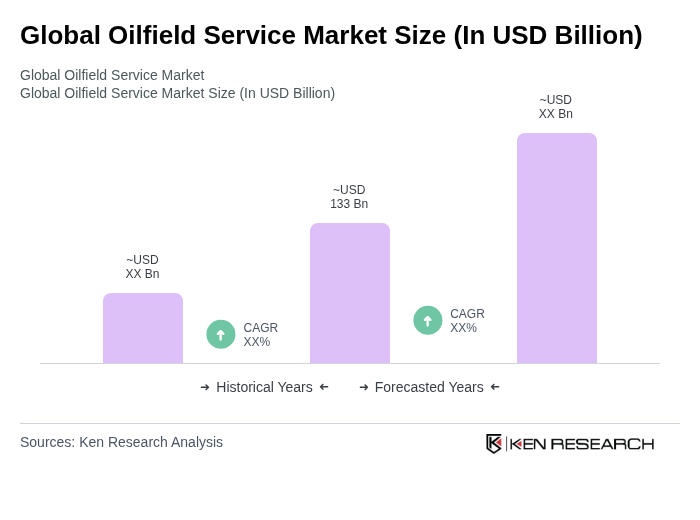
- The Global Oilfield Service Market is valued at approximatelyUSD 133 billion, based on a five-year historical analysis. This growth is primarily driven by the increasing demand for energy, rapid adoption of advanced drilling and extraction technologies, and rising investments in oil and gas exploration activities. The market has seen a resurgence as oil prices stabilize, leading to renewed exploration and production efforts across various regions. Notably, the expansion of deepwater and ultra-deepwater drilling, growth in unconventional oil and gas production, and digitalization of oilfield operations are key trends shaping the sector .
- Key players in this market include the United States, Saudi Arabia, and Russia, which dominate due to their vast oil reserves and advanced technological capabilities. The U.S. leads in shale oil production, leveraging horizontal drilling and hydraulic fracturing, while Saudi Arabia and Russia benefit from extensive conventional oil fields and strategic geopolitical positions, allowing them to significantly influence global oil prices. North America remains the largest regional market, with the Middle East as the fastest-growing region, driven by national oil companies partnering with global providers to boost hydrocarbon production .
- In 2023, the U.S. government implemented new regulations aimed at enhancing environmental standards in oilfield operations. The regulations, under the “Waste Prevention, Production Subject to Royalties, and Resource Conservation; Oil and Gas” rule issued by the Bureau of Land Management (BLM), require oil companies to adopt advanced technologies to minimize methane emissions and improve waste management practices. These measures reflect a growing commitment to sustainable energy practices while ensuring operational efficiency in the oilfield service sector .
Global Oilfield Service Market Segmentation
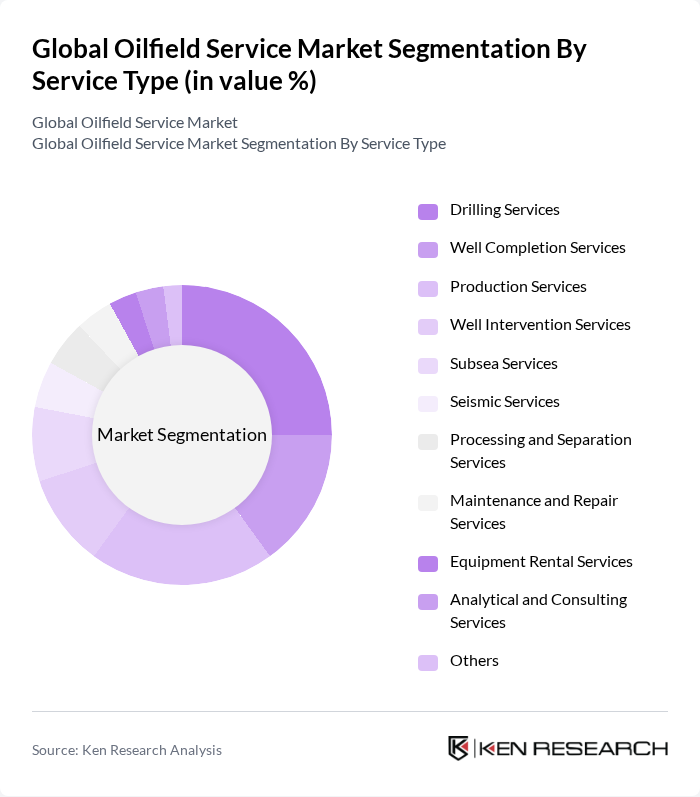
By Service Type:The service type segmentation includes various categories that cater to different operational needs in the oilfield service market. The subsegments include Drilling Services, Well Completion Services, Production Services, Well Intervention Services, Subsea Services, Seismic Services, Processing and Separation Services, Maintenance and Repair Services, Equipment Rental Services, Analytical and Consulting Services, and Others. Each of these services plays a crucial role in the lifecycle of oil and gas extraction, with specific applications and technologies tailored to meet industry demands. Drilling Services remain the largest segment, driven by increased rig counts and the expansion of unconventional resource development. Well Completion and Production Services are also significant, reflecting the growing complexity of reservoirs and the need for enhanced recovery solutions .
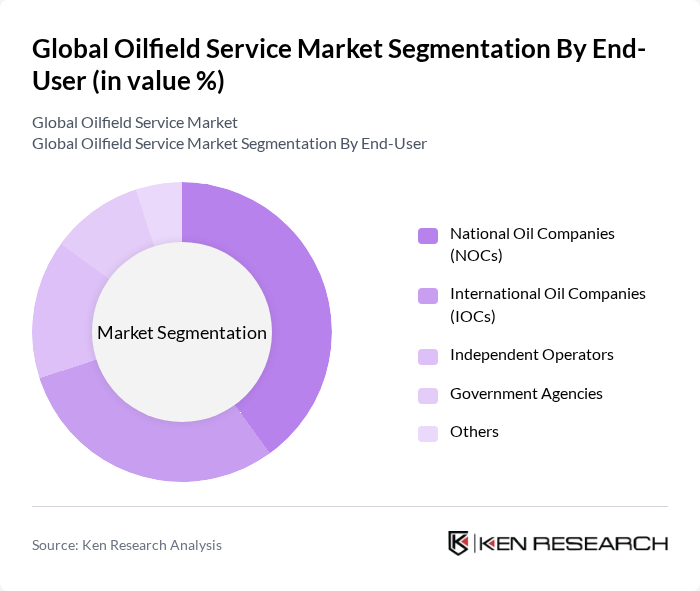
By End-User:The end-user segmentation encompasses various entities that utilize oilfield services, including National Oil Companies (NOCs), International Oil Companies (IOCs), Independent Operators, Government Agencies, and Others. Each of these end-users has distinct operational requirements and investment capabilities, influencing their demand for specific oilfield services. NOCs and IOCs typically dominate the market due to their extensive resources and global operations, while independent operators and government agencies contribute to niche segments. NOCs are increasingly investing in advanced oilfield technologies to maximize output from mature fields, while IOCs focus on expanding offshore and unconventional resource portfolios .
Global Oilfield Service Market Competitive Landscape
The Global Oilfield Service Market is characterized by a dynamic mix of regional and international players. Leading participants such as Schlumberger, Halliburton, Baker Hughes, Weatherford International, TechnipFMC, NOV Inc. (formerly National Oilwell Varco), Aker Solutions, Saipem, Petrofac, KBR, Inc., John Wood Group plc, Subsea 7, Oceaneering International, Expro Group, Superior Energy Services contribute to innovation, geographic expansion, and service delivery in this space.
Global Oilfield Service Market Industry Analysis
Growth Drivers
- Increasing Global Energy Demand:The global energy demand is projected to reach 650 exajoules in future, driven by population growth and industrialization, particularly in emerging economies. The International Energy Agency (IEA) anticipates that oil will continue to play a significant role, accounting for approximately 30% of the energy mix. This rising demand necessitates enhanced oilfield services to optimize extraction and production processes, thereby stimulating market growth in the oilfield service sector.
- Technological Advancements in Drilling and Exploration:The oilfield service industry is experiencing rapid technological advancements, with investments in automation and digital technologies expected to exceed $250 billion in future. Innovations such as advanced drilling techniques and real-time data analytics are enhancing operational efficiency and reducing costs. These technologies enable companies to access previously unreachable reserves, thus driving the demand for oilfield services and contributing to market expansion.
- Expansion of Offshore Oil and Gas Exploration:Offshore oil and gas exploration is projected to grow significantly, with investments expected to reach $175 billion in future. This growth is driven by the discovery of new reserves in deepwater and ultra-deepwater regions. The increasing complexity of offshore projects necessitates specialized oilfield services, including subsea engineering and logistics, thereby creating substantial opportunities for service providers in the market.
Market Challenges
- Volatility in Oil Prices:The oil market remains highly volatile, with prices fluctuating between $45 and $85 per barrel in recent years. This volatility poses significant challenges for oilfield service companies, as unpredictable pricing affects investment decisions and operational budgets. Companies may face reduced demand for services during downturns, leading to potential revenue losses and operational cutbacks, which can hinder market growth.
- Environmental Regulations and Compliance Costs:Stricter environmental regulations are being implemented globally, with compliance costs projected to increase by 20% annually through future. These regulations require oilfield service companies to invest in cleaner technologies and sustainable practices, which can significantly raise operational costs. Failure to comply can result in hefty fines and reputational damage, creating a challenging environment for service providers in the industry.
Global Oilfield Service Market Future Outlook
The future of the oilfield service market is poised for transformation, driven by technological innovations and a growing emphasis on sustainability. As companies increasingly adopt automation and artificial intelligence, operational efficiencies are expected to improve significantly. Additionally, the focus on environmental, social, and governance (ESG) criteria will shape investment strategies, pushing firms to integrate sustainable practices into their operations. This dual focus on technology and sustainability will likely redefine competitive dynamics in the market.
Market Opportunities
- Growth in Emerging Markets:Emerging markets, particularly in Asia and Africa, are expected to see a surge in oil and gas exploration activities, with investments projected to exceed $120 billion in future. This growth presents significant opportunities for oilfield service providers to expand their operations and capture new market share in these regions, driven by increasing energy demands and resource discoveries.
- Investment in Sustainable Practices:The shift towards sustainability is creating opportunities for oilfield service companies to innovate and develop eco-friendly technologies. Investments in renewable energy and carbon capture technologies are expected to reach $60 billion in future. Companies that prioritize sustainable practices will not only comply with regulations but also enhance their market positioning and attract environmentally conscious clients.
Scope of the Report
| Segment | Sub-Segments |
|---|---|
| By Service Type | Drilling Services Well Completion Services Production Services Well Intervention Services Subsea Services Seismic Services Processing and Separation Services Maintenance and Repair Services Equipment Rental Services Analytical and Consulting Services Others |
| By End-User | National Oil Companies (NOCs) International Oil Companies (IOCs) Independent Operators Government Agencies Others |
| By Region | North America Europe Asia-Pacific Middle East & Africa Latin America |
| By Application | Onshore Offshore Others |
| By Technology | Conventional Technologies Advanced Drilling Technologies Digital Oilfield Technologies Enhanced Oil Recovery (EOR) Technologies Others |
| By Investment Source | Private Investments Public Funding Joint Ventures Others |
Key Target Audience
Investors and Venture Capitalist Firms
Government and Regulatory Bodies (e.g., U.S. Department of Energy, International Energy Agency)
Oil and Gas Exploration and Production Companies
Service Providers and Contractors in Oilfield Services
Energy Sector Analysts and Advisors
Environmental Agencies (e.g., Environmental Protection Agency)
Oilfield Equipment Manufacturers
Insurance Companies Specializing in Energy Sector Risks
Players Mentioned in the Report:
Schlumberger
Halliburton
Baker Hughes
Weatherford International
TechnipFMC
NOV Inc. (formerly National Oilwell Varco)
Aker Solutions
Saipem
Petrofac
KBR, Inc.
John Wood Group plc
Subsea 7
Oceaneering International
Expro Group
Superior Energy Services
Table of Contents
Market Assessment Phase
1. Executive Summary and Approach
2. Global Oilfield Service Market Overview
2.1 Key Insights and Strategic Recommendations
2.2 Global Oilfield Service Market Overview
2.3 Definition and Scope
2.4 Evolution of Market Ecosystem
2.5 Timeline of Key Regulatory Milestones
2.6 Value Chain & Stakeholder Mapping
2.7 Business Cycle Analysis
2.8 Policy & Incentive Landscape
3. Global Oilfield Service Market Analysis
3.1 Growth Drivers
3.1.1 Increasing global energy demand
3.1.2 Technological advancements in drilling and exploration
3.1.3 Rising investments in renewable energy sources
3.1.4 Expansion of offshore oil and gas exploration
3.2 Market Challenges
3.2.1 Volatility in oil prices
3.2.2 Environmental regulations and compliance costs
3.2.3 Supply chain disruptions
3.2.4 Skilled labor shortages
3.3 Market Opportunities
3.3.1 Growth in emerging markets
3.3.2 Adoption of digital technologies
3.3.3 Strategic partnerships and collaborations
3.3.4 Investment in sustainable practices
3.4 Market Trends
3.4.1 Shift towards automation and AI in operations
3.4.2 Increasing focus on sustainability and ESG criteria
3.4.3 Development of unconventional oil and gas resources
3.4.4 Enhanced data analytics for operational efficiency
3.5 Government Regulation
3.5.1 Emission reduction targets
3.5.2 Safety and health regulations
3.5.3 Licensing and operational permits
3.5.4 Local content requirements
4. SWOT Analysis
5. Stakeholder Analysis
6. Porter's Five Forces Analysis
7. Global Oilfield Service Market Market Size, 2019-2024
7.1 By Value
7.2 By Volume
7.3 By Average Selling Price
8. Global Oilfield Service Market Segmentation
8.1 By Service Type
8.1.1 Drilling Services
8.1.2 Well Completion Services
8.1.3 Production Services
8.1.4 Well Intervention Services
8.1.5 Subsea Services
8.1.6 Seismic Services
8.1.7 Processing and Separation Services
8.1.8 Maintenance and Repair Services
8.1.9 Equipment Rental Services
8.1.10 Analytical and Consulting Services
8.1.11 Others
8.2 By End-User
8.2.1 National Oil Companies (NOCs)
8.2.2 International Oil Companies (IOCs)
8.2.3 Independent Operators
8.2.4 Government Agencies
8.2.5 Others
8.3 By Region
8.3.1 North America
8.3.2 Europe
8.3.3 Asia-Pacific
8.3.4 Middle East & Africa
8.3.5 Latin America
8.4 By Application
8.4.1 Onshore
8.4.2 Offshore
8.4.3 Others
8.5 By Technology
8.5.1 Conventional Technologies
8.5.2 Advanced Drilling Technologies
8.5.3 Digital Oilfield Technologies
8.5.4 Enhanced Oil Recovery (EOR) Technologies
8.5.5 Others
8.6 By Investment Source
8.6.1 Private Investments
8.6.2 Public Funding
8.6.3 Joint Ventures
8.6.4 Others
9. Global Oilfield Service Market Competitive Analysis
9.1 Market Share of Key Players
9.2 KPIs for Cross Comparison of Key Players
9.2.1 Revenue (USD Million)
9.2.2 EBITDA Margin (%)
9.2.3 Market Share (%)
9.2.4 Geographic Presence (Number of Countries/Regions)
9.2.5 Service Portfolio Breadth
9.2.6 R&D Expenditure (% of Revenue)
9.2.7 Contract Backlog (USD Million)
9.2.8 Capital Expenditure (CAPEX)
9.2.9 Employee Headcount
9.2.10 Safety Record (TRIR/LTIR)
9.2.11 Digitalization/Technology Adoption Index
9.2.12 Customer Retention Rate (%)
9.2.13 Innovation Rate (Patents/Year)
9.2.14 Environmental, Social, and Governance (ESG) Score
9.3 SWOT Analysis of Top Players
9.4 Pricing Analysis
9.5 Detailed Profile of Major Companies
9.5.1 Schlumberger
9.5.2 Halliburton
9.5.3 Baker Hughes
9.5.4 Weatherford International
9.5.5 TechnipFMC
9.5.6 NOV Inc. (formerly National Oilwell Varco)
9.5.7 Aker Solutions
9.5.8 Saipem
9.5.9 Petrofac
9.5.10 KBR, Inc.
9.5.11 John Wood Group plc
9.5.12 Subsea 7
9.5.13 Oceaneering International
9.5.14 Expro Group
9.5.15 Superior Energy Services
10. Global Oilfield Service Market End-User Analysis
10.1 Procurement Behavior of Key Ministries
10.1.1 Budget Allocation Trends
10.1.2 Procurement Processes
10.1.3 Supplier Selection Criteria
10.1.4 Contract Management Practices
10.2 Corporate Spend on Infrastructure & Energy
10.2.1 Investment Priorities
10.2.2 Spending Patterns
10.2.3 Cost Management Strategies
10.2.4 Future Spending Projections
10.3 Pain Point Analysis by End-User Category
10.3.1 Operational Challenges
10.3.2 Financial Constraints
10.3.3 Regulatory Compliance Issues
10.3.4 Technology Adoption Barriers
10.4 User Readiness for Adoption
10.4.1 Awareness Levels
10.4.2 Training and Support Needs
10.4.3 Infrastructure Readiness
10.4.4 Adoption Timeline Expectations
10.5 Post-Deployment ROI and Use Case Expansion
10.5.1 ROI Measurement Techniques
10.5.2 Use Case Identification
10.5.3 Performance Tracking
10.5.4 Future Expansion Opportunities
11. Global Oilfield Service Market Future Size, 2025-2030
11.1 By Value
11.2 By Volume
11.3 By Average Selling Price
Go-To-Market Strategy Phase
1. Whitespace Analysis + Business Model Canvas
1.1 Market Gaps Identification
1.2 Business Model Development
2. Marketing and Positioning Recommendations
2.1 Branding Strategies
2.2 Product USPs
3. Distribution Plan
3.1 Urban Retail Strategies
3.2 Rural NGO Tie-ups
4. Channel & Pricing Gaps
4.1 Underserved Routes
4.2 Pricing Bands
5. Unmet Demand & Latent Needs
5.1 Category Gaps
5.2 Consumer Segments
6. Customer Relationship
6.1 Loyalty Programs
6.2 After-sales Service
7. Value Proposition
7.1 Sustainability Initiatives
7.2 Integrated Supply Chains
8. Key Activities
8.1 Regulatory Compliance
8.2 Branding Efforts
8.3 Distribution Setup
9. Entry Strategy Evaluation
9.1 Domestic Market Entry Strategy
9.1.1 Product Mix Considerations
9.1.2 Pricing Band Analysis
9.1.3 Packaging Strategies
9.2 Export Entry Strategy
9.2.1 Target Countries
9.2.2 Compliance Roadmap
10. Entry Mode Assessment
10.1 Joint Ventures
10.2 Greenfield Investments
10.3 M&A Opportunities
10.4 Distributor Model Evaluation
11. Capital and Timeline Estimation
11.1 Capital Requirements
11.2 Timelines for Implementation
12. Control vs Risk Trade-Off
12.1 Ownership Considerations
12.2 Partnership Dynamics
13. Profitability Outlook
13.1 Breakeven Analysis
13.2 Long-term Sustainability Strategies
14. Potential Partner List
14.1 Distributors
14.2 Joint Ventures
14.3 Acquisition Targets
15. Execution Roadmap
15.1 Phased Plan for Market Entry
15.1.1 Market Setup
15.1.2 Market Entry
15.1.3 Growth Acceleration
15.1.4 Scale & Stabilize
15.2 Key Activities and Milestones
15.2.1 Milestone Planning
15.2.2 Activity Tracking
Research Methodology
Phase 1: Approach1
Desk Research
- Industry reports from the International Energy Agency (IEA) and the U.S. Energy Information Administration (EIA)
- Market analysis publications from leading oilfield service associations and trade journals
- Government publications and regulatory frameworks impacting oilfield services globally
Primary Research
- Interviews with senior executives from major oilfield service companies
- Surveys targeting field engineers and project managers in oil and gas operations
- Focus groups with industry experts and consultants specializing in oilfield technologies
Validation & Triangulation
- Cross-validation of data through multiple industry sources and expert opinions
- Triangulation of market trends using historical data and current market dynamics
- Sanity checks through peer reviews and expert panel discussions
Phase 2: Market Size Estimation1
Top-down Assessment
- Global oilfield service market size derived from upstream oil and gas expenditure reports
- Segmentation by service type, including drilling, completion, and production services
- Incorporation of regional growth trends and investment patterns in oil exploration
Bottom-up Modeling
- Data collection from leading oilfield service providers on service pricing and volume
- Estimation of market share based on operational capacity and service offerings
- Volume x pricing model to calculate revenue generation across different service segments
Forecasting & Scenario Analysis
- Multi-variable regression analysis incorporating oil price fluctuations and technological advancements
- Scenario modeling based on geopolitical factors and environmental regulations
- Baseline, optimistic, and pessimistic forecasts through 2035
Phase 3: CATI Sample Composition1
| Scope Item/Segment | Sample Size | Target Respondent Profiles |
|---|---|---|
| Drilling Services | 100 | Drilling Engineers, Operations Managers |
| Completion Services | 80 | Completion Engineers, Project Managers |
| Production Services | 90 | Production Supervisors, Field Technicians |
| Maintenance and Repair Services | 60 | Maintenance Managers, Safety Officers |
| Consulting and Engineering Services | 50 | Consultants, Technical Directors |
Frequently Asked Questions
What is the current value of the Global Oilfield Service Market?
The Global Oilfield Service Market is valued at approximately USD 133 billion, driven by increasing energy demand, advanced drilling technologies, and rising investments in oil and gas exploration activities.
What are the key drivers of growth in the oilfield service market?
Which regions dominate the Global Oilfield Service Market?
What are the main service types in the oilfield service market?
Other Regional/Country Reports
Indonesia Oilfield Service Market
Malaysia Oilfield Service Market
KSA Oilfield Service Market
APAC Oilfield Service Market
SEA Oilfield Service Market
Vietnam Oilfield Service Market
Other Adjacent Reports
Thailand Oil and Gas Exploration Market
Singapore Drilling Equipment Market
Vietnam Hydraulic Fracturing Market
Brazil Subsea Equipment Market
Germany Seismic Survey Market
Vietnam Wellhead Equipment Market
Brazil Oilfield Chemicals Market
KSA Energy Consulting Market
Thailand Offshore Support Vessels Market
Brazil Carbon Capture Technology Market
Why Buy From Us?

What makes us stand out is that our consultants follow Robust, Refine and Result (RRR) methodology. Robust for clear definitions, approaches and sanity checking, Refine for differentiating respondents' facts and opinions, and Result for presenting data with story.

We have set a benchmark in the industry by offering our clients with syndicated and customized market research reports featuring coverage of entire market as well as meticulous research and analyst insights.

While we don't replace traditional research, we flip the method upside down. Our dual approach of Top Bottom & Bottom Top ensures quality deliverable by not just verifying company fundamentals but also looking at the sector and macroeconomic factors.

With one step in the future, our research team constantly tries to show you the bigger picture. We help with some of the tough questions you may encounter along the way: How is the industry positioned? Best marketing channel? KPI's of competitors? By aligning every element, we help maximize success.

Our report gives you instant access to the answers and sources that other companies might choose to hide. We elaborate each steps of research methodology we have used and showcase you the sample size to earn your trust.

If you need any support, we are here! We pride ourselves on universe strength, data quality, and quick, friendly, and professional service.