About the Report
Base Year 2024Global Online Dating Services Market Overview
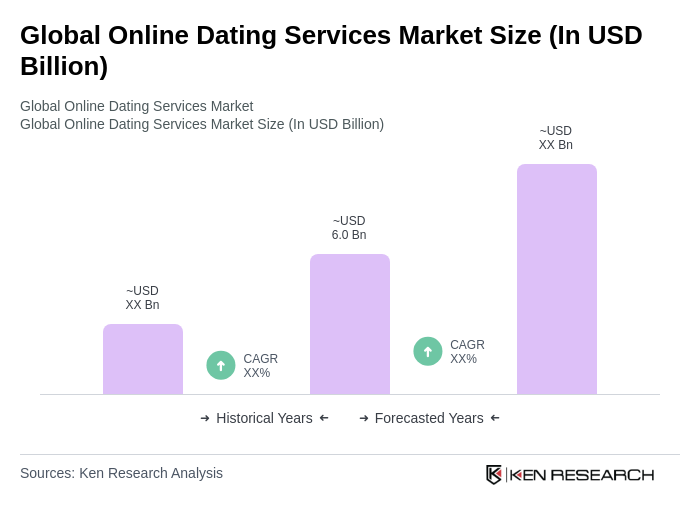
- The Global Online Dating Services Market is valued at USD 6.0 billion, based on a five-year historical analysis. This growth is primarily driven by the increasing adoption of smartphones, the rise of social media, and changing societal norms regarding relationships and dating. The convenience and accessibility of online platforms have made them a preferred choice for individuals seeking companionship, leading to a surge in user engagement and revenue generation.
- Key players in this market include the United States, Canada, and several European countries, which dominate due to their high internet penetration rates, cultural acceptance of online dating, and a large pool of potential users. The presence of major dating platforms and a growing trend towards digital interactions further solidify their leading positions in the global market.
- In 2023, the European Union implemented regulations aimed at enhancing user safety and data protection in online dating services. This regulation mandates that platforms must verify user identities and provide clear guidelines on data usage, ensuring a safer environment for users while promoting transparency and trust in online interactions.
Global Online Dating Services Market Segmentation
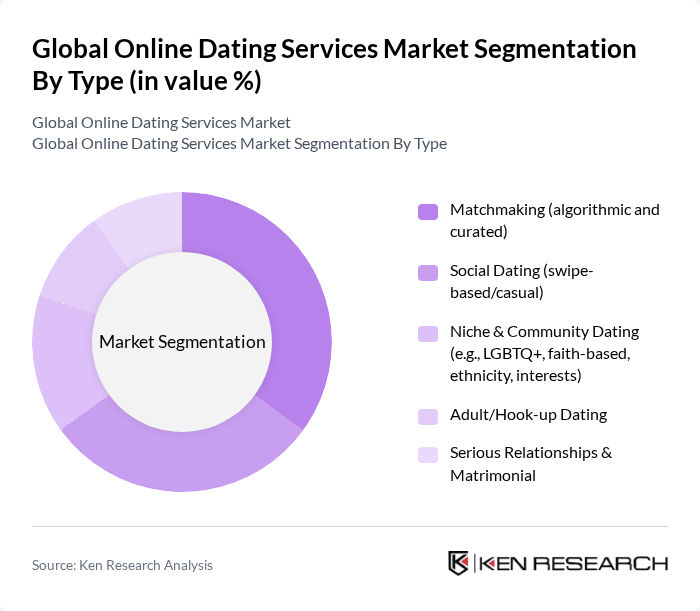
By Type:The online dating services market can be segmented into various types, including matchmaking, social dating, niche & community dating, adult/hook-up dating, and serious relationships & matrimonial. Among these, matchmaking services, which utilize algorithms and curated approaches to connect users, have gained significant traction due to their personalized nature. Social dating platforms, characterized by swipe-based interactions, are also popular, especially among younger demographics seeking casual connections.
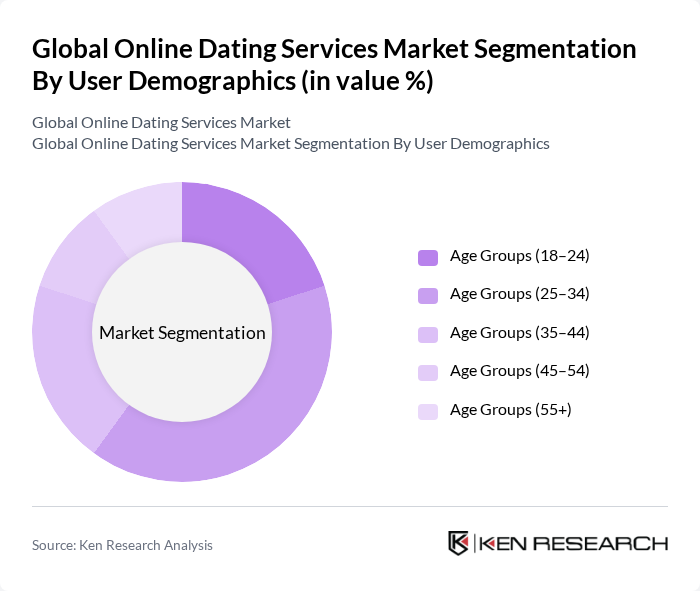
By User Demographics:This segmentation includes age groups, gender identity, sexual orientation, and relationship status. The age group of 25-34 is particularly dominant, as this demographic is more inclined to use online platforms for dating. Additionally, the increasing acceptance of diverse gender identities and sexual orientations has led to a rise in niche dating services catering to specific communities, further enriching the market landscape.
Global Online Dating Services Market Competitive Landscape
The Global Online Dating Services Market is characterized by a dynamic mix of regional and international players. Leading participants such as Match Group, Inc. (Tinder, Hinge, OkCupid, Plenty of Fish), Bumble Inc. (Bumble, Badoo, Fruitz), eHarmony, Inc. (eharmony), The Meet Group, Inc. (MeetMe, Tagged, Skout, LOVOO), Grindr Inc., Spark Networks SE (Zoosk, EliteSingles, Christian Mingle, JDate), Coffee Meets Bagel, Inc., Happn (happn SAS), Tantan (Hello Group Inc.), The League App, Inc., HER (Bloomer Inc.), Muzmatch (Muzz), BLK (Match Group), Hily Corp., Raya App, Inc. contribute to innovation, geographic expansion, and service delivery in this space.
Global Online Dating Services Market Industry Analysis
Growth Drivers
- Increasing Smartphone Penetration:The global smartphone user base reached approximately 8.6 billion, representing a significant increase from 6.4 billion. This surge in smartphone adoption facilitates easier access to online dating platforms, allowing users to connect anytime and anywhere. With 80% of users accessing dating services via mobile devices, the convenience and functionality of apps are driving user engagement and expanding the market reach, particularly in emerging economies where smartphone penetration is rapidly increasing.
- Rising Acceptance of Online Dating:A recent survey indicated that 60% of adults aged 18-34 in the None region view online dating positively, up from 50%. This growing acceptance is attributed to changing social norms and increased visibility of successful online relationships. As societal stigma diminishes, more individuals are willing to explore online platforms for romantic connections, contributing to a robust user base and driving revenue growth for dating services in the region.
- Growth of Social Media Integration:In future, over 70% of online dating platforms have integrated social media features, enhancing user engagement and interaction. This integration allows users to connect their dating profiles with social media accounts, facilitating a more authentic representation of themselves. As a result, platforms that leverage social media are experiencing higher user retention rates, with an average increase of 25% in daily active users, thereby driving overall market growth in the online dating sector.
Market Challenges
- Privacy and Security Concerns:In future, 45% of online dating users expressed concerns about data privacy and security, highlighting a significant challenge for platforms. High-profile data breaches have raised awareness about the risks associated with sharing personal information online. As a result, dating services must invest heavily in cybersecurity measures and transparent data handling practices to build trust and ensure user safety, which can strain operational budgets and resources.
- High Competition Among Platforms:The online dating market is saturated, with over 1,500 platforms operating globally. This intense competition leads to user acquisition costs rising by 30% year-over-year as companies strive to differentiate themselves. As new entrants continue to emerge, established platforms face challenges in maintaining market share and profitability, necessitating innovative marketing strategies and unique value propositions to attract and retain users.
Global Online Dating Services Market Future Outlook
The online dating services market is poised for transformative growth, driven by technological advancements and evolving consumer preferences. As platforms increasingly adopt AI-driven matchmaking algorithms, user experiences are expected to become more personalized and efficient. Additionally, the rise of virtual dating experiences, particularly in the wake of the pandemic, is likely to reshape how users interact. These trends indicate a dynamic future where innovation and user-centric approaches will define the competitive landscape of online dating services.
Market Opportunities
- Emergence of AI-Driven Matchmaking:The integration of AI technologies in matchmaking processes presents a significant opportunity for dating platforms. By utilizing data analytics and machine learning, companies can enhance user experiences, leading to higher satisfaction rates. This innovation is projected to attract a broader audience, particularly tech-savvy users seeking more effective and personalized dating solutions.
- Development of Virtual Dating Experiences:The growing popularity of virtual reality (VR) and augmented reality (AR) technologies offers dating services a unique opportunity to create immersive dating experiences. By developing VR environments for users to interact, platforms can differentiate themselves and cater to a younger demographic that values innovative and engaging interactions, potentially increasing user retention and satisfaction.
Scope of the Report
| Segment | Sub-Segments |
|---|---|
| By Type | Matchmaking (algorithmic and curated) Social Dating (swipe-based/casual) Niche & Community Dating (e.g., LGBTQ+, faith-based, ethnicity, interests) Adult/Hook-up Dating Serious Relationships & Matrimonial |
| By User Demographics | Age Groups (18–24, 25–34, 35–44, 45–54, 55+) Gender Identity Sexual Orientation Relationship Status (Single, Divorced, Widowed, Single Parent) |
| By Monetization Model | Freemium (free tier with in-app purchases) Paid Subscriptions (monthly/annual) Micro-transactions & Virtual Gifts Advertising-Supported |
| By Geographic Focus | Local/Hyperlocal Dating Cross-border/International Dating |
| By Platform | Mobile Applications Desktop Websites |
| By Acquisition Channel | Social Media & Influencers App Store Optimization & Paid UA Partnerships & Affiliates Traditional Advertising |
| By User Engagement Features | Messaging & In-app Chat Audio/Video Dating Profile Verification & Safety Tools Events, Communities & Live Streaming |
Key Target Audience
Investors and Venture Capitalist Firms
Government and Regulatory Bodies (e.g., Federal Trade Commission, European Data Protection Supervisor)
Online Dating Service Providers
Payment Processing Companies
Telecommunications Companies
Digital Marketing Agencies
Cybersecurity Firms
Market Analysts and Industry Experts
Players Mentioned in the Report:
Match Group, Inc. (Tinder, Hinge, OkCupid, Plenty of Fish)
Bumble Inc. (Bumble, Badoo, Fruitz)
eHarmony, Inc. (eharmony)
The Meet Group, Inc. (MeetMe, Tagged, Skout, LOVOO)
Grindr Inc.
Spark Networks SE (Zoosk, EliteSingles, Christian Mingle, JDate)
Coffee Meets Bagel, Inc.
Happn (happn SAS)
Tantan (Hello Group Inc.)
The League App, Inc.
HER (Bloomer Inc.)
Muzmatch (Muzz)
BLK (Match Group)
Hily Corp.
Raya App, Inc.
Table of Contents
Market Assessment Phase
1. Executive Summary and Approach
2. Global Online Dating Services Market Overview
2.1 Key Insights and Strategic Recommendations
2.2 Global Online Dating Services Market Overview
2.3 Definition and Scope
2.4 Evolution of Market Ecosystem
2.5 Timeline of Key Regulatory Milestones
2.6 Value Chain & Stakeholder Mapping
2.7 Business Cycle Analysis
2.8 Policy & Incentive Landscape
3. Global Online Dating Services Market Analysis
3.1 Growth Drivers
3.1.1 Increasing smartphone penetration
3.1.2 Rising acceptance of online dating
3.1.3 Growth of social media integration
3.1.4 Expansion of niche dating platforms
3.2 Market Challenges
3.2.1 Privacy and security concerns
3.2.2 High competition among platforms
3.2.3 User retention issues
3.2.4 Regulatory compliance hurdles
3.3 Market Opportunities
3.3.1 Emergence of AI-driven matchmaking
3.3.2 Growth in international markets
3.3.3 Development of virtual dating experiences
3.3.4 Partnerships with lifestyle brands
3.4 Market Trends
3.4.1 Increased focus on user experience
3.4.2 Rise of video dating features
3.4.3 Integration of augmented reality
3.4.4 Shift towards subscription-based models
3.5 Government Regulation
3.5.1 Data protection regulations
3.5.2 Age verification laws
3.5.3 Anti-discrimination policies
3.5.4 Advertising standards for dating services
4. SWOT Analysis
5. Stakeholder Analysis
6. Porter's Five Forces Analysis
7. Global Online Dating Services Market Market Size, 2019-2024
7.1 By Value
7.2 By Volume
7.3 By Average Selling Price
8. Global Online Dating Services Market Segmentation
8.1 By Type
8.1.1 Matchmaking (algorithmic and curated)
8.1.2 Social Dating (swipe-based/casual)
8.1.3 Niche & Community Dating (e.g., LGBTQ+, faith-based, ethnicity, interests)
8.1.4 Adult/Hook-up Dating
8.1.5 Serious Relationships & Matrimonial
8.2 By User Demographics
8.2.1 Age Groups (18–24, 25–34, 35–44, 45–54, 55+)
8.2.2 Gender Identity
8.2.3 Sexual Orientation
8.2.4 Relationship Status (Single, Divorced, Widowed, Single Parent)
8.3 By Monetization Model
8.3.1 Freemium (free tier with in-app purchases)
8.3.2 Paid Subscriptions (monthly/annual)
8.3.3 Micro-transactions & Virtual Gifts
8.3.4 Advertising-Supported
8.4 By Geographic Focus
8.4.1 Local/Hyperlocal Dating
8.4.2 Cross-border/International Dating
8.5 By Platform
8.5.1 Mobile Applications
8.5.2 Desktop Websites
8.6 By Acquisition Channel
8.6.1 Social Media & Influencers
8.6.2 App Store Optimization & Paid UA
8.6.3 Partnerships & Affiliates
8.6.4 Traditional Advertising
8.7 By User Engagement Features
8.7.1 Messaging & In-app Chat
8.7.2 Audio/Video Dating
8.7.3 Profile Verification & Safety Tools
8.7.4 Events, Communities & Live Streaming
9. Global Online Dating Services Market Competitive Analysis
9.1 Market Share of Key Players
9.2 Cross Comparison of Key Players
9.2.1 Company Name
9.2.2 Company Scale (Users/Revenue Tier)
9.2.3 Customer Acquisition Cost (CAC)
9.2.4 Customer Lifetime Value (LTV)
9.2.5 Monthly Active Users (MAUs)
9.2.6 Churn Rate (Monthly)
9.2.7 Average Revenue Per Paying User (ARPPU) / ARPU
9.2.8 Pricing Strategy (Freemium, Subscription, Micro-transactions)
9.2.9 Engagement Rate (DAU/MAU, Avg. Sessions/User)
9.2.10 Free-to-Paid Conversion Rate
9.2.11 Regional Mix (Revenue/Users by Region)
9.2.12 Safety & Compliance KPIs (Verified Profiles %, Report Rate)
9.3 SWOT Analysis of Top Players
9.4 Pricing Analysis
9.5 Detailed Profile of Major Companies
9.5.1 Match Group, Inc. (Tinder, Hinge, OkCupid, Plenty of Fish)
9.5.2 Bumble Inc. (Bumble, Badoo, Fruitz)
9.5.3 eHarmony, Inc. (eharmony)
9.5.4 The Meet Group, Inc. (MeetMe, Tagged, Skout, LOVOO)
9.5.5 Grindr Inc.
9.5.6 Spark Networks SE (Zoosk, EliteSingles, Christian Mingle, JDate)
9.5.7 Coffee Meets Bagel, Inc.
9.5.8 Happn (happn SAS)
9.5.9 Tantan (Hello Group Inc.)
9.5.10 The League App, Inc.
9.5.11 HER (Bloomer Inc.)
9.5.12 Muzmatch (Muzz)
9.5.13 BLK (Match Group)
9.5.14 Hily Corp.
9.5.15 Raya App, Inc.
10. Global Online Dating Services Market End-User Analysis
10.1 Procurement Behavior of Key Ministries
10.1.1 User demographics and preferences
10.1.2 Budget allocation for dating services
10.1.3 Engagement with service providers
10.2 Corporate Spend on Infrastructure & Energy
10.2.1 Investment in technology platforms
10.2.2 Marketing and promotional expenses
10.2.3 User support and engagement costs
10.3 Pain Point Analysis by End-User Category
10.3.1 Safety and security concerns
10.3.2 Difficulty in finding compatible matches
10.3.3 User interface and experience issues
10.4 User Readiness for Adoption
10.4.1 Awareness of online dating services
10.4.2 Comfort with technology
10.4.3 Perceived value of online dating
10.5 Post-Deployment ROI and Use Case Expansion
10.5.1 User satisfaction and retention rates
10.5.2 Expansion into new demographics
10.5.3 Revenue growth from premium features
11. Global Online Dating Services Market Future Size, 2025-2030
11.1 By Value
11.2 By Volume
11.3 By Average Selling Price
Go-To-Market Strategy Phase
1. Whitespace Analysis + Business Model Canvas
1.1 Market gaps and opportunities
1.2 Value proposition development
1.3 Revenue model exploration
1.4 Customer segmentation analysis
1.5 Competitive landscape overview
2. Marketing and Positioning Recommendations
2.1 Branding strategies
2.2 Product USPs
3. Distribution Plan
3.1 Urban retail vs rural NGO tie-ups
4. Channel & Pricing Gaps
4.1 Underserved routes
4.2 Pricing bands
5. Unmet Demand & Latent Needs
5.1 Category gaps
5.2 Consumer segments
6. Customer Relationship
6.1 Loyalty programs
6.2 After-sales service
7. Value Proposition
7.1 Sustainability
7.2 Integrated supply chains
8. Key Activities
8.1 Regulatory compliance
8.2 Branding
8.3 Distribution setup
9. Entry Strategy Evaluation
9.1 Domestic Market Entry Strategy
9.1.1 Product mix
9.1.2 Pricing band
9.1.3 Packaging
9.2 Export Entry Strategy
9.2.1 Target countries
9.2.2 Compliance roadmap
10. Entry Mode Assessment
10.1 JV
10.2 Greenfield
10.3 M&A
10.4 Distributor Model
11. Capital and Timeline Estimation
11.1 Capital requirements
11.2 Timelines
12. Control vs Risk Trade-Off
12.1 Ownership vs Partnerships
13. Profitability Outlook
13.1 Breakeven analysis
13.2 Long-term sustainability
14. Potential Partner List
14.1 Distributors
14.2 JVs
14.3 Acquisition targets
15. Execution Roadmap
15.1 Phased Plan for Market Entry
15.1.1 Market Setup
15.1.2 Market Entry
15.1.3 Growth Acceleration
15.1.4 Scale & Stabilize
15.2 Key Activities and Milestones
15.2.1 Activity timelines
15.2.2 Milestone tracking
Research Methodology
Phase 1: Approach1
Desk Research
- Analysis of industry reports from market research firms focusing on online dating trends
- Review of demographic data from government databases and social research organizations
- Examination of consumer behavior studies published in academic journals related to online dating
Primary Research
- Interviews with executives from leading online dating platforms to gather insights on market dynamics
- Surveys targeting users of online dating services to understand preferences and satisfaction levels
- Focus groups with diverse demographic segments to explore user experiences and expectations
Validation & Triangulation
- Cross-validation of findings through comparison with existing market data and trends
- Triangulation of insights from primary interviews and secondary research sources
- Sanity checks conducted through expert panel reviews to ensure data reliability
Phase 2: Market Size Estimation1
Top-down Assessment
- Estimation of market size based on global revenue figures from major online dating services
- Segmentation analysis by geographic regions and user demographics
- Incorporation of growth rates derived from historical data and market forecasts
Bottom-up Modeling
- Collection of user subscription data from various online dating platforms
- Analysis of average revenue per user (ARPU) across different service tiers
- Estimation of market penetration rates based on user growth trends in key demographics
Forecasting & Scenario Analysis
- Multi-factor regression analysis incorporating social media influence and mobile app usage
- Scenario modeling based on potential regulatory changes and shifts in consumer behavior
- Development of baseline, optimistic, and pessimistic market projections through 2030
Phase 3: CATI Sample Composition1
| Scope Item/Segment | Sample Size | Target Respondent Profiles |
|---|---|---|
| General Online Dating Users | 120 | Single Adults, Ages 18-35 |
| Premium Subscription Users | 100 | Professionals, Ages 25-45 |
| Mobile App Users | 80 | Tech-Savvy Individuals, Ages 18-30 |
| Users of Niche Dating Services | 70 | Individuals Seeking Specific Interests or Communities |
| Users with Previous Online Dating Experience | 90 | Adults, Ages 30-50 |
Frequently Asked Questions
What is the current value of the Global Online Dating Services Market?
The Global Online Dating Services Market is valued at approximately USD 6.0 billion, reflecting significant growth driven by smartphone adoption, social media influence, and changing societal norms regarding dating and relationships.
What factors are driving the growth of online dating services?
Which regions dominate the online dating services market?
What are the main types of online dating services?
Other Regional/Country Reports
Indonesia Online Dating Services Market
Malaysia Online Dating Services Market
APAC Online Dating Services Market
SEA Online Dating Services Market
Why Buy From Us?

What makes us stand out is that our consultants follow Robust, Refine and Result (RRR) methodology. Robust for clear definitions, approaches and sanity checking, Refine for differentiating respondents' facts and opinions, and Result for presenting data with story.

We have set a benchmark in the industry by offering our clients with syndicated and customized market research reports featuring coverage of entire market as well as meticulous research and analyst insights.

While we don't replace traditional research, we flip the method upside down. Our dual approach of Top Bottom & Bottom Top ensures quality deliverable by not just verifying company fundamentals but also looking at the sector and macroeconomic factors.

With one step in the future, our research team constantly tries to show you the bigger picture. We help with some of the tough questions you may encounter along the way: How is the industry positioned? Best marketing channel? KPI's of competitors? By aligning every element, we help maximize success.

Our report gives you instant access to the answers and sources that other companies might choose to hide. We elaborate each steps of research methodology we have used and showcase you the sample size to earn your trust.

If you need any support, we are here! We pride ourselves on universe strength, data quality, and quick, friendly, and professional service.