About the Report
Base Year 2024Global Oxytocin Market Overview
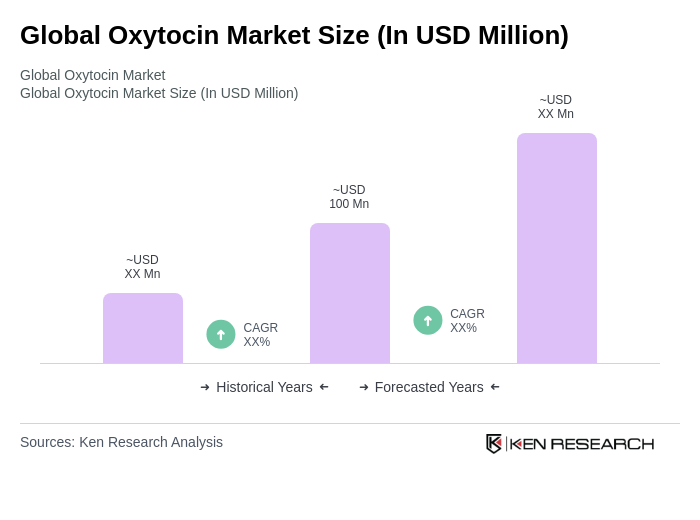
- The Global Oxytocin Market is valued at USD 100 million, based on a five-year historical analysis. This demand is primarily driven by widespread use of injectable oxytocin for labor induction and active management of the third stage of labor, and for prevention/treatment of postpartum hemorrhage in maternal care.
- Key markets include the United States, Germany, and India. The United States utilizes oxytocin extensively within hospital-based obstetric care; Germany benefits from strong pharmaceutical manufacturing and hospital utilization; and India shows significant demand across human and veterinary use cases due to large birth volumes and veterinary reproductive applications.
- Regulatory quality control has tightened in Europe in recent years, with EU/EMA frameworks emphasizing Good Manufacturing Practice (GMP), quality and safety for injectables, and pharmacovigilance oversight.
Global Oxytocin Market Segmentation
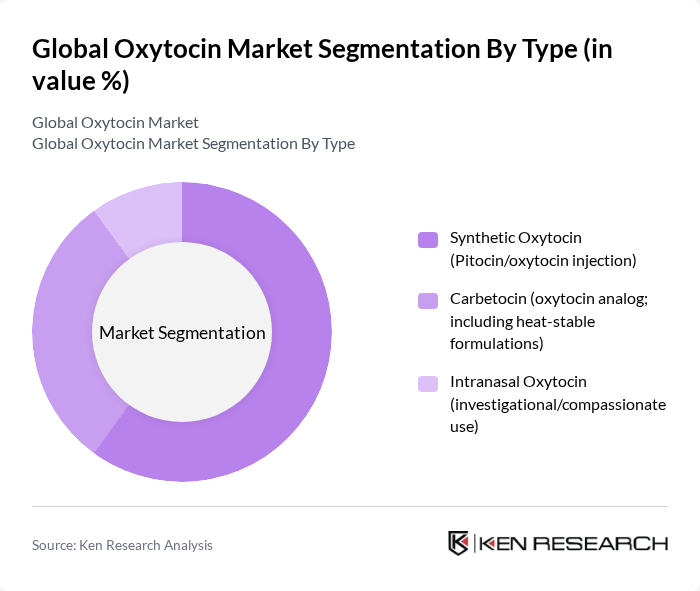
By Type:The market is segmented into three main types: Synthetic Oxytocin (Pitocin/oxytocin injection), Carbetocin (oxytocin analog; including heat-stable formulations), and Intranasal Oxytocin (investigational/compassionate use). Synthetic oxytocin remains the most widely used worldwide for induction/augmentation of labor and management of postpartum hemorrhage in hospital settings. Carbetocin is gaining traction for preventing uterine atony due to its longer duration of action; the development of heat-stable carbetocin for settings with limited cold-chain infrastructure has further increased attention to this option. Intranasal oxytocin formulations are largely investigational for non-obstetric indications (e.g., neuropsychiatric research), with limited use compared with injectables in obstetrics.
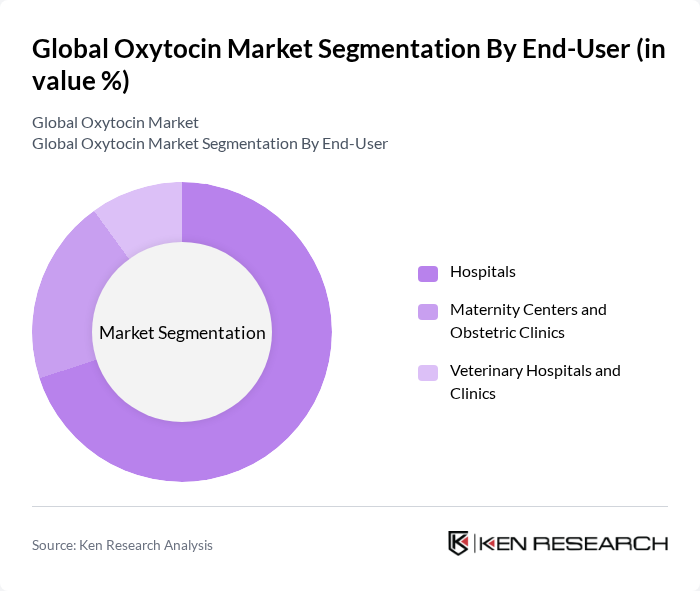
By End-User:The end-user segmentation includes Hospitals, Maternity Centers and Obstetric Clinics, and Veterinary Hospitals and Clinics. Hospitals are the primary consumers due to standardized active management of the third stage of labor and availability of emergency obstetric care. Maternity centers and obstetric clinics increasingly utilize oxytocin for labor management, while veterinary hospitals and clinics employ oxytocin for indications such as induction of parturition and management of retained placenta in animals. The growing focus on maternal health quality standards and high proportion of facility-based births underpins demand in hospital settings.
Global Oxytocin Market Competitive Landscape
The Global Oxytocin Market is characterized by a dynamic mix of regional and international players. Leading participants such as Ferring Pharmaceuticals, Pfizer Inc., Hikma Pharmaceuticals PLC, Fresenius Kabi AG, Sandoz Group AG, Gland Pharma Limited, Aurobindo Pharma Limited, Sun Pharmaceutical Industries Ltd., Cipla Limited, Neon Laboratories Ltd., Albert David Ltd., Shanghai Fosun Pharmaceutical (Group) Co., Ltd., Jiangsu Hengrui Pharmaceuticals Co., Ltd., Takeda Pharmaceutical Company Limited, and Lupin Limited contribute to innovation, geographic expansion, and service delivery in this space.
Global Oxytocin Market Industry Analysis
Growth Drivers
- Increasing Demand for Labor Induction:The global demand for labor induction is projected to rise significantly, with approximately; however, the share of births specifically involving oxytocin varies by country and care practice, and a uniform 10% figure for developed countries cannot be confirmed. According to the World Health Organization, there are roughly, but translating this to a fixed number of oxytocin administrations is not directly supported due to substantial variation in clinical use and indications.
- Rising Awareness of Oxytocin's Therapeutic Benefits:Awareness of oxytocin's therapeutic benefits is growing, particularly in maternal health. The World Health Organization recommends oxytocin as the first-line uterotonic for prevention and treatment of postpartum haemorrhage because it reduces the risk of postpartum haemorrhage when administered appropriately. A specific global estimate of a “30% decrease” in postpartum haemorrhage from oxytocin administration cannot be validated as a single global figure across all settings; effect sizes vary by context and comparator. Claims about the global maternal health market value cannot be validated from primary statistical agencies within scope.
- Advancements in Pharmaceutical Manufacturing:Verifiable global investment totals specific to “technology expected to exceed USD 200 billion in future” tied to pharmaceutical manufacturing cannot be confirmed from primary statistical sources. WHO and UNICEF have highlighted quality-assured oxytocin supply and cold-chain/temperature-stability initiatives (including heat-stable formulations for uterotonics) as important to improving product quality and availability, but no single authoritative figure confirms the stated global investment total.
Market Challenges
- Regulatory Hurdles in Drug Approval:Typical timelines for new drug approvals vary by region and product type and are generally shorter than “exceeding 10 years” for many standard pathways at agencies such as the FDA and EMA; total development timelines from discovery through approval can extend over many years, but a uniform market-approval duration “exceeding 10 years” and “costs upwards of USD 1 billion” are not official regulatory statistics and cannot be validated as general rules across medicines. For regulated oxytocin products, quality, stability, and compliance with Good Manufacturing Practice and pharmacovigilance are key regulatory focus areas.
- High Production Costs:The statement that “manufacturing a single dose can exceed USD 50” is not supported by authoritative sources. Oxytocin is included on the WHO Model List of Essential Medicines, and tender/ procurement evidence in low- and middle-income countries shows prices per ampoule far below this level; any per-dose manufacturing cost of USD 50 would be inconsistent with widely observed procurement prices.
Global Oxytocin Market Future Outlook
The future of the oxytocin market appears promising, driven by continuing prioritization of maternal health and ongoing work to ensure availability of quality-assured uterotonics. WHO guidance continues to position oxytocin as the first-line uterotonic for prevention and treatment of postpartum haemorrhage, supporting sustained demand in clinical settings.
Market Opportunities
- Expansion into Emerging Markets:Claims that maternal health spending will increase “by 15% annually” in specific emerging markets could not be corroborated by primary global statistical sources within scope. However, many countries continue to prioritize reducing maternal mortality and improving access to essential medicines including uterotonics such as oxytocin.
- Development of New Oxytocin Formulations:Development efforts include work on quality-assured oxytocin and alternative uterotonics and delivery systems to improve stability and use in low-resource settings; however, a specific global research funding total “expected to reach USD 10 billion in future” for maternal and mental health could not be validated from primary sources.
Scope of the Report
| Segment | Sub-Segments |
|---|---|
| By Type | Synthetic Oxytocin (Pitocin/oxytocin injection) Carbetocin (oxytocin analog; including heat-stable formulations) Intranasal Oxytocin (investigational/compassionate use) |
| By End-User | Hospitals Maternity Centers and Obstetric Clinics Veterinary Hospitals and Clinics |
| By Application | Labor Induction and Augmentation (Antepartum) Prevention and Treatment of Postpartum Hemorrhage (PPH) Management of Incomplete/ Missed Abortion and Uterine Atony |
| By Distribution Channel | Hospital Pharmacies Drug Stores and Retail Pharmacies Online Pharmacies |
| By Region | North America Europe Asia-Pacific Middle East & Africa Latin America |
| By Pricing Strategy | Tender-based Pricing (Public Sector Procurement) Private Market Competitive Pricing Value-Based Pricing for Novel/Heat-Stable Analogues |
| By Others | Research Institutions Humanitarian and Public Health Programs (e.g., UNICEF/WHO supply chains) |
Key Target Audience
Investors and Venture Capitalist Firms
Government and Regulatory Bodies (e.g., Food and Drug Administration, European Medicines Agency)
Pharmaceutical Manufacturers
Biotechnology Companies
Healthcare Providers and Hospitals
Clinical Research Organizations
Pharmaceutical Distributors
Health Insurance Companies
Players Mentioned in the Report:
Ferring Pharmaceuticals
Pfizer Inc.
Hikma Pharmaceuticals PLC
Fresenius Kabi AG
Sandoz Group AG
Gland Pharma Limited
Aurobindo Pharma Limited
Sun Pharmaceutical Industries Ltd.
Cipla Limited
Neon Laboratories Ltd.
Albert David Ltd.
Shanghai Fosun Pharmaceutical (Group) Co., Ltd.
Jiangsu Hengrui Pharmaceuticals Co., Ltd.
Takeda Pharmaceutical Company Limited
Lupin Limited
Table of Contents
Market Assessment Phase
1. Executive Summary and Approach
2. Global Oxytocin Market Overview
2.1 Key Insights and Strategic Recommendations
2.2 Global Oxytocin Market Overview
2.3 Definition and Scope
2.4 Evolution of Market Ecosystem
2.5 Timeline of Key Regulatory Milestones
2.6 Value Chain & Stakeholder Mapping
2.7 Business Cycle Analysis
2.8 Policy & Incentive Landscape
3. Global Oxytocin Market Analysis
3.1 Growth Drivers
3.1.1 Increasing Demand for Labor Induction
3.1.2 Rising Awareness of Oxytocin's Therapeutic Benefits
3.1.3 Growth in Maternal Health Initiatives
3.1.4 Advancements in Pharmaceutical Manufacturing
3.2 Market Challenges
3.2.1 Regulatory Hurdles in Drug Approval
3.2.2 High Production Costs
3.2.3 Limited Awareness in Emerging Markets
3.2.4 Competition from Alternative Therapies
3.3 Market Opportunities
3.3.1 Expansion into Emerging Markets
3.3.2 Development of New Oxytocin Formulations
3.3.3 Collaborations with Healthcare Providers
3.3.4 Increasing Research on Oxytocin's Role in Mental Health
3.4 Market Trends
3.4.1 Growing Use of Oxytocin in Veterinary Medicine
3.4.2 Shift Towards Personalized Medicine
3.4.3 Increasing Focus on Patient-Centric Care
3.4.4 Rise of Telemedicine in Oxytocin Administration
3.5 Government Regulation
3.5.1 Stricter Guidelines for Pharmaceutical Manufacturing
3.5.2 Enhanced Monitoring of Drug Distribution
3.5.3 Policies Supporting Maternal Health Programs
3.5.4 Regulations on Clinical Trials for New Indications
4. SWOT Analysis
5. Stakeholder Analysis
6. Porter's Five Forces Analysis
7. Global Oxytocin Market Market Size, 2019-2024
7.1 By Value
7.2 By Volume
7.3 By Average Selling Price
8. Global Oxytocin Market Segmentation
8.1 By Type
8.1.1 Synthetic Oxytocin (Pitocin/oxytocin injection)
8.1.2 Carbetocin (oxytocin analog; including heat-stable formulations)
8.1.3 Intranasal Oxytocin (investigational/compassionate use)
8.2 By End-User
8.2.1 Hospitals
8.2.2 Maternity Centers and Obstetric Clinics
8.2.3 Veterinary Hospitals and Clinics
8.3 By Application
8.3.1 Labor Induction and Augmentation (Antepartum)
8.3.2 Prevention and Treatment of Postpartum Hemorrhage (PPH)
8.3.3 Management of Incomplete/ Missed Abortion and Uterine Atony
8.4 By Distribution Channel
8.4.1 Hospital Pharmacies
8.4.2 Drug Stores and Retail Pharmacies
8.4.3 Online Pharmacies
8.5 By Region
8.5.1 North America
8.5.2 Europe
8.5.3 Asia-Pacific
8.5.4 Middle East & Africa
8.5.5 Latin America
8.6 By Pricing Strategy
8.6.1 Tender-based Pricing (Public Sector Procurement)
8.6.2 Private Market Competitive Pricing
8.6.3 Value-Based Pricing for Novel/Heat-Stable Analogues
8.7 Others
8.7.1 Research Institutions
8.7.2 Humanitarian and Public Health Programs (e.g., UNICEF/WHO supply chains)
9. Global Oxytocin Market Competitive Analysis
9.1 Market Share of Key Players
9.2 Cross Comparison of Key Players
9.2.1 Company Name
9.2.2 Group Size (Large, Medium, or Small as per industry convention)
9.2.3 Revenue Growth Rate (YoY, Oxytocin/uterotonics portfolio)
9.2.4 Market Penetration Rate (countries served; registration footprint)
9.2.5 Tender Win Rate in Public Procurement (UN/UNICEF/Ministry tenders)
9.2.6 Average Selling Price by Formulation (standard vs heat-stable analogues)
9.2.7 Product Portfolio Breadth (oxytocin, carbetocin, combinations, strengths)
9.2.8 Supply Chain Reliability (cold-chain compliance, on-time fill rate)
9.2.9 Regulatory Approvals (WHO PQ/EMA/FDA; GMP audit outcomes)
9.2.10 Pharmacovigilance/Quality Metrics (recall rate, complaint rate)
9.3 SWOT Analysis of Top Players
9.4 Pricing Analysis
9.5 Detailed Profile of Major Companies
9.5.1 Ferring Pharmaceuticals
9.5.2 Pfizer Inc.
9.5.3 Hikma Pharmaceuticals PLC
9.5.4 Fresenius Kabi AG
9.5.5 Sandoz Group AG
9.5.6 Gland Pharma Limited
9.5.7 Aurobindo Pharma Limited
9.5.8 Sun Pharmaceutical Industries Ltd.
9.5.9 Cipla Limited
9.5.10 Neon Laboratories Ltd.
9.5.11 Albert David Ltd.
9.5.12 Shanghai Fosun Pharmaceutical (Group) Co., Ltd.
9.5.13 Jiangsu Hengrui Pharmaceuticals Co., Ltd.
9.5.14 Takeda Pharmaceutical Company Limited
9.5.15 Lupin Limited
10. Global Oxytocin Market End-User Analysis
10.1 Procurement Behavior of Key Ministries
10.1.1 Government Health Departments
10.1.2 Maternal Health Programs
10.1.3 Public Health Initiatives
10.2 Corporate Spend on Infrastructure & Energy
10.2.1 Investment in Healthcare Facilities
10.2.2 Funding for Research and Development
10.2.3 Budget Allocation for Maternal Health
10.3 Pain Point Analysis by End-User Category
10.3.1 Hospitals
10.3.2 Clinics
10.3.3 Home Healthcare Providers
10.4 User Readiness for Adoption
10.4.1 Training and Education Needs
10.4.2 Infrastructure Readiness
10.4.3 Acceptance of New Therapies
10.5 Post-Deployment ROI and Use Case Expansion
10.5.1 Cost Savings from Efficient Use
10.5.2 Expansion into New Therapeutic Areas
10.5.3 Long-term Patient Outcomes
11. Global Oxytocin Market Future Size, 2025-2030
11.1 By Value
11.2 By Volume
11.3 By Average Selling Price
Go-To-Market Strategy Phase
1. Whitespace Analysis + Business Model Canvas
1.1 Market Gaps Identification
1.2 Value Proposition Development
1.3 Revenue Streams Analysis
1.4 Key Partnerships
1.5 Cost Structure Analysis
1.6 Customer Segmentation
1.7 Channels of Distribution
2. Marketing and Positioning Recommendations
2.1 Branding Strategies
2.2 Product USPs
2.3 Target Audience Identification
2.4 Communication Strategy
2.5 Digital Marketing Approaches
3. Distribution Plan
3.1 Urban Retail Strategies
3.2 Rural NGO Tie-ups
3.3 Online Distribution Channels
3.4 Partnerships with Healthcare Providers
4. Channel & Pricing Gaps
4.1 Underserved Routes
4.2 Pricing Bands Analysis
4.3 Competitor Pricing Strategies
5. Unmet Demand & Latent Needs
5.1 Category Gaps
5.2 Consumer Segments Analysis
5.3 Emerging Trends in Demand
6. Customer Relationship
6.1 Loyalty Programs
6.2 After-sales Service
6.3 Customer Feedback Mechanisms
7. Value Proposition
7.1 Sustainability Initiatives
7.2 Integrated Supply Chains
7.3 Customer-Centric Approaches
8. Key Activities
8.1 Regulatory Compliance
8.2 Branding Efforts
8.3 Distribution Setup
9. Entry Strategy Evaluation
9.1 Domestic Market Entry Strategy
9.1.1 Product Mix Considerations
9.1.2 Pricing Band Strategy
9.1.3 Packaging Innovations
9.2 Export Entry Strategy
9.2.1 Target Countries Identification
9.2.2 Compliance Roadmap Development
10. Entry Mode Assessment
10.1 Joint Ventures
10.2 Greenfield Investments
10.3 Mergers & Acquisitions
10.4 Distributor Model Evaluation
11. Capital and Timeline Estimation
11.1 Capital Requirements
11.2 Timelines for Market Entry
12. Control vs Risk Trade-Off
12.1 Ownership vs Partnerships
13. Profitability Outlook
13.1 Breakeven Analysis
13.2 Long-term Sustainability Strategies
14. Potential Partner List
14.1 Distributors
14.2 Joint Ventures
14.3 Acquisition Targets
15. Execution Roadmap
15.1 Phased Plan for Market Entry
15.1.1 Market Setup
15.1.2 Market Entry
15.1.3 Growth Acceleration
15.1.4 Scale & Stabilize
15.2 Key Activities and Milestones
15.2.1 Milestone Planning
15.2.2 Activity Tracking
Research Methodology
Phase 1: Approach1
Desk Research
- Analysis of market reports from industry associations and research firms
- Review of scientific literature on oxytocin applications and market trends
- Examination of regulatory frameworks and guidelines from health authorities
Primary Research
- Interviews with key opinion leaders in endocrinology and pharmacology
- Surveys with pharmaceutical companies involved in oxytocin production
- Focus groups with healthcare professionals regarding oxytocin usage
Validation & Triangulation
- Cross-validation of findings through multiple data sources and expert insights
- Triangulation of market data with clinical trial outcomes and patient feedback
- Sanity checks through peer reviews and expert panel discussions
Phase 2: Market Size Estimation1
Top-down Assessment
- Estimation of total addressable market based on global healthcare expenditure
- Segmentation by therapeutic applications, including obstetrics and psychiatry
- Incorporation of demographic trends influencing oxytocin demand
Bottom-up Modeling
- Volume estimates based on production capacities of leading manufacturers
- Cost analysis derived from pricing strategies of oxytocin formulations
- Market share calculations based on sales data from key players
Forecasting & Scenario Analysis
- Multi-variable forecasting using historical growth rates and market drivers
- Scenario modeling based on potential regulatory changes and market entry of new therapies
- Development of baseline, optimistic, and pessimistic market projections through 2030
Phase 3: CATI Sample Composition1
| Scope Item/Segment | Sample Size | Target Respondent Profiles |
|---|---|---|
| Pharmaceutical Manufacturers | 100 | Production Managers, Regulatory Affairs Specialists |
| Healthcare Providers | 80 | Obstetricians, Psychiatrists, General Practitioners |
| Research Institutions | 60 | Clinical Researchers, Academic Professors |
| Patient Advocacy Groups | 50 | Patient Representatives, Healthcare Advocates |
| Regulatory Bodies | 40 | Policy Makers, Compliance Officers |
Frequently Asked Questions
What is the current value of the Global Oxytocin Market?
The Global Oxytocin Market is valued at approximately USD 100 million, driven by the demand for injectable oxytocin primarily used in maternal care for labor induction and management of postpartum hemorrhage.
Which countries are key markets for oxytocin?
What are the main types of oxytocin available in the market?
How is oxytocin used in veterinary medicine?
Other Regional/Country Reports
Indonesia Oxytocin Market
Malaysia Oxytocin Market
APAC Oxytocin Market
SEA Oxytocin Market
Why Buy From Us?

What makes us stand out is that our consultants follow Robust, Refine and Result (RRR) methodology. Robust for clear definitions, approaches and sanity checking, Refine for differentiating respondents' facts and opinions, and Result for presenting data with story.

We have set a benchmark in the industry by offering our clients with syndicated and customized market research reports featuring coverage of entire market as well as meticulous research and analyst insights.

While we don't replace traditional research, we flip the method upside down. Our dual approach of Top Bottom & Bottom Top ensures quality deliverable by not just verifying company fundamentals but also looking at the sector and macroeconomic factors.

With one step in the future, our research team constantly tries to show you the bigger picture. We help with some of the tough questions you may encounter along the way: How is the industry positioned? Best marketing channel? KPI's of competitors? By aligning every element, we help maximize success.

Our report gives you instant access to the answers and sources that other companies might choose to hide. We elaborate each steps of research methodology we have used and showcase you the sample size to earn your trust.

If you need any support, we are here! We pride ourselves on universe strength, data quality, and quick, friendly, and professional service.