About the Report
Base Year 2024Global Pectin Market Overview
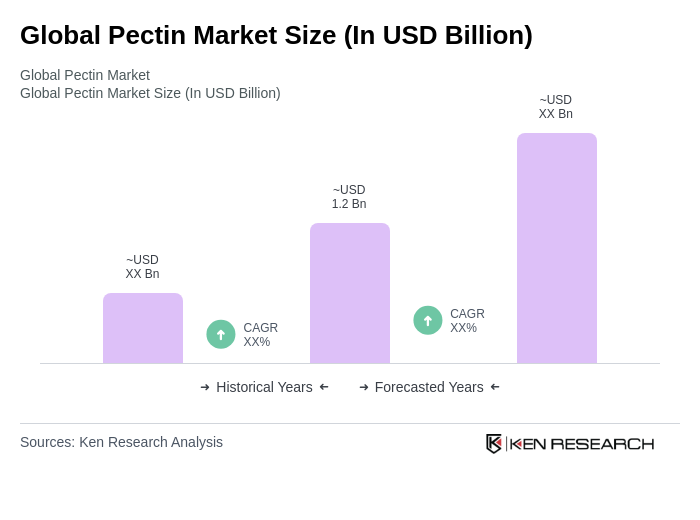
- The Global Pectin Market is valued at USD 1.2 billion, based on a five?year historical analysis. This growth is primarily driven by rising demand for natural and clean?label ingredients, broader use of pectin as a gelling, stabilizing, and thickening agent in jams, dairy, beverages, and confectionery, and increased health awareness favoring plant?based fibers.
- Key players in this market include the United States, Germany, and China. The U.S. benefits from an advanced packaged food ecosystem and significant share of North American pectin consumption. Germany has a strong base of specialty hydrocolloid producers supplying food and pharma applications, reinforcing its influence in Europe, while China is a major producer supported by large?scale citrus processing and manufacturing capabilities that supply both domestic and export markets.
- The European Union maintains a positive list system for food additives under Regulation (EC) No 1333/2008, with pectin authorized as E 440 and subject to the common authorization procedure (Regulation (EC) No 1331/2008), specifications under Regulation (EU) No 231/2012, and ongoing EFSA evaluations—ensuring approved additives meet safety and purity standards and reinforcing consumer trust.
Global Pectin Market Segmentation
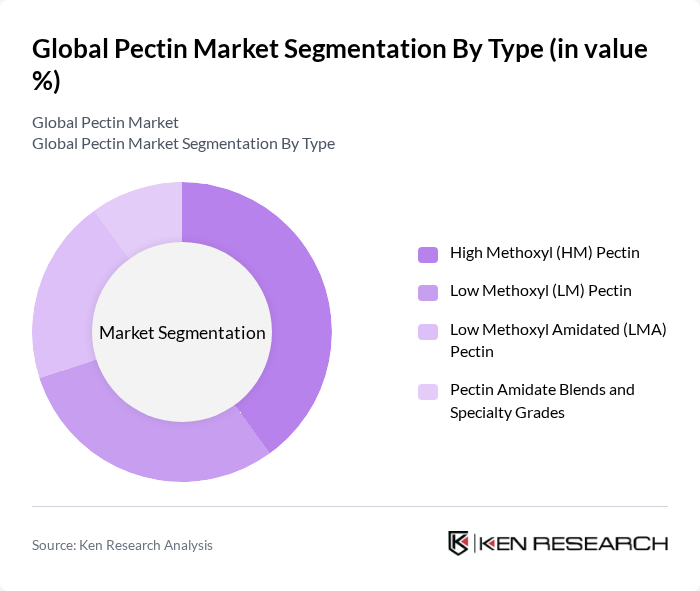
By Type:The market is segmented into High Methoxyl (HM) Pectin, Low Methoxyl (LM) Pectin, Low Methoxyl Amidated (LMA) Pectin, and Pectin Amidate Blends and Specialty Grades. High Methoxyl Pectin is widely used in jams and jellies due to its sugar? and acid?dependent gelling properties, while Low Methoxyl Pectin is preferred for low?sugar or sugar?free systems where calcium?ion crosslinking supports gelation. The demand for Low Methoxyl Amidated Pectin is increasing in pharmaceutical and nutrition applications for controlled release and texture stability in low?sugar matrices.
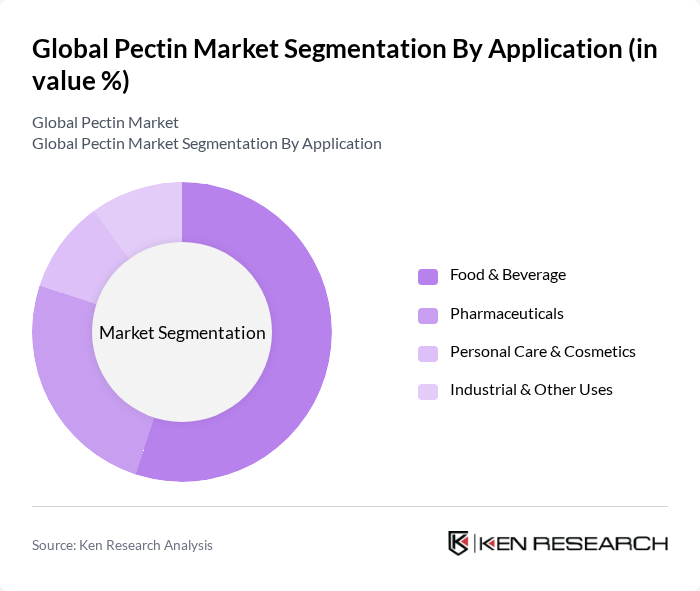
By Application:The applications of pectin include Food & Beverage, Pharmaceuticals, Personal Care & Cosmetics, and Industrial & Other Uses. The Food & Beverage segment dominates the market due to clean?label demand and broad use across jams, confectionery gels, fruit preparations for dairy, beverages, and bakery fillings. The pharmaceutical sector is also witnessing growth in matrix systems for controlled drug delivery and as a functional excipient in gastro?retentive and colon?targeted formulations.
Global Pectin Market Competitive Landscape
The Global Pectin Market is characterized by a dynamic mix of regional and international players. Leading participants such as CP Kelco U.S., Inc., International Flavors & Fragrances Inc. (IFF) – Health & Biosciences, Cargill, Incorporated, Herbstreith & Fox KG Pektin-Fabriken, Naturex S.A. (a Givaudan company), Ashland Inc., Silvateam S.p.A., Gelymar S.A., DSM-Firmenich AG, CEAMSA (Compañía Española de Algas Marinas S.A.), Yantai Andre Pectin Co., Ltd., Herbstreith & Fox Corporate Group (H&F Ingredients, U.S.), Naturex France S.A.S. (Givaudan Active Beauty & Taste), Givaudan SA, Ingredion Incorporated contribute to innovation, geographic expansion, and service delivery in this space.
Global Pectin Market Industry Analysis
Growth Drivers
- Increasing Demand for Natural Food Additives:The global demand for natural food additives is projected to reach approximately 1.5 million tons in future, driven by consumer preferences for healthier options. The shift towards clean label products, which emphasize natural ingredients, is a significant factor. According to the Food and Agriculture Organization, the natural food additives market is expected to grow at a rate of 5% annually, reflecting a robust trend towards pectin as a preferred gelling agent in various food applications.
- Rising Health Consciousness Among Consumers:Health consciousness is influencing consumer choices, with 70% of consumers actively seeking healthier food options. This trend is supported by the World Health Organization's findings that link dietary habits to health outcomes. As a result, the demand for pectin, known for its health benefits such as aiding digestion and lowering cholesterol, is expected to increase. The market for functional foods, which often incorporate pectin, is projected to reach $275 billion in future, further driving pectin consumption.
- Expansion of the Food and Beverage Industry:The food and beverage industry is anticipated to grow significantly, with a projected value of $7 trillion in future. This expansion is fueled by urbanization and changing lifestyles, leading to increased consumption of processed foods. Pectin's role as a gelling agent in jams, jellies, and dairy products positions it favorably within this growing sector. The International Food and Beverage Alliance reports that the demand for innovative food products will further enhance pectin's market presence.
Market Challenges
- Fluctuating Raw Material Prices:The prices of raw materials for pectin production, such as citrus peels and apple pomace, are subject to volatility due to climate change and agricultural yield fluctuations. For instance, citrus fruit production was down by 10% due to adverse weather conditions, leading to increased costs. This unpredictability can hinder manufacturers' ability to maintain stable pricing, impacting profit margins and market competitiveness.
- Stringent Regulatory Standards:The pectin industry faces stringent regulatory standards imposed by food safety authorities, which can complicate production processes. For example, the European Food Safety Authority has set rigorous guidelines for food additives, requiring extensive testing and compliance. This regulatory environment can lead to increased operational costs and longer timeframes for product development, posing challenges for manufacturers aiming to innovate and expand their product lines.
Global Pectin Market Future Outlook
The future of the pectin market appears promising, driven by the increasing consumer preference for natural and organic products. As the food industry continues to innovate, pectin's versatility in various applications will likely enhance its market presence. Additionally, the rise of e-commerce platforms is expected to facilitate broader distribution channels, making pectin more accessible to manufacturers and consumers alike. This trend, combined with ongoing research into new applications, positions the pectin market for sustained growth in the coming years.
Market Opportunities
- Growth in Plant-Based Food Products:The plant-based food sector is projected to reach $74 billion in future, creating significant opportunities for pectin as a natural thickening agent. As consumers increasingly adopt plant-based diets, the demand for pectin in vegan and vegetarian products is expected to rise, enhancing its market potential.
- Increasing Use in Pharmaceuticals and Nutraceuticals:The pharmaceutical and nutraceutical markets are expanding, with a projected value of $400 billion in future. Pectin's health benefits, including its role in drug delivery systems and as a dietary supplement, present lucrative opportunities for manufacturers to explore innovative applications in these sectors.
Scope of the Report
| Segment | Sub-Segments |
|---|---|
| By Type | High Methoxyl (HM) Pectin Low Methoxyl (LM) Pectin Low Methoxyl Amidated (LMA) Pectin Pectin Amidate Blends and Specialty Grades |
| By Application | Food & Beverage (Jams/Jellies, Dairy Fruit Preparations, Beverages, Confectionery) Pharmaceuticals (Drug Delivery, Antidiarrheal, Wound Care) Personal Care & Cosmetics (Skin Care, Hair Care) Industrial & Other Uses (Pet Food, Dietary Supplements) |
| By Source | Citrus Peel Apple Pomace Sugar Beet and Other Botanical Sources |
| By Functionality | Gelling Agent Thickener & Stabilizer Fat/Sugar Replacer and Emulsifier |
| By Region | North America Europe Asia-Pacific Latin America Middle East & Africa |
| By Grade/Certification | Conventional Organic Non-GMO/Allergen-Free |
| By Packaging Format | Bulk (25 kg bags, Big Bags) Industrial Drums/IBC Small Packs for R&D and Specialty |
Key Target Audience
Investors and Venture Capitalist Firms
Government and Regulatory Bodies (e.g., Food and Drug Administration, European Food Safety Authority)
Manufacturers and Producers of Pectin
Food and Beverage Companies
Pharmaceutical Companies
Cosmetic and Personal Care Product Manufacturers
Food Ingredient Suppliers
Packaging Companies
Players Mentioned in the Report:
CP Kelco U.S., Inc.
International Flavors & Fragrances Inc. (IFF) Health & Biosciences
Cargill, Incorporated
Herbstreith & Fox KG Pektin-Fabriken
Naturex S.A. (a Givaudan company)
Ashland Inc.
Silvateam S.p.A.
Gelymar S.A.
DSM-Firmenich AG
CEAMSA (Compania Espanola de Algas Marinas S.A.)
Yantai Andre Pectin Co., Ltd.
Herbstreith & Fox Corporate Group (H&F Ingredients, U.S.)
Naturex France S.A.S. (Givaudan Active Beauty & Taste)
Givaudan SA
Ingredion Incorporated
Table of Contents
Market Assessment Phase
1. Executive Summary and Approach
2. Global Pectin Market Overview
2.1 Key Insights and Strategic Recommendations
2.2 Global Pectin Market Overview
2.3 Definition and Scope
2.4 Evolution of Market Ecosystem
2.5 Timeline of Key Regulatory Milestones
2.6 Value Chain & Stakeholder Mapping
2.7 Business Cycle Analysis
2.8 Policy & Incentive Landscape
3. Global Pectin Market Analysis
3.1 Growth Drivers
3.1.1 Increasing Demand for Natural Food Additives
3.1.2 Rising Health Consciousness Among Consumers
3.1.3 Expansion of the Food and Beverage Industry
3.1.4 Technological Advancements in Extraction Processes
3.2 Market Challenges
3.2.1 Fluctuating Raw Material Prices
3.2.2 Stringent Regulatory Standards
3.2.3 Competition from Alternative Gelling Agents
3.2.4 Limited Awareness in Emerging Markets
3.3 Market Opportunities
3.3.1 Growth in Plant-Based Food Products
3.3.2 Expansion into Emerging Markets
3.3.3 Development of Innovative Applications
3.3.4 Increasing Use in Pharmaceuticals and Nutraceuticals
3.4 Market Trends
3.4.1 Shift Towards Clean Label Products
3.4.2 Rising Popularity of Organic Pectin
3.4.3 Increased Focus on Sustainable Sourcing
3.4.4 Growth of E-commerce in Food Ingredients
3.5 Government Regulation
3.5.1 Food Safety Standards and Compliance
3.5.2 Labeling Requirements for Food Additives
3.5.3 Import and Export Regulations
3.5.4 Environmental Regulations on Production Processes
4. SWOT Analysis
5. Stakeholder Analysis
6. Porter's Five Forces Analysis
7. Global Pectin Market Market Size, 2019-2024
7.1 By Value
7.2 By Volume
7.3 By Average Selling Price
8. Global Pectin Market Segmentation
8.1 By Type
8.1.1 High Methoxyl (HM) Pectin
8.1.2 Low Methoxyl (LM) Pectin
8.1.3 Low Methoxyl Amidated (LMA) Pectin
8.1.4 Pectin Amidate Blends and Specialty Grades
8.2 By Application
8.2.1 Food & Beverage (Jams/Jellies, Dairy Fruit Preparations, Beverages, Confectionery)
8.2.2 Pharmaceuticals (Drug Delivery, Antidiarrheal, Wound Care)
8.2.3 Personal Care & Cosmetics (Skin Care, Hair Care)
8.2.4 Industrial & Other Uses (Pet Food, Dietary Supplements)
8.3 By Source
8.3.1 Citrus Peel
8.3.2 Apple Pomace
8.3.3 Sugar Beet and Other Botanical Sources
8.4 By Functionality
8.4.1 Gelling Agent
8.4.2 Thickener & Stabilizer
8.4.3 Fat/Sugar Replacer and Emulsifier
8.5 By Region
8.5.1 North America
8.5.2 Europe
8.5.3 Asia-Pacific
8.5.4 Latin America
8.5.5 Middle East & Africa
8.6 By Grade/Certification
8.6.1 Conventional
8.6.2 Organic
8.6.3 Non-GMO/Allergen-Free
8.7 By Packaging Format
8.7.1 Bulk (25 kg bags, Big Bags)
8.7.2 Industrial Drums/IBC
8.7.3 Small Packs for R&D and Specialty
9. Global Pectin Market Competitive Analysis
9.1 Market Share of Key Players
9.2 Cross Comparison of Key Players
9.2.1 Company Name
9.2.2 Group Size (Global, Regional, Niche)
9.2.3 Pectin Revenue and Revenue Growth Rate
9.2.4 Installed Capacity (MT/year) and Capacity Utilization
9.2.5 Sourcing Mix (Citrus vs. Apple vs. Other) and Security of Supply
9.2.6 Geographic Footprint (Production Sites, Regions Served)
9.2.7 Application Breadth (Food & Beverage share, Pharma, Personal Care)
9.2.8 Innovation Pipeline (New Grades, Clean-Label/Organic Certifications, IP/Patents)
9.2.9 Quality & Compliance (Certifications: FSSC 22000, ISO, Halal, Kosher)
9.2.10 Pricing Positioning (Commodity vs. Specialty) and ASP Trend
9.2.11 Strategic Partnerships and Vertical Integration (Peel sourcing, citrus processors)
9.2.12 Customer Concentration and Retention (Top-10 accounts share)
9.3 SWOT Analysis of Top Players
9.4 Pricing Analysis
9.5 Detailed Profile of Major Companies
9.5.1 CP Kelco U.S., Inc.
9.5.2 International Flavors & Fragrances Inc. (IFF) – Health & Biosciences
9.5.3 Cargill, Incorporated
9.5.4 Herbstreith & Fox KG Pektin-Fabriken
9.5.5 Naturex S.A. (a Givaudan company)
9.5.6 Ashland Inc.
9.5.7 Silvateam S.p.A.
9.5.8 Gelymar S.A.
9.5.9 DSM-Firmenich AG
9.5.10 CEAMSA (Compañía Española de Algas Marinas S.A.)
9.5.11 Yantai Andre Pectin Co., Ltd.
9.5.12 Herbstreith & Fox Corporate Group (H&F Ingredients, U.S.)
9.5.13 Naturex France S.A.S. (Givaudan Active Beauty & Taste)
9.5.14 Givaudan SA
9.5.15 Ingredion Incorporated
10. Global Pectin Market End-User Analysis
10.1 Procurement Behavior of Key Ministries
10.1.1 Government Food Safety Agencies
10.1.2 Health Ministries
10.1.3 Agricultural Departments
10.2 Corporate Spend on Infrastructure & Energy
10.2.1 Investment in Food Processing Facilities
10.2.2 Expenditure on Quality Control Systems
10.2.3 Budget for Research and Development
10.3 Pain Point Analysis by End-User Category
10.3.1 Food Manufacturers
10.3.2 Beverage Producers
10.3.3 Confectionery Companies
10.4 User Readiness for Adoption
10.4.1 Awareness of Pectin Benefits
10.4.2 Availability of Training Programs
10.4.3 Access to Technical Support
10.5 Post-Deployment ROI and Use Case Expansion
10.5.1 Measurement of Cost Savings
10.5.2 Evaluation of Product Quality Improvements
10.5.3 Analysis of Market Expansion Opportunities
11. Global Pectin Market Future Size, 2025-2030
11.1 By Value
11.2 By Volume
11.3 By Average Selling Price
Go-To-Market Strategy Phase
1. Whitespace Analysis + Business Model Canvas
1.1 Market Gaps Identification
1.2 Value Proposition Development
1.3 Revenue Streams Analysis
1.4 Key Partnerships Exploration
1.5 Cost Structure Assessment
1.6 Customer Segmentation
1.7 Channels of Distribution
2. Marketing and Positioning Recommendations
2.1 Branding Strategies
2.2 Product USPs
2.3 Target Market Identification
2.4 Communication Strategy
2.5 Digital Marketing Approaches
3. Distribution Plan
3.1 Urban Retail Strategies
3.2 Rural NGO Tie-ups
3.3 E-commerce Integration
3.4 Direct Sales Channels
3.5 Distribution Partnerships
4. Channel & Pricing Gaps
4.1 Underserved Routes
4.2 Pricing Bands Analysis
4.3 Competitor Pricing Comparison
4.4 Customer Willingness to Pay
5. Unmet Demand & Latent Needs
5.1 Category Gaps Identification
5.2 Consumer Segments Analysis
5.3 Product Development Opportunities
5.4 Market Entry Strategies
6. Customer Relationship
6.1 Loyalty Programs
6.2 After-sales Service
6.3 Customer Feedback Mechanisms
6.4 Community Engagement Initiatives
7. Value Proposition
7.1 Sustainability Initiatives
7.2 Integrated Supply Chains
7.3 Customer-Centric Innovations
7.4 Competitive Differentiation
8. Key Activities
8.1 Regulatory Compliance
8.2 Branding Efforts
8.3 Distribution Setup
8.4 Market Research Activities
9. Entry Strategy Evaluation
9.1 Domestic Market Entry Strategy
9.1.1 Product Mix Considerations
9.1.2 Pricing Band Strategy
9.1.3 Packaging Innovations
9.2 Export Entry Strategy
9.2.1 Target Countries Identification
9.2.2 Compliance Roadmap Development
10. Entry Mode Assessment
10.1 Joint Ventures
10.2 Greenfield Investments
10.3 Mergers & Acquisitions
10.4 Distributor Model Evaluation
11. Capital and Timeline Estimation
11.1 Capital Requirements Analysis
11.2 Timelines for Implementation
12. Control vs Risk Trade-Off
12.1 Ownership vs Partnerships
12.2 Risk Mitigation Strategies
13. Profitability Outlook
13.1 Breakeven Analysis
13.2 Long-term Sustainability Strategies
14. Potential Partner List
14.1 Distributors
14.2 Joint Ventures
14.3 Acquisition Targets
15. Execution Roadmap
15.1 Phased Plan for Market Entry
15.1.1 Market Setup
15.1.2 Market Entry
15.1.3 Growth Acceleration
15.1.4 Scale & Stabilize
15.2 Key Activities and Milestones
15.2.1 Milestone Planning
15.2.2 Activity Tracking
Research Methodology
Phase 1: Approach1
Desk Research
- Industry reports from global food and beverage associations
- Market analysis from agricultural and food science journals
- Statistical data from international trade organizations and databases
Primary Research
- Interviews with product development managers at food manufacturers
- Surveys with suppliers and distributors of pectin products
- Field interviews with researchers in food technology and pectin applications
Validation & Triangulation
- Cross-validation of market data with historical consumption trends
- Triangulation of insights from industry experts and market reports
- Sanity checks through feedback from focus groups of industry stakeholders
Phase 2: Market Size Estimation1
Top-down Assessment
- Analysis of global pectin consumption trends across key regions
- Segmentation by application areas such as food, pharmaceuticals, and cosmetics
- Incorporation of macroeconomic factors influencing pectin demand
Bottom-up Modeling
- Volume estimates based on production capacities of leading pectin manufacturers
- Cost analysis derived from raw material prices and processing expenses
- Estimation of market share based on sales data from key players
Forecasting & Scenario Analysis
- Multi-variable regression analysis incorporating health trends and dietary shifts
- Scenario modeling based on regulatory changes and consumer preferences
- Baseline, optimistic, and pessimistic forecasts through 2030
Phase 3: CATI Sample Composition1
| Scope Item/Segment | Sample Size | Target Respondent Profiles |
|---|---|---|
| Food and Beverage Manufacturers | 140 | Product Development Managers, Quality Assurance Heads |
| Pharmaceutical Companies | 100 | R&D Directors, Regulatory Affairs Managers |
| Cosmetics and Personal Care Brands | 80 | Formulation Chemists, Brand Managers |
| Food Ingredient Distributors | 70 | Supply Chain Managers, Sales Directors |
| Research Institutions and Universities | 60 | Food Scientists, Academic Researchers |
Frequently Asked Questions
What is the current value of the Global Pectin Market?
The Global Pectin Market is valued at approximately USD 1.2 billion, driven by the increasing demand for natural ingredients and the versatile applications of pectin in food, beverages, and pharmaceuticals.
What are the main drivers of growth in the Global Pectin Market?
Which regions are the largest consumers of pectin?
What are the different types of pectin available in the market?
Other Regional/Country Reports
Why Buy From Us?

What makes us stand out is that our consultants follow Robust, Refine and Result (RRR) methodology. Robust for clear definitions, approaches and sanity checking, Refine for differentiating respondents' facts and opinions, and Result for presenting data with story.

We have set a benchmark in the industry by offering our clients with syndicated and customized market research reports featuring coverage of entire market as well as meticulous research and analyst insights.

While we don't replace traditional research, we flip the method upside down. Our dual approach of Top Bottom & Bottom Top ensures quality deliverable by not just verifying company fundamentals but also looking at the sector and macroeconomic factors.

With one step in the future, our research team constantly tries to show you the bigger picture. We help with some of the tough questions you may encounter along the way: How is the industry positioned? Best marketing channel? KPI's of competitors? By aligning every element, we help maximize success.

Our report gives you instant access to the answers and sources that other companies might choose to hide. We elaborate each steps of research methodology we have used and showcase you the sample size to earn your trust.

If you need any support, we are here! We pride ourselves on universe strength, data quality, and quick, friendly, and professional service.