About the Report
Base Year 2024Global Pineapple Juice Market Overview
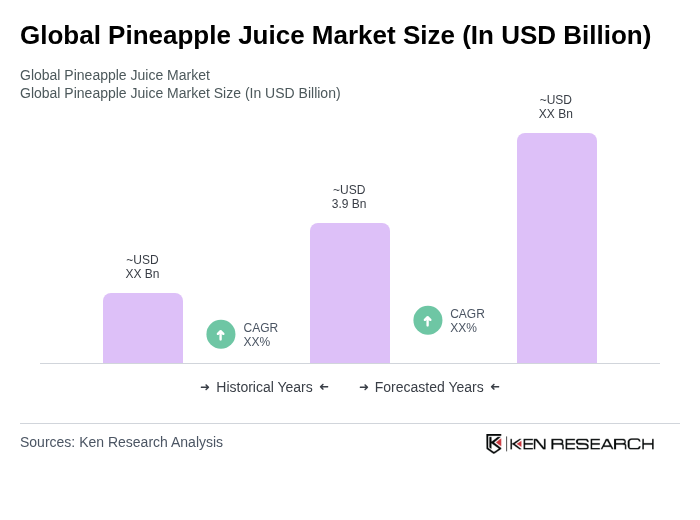
- The Global Pineapple Juice Market is valued at USD 3.9 billion, based on a five-year historical analysis. This growth is primarily driven by increasing consumer demand for natural and healthy beverages, along with the rising popularity of pineapple juice as a versatile ingredient in cocktails and mixed drinks. The market has also benefited from the growing trend of health consciousness among consumers, leading to a shift towards organic and natural juice options. Additional drivers include the expansion of e-commerce and retail distribution channels, as well as the introduction of functional and fortified pineapple juice variants enriched with vitamins and minerals .
- Key players in this market include countries like the United States, Costa Rica, and the Philippines, which dominate due to their significant pineapple production and processing capabilities. The U.S. is a major consumer market, while Costa Rica and the Philippines are leading exporters, leveraging their favorable climates for pineapple cultivation and established supply chains to meet global demand. Costa Rica, the Philippines, and Mexico collectively account for the majority of global pineapple juice production, while the U.S. remains the largest consumer market .
- In 2023, the U.S. government implemented the Juice HACCP Regulation, which requires juice manufacturers to implement Hazard Analysis and Critical Control Points systems for juice products, including pineapple juice. These regulations mandate stricter testing for contaminants, improved labeling practices, and enhanced traceability to ensure transparency and consumer safety. This initiative is part of a broader effort to promote public health and safety in the beverage industry .
Global Pineapple Juice Market Segmentation
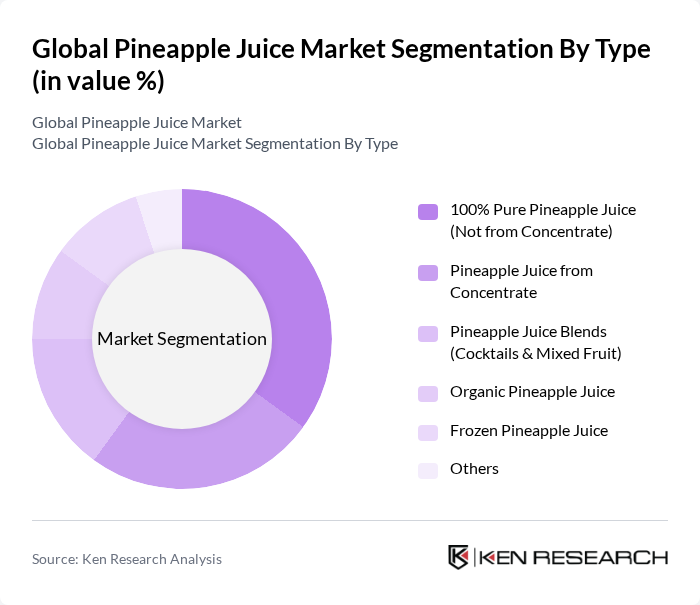
By Type:The market is segmented into various types of pineapple juice, including 100% Pure Pineapple Juice (Not from Concentrate), Pineapple Juice from Concentrate, Pineapple Juice Blends (Cocktails & Mixed Fruit), Organic Pineapple Juice, Frozen Pineapple Juice, and Others. Among these, 100% Pure Pineapple Juice is gaining traction due to its perceived health benefits and natural flavor. Consumers are increasingly opting for pure juices over concentrates, driven by a desire for authenticity and quality. Organic options are also on the rise, reflecting a growing trend towards organic and sustainably sourced products. The concentrated juice segment remains significant due to its longer shelf life and cost-effectiveness for manufacturers and consumers .
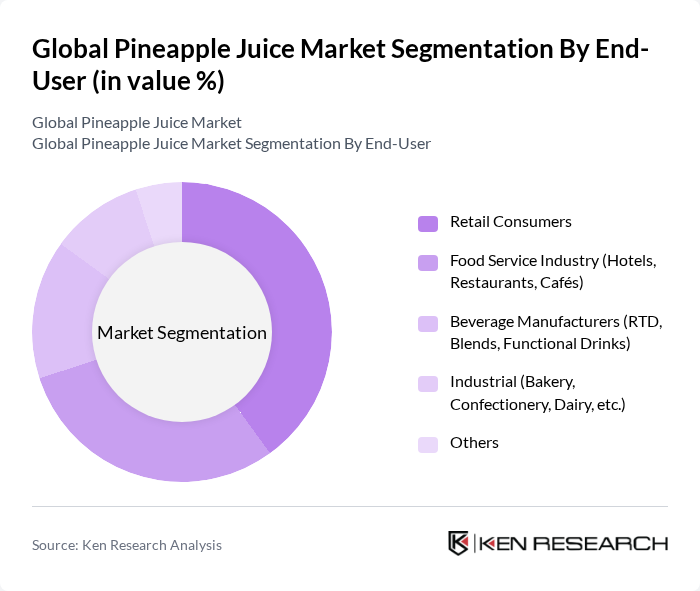
By End-User:The end-user segmentation includes Retail Consumers, Food Service Industry (Hotels, Restaurants, Cafés), Beverage Manufacturers (RTD, Blends, Functional Drinks), Industrial (Bakery, Confectionery, Dairy, etc.), and Others. The retail consumer segment is the largest, driven by the increasing availability of pineapple juice in supermarkets and online platforms. The food service industry is also significant, as restaurants and cafes incorporate pineapple juice into their beverage offerings and culinary creations, enhancing flavor profiles and attracting health-conscious customers. Beverage manufacturers are increasingly using pineapple juice as a base for ready-to-drink and functional beverages, further expanding its industrial applications .
Global Pineapple Juice Market Competitive Landscape
The Global Pineapple Juice Market is characterized by a dynamic mix of regional and international players. Leading participants such as Dole Food Company, Inc., Del Monte Foods, Inc., Tropicana Products, Inc. (PepsiCo, Inc.), The Coca-Cola Company, Suntory Holdings Limited (Orangina Schweppes), Welch Foods Inc., Ocean Spray Cranberries, Inc., Ceres Fruit Juices (Pty) Ltd, Chabaa Bangkok Co., Ltd., Tipco Foods Public Company Limited, R.W. Knudsen Family (The J.M. Smucker Company), Campbell Soup Company (V8), Simply Beverages (The Coca-Cola Company), Naked Juice (PepsiCo, Inc.), Bolthouse Farms, Inc. (Butterfly Equity) contribute to innovation, geographic expansion, and service delivery in this space.
Global Pineapple Juice Market Industry Analysis
Growth Drivers
- Increasing Health Consciousness:The global trend towards healthier lifestyles is driving the demand for pineapple juice, which is rich in vitamins and antioxidants. In future, the health and wellness market is projected to reach $4.5 trillion, with consumers increasingly opting for natural beverages. This shift is evident as 60% of consumers prioritize health benefits when choosing beverages, leading to a surge in pineapple juice consumption, particularly among millennials and Gen Z.
- Rising Demand for Natural Beverages:The global market for natural beverages is expected to exceed $1 trillion in future, with pineapple juice benefiting from this trend. Consumers are increasingly avoiding artificial ingredients, with 70% of beverage buyers preferring products labeled as "natural." This shift is supported by the growing awareness of the health risks associated with artificial additives, prompting manufacturers to innovate and offer more natural pineapple juice options to meet consumer preferences.
- Expansion of Distribution Channels:The pineapple juice market is experiencing significant growth due to the expansion of distribution channels, particularly in e-commerce. In future, online grocery sales are projected to reach $200 billion, providing a platform for pineapple juice brands to reach a wider audience. Retailers are increasingly investing in online platforms, with 40% of consumers now purchasing beverages online, enhancing accessibility and convenience for health-conscious consumers seeking pineapple juice.
Market Challenges
- Fluctuating Raw Material Prices:The pineapple juice industry faces challenges due to the volatility of raw material prices, which can significantly impact production costs. In future, the price of pineapples is expected to fluctuate between $1.50 and $2.00 per kilogram, influenced by weather conditions and supply chain issues. This unpredictability can lead to increased costs for manufacturers, potentially resulting in higher retail prices and reduced profit margins.
- Stringent Regulatory Standards:Compliance with stringent food safety and quality regulations poses a challenge for pineapple juice producers. In future, the global food safety market is projected to reach $20 billion, with increasing regulations impacting production processes. Companies must invest in quality assurance and testing to meet these standards, which can increase operational costs and complicate market entry for smaller producers, limiting competition and innovation.
Global Pineapple Juice Market Future Outlook
The future of the pineapple juice market appears promising, driven by evolving consumer preferences and innovative product developments. As health consciousness continues to rise, brands are likely to focus on enhancing the nutritional profile of their offerings. Additionally, the trend towards sustainable practices will likely influence packaging and production methods, aligning with consumer demand for environmentally friendly products. Companies that adapt to these trends will be well-positioned to capture market share in the coming years.
Market Opportunities
- Growing E-commerce Platforms:The rise of e-commerce presents a significant opportunity for pineapple juice brands. With online grocery sales projected to reach $200 billion in future, companies can leverage digital marketing strategies to enhance visibility and accessibility. This shift allows brands to reach a broader audience, particularly younger consumers who prefer online shopping, thus driving sales growth in the pineapple juice segment.
- Development of Organic Pineapple Juice:The increasing consumer preference for organic products offers a lucrative opportunity for pineapple juice manufacturers. The organic food market is expected to reach $300 billion in future, with consumers willing to pay a premium for organic beverages. By developing organic pineapple juice options, brands can cater to this growing segment, enhancing their market position and attracting health-conscious consumers seeking natural alternatives.
Scope of the Report
| Segment | Sub-Segments |
|---|---|
| By Type | % Pure Pineapple Juice (Not from Concentrate) Pineapple Juice from Concentrate Pineapple Juice Blends (Cocktails & Mixed Fruit) Organic Pineapple Juice Frozen Pineapple Juice Others |
| By End-User | Retail Consumers Food Service Industry (Hotels, Restaurants, Cafés) Beverage Manufacturers (RTD, Blends, Functional Drinks) Industrial (Bakery, Confectionery, Dairy, etc.) Others |
| By Packaging Type | Tetra Pak Cartons Glass Bottles Cans Pouches Bulk Packaging (Drums, IBCs) Others |
| By Distribution Channel | Supermarkets/Hypermarkets Online Retail/E-commerce Convenience Stores Specialty Stores Foodservice & Institutional Others |
| By Region | North America (U.S., Canada, Mexico) Europe (U.K., Germany, France, Italy, Spain, Russia, Rest of Europe) Asia-Pacific (China, India, Japan, Southeast Asia, Australia, Rest of APAC) Latin America (Brazil, Argentina, Costa Rica, Rest of LATAM) Middle East & Africa (GCC, South Africa, Rest of MEA) |
| By Flavor Profile | Original Pineapple Mixed Fruit Blends Tropical Flavors Functional/Enhanced (Probiotic, Vitamin-fortified, etc.) Others |
| By Price Range | Premium Mid-Range Budget Others |
Key Target Audience
Investors and Venture Capitalist Firms
Government and Regulatory Bodies (e.g., Food and Drug Administration, Department of Agriculture)
Manufacturers and Producers
Distributors and Retailers
Exporters and Importers
Food and Beverage Industry Associations
Packaging Suppliers
Quality Assurance and Testing Laboratories
Players Mentioned in the Report:
Dole Food Company, Inc.
Del Monte Foods, Inc.
Tropicana Products, Inc. (PepsiCo, Inc.)
The Coca-Cola Company
Suntory Holdings Limited (Orangina Schweppes)
Welch Foods Inc.
Ocean Spray Cranberries, Inc.
Ceres Fruit Juices (Pty) Ltd
Chabaa Bangkok Co., Ltd.
Tipco Foods Public Company Limited
R.W. Knudsen Family (The J.M. Smucker Company)
Campbell Soup Company (V8)
Simply Beverages (The Coca-Cola Company)
Naked Juice (PepsiCo, Inc.)
Bolthouse Farms, Inc. (Butterfly Equity)
Table of Contents
Market Assessment Phase
1. Executive Summary and Approach
2. Global Pineapple Juice Market Overview
2.1 Key Insights and Strategic Recommendations
2.2 Global Pineapple Juice Market Overview
2.3 Definition and Scope
2.4 Evolution of Market Ecosystem
2.5 Timeline of Key Regulatory Milestones
2.6 Value Chain & Stakeholder Mapping
2.7 Business Cycle Analysis
2.8 Policy & Incentive Landscape
3. Global Pineapple Juice Market Analysis
3.1 Growth Drivers
3.1.1 Increasing Health Consciousness
3.1.2 Rising Demand for Natural Beverages
3.1.3 Expansion of Distribution Channels
3.1.4 Innovative Product Offerings
3.2 Market Challenges
3.2.1 Fluctuating Raw Material Prices
3.2.2 Stringent Regulatory Standards
3.2.3 Competition from Other Beverage Segments
3.2.4 Supply Chain Disruptions
3.3 Market Opportunities
3.3.1 Growing E-commerce Platforms
3.3.2 Expansion into Emerging Markets
3.3.3 Development of Organic Pineapple Juice
3.3.4 Collaborations with Health and Wellness Brands
3.4 Market Trends
3.4.1 Increasing Popularity of Cold-Pressed Juices
3.4.2 Shift Towards Sustainable Packaging
3.4.3 Rise of Functional Beverages
3.4.4 Growing Interest in Exotic Flavors
3.5 Government Regulation
3.5.1 Food Safety Standards
3.5.2 Labeling Requirements
3.5.3 Import Tariffs and Trade Policies
3.5.4 Environmental Regulations
4. SWOT Analysis
5. Stakeholder Analysis
6. Porter's Five Forces Analysis
7. Global Pineapple Juice Market Market Size, 2019-2024
7.1 By Value
7.2 By Volume
7.3 By Average Selling Price
8. Global Pineapple Juice Market Segmentation
8.1 By Type
8.1.1 100% Pure Pineapple Juice (Not from Concentrate)
8.1.2 Pineapple Juice from Concentrate
8.1.3 Pineapple Juice Blends (Cocktails & Mixed Fruit)
8.1.4 Organic Pineapple Juice
8.1.5 Frozen Pineapple Juice
8.1.6 Others
8.2 By End-User
8.2.1 Retail Consumers
8.2.2 Food Service Industry (Hotels, Restaurants, Cafés)
8.2.3 Beverage Manufacturers (RTD, Blends, Functional Drinks)
8.2.4 Industrial (Bakery, Confectionery, Dairy, etc.)
8.2.5 Others
8.3 By Packaging Type
8.3.1 Tetra Pak Cartons
8.3.2 Glass Bottles
8.3.3 Cans
8.3.4 Pouches
8.3.5 Bulk Packaging (Drums, IBCs)
8.3.6 Others
8.4 By Distribution Channel
8.4.1 Supermarkets/Hypermarkets
8.4.2 Online Retail/E-commerce
8.4.3 Convenience Stores
8.4.4 Specialty Stores
8.4.5 Foodservice & Institutional
8.4.6 Others
8.5 By Region
8.5.1 North America (U.S., Canada, Mexico)
8.5.2 Europe (U.K., Germany, France, Italy, Spain, Russia, Rest of Europe)
8.5.3 Asia-Pacific (China, India, Japan, Southeast Asia, Australia, Rest of APAC)
8.5.4 Latin America (Brazil, Argentina, Costa Rica, Rest of LATAM)
8.5.5 Middle East & Africa (GCC, South Africa, Rest of MEA)
8.6 By Flavor Profile
8.6.1 Original Pineapple
8.6.2 Mixed Fruit Blends
8.6.3 Tropical Flavors
8.6.4 Functional/Enhanced (Probiotic, Vitamin-fortified, etc.)
8.6.5 Others
8.7 By Price Range
8.7.1 Premium
8.7.2 Mid-Range
8.7.3 Budget
8.7.4 Others
9. Global Pineapple Juice Market Competitive Analysis
9.1 Market Share of Key Players
9.2 Cross Comparison of Key Players
9.2.1 Company Name
9.2.2 Group Size (Large, Medium, or Small as per industry convention)
9.2.3 Revenue (USD, latest fiscal year)
9.2.4 Revenue Growth Rate (CAGR %)
9.2.5 Market Share (%)
9.2.6 Geographic Presence (Regions/Countries)
9.2.7 Product Portfolio Breadth (SKUs, Juice Types)
9.2.8 Distribution Channel Coverage
9.2.9 Brand Recognition/Consumer Awareness Index
9.2.10 Innovation Index (New Product Launches, R&D Spend)
9.2.11 Sustainability Initiatives (Certifications, Packaging, Sourcing)
9.2.12 Pricing Strategy (Premium, Value, Mass Market)
9.3 SWOT Analysis of Top Players
9.4 Pricing Analysis
9.5 Detailed Profile of Major Companies
9.5.1 Dole Food Company, Inc.
9.5.2 Del Monte Foods, Inc.
9.5.3 Tropicana Products, Inc. (PepsiCo, Inc.)
9.5.4 The Coca-Cola Company
9.5.5 Suntory Holdings Limited (Orangina Schweppes)
9.5.6 Welch Foods Inc.
9.5.7 Ocean Spray Cranberries, Inc.
9.5.8 Ceres Fruit Juices (Pty) Ltd
9.5.9 Chabaa Bangkok Co., Ltd.
9.5.10 Tipco Foods Public Company Limited
9.5.11 R.W. Knudsen Family (The J.M. Smucker Company)
9.5.12 Campbell Soup Company (V8)
9.5.13 Simply Beverages (The Coca-Cola Company)
9.5.14 Naked Juice (PepsiCo, Inc.)
9.5.15 Bolthouse Farms, Inc. (Butterfly Equity)
10. Global Pineapple Juice Market End-User Analysis
10.1 Procurement Behavior of Key Ministries
10.1.1 Government Contracts
10.1.2 Bulk Purchasing Trends
10.1.3 Sustainability Initiatives
10.1.4 Quality Assurance Standards
10.2 Corporate Spend on Infrastructure & Energy
10.2.1 Investment in Production Facilities
10.2.2 Energy Efficiency Programs
10.2.3 Technology Upgrades
10.2.4 Supply Chain Optimization
10.3 Pain Point Analysis by End-User Category
10.3.1 Quality Consistency Issues
10.3.2 Price Volatility
10.3.3 Supply Chain Disruptions
10.3.4 Regulatory Compliance Challenges
10.4 User Readiness for Adoption
10.4.1 Awareness of Health Benefits
10.4.2 Availability of Products
10.4.3 Consumer Preferences
10.4.4 Price Sensitivity
10.5 Post-Deployment ROI and Use Case Expansion
10.5.1 Performance Metrics
10.5.2 Customer Feedback Mechanisms
10.5.3 Market Expansion Opportunities
10.5.4 Long-term Sustainability Goals
11. Global Pineapple Juice Market Future Size, 2025-2030
11.1 By Value
11.2 By Volume
11.3 By Average Selling Price
Go-To-Market Strategy Phase
1. Whitespace Analysis + Business Model Canvas
1.1 Market Gaps Identification
1.2 Value Proposition Development
1.3 Revenue Streams Analysis
1.4 Cost Structure Evaluation
1.5 Key Partnerships Exploration
1.6 Customer Segmentation
1.7 Channels of Distribution
2. Marketing and Positioning Recommendations
2.1 Branding Strategies
2.2 Product USPs
2.3 Target Audience Identification
2.4 Marketing Channels Selection
2.5 Promotional Strategies
3. Distribution Plan
3.1 Urban Retail Strategies
3.2 Rural NGO Tie-ups
3.3 E-commerce Integration
3.4 Direct-to-Consumer Approaches
4. Channel & Pricing Gaps
4.1 Underserved Routes
4.2 Pricing Bands Analysis
4.3 Competitor Pricing Strategies
5. Unmet Demand & Latent Needs
5.1 Category Gaps Identification
5.2 Consumer Segments Analysis
5.3 Product Development Opportunities
6. Customer Relationship
6.1 Loyalty Programs
6.2 After-sales Service
6.3 Customer Engagement Strategies
7. Value Proposition
7.1 Sustainability Initiatives
7.2 Integrated Supply Chains
7.3 Customer-Centric Approaches
8. Key Activities
8.1 Regulatory Compliance
8.2 Branding Efforts
8.3 Distribution Setup
9. Entry Strategy Evaluation
9.1 Domestic Market Entry Strategy
9.1.1 Product Mix Considerations
9.1.2 Pricing Band Strategy
9.1.3 Packaging Innovations
9.2 Export Entry Strategy
9.2.1 Target Countries Analysis
9.2.2 Compliance Roadmap Development
10. Entry Mode Assessment
10.1 Joint Ventures
10.2 Greenfield Investments
10.3 Mergers & Acquisitions
10.4 Distributor Model Evaluation
11. Capital and Timeline Estimation
11.1 Capital Requirements Analysis
11.2 Timelines for Market Entry
12. Control vs Risk Trade-Off
12.1 Ownership vs Partnerships
12.2 Risk Mitigation Strategies
13. Profitability Outlook
13.1 Breakeven Analysis
13.2 Long-term Sustainability Strategies
14. Potential Partner List
14.1 Distributors
14.2 Joint Ventures
14.3 Acquisition Targets
15. Execution Roadmap
15.1 Phased Plan for Market Entry
15.1.1 Market Setup
15.1.2 Market Entry
15.1.3 Growth Acceleration
15.1.4 Scale & Stabilize
15.2 Key Activities and Milestones
15.2.1 Milestone Planning
15.2.2 Activity Tracking
Research Methodology
Phase 1: Approach1
Desk Research
- Market reports from industry associations such as the International Pineapple Organization
- Trade statistics from global agricultural databases and export-import records
- Published articles and white papers on consumer trends in the beverage sector
Primary Research
- Interviews with key stakeholders in the pineapple juice supply chain, including farmers and processors
- Surveys targeting distributors and retailers to understand market dynamics and consumer preferences
- Focus group discussions with consumers to gauge taste preferences and purchasing behavior
Validation & Triangulation
- Cross-validation of data from multiple sources, including trade publications and market surveys
- Triangulation of findings from primary interviews with secondary data insights
- Sanity checks through expert reviews from industry veterans and market analysts
Phase 2: Market Size Estimation1
Top-down Assessment
- Analysis of global beverage market size to estimate the share of pineapple juice
- Segmentation by geographic regions and consumer demographics
- Incorporation of trends in health consciousness and organic product demand
Bottom-up Modeling
- Volume estimates based on production data from leading pineapple juice manufacturers
- Cost analysis of raw materials, processing, and distribution for accurate pricing models
- Estimation of market penetration rates based on historical sales data
Forecasting & Scenario Analysis
- Multi-variable forecasting using economic indicators and consumer behavior trends
- Scenario planning based on potential regulatory changes affecting juice production
- Development of baseline, optimistic, and pessimistic market growth projections through 2030
Phase 3: CATI Sample Composition1
| Scope Item/Segment | Sample Size | Target Respondent Profiles |
|---|---|---|
| Pineapple Juice Producers | 100 | Production Managers, Quality Control Supervisors |
| Retail Outlets Selling Pineapple Juice | 80 | Store Managers, Beverage Category Buyers |
| Consumers of Pineapple Juice | 120 | Health-conscious Consumers, Regular Juice Drinkers |
| Distributors of Beverage Products | 70 | Logistics Coordinators, Sales Representatives |
| Market Analysts and Researchers | 40 | Industry Analysts, Market Research Professionals |
Frequently Asked Questions
What is the current value of the Global Pineapple Juice Market?
The Global Pineapple Juice Market is valued at approximately USD 3.9 billion, reflecting a significant growth trend driven by increasing consumer demand for natural and healthy beverages, as well as the popularity of pineapple juice in cocktails and mixed drinks.
Which countries are the leading producers of pineapple juice?
What are the main types of pineapple juice available in the market?
How has health consciousness impacted the pineapple juice market?
Other Regional/Country Reports
Indonesia Pineapple Juice Market
Malaysia Pineapple Juice Market
KSA Pineapple Juice Market
APAC Pineapple Juice Market
SEA Pineapple Juice Market
Vietnam Pineapple Juice Market
Other Adjacent Reports
Bahrain Tropical Fruit Juice Market
Singapore Organic Beverage Market
Mexico Functional Drink Market
Bahrain Ready-to-Drink Beverage Market
Middle East and Africa Fruit Concentrate Market Outlook to 2030: Size, Share, Growth and TrendsKuwait Non-Alcoholic Beverage Market
Egypt Health and Wellness Beverage Market
Malaysia Bottled Juice Market
UAE Cocktail Mixer Market
KSA sustainable packaging market report Size, Share, Growth Drivers, Trends, Opportunities & Forecast 2025–2030Why Buy From Us?

What makes us stand out is that our consultants follow Robust, Refine and Result (RRR) methodology. Robust for clear definitions, approaches and sanity checking, Refine for differentiating respondents' facts and opinions, and Result for presenting data with story.

We have set a benchmark in the industry by offering our clients with syndicated and customized market research reports featuring coverage of entire market as well as meticulous research and analyst insights.

While we don't replace traditional research, we flip the method upside down. Our dual approach of Top Bottom & Bottom Top ensures quality deliverable by not just verifying company fundamentals but also looking at the sector and macroeconomic factors.

With one step in the future, our research team constantly tries to show you the bigger picture. We help with some of the tough questions you may encounter along the way: How is the industry positioned? Best marketing channel? KPI's of competitors? By aligning every element, we help maximize success.

Our report gives you instant access to the answers and sources that other companies might choose to hide. We elaborate each steps of research methodology we have used and showcase you the sample size to earn your trust.

If you need any support, we are here! We pride ourselves on universe strength, data quality, and quick, friendly, and professional service.