About the Report
Base Year 2024Listen to the audio summary
Global Processed Egg Market Overview
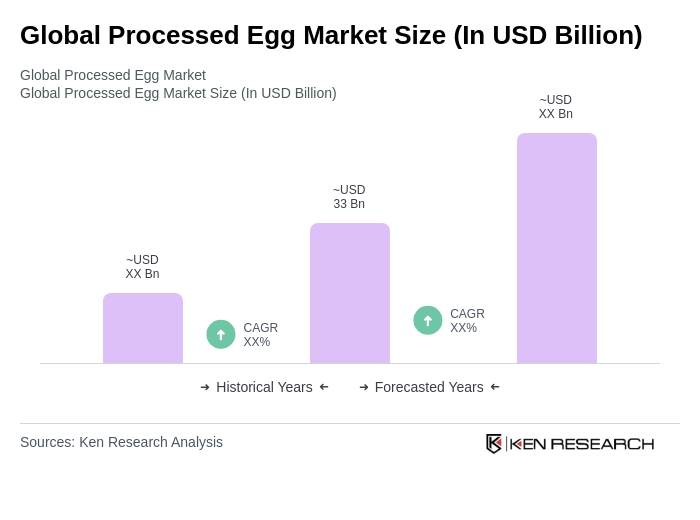
- The Global Processed Egg Market is valued at USD 33 billion, based on a five-year historical analysis. This growth is primarily driven by the increasing demand for convenience foods, rising health consciousness among consumers, and the expanding foodservice sector. The processed egg products are favored for their versatility and nutritional benefits, with widespread use in bakery, confectionery, ready-to-eat, and foodservice applications.
- Key players in this market include the United States, China, and several European countries. The U.S. is a leading market with advanced processing and a large commercial egg industry, and North America holds the largest regional share in recent assessments. China is a major producer and demand center as part of the broader egg industry’s largest output base globally. Europe remains significant, with a strong emphasis on quality and welfare (expansion of cage-free systems), supporting value-added processed egg offerings.
- In 2023, U.S. authorities continued to enforce stringent safety oversight of egg products under USDA Food Safety and Inspection Service, including mandatory pasteurization and hazard controls, with ongoing updates to labeling and food safety communications that aim to reduce foodborne illness and maintain consumer trust. Recent USDA reporting also highlights rising U.S. egg output, which supports processed egg supply to foodservice and manufacturing.
Global Processed Egg Market Segmentation
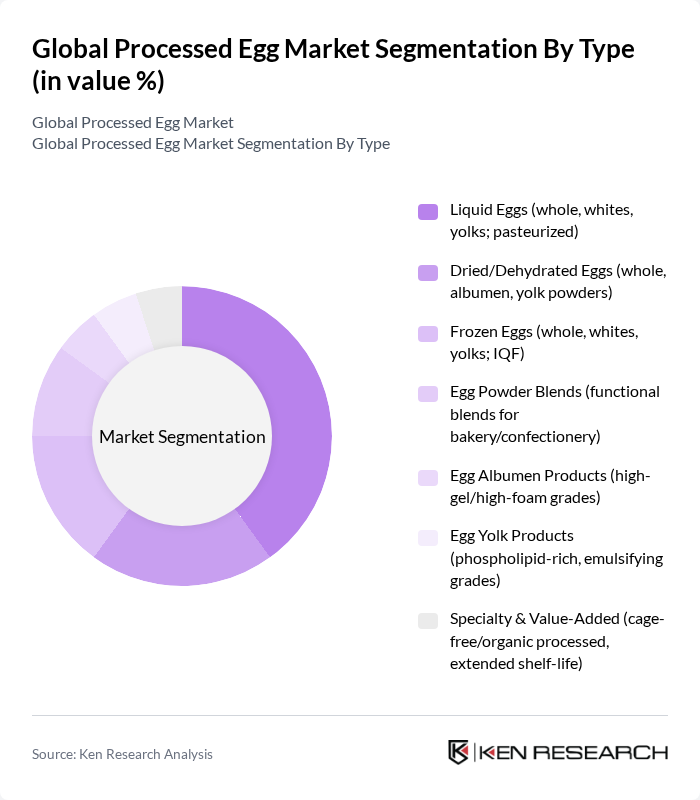
By Type:The processed egg market can be segmented into various types, including liquid eggs, dried/dehydrated eggs, frozen eggs, egg powder blends, egg albumen products, egg yolk products, and specialty & value-added products. Each of these subsegments caters to different consumer needs and preferences, with liquid eggs being particularly popular in foodservice due to convenience and pasteurization safety.
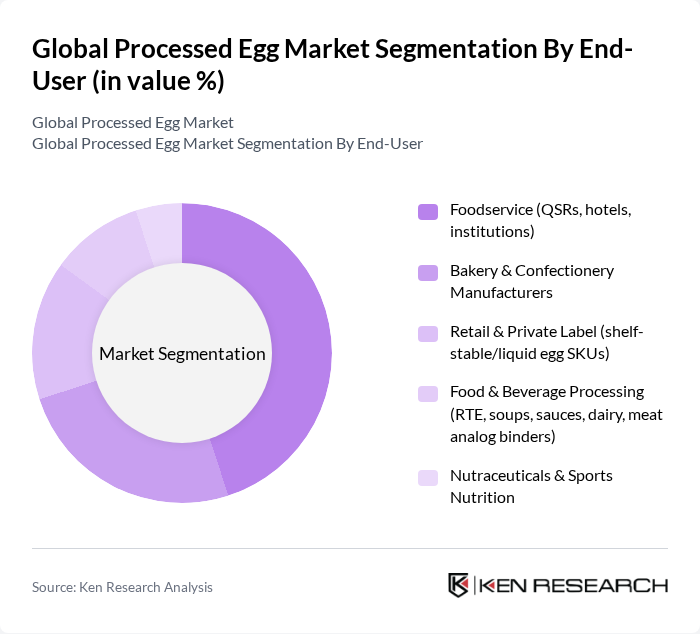
By End-User:The end-user segmentation of the processed egg market includes foodservice, bakery & confectionery manufacturers, retail & private label, food & beverage processing, and nutraceuticals & sports nutrition. The foodservice sector is the largest consumer, supported by growth in QSRs, prepared meals, and institutional catering that rely on pasteurized liquid and frozen egg formats for safety and consistency.
Global Processed Egg Market Competitive Landscape
The Global Processed Egg Market is characterized by a dynamic mix of regional and international players. Leading participants such as Cal-Maine Foods, Inc., Rembrandt Enterprises, Inc., Michael Foods, Inc. (a Post Holdings company), Rose Acre Farms, Inc., Eggland's Best, LLC, Almarai Company, Farm Pride Foods Ltd., Ovostar Union N.V., SANOVO Technology Group, Noble Foods Ltd (The Happy Egg Co.), Cargill, Incorporated, Interovo Egg Group BV, Gruppo Eurovo S.r.l., Henningsen Foods, Inc. (Kewpie Group), Ovotzlom Ltd. (OvoStar Group), Bouwhuis Enthoven (Van Beek Group), Ready Egg Products Ltd., Newburg Egg Corp., SKM Egg Products Export (India) Ltd., Igreca S.A. (France) contribute to innovation, geographic expansion, and service delivery in this space.
Global Processed Egg Market Industry Analysis
Growth Drivers
- Increasing Demand for Convenience Foods:The processed egg market is experiencing a surge due to the growing consumer preference for convenience foods. In future, the global convenience food market is projected to reach approximately $1.6 trillion, driven by busy lifestyles and the need for quick meal solutions. Processed eggs, being versatile and easy to use, are increasingly incorporated into ready-to-eat meals, contributing to their rising demand. This trend is particularly evident in urban areas where time constraints are prevalent.
- Rising Health Consciousness Among Consumers:Health awareness is significantly influencing food choices, with consumers increasingly seeking nutritious options. In future, the global health and wellness food market is expected to exceed $1.1 trillion, reflecting a shift towards healthier eating habits. Processed eggs, rich in protein and essential nutrients, are gaining popularity as a healthy ingredient in various dishes. This trend is further supported by the growing emphasis on protein-rich diets, particularly among fitness enthusiasts and health-conscious individuals.
- Expansion of Food Service Industry:The food service industry is projected to grow substantially, with an estimated value of $4.5 trillion in future. This expansion is driven by the increasing number of restaurants, cafes, and catering services that utilize processed eggs in their offerings. The versatility of processed eggs allows food service providers to create diverse menu items, from breakfast dishes to baked goods, thereby enhancing their appeal to consumers. This growth in food service directly boosts the demand for processed egg products.
Market Challenges
- Fluctuating Raw Material Prices:The processed egg market faces challenges due to the volatility of raw material prices, particularly eggs. In future, the average price of eggs is projected to fluctuate between $1.60 and $2.10 per dozen, influenced by factors such as feed costs and supply chain disruptions. These price fluctuations can significantly impact profit margins for processed egg manufacturers, making it difficult to maintain stable pricing for consumers and affecting overall market growth.
- Stringent Food Safety Regulations:Compliance with food safety regulations poses a significant challenge for the processed egg industry. In future, regulatory bodies are expected to enforce stricter standards, including enhanced testing and traceability requirements. This increased scrutiny can lead to higher operational costs for manufacturers, as they must invest in quality control measures and compliance systems. Failure to meet these regulations can result in product recalls and damage to brand reputation, further complicating market dynamics.
Global Processed Egg Market Future Outlook
The future of the processed egg market appears promising, driven by evolving consumer preferences and technological advancements. As the demand for convenience and health-oriented products continues to rise, manufacturers are likely to innovate and diversify their offerings. Additionally, the expansion of e-commerce platforms will facilitate greater accessibility to processed egg products, particularly in emerging markets. This trend, combined with a focus on sustainability and ethical sourcing, will shape the market landscape in the coming years, fostering growth and resilience.
Market Opportunities
- Growth in E-commerce for Food Products:The e-commerce sector for food products is projected to reach $350 billion in future, presenting a significant opportunity for processed egg manufacturers. Online platforms enable consumers to access a wider range of products, including specialty processed eggs. This shift towards online shopping can enhance market penetration and cater to the growing demand for convenience among consumers, particularly in urban areas.
- Innovations in Product Offerings:There is a notable opportunity for innovation in processed egg products, particularly in developing value-added items such as ready-to-cook meals and organic options. The global organic food market is expected to surpass $350 billion in future, indicating a strong consumer preference for organic products. By introducing innovative and health-focused processed egg offerings, companies can capture a larger share of this growing market segment.
Scope of the Report
| Segment | Sub-Segments |
|---|---|
| By Type | Liquid Eggs (whole, whites, yolks; pasteurized) Dried/Dehydrated Eggs (whole, albumen, yolk powders) Frozen Eggs (whole, whites, yolks; IQF) Egg Powder Blends (functional blends for bakery/confectionery) Egg Albumen Products (high-gel/high-foam grades) Egg Yolk Products (phospholipid-rich, emulsifying grades) Specialty & Value-Added (cage-free/organic processed, extended shelf-life) |
| By End-User | Foodservice (QSRs, hotels, institutions) Bakery & Confectionery Manufacturers Retail & Private Label (shelf-stable/liquid egg SKUs) Food & Beverage Processing (RTE, soups, sauces, dairy, meat analog binders) Nutraceuticals & Sports Nutrition |
| By Application | Bakery & Confectionery Dairy & Desserts (ice cream, custards, puddings) Ready-to-Eat/Ready-to-Cook Meals Sauces, Dressings & Mayonnaise Noodles/Pasta & Snacks Coatings Nutrition & Functional Foods (high-protein, medical foods) |
| By Distribution Channel | Direct B2B (contracts with manufacturers/foodservice) Distributors & Wholesalers Online B2B Marketplaces Modern Retail (supermarkets/hypermarkets) Specialty & Cash-and-Carry |
| By Packaging Type | Bulk (aseptic bags, totes, tankers) Industrial Packs (10–25 kg bags, pails) Retail Packs (cartons, bottles, Tetra Pak) Sustainable/Eco-Friendly (recyclable, biodegradable) |
| By Price Range | Economy Mid-Range Premium |
| By Region | North America Europe Asia-Pacific Latin America Middle East & Africa |
Key Target Audience
Investors and Venture Capitalist Firms
Government and Regulatory Bodies (e.g., Food and Drug Administration, United States Department of Agriculture)
Manufacturers and Producers
Distributors and Retailers
Food Service Companies
Exporters and Importers
Industry Associations (e.g., American Egg Board, International Egg Commission)
Financial Institutions
Players Mentioned in the Report:
Cal-Maine Foods, Inc.
Rembrandt Enterprises, Inc.
Michael Foods, Inc. (a Post Holdings company)
Rose Acre Farms, Inc.
Eggland's Best, LLC
Almarai Company
Farm Pride Foods Ltd.
Ovostar Union N.V.
SANOVO Technology Group
Noble Foods Ltd (The Happy Egg Co.)
Cargill, Incorporated
Interovo Egg Group BV
Gruppo Eurovo S.r.l.
Henningsen Foods, Inc. (Kewpie Group)
Ovotzlom Ltd. (OvoStar Group)
Bouwhuis Enthoven (Van Beek Group)
Ready Egg Products Ltd.
Newburg Egg Corp.
SKM Egg Products Export (India) Ltd.
Igreca S.A. (France)
Table of Contents
Market Assessment Phase
1. Executive Summary and Approach
2. Global Processed Egg Market Overview
2.1 Key Insights and Strategic Recommendations
2.2 Global Processed Egg Market Overview
2.3 Definition and Scope
2.4 Evolution of Market Ecosystem
2.5 Timeline of Key Regulatory Milestones
2.6 Value Chain & Stakeholder Mapping
2.7 Business Cycle Analysis
2.8 Policy & Incentive Landscape
3. Global Processed Egg Market Analysis
3.1 Growth Drivers
3.1.1 Increasing Demand for Convenience Foods
3.1.2 Rising Health Consciousness Among Consumers
3.1.3 Expansion of Food Service Industry
3.1.4 Technological Advancements in Processing
3.2 Market Challenges
3.2.1 Fluctuating Raw Material Prices
3.2.2 Stringent Food Safety Regulations
3.2.3 Competition from Alternative Protein Sources
3.2.4 Supply Chain Disruptions
3.3 Market Opportunities
3.3.1 Growth in E-commerce for Food Products
3.3.2 Innovations in Product Offerings
3.3.3 Expansion into Emerging Markets
3.3.4 Increasing Use of Processed Eggs in Bakery Products
3.4 Market Trends
3.4.1 Shift Towards Organic and Free-Range Products
3.4.2 Rising Popularity of Plant-Based Alternatives
3.4.3 Focus on Sustainable and Ethical Sourcing
3.4.4 Growth of Ready-to-Eat Meal Segments
3.5 Government Regulation
3.5.1 Food Safety Standards Compliance
3.5.2 Labeling Requirements for Processed Foods
3.5.3 Import and Export Regulations
3.5.4 Subsidies for Egg Producers
4. SWOT Analysis
5. Stakeholder Analysis
6. Porter's Five Forces Analysis
7. Global Processed Egg Market Market Size, 2019-2024
7.1 By Value
7.2 By Volume
7.3 By Average Selling Price
8. Global Processed Egg Market Segmentation
8.1 By Type
8.1.1 Liquid Eggs (whole, whites, yolks; pasteurized)
8.1.2 Dried/Dehydrated Eggs (whole, albumen, yolk powders)
8.1.3 Frozen Eggs (whole, whites, yolks; IQF)
8.1.4 Egg Powder Blends (functional blends for bakery/confectionery)
8.1.5 Egg Albumen Products (high-gel/high-foam grades)
8.1.6 Egg Yolk Products (phospholipid-rich, emulsifying grades)
8.1.7 Specialty & Value-Added (cage-free/organic processed, extended shelf-life)
8.2 By End-User
8.2.1 Foodservice (QSRs, hotels, institutions)
8.2.2 Bakery & Confectionery Manufacturers
8.2.3 Retail & Private Label (shelf-stable/liquid egg SKUs)
8.2.4 Food & Beverage Processing (RTE, soups, sauces, dairy, meat analog binders)
8.2.5 Nutraceuticals & Sports Nutrition
8.3 By Application
8.3.1 Bakery & Confectionery
8.3.2 Dairy & Desserts (ice cream, custards, puddings)
8.3.3 Ready-to-Eat/Ready-to-Cook Meals
8.3.4 Sauces, Dressings & Mayonnaise
8.3.5 Noodles/Pasta & Snacks Coatings
8.3.6 Nutrition & Functional Foods (high-protein, medical foods)
8.4 By Distribution Channel
8.4.1 Direct B2B (contracts with manufacturers/foodservice)
8.4.2 Distributors & Wholesalers
8.4.3 Online B2B Marketplaces
8.4.4 Modern Retail (supermarkets/hypermarkets)
8.4.5 Specialty & Cash-and-Carry
8.5 By Packaging Type
8.5.1 Bulk (aseptic bags, totes, tankers)
8.5.2 Industrial Packs (10–25 kg bags, pails)
8.5.3 Retail Packs (cartons, bottles, Tetra Pak)
8.5.4 Sustainable/Eco-Friendly (recyclable, biodegradable)
8.6 By Price Range
8.6.1 Economy
8.6.2 Mid-Range
8.6.3 Premium
8.7 By Region
8.7.1 North America
8.7.2 Europe
8.7.3 Asia-Pacific
8.7.4 Latin America
8.7.5 Middle East & Africa
9. Global Processed Egg Market Competitive Analysis
9.1 Market Share of Key Players
9.2 Cross Comparison of Key Players
9.2.1 Company Name
9.2.2 Group Size (global, regional, or local processor)
9.2.3 Processed Egg Revenue and YoY Growth
9.2.4 Capacity Utilization (%) and Installed Processing Capacity (tonnes/year)
9.2.5 Geographic Footprint (number of plants/countries served)
9.2.6 Product Mix Share (liquid/frozen/dried/specialty %)
9.2.7 Contract Portfolio (major B2B foodservice/manufacturer accounts)
9.2.8 Quality & Compliance (BRC/IFS/USDA/EU approval status)
9.2.9 Supply Chain Resilience (multi-sourcing, cold chain KPIs, lead times)
9.2.10 Innovation & Value-Add (new SKUs/year, functional blends, ESG claims)
9.2.11 Pricing & Margin (ASP by type, gross margin %)
9.2.12 Sustainability Metrics (cage-free % of supply, Scope 1–3 targets)
9.3 SWOT Analysis of Top Players
9.4 Pricing Analysis
9.5 Detailed Profile of Major Companies
9.5.1 Cal-Maine Foods, Inc.
9.5.2 Rembrandt Enterprises, Inc.
9.5.3 Michael Foods, Inc. (a Post Holdings company)
9.5.4 Rose Acre Farms, Inc.
9.5.5 Eggland's Best, LLC
9.5.6 Almarai Company
9.5.7 Farm Pride Foods Ltd.
9.5.8 Ovostar Union N.V.
9.5.9 SANOVO Technology Group
9.5.10 Noble Foods Ltd (The Happy Egg Co.)
9.5.11 Cargill, Incorporated
9.5.12 Interovo Egg Group BV
9.5.13 Gruppo Eurovo S.r.l.
9.5.14 Henningsen Foods, Inc. (Kewpie Group)
9.5.15 Ovotzlom Ltd. (OvoStar Group)
9.5.16 Bouwhuis Enthoven (Van Beek Group)
9.5.17 Ready Egg Products Ltd.
9.5.18 Newburg Egg Corp.
9.5.19 SKM Egg Products Export (India) Ltd.
9.5.20 Igreca S.A. (France)
10. Global Processed Egg Market End-User Analysis
10.1 Procurement Behavior of Key Ministries
10.1.1 Government Procurement Policies
10.1.2 Budget Allocations for Food Products
10.1.3 Supplier Selection Criteria
10.1.4 Contract Management Practices
10.2 Corporate Spend on Infrastructure & Energy
10.2.1 Investment in Food Processing Facilities
10.2.2 Energy Efficiency Initiatives
10.2.3 Infrastructure Development for Distribution
10.3 Pain Point Analysis by End-User Category
10.3.1 Quality Assurance Challenges
10.3.2 Supply Chain Reliability Issues
10.3.3 Cost Management Concerns
10.4 User Readiness for Adoption
10.4.1 Awareness of Processed Egg Benefits
10.4.2 Training and Support Needs
10.4.3 Technology Adoption Barriers
10.5 Post-Deployment ROI and Use Case Expansion
10.5.1 Measurement of ROI Metrics
10.5.2 Case Studies of Successful Implementations
10.5.3 Future Use Case Opportunities
11. Global Processed Egg Market Future Size, 2025-2030
11.1 By Value
11.2 By Volume
11.3 By Average Selling Price
Go-To-Market Strategy Phase
1. Whitespace Analysis + Business Model Canvas
1.1 Market Gaps Identification
1.2 Value Proposition Development
1.3 Revenue Streams Analysis
1.4 Customer Segmentation
1.5 Key Partnerships
1.6 Cost Structure Analysis
1.7 Channels of Distribution
2. Marketing and Positioning Recommendations
2.1 Branding Strategies
2.2 Product USPs
2.3 Target Audience Identification
2.4 Marketing Channels
2.5 Promotional Strategies
3. Distribution Plan
3.1 Urban Retail Strategies
3.2 Rural NGO Tie-Ups
3.3 Direct-to-Consumer Approaches
3.4 E-commerce Integration
4. Channel & Pricing Gaps
4.1 Underserved Routes
4.2 Pricing Bands Analysis
4.3 Competitor Pricing Strategies
5. Unmet Demand & Latent Needs
5.1 Category Gaps
5.2 Consumer Segments Analysis
5.3 Product Development Opportunities
6. Customer Relationship
6.1 Loyalty Programs
6.2 After-sales Service
6.3 Customer Feedback Mechanisms
7. Value Proposition
7.1 Sustainability Initiatives
7.2 Integrated Supply Chains
7.3 Customer-Centric Innovations
8. Key Activities
8.1 Regulatory Compliance
8.2 Branding Efforts
8.3 Distribution Setup
9. Entry Strategy Evaluation
9.1 Domestic Market Entry Strategy
9.1.1 Product Mix Considerations
9.1.2 Pricing Band Strategy
9.1.3 Packaging Innovations
9.2 Export Entry Strategy
9.2.1 Target Countries Identification
9.2.2 Compliance Roadmap Development
10. Entry Mode Assessment
10.1 Joint Ventures
10.2 Greenfield Investments
10.3 Mergers & Acquisitions
10.4 Distributor Model Evaluation
11. Capital and Timeline Estimation
11.1 Capital Requirements Analysis
11.2 Timelines for Implementation
12. Control vs Risk Trade-Off
12.1 Ownership vs Partnerships
12.2 Risk Management Strategies
13. Profitability Outlook
13.1 Breakeven Analysis
13.2 Long-term Sustainability Strategies
14. Potential Partner List
14.1 Distributors
14.2 Joint Ventures
14.3 Acquisition Targets
15. Execution Roadmap
15.1 Phased Plan for Market Entry
15.1.1 Market Setup
15.1.2 Market Entry
15.1.3 Growth Acceleration
15.1.4 Scale & Stabilize
15.2 Key Activities and Milestones
15.2.1 Milestone Planning
15.2.2 Activity Tracking
Research Methodology
Phase 1: Approach1
Desk Research
- Analysis of industry reports from agricultural and food processing organizations
- Review of market trends and forecasts from government agricultural departments
- Examination of academic journals and publications on processed egg products
Primary Research
- Interviews with key stakeholders in the processed egg supply chain, including producers and distributors
- Surveys targeting food manufacturers and food service operators utilizing processed egg products
- Focus group discussions with culinary experts and chefs regarding product preferences
Validation & Triangulation
- Cross-validation of data through multiple industry sources and expert opinions
- Triangulation of findings from primary interviews and secondary data sources
- Sanity checks conducted through expert panel reviews and feedback sessions
Phase 2: Market Size Estimation1
Top-down Assessment
- Estimation of market size based on global egg production statistics and processed egg consumption rates
- Segmentation of the market by product type, including liquid, powdered, and frozen eggs
- Incorporation of regional consumption patterns and growth rates in emerging markets
Bottom-up Modeling
- Collection of sales data from leading processed egg manufacturers
- Estimation of production capacities and output levels from processing facilities
- Analysis of pricing strategies and revenue generation across different product segments
Forecasting & Scenario Analysis
- Utilization of time-series analysis to project future market trends based on historical data
- Scenario modeling based on potential impacts of dietary trends and health regulations
- Development of baseline, optimistic, and pessimistic forecasts through 2030
Phase 3: CATI Sample Composition1
| Scope Item/Segment | Sample Size | Target Respondent Profiles |
|---|---|---|
| Processed Egg Product Manufacturers | 120 | Production Managers, Quality Control Supervisors |
| Food Service Operators | 100 | Restaurant Owners, Executive Chefs |
| Retail Grocery Chains | 90 | Category Managers, Purchasing Agents |
| Food Product Developers | 60 | R&D Managers, Product Innovation Specialists |
| Health and Nutrition Experts | 50 | Dietitians, Nutritionists |
Frequently Asked Questions
What is the current value of the Global Processed Egg Market?
The Global Processed Egg Market is valued at approximately USD 33 billion, reflecting a significant growth trend driven by increasing demand for convenience foods and health-conscious consumer preferences.
What factors are driving the growth of the processed egg market?
Which regions are leading in the processed egg market?
What types of processed egg products are available in the market?
Other Regional/Country Reports
Indonesia Processed Egg Market
Malaysia Processed Egg Market
APAC Processed Egg Market
SEA Processed Egg Market
Why Buy From Us?

What makes us stand out is that our consultants follow Robust, Refine and Result (RRR) methodology. Robust for clear definitions, approaches and sanity checking, Refine for differentiating respondents' facts and opinions, and Result for presenting data with story.

We have set a benchmark in the industry by offering our clients with syndicated and customized market research reports featuring coverage of entire market as well as meticulous research and analyst insights.

While we don't replace traditional research, we flip the method upside down. Our dual approach of Top Bottom & Bottom Top ensures quality deliverable by not just verifying company fundamentals but also looking at the sector and macroeconomic factors.

With one step in the future, our research team constantly tries to show you the bigger picture. We help with some of the tough questions you may encounter along the way: How is the industry positioned? Best marketing channel? KPI's of competitors? By aligning every element, we help maximize success.

Our report gives you instant access to the answers and sources that other companies might choose to hide. We elaborate each steps of research methodology we have used and showcase you the sample size to earn your trust.

If you need any support, we are here! We pride ourselves on universe strength, data quality, and quick, friendly, and professional service.