About the Report
Base Year 2024Listen to the audio summary
Global Ready To Drinks Beverages Market Overview
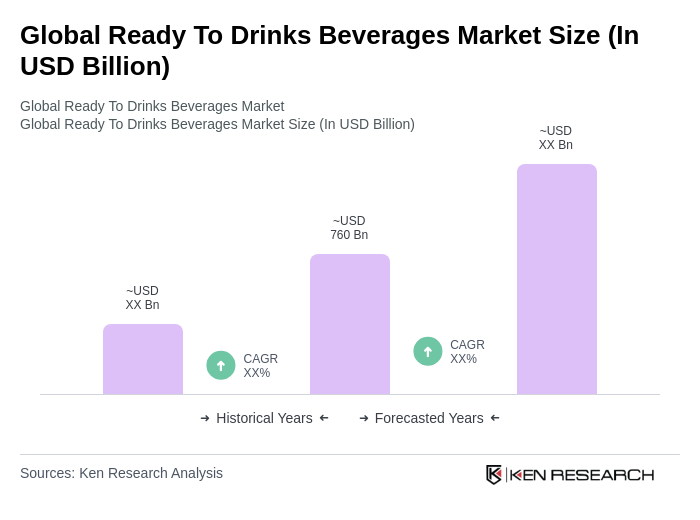
- The Global Ready To Drinks Beverages Market is valued at USD 760 billion, based on a five-year historical analysis. This growth is primarily driven by increasing demand for convenience, functional and better-for-you formulations, and flavor innovation across categories such as energy drinks, teas, coffees, juices, and functional waters .
- Key players in this market include the United States, China, and Germany, supported by large consumer bases, developed retail and cold-chain infrastructure, and strong brand portfolios. The U.S. exhibits high per?capita consumption and breadth of RTD offerings across soft drinks, energy, coffee, and functional beverages; China’s rapid urbanization and rising middle class underpin category expansion; and Germany benefits from a mature beverage culture emphasizing quality and diversified non?alcoholic and alcoholic RTDs .
- In 2023, the European Union did not mandate a uniform cap of 10 grams of sugar per 100 milliliters for all ready?to?drink beverages; instead, the EU framework centers on nutrition labeling, sugar?reduction targets via reformulation initiatives, and national?level taxes or guidelines adopted by some Member States. Therefore, there is no EU?wide legal limit of 10 grams of sugar per 100 milliliters for RTDs; reformulation is driven by voluntary commitments, front?of?pack labeling schemes, and selective national measures influencing product recipes .
Global Ready To Drinks Beverages Market Segmentation
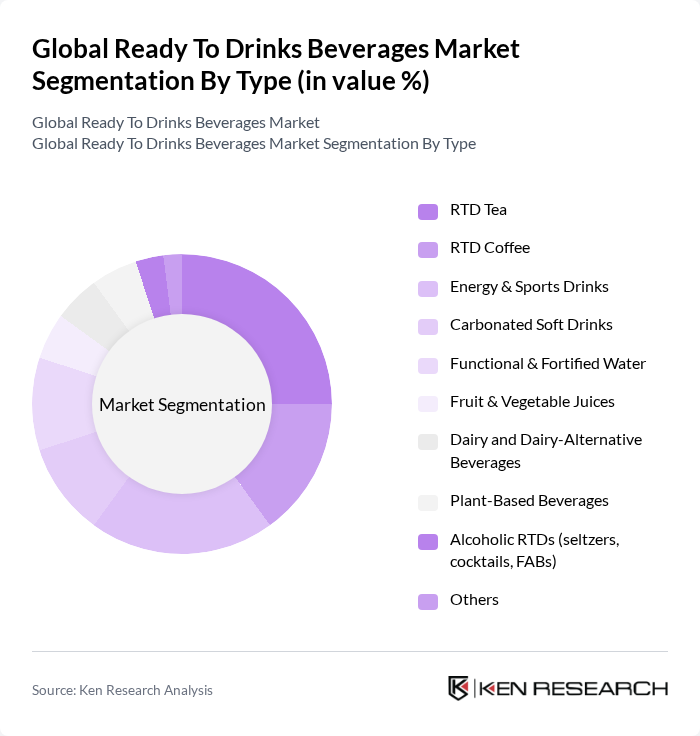
By Type:The market is segmented into various types of ready-to-drink beverages, including RTD Tea, RTD Coffee, Energy & Sports Drinks, Carbonated Soft Drinks, Functional & Fortified Water, Fruit & Vegetable Juices, Dairy and Dairy-Alternative Beverages, Plant-Based Beverages, Alcoholic RTDs (seltzers, cocktails, FABs), and Others. Among these, RTD Tea and Energy & Sports Drinks are particularly popular due to their perceived health and performance benefits (e.g., antioxidants, caffeine, electrolytes) and convenience, with ongoing launches featuring low/no sugar, natural ingredients, probiotics, and botanical blends .
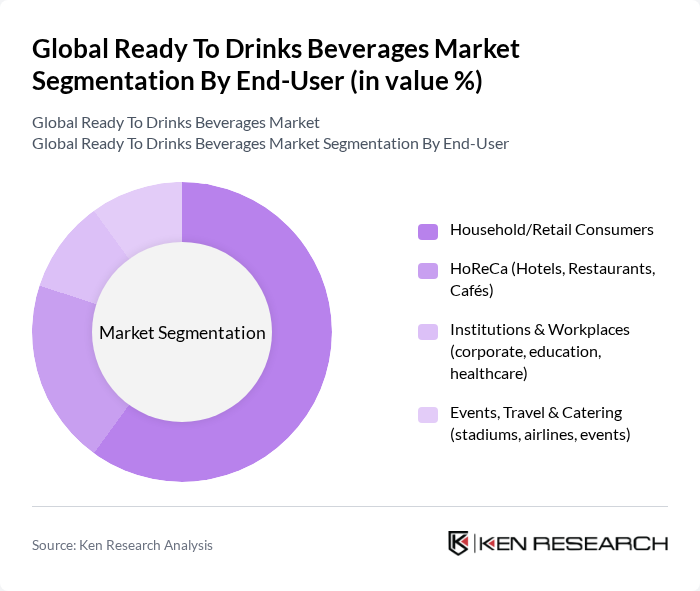
By End-User:The ready-to-drink beverages market serves various end-users, including Household/Retail Consumers, HoReCa (Hotels, Restaurants, Cafés), Institutions & Workplaces (corporate, education, healthcare), and Events, Travel & Catering (stadiums, airlines, events). The Household/Retail Consumers segment dominates the market, supported by growth in modern trade and e?commerce, on?the?go consumption, and expanding single?serve/package innovations across key regions .
Global Ready To Drinks Beverages Market Competitive Landscape
The Global Ready To Drinks Beverages Market is characterized by a dynamic mix of regional and international players. Leading participants such as The Coca?Cola Company, PepsiCo, Inc., Nestlé S.A., Red Bull GmbH, Keurig Dr Pepper Inc., Monster Beverage Corporation, Diageo plc, Heineken N.V., Anheuser?Busch InBev SA/NV, Suntory Holdings Limited, Kirin Holdings Company, Limited, Constellation Brands, Inc., Asahi Group Holdings, Ltd., Coca?Cola Europacific Partners plc, PepsiCo Beverages North America, Danone S.A., Starbucks Corporation (RTD partnerships), Arizona Beverages USA LLC, The Kraft Heinz Company (Capri Sun, Kool?Aid Jammers), Britvic plc contribute to innovation, geographic expansion, and service delivery in this space .
Global Ready To Drinks Beverages Market Industry Analysis
Growth Drivers
- Increasing Consumer Demand for Convenience:The global ready-to-drink (RTD) beverages market is experiencing a surge in demand due to the fast-paced lifestyle of consumers. In future, the convenience sector is projected to account for approximately $1.7 trillion in retail sales, driven by busy schedules and the need for on-the-go options. This trend is particularly evident in urban areas, where 75% of consumers prioritize convenience in their purchasing decisions, leading to increased sales of RTD beverages.
- Rising Health Consciousness Among Consumers:Health awareness is significantly influencing consumer choices, with 65% of individuals actively seeking healthier beverage options. The global health and wellness market is expected to reach $5 trillion in future, reflecting a growing preference for beverages with natural ingredients and functional benefits. This shift is prompting manufacturers to innovate and offer products that align with health trends, such as low-calorie and nutrient-rich RTD beverages, catering to the evolving consumer demands.
- Expansion of Distribution Channels:The expansion of distribution channels is facilitating greater accessibility of RTD beverages. E-commerce sales in the beverage sector are projected to reach $250 billion in future, driven by the increasing popularity of online shopping. Additionally, traditional retail channels are enhancing their offerings, with supermarkets and convenience stores reporting a 20% increase in RTD beverage sales. This multi-channel approach is crucial for meeting consumer demand and driving market growth.
Market Challenges
- Intense Competition Among Key Players:The RTD beverage market is characterized by fierce competition, with over 600 brands vying for market share. Major players like Coca-Cola and PepsiCo dominate, holding approximately 45% of the market. This intense rivalry leads to price wars and increased marketing expenditures, which can strain profit margins for smaller companies. As a result, maintaining a competitive edge becomes increasingly challenging in this saturated market landscape.
- Regulatory Compliance Issues:Navigating regulatory compliance poses significant challenges for RTD beverage manufacturers. In future, the global beverage industry is expected to face over 1,200 new regulations related to health and safety standards. Compliance with these regulations can incur substantial costs, estimated at $60 million annually for mid-sized companies. Failure to adhere to these regulations can result in product recalls and legal penalties, further complicating market entry and expansion efforts.
Global Ready To Drinks Beverages Market Future Outlook
The future of the ready-to-drink beverages market appears promising, driven by evolving consumer preferences and technological advancements. As health-consciousness continues to rise, manufacturers are likely to focus on developing innovative products that cater to this trend. Additionally, the integration of e-commerce platforms will enhance distribution efficiency, allowing brands to reach a broader audience. Sustainability initiatives will also play a crucial role, as consumers increasingly demand eco-friendly packaging and production practices, shaping the market landscape in the coming years.
Market Opportunities
- Growth in E-commerce Sales:The rapid growth of e-commerce presents a significant opportunity for RTD beverage brands. With online sales projected to increase by 25% annually, companies can leverage digital platforms to reach a wider audience. This shift allows for targeted marketing strategies and personalized consumer engagement, enhancing brand loyalty and driving sales growth in the competitive landscape.
- Development of Sustainable Packaging Solutions:The demand for sustainable packaging is on the rise, with 80% of consumers willing to pay more for eco-friendly products. This trend presents an opportunity for RTD beverage manufacturers to innovate in packaging solutions, reducing environmental impact while appealing to eco-conscious consumers. Investing in sustainable practices can enhance brand reputation and attract a loyal customer base, driving long-term growth.
Scope of the Report
| Segment | Sub-Segments |
|---|---|
| By Type | RTD Tea RTD Coffee Energy & Sports Drinks Carbonated Soft Drinks Functional & Fortified Water Fruit & Vegetable Juices Dairy and Dairy-Alternative Beverages Plant-Based Beverages Alcoholic RTDs (seltzers, cocktails, FABs) Others |
| By End-User | Household/Retail Consumers HoReCa (Hotels, Restaurants, Cafés) Institutions & Workplaces (corporate, education, healthcare) Events, Travel & Catering (stadiums, airlines, events) |
| By Distribution Channel | Supermarkets/Hypermarkets Convenience & Grocery Stores Online/E-commerce (D2C and marketplaces) Specialty Retail Stores On-Trade (bars, cafés, QSR) |
| By Packaging Type | PET & Glass Bottles Cans Cartons (Tetra Pak and aseptic) Pouches & Sachets Kegs & Multipacks |
| By Flavor | Citrus Berry Tropical Herbal & Botanical Coffee & Cocoa Cola & Classic |
| By Price Range | Economy Mid-Range Premium |
| By Region | North America Europe Asia-Pacific Latin America Middle East & Africa |
Key Target Audience
Investors and Venture Capitalist Firms
Government and Regulatory Bodies (e.g., Food and Drug Administration, European Food Safety Authority)
Manufacturers and Producers
Distributors and Retailers
Packaging Suppliers
Marketing and Advertising Agencies
Industry Associations (e.g., Beverage Marketing Association)
Financial Institutions
Players Mentioned in the Report:
The CocaCola Company
PepsiCo, Inc.
Nestle S.A.
Red Bull GmbH
Keurig Dr Pepper Inc.
Monster Beverage Corporation
Diageo plc
Heineken N.V.
AnheuserBusch InBev SA/NV
Suntory Holdings Limited
Kirin Holdings Company, Limited
Constellation Brands, Inc.
Asahi Group Holdings, Ltd.
CocaCola Europacific Partners plc
PepsiCo Beverages North America
Danone S.A.
Starbucks Corporation (RTD partnerships)
Arizona Beverages USA LLC
The Kraft Heinz Company (Capri Sun, KoolAid Jammers)
Britvic plc
Table of Contents
Market Assessment Phase
1. Executive Summary and Approach
2. Global Ready To Drinks Beverages Market Overview
2.1 Key Insights and Strategic Recommendations
2.2 Global Ready To Drinks Beverages Market Overview
2.3 Definition and Scope
2.4 Evolution of Market Ecosystem
2.5 Timeline of Key Regulatory Milestones
2.6 Value Chain & Stakeholder Mapping
2.7 Business Cycle Analysis
2.8 Policy & Incentive Landscape
3. Global Ready To Drinks Beverages Market Analysis
3.1 Growth Drivers
3.1.1 Increasing consumer demand for convenience
3.1.2 Rising health consciousness among consumers
3.1.3 Expansion of distribution channels
3.1.4 Innovation in product offerings
3.2 Market Challenges
3.2.1 Intense competition among key players
3.2.2 Regulatory compliance issues
3.2.3 Fluctuating raw material prices
3.2.4 Changing consumer preferences
3.3 Market Opportunities
3.3.1 Growth in e-commerce sales
3.3.2 Development of sustainable packaging solutions
3.3.3 Expansion into emerging markets
3.3.4 Introduction of functional beverages
3.4 Market Trends
3.4.1 Shift towards organic and natural ingredients
3.4.2 Increasing popularity of plant-based beverages
3.4.3 Rise of low-calorie and sugar-free options
3.4.4 Growth of ready-to-drink alcoholic beverages
3.5 Government Regulation
3.5.1 Labeling and packaging regulations
3.5.2 Health and safety standards
3.5.3 Import/export regulations
3.5.4 Environmental regulations on packaging
4. SWOT Analysis
5. Stakeholder Analysis
6. Porter's Five Forces Analysis
7. Global Ready To Drinks Beverages Market Market Size, 2019-2024
7.1 By Value
7.2 By Volume
7.3 By Average Selling Price
8. Global Ready To Drinks Beverages Market Segmentation
8.1 By Type
8.1.1 RTD Tea
8.1.2 RTD Coffee
8.1.3 Energy & Sports Drinks
8.1.4 Carbonated Soft Drinks
8.1.5 Functional & Fortified Water
8.1.6 Fruit & Vegetable Juices
8.1.7 Dairy and Dairy-Alternative Beverages
8.1.8 Plant-Based Beverages
8.1.9 Alcoholic RTDs (seltzers, cocktails, FABs)
8.1.10 Others
8.2 By End-User
8.2.1 Household/Retail Consumers
8.2.2 HoReCa (Hotels, Restaurants, Cafés)
8.2.3 Institutions & Workplaces (corporate, education, healthcare)
8.2.4 Events, Travel & Catering (stadiums, airlines, events)
8.3 By Distribution Channel
8.3.1 Supermarkets/Hypermarkets
8.3.2 Convenience & Grocery Stores
8.3.3 Online/E-commerce (D2C and marketplaces)
8.3.4 Specialty Retail Stores
8.3.5 On-Trade (bars, cafés, QSR)
8.4 By Packaging Type
8.4.1 PET & Glass Bottles
8.4.2 Cans
8.4.3 Cartons (Tetra Pak and aseptic)
8.4.4 Pouches & Sachets
8.4.5 Kegs & Multipacks
8.5 By Flavor
8.5.1 Citrus
8.5.2 Berry
8.5.3 Tropical
8.5.4 Herbal & Botanical
8.5.5 Coffee & Cocoa
8.5.6 Cola & Classic
8.6 By Price Range
8.6.1 Economy
8.6.2 Mid-Range
8.6.3 Premium
8.7 By Region
8.7.1 North America
8.7.2 Europe
8.7.3 Asia-Pacific
8.7.4 Latin America
8.7.5 Middle East & Africa
9. Global Ready To Drinks Beverages Market Competitive Analysis
9.1 Market Share of Key Players
9.2 Cross Comparison of Key Players
9.2.1 Company Name
9.2.2 Scale Classification (Global, Regional, Niche)
9.2.3 RTD Category Revenue (latest fiscal, USD)
9.2.4 3-Year CAGR in RTD Segment
9.2.5 Geographic Footprint (countries/regions served)
9.2.6 Portfolio Breadth (number of RTD categories)
9.2.7 Average Realized Price per Liter (by key region)
9.2.8 Distribution Mix (% modern trade, convenience, on-trade, e-commerce)
9.2.9 Innovation Intensity (new launches per year/patents/line extensions)
9.2.10 Marketing Efficiency (A&P as % of sales, SOV vs. SOM)
9.2.11 Sustainability KPIs (recycled content %, PET lightweighting, water use ratio)
9.2.12 Brand Equity/Preference Index (third-party tracking)
9.3 SWOT Analysis of Top Players
9.4 Pricing Analysis
9.5 Detailed Profile of Major Companies
9.5.1 The Coca?Cola Company
9.5.2 PepsiCo, Inc.
9.5.3 Nestlé S.A.
9.5.4 Red Bull GmbH
9.5.5 Keurig Dr Pepper Inc.
9.5.6 Monster Beverage Corporation
9.5.7 Diageo plc
9.5.8 Heineken N.V.
9.5.9 Anheuser?Busch InBev SA/NV
9.5.10 Suntory Holdings Limited
9.5.11 Kirin Holdings Company, Limited
9.5.12 Constellation Brands, Inc.
9.5.13 Asahi Group Holdings, Ltd.
9.5.14 Coca?Cola Europacific Partners plc
9.5.15 PepsiCo Beverages North America
9.5.16 Danone S.A.
9.5.17 Starbucks Corporation (RTD partnerships)
9.5.18 Arizona Beverages USA LLC
9.5.19 The Kraft Heinz Company (Capri Sun, Kool?Aid Jammers)
9.5.20 Britvic plc
10. Global Ready To Drinks Beverages Market End-User Analysis
10.1 Procurement Behavior of Key Ministries
10.1.1 Government contracts for public events
10.1.2 Bulk purchasing for state functions
10.1.3 Sustainability initiatives in procurement
10.2 Corporate Spend on Infrastructure & Energy
10.2.1 Investment in beverage vending solutions
10.2.2 Sponsorship of events and promotions
10.2.3 Partnerships with local distributors
10.3 Pain Point Analysis by End-User Category
10.3.1 Supply chain disruptions
10.3.2 Quality control issues
10.3.3 Price volatility of raw materials
10.4 User Readiness for Adoption
10.4.1 Awareness of new product launches
10.4.2 Acceptance of health-oriented beverages
10.4.3 Readiness for online purchasing
10.5 Post-Deployment ROI and Use Case Expansion
10.5.1 Evaluation of sales performance
10.5.2 Customer feedback and satisfaction
10.5.3 Opportunities for product line expansion
11. Global Ready To Drinks Beverages Market Future Size, 2025-2030
11.1 By Value
11.2 By Volume
11.3 By Average Selling Price
Go-To-Market Strategy Phase
1. Whitespace Analysis + Business Model Canvas
1.1 Market Gaps Identification
1.2 Business Model Framework
1.3 Value Proposition Canvas
1.4 Competitive Landscape Analysis
1.5 Customer Segmentation
1.6 Revenue Streams
1.7 Cost Structure
2. Marketing and Positioning Recommendations
2.1 Branding strategies
2.2 Product USPs
2.3 Target Audience Identification
2.4 Marketing Channels
2.5 Promotional Strategies
3. Distribution Plan
3.1 Urban retail vs rural NGO tie-ups
3.2 Direct vs indirect distribution
3.3 E-commerce strategies
3.4 Logistics and supply chain management
4. Channel & Pricing Gaps
4.1 Underserved routes
4.2 Pricing bands
4.3 Competitive pricing analysis
4.4 Value-based pricing strategies
5. Unmet Demand & Latent Needs
5.1 Category gaps
5.2 Consumer segments
5.3 Emerging trends
5.4 Product innovation opportunities
6. Customer Relationship
6.1 Loyalty programs
6.2 After-sales service
6.3 Customer engagement strategies
6.4 Feedback mechanisms
7. Value Proposition
7.1 Sustainability
7.2 Integrated supply chains
7.3 Customer-centric approaches
7.4 Competitive advantages
8. Key Activities
8.1 Regulatory compliance
8.2 Branding
8.3 Distribution setup
8.4 Marketing execution
9. Entry Strategy Evaluation
9.1 Domestic Market Entry Strategy
9.1.1 Product mix
9.1.2 Pricing band
9.1.3 Packaging
9.2 Export Entry Strategy
9.2.1 Target countries
9.2.2 Compliance roadmap
10. Entry Mode Assessment
10.1 JV
10.2 Greenfield
10.3 M&A
10.4 Distributor Model
11. Capital and Timeline Estimation
11.1 Capital requirements
11.2 Timelines
12. Control vs Risk Trade-Off
12.1 Ownership vs Partnerships
13. Profitability Outlook
13.1 Breakeven analysis
13.2 Long-term sustainability
14. Potential Partner List
14.1 Distributors
14.2 JVs
14.3 Acquisition targets
15. Execution Roadmap
15.1 Phased Plan for Market Entry
15.1.1 Market Setup
15.1.2 Market Entry
15.1.3 Growth Acceleration
15.1.4 Scale & Stabilize
15.2 Key Activities and Milestones
15.2.1 Activity timelines
15.2.2 Milestone tracking
Research Methodology
Phase 1: Approach1
Desk Research
- Analysis of industry reports from beverage associations and market research firms
- Review of consumer behavior studies and market trends published in trade journals
- Examination of regulatory frameworks and health guidelines impacting ready-to-drink beverages
Primary Research
- Interviews with product development managers at leading beverage manufacturers
- Surveys with distributors and retailers to understand market dynamics and consumer preferences
- Focus groups with consumers to gather insights on taste, packaging, and brand loyalty
Validation & Triangulation
- Cross-validation of findings through multiple data sources including sales data and consumer surveys
- Triangulation of insights from industry experts and market analysts
- Sanity checks through peer reviews and expert panel discussions
Phase 2: Market Size Estimation1
Top-down Assessment
- Estimation of market size based on overall beverage industry revenue and growth rates
- Segmentation of the market by product type, including carbonated drinks, juices, and functional beverages
- Incorporation of demographic trends and urbanization effects on consumption patterns
Bottom-up Modeling
- Collection of sales volume data from key players in the ready-to-drink segment
- Analysis of pricing strategies and average selling prices across different beverage categories
- Estimation of market share based on distribution channels and regional performance
Forecasting & Scenario Analysis
- Utilization of time-series analysis to project future market growth based on historical data
- Scenario modeling based on economic indicators, health trends, and consumer preferences
- Development of best-case, worst-case, and most-likely scenarios through 2030
Phase 3: CATI Sample Composition1
| Scope Item/Segment | Sample Size | Target Respondent Profiles |
|---|---|---|
| Retail Beverage Sales | 150 | Store Managers, Beverage Category Buyers |
| Consumer Preferences in Ready-to-Drink | 150 | General Consumers, Health-Conscious Shoppers |
| Distribution Channel Insights | 100 | Wholesalers, Distributors, Logistics Managers |
| Market Trends in Functional Beverages | 80 | Product Developers, Nutritionists, Health Experts |
| Brand Loyalty and Marketing Effectiveness | 120 | Marketing Managers, Brand Strategists |
Frequently Asked Questions
What is the current value of the Global Ready To Drinks Beverages Market?
The Global Ready To Drinks Beverages Market is valued at approximately USD 760 billion, reflecting a significant growth trend driven by consumer demand for convenience, health-oriented formulations, and innovative flavors across various beverage categories.
Which countries are the key players in the Ready To Drinks Beverages Market?
What types of beverages are included in the Ready To Drinks category?
What are the main growth drivers for the Ready To Drinks Beverages Market?
Other Regional/Country Reports
Indonesia Ready To Drinks Beverages Market
Malaysia Ready To Drinks Beverages Market
APAC Ready To Drinks Beverages Market
SEA Ready To Drinks Beverages Market
Why Buy From Us?

What makes us stand out is that our consultants follow Robust, Refine and Result (RRR) methodology. Robust for clear definitions, approaches and sanity checking, Refine for differentiating respondents' facts and opinions, and Result for presenting data with story.

We have set a benchmark in the industry by offering our clients with syndicated and customized market research reports featuring coverage of entire market as well as meticulous research and analyst insights.

While we don't replace traditional research, we flip the method upside down. Our dual approach of Top Bottom & Bottom Top ensures quality deliverable by not just verifying company fundamentals but also looking at the sector and macroeconomic factors.

With one step in the future, our research team constantly tries to show you the bigger picture. We help with some of the tough questions you may encounter along the way: How is the industry positioned? Best marketing channel? KPI's of competitors? By aligning every element, we help maximize success.

Our report gives you instant access to the answers and sources that other companies might choose to hide. We elaborate each steps of research methodology we have used and showcase you the sample size to earn your trust.

If you need any support, we are here! We pride ourselves on universe strength, data quality, and quick, friendly, and professional service.