About the Report
Base Year 2024Global Recreational Vehicle Financing Market Overview
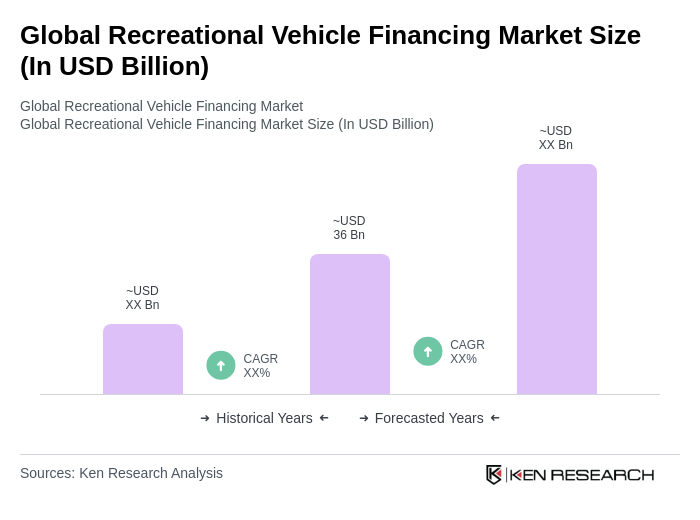
- The Global Recreational Vehicle Financing Market is valued at USD 36 billion, based on a five-year historical analysis. This growth is primarily driven by the increasing popularity of outdoor recreational activities, coupled with a rise in disposable income among consumers. Rising outdoor participation and the expanding installed base of RVs have increased credit demand, aided by flexible loan terms, bundled products, and the rise of digital-first lenders that speed approvals and improve access.
- The United States and Canada dominate the Global Recreational Vehicle Financing Market due to their vast landscapes and established camping culture. North America leads RV ownership and sales, underpinned by a high number of RV parks/campgrounds and an entrenched dealer network that supports financing at point of sale; major U.S. lenders (e.g., Bank of America, Wells Fargo, JPMorgan Chase, Truist, U.S. Bank) are recognized industry leaders in RV financing.
- In 2023, the U.S. government implemented new regulations aimed at promoting sustainable RV manufacturing practices. While there is strong momentum around sustainability and policy actions affecting RVs and dealers (such as efforts to secure floor-plan interest deductibility for towables and industry initiatives to advance greener technologies), no specific federal regulation targeted solely at RV manufacturing sustainability with consumer “green financing” incentives can be verified for that year; industry policy activity centered on dealer tax parity and broader transportation emissions initiatives rather than RV-specific sustainability mandates.
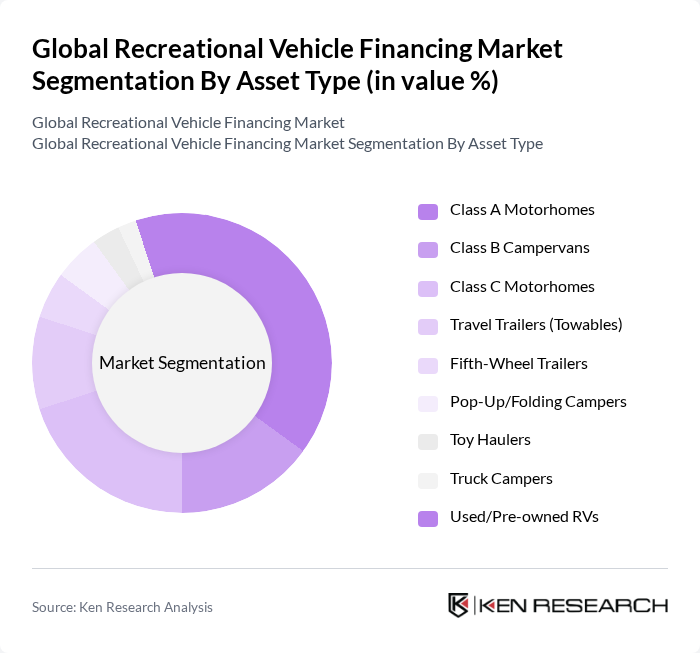
Global Recreational Vehicle Financing Market Segmentation
By Asset Type:The asset type segmentation includes various categories of recreational vehicles that consumers can finance. The dominant sub-segment in this category is Class A Motorhomes, which are favored for their spaciousness and luxury features, appealing to families and long-term travelers. Other notable sub-segments include Class C Motorhomes and Travel Trailers, which cater to different consumer preferences and budgets. Industry data also indicates robust financing activity for towables (travel trailers) given their affordability and broad entry-level appeal, and growing interest in Class B campervans driven by maneuverability and van-life trends.
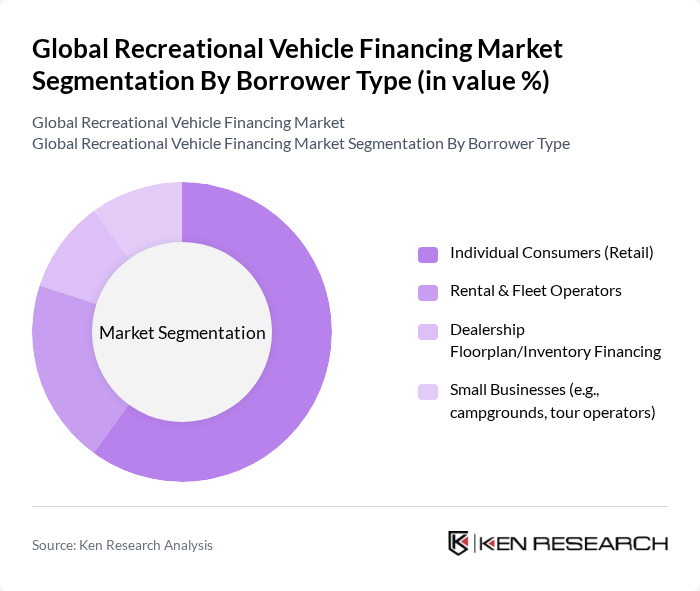
By Borrower Type:This segmentation focuses on the different types of borrowers seeking financing for recreational vehicles. Individual Consumers (Retail) represent the largest segment, driven by personal travel and leisure trends and the convenience of dealership-arranged financing. Rental and fleet operators also play a significant role, requiring financing to maintain and expand fleets amid rising rental adoption, while floorplan financing supports dealership inventory needs.
Global Recreational Vehicle Financing Market Competitive Landscape
The Global Recreational Vehicle Financing Market is characterized by a dynamic mix of regional and international players. Leading participants such as Bank of America, Wells Fargo, JPMorgan Chase, Truist Bank (including LightStream), U.S. Bank, Bank of the West (a BNP Paribas company), Good Sam Finance Center (Camping World Holdings), Southeast Financial, First Bank of the Lake, PNC Bank, Huntington National Bank, Ally Financial, SunTrust Bank (legacy; now Truist), Credit Union of Texas, 1st Source Bank contribute to innovation, geographic expansion, and service delivery in this space.
Global Recreational Vehicle Financing Market Industry Analysis
Growth Drivers
- Increasing Consumer Interest in Outdoor Recreational Activities:The global outdoor recreation market is projected to reach $887 billion in the future, driven by a growing consumer preference for experiences over material goods. This trend is reflected in the rising sales of recreational vehicles (RVs), with the RV Industry Association reporting a 20% increase in RV shipments in the future, indicating a robust demand for financing options to support this lifestyle shift.
- Rising Disposable Income and Spending on Leisure:According to the World Bank, global GDP per capita is expected to rise to approximately $13,000 in the future, leading to increased disposable income. This economic growth correlates with higher spending on leisure activities, including RV purchases. In the U.S., consumer spending on recreational vehicles surged to $20 billion in the future, highlighting the need for accessible financing solutions to accommodate this trend.
- Expansion of RV Rental Services:The RV rental market is projected to grow significantly, with revenues expected to reach $1.5 billion in the future. This growth is fueled by the increasing popularity of RV vacations, particularly among younger demographics. As rental services expand, they create a demand for flexible financing options, enabling consumers to transition from rentals to ownership, thus driving the overall RV financing market.
Market Challenges
- High-Interest Rates Affecting Financing Options:As of the future, average interest rates for RV loans are projected to be around 7.5%, significantly impacting affordability for consumers. High-interest rates can deter potential buyers, leading to a slowdown in RV sales and financing applications. This challenge necessitates innovative financing solutions to attract consumers despite the rising cost of borrowing.
- Regulatory Hurdles in Financing Processes:The RV financing sector faces various regulatory challenges, including compliance with the Dodd-Frank Act and state-specific lending laws. These regulations can complicate the financing process, leading to longer approval times and increased costs for lenders. In the future, the average time to secure RV financing is expected to be 30 days, which may discourage potential buyers from pursuing loans.
Global Recreational Vehicle Financing Market Future Outlook
The future of the recreational vehicle financing market appears promising, driven by technological advancements and changing consumer preferences. The shift towards digital financing solutions is expected to streamline the application process, making it more accessible. Additionally, the increasing demand for luxury RVs indicates a potential market segment that could benefit from tailored financing products, enhancing consumer engagement and satisfaction in the future.
Market Opportunities
- Growth of E-commerce Platforms for RV Sales:The rise of e-commerce platforms is transforming RV sales, with online transactions projected to account for 30% of total sales in the future. This shift presents an opportunity for financing companies to integrate seamless online loan applications, catering to tech-savvy consumers and enhancing the purchasing experience.
- Increasing Demand for Eco-Friendly RVs:The market for eco-friendly RVs is expected to grow, with sales projected to reach 200,000 units in the future. This trend opens avenues for financing products specifically designed for environmentally conscious consumers, potentially increasing market share and fostering brand loyalty among eco-aware buyers.
Scope of the Report
| Segment | Sub-Segments |
|---|---|
| By Asset Type (Financed RV) | Class A Motorhomes Class B Campervans Class C Motorhomes Travel Trailers (Towables) Fifth-Wheel Trailers Pop-Up/Folding Campers Toy Haulers Truck Campers Used/Pre-owned RVs |
| By Borrower Type | Individual Consumers (Retail) Rental & Fleet Operators Dealership Floorplan/Inventory Financing Small Businesses (e.g., campgrounds, tour operators) |
| By Financing Product | Secured Installment Loans Lease & Balloon/Residual Value Programs Refinancing Manufacturer/Dealer-Captive Financing Credit Union Loans Online/Fintech Lenders |
| By Origination Channel | Dealership F&I (On-site) Direct-to-Consumer (Bank/Credit Union) Online Aggregators & Marketplaces Brokers (e.g., Epic Finance, Southeast Financial) |
| By Loan Term | Up to 36 Months –84 Months –144 Months Over 144 Months |
| By Credit Tier | Prime (720+) Near-Prime (660–719) Subprime (<660) Thin/No-File & Alternative Credit |
| By Region | North America Europe Asia-Pacific Latin America Middle East & Africa |
Key Target Audience
Investors and Venture Capitalist Firms
Government and Regulatory Bodies (e.g., National Highway Traffic Safety Administration, Environmental Protection Agency)
Manufacturers and Producers
Distributors and Retailers
Financial Institutions
Insurance Companies
Leasing Companies
Trade Associations
Players Mentioned in the Report:
Bank of America
Wells Fargo
JPMorgan Chase
Truist Bank (including LightStream)
U.S. Bank
Bank of the West (a BNP Paribas company)
Good Sam Finance Center (Camping World Holdings)
Southeast Financial
First Bank of the Lake
PNC Bank
Huntington National Bank
Ally Financial
SunTrust Bank (legacy; now Truist)
Credit Union of Texas
1st Source Bank
Table of Contents
Market Assessment Phase
1. Executive Summary and Approach
2. Global Recreational Vehicle Financing Market Overview
2.1 Key Insights and Strategic Recommendations
2.2 Global Recreational Vehicle Financing Market Overview
2.3 Definition and Scope
2.4 Evolution of Market Ecosystem
2.5 Timeline of Key Regulatory Milestones
2.6 Value Chain & Stakeholder Mapping
2.7 Business Cycle Analysis
2.8 Policy & Incentive Landscape
3. Global Recreational Vehicle Financing Market Analysis
3.1 Growth Drivers
3.1.1 Increasing consumer interest in outdoor recreational activities
3.1.2 Rising disposable income and spending on leisure
3.1.3 Expansion of RV rental services
3.1.4 Technological advancements in RV financing solutions
3.2 Market Challenges
3.2.1 High-interest rates affecting financing options
3.2.2 Regulatory hurdles in financing processes
3.2.3 Limited awareness of financing options among consumers
3.2.4 Economic downturns impacting consumer spending
3.3 Market Opportunities
3.3.1 Growth of e-commerce platforms for RV sales
3.3.2 Increasing demand for eco-friendly RVs
3.3.3 Partnerships with travel and tourism companies
3.3.4 Development of tailored financing products
3.4 Market Trends
3.4.1 Shift towards digital financing solutions
3.4.2 Rise in demand for luxury RVs
3.4.3 Increasing popularity of RV ownership among millennials
3.4.4 Growth in RV-related services and accessories
3.5 Government Regulation
3.5.1 Financing regulations for recreational vehicles
3.5.2 Tax incentives for RV purchases
3.5.3 Environmental regulations impacting RV manufacturing
3.5.4 Consumer protection laws in financing agreements
4. SWOT Analysis
5. Stakeholder Analysis
6. Porter's Five Forces Analysis
7. Global Recreational Vehicle Financing Market Market Size, 2019-2024
7.1 By Value
7.2 By Volume
7.3 By Average Selling Price
8. Global Recreational Vehicle Financing Market Segmentation
8.1 By Asset Type (Financed RV)
8.1.1 Class A Motorhomes
8.1.2 Class B Campervans
8.1.3 Class C Motorhomes
8.1.4 Travel Trailers (Towables)
8.1.5 Fifth-Wheel Trailers
8.1.6 Pop-Up/Folding Campers
8.1.7 Toy Haulers
8.1.8 Truck Campers
8.1.9 Used/Pre-owned RVs
8.2 By Borrower Type
8.2.1 Individual Consumers (Retail)
8.2.2 Rental & Fleet Operators
8.2.3 Dealership Floorplan/Inventory Financing
8.2.4 Small Businesses (e.g., campgrounds, tour operators)
8.3 By Financing Product
8.3.1 Secured Installment Loans
8.3.2 Lease & Balloon/Residual Value Programs
8.3.3 Refinancing
8.3.4 Manufacturer/Dealer-Captive Financing
8.3.5 Credit Union Loans
8.3.6 Online/Fintech Lenders
8.4 By Origination Channel
8.4.1 Dealership F&I (On-site)
8.4.2 Direct-to-Consumer (Bank/Credit Union)
8.4.3 Online Aggregators & Marketplaces
8.4.4 Brokers (e.g., Epic Finance, Southeast Financial)
8.5 By Loan Term
8.5.1 Up to 36 Months
8.5.2 37–84 Months
8.5.3 85–144 Months
8.5.4 Over 144 Months
8.6 By Credit Tier
8.6.1 Prime (720+)
8.6.2 Near-Prime (660–719)
8.6.3 Subprime (<660)
8.6.4 Thin/No-File & Alternative Credit
8.7 By Region
8.7.1 North America
8.7.2 Europe
8.7.3 Asia-Pacific
8.7.4 Latin America
8.7.5 Middle East & Africa
9. Global Recreational Vehicle Financing Market Competitive Analysis
9.1 Market Share of Key Players
9.2 KPIs for Cross Comparison of Key Players
9.2.1 Total RV Loan Originations (annual, USD)
9.2.2 RV Loan Portfolio Outstanding (EoY, USD)
9.2.3 Average Ticket Size (new vs. used)
9.2.4 Approval Rate (%)
9.2.5 Average APR by Credit Tier (Prime/Near-Prime/Subprime)
9.2.6 Portfolio Delinquency Rate (30+/90+ DPD)
9.2.7 Net Charge-off/Default Rate (%)
9.2.8 Cost of Funds & Net Interest Margin
9.2.9 Customer Acquisition Cost (per booked loan)
9.2.10 Digital Origination Mix (% online/dealer/broker)
9.2.11 Time to Decision/Funding (median hours)
9.2.12 Loan Term Mix (share by tenor bands)
9.2.13 New vs. Used RV Mix (%)
9.2.14 Geographic Penetration (loans by region/state)
9.2.15 Cross-sell/Ancillary Attachment (GAP, warranty, insurance)
9.3 SWOT Analysis of Top Players
9.4 Pricing Analysis
9.5 Detailed Profile of Major Companies
9.5.1 Bank of America
9.5.2 Wells Fargo
9.5.3 JPMorgan Chase
9.5.4 Truist Bank (including LightStream)
9.5.5 U.S. Bank
9.5.6 Bank of the West (a BNP Paribas company)
9.5.7 Good Sam Finance Center (Camping World Holdings)
9.5.8 Southeast Financial
9.5.9 First Bank of the Lake
9.5.10 PNC Bank
9.5.11 Huntington National Bank
9.5.12 Ally Financial
9.5.13 SunTrust Bank (legacy; now Truist)
9.5.14 Credit Union of Texas
9.5.15 1st Source Bank
10. Global Recreational Vehicle Financing Market End-User Analysis
10.1 Procurement Behavior of Key Ministries
10.1.1 Budget Allocation for Recreational Vehicles
10.1.2 Decision-Making Processes
10.1.3 Preferred Financing Options
10.2 Corporate Spend on Infrastructure & Energy
10.2.1 Investment Trends in RV Infrastructure
10.2.2 Financing Patterns for Corporate RV Purchases
10.3 Pain Point Analysis by End-User Category
10.3.1 Financing Accessibility Issues
10.3.2 Complexity of Loan Processes
10.3.3 Interest Rate Sensitivity
10.4 User Readiness for Adoption
10.4.1 Awareness of Financing Options
10.4.2 Attitudes Towards RV Ownership
10.5 Post-Deployment ROI and Use Case Expansion
10.5.1 Financial Benefits of RV Ownership
10.5.2 Expansion into New Markets
11. Global Recreational Vehicle Financing Market Future Size, 2025-2030
11.1 By Value
11.2 By Volume
11.3 By Average Selling Price
Go-To-Market Strategy Phase
1. Whitespace Analysis + Business Model Canvas
1.1 Market Gaps Identification
1.2 Business Model Development
2. Marketing and Positioning Recommendations
2.1 Branding Strategies
2.2 Product USPs
3. Distribution Plan
3.1 Urban Retail vs Rural NGO Tie-Ups
4. Channel & Pricing Gaps
4.1 Underserved Routes
4.2 Pricing Bands
5. Unmet Demand & Latent Needs
5.1 Category Gaps
5.2 Consumer Segments
6. Customer Relationship
6.1 Loyalty Programs
6.2 After-Sales Service
7. Value Proposition
7.1 Sustainability
7.2 Integrated Supply Chains
8. Key Activities
8.1 Regulatory Compliance
8.2 Branding
8.3 Distribution Setup
9. Entry Strategy Evaluation
9.1 Domestic Market Entry Strategy
9.1.1 Product Mix
9.1.2 Pricing Band
9.1.3 Packaging
9.2 Export Entry Strategy
9.2.1 Target Countries
9.2.2 Compliance Roadmap
10. Entry Mode Assessment
10.1 JV
10.2 Greenfield
10.3 M&A
10.4 Distributor Model
11. Capital and Timeline Estimation
11.1 Capital Requirements
11.2 Timelines
12. Control vs Risk Trade-Off
12.1 Ownership vs Partnerships
13. Profitability Outlook
13.1 Breakeven Analysis
13.2 Long-Term Sustainability
14. Potential Partner List
14.1 Distributors
14.2 JVs
14.3 Acquisition Targets
15. Execution Roadmap
15.1 Phased Plan for Market Entry
15.1.1 Market Setup
15.1.2 Market Entry
15.1.3 Growth Acceleration
15.1.4 Scale & Stabilize
15.2 Key Activities and Milestones
15.2.1 Activity Timeline
15.2.2 Milestone Tracking
Research Methodology
Phase 1: Approach1
Desk Research
- Industry reports from RV financing associations and financial institutions
- Market analysis publications focusing on consumer trends in recreational vehicle ownership
- Government publications on vehicle financing regulations and economic indicators
Primary Research
- Interviews with financial analysts specializing in recreational vehicle loans
- Surveys with RV dealerships to understand financing options offered to customers
- Field interviews with consumers who have recently financed RV purchases
Validation & Triangulation
- Cross-validation of data from multiple financial institutions and RV manufacturers
- Triangulation of consumer insights with dealership financing practices
- Sanity checks through expert panel reviews from industry veterans
Phase 2: Market Size Estimation1
Top-down Assessment
- Analysis of total RV sales data to estimate financing penetration rates
- Breakdown of financing types (e.g., loans, leases) across different RV segments
- Incorporation of macroeconomic factors influencing consumer financing behavior
Bottom-up Modeling
- Firm-level data from leading RV financing companies on loan volumes
- Operational cost estimates based on interest rates and loan terms
- Volume x average loan amount to derive total financing market size
Forecasting & Scenario Analysis
- Multi-factor regression analysis incorporating economic growth and consumer confidence indices
- Scenarios based on changes in interest rates and consumer credit availability
- Baseline, optimistic, and pessimistic projections through 2030
Phase 3: CATI Sample Composition1
| Scope Item/Segment | Sample Size | Target Respondent Profiles |
|---|---|---|
| Consumer RV Financing | 150 | Recent RV Buyers, Financial Decision Makers |
| Dealer Financing Practices | 100 | RV Dealership Managers, Sales Representatives |
| Financial Institution Offerings | 80 | Loan Officers, Product Managers in Financing Firms |
| Market Trends and Insights | 70 | Industry Analysts, Market Researchers |
| Consumer Financing Preferences | 90 | Potential RV Buyers, Financial Advisors |
Frequently Asked Questions
What is the current value of the Global Recreational Vehicle Financing Market?
The Global Recreational Vehicle Financing Market is valued at approximately USD 36 billion, reflecting a significant increase driven by the growing popularity of outdoor recreational activities and rising disposable incomes among consumers.
Which regions dominate the Global Recreational Vehicle Financing Market?
What are the main drivers of growth in the RV financing market?
What challenges does the RV financing market face?
Other Regional/Country Reports
Indonesia Recreational Vehicle Financing Market
Malaysia Recreational Vehicle Financing Market
APAC Recreational Vehicle Financing Market
SEA Recreational Vehicle Financing Market
Why Buy From Us?

What makes us stand out is that our consultants follow Robust, Refine and Result (RRR) methodology. Robust for clear definitions, approaches and sanity checking, Refine for differentiating respondents' facts and opinions, and Result for presenting data with story.

We have set a benchmark in the industry by offering our clients with syndicated and customized market research reports featuring coverage of entire market as well as meticulous research and analyst insights.

While we don't replace traditional research, we flip the method upside down. Our dual approach of Top Bottom & Bottom Top ensures quality deliverable by not just verifying company fundamentals but also looking at the sector and macroeconomic factors.

With one step in the future, our research team constantly tries to show you the bigger picture. We help with some of the tough questions you may encounter along the way: How is the industry positioned? Best marketing channel? KPI's of competitors? By aligning every element, we help maximize success.

Our report gives you instant access to the answers and sources that other companies might choose to hide. We elaborate each steps of research methodology we have used and showcase you the sample size to earn your trust.

If you need any support, we are here! We pride ourselves on universe strength, data quality, and quick, friendly, and professional service.