About the Report
Base Year 2024Listen to the audio summary
Global Red Biotechnology Market Overview
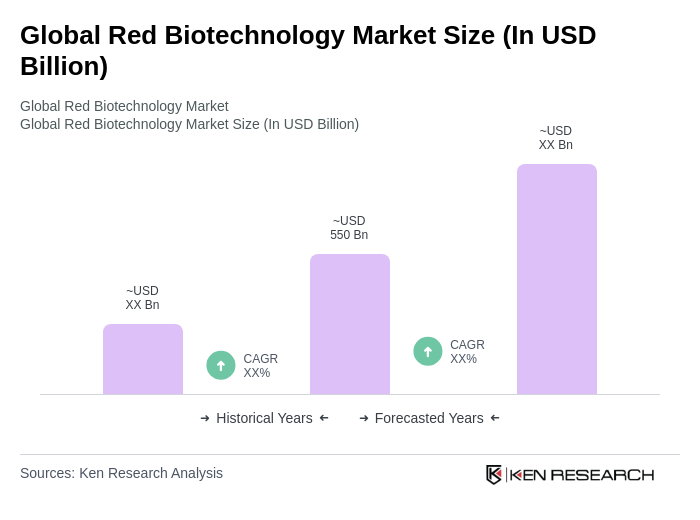
- The Global Red Biotechnology Market is valued at USD 550 billion, based on a five-year historical analysis. This growth is primarily driven by advancements in biopharmaceuticals, increasing prevalence of chronic diseases, and rising investments in research and development. The market is also supported by the growing demand for personalized medicine and innovative therapies that leverage biological processes.
- Key players in this market include the United States, Germany, and China. The United States dominates due to its robust healthcare infrastructure, significant investment in biotechnology research, and a large number of biopharmaceutical companies. Germany and China follow closely, benefiting from strong government support and increasing healthcare expenditure, which fosters innovation and market growth.
- In 2023, the U.S. government implemented the Biologics Control Act, which aims to streamline the approval process for biologics and enhance patient access to innovative therapies. This regulation emphasizes the importance of safety and efficacy while encouraging the development of new biologics, thereby supporting the growth of the red biotechnology sector.
Global Red Biotechnology Market Segmentation
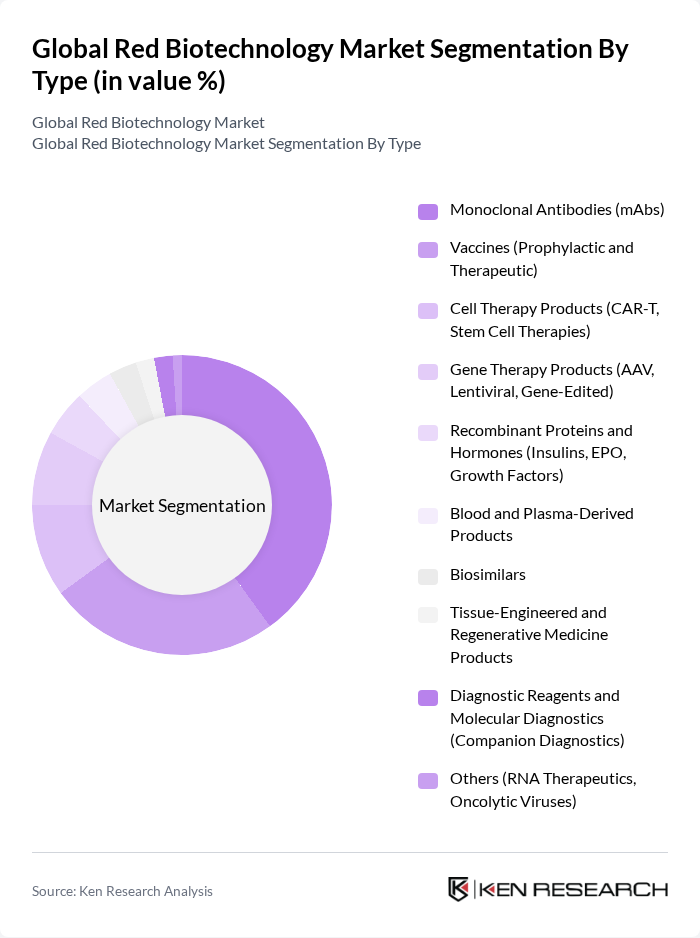
By Type:The market is segmented into various types, including Monoclonal Antibodies (mAbs), Vaccines (Prophylactic and Therapeutic), Cell Therapy Products (CAR-T, Stem Cell Therapies), Gene Therapy Products (AAV, Lentiviral, Gene-Edited), Recombinant Proteins and Hormones (Insulins, EPO, Growth Factors), Blood and Plasma-Derived Products, Biosimilars, Tissue-Engineered and Regenerative Medicine Products, Diagnostic Reagents and Molecular Diagnostics (Companion Diagnostics), and Others (RNA Therapeutics, Oncolytic Viruses). Among these, Monoclonal Antibodies (mAbs) are leading the market due to their widespread application in treating various diseases, including cancer and autoimmune disorders; biopharmaceuticals dominated by antibody therapeutics represent the largest share in recent analyses, supported by sustained investment and clinical success.
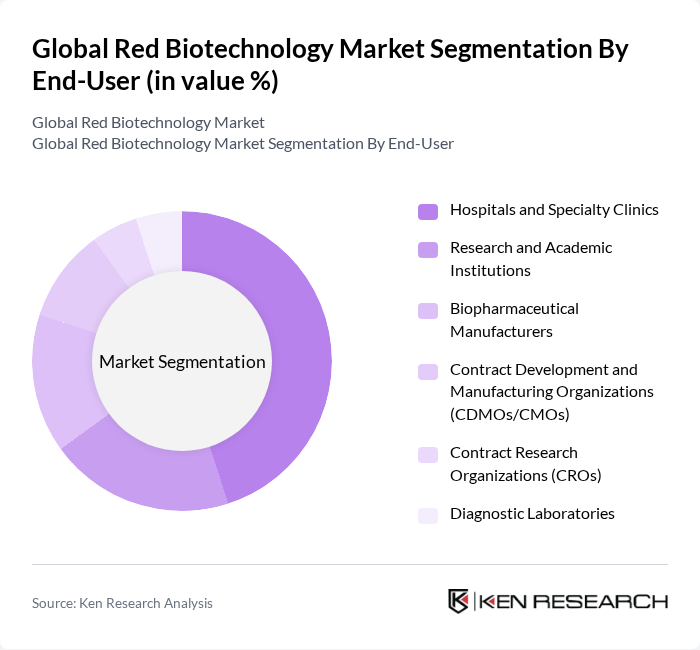
By End-User:The market is segmented by end-users, including Hospitals and Specialty Clinics, Research and Academic Institutions, Biopharmaceutical Manufacturers, Contract Development and Manufacturing Organizations (CDMOs/CMOs), Contract Research Organizations (CROs), and Diagnostic Laboratories. Hospitals and Specialty Clinics dominate the market due to their critical role in patient care and the increasing adoption of advanced therapies; uptake of cell and gene therapies, biologics infusion services, and companion diagnostics integration at care sites supports this dominance.
Global Red Biotechnology Market Competitive Landscape
The Global Red Biotechnology Market is characterized by a dynamic mix of regional and international players. Leading participants such as Amgen Inc., Genentech, Inc. (Roche Group), Gilead Sciences, Inc., Regeneron Pharmaceuticals, Inc., Biogen Inc., Novartis AG, F. Hoffmann-La Roche Ltd., Merck & Co., Inc. (MSD), Sanofi S.A., Takeda Pharmaceutical Company Limited, Eli Lilly and Company, AstraZeneca PLC, Johnson & Johnson (Janssen/Johnson & Johnson Innovative Medicine), Pfizer Inc., Bristol Myers Squibb (including Celgene), AbbVie Inc., Merck KGaA, Darmstadt, Germany, Moderna, Inc., BioNTech SE, CSL Limited (CSL Behring), Takeda Pharmaceutical Company Limited, Vertex Pharmaceuticals Incorporated, Illumina, Inc., Thermo Fisher Scientific Inc., Novo Nordisk A/S contribute to innovation, geographic expansion, and service delivery in this space.
Global Red Biotechnology Market Industry Analysis
Growth Drivers
- Increasing Demand for Biopharmaceuticals:The global biopharmaceutical market is projected to reach $500 billion in future, driven by the rising prevalence of chronic diseases. In future, the World Health Organization reported that over 60% of global deaths were due to chronic conditions, emphasizing the need for innovative therapies. This surge in demand is pushing biotechnology firms to develop advanced biopharmaceuticals, which are often more effective and targeted than traditional drugs, thus fueling market growth in future.
- Advancements in Genetic Engineering:The global genetic engineering market is expected to exceed $30 billion in future, with significant contributions from CRISPR technology and gene editing tools. In future, the National Institutes of Health reported over 1,000 active clinical trials utilizing genetic engineering techniques. These advancements are enabling the development of more precise and effective treatments, thereby enhancing the capabilities of red biotechnology and driving its adoption in future.
- Rising Investments in R&D:In future, global investments in biotechnology R&D reached approximately $200 billion, with a significant portion allocated to red biotechnology. The National Science Foundation indicated that R&D spending in the life sciences sector is expected to grow by 5% annually through future. This influx of funding is crucial for fostering innovation, supporting clinical trials, and accelerating the development of new therapies, thereby propelling market growth in future.
Market Challenges
- High Development Costs:The average cost of developing a new biopharmaceutical can exceed $2.6 billion, according to a future report by the Tufts Center for the Study of Drug Development. These exorbitant costs are primarily due to lengthy clinical trials and regulatory hurdles. As a result, many smaller biotech firms struggle to secure funding, which can hinder innovation and slow down the overall growth of the red biotechnology market in future.
- Stringent Regulatory Framework:The regulatory landscape for biotechnology is complex and varies significantly across regions. In future, the FDA and EMA implemented new guidelines that increased the scrutiny of biologics and gene therapies. Compliance with these regulations can delay product launches and increase costs, creating barriers for companies looking to enter the red biotechnology market in future, ultimately affecting their competitiveness and growth potential.
Global Red Biotechnology Market Future Outlook
The future of the red biotechnology market in future appears promising, driven by ongoing advancements in technology and increasing collaboration among industry stakeholders. The integration of artificial intelligence in drug discovery and development is expected to streamline processes and enhance efficiency. Additionally, the growing focus on personalized medicine will likely lead to more tailored therapies, improving patient outcomes. As these trends continue to evolve, they will shape the landscape of red biotechnology, fostering innovation and expanding market opportunities.
Market Opportunities
- Expansion in Emerging Markets:Emerging markets, particularly in Asia and Africa, are witnessing a surge in healthcare investments, projected to reach $150 billion in future. This growth presents significant opportunities for red biotechnology firms to expand their operations and tap into new customer bases, enhancing their market presence in future.
- Collaborations and Partnerships:Strategic collaborations between biotech firms and academic institutions are on the rise, with over 200 partnerships formed in future alone. These alliances facilitate knowledge sharing and resource pooling, accelerating the development of innovative therapies. Such collaborations are crucial for driving advancements in red biotechnology and creating new market opportunities in future.
Scope of the Report
| Segment | Sub-Segments |
|---|---|
| By Type | Monoclonal Antibodies (mAbs) Vaccines (Prophylactic and Therapeutic) Cell Therapy Products (CAR-T, Stem Cell Therapies) Gene Therapy Products (AAV, Lentiviral, Gene-Edited) Recombinant Proteins and Hormones (Insulins, EPO, Growth Factors) Blood and Plasma-Derived Products Biosimilars Tissue-Engineered and Regenerative Medicine Products Diagnostic Reagents and Molecular Diagnostics (Companion Diagnostics) Others (RNA Therapeutics, Oncolytic Viruses) |
| By End-User | Hospitals and Specialty Clinics Research and Academic Institutions Biopharmaceutical Manufacturers Contract Development and Manufacturing Organizations (CDMOs/CMOs) Contract Research Organizations (CROs) Diagnostic Laboratories |
| By Application | Therapeutics (Oncology, Immunology, Rare Diseases, Infectious Diseases) Diagnostics (Molecular, Companion, Point-of-Care) Research and Development (Genomics, Proteomics, Cell Engineering) Regenerative Medicine and Tissue Engineering Vaccine Development and Immunoprophylaxis |
| By Distribution Channel | Direct Sales to Providers and Institutions Distributors and Wholesalers Online Procurement Platforms |
| By Region | North America Europe Asia-Pacific Latin America Middle East & Africa |
| By Investment Source | Private Investments Government Funding Venture Capital and Private Equity Grants and Philanthropic Funding |
| By Policy Support | Research Grants Tax Incentives Regulatory Support Programs (Fast Track, PRIME, RMAT) |
Key Target Audience
Investors and Venture Capitalist Firms
Government and Regulatory Bodies (e.g., U.S. Food and Drug Administration, European Medicines Agency)
Biotechnology Companies
Pharmaceutical Manufacturers
Biomanufacturing Facilities
Healthcare Providers and Institutions
Industry Associations (e.g., Biotechnology Innovation Organization)
Financial Institutions and Investment Banks
Players Mentioned in the Report:
Amgen Inc.
Genentech, Inc. (Roche Group)
Gilead Sciences, Inc.
Regeneron Pharmaceuticals, Inc.
Biogen Inc.
Novartis AG
F. Hoffmann-La Roche Ltd.
Merck & Co., Inc. (MSD)
Sanofi S.A.
Takeda Pharmaceutical Company Limited
Eli Lilly and Company
AstraZeneca PLC
Johnson & Johnson (Janssen/Johnson & Johnson Innovative Medicine)
Pfizer Inc.
Bristol Myers Squibb (including Celgene)
AbbVie Inc.
Merck KGaA, Darmstadt, Germany
Moderna, Inc.
BioNTech SE
CSL Limited (CSL Behring)
Vertex Pharmaceuticals Incorporated
Illumina, Inc.
Thermo Fisher Scientific Inc.
Novo Nordisk A/S
Table of Contents
Market Assessment Phase
1. Executive Summary and Approach
2. Global Red Biotechnology Market Overview
2.1 Key Insights and Strategic Recommendations
2.2 Global Red Biotechnology Market Overview
2.3 Definition and Scope
2.4 Evolution of Market Ecosystem
2.5 Timeline of Key Regulatory Milestones
2.6 Value Chain & Stakeholder Mapping
2.7 Business Cycle Analysis
2.8 Policy & Incentive Landscape
3. Global Red Biotechnology Market Analysis
3.1 Growth Drivers
3.1.1 Increasing Demand for Biopharmaceuticals
3.1.2 Advancements in Genetic Engineering
3.1.3 Rising Investments in R&D
3.1.4 Growing Awareness of Personalized Medicine
3.2 Market Challenges
3.2.1 High Development Costs
3.2.2 Stringent Regulatory Framework
3.2.3 Market Competition
3.2.4 Ethical Concerns in Biotechnology
3.3 Market Opportunities
3.3.1 Expansion in Emerging Markets
3.3.2 Collaborations and Partnerships
3.3.3 Innovations in Drug Delivery Systems
3.3.4 Increasing Adoption of CRISPR Technology
3.4 Market Trends
3.4.1 Shift Towards Sustainable Practices
3.4.2 Integration of AI in Biotechnology
3.4.3 Growth of Regenerative Medicine
3.4.4 Rise of Telemedicine and Digital Health
3.5 Government Regulation
3.5.1 FDA Guidelines for Biologics
3.5.2 EMA Regulations on Gene Therapy
3.5.3 Compliance with GxP Standards
3.5.4 Intellectual Property Rights Protection
4. SWOT Analysis
5. Stakeholder Analysis
6. Porter's Five Forces Analysis
7. Global Red Biotechnology Market Market Size, 2019-2024
7.1 By Value
7.2 By Volume
7.3 By Average Selling Price
8. Global Red Biotechnology Market Segmentation
8.1 By Type
8.1.1 Monoclonal Antibodies (mAbs)
8.1.2 Vaccines (Prophylactic and Therapeutic)
8.1.3 Cell Therapy Products (CAR-T, Stem Cell Therapies)
8.1.4 Gene Therapy Products (AAV, Lentiviral, Gene-Edited)
8.1.5 Recombinant Proteins and Hormones (Insulins, EPO, Growth Factors)
8.1.6 Blood and Plasma-Derived Products
8.1.7 Biosimilars
8.1.8 Tissue-Engineered and Regenerative Medicine Products
8.1.9 Diagnostic Reagents and Molecular Diagnostics (Companion Diagnostics)
8.1.10 Others (RNA Therapeutics, Oncolytic Viruses)
8.2 By End-User
8.2.1 Hospitals and Specialty Clinics
8.2.2 Research and Academic Institutions
8.2.3 Biopharmaceutical Manufacturers
8.2.4 Contract Development and Manufacturing Organizations (CDMOs/CMOs)
8.2.5 Contract Research Organizations (CROs)
8.2.6 Diagnostic Laboratories
8.3 By Application
8.3.1 Therapeutics (Oncology, Immunology, Rare Diseases, Infectious Diseases)
8.3.2 Diagnostics (Molecular, Companion, Point-of-Care)
8.3.3 Research and Development (Genomics, Proteomics, Cell Engineering)
8.3.4 Regenerative Medicine and Tissue Engineering
8.3.5 Vaccine Development and Immunoprophylaxis
8.4 By Distribution Channel
8.4.1 Direct Sales to Providers and Institutions
8.4.2 Distributors and Wholesalers
8.4.3 Online Procurement Platforms
8.5 By Region
8.5.1 North America
8.5.2 Europe
8.5.3 Asia-Pacific
8.5.4 Latin America
8.5.5 Middle East & Africa
8.6 By Investment Source
8.6.1 Private Investments
8.6.2 Government Funding
8.6.3 Venture Capital and Private Equity
8.6.4 Grants and Philanthropic Funding
8.7 By Policy Support
8.7.1 Research Grants
8.7.2 Tax Incentives
8.7.3 Regulatory Support Programs (Fast Track, PRIME, RMAT)
9. Global Red Biotechnology Market Competitive Analysis
9.1 Market Share of Key Players
9.2 Cross Comparison of Key Players
9.2.1 Company Name
9.2.2 Segment Focus (Biologics, Cell & Gene Therapy, Vaccines, Diagnostics)
9.2.3 Global Biotech/Pharma Revenue (USD) and Share from Red Biotech
9.2.4 Pipeline Strength (No. of clinical assets Ph I–III)
9.2.5 Commercial Portfolio Breadth (No. of approved products)
9.2.6 R&D Intensity (R&D as % of revenue)
9.2.7 Biologics Manufacturing Capacity (kL; in-house vs. CDMO reliance)
9.2.8 CGT Manufacturing Footprint (viral vector, cell processing sites)
9.2.9 Regulatory Milestones (Breakthrough/Orphan/RMAT designations)
9.2.10 Geographic Reach (No. of countries with filings/approvals)
9.2.11 Partnership/BD Activity (No. of deals, licensing, co-developments)
9.2.12 Market Access Strength (HTA wins, major reimbursement listings)
9.2.13 Time-to-Market Metrics (avg. trial duration to approval)
9.2.14 Manufacturing Cost per Gram/Dose Benchmark (where disclosed)
9.2.15 Quality/Compliance Track Record (FDA/EMA observations, recalls)
9.3 SWOT Analysis of Top Players
9.4 Pricing Analysis
9.5 Detailed Profile of Major Companies
9.5.1 Amgen Inc.
9.5.2 Genentech, Inc. (Roche Group)
9.5.3 Gilead Sciences, Inc.
9.5.4 Regeneron Pharmaceuticals, Inc.
9.5.5 Biogen Inc.
9.5.6 Novartis AG
9.5.7 F. Hoffmann-La Roche Ltd.
9.5.8 Merck & Co., Inc. (MSD)
9.5.9 Sanofi S.A.
9.5.10 Takeda Pharmaceutical Company Limited
9.5.11 Eli Lilly and Company
9.5.12 AstraZeneca PLC
9.5.13 Johnson & Johnson (Janssen/Johnson & Johnson Innovative Medicine)
9.5.14 Pfizer Inc.
9.5.15 Bristol Myers Squibb (including Celgene)
9.5.16 AbbVie Inc.
9.5.17 Merck KGaA, Darmstadt, Germany
9.5.18 Moderna, Inc.
9.5.19 BioNTech SE
9.5.20 CSL Limited (CSL Behring)
9.5.21 Takeda Pharmaceutical Company Limited
9.5.22 Vertex Pharmaceuticals Incorporated
9.5.23 Illumina, Inc.
9.5.24 Thermo Fisher Scientific Inc.
9.5.25 Novo Nordisk A/S
10. Global Red Biotechnology Market End-User Analysis
10.1 Procurement Behavior of Key Ministries
10.1.1 Government Health Departments
10.1.2 Research Funding Agencies
10.1.3 Regulatory Bodies
10.2 Corporate Spend on Infrastructure & Energy
10.2.1 Investment in Biotech Facilities
10.2.2 Expenditure on Research Equipment
10.2.3 Budget Allocation for Clinical Trials
10.3 Pain Point Analysis by End-User Category
10.3.1 Access to Innovative Therapies
10.3.2 Cost of Biopharmaceuticals
10.3.3 Regulatory Compliance Challenges
10.4 User Readiness for Adoption
10.4.1 Awareness of Biotech Solutions
10.4.2 Training and Education Needs
10.4.3 Infrastructure Readiness
10.5 Post-Deployment ROI and Use Case Expansion
10.5.1 Measurement of Treatment Outcomes
10.5.2 Expansion into New Therapeutic Areas
10.5.3 Long-term Cost Savings
11. Global Red Biotechnology Market Future Size, 2025-2030
11.1 By Value
11.2 By Volume
11.3 By Average Selling Price
Go-To-Market Strategy Phase
1. Whitespace Analysis + Business Model Canvas
1.1 Market Gaps Identification
1.2 Value Proposition Development
1.3 Revenue Streams Analysis
1.4 Key Partnerships
1.5 Cost Structure Evaluation
1.6 Customer Segmentation
1.7 Competitive Advantage
2. Marketing and Positioning Recommendations
2.1 Branding Strategies
2.2 Product USPs
2.3 Target Market Identification
2.4 Communication Strategy
2.5 Digital Marketing Approaches
3. Distribution Plan
3.1 Urban Retail Strategies
3.2 Rural NGO Tie-ups
3.3 Online Distribution Channels
3.4 Direct Sales Approaches
4. Channel & Pricing Gaps
4.1 Underserved Routes
4.2 Pricing Bands Analysis
4.3 Competitor Pricing Strategies
5. Unmet Demand & Latent Needs
5.1 Category Gaps
5.2 Consumer Segments Analysis
5.3 Emerging Trends Identification
6. Customer Relationship
6.1 Loyalty Programs
6.2 After-sales Service
6.3 Customer Feedback Mechanisms
7. Value Proposition
7.1 Sustainability Initiatives
7.2 Integrated Supply Chains
7.3 Customer-Centric Innovations
8. Key Activities
8.1 Regulatory Compliance
8.2 Branding Efforts
8.3 Distribution Setup
9. Entry Strategy Evaluation
9.1 Domestic Market Entry Strategy
9.1.1 Product Mix Considerations
9.1.2 Pricing Band Strategy
9.1.3 Packaging Innovations
9.2 Export Entry Strategy
9.2.1 Target Countries Identification
9.2.2 Compliance Roadmap Development
10. Entry Mode Assessment
10.1 Joint Ventures
10.2 Greenfield Investments
10.3 Mergers & Acquisitions
10.4 Distributor Model Evaluation
11. Capital and Timeline Estimation
11.1 Capital Requirements Analysis
11.2 Timelines for Market Entry
12. Control vs Risk Trade-Off
12.1 Ownership Considerations
12.2 Partnerships Evaluation
13. Profitability Outlook
13.1 Breakeven Analysis
13.2 Long-term Sustainability Strategies
14. Potential Partner List
14.1 Distributors
14.2 Joint Ventures
14.3 Acquisition Targets
15. Execution Roadmap
15.1 Phased Plan for Market Entry
15.1.1 Market Setup
15.1.2 Market Entry
15.1.3 Growth Acceleration
15.1.4 Scale & Stabilize
15.2 Key Activities and Milestones
15.2.1 Milestone Planning
15.2.2 Activity Tracking
Research Methodology
Phase 1: Approach1
Desk Research
- Analysis of industry reports from biotechnology associations and research institutions
- Review of market trends and forecasts from academic journals and publications
- Examination of regulatory frameworks and guidelines from health authorities and government bodies
Primary Research
- Interviews with key opinion leaders in the red biotechnology sector, including researchers and industry experts
- Surveys targeting executives from biotechnology firms and pharmaceutical companies
- Field interviews with laboratory managers and production supervisors in biomanufacturing facilities
Validation & Triangulation
- Cross-validation of findings through multiple data sources, including market reports and expert insights
- Triangulation of quantitative data with qualitative insights from industry interviews
- Sanity checks conducted through peer reviews and expert panel discussions
Phase 2: Market Size Estimation1
Top-down Assessment
- Estimation of market size based on global biotechnology spending and investment trends
- Segmentation of the market by application areas such as healthcare, agriculture, and industrial biotechnology
- Incorporation of growth rates from emerging markets and technological advancements
Bottom-up Modeling
- Collection of sales data from leading red biotechnology firms and product lines
- Estimation of market share based on product volume and pricing strategies
- Analysis of production capacities and output from biomanufacturing plants
Forecasting & Scenario Analysis
- Utilization of time-series analysis to project market growth based on historical data
- Scenario modeling based on potential regulatory changes and market disruptions
- Development of baseline, optimistic, and pessimistic forecasts through 2030
Phase 3: CATI Sample Composition1
| Scope Item/Segment | Sample Size | Target Respondent Profiles |
|---|---|---|
| Healthcare Biotechnology Applications | 120 | Biotech Researchers, Clinical Trial Managers |
| Agricultural Biotechnology Innovations | 90 | Agronomists, Crop Scientists |
| Industrial Biotechnology Processes | 80 | Production Managers, Process Engineers |
| Regulatory Compliance in Biotechnology | 70 | Regulatory Affairs Specialists, Quality Assurance Managers |
| Investment Trends in Red Biotechnology | 60 | Venture Capitalists, Financial Analysts |
Frequently Asked Questions
What is the current value of the Global Red Biotechnology Market?
The Global Red Biotechnology Market is valued at approximately USD 550 billion, driven by advancements in biopharmaceuticals, the increasing prevalence of chronic diseases, and rising investments in research and development.
Which countries are leading in the Global Red Biotechnology Market?
What regulatory changes have impacted the Red Biotechnology Market in 2023?
What are the main types of products in the Red Biotechnology Market?
Other Regional/Country Reports
Indonesia Red Biotechnology Market
Malaysia Red Biotechnology Market
APAC Red Biotechnology Market
Why Buy From Us?

What makes us stand out is that our consultants follow Robust, Refine and Result (RRR) methodology. Robust for clear definitions, approaches and sanity checking, Refine for differentiating respondents' facts and opinions, and Result for presenting data with story.

We have set a benchmark in the industry by offering our clients with syndicated and customized market research reports featuring coverage of entire market as well as meticulous research and analyst insights.

While we don't replace traditional research, we flip the method upside down. Our dual approach of Top Bottom & Bottom Top ensures quality deliverable by not just verifying company fundamentals but also looking at the sector and macroeconomic factors.

With one step in the future, our research team constantly tries to show you the bigger picture. We help with some of the tough questions you may encounter along the way: How is the industry positioned? Best marketing channel? KPI's of competitors? By aligning every element, we help maximize success.

Our report gives you instant access to the answers and sources that other companies might choose to hide. We elaborate each steps of research methodology we have used and showcase you the sample size to earn your trust.

If you need any support, we are here! We pride ourselves on universe strength, data quality, and quick, friendly, and professional service.