About the Report
Base Year 2024Listen to the audio summary
Global Rice Transplanter Market Overview
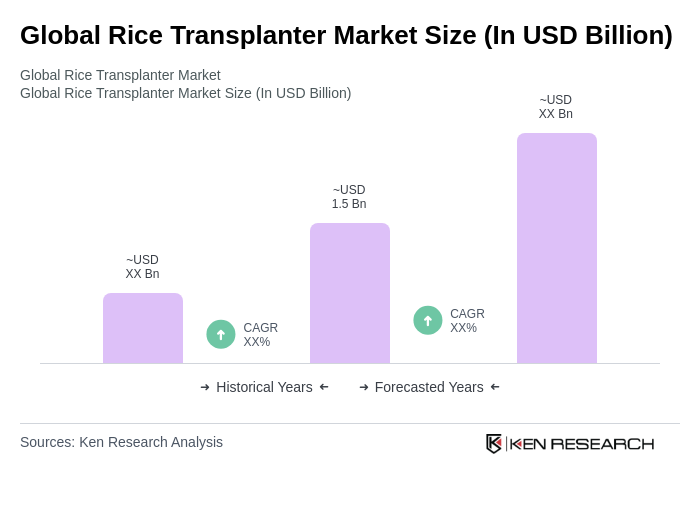
- The Global Rice Transplanter Market is valued at USD 1.5 billion, based on a five-year historical analysis. This growth is primarily driven by the increasing demand for mechanized farming solutions, which enhance productivity and reduce labor costs in rice cultivation. The rising adoption of advanced agricultural technologies and government initiatives promoting mechanization in agriculture further contribute to the market's expansion.
- Countries such as India, China, and Japan dominate the Global Rice Transplanter Market due to their large rice cultivation areas and significant investments in agricultural technology. These nations have established strong agricultural practices and infrastructure, which facilitate the adoption of rice transplanters, thereby enhancing efficiency and yield in rice production.
- India continues to incentivize mechanization of paddy operations via centrally sponsored schemes under the Sub-Mission on Agricultural Mechanization (SMAM), which provide capital subsidies for equipment such as rice transplanters through state-level implementations and custom hiring centers.
Global Rice Transplanter Market Segmentation
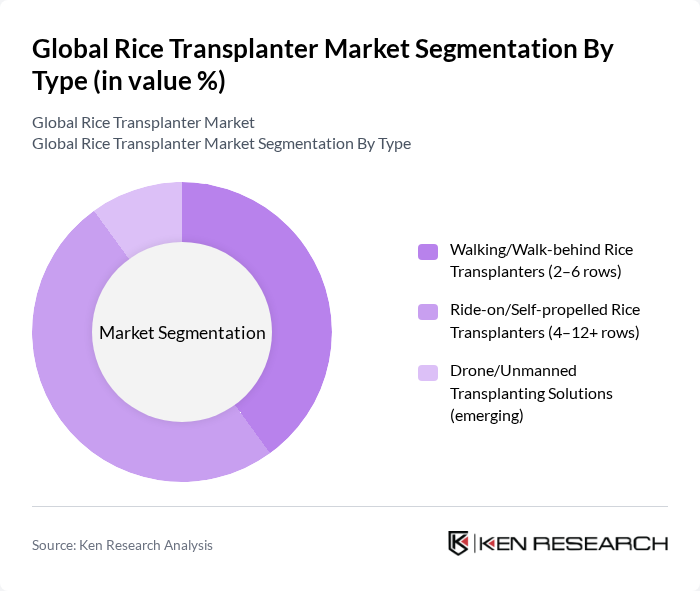
By Type:The market is segmented into three main types: Walking/Walk-behind Rice Transplanters, Ride-on/Self-propelled Rice Transplanters, and Drone/Unmanned Transplanting Solutions. Walking/Walk-behind Rice Transplanters are popular among smallholder farmers for lower acquisition and maintenance costs and maneuverability in small plots and terraced fields. Ride-on/Self-propelled Rice Transplanters are preferred by larger farms and service providers for higher field capacity, greater row options, and better ergonomics. Drone/unmanned solutions are emerging, focused on automating nursery handling and precision spacing in pilot deployments, with limited but growing commercial availability in East and Southeast Asia.
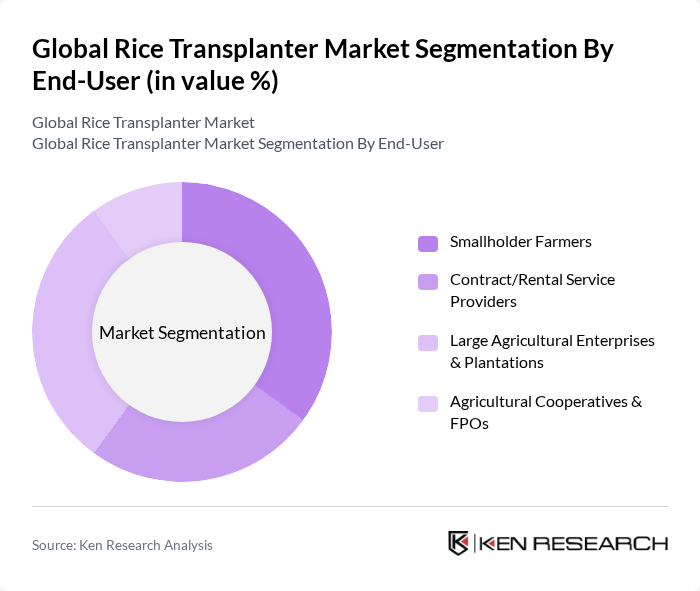
By End-User:The end-user segmentation includes Smallholder Farmers, Contract/Rental Service Providers, Large Agricultural Enterprises & Plantations, and Agricultural Cooperatives & FPOs. Smallholder farmers account for a significant portion where walking transplanters and custom hiring via rental hubs enable affordability. Contract/rental service providers are expanding, supported by government-backed Custom Hiring Centers and FPO-led service models that spread CAPEX and improve utilization. Large enterprises and cooperatives increasingly deploy higher-row, ride-on units to maximize throughput during tight transplanting windows and to standardize agronomy practices.
Global Rice Transplanter Market Competitive Landscape
The Global Rice Transplanter Market is characterized by a dynamic mix of regional and international players. Leading participants such as Yanmar Co., Ltd., Kubota Corporation, Iseki & Co., Ltd., Shandong World Agricultural Machinery Co., Ltd. (World Group), Jiangsu World Agricultural Machinery Co., Ltd., Changfa Agricultural Equipment Co., Ltd., Dongfeng Iseki Agricultural Machinery Co., Ltd., VST Tillers Tractors Ltd., Greaves Cotton Limited, KUBOTA Agricultural Machinery (Suzhou) Co., Ltd., Shaktiman (Tirth Agro Technology Pvt. Ltd.), Mahindra & Mahindra Ltd. (Swaraj Division), CLAAS KGaA mbH, CNH Industrial N.V., TAFE – Tractors and Farm Equipment Limited contribute to innovation, geographic expansion, and service delivery in this space.
Global Rice Transplanter Market Industry Analysis
Growth Drivers
- Increasing Demand for Mechanization in Agriculture:The global trend towards mechanization in agriculture is significantly impacting the rice transplanter market. In future, the mechanization rate in rice cultivation is projected to reach 70%, driven by the need for efficiency and higher yields. Countries like India and Vietnam are investing heavily, with India allocating approximately $2 billion to modernize agricultural practices, thereby increasing the adoption of transplanters among farmers.
- Rising Labor Costs in Rice Cultivation:Labor costs in rice cultivation have surged, with average wages increasing by 12% annually in regions like Southeast Asia. In future, the average daily wage for agricultural workers in countries such as Thailand is expected to exceed $12. This rise in labor costs is prompting farmers to seek mechanized solutions, including rice transplanters, to maintain profitability and productivity in their operations.
- Technological Advancements in Transplanter Design:Innovations in rice transplanter technology are enhancing efficiency and usability. In future, the introduction of automated and GPS-enabled transplanters is expected to increase planting accuracy by 35%. Companies are investing in R&D, with global spending on agricultural technology projected to reach $6 billion, fostering the development of more efficient and user-friendly transplanters that cater to diverse farming needs.
Market Challenges
- High Initial Investment Costs:The initial investment for rice transplanters can be prohibitive, often exceeding $12,000 per unit. This cost is a significant barrier for smallholder farmers, particularly in developing regions where average annual incomes are around $2,500. As a result, many farmers are unable to invest in mechanization, limiting the market's growth potential in these areas.
- Limited Awareness Among Smallholder Farmers:A substantial knowledge gap exists regarding the benefits of rice transplanters among smallholder farmers. In future, it is estimated that only 30% of smallholders in regions like Sub-Saharan Africa are aware of mechanization benefits. This lack of awareness hinders adoption rates, as many farmers continue to rely on traditional planting methods, which are less efficient and labor-intensive.
Global Rice Transplanter Market Future Outlook
The future of the rice transplanter market appears promising, driven by ongoing technological advancements and increasing mechanization in agriculture. As farmers seek to enhance productivity and reduce labor costs, the adoption of innovative transplanters is expected to rise. Additionally, government initiatives aimed at promoting sustainable farming practices will likely support market growth, encouraging investments in eco-friendly and efficient agricultural machinery that aligns with global sustainability goals.
Market Opportunities
- Expansion into Emerging Markets:Emerging markets, particularly in Africa and Southeast Asia, present significant growth opportunities for rice transplanters. With a combined population of over 1.7 billion and increasing food demand, these regions are likely to see a surge in mechanization efforts, supported by government incentives and international aid aimed at improving agricultural productivity.
- Development of Eco-Friendly Transplanters:The growing emphasis on sustainable farming practices is creating opportunities for the development of eco-friendly rice transplanters. Innovations that reduce fuel consumption and minimize environmental impact are gaining traction. In future, the market for eco-friendly agricultural machinery is expected to grow by 25%, driven by consumer demand for sustainable farming solutions and regulatory pressures for greener practices.
Scope of the Report
| Segment | Sub-Segments |
|---|---|
| By Type | Walking/Walk-behind Rice Transplanters (2–6 rows) Ride-on/Self-propelled Rice Transplanters (4–12+ rows) Drone/Unmanned Transplanting Solutions (emerging) |
| By End-User | Smallholder Farmers Contract/Rental Service Providers Large Agricultural Enterprises & Plantations Agricultural Cooperatives & FPOs |
| By Region | Asia-Pacific North America Europe Latin America Middle East & Africa |
| By Application | Wetland Paddy Transplanting Dry/Direct-Seeded Paddy Support Nursery Seedling Handling & Replanting |
| By Distribution Channel | Direct OEM Sales Authorized Dealers/Distributors Agri-Equipment Rental Platforms E-commerce/Online Retail |
| By Price Range | Entry (Walking, basic models) Mid (Ride-on 4–8 rows) Premium (High-capacity 8–12+ rows, smart features) |
| By Others | Electric/Hybrid-Powered Transplanters Precision/Autoguidance & GPS-enabled Transplanters |
Key Target Audience
Investors and Venture Capitalist Firms
Government and Regulatory Bodies (e.g., Food and Agriculture Organization, Ministry of Agriculture)
Manufacturers and Producers
Distributors and Retailers
Agricultural Cooperatives
Technology Providers
Industry Associations (e.g., International Rice Research Institute)
Financial Institutions
Players Mentioned in the Report:
Yanmar Co., Ltd.
Kubota Corporation
Iseki & Co., Ltd.
Shandong World Agricultural Machinery Co., Ltd. (World Group)
Jiangsu World Agricultural Machinery Co., Ltd.
Changfa Agricultural Equipment Co., Ltd.
Dongfeng Iseki Agricultural Machinery Co., Ltd.
VST Tillers Tractors Ltd.
Greaves Cotton Limited
KUBOTA Agricultural Machinery (Suzhou) Co., Ltd.
Shaktiman (Tirth Agro Technology Pvt. Ltd.)
Mahindra & Mahindra Ltd. (Swaraj Division)
CLAAS KGaA mbH
CNH Industrial N.V.
TAFE Tractors and Farm Equipment Limited
Table of Contents
Market Assessment Phase
1. Executive Summary and Approach
2. Global Rice Transplanter Market Overview
2.1 Key Insights and Strategic Recommendations
2.2 Global Rice Transplanter Market Overview
2.3 Definition and Scope
2.4 Evolution of Market Ecosystem
2.5 Timeline of Key Regulatory Milestones
2.6 Value Chain & Stakeholder Mapping
2.7 Business Cycle Analysis
2.8 Policy & Incentive Landscape
3. Global Rice Transplanter Market Analysis
3.1 Growth Drivers
3.1.1 Increasing demand for mechanization in agriculture
3.1.2 Rising labor costs in rice cultivation
3.1.3 Technological advancements in transplanter design
3.1.4 Government initiatives promoting modern farming techniques
3.2 Market Challenges
3.2.1 High initial investment costs
3.2.2 Limited awareness among smallholder farmers
3.2.3 Maintenance and repair issues
3.2.4 Variability in soil and climatic conditions
3.3 Market Opportunities
3.3.1 Expansion into emerging markets
3.3.2 Development of eco-friendly transplanters
3.3.3 Integration of smart technology in transplanters
3.3.4 Partnerships with agricultural cooperatives
3.4 Market Trends
3.4.1 Shift towards precision agriculture
3.4.2 Increasing adoption of electric and hybrid transplanters
3.4.3 Growth in rental services for agricultural machinery
3.4.4 Focus on sustainable farming practices
3.5 Government Regulation
3.5.1 Subsidies for agricultural machinery
3.5.2 Safety and environmental regulations
3.5.3 Standards for machinery performance
3.5.4 Import/export regulations for agricultural equipment
4. SWOT Analysis
5. Stakeholder Analysis
6. Porter's Five Forces Analysis
7. Global Rice Transplanter Market Market Size, 2019-2024
7.1 By Value
7.2 By Volume
7.3 By Average Selling Price
8. Global Rice Transplanter Market Segmentation
8.1 By Type
8.1.1 Walking/Walk-behind Rice Transplanters (2–6 rows)
8.1.2 Ride-on/Self-propelled Rice Transplanters (4–12+ rows)
8.1.3 Drone/Unmanned Transplanting Solutions (emerging)
8.2 By End-User
8.2.1 Smallholder Farmers
8.2.2 Contract/Rental Service Providers
8.2.3 Large Agricultural Enterprises & Plantations
8.2.4 Agricultural Cooperatives & FPOs
8.3 By Region
8.3.1 Asia-Pacific
8.3.2 North America
8.3.3 Europe
8.3.4 Latin America
8.3.5 Middle East & Africa
8.4 By Application
8.4.1 Wetland Paddy Transplanting
8.4.2 Dry/Direct-Seeded Paddy Support
8.4.3 Nursery Seedling Handling & Replanting
8.5 By Distribution Channel
8.5.1 Direct OEM Sales
8.5.2 Authorized Dealers/Distributors
8.5.3 Agri-Equipment Rental Platforms
8.5.4 E-commerce/Online Retail
8.6 By Price Range
8.6.1 Entry (Walking, basic models)
8.6.2 Mid (Ride-on 4–8 rows)
8.6.3 Premium (High-capacity 8–12+ rows, smart features)
8.7 Others
8.7.1 Electric/Hybrid-Powered Transplanters
8.7.2 Precision/Autoguidance & GPS-enabled Transplanters
9. Global Rice Transplanter Market Competitive Analysis
9.1 Market Share of Key Players
9.2 Cross Comparison of Key Players
9.2.1 Company Name
9.2.2 Product Portfolio Breadth (walking vs ride-on, rows supported)
9.2.3 Regional Footprint (APAC, South Asia, China, ASEAN penetration)
9.2.4 Revenue from Rice Transplanters (USD, latest FY)
9.2.5 YoY Unit Shipment Growth (Rice transplanters)
9.2.6 Average Selling Price (ASP) by Type
9.2.7 Dealer/Service Network Coverage (no. of outlets, countries)
9.2.8 R&D Intensity (% of revenue; patents/design registrations)
9.2.9 Feature Differentiation (GPS/autosteer, electric, automation)
9.2.10 After-sales KPIs (spare parts fill rate, warranty turnaround)
9.2.11 Financing & Subsidy Enablement (tie-ups, approval TAT)
9.2.12 Market Share in Core Markets (Japan, China, India, SEA)
9.3 SWOT Analysis of Top Players
9.4 Pricing Analysis
9.5 Detailed Profile of Major Companies
9.5.1 Yanmar Co., Ltd.
9.5.2 Kubota Corporation
9.5.3 Iseki & Co., Ltd.
9.5.4 Shandong World Agricultural Machinery Co., Ltd. (World Group)
9.5.5 Jiangsu World Agricultural Machinery Co., Ltd.
9.5.6 Changfa Agricultural Equipment Co., Ltd.
9.5.7 Dongfeng Iseki Agricultural Machinery Co., Ltd.
9.5.8 VST Tillers Tractors Ltd.
9.5.9 Greaves Cotton Limited
9.5.10 KUBOTA Agricultural Machinery (Suzhou) Co., Ltd.
9.5.11 Shaktiman (Tirth Agro Technology Pvt. Ltd.)
9.5.12 Mahindra & Mahindra Ltd. (Swaraj Division)
9.5.13 CLAAS KGaA mbH
9.5.14 CNH Industrial N.V.
9.5.15 TAFE – Tractors and Farm Equipment Limited
10. Global Rice Transplanter Market End-User Analysis
10.1 Procurement Behavior of Key Ministries
10.1.1 Government procurement policies
10.1.2 Budget allocation for agricultural machinery
10.1.3 Collaboration with private sector
10.2 Corporate Spend on Infrastructure & Energy
10.2.1 Investment in agricultural technology
10.2.2 Funding for mechanization projects
10.2.3 Partnerships with NGOs for rural development
10.3 Pain Point Analysis by End-User Category
10.3.1 Challenges faced by smallholder farmers
10.3.2 Issues in large-scale farming operations
10.3.3 Barriers to technology adoption
10.4 User Readiness for Adoption
10.4.1 Awareness of benefits of transplanters
10.4.2 Training and support needs
10.4.3 Financial readiness for investment
10.5 Post-Deployment ROI and Use Case Expansion
10.5.1 Measurement of productivity gains
10.5.2 Long-term cost savings analysis
10.5.3 Potential for scaling operations
11. Global Rice Transplanter Market Future Size, 2025-2030
11.1 By Value
11.2 By Volume
11.3 By Average Selling Price
Go-To-Market Strategy Phase
1. Whitespace Analysis + Business Model Canvas
1.1 Market gaps identification
1.2 Value proposition development
1.3 Revenue model exploration
1.4 Customer segmentation analysis
1.5 Competitive landscape overview
1.6 Key partnerships and alliances
1.7 Operational framework design
2. Marketing and Positioning Recommendations
2.1 Branding strategies
2.2 Product USPs
2.3 Target audience identification
2.4 Communication channels selection
2.5 Marketing budget allocation
2.6 Performance metrics establishment
3. Distribution Plan
3.1 Urban retail vs rural NGO tie-ups
3.2 Distribution channel optimization
3.3 Logistics and supply chain management
3.4 Partnership with local distributors
3.5 E-commerce strategy development
4. Channel & Pricing Gaps
4.1 Underserved routes
4.2 Pricing bands
4.3 Competitor pricing analysis
4.4 Value-based pricing strategy
4.5 Discount and promotion strategies
5. Unmet Demand & Latent Needs
5.1 Category gaps
5.2 Consumer segments
5.3 Product feature enhancements
5.4 Service and support improvements
5.5 Market entry barriers
6. Customer Relationship
6.1 Loyalty programs
6.2 After-sales service
6.3 Customer feedback mechanisms
6.4 Community engagement initiatives
6.5 Customer education and training
7. Value Proposition
7.1 Sustainability
7.2 Integrated supply chains
7.3 Cost-effectiveness
7.4 Quality assurance
7.5 Innovation and technology
8. Key Activities
8.1 Regulatory compliance
8.2 Branding
8.3 Distribution setup
8.4 Training and support
8.5 Market research and analysis
9. Entry Strategy Evaluation
9.1 Domestic Market Entry Strategy
9.1.1 Product mix
9.1.2 Pricing band
9.1.3 Packaging
9.2 Export Entry Strategy
9.2.1 Target countries
9.2.2 Compliance roadmap
10. Entry Mode Assessment
10.1 JV
10.2 Greenfield
10.3 M&A
10.4 Distributor Model
11. Capital and Timeline Estimation
11.1 Capital requirements
11.2 Timelines
12. Control vs Risk Trade-Off
12.1 Ownership vs Partnerships
13. Profitability Outlook
13.1 Breakeven analysis
13.2 Long-term sustainability
14. Potential Partner List
14.1 Distributors
14.2 JVs
14.3 Acquisition targets
15. Execution Roadmap
15.1 Phased Plan for Market Entry
15.1.1 Market Setup
15.1.2 Market Entry
15.1.3 Growth Acceleration
15.1.4 Scale & Stabilize
15.2 Key Activities and Milestones
15.2.1 Activity timelines
15.2.2 Milestone tracking
Research Methodology
Phase 1: Approach1
Desk Research
- Industry reports from agricultural machinery associations and trade publications
- Market analysis from government agricultural departments and international organizations
- Academic journals focusing on agricultural technology and mechanization trends
Primary Research
- Interviews with rice farmers utilizing transplanters across various regions
- Surveys with manufacturers of rice transplanters to gather insights on production and sales
- Field visits to agricultural expos and trade shows to observe market dynamics
Validation & Triangulation
- Cross-validation of data from multiple sources including trade associations and government reports
- Triangulation of findings from primary interviews with secondary data insights
- Sanity checks through expert panels comprising agronomists and market analysts
Phase 2: Market Size Estimation1
Top-down Assessment
- Analysis of total rice production volumes and mechanization rates in key markets
- Estimation of market share based on regional adoption rates of transplanters
- Incorporation of government initiatives promoting mechanization in agriculture
Bottom-up Modeling
- Data collection on sales volumes from leading rice transplanter manufacturers
- Cost analysis based on pricing strategies and operational expenses of transplanters
- Volume x price calculations to derive revenue estimates for the market
Forecasting & Scenario Analysis
- Multi-variable regression analysis incorporating factors like labor costs and rice prices
- Scenario modeling based on technological advancements and policy changes
- Development of baseline, optimistic, and pessimistic forecasts through 2030
Phase 3: CATI Sample Composition1
| Scope Item/Segment | Sample Size | Target Respondent Profiles |
|---|---|---|
| Smallholder Rice Farmers | 120 | Farm Owners, Agricultural Workers |
| Large-Scale Rice Producers | 80 | Farm Managers, Agronomists |
| Rice Transplanter Manufacturers | 60 | Product Development Managers, Sales Directors |
| Agricultural Equipment Distributors | 50 | Distribution Managers, Supply Chain Coordinators |
| Government Agricultural Policy Makers | 40 | Policy Analysts, Agricultural Economists |
Frequently Asked Questions
What is the current value of the Global Rice Transplanter Market?
The Global Rice Transplanter Market is valued at approximately USD 1.5 billion, reflecting a significant growth trend driven by the increasing demand for mechanized farming solutions that enhance productivity and reduce labor costs in rice cultivation.
Which countries dominate the Global Rice Transplanter Market?
What types of rice transplanters are available in the market?
Who are the primary end-users of rice transplanters?
Other Regional/Country Reports
Indonesia Rice Transplanter Market
Malaysia Rice Transplanter Market
APAC Rice Transplanter Market
SEA Rice Transplanter Market
Why Buy From Us?

What makes us stand out is that our consultants follow Robust, Refine and Result (RRR) methodology. Robust for clear definitions, approaches and sanity checking, Refine for differentiating respondents' facts and opinions, and Result for presenting data with story.

We have set a benchmark in the industry by offering our clients with syndicated and customized market research reports featuring coverage of entire market as well as meticulous research and analyst insights.

While we don't replace traditional research, we flip the method upside down. Our dual approach of Top Bottom & Bottom Top ensures quality deliverable by not just verifying company fundamentals but also looking at the sector and macroeconomic factors.

With one step in the future, our research team constantly tries to show you the bigger picture. We help with some of the tough questions you may encounter along the way: How is the industry positioned? Best marketing channel? KPI's of competitors? By aligning every element, we help maximize success.

Our report gives you instant access to the answers and sources that other companies might choose to hide. We elaborate each steps of research methodology we have used and showcase you the sample size to earn your trust.

If you need any support, we are here! We pride ourselves on universe strength, data quality, and quick, friendly, and professional service.