About the Report
Base Year 2024Global Riot Control Equipment Market Overview
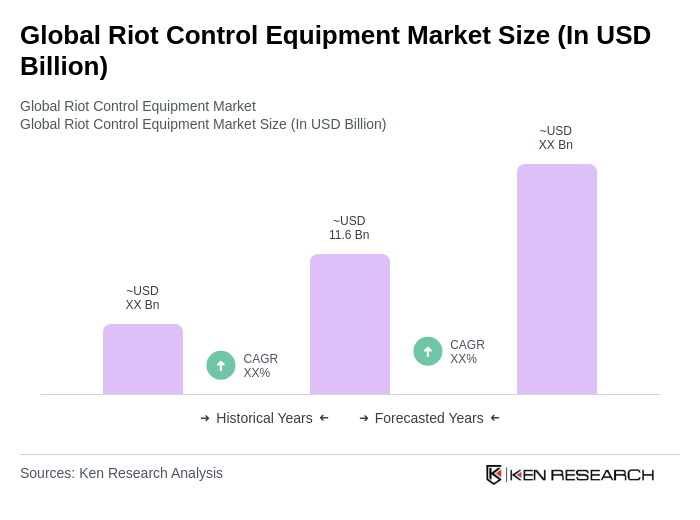
- The Global Riot Control Equipment Market is valued at USD 11.6 billion, based on a five-year historical analysis. This growth is primarily driven by increasing civil unrest, government initiatives to enhance public safety, and the rising demand for non-lethal crowd control solutions. The market has seen a surge in investments from both public and private sectors, focusing on advanced technologies and equipment to manage protests and riots effectively.
- Key players in this market include the United States, China, and several European nations. North America holds the largest regional share, underpinned by sizable federal/state law enforcement budgets and adoption of advanced less-lethal systems, while Europe and China maintain strong manufacturing bases and export capabilities alongside frequent public-order requirements.
- In 2023, the European Union implemented measures reinforcing common standards on the trade and use of non-lethal/“security and military” items through its export control framework, and member states apply strict conformity rules for protective equipment under PPE Regulation (EU) 2016/425 and chemical agent controls (e.g., CS/OC). While there is no single new EU-wide regulation uniquely standardizing all riot-control weapons’ use in 2023, manufacturers operating in the EU market must meet safety, efficacy, and conformity requirements under existing frameworks to supply law enforcement.
Global Riot Control Equipment Market Segmentation
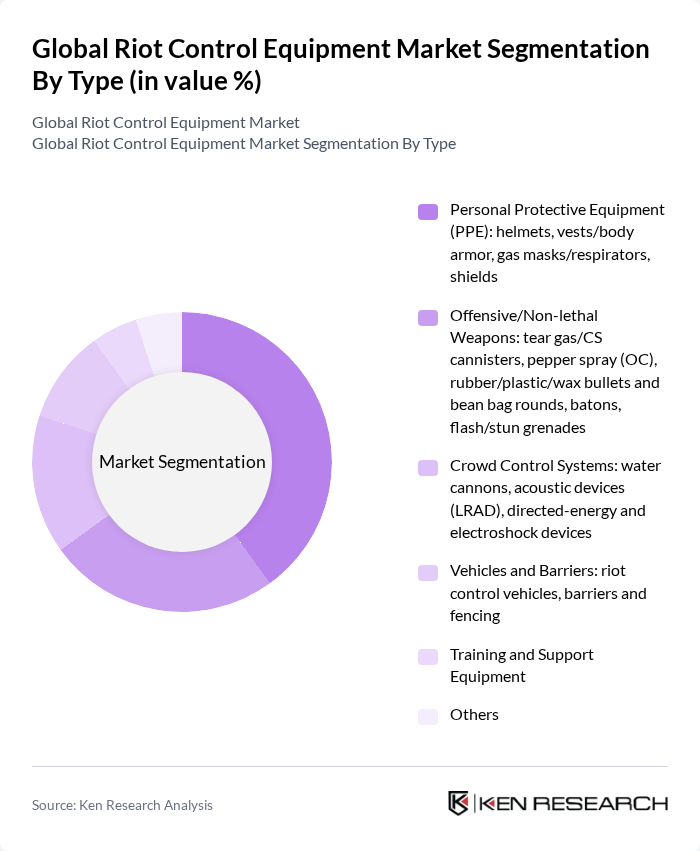
By Type:The market is segmented into various types of riot control equipment, including Personal Protective Equipment (PPE), Offensive/Non-lethal Weapons, Crowd Control Systems, Vehicles and Barriers, Training and Support Equipment, and Others. Among these, Personal Protective Equipment (PPE) is currently the leading sub-segment due to the increasing focus on the safety of law enforcement personnel during crowd control operations. The demand for helmets, body armor, and gas masks has surged as agencies prioritize the protection of their officers in volatile situations.
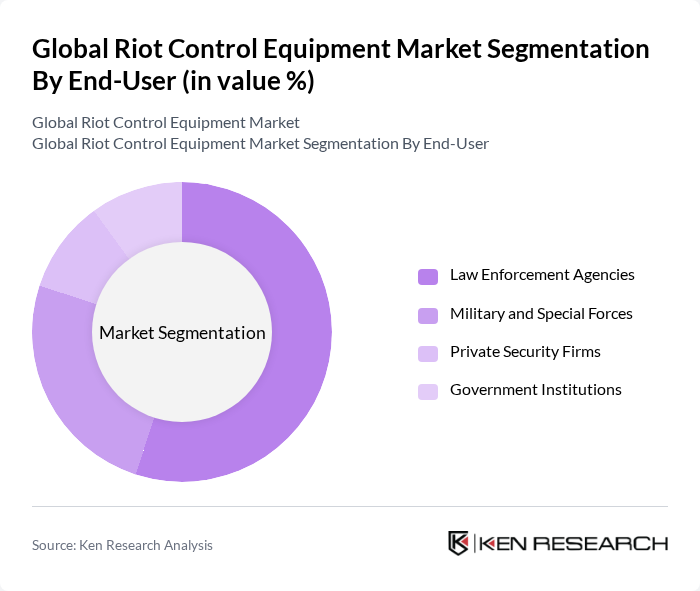
By End-User:The end-user segmentation includes Law Enforcement Agencies, Military and Special Forces, Private Security Firms, and Government Institutions. Law Enforcement Agencies dominate this segment, driven by the increasing need for effective crowd management solutions in urban areas. The growing frequency of protests and civil unrest has led to heightened demand for specialized equipment, ensuring that law enforcement can respond effectively while minimizing risks to public safety.
Global Riot Control Equipment Market Competitive Landscape
The Global Riot Control Equipment Market is characterized by a dynamic mix of regional and international players. Leading participants such as Safariland, LLC, NonLethal Technologies, Inc., Combined Systems, Inc. (CSI), Axon (formerly TASER International, Inc.), BAE Systems plc, Rheinmetall AG, ALS Less-Lethal (AMTEC Less-Lethal Systems, Inc.), Federal Laboratories (brand under CSI), Zarc International, Inc. (Cap-Stun/Pepper Spray), Security Devices International Inc. (SDI), Dae Sung Tech Co., Ltd., Condor Non-Lethal Technologies (Brazil), RUAG International (RUAG Ammotec; non-lethal lines), ARPAC International (riot control vehicles/barriers), AARDVARK Tactical, Inc. contribute to innovation, geographic expansion, and service delivery in this space.
Global Riot Control Equipment Market Industry Analysis
Growth Drivers
- Increasing Civil Unrest and Protests:The rise in civil unrest globally has been significant, with over 1,000 protests reported in the recent past, according to the Global Protest Tracker. This surge is driven by socio-political issues, leading governments to enhance their riot control capabilities. In the future, countries like the U.S. and France are expected to allocate approximately $2.5 billion collectively for riot control equipment, reflecting the urgent need for effective management of public disturbances.
- Government Spending on Public Safety:Governments are projected to increase their public safety budgets by 6% in the future, reaching an estimated $160 billion globally. This increase is primarily aimed at enhancing law enforcement capabilities, including riot control. Countries such as Brazil and India are expected to invest heavily in advanced riot control technologies, with Brazil alone earmarking $600 million for equipment upgrades, indicating a robust commitment to maintaining public order.
- Technological Advancements in Riot Control:The integration of technology in riot control is accelerating, with the global market for smart riot control technologies expected to reach $1.5 billion in the future. Innovations such as drones and surveillance systems are becoming essential tools for law enforcement. For instance, the U.S. Department of Homeland Security has allocated $350 million for the development of these technologies, highlighting the trend towards more sophisticated and effective riot management solutions.
Market Challenges
- Regulatory Restrictions on Equipment Use:Regulatory frameworks governing riot control equipment are becoming increasingly stringent. In the future, over 35 countries are expected to implement new regulations that limit the use of certain riot control technologies, particularly non-lethal weapons. This could hinder market growth, as manufacturers must navigate complex compliance requirements, potentially delaying product launches and increasing operational costs.
- Public Perception and Backlash Against Riot Control:The public's perception of riot control measures is shifting, with a growing backlash against aggressive tactics. In the recent past, surveys indicated that 65% of respondents in major cities opposed the use of tear gas and rubber bullets. This negative sentiment can lead to increased scrutiny and pressure on governments to adopt more humane approaches, complicating the market landscape for riot control equipment manufacturers.
Global Riot Control Equipment Market Future Outlook
The future of the riot control equipment market is poised for transformation, driven by technological advancements and evolving public expectations. As governments increasingly prioritize non-lethal methods, the demand for innovative solutions will rise. Additionally, the integration of smart technologies will enhance operational efficiency. However, manufacturers must navigate regulatory challenges and public sentiment to remain competitive. The focus on human rights in policing will further shape the development of equipment, ensuring that future solutions align with societal values and legal standards.
Market Opportunities
- Expansion into Emerging Markets:Emerging markets, particularly in Asia and Africa, present significant growth opportunities for riot control equipment. With urbanization rates projected to exceed 55% in the future in these regions, the demand for effective public safety solutions is expected to rise sharply, creating a market potential worth approximately $900 million.
- Development of Smart Riot Control Technologies:The development of smart technologies, such as AI-driven surveillance and crowd management systems, offers a lucrative opportunity. With an estimated investment of $250 million in R&D for smart technologies in the future, companies can capitalize on the growing need for efficient and effective riot control solutions that prioritize safety and compliance.
Scope of the Report
| Segment | Sub-Segments |
|---|---|
| By Type | Personal Protective Equipment (PPE): helmets, vests/body armor, gas masks/respirators, shields Offensive/Non-lethal Weapons: tear gas/CS cannisters, pepper spray (OC), rubber/plastic/wax bullets and bean bag rounds, batons, flash/stun grenades Crowd Control Systems: water cannons, acoustic devices (LRAD), directed-energy and electroshock devices Vehicles and Barriers: riot control vehicles, barriers and fencing Training and Support Equipment Others |
| By End-User | Law Enforcement Agencies Military and Special Forces Private Security Firms Government Institutions |
| By Application | Crowd Control and Area Denial Event and Venue Security Riot and Protest Management Emergency and Disaster Response |
| By Distribution Channel | Direct Sales to Agencies Authorized Distributors/Integrators Online/Procurement Portals |
| By Region | North America Europe Asia-Pacific Latin America Middle East & Africa |
| By Price Range | Low-End Mid-Range High-End |
| By Technology | Non-Lethal Technologies Lethal Technologies Hybrid Technologies |
Key Target Audience
Investors and Venture Capitalist Firms
Government and Regulatory Bodies (e.g., Department of Homeland Security, Federal Bureau of Investigation)
Manufacturers and Producers
Distributors and Retailers
Law Enforcement Agencies (e.g., local police departments, national guard units)
Military Organizations (e.g., armed forces, defense ministries)
Security Service Providers
Public Safety Organizations
Players Mentioned in the Report:
Safariland, LLC
NonLethal Technologies, Inc.
Combined Systems, Inc. (CSI)
Axon (formerly TASER International, Inc.)
BAE Systems plc
Rheinmetall AG
ALS Less-Lethal (AMTEC Less-Lethal Systems, Inc.)
Federal Laboratories (brand under CSI)
Zarc International, Inc. (Cap-Stun/Pepper Spray)
Security Devices International Inc. (SDI)
Dae Sung Tech Co., Ltd.
Condor Non-Lethal Technologies (Brazil)
RUAG International (RUAG Ammotec; non-lethal lines)
ARPAC International (riot control vehicles/barriers)
AARDVARK Tactical, Inc.
Table of Contents
Market Assessment Phase
1. Executive Summary and Approach
2. Global Riot Control Equipment Market Overview
2.1 Key Insights and Strategic Recommendations
2.2 Global Riot Control Equipment Market Overview
2.3 Definition and Scope
2.4 Evolution of Market Ecosystem
2.5 Timeline of Key Regulatory Milestones
2.6 Value Chain & Stakeholder Mapping
2.7 Business Cycle Analysis
2.8 Policy & Incentive Landscape
3. Global Riot Control Equipment Market Analysis
3.1 Growth Drivers
3.1.1 Increasing civil unrest and protests
3.1.2 Government spending on public safety
3.1.3 Technological advancements in riot control
3.1.4 Rising demand for non-lethal equipment
3.2 Market Challenges
3.2.1 Regulatory restrictions on equipment use
3.2.2 Public perception and backlash against riot control
3.2.3 High costs of advanced equipment
3.2.4 Competition from alternative security solutions
3.3 Market Opportunities
3.3.1 Expansion into emerging markets
3.3.2 Development of smart riot control technologies
3.3.3 Partnerships with law enforcement agencies
3.3.4 Increasing focus on training and support services
3.4 Market Trends
3.4.1 Shift towards non-lethal riot control methods
3.4.2 Integration of technology in riot management
3.4.3 Growing emphasis on human rights in policing
3.4.4 Rise of private security firms in riot control
3.5 Government Regulation
3.5.1 International guidelines on riot control equipment
3.5.2 National laws governing the use of force
3.5.3 Compliance requirements for manufacturers
3.5.4 Restrictions on export of riot control technologies
4. SWOT Analysis
5. Stakeholder Analysis
6. Porter's Five Forces Analysis
7. Global Riot Control Equipment Market Market Size, 2019-2024
7.1 By Value
7.2 By Volume
7.3 By Average Selling Price
8. Global Riot Control Equipment Market Segmentation
8.1 By Type
8.1.1 Personal Protective Equipment (PPE): helmets, vests/body armor, gas masks/respirators, shields
8.1.2 Offensive/Non-lethal Weapons: tear gas/CS cannisters, pepper spray (OC), rubber/plastic/wax bullets and bean bag rounds, batons, flash/stun grenades
8.1.3 Crowd Control Systems: water cannons, acoustic devices (LRAD), directed-energy and electroshock devices
8.1.4 Vehicles and Barriers: riot control vehicles, barriers and fencing
8.1.5 Training and Support Equipment
8.1.6 Others
8.2 By End-User
8.2.1 Law Enforcement Agencies
8.2.2 Military and Special Forces
8.2.3 Private Security Firms
8.2.4 Government Institutions
8.3 By Application
8.3.1 Crowd Control and Area Denial
8.3.2 Event and Venue Security
8.3.3 Riot and Protest Management
8.3.4 Emergency and Disaster Response
8.4 By Distribution Channel
8.4.1 Direct Sales to Agencies
8.4.2 Authorized Distributors/Integrators
8.4.3 Online/Procurement Portals
8.5 By Region
8.5.1 North America
8.5.2 Europe
8.5.3 Asia-Pacific
8.5.4 Latin America
8.5.5 Middle East & Africa
8.6 By Price Range
8.6.1 Low-End
8.6.2 Mid-Range
8.6.3 High-End
8.7 By Technology
8.7.1 Non-Lethal Technologies
8.7.2 Lethal Technologies
8.7.3 Hybrid Technologies
9. Global Riot Control Equipment Market Competitive Analysis
9.1 Market Share of Key Players
9.2 Cross Comparison of Key Players
9.2.1 Company Name
9.2.2 Company Size (by defense/security revenue tier)
9.2.3 Revenue Growth Rate (3–5 year CAGR)
9.2.4 Geographic Footprint (regions served; export intensity)
9.2.5 Contract Wins with Law Enforcement/Military (count/value)
9.2.6 Product Portfolio Breadth (PPE, munitions, systems, vehicles)
9.2.7 Certification and Compliance (NIJ, ISO, export licenses)
9.2.8 Pricing Strategy (premium, value, bulk/agency pricing)
9.2.9 Distribution Coverage (direct vs. distributor mix, lead times)
9.2.10 Innovation Rate (R&D spend %, new launches per year)
9.2.11 After-Sales and Training Capability (field support, training programs)
9.2.12 Backlog and Book-to-Bill Ratio
9.3 SWOT Analysis of Top Players
9.4 Pricing Analysis
9.5 Detailed Profile of Major Companies
9.5.1 Safariland, LLC
9.5.2 NonLethal Technologies, Inc.
9.5.3 Combined Systems, Inc. (CSI)
9.5.4 Axon (formerly TASER International, Inc.)
9.5.5 BAE Systems plc
9.5.6 Rheinmetall AG
9.5.7 ALS Less-Lethal (AMTEC Less-Lethal Systems, Inc.)
9.5.8 Federal Laboratories (brand under CSI)
9.5.9 Zarc International, Inc. (Cap-Stun/Pepper Spray)
9.5.10 Security Devices International Inc. (SDI)
9.5.11 Dae Sung Tech Co., Ltd.
9.5.12 Condor Non-Lethal Technologies (Brazil)
9.5.13 RUAG International (RUAG Ammotec; non-lethal lines)
9.5.14 ARPAC International (riot control vehicles/barriers)
9.5.15 AARDVARK Tactical, Inc.
10. Global Riot Control Equipment Market End-User Analysis
10.1 Procurement Behavior of Key Ministries
10.1.1 Budget Allocation Trends
10.1.2 Decision-Making Processes
10.1.3 Preferred Suppliers
10.1.4 Evaluation Criteria
10.2 Corporate Spend on Infrastructure & Energy
10.2.1 Investment Trends in Security Infrastructure
10.2.2 Budgeting for Riot Control Equipment
10.2.3 Long-term Contracts vs. One-time Purchases
10.3 Pain Point Analysis by End-User Category
10.3.1 Equipment Reliability
10.3.2 Training and Support Needs
10.3.3 Cost Management
10.4 User Readiness for Adoption
10.4.1 Training Programs
10.4.2 Technology Acceptance
10.4.3 Feedback Mechanisms
10.5 Post-Deployment ROI and Use Case Expansion
10.5.1 Performance Metrics
10.5.2 Case Studies of Successful Deployments
10.5.3 Future Equipment Needs
11. Global Riot Control Equipment Market Future Size, 2025-2030
11.1 By Value
11.2 By Volume
11.3 By Average Selling Price
Go-To-Market Strategy Phase
1. Whitespace Analysis + Business Model Canvas
1.1 Market Gaps Identification
1.2 Value Proposition Development
1.3 Revenue Streams
1.4 Cost Structure Analysis
1.5 Key Partnerships
1.6 Customer Segments
1.7 Channels
2. Marketing and Positioning Recommendations
2.1 Branding Strategies
2.2 Product USPs
3. Distribution Plan
3.1 Urban Retail vs Rural NGO Tie-ups
4. Channel & Pricing Gaps
4.1 Underserved Routes
4.2 Pricing Bands
5. Unmet Demand & Latent Needs
5.1 Category Gaps
5.2 Consumer Segments
6. Customer Relationship
6.1 Loyalty Programs
6.2 After-sales Service
7. Value Proposition
7.1 Sustainability
7.2 Integrated Supply Chains
8. Key Activities
8.1 Regulatory Compliance
8.2 Branding
8.3 Distribution Setup
9. Entry Strategy Evaluation
9.1 Domestic Market Entry Strategy
9.1.1 Product Mix
9.1.2 Pricing Band
9.1.3 Packaging
9.2 Export Entry Strategy
9.2.1 Target Countries
9.2.2 Compliance Roadmap
10. Entry Mode Assessment
10.1 JV
10.2 Greenfield
10.3 M&A
10.4 Distributor Model
11. Capital and Timeline Estimation
11.1 Capital Requirements
11.2 Timelines
12. Control vs Risk Trade-Off
12.1 Ownership vs Partnerships
13. Profitability Outlook
13.1 Breakeven Analysis
13.2 Long-term Sustainability
14. Potential Partner List
14.1 Distributors
14.2 JVs
14.3 Acquisition Targets
15. Execution Roadmap
15.1 Phased Plan for Market Entry
15.1.1 Market Setup
15.1.2 Market Entry
15.1.3 Growth Acceleration
15.1.4 Scale & Stabilize
15.2 Key Activities and Milestones
15.2.1 Milestone Planning
15.2.2 Activity Tracking
Research Methodology
Phase 1: Approach1
Desk Research
- Analysis of market reports from industry associations and governmental bodies
- Review of academic journals and publications on riot control technologies
- Examination of trade publications and news articles related to security equipment
Primary Research
- Interviews with law enforcement officials and riot control unit leaders
- Surveys with manufacturers of riot control equipment and technology
- Field interviews with security consultants and event management professionals
Validation & Triangulation
- Cross-validation of data from multiple sources including government and industry reports
- Triangulation of findings from primary interviews and secondary data analysis
- Sanity checks through expert panels comprising industry veterans and analysts
Phase 2: Market Size Estimation1
Top-down Assessment
- Estimation of market size based on national security budgets and spending
- Segmentation by product types such as non-lethal weapons, barriers, and surveillance
- Incorporation of regional security threats and their impact on equipment demand
Bottom-up Modeling
- Volume estimates based on sales data from leading riot control equipment manufacturers
- Cost analysis of equipment procurement and maintenance across various sectors
- Assessment of unit sales projections based on historical growth rates
Forecasting & Scenario Analysis
- Multi-variable regression analysis incorporating socio-political factors and crime rates
- Scenario modeling based on potential changes in legislation and public safety policies
- Development of baseline, optimistic, and pessimistic forecasts through 2030
Phase 3: CATI Sample Composition1
| Scope Item/Segment | Sample Size | Target Respondent Profiles |
|---|---|---|
| Law Enforcement Agencies | 120 | Police Chiefs, Riot Control Unit Leaders |
| Private Security Firms | 100 | Security Directors, Operations Managers |
| Government Regulatory Bodies | 80 | Policy Makers, Compliance Officers |
| Event Management Companies | 60 | Event Coordinators, Safety Managers |
| Manufacturers of Riot Control Equipment | 90 | Product Managers, Sales Executives |
Frequently Asked Questions
What is the current value of the Global Riot Control Equipment Market?
The Global Riot Control Equipment Market is valued at approximately USD 11.6 billion, reflecting a significant increase driven by rising civil unrest, government initiatives for public safety, and the demand for non-lethal crowd control solutions.
What factors are driving the growth of the Riot Control Equipment Market?
Which regions dominate the Riot Control Equipment Market?
What types of equipment are included in the Riot Control Equipment Market?
Other Regional/Country Reports
Indonesia Riot Control Equipment Market
Malaysia Riot Control Equipment Market
APAC Riot Control Equipment Market
SEA Riot Control Equipment Market
Why Buy From Us?

What makes us stand out is that our consultants follow Robust, Refine and Result (RRR) methodology. Robust for clear definitions, approaches and sanity checking, Refine for differentiating respondents' facts and opinions, and Result for presenting data with story.

We have set a benchmark in the industry by offering our clients with syndicated and customized market research reports featuring coverage of entire market as well as meticulous research and analyst insights.

While we don't replace traditional research, we flip the method upside down. Our dual approach of Top Bottom & Bottom Top ensures quality deliverable by not just verifying company fundamentals but also looking at the sector and macroeconomic factors.

With one step in the future, our research team constantly tries to show you the bigger picture. We help with some of the tough questions you may encounter along the way: How is the industry positioned? Best marketing channel? KPI's of competitors? By aligning every element, we help maximize success.

Our report gives you instant access to the answers and sources that other companies might choose to hide. We elaborate each steps of research methodology we have used and showcase you the sample size to earn your trust.

If you need any support, we are here! We pride ourselves on universe strength, data quality, and quick, friendly, and professional service.