About the Report
Base Year 2024Global ROV Market Overview
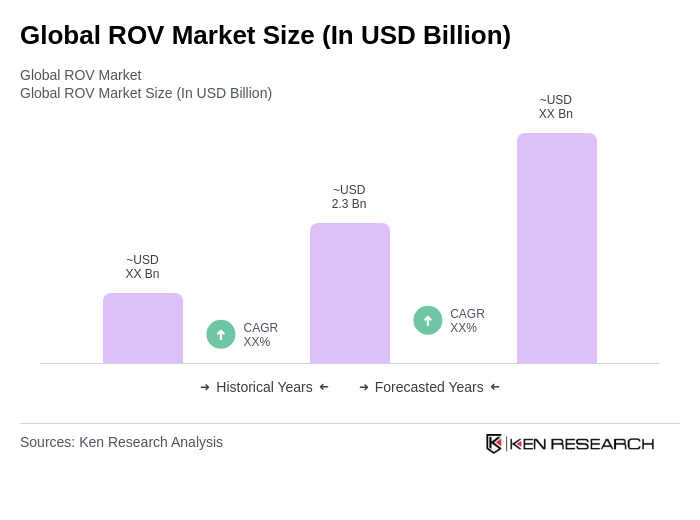
- The Global ROV Market is valued at USD 2.3 billion, based on a five-year historical analysis. This growth is primarily driven by the rising demand for underwater exploration, inspection, and maintenance services across industries such as oil and gas, marine research, defense, and renewable energy. Recent trends include the integration of advanced sensors, artificial intelligence, and automation in ROV systems, which enhance operational efficiency and expand the scope of subsea applications. The market is also benefiting from the expansion of offshore energy projects and increased investments in subsea infrastructure .
- Key players in this market include the United States, Norway, and the United Kingdom, which maintain leadership due to their advanced technological infrastructure, robust supply chains, and significant investments in offshore oil and gas exploration. The presence of major ROV manufacturers and service providers, coupled with mature offshore industries, further consolidates their dominant market positions .
- The U.S. government regulates commercial underwater operations involving ROVs through the Code of Federal Regulations, specifically 29 CFR Part 1910 Subpart T (“Commercial Diving Operations”), issued by the Occupational Safety and Health Administration (OSHA), last amended in 2023. This regulation requires that all ROVs used in commercial diving support comply with strict safety protocols, including regular maintenance, operator training and certification, and adherence to environmental protection standards .
Global ROV Market Segmentation
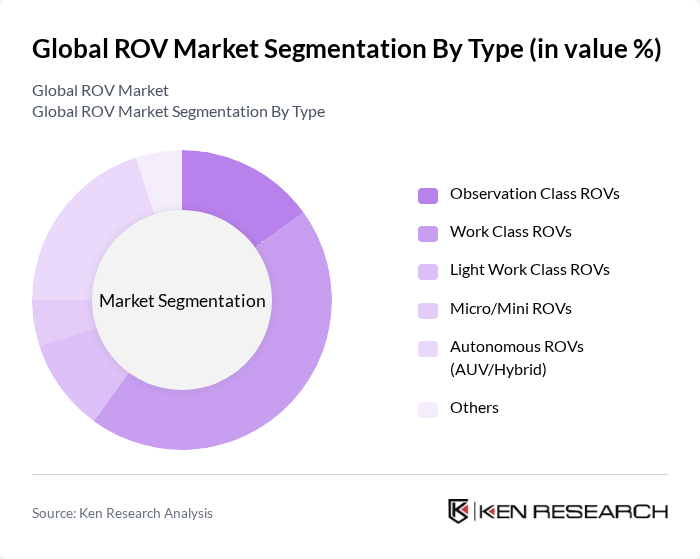
By Type:The market is segmented into various types of ROVs, including Observation Class ROVs, Work Class ROVs, Light Work Class ROVs, Micro/Mini ROVs, Autonomous ROVs (AUV/Hybrid), and Others. Among these, Work Class ROVs are the most dominant due to their versatility and ability to perform complex tasks in deep-water environments. The growing demand for subsea construction, inspection, and maintenance—particularly in the oil and gas sector—continues to drive adoption of Work Class ROVs. Additionally, technological advancements in autonomy and sensor integration are expanding the use of autonomous and hybrid ROVs for scientific and commercial applications .
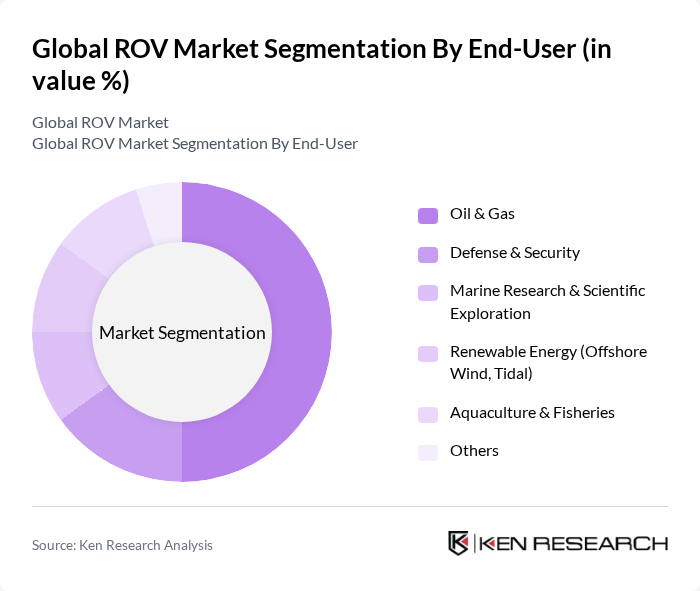
By End-User:The end-user segmentation includes Oil & Gas, Defense & Security, Marine Research & Scientific Exploration, Renewable Energy (Offshore Wind, Tidal), Aquaculture & Fisheries, and Others. The Oil & Gas sector remains the leading end-user, driven by the need for ROVs in exploration, drilling, inspection, and maintenance of offshore fields. The sector’s dominance is reinforced by ongoing investments in deep-water and ultra-deep-water projects, as well as the expansion of subsea infrastructure. Defense and security applications are also increasing, particularly for mine countermeasures and surveillance, while renewable energy projects are driving demand for ROVs in offshore wind and tidal installations .
Global ROV Market Competitive Landscape
The Global ROV Market is characterized by a dynamic mix of regional and international players. Leading participants such as Oceaneering International, Inc., TechnipFMC plc, Subsea 7 S.A., Forum Energy Technologies, Inc., Kongsberg Gruppen ASA, Saab Seaeye Ltd., DeepOcean Group Holding AS, ECA Group, DOF Subsea AS, ROVOP Ltd., Bluefin Robotics (General Dynamics Mission Systems), Ocean Infinity, Triton Submarines, LLC, C-Innovation, LLC, Riptide Autonomous Solutions contribute to innovation, geographic expansion, and service delivery in this space.
Global ROV Market Industry Analysis
Growth Drivers
- Increasing Demand for Underwater Exploration:The global underwater exploration market is projected to reach $3.5 billion in future, driven by the need for resource discovery and environmental monitoring. The International Marine Organization reported that over 70% of the Earth's surface is covered by oceans, highlighting the vast potential for exploration. This demand is further fueled by advancements in technology, enabling deeper and more efficient exploration, thus increasing the utilization of remotely operated vehicles (ROVs) in various sectors.
- Advancements in ROV Technology:The ROV technology landscape is evolving rapidly, with investments in research and development reaching approximately $1.2 billion in future. Innovations such as enhanced imaging systems and improved maneuverability are making ROVs more effective for complex underwater tasks. According to industry reports, the integration of AI and machine learning into ROV systems is expected to enhance operational efficiency, allowing for real-time data processing and decision-making, which is crucial for underwater operations.
- Rising Investments in Offshore Oil and Gas:The offshore oil and gas sector is projected to invest over $200 billion in exploration and production activities in future. This surge is driven by the increasing global energy demand and the depletion of onshore reserves. The U.S. Energy Information Administration reported that offshore production accounts for about 18% of total U.S. crude oil production, emphasizing the critical role of ROVs in supporting these operations through inspection, maintenance, and repair tasks.
Market Challenges
- High Operational Costs:The operational costs associated with ROV deployment can exceed $1 million per mission, which poses a significant barrier for many companies. Factors contributing to these costs include specialized personnel, maintenance, and equipment wear and tear. According to the World Bank, the high capital expenditure required for ROV technology can deter smaller firms from entering the market, limiting competition and innovation in the sector.
- Regulatory Compliance Complexities:Navigating the regulatory landscape for ROV operations can be challenging, with compliance costs estimated at around $500,000 annually for companies operating in multiple jurisdictions. Regulations vary significantly across regions, complicating operational planning. The International Maritime Organization has established numerous guidelines that companies must adhere to, which can lead to delays and increased operational risks if not properly managed.
Global ROV Market Future Outlook
The future of the ROV market appears promising, driven by technological advancements and increasing applications across various sectors. The integration of AI and machine learning is expected to revolutionize ROV capabilities, enhancing data collection and operational efficiency. Additionally, the growing focus on sustainability will likely lead to the development of eco-friendly ROV designs, aligning with global environmental goals. As industries seek innovative solutions for underwater challenges, the demand for advanced ROV systems is anticipated to rise significantly.
Market Opportunities
- Expansion in Renewable Energy Sectors:The shift towards renewable energy sources, particularly offshore wind farms, presents a significant opportunity for ROVs. With investments in offshore wind expected to exceed $100 billion in future, ROVs will play a crucial role in installation and maintenance, ensuring operational efficiency and safety in these projects.
- Increased Demand for Underwater Inspections:The need for regular underwater inspections is growing, particularly in infrastructure and environmental monitoring. The global underwater inspection market is projected to reach $2 billion in future, driven by aging infrastructure and stricter regulatory requirements. ROVs are essential for conducting these inspections efficiently and safely, creating a robust market opportunity.
Scope of the Report
| Segment | Sub-Segments |
|---|---|
| By Type | Observation Class ROVs Work Class ROVs Light Work Class ROVs Micro/Mini ROVs Autonomous ROVs (AUV/Hybrid) Others |
| By End-User | Oil & Gas Defense & Security Marine Research & Scientific Exploration Renewable Energy (Offshore Wind, Tidal) Aquaculture & Fisheries Others |
| By Application | Inspection, Repair & Maintenance (IRM) Construction Support Environmental Monitoring Survey & Mapping Search & Recovery Salvage Operations Others |
| By Component | Cameras & Imaging Systems Sensors (Sonar, Environmental, etc.) Control & Navigation Systems Propulsion Systems Power Supply & Batteries Manipulator Arms & Tools Others |
| By Sales Channel | Direct Sales Distributors/Dealers Online Sales Others |
| By Distribution Mode | Domestic Distribution International Distribution Others |
| By Price Range | Low-End ROVs Mid-Range ROVs High-End ROVs Others |
Key Target Audience
Investors and Venture Capitalist Firms
Government and Regulatory Bodies (e.g., National Oceanic and Atmospheric Administration, U.S. Geological Survey)
Manufacturers and Producers
Oil and Gas Exploration Companies
Marine Research Institutions
Defense and Military Agencies (e.g., U.S. Navy, NATO)
Environmental Protection Agencies (e.g., Environmental Protection Agency)
Underwater Construction and Maintenance Firms
Players Mentioned in the Report:
Oceaneering International, Inc.
TechnipFMC plc
Subsea 7 S.A.
Forum Energy Technologies, Inc.
Kongsberg Gruppen ASA
Saab Seaeye Ltd.
DeepOcean Group Holding AS
ECA Group
DOF Subsea AS
ROVOP Ltd.
Bluefin Robotics (General Dynamics Mission Systems)
Ocean Infinity
Triton Submarines, LLC
C-Innovation, LLC
Riptide Autonomous Solutions
Table of Contents
Market Assessment Phase
1. Executive Summary and Approach
2. Global ROV Market Overview
2.1 Key Insights and Strategic Recommendations
2.2 Global ROV Market Overview
2.3 Definition and Scope
2.4 Evolution of Market Ecosystem
2.5 Timeline of Key Regulatory Milestones
2.6 Value Chain & Stakeholder Mapping
2.7 Business Cycle Analysis
2.8 Policy & Incentive Landscape
3. Global ROV Market Analysis
3.1 Growth Drivers
3.1.1 Increasing demand for underwater exploration
3.1.2 Advancements in ROV technology
3.1.3 Rising investments in offshore oil and gas
3.1.4 Growing focus on marine research and conservation
3.2 Market Challenges
3.2.1 High operational costs
3.2.2 Regulatory compliance complexities
3.2.3 Limited skilled workforce
3.2.4 Environmental concerns and restrictions
3.3 Market Opportunities
3.3.1 Expansion in renewable energy sectors
3.3.2 Increased demand for underwater inspections
3.3.3 Development of autonomous ROVs
3.3.4 Collaborations with research institutions
3.4 Market Trends
3.4.1 Integration of AI and machine learning
3.4.2 Growth of hybrid ROV systems
3.4.3 Enhanced data analytics capabilities
3.4.4 Focus on sustainability and eco-friendly designs
3.5 Government Regulation
3.5.1 Safety and operational standards
3.5.2 Environmental protection regulations
3.5.3 Licensing and certification requirements
3.5.4 International maritime laws
4. SWOT Analysis
5. Stakeholder Analysis
6. Porter's Five Forces Analysis
7. Global ROV Market Market Size, 2019-2024
7.1 By Value
7.2 By Volume
7.3 By Average Selling Price
8. Global ROV Market Segmentation
8.1 By Type
8.1.1 Observation Class ROVs
8.1.2 Work Class ROVs
8.1.3 Light Work Class ROVs
8.1.4 Micro/Mini ROVs
8.1.5 Autonomous ROVs (AUV/Hybrid)
8.1.6 Others
8.2 By End-User
8.2.1 Oil & Gas
8.2.2 Defense & Security
8.2.3 Marine Research & Scientific Exploration
8.2.4 Renewable Energy (Offshore Wind, Tidal)
8.2.5 Aquaculture & Fisheries
8.2.6 Others
8.3 By Application
8.3.1 Inspection, Repair & Maintenance (IRM)
8.3.2 Construction Support
8.3.3 Environmental Monitoring
8.3.4 Survey & Mapping
8.3.5 Search & Recovery
8.3.6 Salvage Operations
8.3.7 Others
8.4 By Component
8.4.1 Cameras & Imaging Systems
8.4.2 Sensors (Sonar, Environmental, etc.)
8.4.3 Control & Navigation Systems
8.4.4 Propulsion Systems
8.4.5 Power Supply & Batteries
8.4.6 Manipulator Arms & Tools
8.4.7 Others
8.5 By Sales Channel
8.5.1 Direct Sales
8.5.2 Distributors/Dealers
8.5.3 Online Sales
8.5.4 Others
8.6 By Distribution Mode
8.6.1 Domestic Distribution
8.6.2 International Distribution
8.6.3 Others
8.7 By Price Range
8.7.1 Low-End ROVs
8.7.2 Mid-Range ROVs
8.7.3 High-End ROVs
8.7.4 Others
9. Global ROV Market Competitive Analysis
9.1 Market Share of Key Players
9.2 Cross Comparison of Key Players
9.2.1 Company Name
9.2.2 ROV Fleet Size & Class Mix
9.2.3 Revenue from ROV Operations (USD, latest year)
9.2.4 Market Penetration (by region & sector)
9.2.5 Contract Backlog/Order Book
9.2.6 Utilization Rate (%)
9.2.7 Average Day Rate / Project Value
9.2.8 Technology Innovation Index (Patents, AI/Autonomy, etc.)
9.2.9 Safety Record (Incidents per 100,000 hours)
9.2.10 Customer Base Diversification (Oil & Gas, Renewables, Defense, Research, etc.)
9.3 SWOT Analysis of Top Players
9.4 Pricing Analysis
9.5 Detailed Profile of Major Companies
9.5.1 Oceaneering International, Inc.
9.5.2 TechnipFMC plc
9.5.3 Subsea 7 S.A.
9.5.4 Forum Energy Technologies, Inc.
9.5.5 Kongsberg Gruppen ASA
9.5.6 Saab Seaeye Ltd.
9.5.7 DeepOcean Group Holding AS
9.5.8 ECA Group
9.5.9 DOF Subsea AS
9.5.10 ROVOP Ltd.
9.5.11 Bluefin Robotics (General Dynamics Mission Systems)
9.5.12 Ocean Infinity
9.5.13 Triton Submarines, LLC
9.5.14 C-Innovation, LLC
9.5.15 Riptide Autonomous Solutions
10. Global ROV Market End-User Analysis
10.1 Procurement Behavior of Key Ministries
10.1.1 Government contracts for marine exploration
10.1.2 Budget allocations for defense applications
10.1.3 Funding for environmental monitoring projects
10.1.4 Partnerships with research institutions
10.2 Corporate Spend on Infrastructure & Energy
10.2.1 Investment in offshore energy projects
10.2.2 Expenditure on marine research initiatives
10.2.3 Budget for defense and security applications
10.3 Pain Point Analysis by End-User Category
10.3.1 High operational costs in oil and gas
10.3.2 Need for advanced inspection technologies
10.3.3 Challenges in regulatory compliance
10.4 User Readiness for Adoption
10.4.1 Awareness of ROV capabilities
10.4.2 Training and skill development needs
10.4.3 Infrastructure readiness for ROV deployment
10.5 Post-Deployment ROI and Use Case Expansion
10.5.1 Measurement of operational efficiency gains
10.5.2 Assessment of cost savings
10.5.3 Exploration of new applications
11. Global ROV Market Future Size, 2025-2030
11.1 By Value
11.2 By Volume
11.3 By Average Selling Price
Go-To-Market Strategy Phase
1. Whitespace Analysis + Business Model Canvas
1.1 Market gaps and opportunities
1.2 Value proposition development
1.3 Revenue model exploration
1.4 Customer segmentation analysis
1.5 Competitive landscape overview
1.6 Key partnerships identification
1.7 Risk assessment and mitigation strategies
2. Marketing and Positioning Recommendations
2.1 Branding strategies
2.2 Product USPs
2.3 Target audience identification
2.4 Communication strategies
2.5 Digital marketing initiatives
2.6 Trade show participation
3. Distribution Plan
3.1 Urban retail strategies
3.2 Rural NGO tie-ups
3.3 Online distribution channels
3.4 Direct sales approach
3.5 Partnerships with distributors
4. Channel & Pricing Gaps
4.1 Underserved routes
4.2 Pricing bands analysis
4.3 Competitor pricing strategies
4.4 Customer willingness to pay
5. Unmet Demand & Latent Needs
5.1 Category gaps identification
5.2 Consumer segments analysis
5.3 Emerging trends and needs
5.4 Feedback from end-users
6. Customer Relationship
6.1 Loyalty programs
6.2 After-sales service
6.3 Customer engagement strategies
6.4 Feedback mechanisms
7. Value Proposition
7.1 Sustainability initiatives
7.2 Integrated supply chains
7.3 Unique selling points
7.4 Customer-centric approach
8. Key Activities
8.1 Regulatory compliance
8.2 Branding efforts
8.3 Distribution setup
8.4 Training and development
9. Entry Strategy Evaluation
9.1 Domestic Market Entry Strategy
9.1.1 Product mix considerations
9.1.2 Pricing band analysis
9.1.3 Packaging strategies
9.2 Export Entry Strategy
9.2.1 Target countries identification
9.2.2 Compliance roadmap development
10. Entry Mode Assessment
10.1 Joint Ventures
10.2 Greenfield investments
10.3 Mergers and Acquisitions
10.4 Distributor Model
11. Capital and Timeline Estimation
11.1 Capital requirements
11.2 Timelines for market entry
12. Control vs Risk Trade-Off
12.1 Ownership considerations
12.2 Partnerships evaluation
13. Profitability Outlook
13.1 Breakeven analysis
13.2 Long-term sustainability strategies
14. Potential Partner List
14.1 Distributors
14.2 Joint Ventures
14.3 Acquisition targets
15. Execution Roadmap
15.1 Phased Plan for Market Entry
15.1.1 Market Setup
15.1.2 Market Entry
15.1.3 Growth Acceleration
15.1.4 Scale & Stabilize
15.2 Key Activities and Milestones
15.2.1 Activity planning
15.2.2 Milestone tracking
Research Methodology
Phase 1: Approach1
Desk Research
- Industry reports from leading market research firms focusing on ROV technology trends
- Government publications and maritime regulations impacting ROV deployment
- Academic journals and white papers on underwater robotics and their applications
Primary Research
- Interviews with ROV manufacturers and technology developers
- Surveys with end-users in sectors such as oil & gas, marine research, and defense
- Field interviews with operators and technicians working with ROVs in various environments
Validation & Triangulation
- Cross-validation of data from multiple industry sources and expert opinions
- Triangulation of market size estimates using sales data and deployment statistics
- Sanity checks through expert panel reviews and feedback from industry stakeholders
Phase 2: Market Size Estimation1
Top-down Assessment
- Analysis of global maritime spending trends and their correlation with ROV adoption
- Segmentation of the market by application areas such as inspection, maintenance, and exploration
- Incorporation of regional growth rates based on economic and environmental factors
Bottom-up Modeling
- Volume estimates based on the number of ROVs deployed across various sectors
- Cost analysis of ROV systems including hardware, software, and operational expenses
- Revenue projections based on service contracts and maintenance agreements
Forecasting & Scenario Analysis
- Multi-factor regression analysis incorporating technological advancements and market demand
- Scenario modeling based on potential regulatory changes and environmental impacts
- Baseline, optimistic, and pessimistic forecasts through 2030 based on market dynamics
Phase 3: CATI Sample Composition1
| Scope Item/Segment | Sample Size | Target Respondent Profiles |
|---|---|---|
| Oil & Gas Exploration | 100 | Field Engineers, Project Managers |
| Marine Research Applications | 60 | Marine Biologists, Research Coordinators |
| Defense and Security Operations | 50 | Defense Analysts, Operations Officers |
| Underwater Construction Projects | 40 | Construction Managers, Safety Officers |
| Environmental Monitoring | 70 | Environmental Scientists, Policy Makers |
Frequently Asked Questions
What is the current value of the Global ROV Market?
The Global ROV Market is valued at approximately USD 2.3 billion, driven by increasing demand for underwater exploration, inspection, and maintenance services across various sectors, including oil and gas, marine research, and renewable energy.
What are the main drivers of growth in the Global ROV Market?
Which sectors are the primary end-users of ROVs?
What types of ROVs are available in the market?
Other Regional/Country Reports
Other Adjacent Reports
Indonesia Subsea Equipment Market
Belgium Offshore Oil and Gas Services Market
Philippines Marine Research Equipment Market
Vietnam Defense Underwater Systems Market
UAE Offshore Wind Energy MarketBelgium Aquaculture Technology Market
South Korea Underwater Inspection Services Market
Qatar Subsea Cable Installation Market
South Africa Deep Sea Mining Equipment Market
Why Buy From Us?

What makes us stand out is that our consultants follow Robust, Refine and Result (RRR) methodology. Robust for clear definitions, approaches and sanity checking, Refine for differentiating respondents' facts and opinions, and Result for presenting data with story.

We have set a benchmark in the industry by offering our clients with syndicated and customized market research reports featuring coverage of entire market as well as meticulous research and analyst insights.

While we don't replace traditional research, we flip the method upside down. Our dual approach of Top Bottom & Bottom Top ensures quality deliverable by not just verifying company fundamentals but also looking at the sector and macroeconomic factors.

With one step in the future, our research team constantly tries to show you the bigger picture. We help with some of the tough questions you may encounter along the way: How is the industry positioned? Best marketing channel? KPI's of competitors? By aligning every element, we help maximize success.

Our report gives you instant access to the answers and sources that other companies might choose to hide. We elaborate each steps of research methodology we have used and showcase you the sample size to earn your trust.

If you need any support, we are here! We pride ourselves on universe strength, data quality, and quick, friendly, and professional service.