About the Report
Base Year 2024Global Safety Instrumented Systems Market Overview
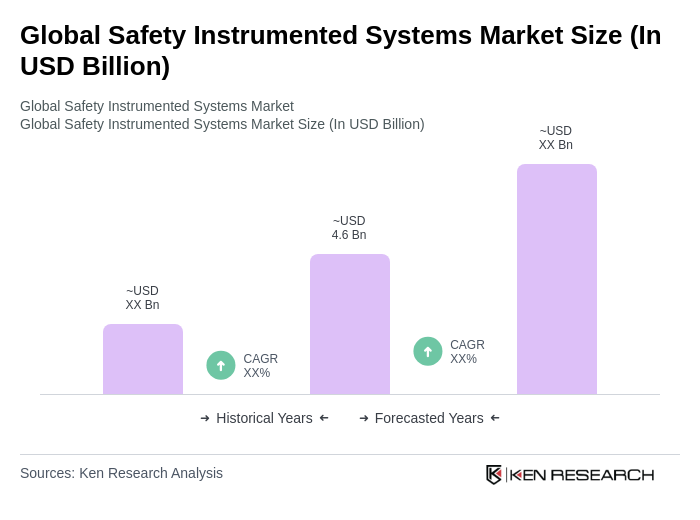
- The Global Safety Instrumented Systems Market is valued at USD 4.6 billion, based on a five-year historical analysis. This growth is primarily driven by increasing safety regulations across process industries, the rising need for process safety management aligned with IEC 61508/61511, and technology advancements (e.g., safety PLCs with enhanced diagnostics, cybersecurity-by-design) that improve reliability and availability. The market is witnessing stronger demand due to heightened focus on functional safety, incident prevention in chemicals and oil and gas, and integration of remote monitoring and modular SIS architectures.
- Key players in this market include the United States, Germany, and China, driven by large installed process industry bases and stringent safety/functional safety frameworks and enforcement. North America and Europe hold significant shares due to mature regulatory regimes and brownfield modernization, while Asia-Pacific—led by China—shows fast adoption with industrial expansion and standardization to international safety norms.
- In 2023, the European Union advanced the replacement of the Machinery Directive with the new Machinery Regulation (EU) 2023/1230, which was adopted in 2023 and applies after a transition period; it mandates that machinery placed on the EU market meets essential health and safety requirements, with updates including digital documentation and AI/human–robot interaction provisions relevant to safety-related controls. While not SIS-specific, this regulatory shift, together with long-standing functional safety standards (e.g., IEC 62061 for machinery) encourages the use of compliant safety systems in industrial environments, supporting demand across member states.
Global Safety Instrumented Systems Market Segmentation
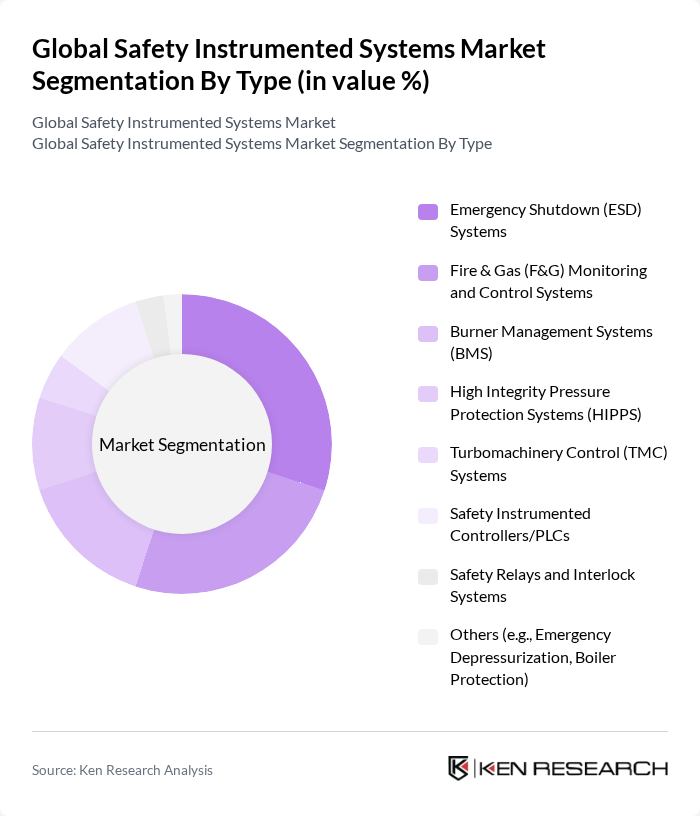
By Type:The market is segmented into various types of safety instrumented systems, including Emergency Shutdown (ESD) Systems, Fire & Gas (F&G) Monitoring and Control Systems, Burner Management Systems (BMS), High Integrity Pressure Protection Systems (HIPPS), Turbomachinery Control (TMC) Systems, Safety Instrumented Controllers/PLCs, Safety Relays and Interlock Systems, and Others. Among these, Emergency Shutdown (ESD) Systems are leading the market due to their critical role in preventing catastrophic failures and ensuring operational safety in high-risk industries.
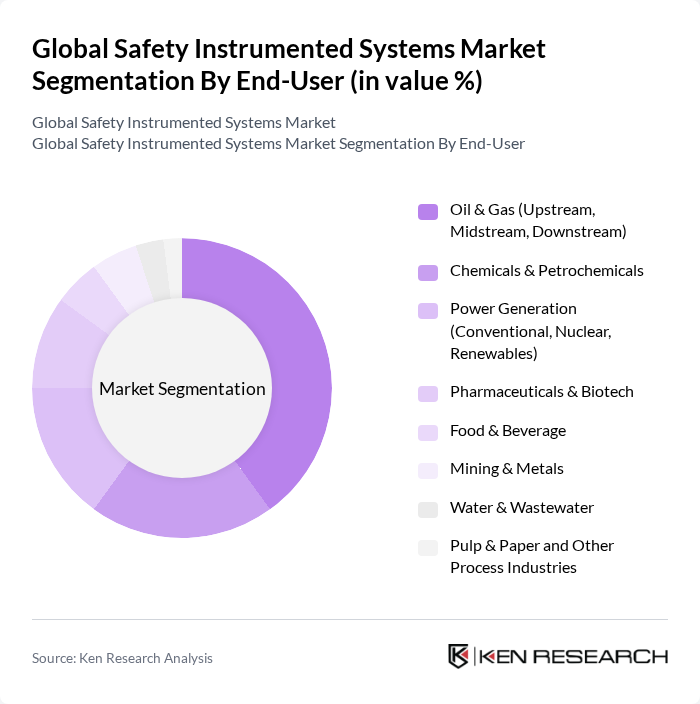
By End-User:The end-user segmentation includes Oil & Gas (Upstream, Midstream, Downstream), Chemicals & Petrochemicals, Power Generation (Conventional, Nuclear, Renewables), Pharmaceuticals & Biotech, Food & Beverage, Mining & Metals, Water & Wastewater, and Pulp & Paper and Other Process Industries. The Oil & Gas sector is the dominant end-user, driven by the need for stringent safety measures in exploration and production activities, which are often associated with high risks and potential hazards.
Global Safety Instrumented Systems Market Competitive Landscape
The Global Safety Instrumented Systems Market is characterized by a dynamic mix of regional and international players. Leading participants such as Honeywell International Inc., Siemens AG, Schneider Electric SE, ABB Ltd., Emerson Electric Co., Yokogawa Electric Corporation, Rockwell Automation, Inc., General Electric Company, Mitsubishi Electric Corporation, Endress+Hauser Group Services AG, KROHNE Messtechnik GmbH (KROHNE Group), Phoenix Contact GmbH & Co. KG, National Instruments Corporation (NI), Azbil Corporation, Hexagon AB (Intergraph), HIMA Paul Hildebrandt GmbH, ABB Measurement & Analytics (incl. TÜV-certified Safety), Schneider Electric Triconex (Invensys), Baker Hughes (Bently Nevada), OMRON Corporation contribute to innovation, geographic expansion, and service delivery in this space.
Global Safety Instrumented Systems Market Industry Analysis
Growth Drivers
- Increasing Industrial Automation:The global industrial automation market is projected to reach $300 billion by 2025, driven by the need for efficiency and productivity. As industries adopt automated processes, the demand for safety instrumented systems (SIS) rises to mitigate risks associated with automation. In future, approximately 70% of manufacturing companies reported increased investments in automation technologies, highlighting a significant shift towards automated safety solutions that ensure operational integrity and compliance with safety standards.
- Stringent Safety Regulations:Regulatory bodies worldwide are enforcing stricter safety regulations, with the U.S. Occupational Safety and Health Administration (OSHA) reporting a 15% increase in safety inspections in future. Compliance with these regulations necessitates the implementation of advanced safety systems. The European Union's directives on industrial safety have also led to a 20% rise in demand for SIS, as companies strive to meet legal requirements and avoid penalties associated with non-compliance.
- Rising Demand for Process Safety:The global process safety market is expected to exceed $5 billion by 2025, driven by industries such as oil and gas, chemicals, and pharmaceuticals. In future, incidents related to process safety resulted in losses exceeding $1.2 billion, prompting companies to invest in SIS to enhance safety measures. This growing awareness of process safety risks is leading to increased adoption of safety instrumented systems, ensuring operational reliability and protection against hazardous events.
Market Challenges
- High Initial Investment Costs:The implementation of safety instrumented systems often requires significant upfront capital, with average costs ranging from $100,000 to $500,000 per installation. Many small to medium-sized enterprises (SMEs) struggle to allocate such budgets, limiting their ability to adopt advanced safety technologies. In future, 40% of SMEs cited financial constraints as a primary barrier to investing in SIS, hindering overall market growth and innovation in safety solutions.
- Complexity of System Integration:Integrating safety instrumented systems with existing infrastructure poses significant challenges, particularly in legacy systems. In future, 60% of companies reported difficulties in achieving seamless integration, leading to project delays and increased costs. This complexity can deter organizations from upgrading their safety systems, as they fear operational disruptions and the potential for increased downtime, ultimately impacting productivity and safety outcomes.
Global Safety Instrumented Systems Market Future Outlook
The future of safety instrumented systems is poised for transformative growth, driven by technological advancements and evolving industry needs. The integration of artificial intelligence and machine learning into SIS is expected to enhance predictive maintenance and risk assessment capabilities. Additionally, the shift towards cloud-based solutions will facilitate real-time monitoring and data analytics, improving decision-making processes. As industries increasingly prioritize safety and compliance, the demand for innovative safety solutions will continue to rise, shaping the market landscape in the coming years.
Market Opportunities
- Expansion in Emerging Markets:Emerging markets, particularly in Asia-Pacific, are witnessing rapid industrialization, with investments in safety systems projected to grow by 25% annually. Countries like India and China are increasing their focus on safety regulations, creating significant opportunities for SIS providers to capture new market share and drive growth in these regions.
- Adoption of IoT in Safety Systems:The Internet of Things (IoT) is revolutionizing safety systems, with an estimated 30% of safety instrumented systems expected to incorporate IoT technologies by 2025. This integration allows for enhanced data collection and analysis, enabling proactive safety measures and real-time monitoring, thus presenting a lucrative opportunity for companies to innovate and differentiate their offerings in the market.
Scope of the Report
| Segment | Sub-Segments |
|---|---|
| By Type | Emergency Shutdown (ESD) Systems Fire & Gas (F&G) Monitoring and Control Systems Burner Management Systems (BMS) High Integrity Pressure Protection Systems (HIPPS) Turbomachinery Control (TMC) Systems Safety Instrumented Controllers/PLCs Safety Relays and Interlock Systems Others (e.g., Emergency Depressurization, Boiler Protection) |
| By End-User | Oil & Gas (Upstream, Midstream, Downstream) Chemicals & Petrochemicals Power Generation (Conventional, Nuclear, Renewables) Pharmaceuticals & Biotech Food & Beverage Mining & Metals Water & Wastewater Pulp & Paper and Other Process Industries |
| By Application | Emergency Shutdown and Isolation Fire and Gas Detection, Alarm, and Suppression Control Burner and Boiler Safety Management Pressure Protection and Overfill Prevention Turbomachinery Overspeed/Surge Protection Safety Instrumented Functions (SIFs) for Process Hazard Mitigation Compliance to Functional Safety (IEC 61508/61511) and SIL Management Others (e.g., Pipeline Safety, Tank Farm Safety) |
| By Component | Sensors/Transmitters (Pressure, Temperature, Flow, Gas) Logic Solvers/Controllers (Safety PLC, DCS Safety Modules) Final Control Elements (Valves, Actuators, Drives) Software (Safety Lifecycle, Configuration, Diagnostic) Services (Consulting, SIL Assessment, Validation, Maintenance) |
| By Sales Channel | Direct (OEMs and System Integrators) Authorized Distributors/VARs EPC and System Integrator-Led Projects Others |
| By Distribution Mode | Offline Distribution Online Distribution Hybrid Distribution |
| By Price Range | Entry-Level Mid-Range High-End Others |
Key Target Audience
Investors and Venture Capitalist Firms
Government and Regulatory Bodies (e.g., Occupational Safety and Health Administration, Environmental Protection Agency)
Manufacturers and Producers of Safety Instrumented Systems
System Integrators and Engineering Firms
Industry Associations (e.g., International Society of Automation)
Oil and Gas Companies
Pharmaceutical and Chemical Manufacturers
Financial Institutions and Investment Banks
Players Mentioned in the Report:
Honeywell International Inc.
Siemens AG
Schneider Electric SE
ABB Ltd.
Emerson Electric Co.
Yokogawa Electric Corporation
Rockwell Automation, Inc.
General Electric Company
Mitsubishi Electric Corporation
Endress+Hauser Group Services AG
KROHNE Messtechnik GmbH (KROHNE Group)
Phoenix Contact GmbH & Co. KG
National Instruments Corporation (NI)
Azbil Corporation
Hexagon AB (Intergraph)
HIMA Paul Hildebrandt GmbH
ABB Measurement & Analytics (incl. TUV-certified Safety)
Schneider Electric Triconex (Invensys)
Baker Hughes (Bently Nevada)
OMRON Corporation
Table of Contents
Market Assessment Phase
1. Executive Summary and Approach
2. Global Safety Instrumented Systems Market Overview
2.1 Key Insights and Strategic Recommendations
2.2 Global Safety Instrumented Systems Market Overview
2.3 Definition and Scope
2.4 Evolution of Market Ecosystem
2.5 Timeline of Key Regulatory Milestones
2.6 Value Chain & Stakeholder Mapping
2.7 Business Cycle Analysis
2.8 Policy & Incentive Landscape
3. Global Safety Instrumented Systems Market Analysis
3.1 Growth Drivers
3.1.1 Increasing industrial automation
3.1.2 Stringent safety regulations
3.1.3 Rising demand for process safety
3.1.4 Technological advancements in safety systems
3.2 Market Challenges
3.2.1 High initial investment costs
3.2.2 Complexity of system integration
3.2.3 Lack of skilled workforce
3.2.4 Rapid technological changes
3.3 Market Opportunities
3.3.1 Expansion in emerging markets
3.3.2 Adoption of IoT in safety systems
3.3.3 Development of smart safety solutions
3.3.4 Increasing focus on sustainability
3.4 Market Trends
3.4.1 Integration of AI and machine learning
3.4.2 Shift towards cloud-based solutions
3.4.3 Growing emphasis on cybersecurity
3.4.4 Enhanced user interface and experience
3.5 Government Regulation
3.5.1 OSHA regulations on workplace safety
3.5.2 IEC 61508 standards for functional safety
3.5.3 EU directives on industrial safety
3.5.4 National safety regulations in key markets
4. SWOT Analysis
5. Stakeholder Analysis
6. Porter's Five Forces Analysis
7. Global Safety Instrumented Systems Market Market Size, 2019-2024
7.1 By Value
7.2 By Volume
7.3 By Average Selling Price
8. Global Safety Instrumented Systems Market Segmentation
8.1 By Type
8.1.1 Emergency Shutdown (ESD) Systems
8.1.2 Fire & Gas (F&G) Monitoring and Control Systems
8.1.3 Burner Management Systems (BMS)
8.1.4 High Integrity Pressure Protection Systems (HIPPS)
8.1.5 Turbomachinery Control (TMC) Systems
8.1.6 Safety Instrumented Controllers/PLCs
8.1.7 Safety Relays and Interlock Systems
8.1.8 Others (e.g., Emergency Depressurization, Boiler Protection)
8.2 By End-User
8.2.1 Oil & Gas (Upstream, Midstream, Downstream)
8.2.2 Chemicals & Petrochemicals
8.2.3 Power Generation (Conventional, Nuclear, Renewables)
8.2.4 Pharmaceuticals & Biotech
8.2.5 Food & Beverage
8.2.6 Mining & Metals
8.2.7 Water & Wastewater
8.2.8 Pulp & Paper and Other Process Industries
8.3 By Application
8.3.1 Emergency Shutdown and Isolation
8.3.2 Fire and Gas Detection, Alarm, and Suppression Control
8.3.3 Burner and Boiler Safety Management
8.3.4 Pressure Protection and Overfill Prevention
8.3.5 Turbomachinery Overspeed/Surge Protection
8.3.6 Safety Instrumented Functions (SIFs) for Process Hazard Mitigation
8.3.7 Compliance to Functional Safety (IEC 61508/61511) and SIL Management
8.3.8 Others (e.g., Pipeline Safety, Tank Farm Safety)
8.4 By Component
8.4.1 Sensors/Transmitters (Pressure, Temperature, Flow, Gas)
8.4.2 Logic Solvers/Controllers (Safety PLC, DCS Safety Modules)
8.4.3 Final Control Elements (Valves, Actuators, Drives)
8.4.4 Software (Safety Lifecycle, Configuration, Diagnostic)
8.4.5 Services (Consulting, SIL Assessment, Validation, Maintenance)
8.5 By Sales Channel
8.5.1 Direct (OEMs and System Integrators)
8.5.2 Authorized Distributors/VARs
8.5.3 EPC and System Integrator-Led Projects
8.5.4 Others
8.6 By Distribution Mode
8.6.1 Offline Distribution
8.6.2 Online Distribution
8.6.3 Hybrid Distribution
8.7 By Price Range
8.7.1 Entry-Level
8.7.2 Mid-Range
8.7.3 High-End
8.7.4 Others
9. Global Safety Instrumented Systems Market Competitive Analysis
9.1 Market Share of Key Players
9.2 Cross Comparison of Key Players
9.2.1 Company Name
9.2.2 Group Size (Global, Regional, or Niche Player)
9.2.3 Safety Revenue and Growth (SIS-related, YoY %)
9.2.4 Installed Base (Sites/Projects with SIS)
9.2.5 Coverage of SIL Levels (SIL 1–3 Certifications)
9.2.6 Vertical Penetration (Oil & Gas, Chemicals, Power, etc.)
9.2.7 Product Breadth (ESD, F&G, BMS, HIPPS, TMC, Safety PLC)
9.2.8 Compliance & Certifications (IEC 61508/61511, TÜV, FM, ATEX)
9.2.9 Cybersecurity Readiness (IEC 62443 certification, features)
9.2.10 Innovation Intensity (R&D %, new launches, patents)
9.2.11 Project Execution Capability (EPC/SI partnerships, lead times)
9.2.12 Service Maturity (SIL lifecycle services, uptime SLAs)
9.2.13 Total Cost of Ownership (Capex/Opex benchmarks)
9.2.14 Customer Satisfaction/NPS in Process Industries
9.2.15 Global Footprint (Regions served, service centers)
9.3 SWOT Analysis of Top Players
9.4 Pricing Analysis
9.5 Detailed Profile of Major Companies
9.5.1 Honeywell International Inc.
9.5.2 Siemens AG
9.5.3 Schneider Electric SE
9.5.4 ABB Ltd.
9.5.5 Emerson Electric Co.
9.5.6 Yokogawa Electric Corporation
9.5.7 Rockwell Automation, Inc.
9.5.8 General Electric Company
9.5.9 Mitsubishi Electric Corporation
9.5.10 Endress+Hauser Group Services AG
9.5.11 KROHNE Messtechnik GmbH (KROHNE Group)
9.5.12 Phoenix Contact GmbH & Co. KG
9.5.13 National Instruments Corporation (NI)
9.5.14 Azbil Corporation
9.5.15 Hexagon AB (Intergraph)
9.5.16 HIMA Paul Hildebrandt GmbH
9.5.17 ABB Measurement & Analytics (incl. TÜV-certified Safety)
9.5.18 Schneider Electric Triconex (Invensys)
9.5.19 Baker Hughes (Bently Nevada)
9.5.20 OMRON Corporation
10. Global Safety Instrumented Systems Market End-User Analysis
10.1 Procurement Behavior of Key Ministries
10.1.1 Government procurement policies
10.1.2 Budget allocation for safety systems
10.1.3 Decision-making processes
10.1.4 Supplier evaluation criteria
10.2 Corporate Spend on Infrastructure & Energy
10.2.1 Investment trends in safety systems
10.2.2 Budgeting for safety upgrades
10.2.3 Long-term financial commitments
10.3 Pain Point Analysis by End-User Category
10.3.1 Safety compliance challenges
10.3.2 Integration issues with existing systems
10.3.3 Cost management concerns
10.4 User Readiness for Adoption
10.4.1 Training and skill development needs
10.4.2 Awareness of safety technologies
10.4.3 Organizational readiness for change
10.5 Post-Deployment ROI and Use Case Expansion
10.5.1 Measurement of safety improvements
10.5.2 Expansion into new applications
10.5.3 Long-term cost savings analysis
11. Global Safety Instrumented Systems Market Future Size, 2025-2030
11.1 By Value
11.2 By Volume
11.3 By Average Selling Price
Go-To-Market Strategy Phase
1. Whitespace Analysis + Business Model Canvas
1.1 Market gaps identification
1.2 Value proposition development
1.3 Revenue model exploration
1.4 Customer segmentation analysis
1.5 Competitive landscape overview
1.6 Key partnerships identification
1.7 Resource allocation strategy
2. Marketing and Positioning Recommendations
2.1 Branding strategies
2.2 Product USPs
2.3 Target audience identification
2.4 Communication strategy
2.5 Digital marketing tactics
2.6 Trade show participation
3. Distribution Plan
3.1 Urban retail strategies
3.2 Rural NGO tie-ups
3.3 E-commerce integration
3.4 Direct sales force deployment
3.5 Distribution partnerships
4. Channel & Pricing Gaps
4.1 Underserved routes
4.2 Pricing bands analysis
4.3 Competitor pricing comparison
4.4 Value-based pricing strategies
5. Unmet Demand & Latent Needs
5.1 Category gaps identification
5.2 Consumer segments analysis
5.3 Emerging trends exploration
6. Customer Relationship
6.1 Loyalty programs
6.2 After-sales service
6.3 Customer feedback mechanisms
7. Value Proposition
7.1 Sustainability initiatives
7.2 Integrated supply chains
7.3 Customer-centric solutions
8. Key Activities
8.1 Regulatory compliance
8.2 Branding efforts
8.3 Distribution setup
9. Entry Strategy Evaluation
9.1 Domestic Market Entry Strategy
9.1.1 Product mix considerations
9.1.2 Pricing band strategy
9.1.3 Packaging options
9.2 Export Entry Strategy
9.2.1 Target countries analysis
9.2.2 Compliance roadmap development
10. Entry Mode Assessment
10.1 Joint Ventures
10.2 Greenfield investments
10.3 Mergers & Acquisitions
10.4 Distributor Model
11. Capital and Timeline Estimation
11.1 Capital requirements
11.2 Timelines for market entry
12. Control vs Risk Trade-Off
12.1 Ownership considerations
12.2 Partnerships evaluation
13. Profitability Outlook
13.1 Breakeven analysis
13.2 Long-term sustainability strategies
14. Potential Partner List
14.1 Distributors
14.2 Joint Ventures
14.3 Acquisition targets
15. Execution Roadmap
15.1 Phased Plan for Market Entry
15.1.1 Market Setup
15.1.2 Market Entry
15.1.3 Growth Acceleration
15.1.4 Scale & Stabilize
15.2 Key Activities and Milestones
15.2.1 Milestone tracking
15.2.2 Activity scheduling
Research Methodology
Phase 1: Approach1
Desk Research
- Industry reports from safety standards organizations and regulatory bodies
- Market analysis publications from engineering and automation journals
- Data from global safety instrumented systems manufacturers' annual reports
Primary Research
- Interviews with safety engineers and system integrators in various industries
- Surveys targeting end-users in oil & gas, chemical, and manufacturing sectors
- Field visits to facilities implementing safety instrumented systems
Validation & Triangulation
- Cross-validation of findings with industry expert panels
- Triangulation of data from multiple sources including trade associations and market reports
- Sanity checks through historical data trends and current market dynamics
Phase 2: Market Size Estimation1
Top-down Assessment
- Analysis of global safety regulations impacting market demand
- Estimation of market size based on industry growth rates and safety investments
- Segmentation by application areas such as process industries and manufacturing
Bottom-up Modeling
- Data collection from key players regarding installed base and revenue generation
- Cost analysis of safety instrumented systems including hardware and software components
- Volume estimates based on project pipelines and historical installation rates
Forecasting & Scenario Analysis
- Multi-variable forecasting models incorporating economic indicators and safety trends
- Scenario analysis based on potential regulatory changes and technological advancements
- Development of baseline, optimistic, and pessimistic market projections through 2030
Phase 3: CATI Sample Composition1
| Scope Item/Segment | Sample Size | Target Respondent Profiles |
|---|---|---|
| Oil & Gas Safety Systems | 120 | Safety Managers, Process Engineers |
| Chemical Manufacturing Safety Solutions | 90 | Plant Managers, Compliance Officers |
| Automotive Industry Safety Instrumentation | 70 | Quality Assurance Managers, Production Supervisors |
| Pharmaceutical Safety Systems | 60 | Regulatory Affairs Specialists, Safety Engineers |
| Food & Beverage Safety Applications | 80 | Operations Managers, Safety Compliance Officers |
Frequently Asked Questions
What is the current value of the Global Safety Instrumented Systems Market?
The Global Safety Instrumented Systems Market is valued at approximately USD 4.6 billion, driven by increasing safety regulations, the need for process safety management, and advancements in technology that enhance reliability and availability in various industries.
What are the key drivers of growth in the Safety Instrumented Systems Market?
Which regions are leading in the Safety Instrumented Systems Market?
What types of systems are included in the Safety Instrumented Systems Market?
Other Regional/Country Reports
Indonesia Safety Instrumented Systems Market
Malaysia Safety Instrumented Systems Market
APAC Safety Instrumented Systems Market
SEA Safety Instrumented Systems Market
Why Buy From Us?

What makes us stand out is that our consultants follow Robust, Refine and Result (RRR) methodology. Robust for clear definitions, approaches and sanity checking, Refine for differentiating respondents' facts and opinions, and Result for presenting data with story.

We have set a benchmark in the industry by offering our clients with syndicated and customized market research reports featuring coverage of entire market as well as meticulous research and analyst insights.

While we don't replace traditional research, we flip the method upside down. Our dual approach of Top Bottom & Bottom Top ensures quality deliverable by not just verifying company fundamentals but also looking at the sector and macroeconomic factors.

With one step in the future, our research team constantly tries to show you the bigger picture. We help with some of the tough questions you may encounter along the way: How is the industry positioned? Best marketing channel? KPI's of competitors? By aligning every element, we help maximize success.

Our report gives you instant access to the answers and sources that other companies might choose to hide. We elaborate each steps of research methodology we have used and showcase you the sample size to earn your trust.

If you need any support, we are here! We pride ourselves on universe strength, data quality, and quick, friendly, and professional service.