About the Report
Base Year 2024Global Smart Fridge Market Overview
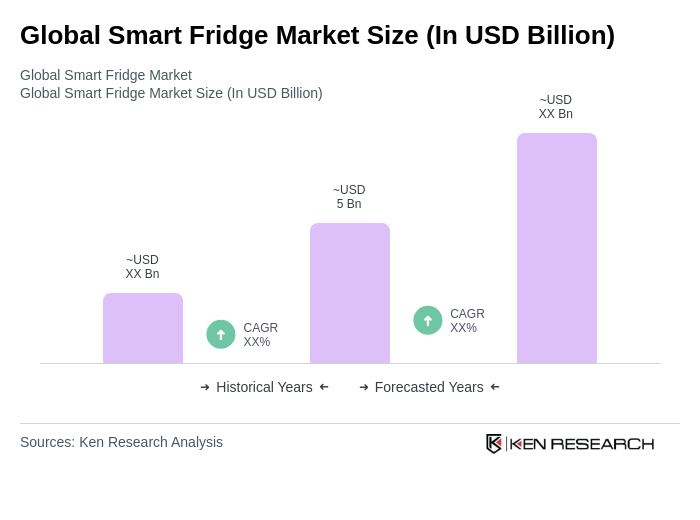
- The Global Smart Fridge Market is valued at USD 5 billion, based on a five-year historical analysis. This growth is primarily driven by increasing consumer demand for energy-efficient appliances, advancements in smart technology, and the rising trend of connected homes. The integration of IoT features in refrigerators has significantly enhanced user convenience, leading to a surge in adoption rates among tech-savvy consumers .
- Key players in this market include the United States, Germany, and China, which dominate due to their strong manufacturing capabilities, technological advancements, and high consumer spending on home appliances. The United States leads in innovation and product development, Germany is recognized for its engineering excellence, and China benefits from a vast production base and rapidly growing domestic demand .
- In 2023, the European Union implemented regulations mandating energy efficiency standards for household appliances, including smart fridges. This regulation aims to reduce energy consumption and greenhouse gas emissions, pushing manufacturers to innovate and produce more energy-efficient models, thereby enhancing the overall sustainability of the market .
Global Smart Fridge Market Segmentation
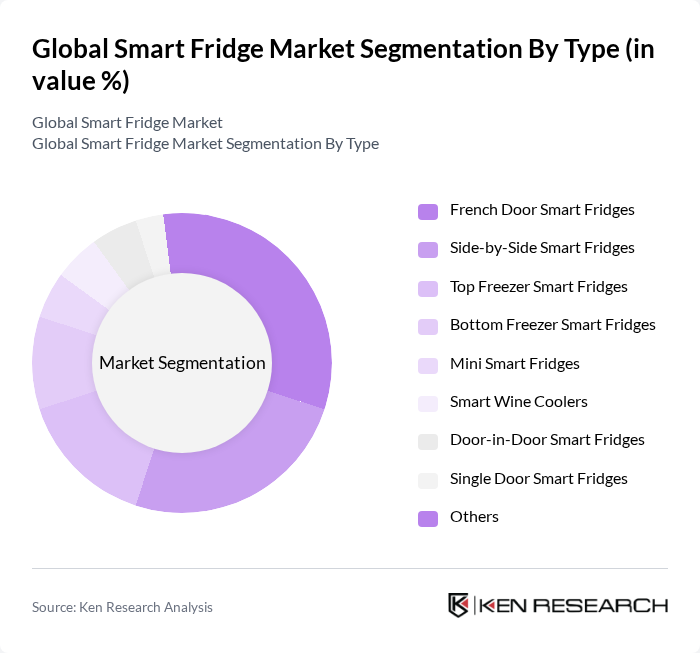
By Type:The market is segmented into various types of smart fridges, including French Door Smart Fridges, Side-by-Side Smart Fridges, Top Freezer Smart Fridges, Bottom Freezer Smart Fridges, Mini Smart Fridges, Smart Wine Coolers, Door-in-Door Smart Fridges, Single Door Smart Fridges, and Others. Among these, French Door Smart Fridges are currently leading the market due to their spacious design, flexible storage options, and advanced features such as smart displays, inventory management, and connectivity with home automation systems. These attributes cater to modern consumer needs for convenience, organization, and integration with other smart devices .
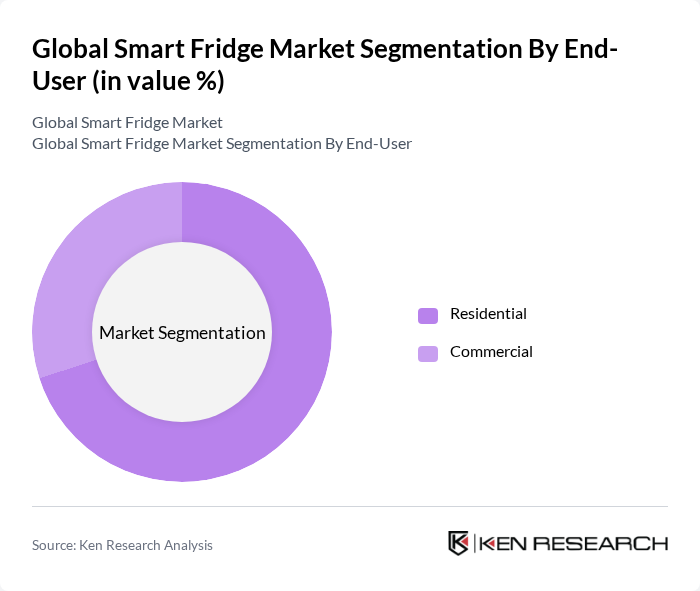
By End-User:The market is divided into Residential and Commercial segments. The Residential segment dominates the market, driven by the increasing trend of smart home integration, consumer preference for energy-efficient appliances, and the growing adoption of connected kitchen solutions. The rising number of households opting for smart technology in their kitchens and the demand for convenience and food freshness have significantly contributed to the expansion of this segment .
Global Smart Fridge Market Competitive Landscape
The Global Smart Fridge Market is characterized by a dynamic mix of regional and international players. Leading participants such as Samsung Electronics Co., Ltd., LG Electronics Inc., Whirlpool Corporation, Haier Group Corporation, BSH Hausgeräte GmbH (Bosch), AB Electrolux, GE Appliances, a Haier company, Panasonic Holdings Corporation, Miele & Cie. KG, Frigidaire (Electrolux subsidiary), Hisense Group Co., Ltd., Sharp Corporation, Smeg S.p.A., Sub-Zero Group, Inc., Danby Products Ltd., Liebherr Group, TCL Technology Group Corporation, and Arçelik A.?. contribute to innovation, geographic expansion, and service delivery in this space.
Global Smart Fridge Market Industry Analysis
Growth Drivers
- Increasing Consumer Demand for Energy Efficiency:The global push for energy-efficient appliances is evident, with the energy-efficient appliance market projected to reach $1.2 trillion in future. Consumers are increasingly prioritizing energy savings, as evidenced by the 30% increase in sales of Energy Star-rated appliances in future. This trend is driven by rising energy costs, with average electricity prices expected to rise by 5% in future, prompting consumers to seek energy-efficient solutions like smart fridges.
- Rising Adoption of Smart Home Technologies:The smart home technology market is anticipated to grow to $100 billion in future, with smart fridges playing a pivotal role. As of future, 45% of households in developed regions have adopted at least one smart home device, indicating a growing acceptance of interconnected appliances. This trend is fueled by advancements in wireless technology, with 5G connectivity expected to cover 60% of urban areas in future, enhancing the functionality of smart fridges.
- Growing Awareness of Food Safety and Preservation:With food waste accounting for approximately 1.3 billion tons annually, the demand for smart fridges that enhance food preservation is surging. In future, 70% of consumers expressed concern over food safety, leading to a 25% increase in the purchase of smart fridges equipped with advanced preservation technologies. This trend is supported by the projected 10% growth in the organic food market in future, as consumers seek to maintain the quality of their food.
Market Challenges
- High Initial Investment Costs:The average cost of a smart fridge ranges from $1,500 to $3,000, which can deter potential buyers. In future, 60% of consumers cited high prices as a significant barrier to purchase. This challenge is compounded by the fact that household disposable income growth is projected to be only 2% in future, limiting the ability of many consumers to invest in high-end appliances.
- Limited Consumer Awareness:Despite the benefits, consumer awareness of smart fridges remains low, with only 35% of consumers familiar with their features as of future. This lack of knowledge is a barrier to market penetration, especially in regions where traditional fridges dominate. The projected 3% increase in consumer electronics advertising spending in future may help address this challenge, but significant educational efforts are still needed to boost awareness.
Global Smart Fridge Market Future Outlook
The future of the smart fridge market appears promising, driven by technological advancements and changing consumer preferences. As sustainability becomes a priority, manufacturers are likely to focus on developing energy-efficient models that align with environmental regulations. Additionally, the integration of artificial intelligence and machine learning into smart fridges will enhance user experience, making them more appealing. The anticipated growth in smart home ecosystems will further support the adoption of smart fridges, creating a more interconnected kitchen environment.
Market Opportunities
- Expansion in Emerging Markets:Emerging markets, particularly in Asia-Pacific, are witnessing a surge in middle-class households, projected to reach 3 billion in future. This demographic shift presents a significant opportunity for smart fridge manufacturers to tap into new customer bases, as rising disposable incomes will likely increase demand for advanced kitchen appliances.
- Integration with IoT and Smart Devices:The integration of smart fridges with IoT devices is expected to enhance functionality and user engagement. With an estimated 75 billion IoT devices projected to be in use in future, manufacturers can leverage this trend to create more interconnected kitchen solutions, improving convenience and efficiency for consumers.
Scope of the Report
| Segment | Sub-Segments |
|---|---|
| By Type | French Door Smart Fridges Side-by-Side Smart Fridges Top Freezer Smart Fridges Bottom Freezer Smart Fridges Mini Smart Fridges Smart Wine Coolers Door-in-Door Smart Fridges Single Door Smart Fridges Others |
| By End-User | Residential Commercial |
| By Distribution Channel | Online Retail Offline Retail Direct Sales |
| By Price Range | Budget Smart Fridges Mid-Range Smart Fridges Premium Smart Fridges |
| By Feature | Smart Connectivity (Wi-Fi, Bluetooth, Voice Assistant Integration) Energy Efficiency (Smart Grid, Inverter Technology) Advanced Cooling Technology (Multi-Air Flow, Dual Compressors) Built-in Cameras & Food Inventory Management Touchscreen Displays & Digital Controls |
| By Brand | Major Brands Emerging Brands Private Labels |
| By Application | Home Use Commercial Use (Hotels, Restaurants, Retail) Hospitality Industry Others |
| By Region | North America (U.S., Canada) Europe (Germany, UK, France, Italy, Spain, Rest of Europe) Asia-Pacific (China, Japan, South Korea, India, Australia, Rest of Asia-Pacific) Latin America (Brazil, Mexico, Rest of Latin America) Middle East & Africa (Saudi Arabia, UAE, South Africa, Rest of MEA) |
Key Target Audience
Investors and Venture Capitalist Firms
Government and Regulatory Bodies (e.g., U.S. Department of Energy, European Commission)
Manufacturers and Producers
Distributors and Retailers
Smart Home Technology Developers
Energy Management Companies
Consumer Electronics Trade Associations
Logistics and Supply Chain Companies
Players Mentioned in the Report:
Samsung Electronics Co., Ltd.
LG Electronics Inc.
Whirlpool Corporation
Haier Group Corporation
BSH Hausgerate GmbH (Bosch)
AB Electrolux
GE Appliances, a Haier company
Panasonic Holdings Corporation
Miele & Cie. KG
Frigidaire (Electrolux subsidiary)
Hisense Group Co., Ltd.
Sharp Corporation
Smeg S.p.A.
Sub-Zero Group, Inc.
Danby Products Ltd.
Liebherr Group
TCL Technology Group Corporation
Arcelik A.S.
Table of Contents
Market Assessment Phase
1. Executive Summary and Approach
2. Global Smart Fridge Market Overview
2.1 Key Insights and Strategic Recommendations
2.2 Global Smart Fridge Market Overview
2.3 Definition and Scope
2.4 Evolution of Market Ecosystem
2.5 Timeline of Key Regulatory Milestones
2.6 Value Chain & Stakeholder Mapping
2.7 Business Cycle Analysis
2.8 Policy & Incentive Landscape
3. Global Smart Fridge Market Analysis
3.1 Growth Drivers
3.1.1 Increasing Consumer Demand for Energy Efficiency
3.1.2 Rising Adoption of Smart Home Technologies
3.1.3 Growing Awareness of Food Safety and Preservation
3.1.4 Technological Advancements in Refrigeration
3.2 Market Challenges
3.2.1 High Initial Investment Costs
3.2.2 Limited Consumer Awareness
3.2.3 Compatibility Issues with Existing Appliances
3.2.4 Data Privacy Concerns
3.3 Market Opportunities
3.3.1 Expansion in Emerging Markets
3.3.2 Integration with IoT and Smart Devices
3.3.3 Development of Eco-Friendly Models
3.3.4 Customization and Personalization Trends
3.4 Market Trends
3.4.1 Increasing Focus on Sustainability
3.4.2 Growth of Subscription-Based Services
3.4.3 Enhanced Connectivity Features
3.4.4 Rise of Smart Kitchen Appliances
3.5 Government Regulation
3.5.1 Energy Efficiency Standards
3.5.2 Environmental Protection Regulations
3.5.3 Consumer Safety Guidelines
3.5.4 Data Protection Laws
4. SWOT Analysis
5. Stakeholder Analysis
6. Porter's Five Forces Analysis
7. Global Smart Fridge Market Market Size, 2019-2024
7.1 By Value
7.2 By Volume
7.3 By Average Selling Price
8. Global Smart Fridge Market Segmentation
8.1 By Type
8.1.1 French Door Smart Fridges
8.1.2 Side-by-Side Smart Fridges
8.1.3 Top Freezer Smart Fridges
8.1.4 Bottom Freezer Smart Fridges
8.1.5 Mini Smart Fridges
8.1.6 Smart Wine Coolers
8.1.7 Door-in-Door Smart Fridges
8.1.8 Single Door Smart Fridges
8.1.9 Others
8.2 By End-User
8.2.1 Residential
8.2.2 Commercial
8.3 By Distribution Channel
8.3.1 Online Retail
8.3.2 Offline Retail
8.3.3 Direct Sales
8.4 By Price Range
8.4.1 Budget Smart Fridges
8.4.2 Mid-Range Smart Fridges
8.4.3 Premium Smart Fridges
8.5 By Feature
8.5.1 Smart Connectivity (Wi-Fi, Bluetooth, Voice Assistant Integration)
8.5.2 Energy Efficiency (Smart Grid, Inverter Technology)
8.5.3 Advanced Cooling Technology (Multi-Air Flow, Dual Compressors)
8.5.4 Built-in Cameras & Food Inventory Management
8.5.5 Touchscreen Displays & Digital Controls
8.6 By Brand
8.6.1 Major Brands
8.6.2 Emerging Brands
8.6.3 Private Labels
8.7 By Application
8.7.1 Home Use
8.7.2 Commercial Use (Hotels, Restaurants, Retail)
8.7.3 Hospitality Industry
8.7.4 Others
8.8 By Region
8.8.1 North America (U.S., Canada)
8.8.2 Europe (Germany, UK, France, Italy, Spain, Rest of Europe)
8.8.3 Asia-Pacific (China, Japan, South Korea, India, Australia, Rest of Asia-Pacific)
8.8.4 Latin America (Brazil, Mexico, Rest of Latin America)
8.8.5 Middle East & Africa (Saudi Arabia, UAE, South Africa, Rest of MEA)
9. Global Smart Fridge Market Competitive Analysis
9.1 Market Share of Key Players
9.2 Cross Comparison of Key Players
9.2.1 Company Name
9.2.2 Company Size (Large, Medium, Small)
9.2.3 Global Smart Fridge Revenue (USD Millions)
9.2.4 Revenue Growth Rate (YoY %)
9.2.5 Market Share (%)
9.2.6 Geographic Presence (No. of Countries/Regions)
9.2.7 R&D Investment as % of Revenue
9.2.8 Product Innovation Rate (No. of New Models/Year)
9.2.9 Energy Efficiency Rating (Average Star Rating or kWh/year)
9.2.10 Smart Feature Adoption Rate (% of Models with IoT/AI)
9.2.11 Distribution Channel Strength (Online vs. Offline %)
9.2.12 Customer Satisfaction Index (NPS or Equivalent)
9.2.13 Brand Recognition Score (Global/Regional)
9.2.14 After-Sales Service Coverage (Countries/Regions)
9.3 SWOT Analysis of Top Players
9.4 Pricing Analysis
9.5 Detailed Profile of Major Companies
9.5.1 Samsung Electronics Co., Ltd.
9.5.2 LG Electronics Inc.
9.5.3 Whirlpool Corporation
9.5.4 Haier Group Corporation
9.5.5 BSH Hausgeräte GmbH (Bosch)
9.5.6 AB Electrolux
9.5.7 GE Appliances, a Haier company
9.5.8 Panasonic Holdings Corporation
9.5.9 Miele & Cie. KG
9.5.10 Frigidaire (Electrolux subsidiary)
9.5.11 Hisense Group Co., Ltd.
9.5.12 Sharp Corporation
9.5.13 Smeg S.p.A.
9.5.14 Sub-Zero Group, Inc.
9.5.15 Danby Products Ltd.
9.5.16 Liebherr Group
9.5.17 TCL Technology Group Corporation
9.5.18 Arçelik A.?.
10. Global Smart Fridge Market End-User Analysis
10.1 Procurement Behavior of Key Ministries
10.1.1 Government Procurement Policies
10.1.2 Budget Allocations for Smart Appliances
10.1.3 Evaluation Criteria for Smart Fridge Purchases
10.2 Corporate Spend on Infrastructure & Energy
10.2.1 Investment in Energy-Efficient Appliances
10.2.2 Budgeting for Smart Technology Integration
10.2.3 Long-term Financial Planning for Upgrades
10.3 Pain Point Analysis by End-User Category
10.3.1 Residential User Concerns
10.3.2 Commercial User Challenges
10.3.3 Industrial User Requirements
10.4 User Readiness for Adoption
10.4.1 Awareness of Smart Fridge Benefits
10.4.2 Willingness to Invest in Smart Technology
10.4.3 Training and Support Needs
10.5 Post-Deployment ROI and Use Case Expansion
10.5.1 Measurement of Energy Savings
10.5.2 User Experience Feedback
10.5.3 Potential for Additional Smart Features
11. Global Smart Fridge Market Future Size, 2025-2030
11.1 By Value
11.2 By Volume
11.3 By Average Selling Price
Go-To-Market Strategy Phase
1. Whitespace Analysis + Business Model Canvas
1.1 Market Gaps Identification
1.2 Business Model Development
2. Marketing and Positioning Recommendations
2.1 Branding Strategies
2.2 Product USPs
3. Distribution Plan
3.1 Urban Retail Strategies
3.2 Rural NGO Tie-ups
4. Channel & Pricing Gaps
4.1 Underserved Routes
4.2 Pricing Bands Analysis
5. Unmet Demand & Latent Needs
5.1 Category Gaps
5.2 Consumer Segments
6. Customer Relationship
6.1 Loyalty Programs
6.2 After-sales Service
7. Value Proposition
7.1 Sustainability Initiatives
7.2 Integrated Supply Chains
8. Key Activities
8.1 Regulatory Compliance
8.2 Branding Efforts
8.3 Distribution Setup
9. Entry Strategy Evaluation
9.1 Domestic Market Entry Strategy
9.1.1 Product Mix Considerations
9.1.2 Pricing Band Strategy
9.1.3 Packaging Solutions
9.2 Export Entry Strategy
9.2.1 Target Countries Identification
9.2.2 Compliance Roadmap Development
10. Entry Mode Assessment
10.1 Joint Ventures
10.2 Greenfield Investments
10.3 Mergers & Acquisitions
10.4 Distributor Model Evaluation
11. Capital and Timeline Estimation
11.1 Capital Requirements
11.2 Timelines for Implementation
12. Control vs Risk Trade-Off
12.1 Ownership vs Partnerships
13. Profitability Outlook
13.1 Breakeven Analysis
13.2 Long-term Sustainability
14. Potential Partner List
14.1 Distributors
14.2 Joint Ventures
14.3 Acquisition Targets
15. Execution Roadmap
15.1 Phased Plan for Market Entry
15.1.1 Market Setup
15.1.2 Market Entry
15.1.3 Growth Acceleration
15.1.4 Scale & Stabilize
15.2 Key Activities and Milestones
15.2.1 Milestone Planning
15.2.2 Activity Tracking
Research Methodology
Phase 1: Approach1
Desk Research
- Market reports from industry associations such as the International Refrigeration and Air Conditioning Association
- Analysis of consumer behavior trends through published studies and surveys from market research firms
- Review of technological advancements in smart fridge features from white papers and patent filings
Primary Research
- Interviews with product managers at leading appliance manufacturers
- Surveys conducted with end-users to understand preferences and usage patterns
- Focus group discussions with technology enthusiasts and early adopters of smart appliances
Validation & Triangulation
- Cross-validation of findings through multiple data sources including sales data and consumer feedback
- Triangulation of insights from industry experts, market analysts, and consumer surveys
- Sanity checks through expert panel reviews to ensure data accuracy and relevance
Phase 2: Market Size Estimation1
Top-down Assessment
- Analysis of global appliance market size and growth rates to estimate smart fridge market share
- Segmentation by geographical regions and consumer demographics to identify key markets
- Incorporation of trends in smart home technology adoption and energy efficiency regulations
Bottom-up Modeling
- Estimation of unit sales based on historical data from major retailers and e-commerce platforms
- Cost analysis of smart fridge components and features to determine pricing strategies
- Volume projections based on consumer adoption rates and replacement cycles
Forecasting & Scenario Analysis
- Multi-variable forecasting using economic indicators, consumer income levels, and technological advancements
- Scenario analysis based on potential market disruptions such as supply chain issues or regulatory changes
- Development of baseline, optimistic, and pessimistic market growth projections through 2030
Phase 3: CATI Sample Composition1
| Scope Item/Segment | Sample Size | Target Respondent Profiles |
|---|---|---|
| Consumer Insights on Smart Fridge Features | 120 | Homeowners, Tech-savvy Consumers |
| Retailer Perspectives on Smart Appliance Sales | 80 | Store Managers, Sales Representatives |
| Manufacturers' Views on Market Trends | 60 | Product Managers, Marketing Directors |
| Energy Efficiency and Sustainability Practices | 50 | Environmental Consultants, Energy Auditors |
| Technological Adoption in Smart Homes | 70 | Smart Home Enthusiasts, IT Professionals |
Frequently Asked Questions
What is the current value of the Global Smart Fridge Market?
The Global Smart Fridge Market is valued at approximately USD 5 billion, driven by increasing consumer demand for energy-efficient appliances and advancements in smart technology. This market is expected to grow significantly in the coming years as smart home integration becomes more prevalent.
What are the main drivers of growth in the Smart Fridge Market?
Which countries are leading in the Smart Fridge Market?
What types of smart fridges are available in the market?
Other Regional/Country Reports
Indonesia Smart Fridge Market
Malaysia Smart Fridge Market
APAC Smart Fridge Market
Why Buy From Us?

What makes us stand out is that our consultants follow Robust, Refine and Result (RRR) methodology. Robust for clear definitions, approaches and sanity checking, Refine for differentiating respondents' facts and opinions, and Result for presenting data with story.

We have set a benchmark in the industry by offering our clients with syndicated and customized market research reports featuring coverage of entire market as well as meticulous research and analyst insights.

While we don't replace traditional research, we flip the method upside down. Our dual approach of Top Bottom & Bottom Top ensures quality deliverable by not just verifying company fundamentals but also looking at the sector and macroeconomic factors.

With one step in the future, our research team constantly tries to show you the bigger picture. We help with some of the tough questions you may encounter along the way: How is the industry positioned? Best marketing channel? KPI's of competitors? By aligning every element, we help maximize success.

Our report gives you instant access to the answers and sources that other companies might choose to hide. We elaborate each steps of research methodology we have used and showcase you the sample size to earn your trust.

If you need any support, we are here! We pride ourselves on universe strength, data quality, and quick, friendly, and professional service.