About the Report
Base Year 2024Listen to the audio summary
Global Sperm Bank Market Overview
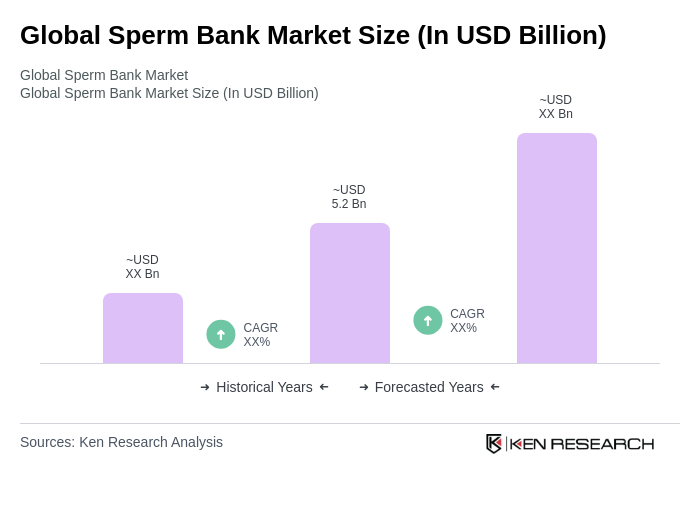
- The Global Sperm Bank Market is valued at USD 5.2 billion, based on a five-year historical analysis. This growth is primarily driven by rising infertility rates, increasing awareness of assisted reproductive technologies, and the growing acceptance of sperm donation as a viable option for family planning. The market has seen a significant uptick in demand for sperm storage and related services, reflecting changing societal norms, technological advancements in cryopreservation and genetic screening, and the expansion of fertility centers and research institutes.
- Key players in this market include the United States, Canada, and several European countries such as the UK and Germany. The dominance of these regions is attributed to their advanced healthcare infrastructure, high levels of investment in reproductive technologies, and a well-established regulatory framework supporting sperm banking operations. Additionally, cultural acceptance of sperm donation, especially among single women and LGBTQ+ couples, has further fueled market growth.
- In 2023, the U.S. government implemented regulations requiring sperm banks to adhere to stringent screening processes for donors, including comprehensive health assessments and genetic testing. The regulatory framework is governed by the U.S. Food and Drug Administration (FDA) under 21 CFR Part 1271, which mandates donor eligibility determination, communicable disease testing, and recordkeeping for human cells, tissues, and cellular and tissue-based products (HCT/Ps) . This regulation aims to ensure the safety and quality of sperm samples, thereby enhancing consumer confidence and promoting ethical practices within the industry.
Global Sperm Bank Market Segmentation
By Donor Type:The market is segmented into Known Donor and Anonymous Donor. The Known Donor segment is gaining traction as individuals seek more personal connections in the donation process, while the Anonymous Donor segment remains popular due to privacy concerns and the convenience it offers.
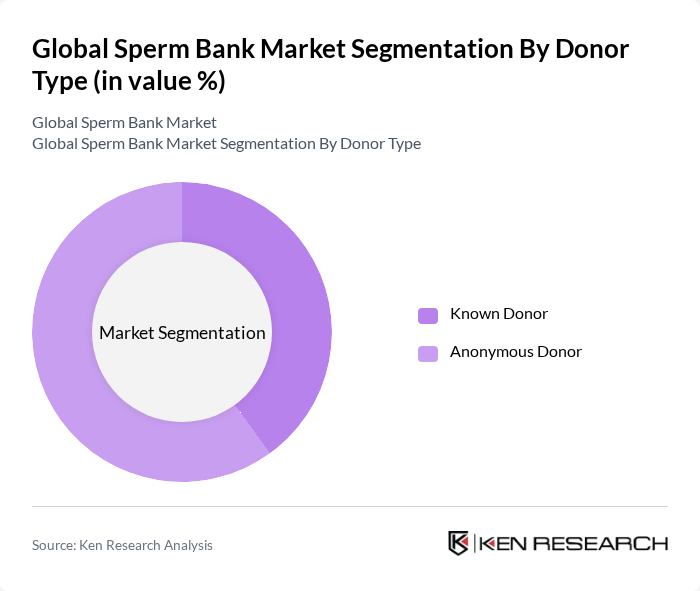
The Anonymous Donor segment currently dominates the market, accounting for a significant portion of sperm donations. This preference is largely driven by the desire for privacy among donors and recipients, as well as established protocols that ensure anonymity. Many individuals and couples prefer anonymous donations due to the reduced emotional complexities involved, making it a more straightforward option for those seeking fertility solutions. The Known Donor segment, while growing, is often chosen by individuals who wish to have a personal connection with the donor, reflecting a shift in consumer behavior towards more personalized reproductive options.
By Service:The market is segmented into Sperm Storage, Semen Analysis, Genetic Consultation, and Others. Sperm Storage is the most critical service, driven by the increasing demand for long-term preservation of sperm samples.
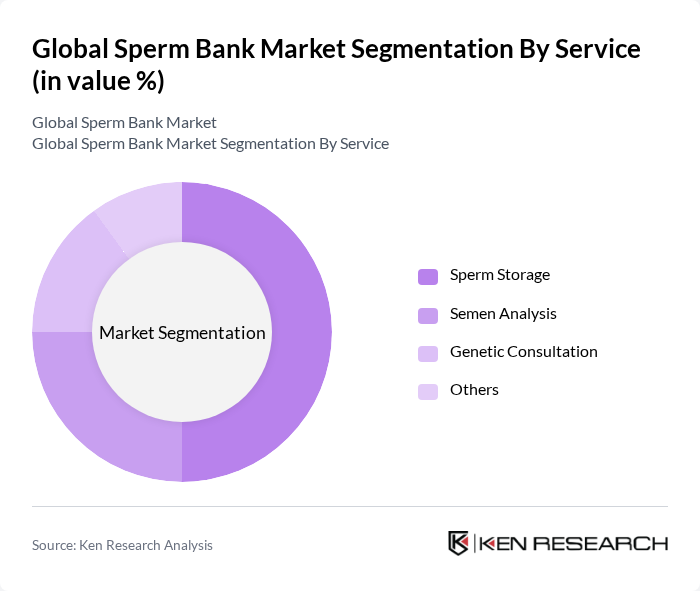
Sperm Storage is the leading service in the market, accounting for half of the total market share. This dominance is attributed to the increasing number of individuals opting for sperm banking for various reasons, including medical treatments, fertility preservation prior to cancer therapy, career planning, and personal choice. The demand for Semen Analysis and Genetic Consultation services is also on the rise, as consumers become more informed about the importance of genetic health and the quality of sperm. The Others category includes ancillary services that support the primary offerings, contributing to the overall growth of the market.
Global Sperm Bank Market Competitive Landscape
The Global Sperm Bank Market is characterized by a dynamic mix of regional and international players. Leading participants such as California Cryobank, Cryos International, Fairfax Cryobank, Xytex Cryo International, Reproductive Medicine Associates of New Jersey (RMANJ), The Sperm Bank of California, Andrology Solutions, European Sperm Bank, New England Cryogenic Center, Cryobank America LLC, London Sperm Bank, Indian Spermtech, ReproTech LLC, The Sperm Bank of Australia, The Sperm Bank of Canada contribute to innovation, geographic expansion, and service delivery in this space.
Global Sperm Bank Market Industry Analysis
Growth Drivers
- Increasing Demand for Assisted Reproductive Technologies:The global market for assisted reproductive technologies (ART) is projected to reach $30 billion in future, driven by rising infertility rates, which affect approximately 15% of couples worldwide. This growing demand for ART directly correlates with the need for sperm banks, as they provide essential resources for procedures like in vitro fertilization (IVF). The increasing number of ART cycles performed annually, estimated at over 2 million, further emphasizes the critical role of sperm banks in this expanding market.
- Rising Awareness of Infertility Issues:Awareness campaigns and educational initiatives have significantly increased public knowledge about infertility, with 60% of individuals now recognizing it as a common health issue. This heightened awareness has led to a surge in consultations with fertility specialists, with over 1.5 million visits reported in future alone. As more people seek solutions, the demand for sperm banks is expected to rise, as they are integral to addressing infertility challenges faced by couples and individuals.
- Advancements in Sperm Preservation Techniques:Innovations in sperm preservation, such as cryopreservation and vitrification, have improved success rates for sperm storage and usage. The global cryopreservation market is anticipated to grow to $4.5 billion in future, reflecting a 10% annual increase. These advancements not only enhance the viability of stored sperm but also expand the potential for long-term storage, making sperm banks more appealing to prospective donors and recipients alike, thereby driving market growth.
Market Challenges
- Ethical and Legal Concerns:The sperm banking industry faces significant ethical dilemmas, particularly regarding donor anonymity and the rights of offspring. In future, over 40% of sperm banks reported legal challenges related to donor agreements and the implications of donor anonymity. These concerns can deter potential donors and recipients, complicating the operational landscape for sperm banks and potentially limiting their growth in certain regions.
- Regulatory Compliance Issues:Sperm banks must navigate a complex web of regulations, which can vary significantly by region. In future, compliance costs are expected to exceed $1 million for many facilities due to stringent health and safety standards. This regulatory burden can hinder operational efficiency and increase costs, making it challenging for smaller sperm banks to compete with larger, well-established entities that can absorb these expenses more easily.
Global Sperm Bank Market Future Outlook
The future of the sperm bank industry appears promising, driven by technological advancements and increasing societal acceptance of assisted reproductive technologies. As more individuals and couples seek fertility solutions, sperm banks are likely to expand their services, including online platforms for donor selection and genetic screening. Additionally, partnerships with fertility clinics will enhance service offerings, ensuring that sperm banks remain integral to the reproductive health landscape, particularly in regions experiencing rising infertility rates.
Market Opportunities
- Expansion into Emerging Markets:Emerging markets, particularly in Asia and Africa, present significant growth opportunities for sperm banks. With rising disposable incomes and increasing awareness of reproductive health, these regions are witnessing a surge in demand for fertility services. Establishing operations in these markets could lead to substantial revenue growth, as local populations seek accessible and reliable sperm banking solutions.
- Development of Innovative Sperm Banking Solutions:The introduction of innovative technologies, such as mobile sperm collection kits and telehealth consultations, can enhance the customer experience. By investing in these solutions, sperm banks can attract a broader clientele, particularly younger demographics who value convenience and accessibility. This innovation-driven approach can significantly boost market penetration and customer loyalty.
Scope of the Report
| Segment | Sub-Segments |
|---|---|
| By Donor Type | Known Donor Anonymous Donor |
| By Service | Sperm Storage Semen Analysis Genetic Consultation Others |
| By Fertilization Technique | Donor Insemination In Vitro Fertilization (IVF) Others |
| By End-User | Fertility Clinics Hospitals Research Institutions Individuals Others |
| By Geographic Distribution | North America (U.S., Canada) Europe (UK, Germany, France, Italy, Spain, Denmark, Sweden, Norway) Asia-Pacific (China, Japan, India, Australia, South Korea, Thailand) Latin America (Brazil, Mexico, Argentina) Middle East & Africa (South Africa, Saudi Arabia, UAE) |
Key Target Audience
Investors and Venture Capitalist Firms
Government and Regulatory Bodies (e.g., Food and Drug Administration, European Medicines Agency)
Manufacturers and Producers of Sperm Preservation Technologies
Healthcare Providers and Fertility Clinics
Biotechnology and Pharmaceutical Companies
Industry Associations and Advocacy Groups
Insurance Companies and Health Plans
Logistics and Supply Chain Companies in Biobanking
Players Mentioned in the Report:
California Cryobank
Cryos International
Fairfax Cryobank
Xytex Cryo International
Reproductive Medicine Associates of New Jersey (RMANJ)
The Sperm Bank of California
Andrology Solutions
European Sperm Bank
New England Cryogenic Center
Cryobank America LLC
London Sperm Bank
Indian Spermtech
ReproTech LLC
The Sperm Bank of Australia
The Sperm Bank of Canada
Table of Contents
Market Assessment Phase
1. Executive Summary and Approach
2. Global Sperm Bank Market Overview
2.1 Key Insights and Strategic Recommendations
2.2 Global Sperm Bank Market Overview
2.3 Definition and Scope
2.4 Evolution of Market Ecosystem
2.5 Timeline of Key Regulatory Milestones
2.6 Value Chain & Stakeholder Mapping
2.7 Business Cycle Analysis
2.8 Policy & Incentive Landscape
3. Global Sperm Bank Market Analysis
3.1 Growth Drivers
3.1.1 Increasing Demand for Assisted Reproductive Technologies
3.1.2 Rising Awareness of Infertility Issues
3.1.3 Advancements in Sperm Preservation Techniques
3.1.4 Growing Acceptance of Sperm Donation
3.2 Market Challenges
3.2.1 Ethical and Legal Concerns
3.2.2 Regulatory Compliance Issues
3.2.3 Limited Awareness in Certain Regions
3.2.4 Competition from Alternative Reproductive Solutions
3.3 Market Opportunities
3.3.1 Expansion into Emerging Markets
3.3.2 Development of Innovative Sperm Banking Solutions
3.3.3 Partnerships with Fertility Clinics
3.3.4 Increasing Investment in Research and Development
3.4 Market Trends
3.4.1 Shift Towards Online Sperm Banking Services
3.4.2 Growing Use of Genetic Screening Technologies
3.4.3 Rise in Personalized Medicine Approaches
3.4.4 Increasing Focus on Quality Assurance Standards
3.5 Government Regulation
3.5.1 Guidelines for Sperm Donation and Storage
3.5.2 Regulations on Sperm Donor Anonymity
3.5.3 Compliance with Health and Safety Standards
3.5.4 Licensing Requirements for Sperm Banks
4. SWOT Analysis
5. Stakeholder Analysis
6. Porter's Five Forces Analysis
7. Global Sperm Bank Market Market Size, 2019-2024
7.1 By Value
7.2 By Volume
7.3 By Average Selling Price
8. Global Sperm Bank Market Segmentation
8.1 By Donor Type
8.1.1 Known Donor
8.1.2 Anonymous Donor
8.2 By Service
8.2.1 Sperm Storage
8.2.2 Semen Analysis
8.2.3 Genetic Consultation
8.2.4 Others
8.3 By Fertilization Technique
8.3.1 Donor Insemination
8.3.2 In Vitro Fertilization (IVF)
8.3.3 Others
8.4 By End-User
8.4.1 Fertility Clinics
8.4.2 Hospitals
8.4.3 Research Institutions
8.4.4 Individuals
8.4.5 Others
8.5 By Geographic Distribution
8.5.1 North America (U.S., Canada)
8.5.2 Europe (UK, Germany, France, Italy, Spain, Denmark, Sweden, Norway)
8.5.3 Asia-Pacific (China, Japan, India, Australia, South Korea, Thailand)
8.5.4 Latin America (Brazil, Mexico, Argentina)
8.5.5 Middle East & Africa (South Africa, Saudi Arabia, UAE)
9. Global Sperm Bank Market Competitive Analysis
9.1 Market Share of Key Players
9.2 KPIs for Cross Comparison of Key Players
9.2.1 Company Name
9.2.2 Group Size (Large, Medium, Small as per industry convention)
9.2.3 Number of Donor Samples Available
9.2.4 Geographic Presence (Number of Countries/Regions Served)
9.2.5 Annual Revenue
9.2.6 Number of Successful Procedures (e.g., pregnancies facilitated)
9.2.7 Average Processing Time (from donor screening to sample availability)
9.2.8 Customer Satisfaction/Net Promoter Score (NPS)
9.2.9 Compliance Certifications (e.g., FDA, HFEA, ISO)
9.2.10 R&D Investment as % of Revenue
9.2.11 Digital Platform Capabilities (e.g., online donor matching, genetic screening)
9.2.12 Pricing Strategy
9.2.13 Revenue Growth Rate
9.2.14 Market Penetration Rate
9.2.15 Customer Retention Rate
9.3 SWOT Analysis of Top Players
9.4 Pricing Analysis
9.5 Detailed Profile of Major Companies
9.5.1 California Cryobank
9.5.2 Cryos International
9.5.3 Fairfax Cryobank
9.5.4 Xytex Cryo International
9.5.5 Reproductive Medicine Associates of New Jersey (RMANJ)
9.5.6 The Sperm Bank of California
9.5.7 Andrology Solutions
9.5.8 European Sperm Bank
9.5.9 New England Cryogenic Center
9.5.10 Cryobank America LLC
9.5.11 London Sperm Bank
9.5.12 Indian Spermtech
9.5.13 ReproTech LLC
9.5.14 The Sperm Bank of Australia
9.5.15 The Sperm Bank of Canada
10. Global Sperm Bank Market End-User Analysis
10.1 Procurement Behavior of Key Ministries
10.1.1 Government Funding for Fertility Treatments
10.1.2 Regulations on Sperm Procurement
10.1.3 Collaboration with Fertility Clinics
10.2 Corporate Spend on Infrastructure & Energy
10.2.1 Investment in Sperm Banking Facilities
10.2.2 Budget Allocation for Research and Development
10.3 Pain Point Analysis by End-User Category
10.3.1 Accessibility of Sperm Banks
10.3.2 Quality Assurance Concerns
10.3.3 Cost of Services
10.4 User Readiness for Adoption
10.4.1 Awareness of Sperm Banking Services
10.4.2 Attitudes Towards Sperm Donation
10.5 Post-Deployment ROI and Use Case Expansion
10.5.1 Long-term Storage Benefits
10.5.2 Success Rates of Assisted Reproductive Technologies
11. Global Sperm Bank Market Future Size, 2025-2030
11.1 By Value
11.2 By Volume
11.3 By Average Selling Price
Go-To-Market Strategy Phase
1. Whitespace Analysis + Business Model Canvas
1.1 Market Gaps Identification
1.2 Business Model Development
2. Marketing and Positioning Recommendations
2.1 Branding Strategies
2.2 Product USPs
3. Distribution Plan
3.1 Urban Retail vs Rural NGO Tie-ups
4. Channel & Pricing Gaps
4.1 Underserved Routes
4.2 Pricing Bands
5. Unmet Demand & Latent Needs
5.1 Category Gaps
5.2 Consumer Segments
6. Customer Relationship
6.1 Loyalty Programs
6.2 After-sales Service
7. Value Proposition
7.1 Sustainability
7.2 Integrated Supply Chains
8. Key Activities
8.1 Regulatory Compliance
8.2 Branding
8.3 Distribution Setup
9. Entry Strategy Evaluation
9.1 Domestic Market Entry Strategy
9.1.1 Product Mix
9.1.2 Pricing Band
9.1.3 Packaging
9.2 Export Entry Strategy
9.2.1 Target Countries
9.2.2 Compliance Roadmap
10. Entry Mode Assessment
10.1 JV
10.2 Greenfield
10.3 M&A
10.4 Distributor Model
11. Capital and Timeline Estimation
11.1 Capital Requirements
11.2 Timelines
12. Control vs Risk Trade-Off
12.1 Ownership vs Partnerships
13. Profitability Outlook
13.1 Breakeven Analysis
13.2 Long-term Sustainability
14. Potential Partner List
14.1 Distributors
14.2 JVs
14.3 Acquisition Targets
15. Execution Roadmap
15.1 Phased Plan for Market Entry
15.1.1 Market Setup
15.1.2 Market Entry
15.1.3 Growth Acceleration
15.1.4 Scale & Stabilize
15.2 Key Activities and Milestones
15.2.1 Activity Planning
15.2.2 Milestone Tracking
Research Methodology
Phase 1: Approach1
Desk Research
- Analysis of industry reports from global health organizations and fertility clinics
- Review of academic journals and publications on reproductive health and sperm banking
- Examination of market trends and statistics from government health departments and fertility associations
Primary Research
- Interviews with medical professionals specializing in reproductive endocrinology
- Surveys conducted with sperm bank operators and fertility clinic managers
- Focus groups with potential sperm donors to understand motivations and concerns
Validation & Triangulation
- Cross-validation of findings through multiple expert interviews and industry surveys
- Triangulation of data from academic research, market reports, and expert opinions
- Sanity checks through feedback from a panel of reproductive health experts
Phase 2: Market Size Estimation1
Top-down Assessment
- Estimation of the global sperm bank market size based on fertility treatment statistics
- Analysis of demographic trends affecting sperm donation rates and fertility treatments
- Incorporation of regional market growth rates and healthcare expenditure data
Bottom-up Modeling
- Collection of data on the number of sperm banks and their operational capacities
- Estimation of average costs associated with sperm donation and storage services
- Volume x pricing model based on service offerings and market demand
Forecasting & Scenario Analysis
- Multi-factor regression analysis considering factors like fertility rates and societal attitudes
- Scenario modeling based on potential changes in regulations and healthcare policies
- Baseline, optimistic, and pessimistic forecasts through 2030 based on market dynamics
Phase 3: CATI Sample Composition1
| Scope Item/Segment | Sample Size | Target Respondent Profiles |
|---|---|---|
| Fertility Clinics | 80 | Clinic Directors, Reproductive Health Specialists |
| Sperm Bank Operators | 60 | Operations Managers, Quality Control Officers |
| Potential Sperm Donors | 100 | Young Adults, Health-Conscious Individuals |
| Healthcare Policy Makers | 40 | Health Administrators, Policy Analysts |
| Patients Seeking Fertility Treatments | 70 | Couples, Individuals with Fertility Issues |
Frequently Asked Questions
What is the current value of the Global Sperm Bank Market?
The Global Sperm Bank Market is valued at approximately USD 5.2 billion, reflecting a significant growth trend driven by rising infertility rates and increased awareness of assisted reproductive technologies.
What factors are driving the growth of the Global Sperm Bank Market?
Which regions dominate the Global Sperm Bank Market?
What are the main services offered by sperm banks?
Other Regional/Country Reports
Indonesia Sperm Bank Market
Malaysia Sperm Bank Market
APAC Sperm Bank Market
Other Adjacent Reports
Thailand Infertility Treatment Market
Egypt Cryopreservation Market
Indonesia Genetic Testing Market Report Size Share Growth Drivers Trends Opportunities & Forecast 2025–2030Germany Fertility Clinic Market
APAC Pacific In Vitro Fertilization Market Report Size Share Growth Drivers Trends Opportunities & Forecast 2025–2030Belgium Egg Bank Market
Singapore Surrogacy Services Market
Kuwait Reproductive Health Market
Qatar Semen Analysis Market
Why Buy From Us?

What makes us stand out is that our consultants follow Robust, Refine and Result (RRR) methodology. Robust for clear definitions, approaches and sanity checking, Refine for differentiating respondents' facts and opinions, and Result for presenting data with story.

We have set a benchmark in the industry by offering our clients with syndicated and customized market research reports featuring coverage of entire market as well as meticulous research and analyst insights.

While we don't replace traditional research, we flip the method upside down. Our dual approach of Top Bottom & Bottom Top ensures quality deliverable by not just verifying company fundamentals but also looking at the sector and macroeconomic factors.

With one step in the future, our research team constantly tries to show you the bigger picture. We help with some of the tough questions you may encounter along the way: How is the industry positioned? Best marketing channel? KPI's of competitors? By aligning every element, we help maximize success.

Our report gives you instant access to the answers and sources that other companies might choose to hide. We elaborate each steps of research methodology we have used and showcase you the sample size to earn your trust.

If you need any support, we are here! We pride ourselves on universe strength, data quality, and quick, friendly, and professional service.