About the Report
Base Year 2024Global Telecom Power System Market Overview
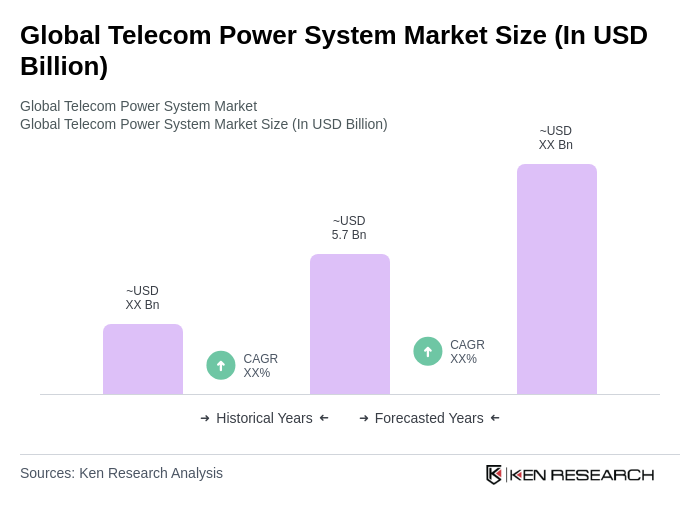
- The Global Telecom Power System Market is valued at USD 5.7 billion, based on a five-year historical analysis. This growth is primarily driven by the increasing demand for reliable and efficient power solutions in the telecommunications sector, as operators seek to enhance network performance and reduce operational costs. The rise in mobile data traffic and the expansion of 5G networks have further fueled the need for advanced power systems .
- Key players in this market include the United States, China, and India, which dominate due to their large telecommunications infrastructure and rapid technological advancements. The U.S. leads in innovation and investment in telecom technologies, while China and India benefit from their vast consumer bases and ongoing network expansions, making them critical markets for telecom power systems . Additional momentum comes from Asia-Pacific 5G deployments and rural coverage programs that expand tower counts and off-grid/bad-grid requirements .
- In 2023, the Federal Communications Commission (FCC) in the United States implemented new regulations aimed at enhancing energy efficiency in telecom power systems. This regulation mandates that all new telecom installations must comply with specific energy consumption standards, promoting the adoption of renewable energy sources and energy-efficient technologies to reduce the carbon footprint of telecom operations. Note: While U.S. policy has increasingly emphasized communications network resiliency, broadband expansion, and energy efficiency initiatives, no specific FCC rulemaking uniquely mandating telecom power system energy consumption standards for all new installations is documented; instead, market adoption of hybrid/renewable and high-efficiency rectifier systems is being driven by operator goals and broader sustainability programs .
Global Telecom Power System Market Segmentation
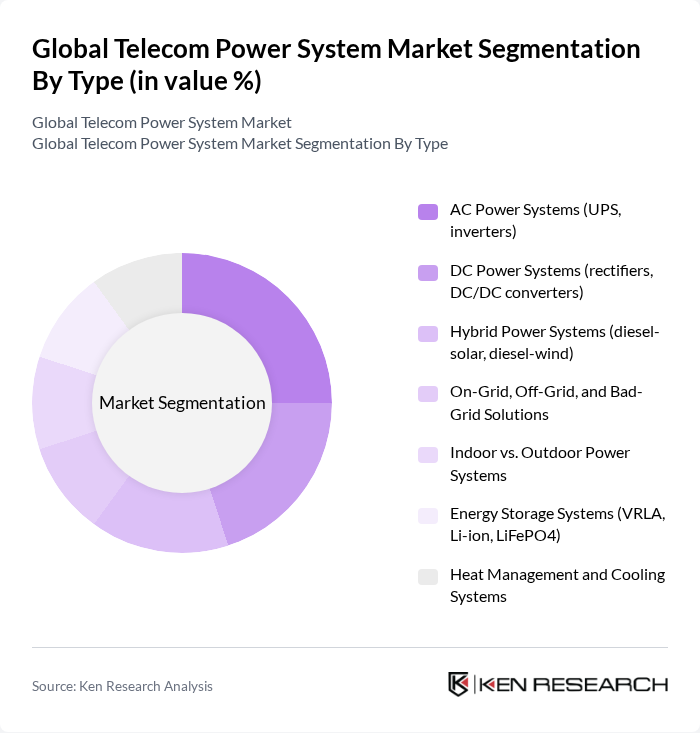
By Type:The telecom power systems can be categorized into several types, including AC Power Systems, DC Power Systems, Hybrid Power Systems, On-Grid, Off-Grid, and Bad-Grid Solutions, Indoor vs. Outdoor Power Systems, Energy Storage Systems, and Heat Management and Cooling Systems. Each type serves distinct operational needs and is tailored to specific environments and applications.
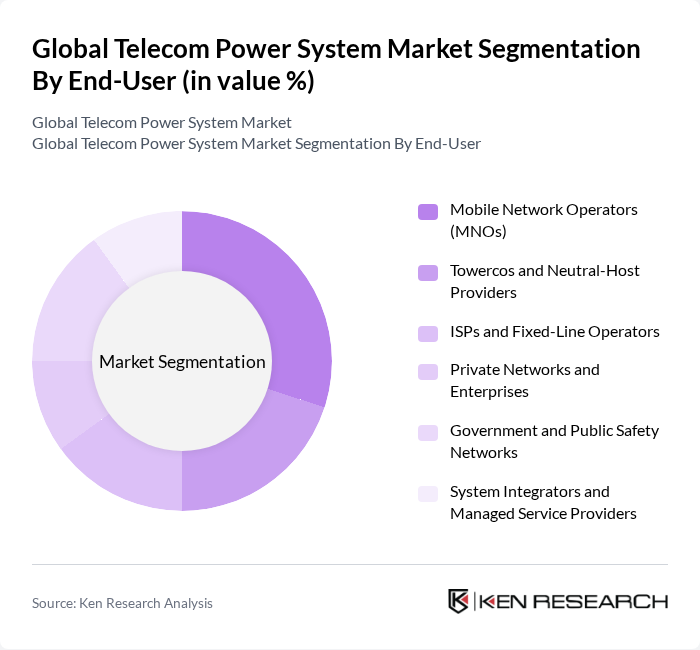
By End-User:The end-users of telecom power systems include Mobile Network Operators (MNOs), Towercos and Neutral-Host Providers, ISPs and Fixed-Line Operators, Private Networks and Enterprises, Government and Public Safety Networks, and System Integrators and Managed Service Providers. Each end-user segment has unique requirements based on their operational scale and service offerings.
Global Telecom Power System Market Competitive Landscape
The Global Telecom Power System Market is characterized by a dynamic mix of regional and international players. Leading participants such as Delta Electronics, Inc., Huawei Technologies Co., Ltd. (Huawei Digital Power), Vertiv Group Corporation, Eaton Corporation plc, Schneider Electric SE, ABB Ltd., Cummins Inc., ZTE Corporation (ZTE Energy), Eltek (Delta Eltek AS), UNIPOWER LLC, Ascot Industrial S.r.l., Myers Power Products, Inc., Enatel Limited, Lite-On Technology Corporation (Power systems), Alpha Technologies Ltd. (EnerSys/Alpha) contribute to innovation, geographic expansion, and service delivery in this space.
Global Telecom Power System Market Industry Analysis
Growth Drivers
- Increasing Demand for Reliable Power Supply:The global telecom sector is projected to require an additional 1,300 terawatt-hours (TWh) of electricity in the future, driven by the surge in mobile data traffic, which is expected to reach 80 exabytes per month. This demand necessitates robust power systems to ensure uninterrupted service, particularly in regions with unstable grids. The need for reliable power is further underscored by the projected 5G rollout, which will require enhanced power infrastructure to support its high bandwidth and low latency requirements.
- Expansion of Telecom Infrastructure:The global telecom infrastructure investment is anticipated to exceed $1.5 trillion in the future, with significant allocations directed towards expanding network coverage and capacity. This expansion includes the deployment of new cell towers and data centers, which require advanced power systems to operate efficiently. In regions like Asia-Pacific, where mobile subscriptions are expected to surpass 6 billion, the demand for reliable telecom power systems will be critical to support this infrastructure growth and ensure service continuity.
- Adoption of Renewable Energy Sources:The renewable energy sector is projected to grow significantly, with investments expected to reach $600 billion globally in the future. Telecom companies are increasingly integrating solar and wind energy solutions into their power systems to reduce operational costs and carbon footprints. For instance, companies like AT&T and Vodafone are committing to 100% renewable energy in the future, which not only enhances sustainability but also aligns with global emission reduction targets, driving demand for innovative power solutions.
Market Challenges
- High Initial Investment Costs:The upfront costs associated with deploying advanced telecom power systems can be substantial, often exceeding $1.5 million per site for renewable energy integration. This financial barrier can deter smaller telecom operators from upgrading their infrastructure. Additionally, the need for specialized equipment and technology further escalates these costs, making it challenging for companies to justify investments in power systems amidst tight profit margins in the telecom industry.
- Regulatory Compliance Complexities:Telecom power systems must adhere to a myriad of regulations, which can vary significantly by region. For example, compliance with the European Union's stringent energy efficiency directives can require extensive modifications to existing systems, often incurring costs upwards of $250,000 per site. Navigating these regulatory landscapes can be cumbersome, leading to delays in project implementation and increased operational risks for telecom operators.
Global Telecom Power System Market Future Outlook
The future of the telecom power system market is poised for transformative growth, driven by technological advancements and a shift towards sustainable energy solutions. As 5G networks expand, the demand for efficient power systems will intensify, prompting telecom operators to invest in hybrid and renewable energy sources. Additionally, the integration of IoT technologies in power management will enhance operational efficiency, enabling real-time monitoring and optimization of energy consumption, which is crucial for meeting the increasing energy demands of modern telecom infrastructure.
Market Opportunities
- Growth in 5G Network Deployment:The global rollout of 5G networks is expected to create significant opportunities for telecom power systems, with an estimated 2 million new base stations required in the future. This demand will drive investments in advanced power solutions that can support the high energy requirements of 5G technology, presenting a lucrative market for power system providers.
- Increasing Focus on Energy Efficiency:As telecom operators strive to reduce operational costs, the emphasis on energy-efficient power systems is growing. The global market for energy-efficient technologies in telecom is projected to reach $400 billion in the future, driven by the need to lower energy consumption and carbon emissions. This trend presents a significant opportunity for companies offering innovative power solutions that enhance energy efficiency.
Scope of the Report
| Segment | Sub-Segments |
|---|---|
| By Type | AC Power Systems (UPS, inverters) DC Power Systems (rectifiers, DC/DC converters) Hybrid Power Systems (diesel-solar, diesel-wind) On-Grid, Off-Grid, and Bad-Grid Solutions Indoor vs. Outdoor Power Systems Energy Storage Systems (VRLA, Li-ion, LiFePO4) Heat Management and Cooling Systems |
| By End-User | Mobile Network Operators (MNOs) Towercos and Neutral-Host Providers ISPs and Fixed-Line Operators Private Networks and Enterprises Government and Public Safety Networks System Integrators and Managed Service Providers |
| By Application | Macro Cell Sites and RAN (2G/3G/4G/5G) Small Cells and Edge Sites Core Network, Central Office, and PoPs Remote and Off-Grid Telecom Sites Disaster Recovery and Emergency Communications Data Center and Edge Data Center Power |
| By Component | Rectifiers and Power Modules Inverters and UPS Batteries (VRLA, Li-ion, Ni-Cd) Controllers and Remote Monitoring Units Converters (AC/DC, DC/DC) Generators (diesel, gas) Power Distribution Units (DCDB, PDU) Enclosures, Racks, and Cooling |
| By Sales Channel | Direct Sales to Operators and Towercos Value-Added Resellers and Distributors OEM Partnerships and System Integrators Online and E-Procurement EPC and Turnkey Project Contracts |
| By Power Source | Diesel-Battery Systems Diesel-Solar Hybrid Diesel-Wind Hybrid Grid-Connected with Backup Renewable-Only (Solar, Wind, Fuel Cells) |
| By Grid Type | On-Grid Off-Grid Bad-Grid (unstable grid) |
| By Region | North America Europe Asia Pacific Latin America Middle East & Africa |
Key Target Audience
Investors and Venture Capitalist Firms
Government and Regulatory Bodies (e.g., Federal Communications Commission, International Telecommunication Union)
Telecom Infrastructure Providers
Energy Management Companies
Telecom Equipment Manufacturers
Network Operators
Telecom Industry Associations
Financial Institutions
Players Mentioned in the Report:
Delta Electronics, Inc.
Huawei Technologies Co., Ltd. (Huawei Digital Power)
Vertiv Group Corporation
Eaton Corporation plc
Schneider Electric SE
ABB Ltd.
Cummins Inc.
ZTE Corporation (ZTE Energy)
Eltek (Delta Eltek AS)
UNIPOWER LLC
Ascot Industrial S.r.l.
Myers Power Products, Inc.
Enatel Limited
Lite-On Technology Corporation (Power systems)
Alpha Technologies Ltd. (EnerSys/Alpha)
Table of Contents
Market Assessment Phase
1. Executive Summary and Approach
2. Global Telecom Power System Market Overview
2.1 Key Insights and Strategic Recommendations
2.2 Global Telecom Power System Market Overview
2.3 Definition and Scope
2.4 Evolution of Market Ecosystem
2.5 Timeline of Key Regulatory Milestones
2.6 Value Chain & Stakeholder Mapping
2.7 Business Cycle Analysis
2.8 Policy & Incentive Landscape
3. Global Telecom Power System Market Analysis
3.1 Growth Drivers
3.1.1 Increasing demand for reliable power supply
3.1.2 Expansion of telecom infrastructure
3.1.3 Adoption of renewable energy sources
3.1.4 Technological advancements in power systems
3.2 Market Challenges
3.2.1 High initial investment costs
3.2.2 Regulatory compliance complexities
3.2.3 Competition from alternative energy solutions
3.2.4 Supply chain disruptions
3.3 Market Opportunities
3.3.1 Growth in 5G network deployment
3.3.2 Increasing focus on energy efficiency
3.3.3 Government incentives for green energy
3.3.4 Emerging markets with telecom expansion
3.4 Market Trends
3.4.1 Shift towards hybrid power systems
3.4.2 Integration of IoT in power management
3.4.3 Rise of smart grid technologies
3.4.4 Focus on sustainability and carbon reduction
3.5 Government Regulation
3.5.1 Renewable energy mandates
3.5.2 Emission reduction targets
3.5.3 Incentives for energy storage solutions
3.5.4 Standards for telecom power systems
4. SWOT Analysis
5. Stakeholder Analysis
6. Porter's Five Forces Analysis
7. Global Telecom Power System Market Market Size, 2019-2024
7.1 By Value
7.2 By Volume
7.3 By Average Selling Price
8. Global Telecom Power System Market Segmentation
8.1 By Type
8.1.1 AC Power Systems (UPS, inverters)
8.1.2 DC Power Systems (rectifiers, DC/DC converters)
8.1.3 Hybrid Power Systems (diesel-solar, diesel-wind)
8.1.4 On-Grid, Off-Grid, and Bad-Grid Solutions
8.1.5 Indoor vs. Outdoor Power Systems
8.1.6 Energy Storage Systems (VRLA, Li-ion, LiFePO4)
8.1.7 Heat Management and Cooling Systems
8.2 By End-User
8.2.1 Mobile Network Operators (MNOs)
8.2.2 Towercos and Neutral-Host Providers
8.2.3 ISPs and Fixed-Line Operators
8.2.4 Private Networks and Enterprises
8.2.5 Government and Public Safety Networks
8.2.6 System Integrators and Managed Service Providers
8.3 By Application
8.3.1 Macro Cell Sites and RAN (2G/3G/4G/5G)
8.3.2 Small Cells and Edge Sites
8.3.3 Core Network, Central Office, and PoPs
8.3.4 Remote and Off-Grid Telecom Sites
8.3.5 Disaster Recovery and Emergency Communications
8.3.6 Data Center and Edge Data Center Power
8.4 By Component
8.4.1 Rectifiers and Power Modules
8.4.2 Inverters and UPS
8.4.3 Batteries (VRLA, Li-ion, Ni-Cd)
8.4.4 Controllers and Remote Monitoring Units
8.4.5 Converters (AC/DC, DC/DC)
8.4.6 Generators (diesel, gas)
8.4.7 Power Distribution Units (DCDB, PDU)
8.4.8 Enclosures, Racks, and Cooling
8.5 By Sales Channel
8.5.1 Direct Sales to Operators and Towercos
8.5.2 Value-Added Resellers and Distributors
8.5.3 OEM Partnerships and System Integrators
8.5.4 Online and E-Procurement
8.5.5 EPC and Turnkey Project Contracts
8.6 By Power Source
8.6.1 Diesel-Battery Systems
8.6.2 Diesel-Solar Hybrid
8.6.3 Diesel-Wind Hybrid
8.6.4 Grid-Connected with Backup
8.6.5 Renewable-Only (Solar, Wind, Fuel Cells)
8.7 By Grid Type
8.7.1 On-Grid
8.7.2 Off-Grid
8.7.3 Bad-Grid (unstable grid)
8.8 By Region
8.8.1 North America
8.8.2 Europe
8.8.3 Asia Pacific
8.8.4 Latin America
8.8.5 Middle East & Africa
9. Global Telecom Power System Market Competitive Analysis
9.1 Market Share of Key Players
9.2 Cross Comparison of Key Players
9.2.1 Company Name
9.2.2 Group Size (Large, Medium, or Small as per industry convention)
9.2.3 Revenue from Telecom Power Systems (USD, latest FY)
9.2.4 YoY Revenue Growth in Telecom Power
9.2.5 Installed Base (number of telecom sites served)
9.2.6 Geographic Footprint (countries/regions served)
9.2.7 Product Portfolio Breadth (DC power, hybrid, batteries, controls)
9.2.8 R&D Intensity (% of revenue)
9.2.9 Gross Margin (telecom power segment)
9.2.10 Average System Efficiency (% at typical load)
9.2.11 Hybrid/Renewable Share of Shipments (%)
9.2.12 Service and O&M Revenue Mix (%)
9.2.13 Tender Win Rate / Major Contracts (past 24 months)
9.2.14 ESG Metrics (scope 1/2 emissions intensity; energy-saving features)
9.3 SWOT Analysis of Top Players
9.4 Pricing Analysis
9.5 Detailed Profile of Major Companies
9.5.1 Delta Electronics, Inc.
9.5.2 Huawei Technologies Co., Ltd. (Huawei Digital Power)
9.5.3 Vertiv Group Corporation
9.5.4 Eaton Corporation plc
9.5.5 Schneider Electric SE
9.5.6 ABB Ltd.
9.5.7 Cummins Inc.
9.5.8 ZTE Corporation (ZTE Energy)
9.5.9 Eltek (Delta Eltek AS)
9.5.10 UNIPOWER LLC
9.5.11 Ascot Industrial S.r.l.
9.5.12 Myers Power Products, Inc.
9.5.13 Enatel Limited
9.5.14 Lite-On Technology Corporation (Power systems)
9.5.15 Alpha Technologies Ltd. (EnerSys/Alpha)
10. Global Telecom Power System Market End-User Analysis
10.1 Procurement Behavior of Key Ministries
10.1.1 Budget Allocation Trends
10.1.2 Decision-Making Processes
10.1.3 Preferred Suppliers
10.1.4 Compliance Requirements
10.2 Corporate Spend on Infrastructure & Energy
10.2.1 Investment Priorities
10.2.2 Budgeting Cycles
10.2.3 Cost Management Strategies
10.3 Pain Point Analysis by End-User Category
10.3.1 Reliability Issues
10.3.2 Cost Constraints
10.3.3 Regulatory Compliance Challenges
10.4 User Readiness for Adoption
10.4.1 Awareness Levels
10.4.2 Training Needs
10.4.3 Technology Acceptance
10.5 Post-Deployment ROI and Use Case Expansion
10.5.1 Performance Metrics
10.5.2 Scalability Potential
10.5.3 Future Investment Plans
11. Global Telecom Power System Market Future Size, 2025-2030
11.1 By Value
11.2 By Volume
11.3 By Average Selling Price
Go-To-Market Strategy Phase
1. Whitespace Analysis + Business Model Canvas
1.1 Market Gaps Identification
1.2 Value Proposition Development
1.3 Revenue Streams Analysis
1.4 Cost Structure Evaluation
1.5 Key Partnerships Exploration
1.6 Customer Segmentation
1.7 Channels of Distribution
2. Marketing and Positioning Recommendations
2.1 Branding Strategies
2.2 Product USPs
2.3 Target Market Identification
2.4 Communication Strategies
2.5 Digital Marketing Approaches
3. Distribution Plan
3.1 Urban Retail Strategies
3.2 Rural NGO Tie-Ups
3.3 E-commerce Integration
3.4 Logistics and Supply Chain Management
4. Channel & Pricing Gaps
4.1 Underserved Routes
4.2 Pricing Bands Analysis
4.3 Competitor Pricing Strategies
5. Unmet Demand & Latent Needs
5.1 Category Gaps
5.2 Consumer Segments Analysis
5.3 Emerging Trends Identification
6. Customer Relationship
6.1 Loyalty Programs
6.2 After-sales Service
6.3 Customer Feedback Mechanisms
7. Value Proposition
7.1 Sustainability Initiatives
7.2 Integrated Supply Chains
7.3 Competitive Advantages
8. Key Activities
8.1 Regulatory Compliance
8.2 Branding Efforts
8.3 Distribution Setup
9. Entry Strategy Evaluation
9.1 Domestic Market Entry Strategy
9.1.1 Product Mix Considerations
9.1.2 Pricing Band Strategy
9.1.3 Packaging Options
9.2 Export Entry Strategy
9.2.1 Target Countries
9.2.2 Compliance Roadmap
10. Entry Mode Assessment
10.1 Joint Ventures
10.2 Greenfield Investments
10.3 Mergers & Acquisitions
10.4 Distributor Model
11. Capital and Timeline Estimation
11.1 Capital Requirements
11.2 Timelines for Implementation
12. Control vs Risk Trade-Off
12.1 Ownership vs Partnerships
13. Profitability Outlook
13.1 Breakeven Analysis
13.2 Long-term Sustainability
14. Potential Partner List
14.1 Distributors
14.2 Joint Ventures
14.3 Acquisition Targets
15. Execution Roadmap
15.1 Phased Plan for Market Entry
15.1.1 Market Setup
15.1.2 Market Entry
15.1.3 Growth Acceleration
15.1.4 Scale & Stabilize
15.2 Key Activities and Milestones
15.2.1 Milestone Planning
15.2.2 Activity Tracking
Research Methodology
Phase 1: Approach1
Desk Research
- Industry reports from global telecom associations and market research firms
- Government publications and regulatory frameworks impacting telecom power systems
- Technical papers and whitepapers from leading telecom infrastructure providers
Primary Research
- Interviews with energy managers at major telecom operators
- Surveys with infrastructure engineers specializing in telecom power systems
- Field interviews with project managers overseeing telecom power installations
Validation & Triangulation
- Cross-validation of data through multiple industry sources and expert opinions
- Triangulation of findings from primary interviews and secondary data sources
- Sanity checks through expert panel reviews and feedback loops
Phase 2: Market Size Estimation1
Top-down Assessment
- Analysis of global telecom market size and growth trends
- Segmentation by power system types (e.g., DC, AC, hybrid systems)
- Incorporation of regional growth factors and infrastructure investments
Bottom-up Modeling
- Estimation of power consumption metrics from telecom equipment manufacturers
- Operational cost analysis based on energy pricing and system efficiency
- Volume x cost calculations for different telecom power system configurations
Forecasting & Scenario Analysis
- Multi-factor regression analysis incorporating technological advancements and energy trends
- Scenario modeling based on regulatory changes and sustainability initiatives
- Baseline, optimistic, and pessimistic forecasts through 2030
Phase 3: CATI Sample Composition1
| Scope Item/Segment | Sample Size | Target Respondent Profiles |
|---|---|---|
| Telecom Operator Power Management | 120 | Energy Managers, Network Operations Directors |
| Telecom Infrastructure Providers | 90 | Product Development Managers, Technical Sales Engineers |
| Renewable Energy Integration in Telecom | 70 | Sustainability Officers, Project Managers |
| Power System Maintenance Practices | 60 | Field Engineers, Maintenance Supervisors |
| Energy Efficiency Initiatives | 100 | Operations Managers, Energy Analysts |
Frequently Asked Questions
What is the current value of the Global Telecom Power System Market?
The Global Telecom Power System Market is valued at approximately USD 5.7 billion, driven by the increasing demand for reliable and efficient power solutions in the telecommunications sector, particularly with the rise of mobile data traffic and 5G network expansions.
What are the key drivers of growth in the telecom power system market?
Which regions dominate the Global Telecom Power System Market?
What types of telecom power systems are available?
Other Regional/Country Reports
Indonesia Telecom Power System Market
Malaysia Telecom Power System Market
APAC Telecom Power System Market
Why Buy From Us?

What makes us stand out is that our consultants follow Robust, Refine and Result (RRR) methodology. Robust for clear definitions, approaches and sanity checking, Refine for differentiating respondents' facts and opinions, and Result for presenting data with story.

We have set a benchmark in the industry by offering our clients with syndicated and customized market research reports featuring coverage of entire market as well as meticulous research and analyst insights.

While we don't replace traditional research, we flip the method upside down. Our dual approach of Top Bottom & Bottom Top ensures quality deliverable by not just verifying company fundamentals but also looking at the sector and macroeconomic factors.

With one step in the future, our research team constantly tries to show you the bigger picture. We help with some of the tough questions you may encounter along the way: How is the industry positioned? Best marketing channel? KPI's of competitors? By aligning every element, we help maximize success.

Our report gives you instant access to the answers and sources that other companies might choose to hide. We elaborate each steps of research methodology we have used and showcase you the sample size to earn your trust.

If you need any support, we are here! We pride ourselves on universe strength, data quality, and quick, friendly, and professional service.