About the Report
Base Year 2024India Citrus Fruit Market Overview
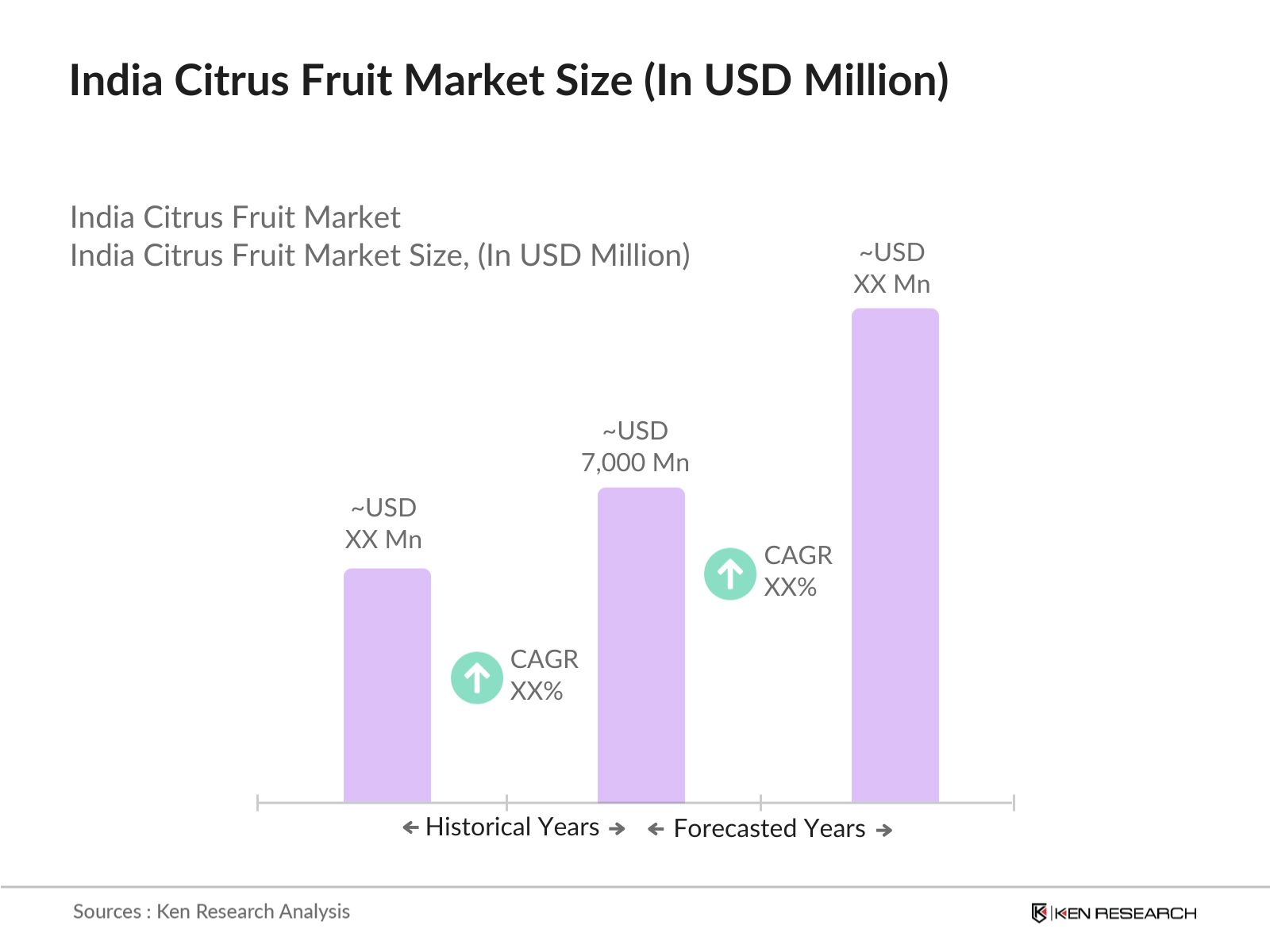
- The India Citrus Fruit Market is valued at USD 7,000 Million, based on a five-year historical analysis. This growth is primarily driven by increasing health consciousness among consumers, rising demand for fresh fruits, and the expanding food processing industry. The market has seen a significant uptick in citrus fruit consumption, particularly oranges and lemons, due to their nutritional benefits and versatility in culinary applications.
- Key regions dominating the market include Maharashtra, Punjab, and Andhra Pradesh. Maharashtra is known for its high production of oranges, while Punjab excels in Kinnow cultivation. Andhra Pradesh has a diverse citrus fruit production, including lemons and limes, making this state pivotal in meeting both domestic and export demands.
- The Mission for Integrated Development of Horticulture (MIDH), launched by the Department of Agriculture & Farmers Welfare, Ministry of Agriculture & Farmers Welfare, Government of India in 2014, includes a dedicated Citrus Fruit Development Program. This initiative provides financial support for farmers, promotes research and development in pest management, and encourages organic farming practices, thereby enhancing productivity and quality in the citrus fruit sector.
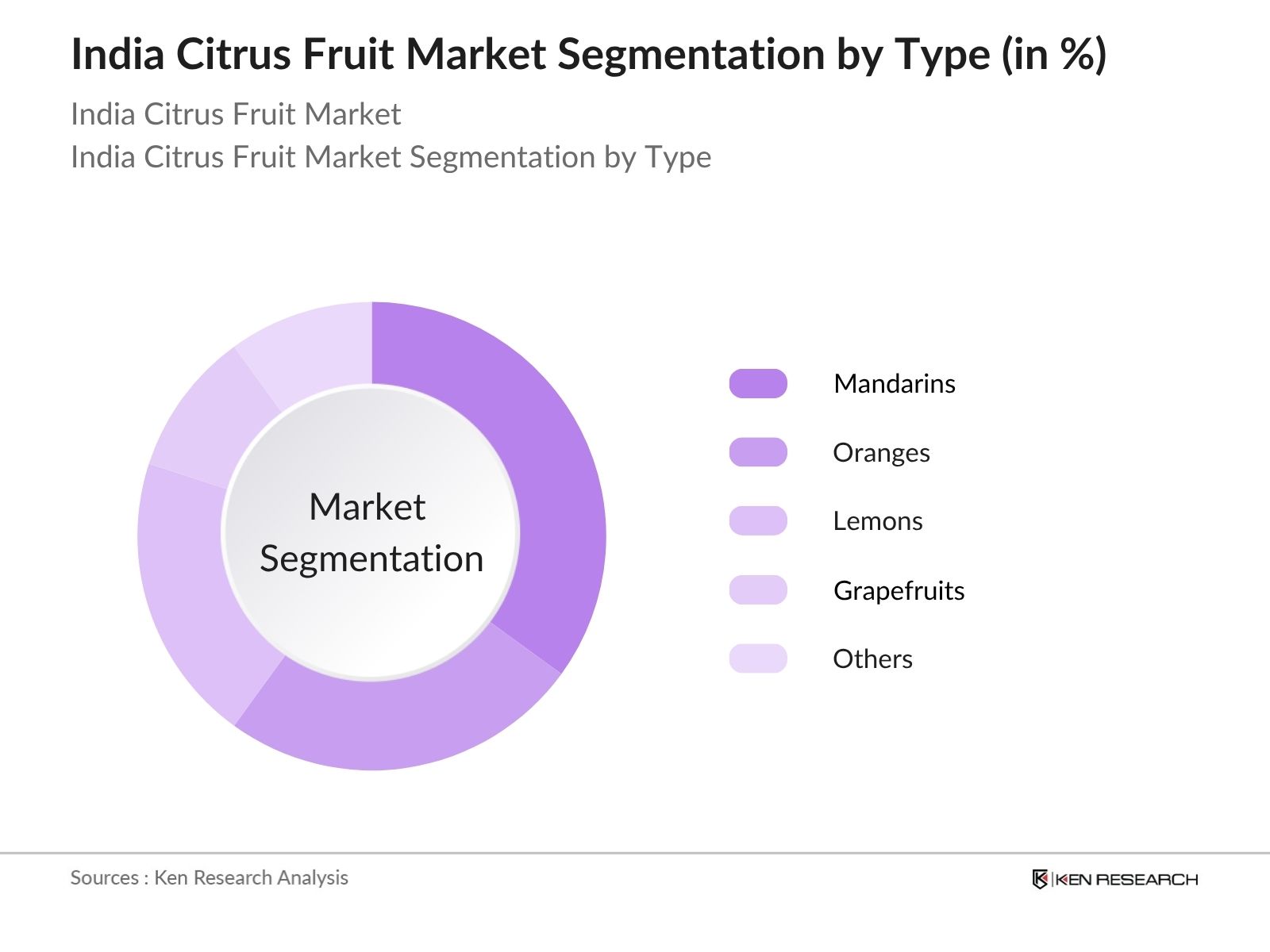
India Citrus Fruit Market Segmentation
By Type:The India citrus fruit market is segmented into oranges, lemons, mandarins, grapefruits, and others. Mandarins dominate the category, accounting for the largest share due to their year-round availability and preference in household consumption. Oranges and lemons follow closely, driven by their widespread use in juices, culinary dishes, and immunity-boosting products. Grapefruits and other citrus varieties hold smaller shares but cater to niche health-conscious consumers. Urbanization and the rise in wellness trends continue to drive demand across all citrus segments.
By Channel Type: The distribution of citrus fruits in India occurs through four major channels: Local Markets, Modern Retail, E-Commerce/Q-Commerce, and Wholesale Mandis. Local markets dominate the channel mix, catering to daily consumer needs across urban and rural areas. Modern retail, with its focus on quality and hygiene, is steadily gaining traction in metro cities. E-Commerce and Q-Commerce platforms are emerging as convenient options, especially in urban clusters, while wholesale mandis maintain a niche role primarily in bulk procurement and rural distribution.
India Citrus Fruit Market Competitive Landscape
The India Citrus Fruit Market is characterized by a dynamic mix of regional and international players. Leading participants such as MKC Agro Fresh Ltd, Sahyadri Farms, IG International, Annora Imports & Exports, and EDS Agro India Pvt Ltd contribute to innovation, geographic expansion, and service delivery in this space.
India Citrus Fruit Market Industry Analysis
Growth Drivers
- Government Backing and Horticulture Initiatives:Government schemes like the National Horticulture Mission and cluster-based citrus development programs are boosting productivity and supporting export readiness. These initiatives are improving farm-level practices, enhancing competitiveness, and ensuring consistent supply. In future, expanded policy focus on citrus value chains is expected to further strengthen India’s domestic and international citrus trade ecosystem.
- Urbanization and Rising Per-Capita Citrus Consumption:India’s rising disposable income and urban lifestyle transitions are driving higher citrus fruit intake—currently averaging ~30.6 kg per capita annually. With growing demand for convenient and vitamin-rich dietary options, citrus fruits are increasingly favored in urban households. This consumption trend is expected to sustain upward momentum, supported by wellness preferences and easy availability through modern retail and e-commerce platforms.
- Enhanced Cold Chain and Processing Integration:Modern supply chain infrastructure—including cold storage, pack houses, and logistics—is reducing post-harvest losses and improving quality retention for citrus fruits. Simultaneously, demand from the food and beverage sector for juice, concentrate, and flavoring applications is expanding bulk procurement. These advancements are enabling better price realization for farmers and driving deeper value-chain integration across domestic and export-focused processing units.
Market Challenges
- Logistical Inefficiencies and High Distribution Costs:Despite improvements in trade policies, inefficient logistics remain a major hurdle for India’s citrus import sector. Poor infrastructure and supply chain bottlenecks significantly delay shipments and increase costs, with the citrus industry reportedly losing over US$288 million annually. These inefficiencies undermine the viability of imported citrus, especially when freshness and shelf-life are critical, limiting market scalability and consistency in availability.
- High Tariffs and Compliance Barriers:Imported citrus in India is subject to a steep 30% tariff, raising the landed cost and reducing price competitiveness against domestic produce. Additionally, strict FSSAI regulations, quarantine protocols, and seasonal entry restrictions delay shipments and complicate compliance for exporters. These trade and regulatory hurdles discourage bulk imports and restrict variety availability, making it difficult for international citrus brands to gain market share.
India Citrus Fruit Market Future Outlook
The future of the India citrus fruit market appears promising, driven by increasing health consciousness and a shift towards organic produce. As consumers prioritize health and wellness, the demand for citrus fruits is expected to rise. Additionally, advancements in agricultural technology and sustainable farming practices will likely enhance productivity. The growth of e-commerce platforms will further facilitate access to fresh citrus products, ensuring that the market remains dynamic and responsive to consumer needs in the future.
Market Opportunities
- Off-Season Supply Gap Unlocking Import-Driven Export Plays:India’s domestic citrus output peaks between November and March, leaving a five-month supply gap during April to September. This creates a window for counter-seasonal imports or even re-exports by aggregators and exporters. Global players like South Africa’s FruitOne are tapping into this off-season to supply Indian demand, presenting a reverse opportunity for India to explore citrus exports in reciprocal off-seasons.
- HORECA and Retail Demand Driving Value-Added Citrus Innovation:Premium citrus is gaining traction in urban India’s hotels, juice bars, and gourmet retail due to consumer focus on flavour and visual appeal. This demand opens up avenues for value-added offerings—like juices, seedless variants, and segmented packs—targeting HORECA and premium supermarkets. Brands that secure long-term partnerships in these channels can boost margins while diversifying beyond raw produce.
Scope of the Report
| Segment | Sub-Segments |
|---|---|
| By Type | Mandarins Oranges Lemons Grapefruits Others |
| By Channel Type | Local Market Modern Retail E-Commerce / Q-Commerce Wholesale Mandi |
| By End-User | Retail Consumers Food Service & Hospitality (HoReCa) Institutional Buyers Food & Beverage Processors |
| By Source Type | Domestic Production Import |
| By Region | Secondary Primary |
Key Target Audience
Investors and Venture Capitalist Firms
Government and Regulatory Bodies (e.g., Ministry of Agriculture and Farmers' Welfare, Food Safety and Standards Authority of India)
Manufacturers and Producers
Distributors and Retailers
Exporters and Importers
Food Processing Companies
Industry Associations (e.g., Indian Citrus Growers Association)
Financial Institutions
Players Mentioned in the Report:
MKC Agro Fresh Ltd
Sahyadri Farms
IG International
Annora Imports & Exports
EDS Agro India Pvt Ltd
Table of Contents
Market Assessment Phase
1. Overview of Citrus Fruit Market
1.1 Citrus Fruit Market Landscape and Growth Drivers1.2 Citrus Fruit Business Model
2. Citrus Fruit Market Size and Segmentations
2.1 Market Sizing Analysis of Citrus Fruit Market, FY 2019–FY 20312.2 Segmentation By Type, FY 20252.3 Segmentation By Source, FY 20252.4 Segmentation By Channel, FY 20252.5 Segmentation By End User, FY 20252.6 Regional Demand Mapping, FY 2025
3. Opportunities & Challenges
3.1 Relevant Opportunities3.2 Key Challenges & Threats
4. Competition Benchmarking
4.1 Competition Overview
5. Analyst Recommendation
5.1 Whitespace Opportunity5.2 Competitive Positioning & Differentiation Strategy5.3 Risk Assessment & Mitigation Plan5.4 TAM, SAM & SOM Identification5.5 Analyst Recommendation
Research Methodology
Phase 1: Approach1
Desk Research
- Analysis of trade statistics from the Ministry of Agriculture and Farmers' Welfare
- Review of market reports from the Agricultural and Processed Food Products Export Development Authority (APEDA)
- Examination of published articles and journals on citrus fruit production and consumption trends in India
Primary Research
- Interviews with citrus fruit growers and farmers in key producing states
- Surveys with distributors and wholesalers in the citrus supply chain
- Field visits to major citrus fruit markets to gather firsthand insights
Validation & Triangulation
- Cross-validation of data from multiple sources including government reports and industry publications
- Triangulation of findings from primary interviews with secondary data trends
- Sanity checks through expert panels comprising agronomists and market analysts
Phase 2: Market Size Estimation1
Top-down Assessment
- Estimation of total citrus fruit production based on national agricultural output data
- Segmentation of market size by citrus varieties such as oranges, lemons, and limes
- Incorporation of export and import data to assess market dynamics
Bottom-up Modeling
- Volume estimates derived from farm-level production data and yield rates
- Cost analysis based on pricing trends in wholesale and retail markets
- Calculation of market size using volume x price methodology for different citrus segments
Forecasting & Scenario Analysis
- Multi-variable forecasting using historical growth rates and market drivers
- Scenario analysis based on climate change impacts and consumer preferences
- Development of baseline, optimistic, and pessimistic market projections through 2030
Phase 3: CATI Sample Composition1
| Scope Item/Segment | Sample Size | Target Respondent Profiles |
|---|---|---|
| Citrus Fruit Growers | 100 | Farm Owners, Agricultural Extension Officers |
| Distributors and Wholesalers | 60 | Supply Chain Managers, Sales Executives |
| Retail Sector Insights | 50 | Store Managers, Category Buyers |
| Export Market Analysis | 40 | Export Managers, Trade Analysts |
| Consumer Preferences | 100 | End Consumers, Health-conscious Shoppers |
Frequently Asked Questions
What is the current value of the India Citrus Fruit Market?
The India Citrus Fruit Market is valued at approximately USD 7,000 billion, reflecting significant growth driven by increasing health consciousness, rising demand for fresh fruits, and the expansion of the food processing industry.
Which regions in India are the largest producers of citrus fruits?
What are the main types of citrus fruits produced in India?
How is the India Citrus Fruit Market segmented by end-user?
Other Regional/Country Reports
Indonesia Citrus Fruit Market Outlook
Malaysia Citrus Fruit Market Outlook
KSA Citrus Fruit Market Outlook
APAC Citrus Fruit Market Outlook
SEA Citrus Fruit Market Outlook
Vietnam Citrus Fruit Market Outlook
Other Adjacent Reports
Belgium Fruit Processing Market
Philippines Juice Manufacturing Market
South Africa Organic Produce Market
South Korea Agricultural Export Market
KSA Horticulture Equipment Market
Vietnam Pest Control Market Outlook to 2030Malaysia Food Beverage Market
Bahrain Health Food Market
Singapore Supply Chain Logistics Market
Brazil Sustainable Agriculture Market
Why Buy From Us?

What makes us stand out is that our consultants follow Robust, Refine and Result (RRR) methodology. Robust for clear definitions, approaches and sanity checking, Refine for differentiating respondents' facts and opinions, and Result for presenting data with story.

We have set a benchmark in the industry by offering our clients with syndicated and customized market research reports featuring coverage of entire market as well as meticulous research and analyst insights.

While we don't replace traditional research, we flip the method upside down. Our dual approach of Top Bottom & Bottom Top ensures quality deliverable by not just verifying company fundamentals but also looking at the sector and macroeconomic factors.

With one step in the future, our research team constantly tries to show you the bigger picture. We help with some of the tough questions you may encounter along the way: How is the industry positioned? Best marketing channel? KPI's of competitors? By aligning every element, we help maximize success.

Our report gives you instant access to the answers and sources that other companies might choose to hide. We elaborate each steps of research methodology we have used and showcase you the sample size to earn your trust.

If you need any support, we are here! We pride ourselves on universe strength, data quality, and quick, friendly, and professional service.