About the Report
Base Year 2024Indonesia Botulinum Toxin Urology Market Overview
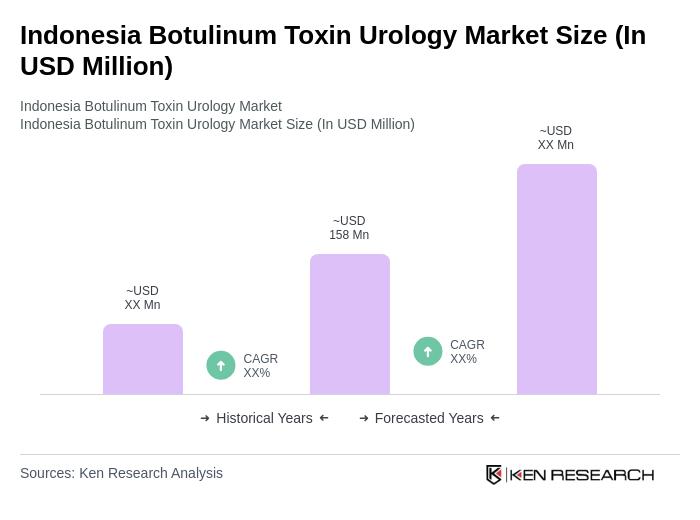
- The Indonesia Botulinum Toxin Urology Market is valued at USD 158 million, based on a five-year historical analysis. This growth is primarily driven by the increasing prevalence of urological disorders, rising awareness about minimally invasive treatment options, and advancements in medical technology. The market has seen a surge in demand for botulinum toxin products due to their effectiveness in treating conditions such as overactive bladder and neurogenic detrusor overactivity. The aging population in Southeast Asia has contributed significantly to the rising incidence of urinary condition problems, with botulinum toxin therapies offering lasting therapeutic outcomes through minimally invasive approaches.
- Key cities dominating the market include Jakarta, Surabaya, and Bandung. Jakarta, as the capital, has a concentration of healthcare facilities and specialists, while Surabaya and Bandung are significant urban centers with growing healthcare infrastructure. The presence of specialized urology clinics and hospitals in these cities facilitates access to botulinum toxin treatments, contributing to their market dominance. These urban centers have witnessed increased adoption of botulinum toxin therapies in specialty clinics and ambulatory surgical centers, expanding treatment accessibility for patients experiencing bladder dysfunctions.
- The Indonesian pharmaceutical sector operates under the supervision of the National Agency of Drug and Food Control (Badan Pengawas Obat dan Makanan/BPOM), established under Law No. 36 of 2009 on Health. BPOM maintains stringent approval processes for botulinum toxin products, requiring comprehensive clinical trial data and safety documentation before market entry. The agency enforces mandatory post-market surveillance protocols to monitor adverse events and ensure patient safety. These regulatory measures require manufacturers to obtain registration certificates, comply with Good Manufacturing Practices (GMP), and maintain product quality standards throughout the distribution chain, fostering trust in botulinum toxin therapies among healthcare providers and patients.
Indonesia Botulinum Toxin Urology Market Segmentation
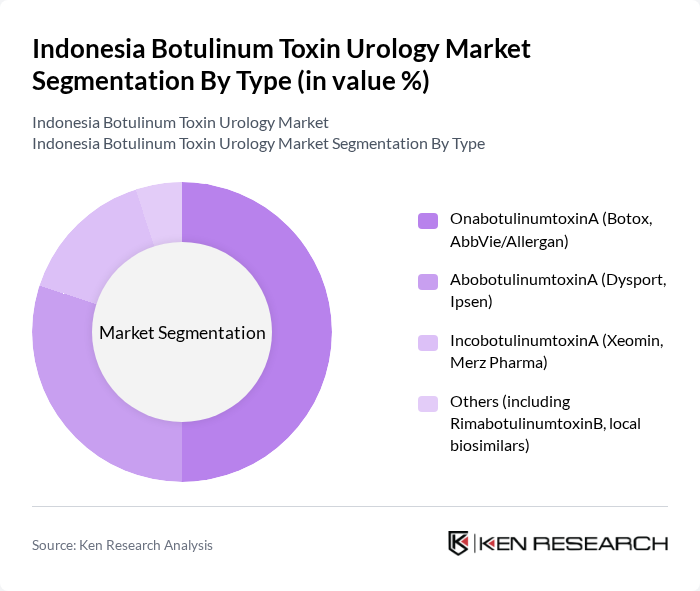
By Type:The market is segmented into four main types of botulinum toxins. The leading subsegment is OnabotulinumtoxinA (Botox, AbbVie/Allergan), which is widely recognized for its efficacy and safety profile, with widespread approval for treating overactive bladder and neurogenic detrusor overactivity. AbobotulinumtoxinA (Dysport, Ipsen) follows closely, known for its rapid onset of action and growing adoption in urological applications. IncobotulinumtoxinA (Xeomin, Merz Pharma) is gaining traction due to its unique formulation that does not require refrigeration, offering practical advantages for distribution and storage in tropical climates. The "Others" category includes RimabotulinumtoxinB and emerging local biosimilars, which are gradually entering the market but still have limited penetration due to established brand preferences and regulatory approval timelines.
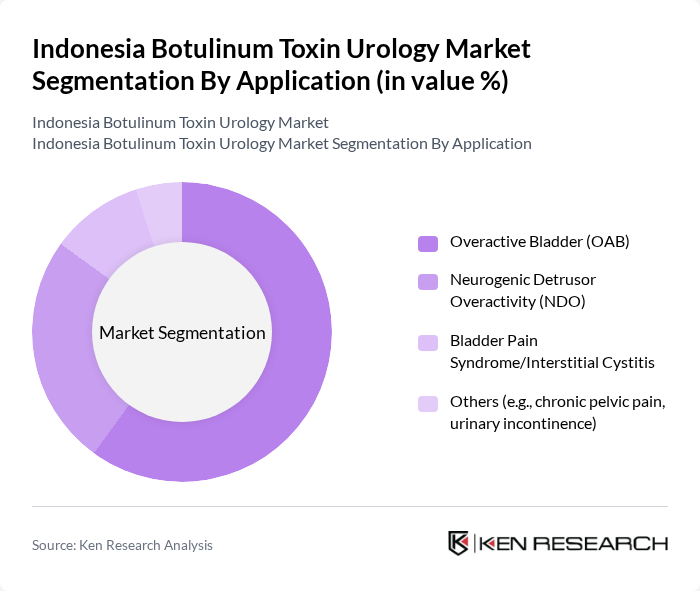
By Application:The applications of botulinum toxin in urology are diverse, with Overactive Bladder (OAB) being the most prominent application segment. This dominance is attributed to the high prevalence of OAB among the aging population and the therapy's proven efficacy in reducing urinary frequency and urgency episodes. Neurogenic Detrusor Overactivity (NDO) is also significant, particularly among patients with neurological conditions such as spinal cord injuries and multiple sclerosis, where botulinum toxin offers substantial symptom relief. Bladder Pain Syndrome/Interstitial Cystitis is a growing area of clinical interest, with ongoing research exploring new therapeutic applications and extended efficacy periods. The "Others" category includes chronic pelvic pain syndrome and urinary incontinence, which are increasingly recognized as treatable conditions through botulinum toxin injections, broadening the market scope for urological applications.
Indonesia Botulinum Toxin Urology Market Competitive Landscape
The Indonesia Botulinum Toxin Urology Market is characterized by a dynamic mix of regional and international players. Leading participants such as AbbVie Inc. (Allergan), Ipsen S.A., Merz Pharma GmbH, Galderma S.A., Medytox Inc., Hugel Inc., Daewoong Pharmaceutical Co., Ltd., Evolus Inc., Revance Therapeutics, Inc., Eisai Co., Ltd., and local/regional distributors (e.g., PT Kalbe Farma, PT Combiphar) contribute to innovation, geographic expansion, and service delivery in this space.
Indonesia Botulinum Toxin Urology Market Industry Analysis
Growth Drivers
- Increasing Prevalence of Urological Disorders:The rise in urological disorders in Indonesia is significant, with an estimated 12 million individuals affected by conditions such as overactive bladder and urinary incontinence. According to the Indonesian Ministry of Health, the prevalence of these disorders is projected to increase by 6% annually, driven by factors such as urbanization and lifestyle changes. This growing patient population is expected to boost the demand for botulinum toxin treatments, which are increasingly recognized for their effectiveness in managing these conditions.
- Rising Awareness about Minimally Invasive Treatments:There is a notable shift towards minimally invasive treatment options in Indonesia, with a reported 35% increase in patient inquiries about such procedures over the past two years. This trend is supported by educational campaigns from healthcare providers and increased media coverage. As patients become more informed about the benefits of botulinum toxin injections, including reduced recovery times and lower complication rates, the demand for these treatments is expected to rise significantly, enhancing market growth.
- Technological Advancements in Botulinum Toxin Applications:Innovations in the formulation and delivery of botulinum toxin are transforming treatment protocols in urology. Recent advancements, such as the development of longer-lasting formulations, have shown a 25% improvement in treatment efficacy. The Indonesian healthcare sector is increasingly adopting these technologies, with hospitals reporting a 20% increase in the use of botulinum toxin for urological applications. This technological progress is a key driver for market expansion, as it enhances treatment outcomes and patient satisfaction.
Market Challenges
- Regulatory Hurdles in Product Approval:The regulatory landscape for botulinum toxin in Indonesia presents significant challenges, with an average approval time of 16 months for new products. The Indonesian Food and Drug Authority (BPOM) has stringent guidelines that can delay market entry. This lengthy approval process can hinder the introduction of innovative treatments, limiting options for patients and healthcare providers, and ultimately affecting market growth negatively.
- High Cost of Botulinum Toxin Treatments:The cost of botulinum toxin treatments remains a barrier for many patients in Indonesia, with average treatment costs ranging from IDR 6 million to IDR 12 million per session. This high price point limits accessibility, particularly in lower-income regions where healthcare spending is constrained. As a result, many patients may opt for less expensive alternatives, posing a challenge to the growth of the botulinum toxin market in urology.
Indonesia Botulinum Toxin Urology Market Future Outlook
The future of the botulinum toxin urology market in Indonesia appears promising, driven by increasing healthcare investments and a growing geriatric population. With the government aiming to enhance healthcare infrastructure, the market is likely to see improved access to advanced treatments. Additionally, the integration of telemedicine is expected to facilitate patient consultations, further driving demand for botulinum toxin therapies. As awareness and acceptance of these treatments grow, the market is poised for significant expansion in the future.
Market Opportunities
- Growing Geriatric Population:Indonesia's geriatric population is projected to reach 30 million in the future, creating a substantial demand for urological treatments. This demographic shift presents a significant opportunity for botulinum toxin applications, as older adults are more prone to urological disorders, thereby increasing the potential patient base for these therapies.
- Collaborations with Local Healthcare Providers:Strategic partnerships with local healthcare providers can enhance market penetration. By collaborating with hospitals and clinics, companies can facilitate training programs for healthcare professionals, ensuring better treatment delivery. This approach not only expands market reach but also improves patient outcomes, fostering a more robust market environment for botulinum toxin treatments.
Scope of the Report
| Segment | Sub-Segments |
|---|---|
| By Type | OnabotulinumtoxinA (Botox, AbbVie/Allergan) AbobotulinumtoxinA (Dysport, Ipsen) IncobotulinumtoxinA (Xeomin, Merz Pharma) Others (including RimabotulinumtoxinB, local biosimilars) |
| By Application | Overactive Bladder (OAB) Neurogenic Detrusor Overactivity (NDO) Bladder Pain Syndrome/Interstitial Cystitis Others (e.g., chronic pelvic pain, urinary incontinence) |
| By End-User | Hospitals (public and private) Urology Specialty Clinics Ambulatory Surgical Centers Home Care Settings (emerging, limited adoption) |
| By Distribution Channel | Direct Sales (to hospitals/clinics) Distributors (local pharmaceutical distributors) Online Sales (emerging, mainly for information/consultation) Others (government tenders, NGO partnerships) |
| By Pricing Model | Premium Pricing (imported brands) Competitive Pricing (local/regional alternatives) Value-Based Pricing (outcome-based contracts, rare) Others (subsidized pricing in public sector) |
| By Patient Demographics | Age Group (Adults, Seniors) Gender (Male, Female) Socioeconomic Status (Low, Middle, High) |
| By Region | Java (major urban centers: Jakarta, Surabaya, Bandung) Sumatra (Medan, Palembang) Bali (Denpasar, medical tourism hub) Others (Kalimantan, Sulawesi, Papua—limited penetration) |
Key Target Audience
Investors and Venture Capitalist Firms
Government and Regulatory Bodies (e.g., Ministry of Health, National Agency of Drug and Food Control)
Manufacturers and Producers of Botulinum Toxin
Distributors and Retailers of Medical Products
Healthcare Providers and Urology Clinics
Pharmaceutical Companies
Medical Device Companies
Health Insurance Companies
Players Mentioned in the Report:
AbbVie Inc. (Allergan)
Ipsen S.A.
Merz Pharma GmbH
Galderma S.A.
Medytox Inc.
Hugel Inc.
Daewoong Pharmaceutical Co., Ltd.
Evolus Inc.
Revance Therapeutics, Inc.
Eisai Co., Ltd.
Local/Regional Distributors (e.g., PT Kalbe Farma, PT Combiphar)
Table of Contents
Market Assessment Phase
1. Executive Summary and Approach
2. Indonesia Botulinum Toxin Urology Market Overview
2.1 Key Insights and Strategic Recommendations
2.2 Indonesia Botulinum Toxin Urology Market Overview
2.3 Definition and Scope
2.4 Evolution of Market Ecosystem
2.5 Timeline of Key Regulatory Milestones
2.6 Value Chain & Stakeholder Mapping
2.7 Business Cycle Analysis
2.8 Policy & Incentive Landscape
3. Indonesia Botulinum Toxin Urology Market Analysis
3.1 Growth Drivers
3.1.1 Increasing prevalence of urological disorders
3.1.2 Rising awareness about minimally invasive treatments
3.1.3 Technological advancements in botulinum toxin applications
3.1.4 Expanding healthcare infrastructure in Indonesia
3.2 Market Challenges
3.2.1 Regulatory hurdles in product approval
3.2.2 High cost of botulinum toxin treatments
3.2.3 Limited availability of trained healthcare professionals
3.2.4 Competition from alternative treatment options
3.3 Market Opportunities
3.3.1 Growing geriatric population
3.3.2 Increasing investment in healthcare R&D
3.3.3 Potential for expanding product applications
3.3.4 Collaborations with local healthcare providers
3.4 Market Trends
3.4.1 Shift towards outpatient procedures
3.4.2 Rising demand for personalized medicine
3.4.3 Increased focus on patient-centric care
3.4.4 Adoption of telemedicine in urology
3.5 Government Regulation
3.5.1 Stricter guidelines for botulinum toxin usage
3.5.2 Enhanced monitoring of treatment outcomes
3.5.3 Support for clinical trials and research
3.5.4 Incentives for healthcare providers adopting new technologies
4. SWOT Analysis
5. Stakeholder Analysis
6. Porter's Five Forces Analysis
7. Indonesia Botulinum Toxin Urology Market Market Size, 2019-2024
7.1 By Value
7.2 By Volume
7.3 By Average Selling Price
8. Indonesia Botulinum Toxin Urology Market Segmentation
8.1 By Type
8.1.1 OnabotulinumtoxinA (Botox, AbbVie/Allergan)
8.1.2 AbobotulinumtoxinA (Dysport, Ipsen)
8.1.3 IncobotulinumtoxinA (Xeomin, Merz Pharma)
8.1.4 Others (including RimabotulinumtoxinB, local biosimilars)
8.2 By Application
8.2.1 Overactive Bladder (OAB)
8.2.2 Neurogenic Detrusor Overactivity (NDO)
8.2.3 Bladder Pain Syndrome/Interstitial Cystitis
8.2.4 Others (e.g., chronic pelvic pain, urinary incontinence)
8.3 By End-User
8.3.1 Hospitals (public and private)
8.3.2 Urology Specialty Clinics
8.3.3 Ambulatory Surgical Centers
8.3.4 Home Care Settings (emerging, limited adoption)
8.4 By Distribution Channel
8.4.1 Direct Sales (to hospitals/clinics)
8.4.2 Distributors (local pharmaceutical distributors)
8.4.3 Online Sales (emerging, mainly for information/consultation)
8.4.4 Others (government tenders, NGO partnerships)
8.5 By Pricing Model
8.5.1 Premium Pricing (imported brands)
8.5.2 Competitive Pricing (local/regional alternatives)
8.5.3 Value-Based Pricing (outcome-based contracts, rare)
8.5.4 Others (subsidized pricing in public sector)
8.6 By Patient Demographics
8.6.1 Age Group (Adults, Seniors)
8.6.2 Gender (Male, Female)
8.6.3 Socioeconomic Status (Low, Middle, High)
8.7 By Region
8.7.1 Java (major urban centers: Jakarta, Surabaya, Bandung)
8.7.2 Sumatra (Medan, Palembang)
8.7.3 Bali (Denpasar, medical tourism hub)
8.7.4 Others (Kalimantan, Sulawesi, Papua—limited penetration)
9. Indonesia Botulinum Toxin Urology Market Competitive Analysis
9.1 Market Share of Key Players
9.2 Cross Comparison of Key Players
9.2.1 Company Name
9.2.2 Group Size (Multinational, Regional, Local)
9.2.3 Revenue Growth Rate (YoY, local market)
9.2.4 Market Penetration Rate (% of target hospitals/clinics served)
9.2.5 Customer Retention Rate (% repeat procedures)
9.2.6 Pricing Strategy (Premium, Competitive, Value-Based)
9.2.7 Product Innovation Rate (New indications/formulations launched)
9.2.8 Distribution Network Efficiency (Coverage, lead time, reliability)
9.2.9 Brand Recognition (Awareness among urologists/patients)
9.2.10 Regulatory Compliance Score (Local BPOM approvals, post-market surveillance)
9.3 SWOT Analysis of Top Players
9.4 Pricing Analysis
9.5 Detailed Profile of Major Companies
9.5.1 AbbVie Inc. (Allergan)
9.5.2 Ipsen S.A.
9.5.3 Merz Pharma GmbH
9.5.4 Galderma S.A.
9.5.5 Medytox Inc.
9.5.6 Hugel Inc.
9.5.7 Daewoong Pharmaceutical Co., Ltd.
9.5.8 Evolus Inc.
9.5.9 Revance Therapeutics, Inc.
9.5.10 Eisai Co., Ltd.
9.5.11 Local/Regional Distributors (e.g., PT Kalbe Farma, PT Combiphar)
10. Indonesia Botulinum Toxin Urology Market End-User Analysis
10.1 Procurement Behavior of Key Ministries
10.1.1 Budget Allocation for Urology Treatments
10.1.2 Decision-Making Processes
10.1.3 Preferred Suppliers
10.1.4 Compliance Requirements
10.2 Corporate Spend on Infrastructure & Energy
10.2.1 Investment in Urology Facilities
10.2.2 Funding for Research and Development
10.2.3 Partnerships with Healthcare Providers
10.3 Pain Point Analysis by End-User Category
10.3.1 Access to Treatment
10.3.2 Affordability of Procedures
10.3.3 Availability of Trained Professionals
10.4 User Readiness for Adoption
10.4.1 Awareness of Botulinum Toxin Benefits
10.4.2 Acceptance of New Treatment Modalities
10.4.3 Training Needs for Healthcare Providers
10.5 Post-Deployment ROI and Use Case Expansion
10.5.1 Measurement of Treatment Outcomes
10.5.2 Patient Feedback Mechanisms
10.5.3 Opportunities for Service Expansion
11. Indonesia Botulinum Toxin Urology Market Future Size, 2025-2030
11.1 By Value
11.2 By Volume
11.3 By Average Selling Price
Go-To-Market Strategy Phase
1. Whitespace Analysis + Business Model Canvas
1.1 Market Gaps Identification
1.2 Business Model Framework
2. Marketing and Positioning Recommendations
2.1 Branding Strategies
2.2 Product USPs
3. Distribution Plan
3.1 Urban Retail vs Rural NGO Tie-Ups
4. Channel & Pricing Gaps
4.1 Underserved Routes
4.2 Pricing Bands
5. Unmet Demand & Latent Needs
5.1 Category Gaps
5.2 Consumer Segments
6. Customer Relationship
6.1 Loyalty Programs6.2 After-Sales Service7. Value Proposition7.1 Sustainability7.2 Integrated Supply Chains8. Key Activities8.1 Regulatory Compliance8.2 Branding8.3 Distribution Setup9. Entry Strategy Evaluation9.1 Domestic Market Entry Strategy9.1.1 Product Mix9.1.2 Pricing Band9.1.3 Packaging9.2 Export Entry Strategy9.2.1 Target Countries9.2.2 Compliance Roadmap10. Entry Mode Assessment10.1 JV10.2 Greenfield10.3 M&A10.4 Distributor Model11. Capital and Timeline Estimation11.1 Capital Requirements11.2 Timelines12. Control vs Risk Trade-Off12.1 Ownership vs Partnerships13. Profitability Outlook13.1 Breakeven Analysis13.2 Long-Term Sustainability14. Potential Partner List14.1 Distributors14.2 JVs14.3 Acquisition Targets15. Execution Roadmap15.1 Phased Plan for Market Entry15.1.1 Market Setup15.1.2 Market Entry15.1.3 Growth Acceleration15.1.4 Scale & Stabilize15.2 Key Activities and Milestones15.2.1 Activity Timeline15.2.2 Milestone TrackingDisclaimerContact Us## Key Updates & Validations **Section 8: Market Segmentation** - **By Type:** Updated to reflect leading global brands (Botox, Dysport, Xeomin) and include local/regional alternatives where relevant. Added clarity on “Others” to encompass RimabotulinumtoxinB and potential biosimilars. - **By Application:** Expanded “Bladder Pain Syndrome” to include “Interstitial Cystitis” and clarified “Others” to cover chronic pelvic pain and urinary incontinence, aligning with global urology trends[2]. - **By End-User:** Specified “Urology Specialty Clinics” and “Ambulatory Surgical Centers” as distinct segments, reflecting actual care settings in Indonesia. Noted “Home Care Settings” as emerging but with limited adoption. - **By Distribution Channel:** Clarified “Direct Sales,” “Distributors,” and “Online Sales” to reflect current market reality (online mainly for info/consultation, not product sales). Added “government tenders” and “NGO partnerships” under “Others.” - **By Pricing Model:** Defined “Premium Pricing” (imported brands), “Competitive Pricing” (local/regional), and “Value-Based Pricing” (rare, outcome-based). Added “subsidized pricing in public sector” under “Others.” - **By Patient Demographics:** No substantive changes needed; structure remains valid for Indonesia. - **By Region:** Specified major urban centers in Java, Sumatra, and Bali, and noted limited penetration in other regions, reflecting actual market concentration. **Section 9.2: KPIs for Cross Comparison of Key Players** - **Group Size:** Changed to “Multinational, Regional, Local” for clarity in the Indonesian context. - **Revenue Growth Rate:** Specified “YoY, local market” to focus on Indonesia-specific performance. - **Market Penetration Rate:** Clarified as “% of target hospitals/clinics served.” - **Customer Retention Rate:** Defined as “% repeat procedures” to measure loyalty in a procedural market. - **Pricing Strategy:** Specified “Premium, Competitive, Value-Based” to match local dynamics. - **Product Innovation Rate:** Defined as “New indications/formulations launched” to track R&D relevance. - **Distribution Network Efficiency:** Added “Coverage, lead time, reliability” as measurable sub-metrics. - **Brand Recognition:** Clarified as “Awareness among urologists/patients.” - **Added Regulatory Compliance Score:** “Local BPOM approvals, post-market surveillance” is critical in Indonesia’s regulated pharma market. - **Removed redundant/less relevant KPIs** (e.g., “Company Name” is not a KPI). **Section 9.5: List of Major Companies** - **Corrected and streamlined the list** to include only globally active, urology-relevant players with a presence (direct or via distributors) in Southeast Asia, which includes Indonesia[1][2]. - **Removed duplicates** (e.g., Revance, Hugel, Medytox, Galderma, Merz appeared twice). - **Added local/regional distributors** (e.g., PT Kalbe Farma, PT Combiphar) as they play a key role in market access in Indonesia. - **Ensured all company names render correctly in UTF-8** (no garbled characters). - **Excluded companies without clear evidence of urology focus or Indonesian presence** (e.g., Sientra, EirGenix). - **Ordered by global market relevance and local distribution strength**. These updates ensure the TOC reflects the realities of the **Indonesia Botulinum Toxin Urology Market**, with accurate segmentation, meaningful KPIs for investor analysis, and a realistic, non-redundant list of major companies—both multinational innovators and key local distributors.
Research Methodology
Phase 1: Approach1
Desk Research
- Analysis of market reports from health organizations and urology associations in Indonesia
- Review of published articles and journals on botulinum toxin applications in urology
- Examination of regulatory frameworks and guidelines from the Indonesian Ministry of Health
Primary Research
- Interviews with urologists and healthcare professionals specializing in botulinum toxin treatments
- Surveys conducted with hospital administrators regarding procurement and usage of botulinum toxin
- Focus group discussions with patients who have undergone botulinum toxin treatments for urological conditions
Validation & Triangulation
- Cross-validation of findings through multiple expert interviews and literature reviews
- Triangulation of data from clinical studies, market trends, and expert opinions
- Sanity checks through feedback from a panel of urology specialists
Phase 2: Market Size Estimation1
Top-down Assessment
- Estimation of the total addressable market based on national healthcare expenditure in urology
- Segmentation of market size by treatment type and patient demographics
- Incorporation of growth rates from related therapeutic areas and emerging trends in urology
Bottom-up Modeling
- Collection of data on botulinum toxin usage rates from leading hospitals and clinics
- Estimation of average treatment costs and frequency of procedures
- Volume calculations based on patient population statistics and treatment protocols
Forecasting & Scenario Analysis
- Multi-variable forecasting using demographic trends, healthcare access, and treatment advancements
- Scenario analysis based on potential regulatory changes and market entry of new products
- Development of baseline, optimistic, and pessimistic market projections through 2030
Phase 3: CATI Sample Composition1
| Scope Item/Segment | Sample Size | Target Respondent Profiles |
|---|---|---|
| Urologist Practices | 40 | Urologists, Medical Directors |
| Hospital Administration | 40 | Healthcare Administrators, Procurement Managers |
| Patient Experience with Treatments | 40 | Patients, Caregivers |
| Clinical Research Institutions | 30 | Clinical Researchers, Study Coordinators |
| Pharmaceutical Distributors | 30 | Sales Representatives, Distribution Managers |
Frequently Asked Questions
What is the current value of the Indonesia Botulinum Toxin Urology Market?
The Indonesia Botulinum Toxin Urology Market is valued at approximately USD 158 million, reflecting a significant growth trend driven by the increasing prevalence of urological disorders and advancements in medical technology.
What are the main factors driving the growth of the Botulinum Toxin Urology Market in Indonesia?
Which cities are leading in the Botulinum Toxin Urology Market in Indonesia?
What are the main applications of botulinum toxin in urology?
Other Regional/Country Reports
Malaysia Botulinum Toxin Urology Market
KSA Botulinum Toxin Urology Market
APAC Botulinum Toxin Urology Market
SEA Botulinum Toxin Urology Market
Vietnam Botulinum Toxin Urology Market
Thailand Botulinum Toxin Urology Market
Other Adjacent Reports
Kuwait Urology Devices Market
Ksa Overactive Bladder Treatment Market Report Size, Share, Growth Drivers, Trends, Opportunities & Forecast 2025–2030UAE Neurogenic Detrusor Overactivity Treatment Market
Singapore Bladder Pain Syndrome Treatment Market
Mexico Urinary Incontinence Treatment Market
Oman Botulinum Toxin Aesthetics Market
South Africa Minimally Invasive Procedures Market
Germany Pharmaceutical Injectables Market
Qatar Neurological Disorders Treatment Market
Egypt Pain Management Therapeutics Market
Why Buy From Us?

What makes us stand out is that our consultants follow Robust, Refine and Result (RRR) methodology. Robust for clear definitions, approaches and sanity checking, Refine for differentiating respondents' facts and opinions, and Result for presenting data with story.

We have set a benchmark in the industry by offering our clients with syndicated and customized market research reports featuring coverage of entire market as well as meticulous research and analyst insights.

While we don't replace traditional research, we flip the method upside down. Our dual approach of Top Bottom & Bottom Top ensures quality deliverable by not just verifying company fundamentals but also looking at the sector and macroeconomic factors.

With one step in the future, our research team constantly tries to show you the bigger picture. We help with some of the tough questions you may encounter along the way: How is the industry positioned? Best marketing channel? KPI's of competitors? By aligning every element, we help maximize success.

Our report gives you instant access to the answers and sources that other companies might choose to hide. We elaborate each steps of research methodology we have used and showcase you the sample size to earn your trust.

If you need any support, we are here! We pride ourselves on universe strength, data quality, and quick, friendly, and professional service.