About the Report
Base Year 2024Indonesia In-Flight Catering Services Market Overview
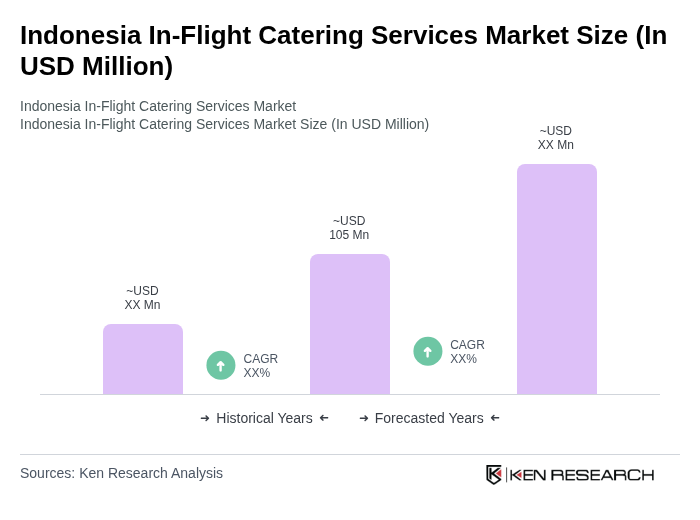
- The Indonesia In-Flight Catering Services Market is valued at USD 105 million, based on a five-year historical analysis. This growth is primarily driven by the increasing number of air travelers, rising disposable incomes, and a growing preference for premium in-flight dining experiences. The expansion of both domestic and international airlines, along with the proliferation of low-cost carriers and the introduction of diverse meal options, has further fueled demand for catering services, enhancing the overall market landscape. Airlines are increasingly focusing on menu innovation, including specialty meals and healthier options, to meet evolving passenger expectations and differentiate their services.
- Key cities such asJakarta, Bali, and Surabayadominate the market due to their status as major travel hubs. Jakarta, being the capital, serves as a central point for international flights, while Bali attracts a significant number of tourists. Surabaya, as an emerging economic center, also contributes to the growing demand for in-flight catering services, making these regions pivotal in shaping market dynamics. The concentration of international and domestic flights in these cities drives higher volumes of catering orders and supports the presence of leading catering service providers.
- In 2023, the Indonesian government implemented regulations to enhance food safety standards in the aviation sector. This includes mandatory compliance with theIndonesian National Standard (SNI) for Food Safety in Aviation Catering, as stipulated by SNI 01-4852-1998 and enforced by the National Standardization Agency of Indonesia (BSN). The regulation requires all in-flight catering providers to adhere to strict hygiene, preparation, and storage protocols, with regular audits and certification to ensure passenger safety and consistent meal quality.
Indonesia In-Flight Catering Services Market Segmentation
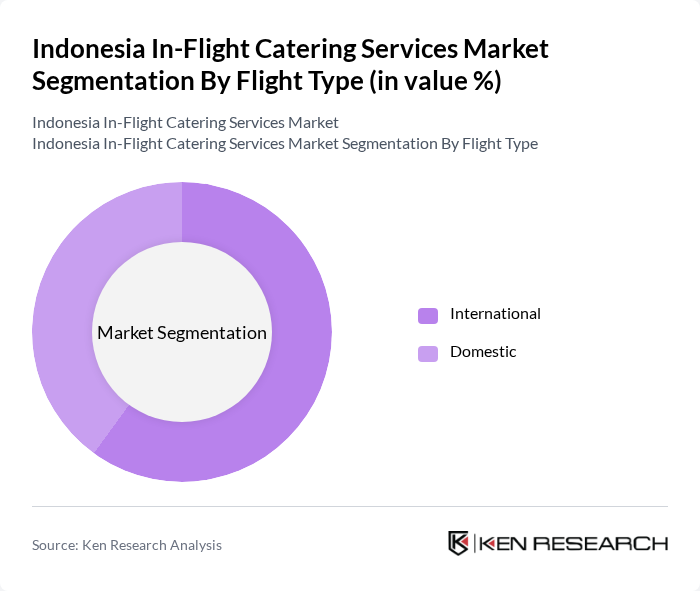
By Flight Type:The market is segmented into International and Domestic flights. The International segment is driven by the increasing number of international travelers and the demand for diverse culinary experiences. The Domestic segment benefits from the growing local tourism and business travel, with airlines focusing on enhancing passenger satisfaction through quality catering services. The International segment currently holds the largest share, reflecting Indonesia’s role as a regional air travel hub and the higher meal service standards required for long-haul flights.
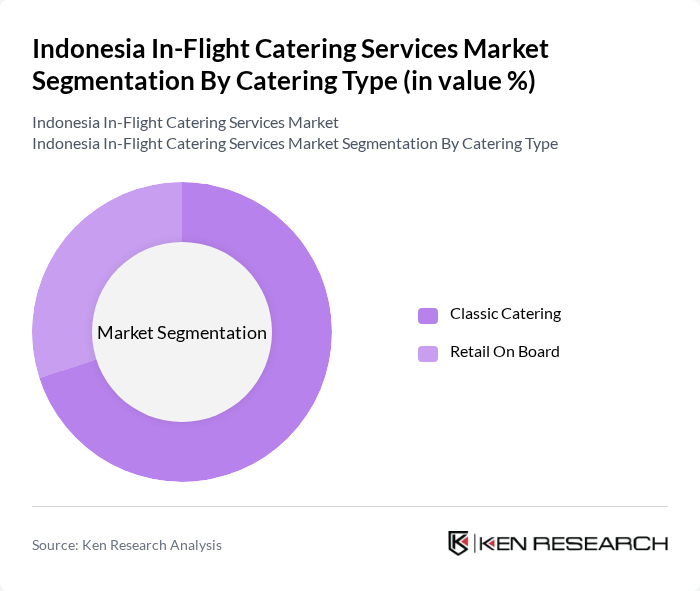
By Catering Type:The catering services are categorized into Classic Catering and Retail On Board. Classic Catering focuses on providing full meals with a variety of options, appealing to premium travelers and full-service carriers. Retail On Board caters to budget-conscious passengers by offering a selection of snacks and beverages for purchase, reflecting the trend towards more flexible and personalized in-flight dining options. The market is witnessing a shift towards healthier and specialty meal offerings, including vegetarian, halal, and gluten-free options, to address diverse passenger preferences.
Indonesia In-Flight Catering Services Market Competitive Landscape
The Indonesia In-Flight Catering Services Market is characterized by a dynamic mix of regional and international players. Leading participants such as Aerofood ACS (Aerowisata Catering Services), LSG Sky Chefs Indonesia, SATS Ltd. (SATS Indonesia), Dnata Catering Indonesia, PT. Indocater, PT. Cardig Aero Services Tbk (CAS Food), PT. Angkasa Boga, PT. Pangan Lestari, PT. Cipta Rasa Prima, PT. Bina Rasa, PT. Mitra Boga Persada, PT. Golden Harvest Catering, PT. Rasa Sayang, AirAsia Food Services Indonesia, and Prima Catering contribute to innovation, geographic expansion, and service delivery in this space. These companies are investing in technology upgrades, food safety certifications, and menu diversification to strengthen their market positions and meet evolving airline requirements.
Indonesia In-Flight Catering Services Market Industry Analysis
Growth Drivers
- Increasing Air Travel Demand:The Indonesian air travel market is projected to reach 115 million passengers in future, up from 105 million in future, driven by a growing middle class and increased connectivity. The International Air Transport Association (IATA) anticipates a 6% annual growth rate in passenger numbers, which directly boosts demand for in-flight catering services. This surge in air travel is expected to enhance the revenue streams for catering providers, as airlines seek to improve passenger experience through quality meal offerings.
- Rising Disposable Income:Indonesia's GDP per capita is expected to rise to approximately $4,580 in future, reflecting a 5% increase from future. This growth in disposable income allows consumers to spend more on travel and premium services, including in-flight meals. As more Indonesians can afford air travel, airlines are responding by enhancing their catering services to meet the expectations of a more affluent customer base, thereby driving market growth in the in-flight catering sector.
- Expansion of Airline Services:The Indonesian airline industry is witnessing significant expansion, with new routes and increased flight frequencies. In future, it is estimated that 15 new airlines will enter the market, contributing to a projected 10% increase in domestic flights. This expansion necessitates enhanced in-flight catering services to accommodate the growing number of passengers. Airlines are investing in diverse meal options to attract and retain customers, further propelling the in-flight catering market.
Market Challenges
- Stringent Regulatory Compliance:The in-flight catering industry in Indonesia faces rigorous regulatory requirements, including food safety standards set by the National Agency of Drug and Food Control (BPOM). Compliance with these regulations can be costly and time-consuming, with penalties for non-compliance reaching up to $50,000. This challenge can deter new entrants and strain existing providers, impacting their operational efficiency and profitability in a competitive market.
- Supply Chain Disruptions:The in-flight catering sector is vulnerable to supply chain disruptions, particularly due to Indonesia's geographical diversity. In future, it is anticipated that logistical challenges will increase costs by approximately 15% due to rising fuel prices and transportation issues. These disruptions can lead to inconsistent food quality and availability, negatively affecting customer satisfaction and airline reputations, thereby posing a significant challenge to market stability.
Indonesia In-Flight Catering Services Market Future Outlook
The future of Indonesia's in-flight catering services market appears promising, driven by increasing air travel and evolving consumer preferences. Airlines are likely to invest in innovative catering solutions, focusing on sustainability and health-conscious options. The integration of technology in food preparation and ordering processes will enhance operational efficiency. As the market matures, providers will need to adapt to changing regulations and consumer demands, ensuring they remain competitive in a rapidly evolving landscape.
Market Opportunities
- Growth in Low-Cost Carriers:The rise of low-cost carriers in Indonesia presents a significant opportunity for in-flight catering services. With an expected increase of 20% in low-cost flights by future, catering providers can develop affordable meal options tailored to budget-conscious travelers, enhancing their market share and profitability in this segment.
- Demand for Health-Conscious Options:As health awareness rises among consumers, there is a growing demand for nutritious meal options in-flight. Catering companies can capitalize on this trend by offering organic, low-calorie, and vegetarian meals. This shift is expected to attract health-conscious travelers, potentially increasing sales by 30% in the next year as airlines adapt their menus to meet these preferences.
Scope of the Report
| Segment | Sub-Segments |
|---|---|
| By Flight Type | International Domestic |
| By Catering Type | Classic Catering Retail On Board |
| By Aircraft Seating Class | First Class Business Class Economy Class |
| By Flight Category | Full-Service Carriers Low-Cost Carriers |
| By Food Type | Meals Confectionery Bakery Beverages Convenience Food |
| By Service Model | In-House Catering Outsourced Catering Hybrid Model |
| By Meal Timing | Breakfast Lunch Dinner Snacks |
| By Customer Segment | Business Class Economy Class First Class |
| By Distribution Channel | Direct Sales Online Platforms Travel Agencies |
| By Region | Java Sumatra Bali Kalimantan Others |
Key Target Audience
Investors and Venture Capitalist Firms
Government and Regulatory Bodies (e.g., Ministry of Transportation, Indonesian Civil Aviation Authority)
Airline Companies
Catering Service Providers
Food and Beverage Suppliers
Logistics and Supply Chain Companies
Airport Authorities
Health and Safety Regulatory Agencies
Players Mentioned in the Report:
Aerofood ACS (Aerowisata Catering Services)
LSG Sky Chefs Indonesia
SATS Ltd. (SATS Indonesia)
Dnata Catering Indonesia
PT. Indocater
PT. Cardig Aero Services Tbk (CAS Food)
PT. Angkasa Boga
PT. Pangan Lestari
PT. Cipta Rasa Prima
PT. Bina Rasa
PT. Mitra Boga Persada
PT. Golden Harvest Catering
PT. Rasa Sayang
AirAsia Food Services Indonesia
Prima Catering
Table of Contents
Market Assessment Phase
1. Executive Summary and Approach
2. Indonesia In-Flight Catering Services Market Overview
2.1 Key Insights and Strategic Recommendations
2.2 Indonesia In-Flight Catering Services Market Overview
2.3 Definition and Scope
2.4 Evolution of Market Ecosystem
2.5 Timeline of Key Regulatory Milestones
2.6 Value Chain & Stakeholder Mapping
2.7 Business Cycle Analysis
2.8 Policy & Incentive Landscape
3. Indonesia In-Flight Catering Services Market Analysis
3.1 Growth Drivers
3.1.1 Increasing Air Travel Demand
3.1.2 Rising Disposable Income
3.1.3 Expansion of Airline Services
3.1.4 Focus on Quality and Variety of Food
3.2 Market Challenges
3.2.1 Stringent Regulatory Compliance
3.2.2 Supply Chain Disruptions
3.2.3 High Competition Among Providers
3.2.4 Fluctuating Food Prices
3.3 Market Opportunities
3.3.1 Growth in Low-Cost Carriers
3.3.2 Demand for Health-Conscious Options
3.3.3 Technological Advancements in Food Preparation
3.3.4 Expansion into Remote Destinations
3.4 Market Trends
3.4.1 Increasing Focus on Sustainability
3.4.2 Customization of Meal Options
3.4.3 Integration of Local Cuisine
3.4.4 Use of Digital Platforms for Ordering
3.5 Government Regulation
3.5.1 Food Safety Standards
3.5.2 Licensing Requirements for Caterers
3.5.3 Health Regulations for Food Handling
3.5.4 Environmental Regulations on Waste Management
4. SWOT Analysis
5. Stakeholder Analysis
6. Porter's Five Forces Analysis
7. Indonesia In-Flight Catering Services Market Market Size, 2019-2024
7.1 By Value
7.2 By Volume
7.3 By Average Selling Price
8. Indonesia In-Flight Catering Services Market Segmentation
8.1 By Flight Type
8.1.1 International
8.1.2 Domestic
8.2 By Catering Type
8.2.1 Classic Catering
8.2.2 Retail On Board
8.3 By Aircraft Seating Class
8.3.1 First Class
8.3.2 Business Class
8.3.3 Economy Class
8.4 By Flight Category
8.4.1 Full-Service Carriers
8.4.2 Low-Cost Carriers
8.5 By Food Type
8.5.1 Meals
8.5.2 Confectionery
8.5.3 Bakery
8.5.4 Beverages
8.5.5 Convenience Food
8.6 By Service Model
8.6.1 In-House Catering
8.6.2 Outsourced Catering
8.6.3 Hybrid Model
8.7 By Meal Timing
8.7.1 Breakfast
8.7.2 Lunch
8.7.3 Dinner
8.7.4 Snacks
8.8 By Customer Segment
8.8.1 Business Class
8.8.2 Economy Class
8.8.3 First Class
8.9 By Distribution Channel
8.9.1 Direct Sales
8.9.2 Online Platforms
8.9.3 Travel Agencies
8.10 By Region
8.10.1 Java
8.10.2 Sumatra
8.10.3 Bali
8.10.4 Kalimantan
8.10.5 Others
9. Indonesia In-Flight Catering Services Market Competitive Analysis
9.1 Market Share of Key Players
9.2 KPIs for Cross Comparison of Key Players
9.2.1 Company Name
9.2.2 Group Size (Large, Medium, or Small as per industry convention)
9.2.3 Revenue (USD Million)
9.2.4 Revenue Growth Rate (%)
9.2.5 Number of Airline Clients
9.2.6 Meals Served per Year
9.2.7 Market Share (%)
9.2.8 Customer Satisfaction Score
9.2.9 Food Safety Compliance Rate (%)
9.2.10 On-Time Delivery Rate (%)
9.2.11 Innovation Index (e.g., new menu launches, digitalization)
9.2.12 Brand Recognition Score
9.3 SWOT Analysis of Top Players
9.4 Pricing Analysis
9.5 Detailed Profile of Major Companies
9.5.1 Aerofood ACS (Aerowisata Catering Services)
9.5.2 LSG Sky Chefs Indonesia
9.5.3 SATS Ltd. (SATS Indonesia)
9.5.4 Dnata Catering Indonesia
9.5.5 PT. Indocater
9.5.6 PT. Cardig Aero Services Tbk (CAS Food)
9.5.7 PT. Angkasa Boga
9.5.8 PT. Pangan Lestari
9.5.9 PT. Cipta Rasa Prima
9.5.10 PT. Bina Rasa
9.5.11 PT. Mitra Boga Persada
9.5.12 PT. Golden Harvest Catering
9.5.13 PT. Rasa Sayang
9.5.14 AirAsia Food Services Indonesia
9.5.15 Prima Catering
10. Indonesia In-Flight Catering Services Market End-User Analysis
10.1 Procurement Behavior of Key Ministries
10.1.1 Budget Allocation for Catering Services
10.1.2 Preferred Vendors
10.1.3 Compliance with Local Sourcing
10.1.4 Quality Assurance Standards
10.2 Corporate Spend on Infrastructure & Energy
10.2.1 Investment in Catering Facilities
10.2.2 Expenditure on Food Safety Equipment
10.2.3 Budget for Staff Training
10.2.4 Technology Upgrades
10.3 Pain Point Analysis by End-User Category
10.3.1 Quality of Food
10.3.2 Timeliness of Service
10.3.3 Variety of Options
10.3.4 Cost Management
10.4 User Readiness for Adoption
10.4.1 Awareness of Catering Options
10.4.2 Willingness to Pay for Quality
10.4.3 Feedback Mechanisms
10.4.4 Training Needs
10.5 Post-Deployment ROI and Use Case Expansion
10.5.1 Measurement of Customer Satisfaction
10.5.2 Analysis of Repeat Business
10.5.3 Cost-Benefit Analysis
10.5.4 Opportunities for Menu Expansion
11. Indonesia In-Flight Catering Services Market Future Size, 2025-2030
11.1 By Value
11.2 By Volume
11.3 By Average Selling Price
Go-To-Market Strategy Phase
1. Whitespace Analysis + Business Model Canvas
1.1 Market Gaps Identification
1.2 Value Proposition Development
1.3 Revenue Streams
1.4 Cost Structure Analysis
1.5 Key Partnerships
1.6 Customer Segments
1.7 Channels
2. Marketing and Positioning Recommendations
2.1 Branding Strategies
2.2 Product USPs
3. Distribution Plan
3.1 Urban Retail vs Rural NGO Tie-ups
4. Channel & Pricing Gaps
4.1 Underserved Routes
4.2 Pricing Bands
5. Unmet Demand & Latent Needs
5.1 Category Gaps
5.2 Consumer Segments
6. Customer Relationship
6.1 Loyalty Programs
6.2 After-Sales Service
7. Value Proposition
7.1 Sustainability
7.2 Integrated Supply Chains
8. Key Activities
8.1 Regulatory Compliance
8.2 Branding
8.3 Distribution Setup
9. Entry Strategy Evaluation
9.1 Domestic Market Entry Strategy
9.1.1 Product Mix
9.1.2 Pricing Band
9.1.3 Packaging
9.2 Export Entry Strategy
9.2.1 Target Countries
9.2.2 Compliance Roadmap
10. Entry Mode Assessment
10.1 JV
10.2 Greenfield
10.3 M&A
10.4 Distributor Model
11. Capital and Timeline Estimation
11.1 Capital Requirements
11.2 Timelines
12. Control vs Risk Trade-Off
12.1 Ownership vs Partnerships
13. Profitability Outlook
13.1 Breakeven Analysis
13.2 Long-Term Sustainability
14. Potential Partner List
14.1 Distributors
14.2 JVs
14.3 Acquisition Targets
15. Execution Roadmap
15.1 Phased Plan for Market Entry
15.1.1 Market Setup
15.1.2 Market Entry
15.1.3 Growth Acceleration
15.1.4 Scale & Stabilize
15.2 Key Activities and Milestones
15.2.1 Milestone Planning
15.2.2 Activity Tracking
Research Methodology
Phase 1: Approach1
Desk Research
- Industry reports from aviation and catering associations in Indonesia
- Government publications on aviation regulations and food safety standards
- Market analysis from trade journals focusing on in-flight services and catering trends
Primary Research
- Interviews with airline executives responsible for in-flight catering decisions
- Surveys with catering service providers to understand operational capabilities
- Field visits to catering facilities to assess service quality and compliance
Validation & Triangulation
- Cross-validation of data through multiple industry sources and expert opinions
- Triangulation of findings from desk research and primary interviews
- Sanity checks through feedback from industry panels and focus groups
Phase 2: Market Size Estimation1
Top-down Assessment
- Analysis of total airline passenger traffic growth in Indonesia
- Estimation of average spend per passenger on in-flight catering services
- Incorporation of trends in premium services and dietary preferences
Bottom-up Modeling
- Volume estimates based on the number of flights and average passenger load
- Cost analysis of catering contracts with airlines and service providers
- Calculation of revenue streams from various catering service segments
Forecasting & Scenario Analysis
- Multi-variable forecasting considering economic growth and tourism trends
- Scenario analysis based on potential regulatory changes and health crises
- Development of baseline, optimistic, and pessimistic market growth projections through 2030
Phase 3: CATI Sample Composition1
| Scope Item/Segment | Sample Size | Target Respondent Profiles |
|---|---|---|
| Airline In-Flight Catering Services | 100 | Airline Executives, Catering Managers |
| Catering Service Providers | 75 | Operations Managers, Quality Assurance Managers |
| Regulatory Compliance in Catering | 45 | Food Safety Inspectors, Regulatory Affairs Managers |
| Consumer Preferences for In-Flight Meals | 110 | Frequent Flyers, Travel Enthusiasts |
| Trends in Sustainable Catering Practices | 60 | Sustainability Officers, Procurement Specialists |
Frequently Asked Questions
What is the current value of the Indonesia In-Flight Catering Services Market?
The Indonesia In-Flight Catering Services Market is valued at approximately USD 105 million, reflecting growth driven by increasing air travel, rising disposable incomes, and a demand for premium in-flight dining experiences.
Which cities are the main hubs for in-flight catering services in Indonesia?
What regulations govern food safety in Indonesia's in-flight catering services?
What are the main growth drivers for the in-flight catering market in Indonesia?
Other Regional/Country Reports
Malaysia In-flight Catering Services Market
KSA In-flight Catering Services Market
APAC In-flight Catering Services Market
SEA In-flight Catering Services Market
Vietnam In-flight Catering Services Market
Thailand In-flight Catering Services Market
Other Adjacent Reports
Indonesia Airline Ground Handling Market
Belgium Aviation Logistics Market
Qatar Food Supply Chain Market
Kuwait Hospitality Services Market
Kuwait Tourism Catering Market
KSA Airport Retail Market
Kuwait Meal Preparation Equipment Market
Singapore Food Safety Compliance Market
KSA sustainable packaging market report Size, Share, Growth Drivers, Trends, Opportunities & Forecast 2025–2030Malaysia Halal Food Services Market
Why Buy From Us?

What makes us stand out is that our consultants follow Robust, Refine and Result (RRR) methodology. Robust for clear definitions, approaches and sanity checking, Refine for differentiating respondents' facts and opinions, and Result for presenting data with story.

We have set a benchmark in the industry by offering our clients with syndicated and customized market research reports featuring coverage of entire market as well as meticulous research and analyst insights.

While we don't replace traditional research, we flip the method upside down. Our dual approach of Top Bottom & Bottom Top ensures quality deliverable by not just verifying company fundamentals but also looking at the sector and macroeconomic factors.

With one step in the future, our research team constantly tries to show you the bigger picture. We help with some of the tough questions you may encounter along the way: How is the industry positioned? Best marketing channel? KPI's of competitors? By aligning every element, we help maximize success.

Our report gives you instant access to the answers and sources that other companies might choose to hide. We elaborate each steps of research methodology we have used and showcase you the sample size to earn your trust.

If you need any support, we are here! We pride ourselves on universe strength, data quality, and quick, friendly, and professional service.