About the Report
Base Year 2024Indonesia Pacific Underwear Market Overview
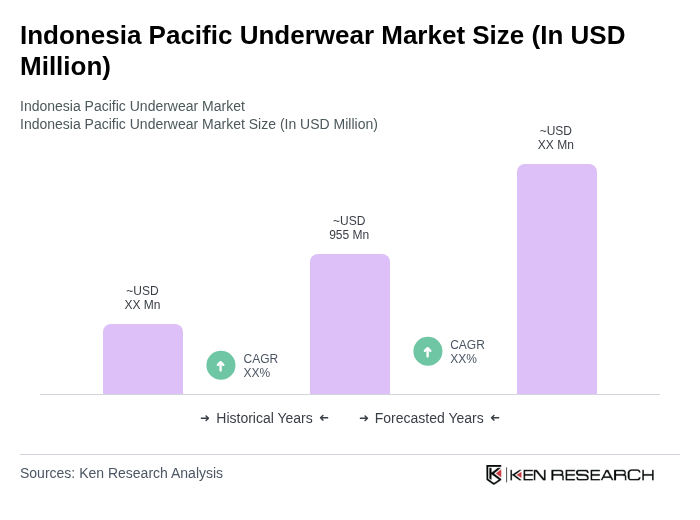
- The Indonesia Pacific Underwear Market is valued at USD 955 million, based on a five-year historical analysis. This growth is primarily driven by rising fashion consciousness, premiumization trends, the increasing focus on comfort and hygiene, and the adoption of sustainable and performance fabrics such as moisture-wicking and seamless designs. E-commerce expansion and athleisure influences are also fueling demand, supporting market dynamics in line with evolving consumer preferences.
- Key players in this market include Calvin Klein, Hanesbrands Inc., Jockey, Victoria’s Secret, Uniqlo, H&M, and Triumph International. These companies capitalize on inclusive sizing, sustainable lines, and digital outreach, benefiting from increasing middle-class disposable income, digital retail channels, and lifestyle-driven consumer behavior, enhancing their market leadership across diverse Indonesian demographics.
- In 2024, Indonesia's government implemented safeguard import duties under Finance Minister Regulation No. 67/2025 on cotton yarn and actions to curb illegal used-clothing imports. These measures bolster domestic textile and underwear manufacturing, further supported by rising investment levels, export recovery, and improved utilization rates within the textile sector.
Indonesia Pacific Underwear Market Segmentation
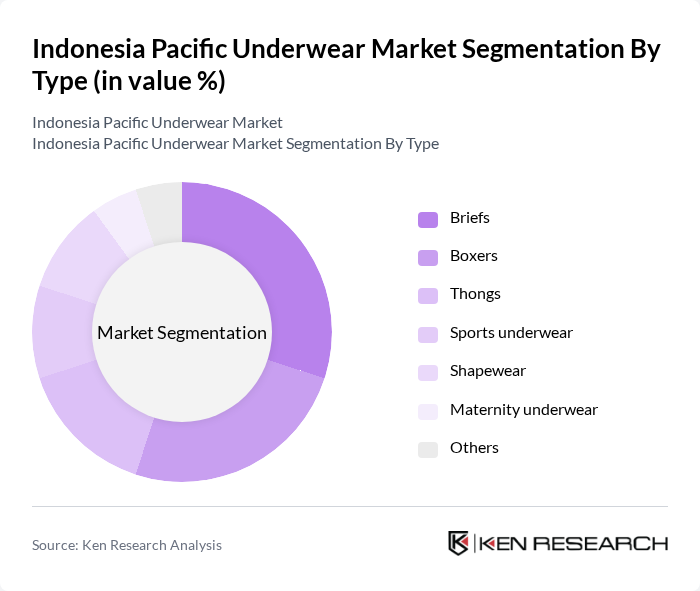
By Type:The underwear market in Indonesia is segmented into various types, including briefs, boxers, thongs, sports underwear, shapewear, maternity underwear, and others. Among these, briefs and boxers dominate the market due to their widespread acceptance and comfort. The increasing trend towards athleisure has also boosted the demand for sports underwear, while shapewear and maternity underwear are gaining traction as consumers seek functional yet stylish options.
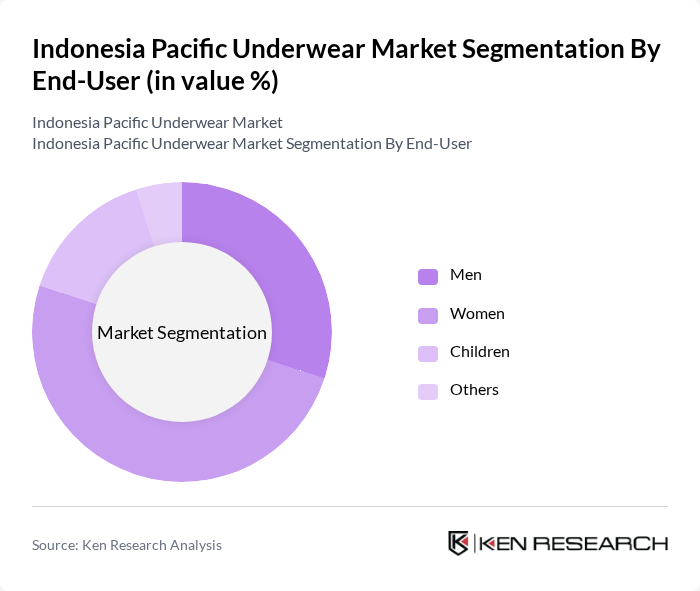
By End-User:The end-user segmentation of the underwear market includes men, women, children, and others. Women represent the largest segment due to their diverse needs for various styles and functionalities, including fashion and comfort. The men's segment is also significant, driven by increasing awareness of personal grooming and fashion. The children's segment is growing as parents become more conscious of quality and comfort in children's clothing.
Indonesia Pacific Underwear Market Competitive Landscape
The Indonesia Pacific Underwear Market is characterized by a dynamic mix of regional and international players. Leading participants such as PT. Sritex, PT. Pan Brothers Tbk, PT. Adis Dimension Footwear, PT. Gistex Textile Manufactory, PT. Indorama Synthetics Tbk, PT. Djarum, PT. Trisula International Tbk, PT. Citra Borneo Indah, PT. Kewalram Indonesia, PT. Sumber Alfaria Trijaya Tbk, PT. Mitra Adiperkasa Tbk, PT. Tiga Pilar Sejahtera Food Tbk, PT. Bina Busana Internusa, PT. Sumber Berkat Abadi, and PT. Citra Lestari contribute to innovation, geographic expansion, and service delivery in this space.
Indonesia Pacific Underwear Market Industry Analysis
Growth Drivers
- Robust National GDP and Rising Disposable Income:Indonesia’s nominal GDP reached USD 4,662.9 billion in future, with a GDP per capita of USD 1,396. This economic growth enhances consumer purchasing power, particularly in the apparel and underwear sectors. As disposable income rises, households are more inclined to spend on quality clothing, including underwear, which is essential for daily comfort and hygiene. This trend is expected to drive significant growth in the underwear market as consumers seek better quality products.
- Strong Investment into Textile, Apparel & Footwear Sector:Total investment in Indonesia's textile sector surged to IDR 39.21 trillion in future, up from IDR 29.92 trillion in the previous year. Specifically, apparel investment increased from IDR 4.53 trillion to IDR 10.20 trillion. This influx of capital indicates robust investor confidence and a commitment to scaling production capabilities, including underwear manufacturing. Enhanced investment is likely to lead to improved product offerings and increased market competition, benefiting consumers.
- Expanding Domestic Market Potential:The average per-capita monthly expenditure on clothing, footwear, and headgear was IDR 35,457 from March 2020 to future, with the domestic market potential for textiles estimated at IDR 119.82 trillion. This substantial market potential reflects strong consumer demand for apparel, including underwear. As urbanization continues and lifestyles evolve, the demand for diverse and quality underwear options is expected to grow, presenting significant opportunities for brands.
Market Challenges
- Surge in Illicit Imports and Factory Closures:By future, approximately 60 textile companies in Indonesia shut down, resulting in around 250,000 job losses. The influx of illegal imports disrupts local production, leading to reduced orders and threatening labor-intensive segments like underwear manufacturing. This challenge not only affects employment but also undermines the competitiveness of local brands, making it difficult for them to maintain market share against cheaper, unregulated products.
- Workforce Decline in TPT Sector:The workforce in the textile, apparel, and footwear (TPT) sector decreased from 3.98 million in the previous year to 3.87 million in future. This decline presents significant challenges in scaling production and meeting the growing demand for underwear. A shrinking labor pool can lead to increased labor costs and production delays, ultimately impacting the overall efficiency and profitability of manufacturers in the sector.
Indonesia Pacific Underwear Market Future Outlook
The future of the Indonesia Pacific underwear market appears promising, driven by increasing domestic utilization rates and a shift towards sustainable production practices. With targeted industry utilization rates expected to reach 70 percent by the second half of future, local manufacturers may benefit from reduced reliance on imports. Additionally, the government's support for environmentally friendly technologies could foster innovation in sustainable underwear products, appealing to a growing segment of eco-conscious consumers.
Market Opportunities
- Export Expansion to U.S. Market:Indonesia's apparel and footwear exports to the U.S. reached USD 7.11 billion in future. This growth presents a significant opportunity for underwear manufacturers to capitalize on favorable export dynamics, allowing them to diversify product offerings and cater to the preferences of U.S. consumers, thereby enhancing revenue streams.
- Domestic Under-Penetrated Market Potential:The domestic market potential for textiles is estimated at IDR 119.82 trillion. This substantial untapped demand for underwear, particularly in a large and diverse population, offers significant growth opportunities for brands willing to innovate and cater to local preferences, potentially leading to increased market share and profitability.
Scope of the Report
| Segment | Sub-Segments |
|---|---|
| By Type | Briefs Boxers Thongs Sports underwear Shapewear Maternity underwear Others |
| By End-User | Men Women Children Others |
| By Distribution Channel | Online retail Supermarkets/Hypermarkets Specialty stores Convenience stores Others |
| By Material | Cotton Polyester Nylon Bamboo Others |
| By Price Range | Budget Mid-range Premium Others |
| By Brand Type | Local brands International brands Private labels Others |
| By Consumer Behavior | Brand loyalty Price sensitivity Trend adoption Others |
Key Target Audience
Investors and Venture Capitalist Firms
Government and Regulatory Bodies (e.g., Ministry of Trade, Ministry of Industry)
Manufacturers and Producers
Distributors and Retailers
Textile and Apparel Trade Associations
Importers and Exporters
Logistics and Supply Chain Companies
Financial Institutions
Players Mentioned in the Report:
PT. Sritex
PT. Pan Brothers Tbk
PT. Adis Dimension Footwear
PT. Gistex Textile Manufactory
PT. Indorama Synthetics Tbk
PT. Djarum
PT. Trisula International Tbk
PT. Citra Borneo Indah
PT. Kewalram Indonesia
PT. Sumber Alfaria Trijaya Tbk
PT. Mitra Adiperkasa Tbk
PT. Tiga Pilar Sejahtera Food Tbk
PT. Bina Busana Internusa
PT. Sumber Berkat Abadi
PT. Citra Lestari
Table of Contents
Market Assessment Phase
1. Executive Summary and Approach
2. Indonesia Pacific Underwear Market Overview
2.1 Key Insights and Strategic Recommendations
2.2 Indonesia Pacific Underwear Market Overview
2.3 Definition and Scope
2.4 Evolution of Market Ecosystem
2.5 Timeline of Key Regulatory Milestones
2.6 Value Chain & Stakeholder Mapping
2.7 Business Cycle Analysis
2.8 Policy & Incentive Landscape
3. Indonesia Pacific Underwear Market Analysis
3.1 Growth Drivers
3.1.1 Increasing disposable income
3.1.2 Rising awareness of health and hygiene
3.1.3 Growth of e-commerce platforms
3.1.4 Expansion of local and international brands
3.2 Market Challenges
3.2.1 Intense competition among brands
3.2.2 Fluctuating raw material prices
3.2.3 Regulatory compliance issues
3.2.4 Changing consumer preferences
3.3 Market Opportunities
3.3.1 Expansion into rural markets
3.3.2 Introduction of eco-friendly products
3.3.3 Collaborations with local retailers
3.3.4 Customization and personalization trends
3.4 Market Trends
3.4.1 Growth of athleisure wear
3.4.2 Increasing demand for sustainable materials
3.4.3 Rise of subscription-based models
3.4.4 Influence of social media marketing
3.5 Government Regulation
3.5.1 Import tariffs on textile products
3.5.2 Standards for textile safety and quality
3.5.3 Labor laws affecting manufacturing
3.5.4 Environmental regulations for production
4. SWOT Analysis
5. Stakeholder Analysis
6. Porter's Five Forces Analysis
7. Indonesia Pacific Underwear Market Market Size, 2019-2024
7.1 By Value
7.2 By Volume
7.3 By Average Selling Price
8. Indonesia Pacific Underwear Market Segmentation
8.1 By Type
8.1.1 Briefs
8.1.2 Boxers
8.1.3 Thongs
8.1.4 Sports underwear
8.1.5 Shapewear
8.1.6 Maternity underwear
8.1.7 Others
8.2 By End-User
8.2.1 Men
8.2.2 Women
8.2.3 Children
8.2.4 Others
8.3 By Distribution Channel
8.3.1 Online retail
8.3.2 Supermarkets/Hypermarkets
8.3.3 Specialty stores
8.3.4 Convenience stores
8.3.5 Others
8.4 By Material
8.4.1 Cotton
8.4.2 Polyester
8.4.3 Nylon
8.4.4 Bamboo
8.4.5 Others
8.5 By Price Range
8.5.1 Budget
8.5.2 Mid-range
8.5.3 Premium
8.5.4 Others
8.6 By Brand Type
8.6.1 Local brands
8.6.2 International brands
8.6.3 Private labels
8.6.4 Others
8.7 By Consumer Behavior
8.7.1 Brand loyalty
8.7.2 Price sensitivity
8.7.3 Trend adoption
8.7.4 Others
9. Indonesia Pacific Underwear Market Competitive Analysis
9.1 Market Share of Key Players
9.2 Cross Comparison of Key Players
9.2.1 Company Name
9.2.2 Group Size (Large, Medium, or Small as per industry convention)
9.2.3 Revenue Growth Rate
9.2.4 Market Penetration Rate
9.2.5 Customer Retention Rate
9.2.6 Pricing Strategy
9.2.7 Product Diversification Index
9.2.8 Brand Recognition Score
9.2.9 Distribution Network Efficiency
9.2.10 Customer Satisfaction Index
9.3 SWOT Analysis of Top Players
9.4 Pricing Analysis
9.5 Detailed Profile of Major Companies
9.5.1 PT. Sritex
9.5.2 PT. Pan Brothers Tbk
9.5.3 PT. Adis Dimension Footwear
9.5.4 PT. Gistex Textile Manufactory
9.5.5 PT. Indorama Synthetics Tbk
9.5.6 PT. Djarum
9.5.7 PT. Trisula International Tbk
9.5.8 PT. Citra Borneo Indah
9.5.9 PT. Kewalram Indonesia
9.5.10 PT. Sumber Alfaria Trijaya Tbk
9.5.11 PT. Mitra Adiperkasa Tbk
9.5.12 PT. Tiga Pilar Sejahtera Food Tbk
9.5.13 PT. Bina Busana Internusa
9.5.14 PT. Sumber Berkat Abadi
9.5.15 PT. Citra Lestari
10. Indonesia Pacific Underwear Market End-User Analysis
10.1 Procurement Behavior of Key Ministries
10.1.1 Government contracts for uniforms
10.1.2 Bulk purchasing trends
10.1.3 Sustainability considerations
10.1.4 Vendor selection criteria
10.2 Corporate Spend on Infrastructure & Energy
10.2.1 Budget allocation for employee uniforms
10.2.2 Investment in sustainable materials
10.2.3 Trends in corporate gifting
10.2.4 Others
10.3 Pain Point Analysis by End-User Category
10.3.1 Quality concerns
10.3.2 Sizing issues
10.3.3 Availability of styles
10.3.4 Others
10.4 User Readiness for Adoption
10.4.1 Awareness of new brands
10.4.2 Willingness to try online shopping
10.4.3 Feedback on product trials
10.4.4 Others
10.5 Post-Deployment ROI and Use Case Expansion
10.5.1 Measurement of employee satisfaction
10.5.2 Impact on brand image
10.5.3 Cost savings from bulk purchases
10.5.4 Others
11. Indonesia Pacific Underwear Market Future Size, 2025-2030
11.1 By Value
11.2 By Volume
11.3 By Average Selling Price
Go-To-Market Strategy Phase
1. Whitespace Analysis + Business Model Canvas
1.1 Market gaps identification
1.2 Value proposition development
1.3 Revenue model exploration
1.4 Customer segmentation analysis
1.5 Competitive landscape overview
1.6 Key partnerships identification
1.7 Operational framework design
2. Marketing and Positioning Recommendations
2.1 Branding strategies
2.2 Product USPs
3. Distribution Plan
3.1 Urban retail vs rural NGO tie-ups
4. Channel & Pricing Gaps
4.1 Underserved routes
4.2 Pricing bands
5. Unmet Demand & Latent Needs
5.1 Category gaps
5.2 Consumer segments
6. Customer Relationship
6.1 Loyalty programs
6.2 After-sales service
7. Value Proposition
7.1 Sustainability
7.2 Integrated supply chains
8. Key Activities
8.1 Regulatory compliance
8.2 Branding
8.3 Distribution setup
9. Entry Strategy Evaluation
9.1 Domestic Market Entry Strategy
9.1.1 Product mix
9.1.2 Pricing band
9.1.3 Packaging
9.2 Export Entry Strategy
9.2.1 Target countries
9.2.2 Compliance roadmap
10. Entry Mode Assessment
10.1 JV
10.2 Greenfield
10.3 M&A
10.4 Distributor Model
11. Capital and Timeline Estimation
11.1 Capital requirements
11.2 Timelines
12. Control vs Risk Trade-Off
12.1 Ownership vs Partnerships
13. Profitability Outlook
13.1 Breakeven analysis
13.2 Long-term sustainability
14. Potential Partner List
14.1 Distributors
14.2 JVs
14.3 Acquisition targets
15. Execution Roadmap
15.1 Phased Plan for Market Entry
15.1.1 Market Setup
15.1.2 Market Entry
15.1.3 Growth Acceleration
15.1.4 Scale & Stabilize
15.2 Key Activities and Milestones
15.2.1 Milestone tracking
15.2.2 Activity scheduling
Research Methodology
Phase 1: Approach1
Desk Research
- Analysis of industry reports from local market research firms focusing on the underwear sector
- Review of government publications and trade statistics related to textile and apparel exports/imports
- Examination of consumer behavior studies and demographic data from national statistics agencies
Primary Research
- Interviews with key stakeholders in the underwear manufacturing sector, including factory owners and managers
- Surveys conducted with retailers and distributors to understand market dynamics and consumer preferences
- Focus group discussions with target consumers to gather insights on brand perception and purchasing behavior
Validation & Triangulation
- Cross-validation of findings through comparison with international market trends and benchmarks
- Triangulation of data from primary interviews, surveys, and secondary research sources
- Sanity checks through expert reviews from industry analysts and market consultants
Phase 2: Market Size Estimation1
Top-down Assessment
- Estimation of total market size based on national apparel expenditure and specific underwear segment analysis
- Segmentation of the market by product type (e.g., men's, women's, children's underwear) and distribution channels
- Incorporation of growth rates derived from historical data and projected economic indicators
Bottom-up Modeling
- Collection of sales data from leading retailers and e-commerce platforms to establish baseline figures
- Analysis of production capacity and output from major manufacturers in the region
- Estimation of average selling prices across different product categories to calculate revenue potential
Forecasting & Scenario Analysis
- Development of forecasting models based on demographic trends, urbanization rates, and disposable income growth
- Scenario analysis considering potential impacts of economic fluctuations and changing consumer preferences
- Creation of multiple projections (baseline, optimistic, and pessimistic) through 2030 to assess market resilience
Phase 3: CATI Sample Composition1
| Scope Item/Segment | Sample Size | Target Respondent Profiles |
|---|---|---|
| Retail Sector Insights | 150 | Store Managers, Merchandising Directors |
| Consumer Preferences Survey | 200 | End Consumers, Fashion Enthusiasts |
| Manufacturing Insights | 100 | Production Managers, Quality Control Officers |
| E-commerce Trends | 120 | eCommerce Managers, Digital Marketing Specialists |
| Distribution Channel Analysis | 80 | Logistics Coordinators, Supply Chain Analysts |
Frequently Asked Questions
What is the current value of the Indonesia Pacific Underwear Market?
The Indonesia Pacific Underwear Market is valued at approximately USD 955 million, reflecting a significant growth trend driven by factors such as rising fashion consciousness, premiumization, and the increasing focus on comfort and hygiene among consumers.
Who are the key players in the Indonesia Pacific Underwear Market?
What factors are driving growth in the Indonesia Pacific Underwear Market?
What challenges does the Indonesia Pacific Underwear Market face?
Other Regional/Country Reports
Indonesia Underwear Market
Malaysia Underwear Market
KSA Underwear Market
APAC Underwear Market
SEA Underwear Market
Vietnam Underwear Market
Other Adjacent Reports
Singapore Textile Manufacturing Market
Kuwait Apparel Market
South Africa Footwear Market
Brazil E-commerce Market
Vietnam Sustainable Fashion Market
Malaysia Athleisure Market
Brazil Performance Fabric Market
Indonesia Digital Retail Market
Vietnam Personal Grooming Market
KSA Childrens Clothing Market
Why Buy From Us?

What makes us stand out is that our consultants follow Robust, Refine and Result (RRR) methodology. Robust for clear definitions, approaches and sanity checking, Refine for differentiating respondents' facts and opinions, and Result for presenting data with story.

We have set a benchmark in the industry by offering our clients with syndicated and customized market research reports featuring coverage of entire market as well as meticulous research and analyst insights.

While we don't replace traditional research, we flip the method upside down. Our dual approach of Top Bottom & Bottom Top ensures quality deliverable by not just verifying company fundamentals but also looking at the sector and macroeconomic factors.

With one step in the future, our research team constantly tries to show you the bigger picture. We help with some of the tough questions you may encounter along the way: How is the industry positioned? Best marketing channel? KPI's of competitors? By aligning every element, we help maximize success.

Our report gives you instant access to the answers and sources that other companies might choose to hide. We elaborate each steps of research methodology we have used and showcase you the sample size to earn your trust.

If you need any support, we are here! We pride ourselves on universe strength, data quality, and quick, friendly, and professional service.