About the Report
Base Year 2024Indonesia Reef Aquarium Market Overview
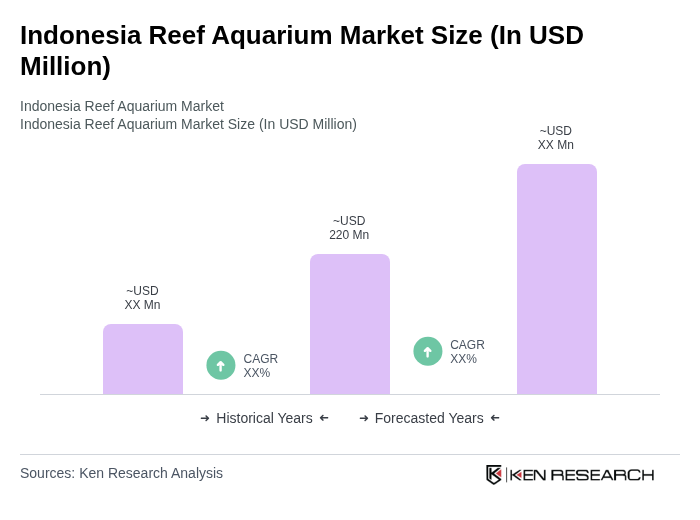
- The Indonesia Reef Aquarium Market is valued at USD 220 million, based on a five-year historical analysis of Indonesia’s share within the Asia-Pacific segment of the global reef aquarium market, and supported by Indonesia’s leading role as a supplier of marine ornamental fish and corals. This growth is driven by increasing consumer interest in marine life, rising disposable income, urbanization, and a surge in demand for both marine fish and aquarium equipment as more households and businesses invest in aquatic environments .
- Key cities such as Jakarta, Surabaya, and Bali dominate the market due to high population density, tourism activities, and their roles as central hubs for aquarium supplies and services. Jakarta, as the capital, leads in distribution and retail, while Bali’s tourism sector drives local demand for marine life displays. Surabaya’s strategic port location and growing urban population further support market growth .
- The Indonesian government regulates the marine aquarium trade through the Regulation of the Minister of Marine Affairs and Fisheries of the Republic of Indonesia Number 8/2021 concerning the Management of Ornamental Fish and Conservation of Coral Reefs. This regulation mandates that all aquarium fish and coral species for trade must be sourced from certified aquaculture facilities or sustainable collection areas, with strict licensing, reporting, and traceability requirements to protect biodiversity and support the local aquaculture industry .
Indonesia Reef Aquarium Market Segmentation
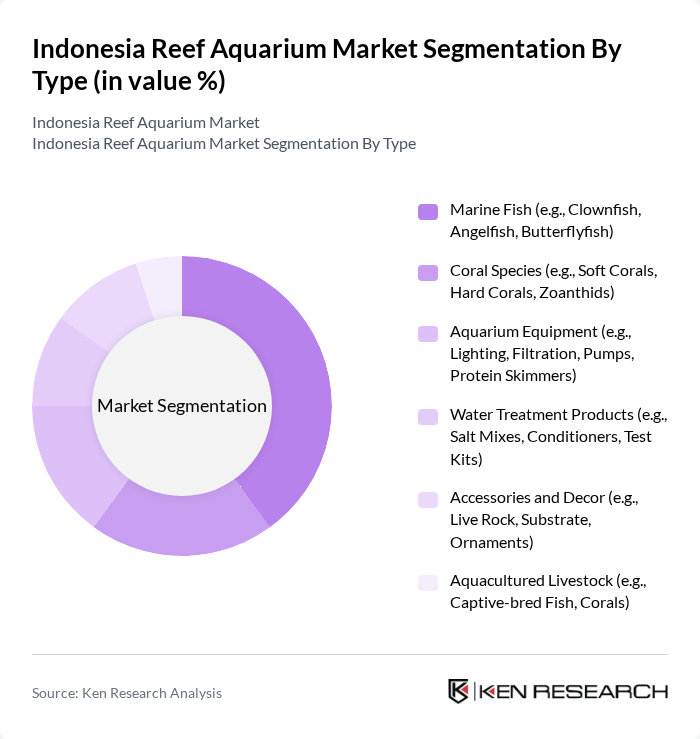
By Type:The market is segmented into Marine Fish, Coral Species, Aquarium Equipment, Water Treatment Products, Accessories and Decor, and Aquacultured Livestock. Among these, Marine Fish—including popular species like Clownfish, Angelfish, and Butterflyfish—dominate due to their appeal to hobbyists and commercial aquarists. The trend of home aquariums, fueled by social media and online communities, has significantly increased demand for these species, making them a primary revenue driver .
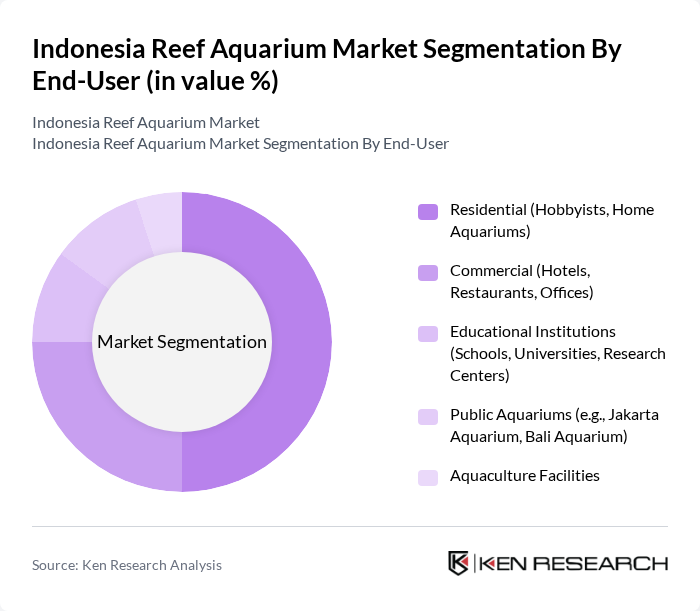
By End-User:The end-user segmentation includes Residential, Commercial, Educational Institutions, Public Aquariums, and Aquaculture Facilities. The Residential segment is the largest, driven by the growing number of hobbyists establishing home aquariums. This trend is amplified by social media platforms and online communities, which facilitate the sharing of aquarium setups and information, further fueling interest and investment .
Indonesia Reef Aquarium Market Competitive Landscape
The Indonesia Reef Aquarium Market is characterized by a dynamic mix of regional and international players. Leading participants such as CV Dinar Aquarium (Indonesia), PT Alam Laut Agung (Indonesia), CV Banyu Biru Sejahtera (Indonesia), IndoReef (Indonesia), Bali Aquarium (Indonesia), LINI Foundation (Indonesia), Aquamarine Aquatic (Indonesia), PT Suri Tani Pemuka (Indonesia), Jakarta Aquarium & Safari (Indonesia), PT Arwana Citramulia Tbk (Indonesia), Tetra (Germany), Red Sea (Israel), Seachem (USA), Eheim (Germany), Hagen (Canada) contribute to innovation, geographic expansion, and service delivery in this space.
Indonesia Reef Aquarium Market Industry Analysis
Growth Drivers
- Increasing Popularity of Marine Aquariums:The Indonesian reef aquarium market is experiencing a surge in popularity, with over 1.5 million households owning aquariums as of in future. This trend is driven by a growing interest in marine biodiversity, with the number of marine aquarium enthusiasts increasing by approximately 20% annually. The rise in social media platforms showcasing aquarium setups has further fueled this interest, leading to increased sales of marine species and aquarium equipment.
- Rising Disposable Income Among Consumers:Indonesia's GDP per capita is estimated at approximately $4,580 in current terms according to the World Bank. This rise in disposable income allows consumers to invest more in luxury items, including marine aquariums. As more individuals enter the middle class, the demand for high-quality aquarium products and services is expected to grow, with an estimated 30% increase in spending on aquarium-related products anticipated over the next year.
- Growth in Tourism and Hospitality Sectors:The tourism sector in Indonesia is expected to contribute approximately $10.46 billion to the economy in future, with a projected 15 million international visitors. This influx of tourists has led to increased investments in hospitality, including hotels and resorts featuring marine aquariums as attractions. The integration of aquariums in these establishments enhances guest experiences, driving demand for aquarium products and services in the hospitality industry.
Market Challenges
- High Initial Setup Costs for Aquariums:The average cost of setting up a marine aquarium in Indonesia can range from $1,000 to $5,000, depending on size and equipment quality. This high initial investment can deter potential customers, particularly in lower-income segments. As a result, many consumers may opt for smaller, less expensive freshwater aquariums, limiting the growth potential of the marine aquarium market.
- Regulatory Restrictions on Marine Life Trade:Indonesia has stringent regulations governing the trade of marine species, with over 200 species listed under protection laws. These regulations can complicate sourcing for aquarium businesses, leading to limited availability of popular marine species. Compliance with these laws often results in increased operational costs, which can be a significant barrier for new entrants in the market.
Indonesia Reef Aquarium Market Future Outlook
The future of the Indonesia reef aquarium market appears promising, driven by increasing consumer interest in marine life and sustainable practices. As disposable incomes rise, more households are likely to invest in marine aquariums, while the tourism sector's growth will further enhance market demand. Additionally, advancements in technology and eco-friendly products are expected to shape the market landscape, encouraging responsible aquarium ownership and conservation efforts among enthusiasts.
Market Opportunities
- Expansion of Online Retail Platforms:The rise of e-commerce in Indonesia presents a significant opportunity for aquarium businesses. With online sales estimated at approximately $10 billion in future, companies can leverage digital platforms to reach a broader audience, offering convenience and a wider selection of marine products, thus enhancing customer engagement and sales.
- Development of Sustainable Aquaculture Practices:As awareness of environmental issues grows, there is a rising demand for sustainably sourced marine species. The implementation of sustainable aquaculture practices can not only meet consumer demand but also align with global conservation efforts, potentially increasing market share for businesses that prioritize eco-friendly sourcing and practices.
Scope of the Report
| Segment | Sub-Segments |
|---|---|
| By Type | Marine Fish (e.g., Clownfish, Angelfish, Butterflyfish) Coral Species (e.g., Soft Corals, Hard Corals, Zoanthids) Aquarium Equipment (e.g., Lighting, Filtration, Pumps, Protein Skimmers) Water Treatment Products (e.g., Salt Mixes, Conditioners, Test Kits) Accessories and Decor (e.g., Live Rock, Substrate, Ornaments) Aquacultured Livestock (e.g., Captive-bred Fish, Corals) |
| By End-User | Residential (Hobbyists, Home Aquariums) Commercial (Hotels, Restaurants, Offices) Educational Institutions (Schools, Universities, Research Centers) Public Aquariums (e.g., Jakarta Aquarium, Bali Aquarium) Aquaculture Facilities |
| By Size of Aquarium | Nano Aquariums (<40 liters) Small Aquariums (40–100 liters) Medium Aquariums (100–300 liters) Large Aquariums (>300 liters) Custom Installations |
| By Distribution Channel | Online Retail (Tokopedia, Shopee, Bukalapak, Dedicated E-commerce) Specialty Aquarium Stores Pet Supermarkets Direct Sales (Manufacturers, Distributors) Export/Import Channels |
| By Geographic Distribution | Java (Jakarta, Surabaya, Bandung) Sumatra (Medan, Palembang) Bali (Denpasar, Badung) Sulawesi (Makassar, Manado) Eastern Indonesia (Maluku, Papua) |
| By Customer Segment | Hobbyists Professional Aquarists Institutions (Research, Conservation, Education) Retailers/Wholesalers Exporters |
| By Product Lifecycle Stage | New Products Growth Stage Products Mature Products Declining Products Others |
Key Target Audience
Investors and Venture Capitalist Firms
Government and Regulatory Bodies (e.g., Ministry of Marine Affairs and Fisheries, Indonesian Biodiversity Foundation)
Manufacturers and Producers
Distributors and Retailers
Marine Conservation Organizations
Aquarium Equipment Suppliers
Tourism and Hospitality Industry Stakeholders
Environmental NGOs
Players Mentioned in the Report:
CV Dinar Aquarium (Indonesia)
PT Alam Laut Agung (Indonesia)
CV Banyu Biru Sejahtera (Indonesia)
IndoReef (Indonesia)
Bali Aquarium (Indonesia)
LINI Foundation (Indonesia)
Aquamarine Aquatic (Indonesia)
PT Suri Tani Pemuka (Indonesia)
Jakarta Aquarium & Safari (Indonesia)
PT Arwana Citramulia Tbk (Indonesia)
Tetra (Germany)
Red Sea (Israel)
Seachem (USA)
Eheim (Germany)
Hagen (Canada)
Table of Contents
Market Assessment Phase
1. Executive Summary and Approach
2. Indonesia Reef Aquarium Market Overview
2.1 Key Insights and Strategic Recommendations
2.2 Indonesia Reef Aquarium Market Overview
2.3 Definition and Scope
2.4 Evolution of Market Ecosystem
2.5 Timeline of Key Regulatory Milestones
2.6 Value Chain & Stakeholder Mapping
2.7 Business Cycle Analysis
2.8 Policy & Incentive Landscape
3. Indonesia Reef Aquarium Market Analysis
3.1 Growth Drivers
3.1.1 Increasing popularity of marine aquariums
3.1.2 Rising disposable income among consumers
3.1.3 Growth in tourism and hospitality sectors
3.1.4 Enhanced awareness of marine conservation
3.2 Market Challenges
3.2.1 High initial setup costs for aquariums
3.2.2 Limited availability of quality marine species
3.2.3 Regulatory restrictions on marine life trade
3.2.4 Environmental concerns affecting sourcing
3.3 Market Opportunities
3.3.1 Expansion of online retail platforms
3.3.2 Development of sustainable aquaculture practices
3.3.3 Increasing demand for aquarium maintenance services
3.3.4 Collaboration with educational institutions for awareness
3.4 Market Trends
3.4.1 Shift towards eco-friendly aquarium products
3.4.2 Rise in DIY aquarium setups
3.4.3 Integration of technology in aquarium management
3.4.4 Growth of community-based aquarium clubs
3.5 Government Regulation
3.5.1 Regulations on the import of marine species
3.5.2 Licensing requirements for aquarium businesses
3.5.3 Environmental protection laws affecting sourcing
3.5.4 Guidelines for sustainable aquarium practices
4. SWOT Analysis
5. Stakeholder Analysis
6. Porter's Five Forces Analysis
7. Indonesia Reef Aquarium Market Market Size, 2019-2024
7.1 By Value
7.2 By Volume
7.3 By Average Selling Price
8. Indonesia Reef Aquarium Market Segmentation
8.1 By Type
8.1.1 Marine Fish (e.g., Clownfish, Angelfish, Butterflyfish)
8.1.2 Coral Species (e.g., Soft Corals, Hard Corals, Zoanthids)
8.1.3 Aquarium Equipment (e.g., Lighting, Filtration, Pumps, Protein Skimmers)
8.1.4 Water Treatment Products (e.g., Salt Mixes, Conditioners, Test Kits)
8.1.5 Accessories and Decor (e.g., Live Rock, Substrate, Ornaments)
8.1.6 Aquacultured Livestock (e.g., Captive-bred Fish, Corals)
8.2 By End-User
8.2.1 Residential (Hobbyists, Home Aquariums)
8.2.2 Commercial (Hotels, Restaurants, Offices)
8.2.3 Educational Institutions (Schools, Universities, Research Centers)
8.2.4 Public Aquariums (e.g., Jakarta Aquarium, Bali Aquarium)
8.2.5 Aquaculture Facilities
8.3 By Size of Aquarium
8.3.1 Nano Aquariums (<40 liters)
8.3.2 Small Aquariums (40–100 liters)
8.3.3 Medium Aquariums (100–300 liters)
8.3.4 Large Aquariums (>300 liters)
8.3.5 Custom Installations
8.4 By Distribution Channel
8.4.1 Online Retail (Tokopedia, Shopee, Bukalapak, Dedicated E-commerce)
8.4.2 Specialty Aquarium Stores
8.4.3 Pet Supermarkets
8.4.4 Direct Sales (Manufacturers, Distributors)
8.4.5 Export/Import Channels
8.5 By Geographic Distribution
8.5.1 Java (Jakarta, Surabaya, Bandung)
8.5.2 Sumatra (Medan, Palembang)
8.5.3 Bali (Denpasar, Badung)
8.5.4 Sulawesi (Makassar, Manado)
8.5.5 Eastern Indonesia (Maluku, Papua)
8.6 By Customer Segment
8.6.1 Hobbyists
8.6.2 Professional Aquarists
8.6.3 Institutions (Research, Conservation, Education)
8.6.4 Retailers/Wholesalers
8.6.5 Exporters
8.7 By Product Lifecycle Stage
8.7.1 New Products
8.7.2 Growth Stage Products
8.7.3 Mature Products
8.7.4 Declining Products
8.7.5 Others
9. Indonesia Reef Aquarium Market Competitive Analysis
9.1 Market Share of Key Players
9.2 Cross Comparison of Key Players
9.2.1 Company Name
9.2.2 Group Size (Large, Medium, or Small as per industry convention)
9.2.3 Revenue Growth Rate (Year-on-Year %)
9.2.4 Export Volume (Number of Fish/Corals Exported Annually)
9.2.5 Domestic Market Share (%)
9.2.6 Product Portfolio Breadth (Number of SKUs/Species Offered)
9.2.7 Certification & Compliance Score (e.g., CITES, Sustainable Practices)
9.2.8 Distribution Network Coverage (Number of Cities/Regions Served)
9.2.9 Online Sales Penetration (%)
9.2.10 Customer Satisfaction Index (Survey/Review Score)
9.3 SWOT Analysis of Top Players
9.4 Pricing Analysis
9.5 Detailed Profile of Major Companies
9.5.1 CV Dinar Aquarium (Indonesia)
9.5.2 PT Alam Laut Agung (Indonesia)
9.5.3 CV Banyu Biru Sejahtera (Indonesia)
9.5.4 IndoReef (Indonesia)
9.5.5 Bali Aquarium (Indonesia)
9.5.6 LINI Foundation (Indonesia)
9.5.7 Aquamarine Aquatic (Indonesia)
9.5.8 PT Suri Tani Pemuka (Indonesia)
9.5.9 Jakarta Aquarium & Safari (Indonesia)
9.5.10 PT Arwana Citramulia Tbk (Indonesia)
9.5.11 Tetra (Germany)
9.5.12 Red Sea (Israel)
9.5.13 Seachem (USA)
9.5.14 Eheim (Germany)
9.5.15 Hagen (Canada)
10. Indonesia Reef Aquarium Market End-User Analysis
10.1 Procurement Behavior of Key Ministries
10.1.1 Budget Allocation for Marine Conservation
10.1.2 Procurement Processes for Public Aquariums
10.1.3 Collaboration with Private Sector
10.1.4 Regulatory Compliance in Procurement
10.2 Corporate Spend on Infrastructure & Energy
10.2.1 Investment in Sustainable Practices
10.2.2 Budget for Aquarium Maintenance
10.2.3 Expenditure on Educational Programs
10.2.4 Funding for Research and Development
10.3 Pain Point Analysis by End-User Category
10.3.1 High Costs of Maintenance
10.3.2 Limited Access to Quality Products
10.3.3 Regulatory Compliance Challenges
10.3.4 Environmental Sustainability Concerns
10.4 User Readiness for Adoption
10.4.1 Awareness of Sustainable Practices
10.4.2 Readiness to Invest in Technology
10.4.3 Interest in Community Engagement
10.4.4 Adoption of Eco-Friendly Products
10.5 Post-Deployment ROI and Use Case Expansion
10.5.1 Measurement of Customer Satisfaction
10.5.2 Analysis of Cost Savings
10.5.3 Expansion into New Markets
10.5.4 Long-term Sustainability Metrics
11. Indonesia Reef Aquarium Market Future Size, 2025-2030
11.1 By Value
11.2 By Volume
11.3 By Average Selling Price
Go-To-Market Strategy Phase
1. Whitespace Analysis + Business Model Canvas
1.1 Market Gaps Identification
1.2 Business Model Development
2. Marketing and Positioning Recommendations
2.1 Branding Strategies
2.2 Product USPs
3. Distribution Plan
3.1 Urban Retail vs Rural NGO Tie-ups
4. Channel & Pricing Gaps
4.1 Underserved Routes
4.2 Pricing Bands
5. Unmet Demand & Latent Needs
5.1 Category Gaps
5.2 Consumer Segments
6. Customer Relationship
6.1 Loyalty Programs
6.2 After-sales Service
7. Value Proposition
7.1 Sustainability
7.2 Integrated Supply Chains
8. Key Activities
8.1 Regulatory Compliance
8.2 Branding
8.3 Distribution Setup
9. Entry Strategy Evaluation
9.1 Domestic Market Entry Strategy
9.1.1 Product Mix
9.1.2 Pricing Band
9.1.3 Packaging
9.2 Export Entry Strategy
9.2.1 Target Countries
9.2.2 Compliance Roadmap
10. Entry Mode Assessment
10.1 JV
10.2 Greenfield
10.3 M&A
10.4 Distributor Model
11. Capital and Timeline Estimation
11.1 Capital Requirements
11.2 Timelines
12. Control vs Risk Trade-Off
12.1 Ownership vs Partnerships
13. Profitability Outlook
13.1 Breakeven Analysis
13.2 Long-term Sustainability
14. Potential Partner List
14.1 Distributors
14.2 JVs
14.3 Acquisition Targets
15. Execution Roadmap
15.1 Phased Plan for Market Entry
15.1.1 Market Setup
15.1.2 Market Entry
15.1.3 Growth Acceleration
15.1.4 Scale & Stabilize
15.2 Key Activities and Milestones
15.2.1 Activity Planning
15.2.2 Milestone Tracking
Research Methodology
Phase 1: Approach1
Desk Research
- Analysis of industry reports from marine conservation organizations and aquarium trade associations
- Review of government publications on marine biodiversity and aquarium regulations in Indonesia
- Examination of market trends through online databases and publications focused on the aquarium industry
Primary Research
- Interviews with aquarium retailers and wholesalers to understand market dynamics
- Surveys with marine biologists and aquarists to gather insights on consumer preferences
- Field visits to aquarium expos and trade shows to observe product offerings and innovations
Validation & Triangulation
- Cross-validation of findings through multiple expert interviews and industry reports
- Triangulation of data from retail sales, import/export statistics, and consumer surveys
- Sanity checks through feedback from a panel of industry experts and stakeholders
Phase 2: Market Size Estimation1
Top-down Assessment
- Estimation of market size based on national aquarium product sales and import data
- Segmentation of the market by product categories such as fish, corals, and equipment
- Incorporation of growth rates from related sectors like tourism and marine conservation
Bottom-up Modeling
- Collection of sales data from leading aquarium retailers and online platforms
- Estimation of average spending per consumer on aquarium products and services
- Volume and price analysis for key product segments to derive total market value
Forecasting & Scenario Analysis
- Multi-factor regression analysis incorporating economic indicators and consumer trends
- Scenario modeling based on potential regulatory changes and environmental impacts
- Development of baseline, optimistic, and pessimistic forecasts through 2030
Phase 3: CATI Sample Composition1
| Scope Item/Segment | Sample Size | Target Respondent Profiles |
|---|---|---|
| Aquarium Retailers | 60 | Store Owners, Sales Managers |
| Marine Biologists | 40 | Research Scientists, Conservationists |
| Aquarium Equipment Manufacturers | 50 | Product Development Managers, Marketing Directors |
| Hobbyist Aquarists | 80 | Enthusiasts, Community Leaders |
| Importers of Marine Life | 40 | Business Owners, Supply Chain Managers |
Frequently Asked Questions
What is the current value of the Indonesia Reef Aquarium Market?
The Indonesia Reef Aquarium Market is valued at approximately USD 220 million, reflecting its significant role in the Asia-Pacific segment of the global reef aquarium market, driven by increasing consumer interest and investment in marine life.
Which cities are the main hubs for the Indonesia Reef Aquarium Market?
What types of products are included in the Indonesia Reef Aquarium Market?
Who are the primary end-users in the Indonesia Reef Aquarium Market?
Other Regional/Country Reports
Malaysia Reef Aquarium Market
KSA Reef Aquarium Market
APAC Reef Aquarium Market
SEA Reef Aquarium Market
Vietnam Reef Aquarium Market
Other Adjacent Reports
Thailand Marine Ornamental Fish Market
Thailand Coral Farming Market
Qatar Aquarium Equipment Market
Vietnam Water Treatment Products Market
Mexico Aquacultured Livestock Market
UAE Pet Supplies Market Eco-Tourism MarketBelgium Sustainable Aquaculture Market
KSA Marine Conservation Market
Germany Online Pet Retail Market
Why Buy From Us?

What makes us stand out is that our consultants follow Robust, Refine and Result (RRR) methodology. Robust for clear definitions, approaches and sanity checking, Refine for differentiating respondents' facts and opinions, and Result for presenting data with story.

We have set a benchmark in the industry by offering our clients with syndicated and customized market research reports featuring coverage of entire market as well as meticulous research and analyst insights.

While we don't replace traditional research, we flip the method upside down. Our dual approach of Top Bottom & Bottom Top ensures quality deliverable by not just verifying company fundamentals but also looking at the sector and macroeconomic factors.

With one step in the future, our research team constantly tries to show you the bigger picture. We help with some of the tough questions you may encounter along the way: How is the industry positioned? Best marketing channel? KPI's of competitors? By aligning every element, we help maximize success.

Our report gives you instant access to the answers and sources that other companies might choose to hide. We elaborate each steps of research methodology we have used and showcase you the sample size to earn your trust.

If you need any support, we are here! We pride ourselves on universe strength, data quality, and quick, friendly, and professional service.