About the Report
Base Year 2024Indonesia Waterless Cosmetics Market Overview
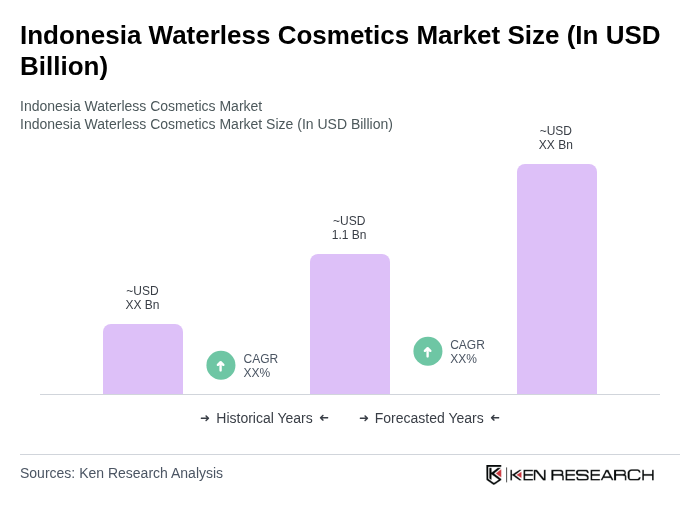
- The Indonesia Waterless Cosmetics Market is valued at USD 1.1 billion, based on a five-year historical analysis. This growth is primarily driven by increasing consumer awareness of sustainability, the rise of eco-friendly products, and the demand for convenience in personal care routines. The market has seen a significant shift towards waterless formulations, which are perceived as more environmentally friendly and efficient, with consumers prioritizing products that minimize water usage and environmental impact.
- Key cities such as Jakarta, Surabaya, and Bandung dominate the market due to their high population density, urban lifestyle, and growing middle class. These cities are also hubs for beauty and personal care trends, making them focal points for the distribution and consumption of waterless cosmetics. The expansion of e-commerce platforms and the influence of social media beauty influencers further accelerate product adoption in these urban centers.
- In 2023, the Indonesian government implemented the Cosmetic Product Registration and Labeling Guidelines, 2023 issued by the National Agency of Drug and Food Control (BPOM). These regulations require manufacturers to disclose water usage in production, promote sustainable packaging, and ensure clear labeling of waterless formulations, encouraging the adoption of eco-friendly practices across the cosmetics sector.
Indonesia Waterless Cosmetics Market Segmentation
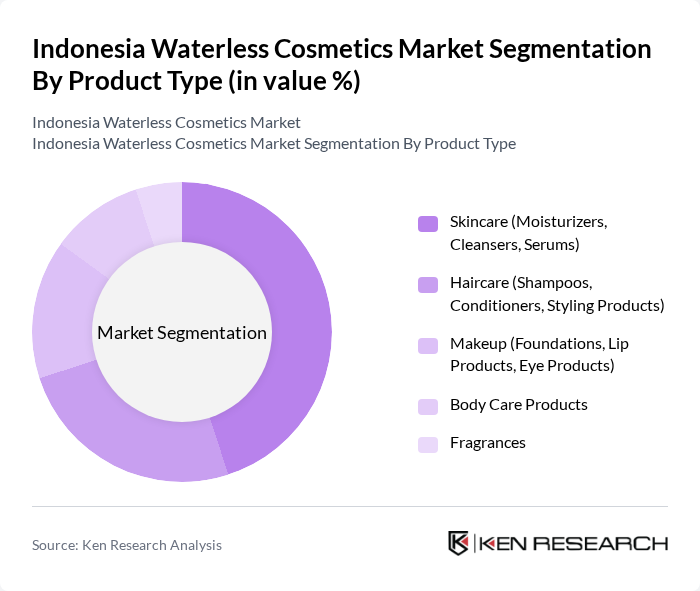
By Product Type:The product type segmentation includes various categories such as skincare, haircare, makeup, body care products, and fragrances. Among these, skincare products, particularly moisturizers and cleansers, dominate the market due to the increasing focus on skin health and the effectiveness of waterless formulations in delivering concentrated benefits. Consumers are increasingly opting for products that offer convenience and sustainability, leading to a surge in demand for waterless skincare solutions.
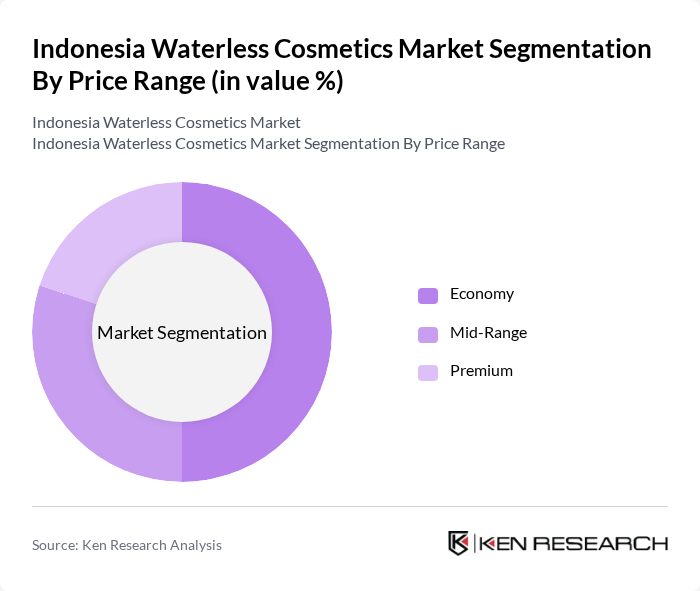
By Price Range:The price range segmentation includes economy, mid-range, and premium products. The economy segment is currently leading the market, driven by the increasing demand for affordable yet effective waterless cosmetics among budget-conscious consumers. The mid-range and premium segments are also growing, as consumers are willing to invest in high-quality, sustainable products that align with their values and lifestyle preferences.
Indonesia Waterless Cosmetics Market Competitive Landscape
The Indonesia Waterless Cosmetics Market is characterized by a dynamic mix of regional and international players. Leading participants such as L'Oréal SA, Kao Corporation, Clensta International Pvt. Ltd., Ktein Biotech Private Limited, Living Organic Loving Ingredients (LOLI), The Body Shop Indonesia, Lush Cosmetics, Aveda, Ethique, Kiehl's, Biore (Kao), Tatcha, Herbivore Botanicals, Wildcraft, and local Indonesian brands contribute to innovation, geographic expansion, and service delivery in this space.
Indonesia Waterless Cosmetics Market Industry Analysis
Growth Drivers
- Increasing Environmental Awareness:The Indonesian population is becoming increasingly aware of environmental issues, with 75% of consumers expressing concern about plastic waste, according to a survey by the Indonesian Ministry of Environment. This awareness drives demand for waterless cosmetics, which typically use less packaging and reduce water consumption. The government’s commitment to reducing plastic waste by 70% in future further supports this trend, encouraging brands to innovate and align with eco-friendly practices.
- Rising Demand for Sustainable Products:The sustainable product market in Indonesia is estimated to be valued at approximately IDR 16 trillion, reflecting a growing consumer preference for eco-friendly options. This shift is evident as 65% of consumers are willing to pay more for sustainable products, according to a Nielsen report. Waterless cosmetics, which align with this demand, are gaining traction as brands emphasize their commitment to sustainability, thus attracting a broader customer base focused on ethical consumption.
- Innovation in Formulation:The Indonesian cosmetics industry is witnessing significant innovation, with over 250 new waterless cosmetic products launched in future. This surge is driven by advancements in formulation technologies that enhance product efficacy while minimizing water usage. Companies are investing in research and development, with an estimated IDR 1.8 trillion allocated for innovation in future, leading to a diverse range of offerings that cater to various consumer needs and preferences.
Market Challenges
- High Production Costs:The production costs for waterless cosmetics are approximately 35% higher than traditional cosmetics due to the need for specialized ingredients and formulations. This financial burden can deter smaller brands from entering the market, limiting competition and innovation. Additionally, the high costs may lead to higher retail prices, which could alienate price-sensitive consumers in Indonesia, where the average monthly income is around IDR 3.5 million.
- Limited Consumer Awareness:Despite the growing interest in waterless cosmetics, consumer awareness remains low, with only 30% of Indonesian consumers familiar with the concept. This lack of knowledge poses a significant barrier to market growth, as many potential customers are unaware of the benefits of waterless products. Brands must invest in educational marketing campaigns to inform consumers about the advantages of these products, which could require substantial financial resources.
Indonesia Waterless Cosmetics Market Future Outlook
The future of the waterless cosmetics market in Indonesia appears promising, driven by increasing environmental consciousness and a shift towards sustainable beauty products. As consumer preferences evolve, brands that prioritize innovation and eco-friendly practices are likely to thrive. The rise of digital marketing strategies will further enhance brand visibility, enabling companies to reach a broader audience. Additionally, collaborations with local influencers can amplify awareness and drive sales, positioning waterless cosmetics as a mainstream choice in the beauty industry.
Market Opportunities
- Growth in Eco-conscious Consumer Base:The eco-conscious consumer base in Indonesia is expanding, with an estimated 45% of consumers actively seeking sustainable products. This trend presents a significant opportunity for brands to develop targeted marketing strategies that resonate with environmentally aware consumers, potentially increasing market share and brand loyalty.
- Collaborations with Influencers:Collaborating with local influencers can significantly enhance brand visibility and credibility. With over 60 million active social media users in Indonesia, influencer partnerships can effectively reach a large audience, driving awareness and sales of waterless cosmetics. This strategy can leverage the growing trend of social media marketing, particularly among younger consumers.
Scope of the Report
| Segment | Sub-Segments |
|---|---|
| By Product Type | Skincare (Moisturizers, Cleansers, Serums) Haircare (Shampoos, Conditioners, Styling Products) Makeup (Foundations, Lip Products, Eye Products) Body Care Products Fragrances |
| By Price Range | Economy Mid-Range Premium |
| By Customer Orientation | Men Women Unisex |
| By Distribution Channel | Online Retailers Specialty Stores Hypermarkets/Supermarkets Convenience Stores Direct Sales |
| By Product Form | Solid Bars and Tablets Powders Creams and Gels Sheets and Patches |
| By Ingredient Type | Organic/Natural Synthetic |
| By Packaging Type | Refillable Containers Biodegradable Packaging Recyclable Packaging |
Key Target Audience
Investors and Venture Capitalist Firms
Government and Regulatory Bodies (e.g., Badan Pengawas Obat dan Makanan - BPOM)
Manufacturers and Producers
Distributors and Retailers
Beauty and Personal Care Brands
Environmental NGOs and Sustainability Advocates
Packaging Suppliers and Innovators
Market Analysts and Industry Experts
Players Mentioned in the Report:
L'Oreal SA
Kao Corporation
Clensta International Pvt. Ltd.
Ktein Biotech Private Limited
Living Organic Loving Ingredients (LOLI)
The Body Shop Indonesia
Lush Cosmetics
Aveda
Ethique
Kiehl's
Biore (Kao)
Tatcha
Herbivore Botanicals
Wildcraft
Local Indonesian Brands (Emerging Players)
Table of Contents
Market Assessment Phase
1. Executive Summary and Approach
2. Indonesia Waterless Cosmetics Market Overview
2.1 Key Insights and Strategic Recommendations
2.2 Indonesia Waterless Cosmetics Market Overview
2.3 Definition and Scope
2.4 Evolution of Market Ecosystem
2.5 Timeline of Key Regulatory Milestones
2.6 Value Chain & Stakeholder Mapping
2.7 Business Cycle Analysis
2.8 Policy & Incentive Landscape
3. Indonesia Waterless Cosmetics Market Analysis
3.1 Growth Drivers
3.1.1 Increasing Environmental Awareness
3.1.2 Rising Demand for Sustainable Products
3.1.3 Innovation in Formulation
3.1.4 Expansion of E-commerce Platforms
3.2 Market Challenges
3.2.1 High Production Costs
3.2.2 Limited Consumer Awareness
3.2.3 Regulatory Compliance Issues
3.2.4 Competition from Traditional Cosmetics
3.3 Market Opportunities
3.3.1 Growth in Eco-conscious Consumer Base
3.3.2 Collaborations with Influencers
3.3.3 Development of Niche Products
3.3.4 Export Potential to Neighboring Countries
3.4 Market Trends
3.4.1 Rise of Clean Beauty Movement
3.4.2 Customization and Personalization
3.4.3 Increased Focus on Packaging Sustainability
3.4.4 Digital Marketing Strategies
3.5 Government Regulation
3.5.1 Cosmetic Product Safety Standards
3.5.2 Environmental Protection Regulations
3.5.3 Import and Export Regulations
3.5.4 Labeling and Advertising Guidelines
4. SWOT Analysis
5. Stakeholder Analysis
6. Porter's Five Forces Analysis
7. Indonesia Waterless Cosmetics Market Market Size, 2019-2024
7.1 By Value
7.2 By Volume
7.3 By Average Selling Price
8. Indonesia Waterless Cosmetics Market Segmentation
8.1 By Product Type
8.1.1 Skincare (Moisturizers, Cleansers, Serums)
8.1.2 Haircare (Shampoos, Conditioners, Styling Products)
8.1.3 Makeup (Foundations, Lip Products, Eye Products)
8.1.4 Body Care Products
8.1.5 Fragrances
8.2 By Price Range
8.2.1 Economy
8.2.2 Mid-Range
8.2.3 Premium
8.3 By Customer Orientation
8.3.1 Men
8.3.2 Women
8.3.3 Unisex
8.4 By Distribution Channel
8.4.1 Online Retailers
8.4.2 Specialty Stores
8.4.3 Hypermarkets/Supermarkets
8.4.4 Convenience Stores
8.4.5 Direct Sales
8.5 By Product Form
8.5.1 Solid Bars and Tablets
8.5.2 Powders
8.5.3 Creams and Gels
8.5.4 Sheets and Patches
8.6 By Ingredient Type
8.6.1 Organic/Natural
8.6.2 Synthetic
8.7 By Packaging Type
8.7.1 Refillable Containers
8.7.2 Biodegradable Packaging
8.7.3 Recyclable Packaging
9. Indonesia Waterless Cosmetics Market Competitive Analysis
9.1 Market Share of Key Players
9.2 KPIs for Cross Comparison of Key Players
9.2.1 Company Name
9.2.2 Company Size Classification (Large, Medium, Small)
9.2.3 Year-over-Year Revenue Growth Rate (%)
9.2.4 Market Share in Indonesia Waterless Cosmetics (%)
9.2.5 Distribution Channel Coverage (Online, Retail, Direct)
9.2.6 Product Portfolio Breadth (Number of SKUs)
9.2.7 Average Price Point (USD/Product)
9.2.8 Brand Awareness Score (% of Target Consumers)
9.2.9 Customer Retention Rate (%)
9.2.10 Innovation Index (New Product Launches per Year)
9.3 SWOT Analysis of Top Players
9.4 Pricing Analysis
9.5 Detailed Profile of Major Companies
9.5.1 L'Oréal SA
9.5.2 Kao Corporation
9.5.3 Clensta International Pvt. Ltd.
9.5.4 Ktein Biotech Private Limited
9.5.5 Living Organic Loving Ingredients (LOLI)
9.5.6 The Body Shop Indonesia
9.5.7 Lush Cosmetics
9.5.8 Aveda
9.5.9 Ethique
9.5.10 Kiehl's
9.5.11 Biore (Kao)
9.5.12 Tatcha
9.5.13 Herbivore Botanicals
9.5.14 Wildcraft
9.5.15 Local Indonesian Brands (Emerging Players)
10. Indonesia Waterless Cosmetics Market End-User Analysis
10.1 Consumer Procurement Behavior
10.1.1 Online Shopping Preferences
10.1.2 Retail Store Preferences
10.1.3 Price Sensitivity and Willingness to Pay
10.1.4 Brand Loyalty Patterns
10.2 Corporate and Institutional Adoption
10.2.1 Investment in Sustainable Beauty Products
10.2.2 Partnerships with Green Brands
10.2.3 Employee Wellness Programs
10.2.4 Corporate Social Responsibility Initiatives
10.3 Pain Point Analysis by End-User Category
10.3.1 Cost Sensitivity
10.3.2 Product Efficacy Concerns
10.3.3 Availability and Accessibility
10.3.4 Lack of Product Information
10.4 User Readiness for Adoption
10.4.1 Awareness of Waterless Products
10.4.2 Willingness to Pay Premium Prices
10.4.3 Environmental Consciousness Level
10.4.4 Digital Literacy and E-commerce Adoption
10.5 Post-Purchase Behavior and Expansion
10.5.1 Customer Satisfaction and Repeat Purchase Rates
10.5.2 Word-of-Mouth and Social Media Advocacy
10.5.3 Cross-Category Purchase Expansion
10.5.4 Regional Market Expansion Potential
11. Indonesia Waterless Cosmetics Market Future Size, 2025-2030
11.1 By Value
11.2 By Volume
11.3 By Average Selling Price
Go-To-Market Strategy Phase
1. Whitespace Analysis + Business Model Canvas
1.1 Market Gaps Identification
1.2 Business Model Development
2. Marketing and Positioning Recommendations
2.1 Branding Strategies
2.2 Product USPs
3. Distribution Plan
3.1 Urban Retail vs Rural NGO Tie-ups
4. Channel & Pricing Gaps
4.1 Underserved Routes
4.2 Pricing Bands
5. Unmet Demand & Latent Needs
5.1 Category Gaps
5.2 Consumer Segments
6. Customer Relationship
6.1 Loyalty Programs
6.2 After-sales Service
7. Value Proposition
7.1 Sustainability
7.2 Integrated Supply Chains
8. Key Activities
8.1 Regulatory Compliance
8.2 Branding
8.3 Distribution Setup
9. Entry Strategy Evaluation
9.1 Domestic Market Entry Strategy
9.1.1 Product Mix
9.1.2 Pricing Band
9.1.3 Packaging
9.2 Export Entry Strategy
9.2.1 Target Countries
9.2.2 Compliance Roadmap
10. Entry Mode Assessment
10.1 JV
10.2 Greenfield
10.3 M&A
10.4 Distributor Model
11. Capital and Timeline Estimation
11.1 Capital Requirements
11.2 Timelines
12. Control vs Risk Trade-Off
12.1 Ownership vs Partnerships
13. Profitability Outlook
13.1 Breakeven Analysis
13.2 Long-term Sustainability
14. Potential Partner List
14.1 Distributors
14.2 JVs
14.3 Acquisition Targets
15. Execution Roadmap
15.1 Phased Plan for Market Entry
15.1.1 Market Setup
15.1.2 Market Entry
15.1.3 Growth Acceleration
15.1.4 Scale & Stabilize
15.2 Key Activities and Milestones
15.2.1 Milestone Planning
15.2.2 Activity Tracking
Research Methodology
Phase 1: Approach1
Desk Research
- Analysis of market reports from industry associations and government publications on waterless cosmetics
- Review of academic journals and articles focusing on sustainable beauty trends in Indonesia
- Examination of consumer behavior studies related to eco-friendly products and waterless formulations
Primary Research
- Interviews with product development managers at leading cosmetic brands in Indonesia
- Surveys targeting consumers to gauge awareness and acceptance of waterless cosmetics
- Focus group discussions with beauty influencers and sustainability advocates
Validation & Triangulation
- Cross-validation of findings through multiple data sources including sales data and consumer feedback
- Triangulation of insights from industry experts, market analysts, and consumer surveys
- Sanity checks through expert panel reviews to ensure data reliability and relevance
Phase 2: Market Size Estimation1
Top-down Assessment
- Estimation of market size based on overall cosmetics market growth and waterless product penetration rates
- Segmentation analysis by product type, including skincare, haircare, and makeup
- Incorporation of demographic trends and urbanization impacts on consumer preferences
Bottom-up Modeling
- Collection of sales data from key retailers and e-commerce platforms offering waterless cosmetics
- Estimation of average price points and volume sold for various product categories
- Analysis of distribution channels and their contribution to overall market revenue
Forecasting & Scenario Analysis
- Development of growth projections based on historical data and emerging market trends
- Scenario analysis considering regulatory changes and shifts in consumer behavior towards sustainability
- Creation of baseline, optimistic, and pessimistic forecasts through 2030
Phase 3: CATI Sample Composition1
| Scope Item/Segment | Sample Size | Target Respondent Profiles |
|---|---|---|
| Consumer Awareness of Waterless Cosmetics | 120 | General Consumers, Eco-conscious Shoppers |
| Retailer Insights on Waterless Product Offerings | 75 | Store Managers, Beauty Product Buyers |
| Industry Expert Opinions on Market Trends | 45 | Market Analysts, Cosmetic Chemists |
| Feedback from Beauty Influencers | 40 | Social Media Influencers, Beauty Bloggers |
| Consumer Purchase Behavior Analysis | 110 | Frequent Buyers, Online Shoppers |
Frequently Asked Questions
What is the current value of the Indonesia Waterless Cosmetics Market?
The Indonesia Waterless Cosmetics Market is valued at approximately USD 1.1 billion, reflecting a significant growth trend driven by consumer awareness of sustainability and the demand for eco-friendly personal care products.
What factors are driving the growth of waterless cosmetics in Indonesia?
Which cities in Indonesia are leading in the waterless cosmetics market?
What regulations has the Indonesian government implemented regarding cosmetics?
Other Regional/Country Reports
Malaysia Waterless Cosmetics Market
KSA Waterless Cosmetics Market
APAC Waterless Cosmetics Market
SEA Waterless Cosmetics Market
Vietnam Waterless Cosmetics Market
Thailand Waterless Cosmetics Market
Other Adjacent Reports
Germany Sustainable Beauty Market
UAE Organic Cosmetics Market
UAE Eco-Friendly Packaging Market
Singapore Vegan Personal Care Market
Brazil Clean Beauty Market
Vietnam Natural Skincare Market Outlook to 2030KSA Halal Cosmetics Market
Germany Beauty E-Commerce Market
Bahrain Solid Formulations Market
UAE Zero-Waste Products Market
Why Buy From Us?

What makes us stand out is that our consultants follow Robust, Refine and Result (RRR) methodology. Robust for clear definitions, approaches and sanity checking, Refine for differentiating respondents' facts and opinions, and Result for presenting data with story.

We have set a benchmark in the industry by offering our clients with syndicated and customized market research reports featuring coverage of entire market as well as meticulous research and analyst insights.

While we don't replace traditional research, we flip the method upside down. Our dual approach of Top Bottom & Bottom Top ensures quality deliverable by not just verifying company fundamentals but also looking at the sector and macroeconomic factors.

With one step in the future, our research team constantly tries to show you the bigger picture. We help with some of the tough questions you may encounter along the way: How is the industry positioned? Best marketing channel? KPI's of competitors? By aligning every element, we help maximize success.

Our report gives you instant access to the answers and sources that other companies might choose to hide. We elaborate each steps of research methodology we have used and showcase you the sample size to earn your trust.

If you need any support, we are here! We pride ourselves on universe strength, data quality, and quick, friendly, and professional service.