APAC Digital Agriculture Market Outlook to 2030

Region:Asia

Author(s):Shambhavi

Product Code:KROD4930

Published On

November 2024

Total pages

82

About the Report

APAC Digital Agriculture Market Overview

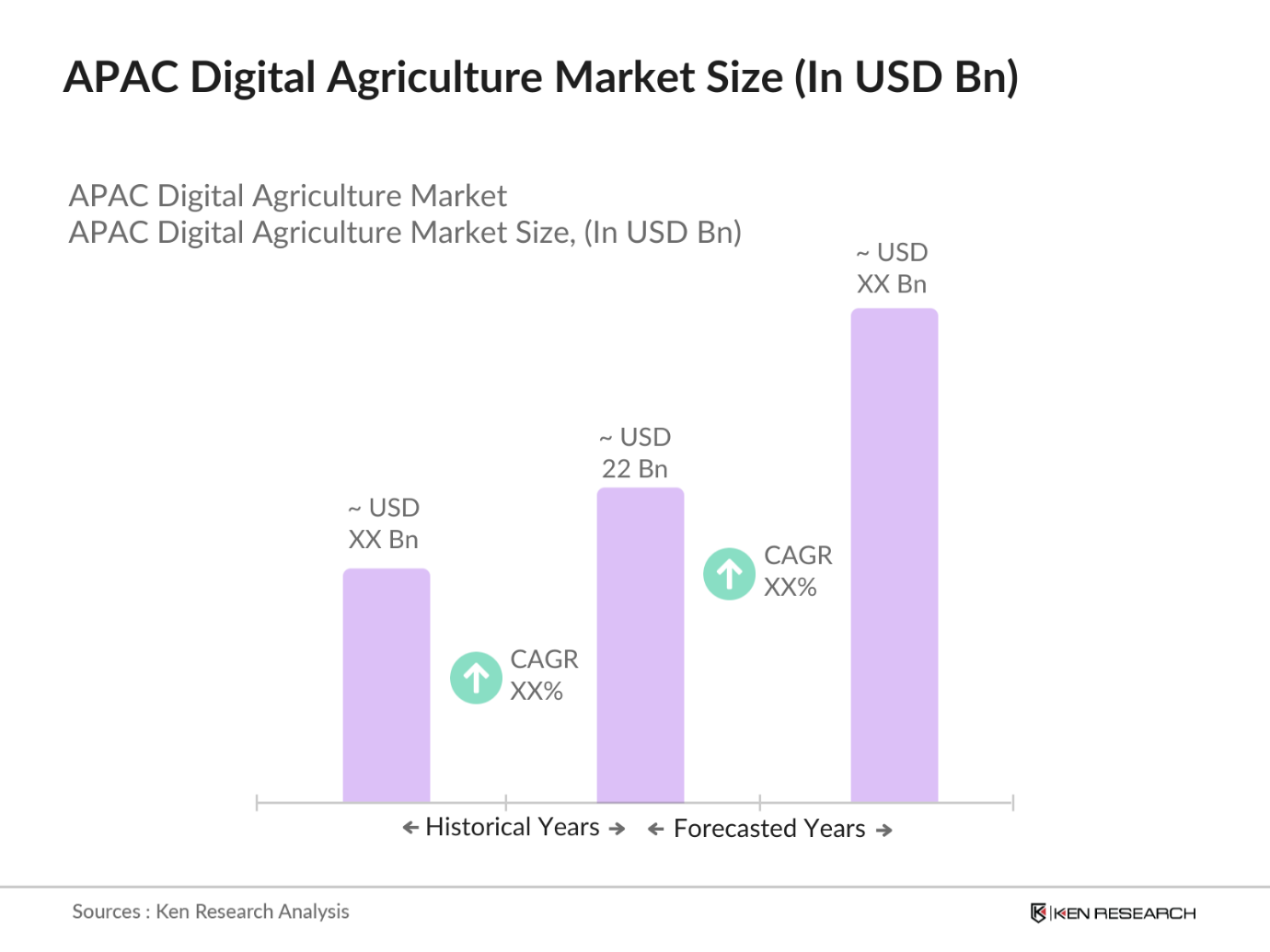
  • The APAC digital agriculture market is valued at USD 22 billion, driven by increasing adoption of precision farming technologies and governmental policies supporting agritech advancements. The market has been bolstered by advancements in IoT devices, data analytics, and satellite imagery, which have enhanced productivity and resource efficiency in farming. Government incentives aimed at improving agricultural productivity, along with rising food demand, are key drivers of this market growth.

APAC Digital Agriculture Market

  • Countries like China and India dominate the market due to their vast agricultural land and increasing adoption of digital technologies in farming. Chinas government initiatives, such as digital farming subsidies, and Indias rapid shift towards tech-driven agriculture practices, make them the leading countries in the region. These nations also benefit from the integration of AI and IoT-based solutions, which are rapidly transforming their agricultural landscape.
  • Government subsidies are crucial in the rapid adoption of digital agriculture in the APAC region. For instance, China allocated $25 billion in 2024 for digital agriculture subsidies, focusing on smart irrigation systems and AI-driven pest management. Similarly, Indias National Agriculture Market (eNAM) scheme received additional funding of $10 billion in 2024 to enhance digital marketplaces for farmers. In Australia, the government launched a $1 billion fund to support the adoption of smart farming technologies, providing grants and low-interest loans to farmers transitioning to digital agriculture.

APAC Digital Agriculture Market Segmentation

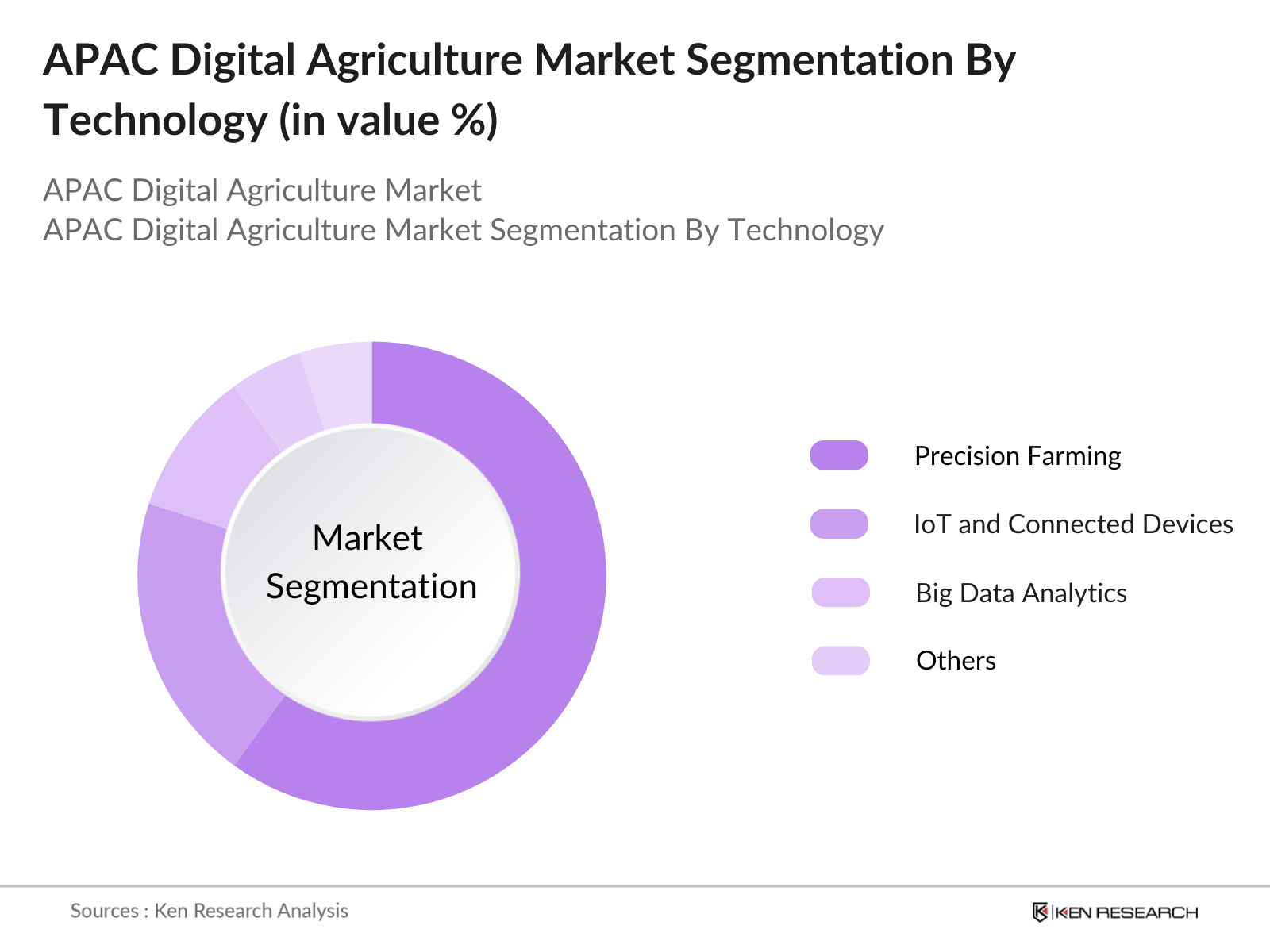
By Technology: The APAC digital agriculture market is segmented by technology into precision farming, IoT and connected devices, big data analytics and others. Precision farming currently holds a dominant market share due to its widespread adoption in large-scale farming operations across key regions like China and Australia. The use of AI-driven solutions to optimize irrigation and fertilization has significantly enhanced crop yield and reduced input costs, making precision farming a leading technology in the digital agriculture landscape.
APAC Digital Agriculture Market Segmentation

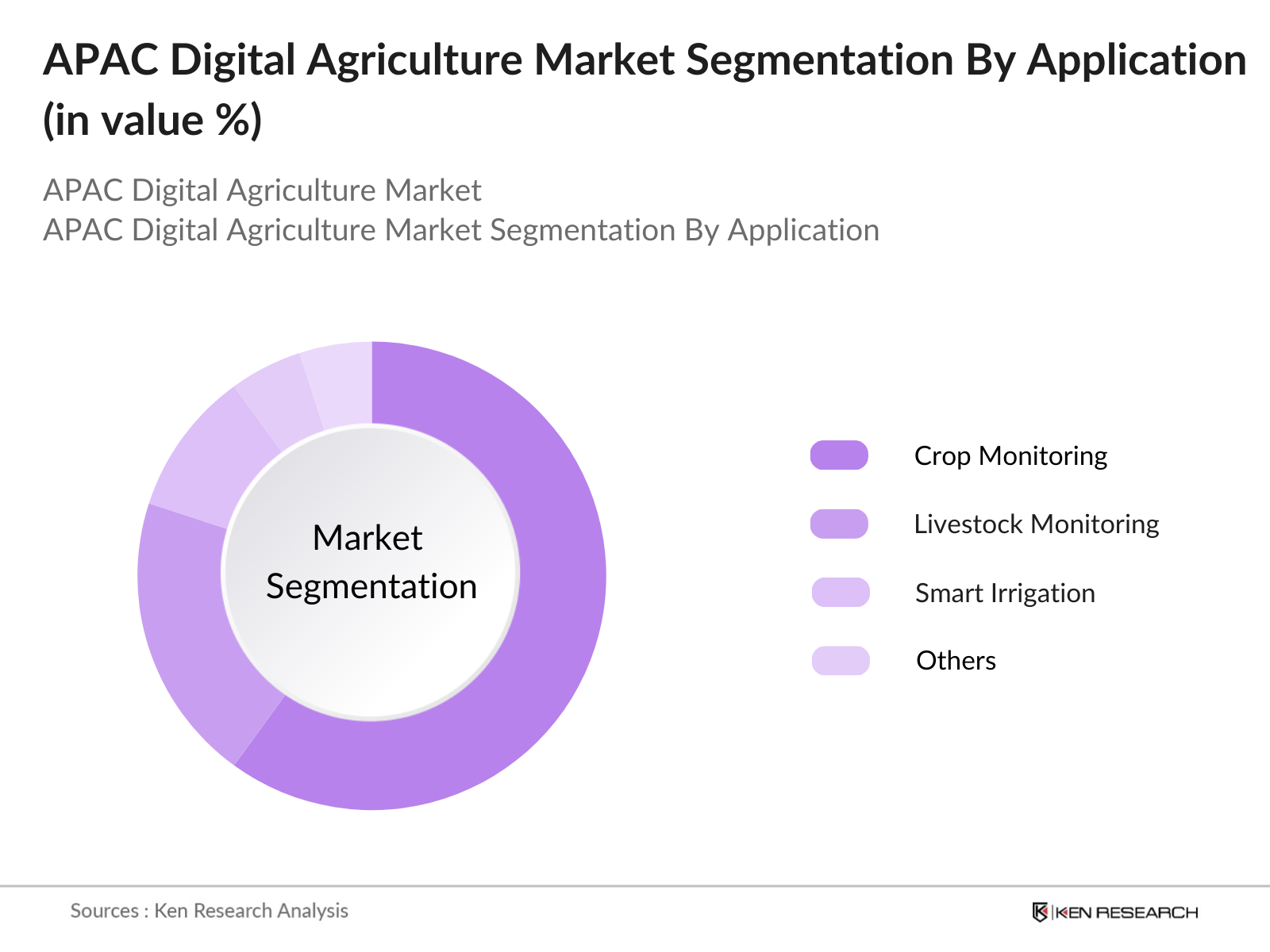
By Application: The market is further segmented by application into crop monitoring, livestock monitoring, aquaculture management and others. Crop monitoring dominates the application segment, primarily due to the increasing use of sensor-based technologies and AI-driven analytics, allowing farmers to monitor crop health and optimize field operations. This has become critical in addressing challenges related to climate change and resource optimization in key APAC regions.
APAC Digital Agriculture Market Segmentation

APAC Digital Agriculture Market Competitive Landscape

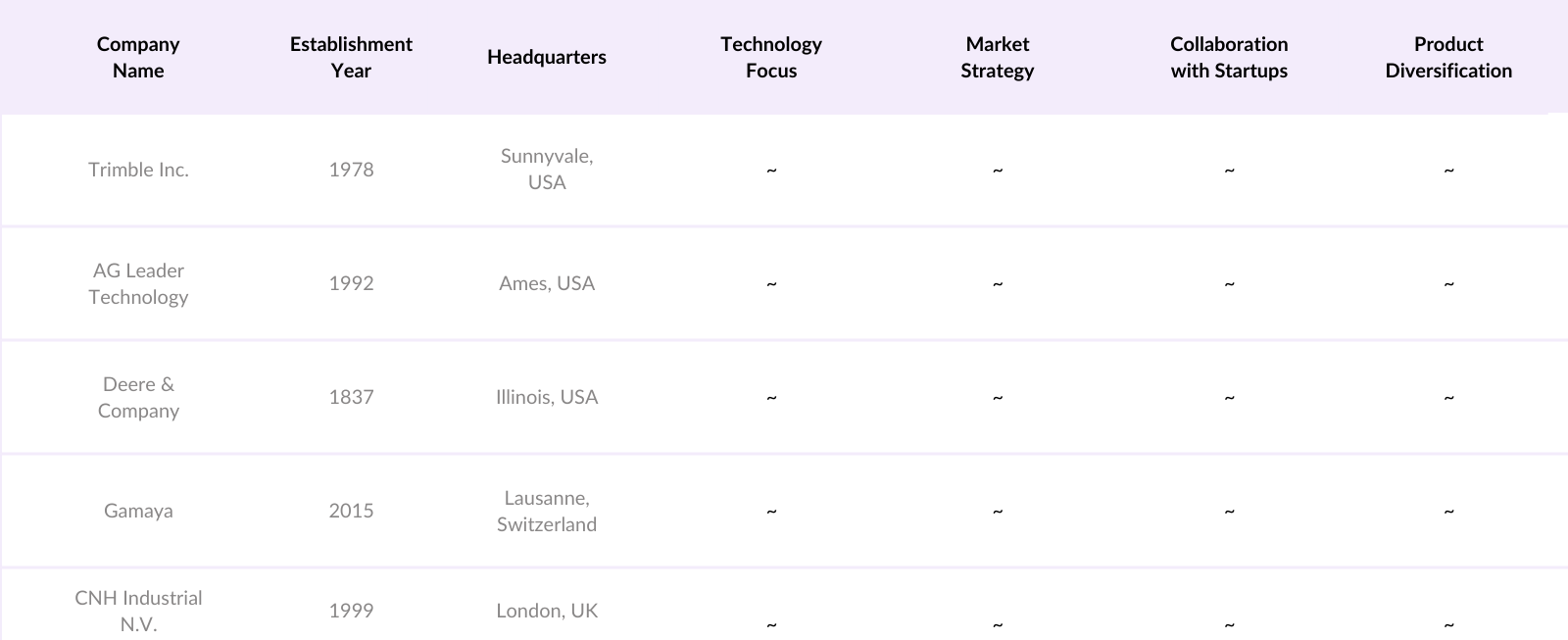
The APAC digital agriculture market is dominated by both regional and global players. These key companies have established strong presences in various APAC countries, contributing to market consolidation. Companies like Trimble and AG Leader Technology have been key in providing precision farming solutions, while startups like Gamaya are introducing AI-driven crop monitoring systems. This diversity of players, from established global firms to innovative startups, showcases the competitive nature of the market.
APAC Digital Agriculture Market Competitive Landscape

APAC Digital Agriculture Market Analysis

Growth Drivers

  • Precision Farming: Precision farming is becoming a key driver in the APAC digital agriculture market, with nations like China and India adopting advanced technologies to improve agricultural productivity. In 2024, China allocated over $16 billion for precision farming technologies, aiming to improve water efficiency by 30% across major crop-producing regions. India also introduced the PM-Kisan scheme, providing subsidies for farmers using precision farming tools. Furthermore, countries like Japan are promoting the integration of IoT devices for precision agriculture, where approximately 1.2 million hectares of farmland in Japan are now equipped with digital sensors for real-time monitoring.
  • Remote Sensing Technology: Remote sensing technology is driving agricultural innovations by enabling farmers to monitor crop health and environmental conditions efficiently. In 2024, the Indian Space Research Organization (ISRO) launched a remote-sensing satellite aimed at enhancing crop yield forecasting. Meanwhile, in Southeast Asia, Vietnams Ministry of Agriculture is utilizing satellite data to monitor nearly 500,000 hectares of rice paddies, helping reduce losses by 12% in the Mekong Delta region. Government initiatives across the APAC region are incentivizing remote sensing technology as a part of climate-smart agriculture strategies, with $3 billion allocated by the ASEAN Secretariat in 2024.
  • AI and Big Data Integration: In 2024, South Korea announced a national AI-based smart farming initiative, which will benefit over 100,000 farms by the year-end, with $4.7 billion being invested in AI and Big Data for precision agriculture. Similarly, in Australia, 35% of the agricultural sector has adopted AI tools for crop disease detection, leveraging vast datasets provided by the government. Indonesia is expanding its agricultural data networks, with 2.5 million hectares of farmland now connected to cloud-based AI platforms, facilitating data-driven decisions in farming operations. These advancements are significantly improving the efficiency and sustainability of agricultural practices.

Market Challenges

  • High Initial Investment: The high initial investment required for digital agriculture adoption remains a challenge in the APAC region. For instance, smart irrigation systems in Australia cost an average of $15,000 per hectare in 2024, a significant barrier for smallholder farmers. In India, the average installation cost of IoT sensors and AI-based crop monitoring systems is approximately $20,000 per 100 hectares, making it unaffordable for many farmers despite government subsidies. While large-scale farms are rapidly adopting these technologies, small-scale farms struggle due to the high capital required for infrastructure and training.
    Source
  • Data Privacy Issues: Data privacy concerns are growing as the APAC region adopts more digital agricultural technologies. In 2024, Australia reported over 200 cases of farm data breaches, raising concerns about the security of agricultural data. Meanwhile, in South Korea, 15% of farmers reported reluctance to adopt digital solutions due to fears of unauthorized access to their farming data. The Indian government has implemented stringent data protection regulations under the Data Privacy Act 2024, yet compliance remains a challenge for many agritech startups that lack robust cybersecurity measures.

APAC Digital Agriculture Market Future Outlook

The APAC digital agriculture market is poised for rapid growth, driven by technological advancements and increasing government support for digital farming initiatives. Over the next five years, the adoption of AI, IoT, and blockchain technologies is expected to transform the agriculture industry in the region. Governments in China, India, and Australia are providing incentives and funding to promote smart farming practices. In addition, the rising demand for sustainable farming solutions will push the market towards more innovation in digital agriculture tools and platforms.

Market Opportunities

  • Collaboration with Agritech Startups: Collaboration between governments and agritech startups presents a significant opportunity in APACs digital agriculture landscape. In 2024, the Indian government partnered with over 200 agritech startups to develop AI-powered tools for smallholder farmers, boosting productivity by 15% across 500,000 hectares of farmland. Similarly, Australias agri-fintech sector saw a 20% increase in investments in 2024, driven by collaborations aimed at creating affordable digital solutions for farmers. Vietnam is also seeing a surge in agritech partnerships, with $600 million invested in 2024 to develop smart farming solutions in collaboration with startups.
    Source
  • Expansion of Smart Irrigation Systems: Smart irrigation systems are rapidly expanding in APAC, driven by government initiatives and growing water scarcity concerns. In 2024, China installed smart irrigation systems across 1.5 million hectares of farmland, reducing water usage by 35%. Australia followed with investments totaling $500 million in 2024 for the development of advanced irrigation technologies in drought-prone areas. The Indian government has also allocated $300 million in 2024 to expand the use of smart irrigation systems in its key agricultural states, such as Punjab and Haryana.

Scope of the Report

Segment

Sub-segment

By Technology

Precision Farming, Remote Sensing, Big Data, IoT, Blockchain

By Application

Crop Monitoring, Livestock Monitoring, Smart Irrigation, Aquaculture Monitoring, Weather Forecasting

By Component

Hardware (Sensors, Drones), Software (AI Platforms), Services (Consulting, Maintenance)

By End-User

Smallholder Farmers, Commercial Farming Enterprises, Cooperatives, Government Agencies, Research Institutions

By Region

Southeast Asia, East Asia, South Asia, Oceania, Central Asia

Products

Key Target Audience

  • Agritech Startups

  • Agricultural Equipment Manufacturers

  • Government and Regulatory Bodies (APAC Agriculture Ministries)

  • Large Scale Farming Enterprises

  • Venture Capital and Investor Firms

  • Technology Solution Providers

  • Cooperatives and Farming Associations

  • AI and IoT Platform Developers

Companies

Players mentioned in the report

  • Trimble Inc.

  • AG Leader Technology

  • Deere & Company

  • Topcon Agriculture

  • Raven Industries

  • Hexagon Agriculture

  • The Climate Corporation

  • CNH Industrial N.V.

  • AgJunction

  • PrecisionHawk

  • Granular

  • Farmers Edge

  • Gamaya

  • AgEagle Aerial Systems

  • Kubota Corporation

Table of Contents

1. APAC Digital Agriculture Market Overview


1.1. Definition and Scope
1.2. Market Taxonomy
1.3. Market Growth Rate
1.4. Market Segmentation Overview

2. APAC Digital Agriculture Market Size (in USD Bn)


2.1. Historical Market Size
2.2. Year-On-Year Growth Analysis
2.3. Key Market Developments and Milestones

3. APAC Digital Agriculture Market Analysis


3.1. Growth Drivers (e.g., Precision Farming, Remote Sensing Technology, AI and Big Data Integration, Government Subsidies, Climate-Smart Agriculture)
3.2. Market Challenges (e.g., High Initial Investment, Data Privacy Issues, Limited Connectivity in Rural Areas)
3.3. Opportunities (e.g., Collaboration with Agritech Startups, Expansion of Smart Irrigation Systems, Adoption of IoT in Agriculture)
3.4. Trends (e.g., AI-based Crop Monitoring, Blockchain for Traceability, Cloud Platforms for Data Management, Rise of Agribots)
3.5. Government Regulations (e.g., Agricultural Digitalization Policies, Subsidies for Smart Farming, Regulatory Framework for Agritech Startups)
3.6. SWOT Analysis
3.7. Stakeholder Ecosystem (e.g., Farmers, Agritech Companies, Government Agencies, Investors, Agronomists)
3.8. Porters Five Forces
3.9. Competition Ecosystem

4. APAC Digital Agriculture Market Segmentation


4.1. By Technology (In Value %)
4.1.1. Precision Farming
4.1.2. Remote Sensing and Satellite Imaging
4.1.3. Big Data and Analytics
4.1.4. IoT Devices and Platforms
4.1.5. Blockchain

4.2. By Application (In Value %)
4.2.1. Crop Monitoring and Management
4.2.2. Livestock Monitoring
4.2.3. Aquaculture Monitoring
4.2.4. Smart Irrigation
4.2.5. Weather Forecasting

4.3. By Component (In Value %)
4.3.1. Hardware (Sensors, Drones, GPS Devices)
4.3.2. Software (Farm Management Systems, AI Analytics Platforms)
4.3.3. Services (Consulting, Data Analytics, Maintenance)

4.4. By End-User (In Value %)
4.4.1. Smallholder Farmers
4.4.2. Commercial Farming Enterprises
4.4.3. Cooperatives and Associations
4.4.4. Government Agencies
4.4.5. Research Institutions

4.5. By Region (In Value %)
4.5.1. Southeast Asia
4.5.2. East Asia
4.5.3. South Asia
4.5.4. Oceania
4.5.5. Central Asia

5. APAC Digital Agriculture Market Competitive Analysis


5.1 Detailed Profiles of Major Companies
5.1.1. Trimble Inc.
5.1.2. AG Leader Technology
5.1.3. Deere & Company
5.1.4. Topcon Agriculture
5.1.5. Raven Industries
5.1.6. Hexagon Agriculture
5.1.7. The Climate Corporation
5.1.8. CNH Industrial N.V.
5.1.9. AgJunction
5.1.10. PrecisionHawk
5.1.11. Granular
5.1.12. Farmers Edge
5.1.13. Gamaya
5.1.14. AgEagle Aerial Systems
5.1.15. Kubota Corporation

5.2 Cross Comparison Parameters (Technology Adoption Rate, R&D Investment, Geographic Presence, Market Share, Product Portfolio, Collaboration with Agritech Startups, Customer Base, Revenue Growth)
5.3 Market Share Analysis
5.4 Strategic Initiatives
5.5 Mergers and Acquisitions
5.6 Investment Analysis
5.7 Venture Capital Funding
5.8 Government Grants
5.9 Private Equity Investments

6. APAC Digital Agriculture Market Regulatory Framework


6.1 Environmental and Data Privacy Standards
6.2 Compliance Requirements
6.3 Certification Processes
6.4 Government Incentives for Smart Farming Adoption

7. APAC Digital Agriculture Future Market Size (in USD Bn)


7.1 Future Market Size Projections
7.2 Key Factors Driving Future Market Growth

8. APAC Digital Agriculture Future Market Segmentation


8.1 By Technology (In Value %)
8.2 By Application (In Value %)
8.3 By Component (In Value %)
8.4 By End-User (In Value %)
8.5 By Region (In Value %)

9. APAC Digital Agriculture Market Analysts' Recommendations


9.1 TAM/SAM/SOM Analysis
9.2 Customer Cohort Analysis
9.3 Marketing Initiatives
9.4 White Space Opportunity Analysis

Disclaimer

Contact Us

Research Methodology

Step 1: Identification of Key Variables

The initial phase involves mapping the key stakeholders within the APAC Digital Agriculture Market. This includes desk research leveraging proprietary databases and public sources to gather critical industry data. The primary goal is to identify the variables impacting market growth, such as government policies, technological advancements, and industry challenges.

Step 2: Market Analysis and Construction

This phase focuses on analyzing historical market data, evaluating market penetration of digital agriculture technologies, and assessing revenue generation. A thorough review of regional dynamics in major APAC countries helps construct accurate market estimates and identify trends shaping the market.

Step 3: Hypothesis Validation and Expert Consultation

Expert consultations are conducted through interviews with key industry participants, including agritech startups, digital platform providers, and government officials. These discussions are crucial in validating our hypotheses and refining the market insights.

Step 4: Research Synthesis and Final Output

In the final stage, we integrate data from both primary and secondary research to deliver a comprehensive market report. This includes validation of market estimates through consultations with key industry stakeholders and refining data points to ensure a holistic view of the APAC Digital Agriculture Market.


Frequently Asked Questions

  1. How big is the APAC Digital Agriculture Market?

    The APAC Digital Agriculture Market is valued at USD 22 billion, driven by the rising adoption of precision farming and IoT technologies across the region.
  2. What are the major challenges in the APAC Digital Agriculture Market?

    Challenges include high initial investment, limited connectivity in rural areas, and data privacy concerns, which are slowing the adoption of digital agriculture solutions in certain regions.
  3. Who are the major players in the APAC Digital Agriculture Market?

    Key players in the market include Trimble Inc., AG Leader Technology, Deere & Company, Gamaya, and CNH Industrial N.V. These companies lead the market due to their innovative solutions and extensive geographical reach.
  4. What are the growth drivers of the APAC Digital Agriculture Market?

    The market is primarily driven by advancements in precision farming, government subsidies, and increasing demand for sustainable agriculture practices. The integration of AI and IoT technologies has significantly contributed to market growth.

Why Buy From Us?

RRR
Refine Robust Result (RRR) Framework

What makes us stand out is that our consultants follows Robust, Refine and Result (RRR) methodology. i.e. Robust for clear definitions, approaches and sanity checking, Refine for differentiating respondents facts and opinions and Result for presenting data with story

Our Reach Is Unmatched

We have set a benchmark in the industry by offering our clients with syndicated and customized market research reports featuring coverage of entire market as well as meticulous research and analyst insights.

Research
Shifting the Research Paradigm

While we don't replace traditional research, we flip the method upside down. Our dual approach of Top Bottom & Bottom Top ensures quality deliverable by not just verifying company fundamentals but also looking at the sector and macroeconomic factors.

Insite
More Insights-Better Decisions

With one step in the future, our research team constantly tries to show you the bigger picture. We help with some of the tough questions you may encounter along the way: How is the industry positioned? Best marketing channel? KPI's of competitors? By aligning every element, we help maximize success.

Trust
Transparency and Trust

Our report gives you instant access to the answers and sources that other companies might choose to hide. We elaborate each steps of research methodology we have used and showcase you the sample size to earn your trust.

support
Round the Clock Support

If you need any support, we are here! We pride ourselves on universe strength, data quality, and quick, friendly, and professional service.

Why Client Choose Us?

400000+ Reports in repository
150+ Consulting project a year
100+ Analysts
8000+ Client Queries in 2022