Join Meeting Now

Your data is secure and never shared.

APAC Directed Energy Weapon Market Outlook to 2030

Region:Afganistan

Author(s):Mukul Soni

Product Code:KROD4294

Download Sample Report
Published On

December 2024

Total pages

100

About the Report

APAC Directed Energy Weapon Market Overview

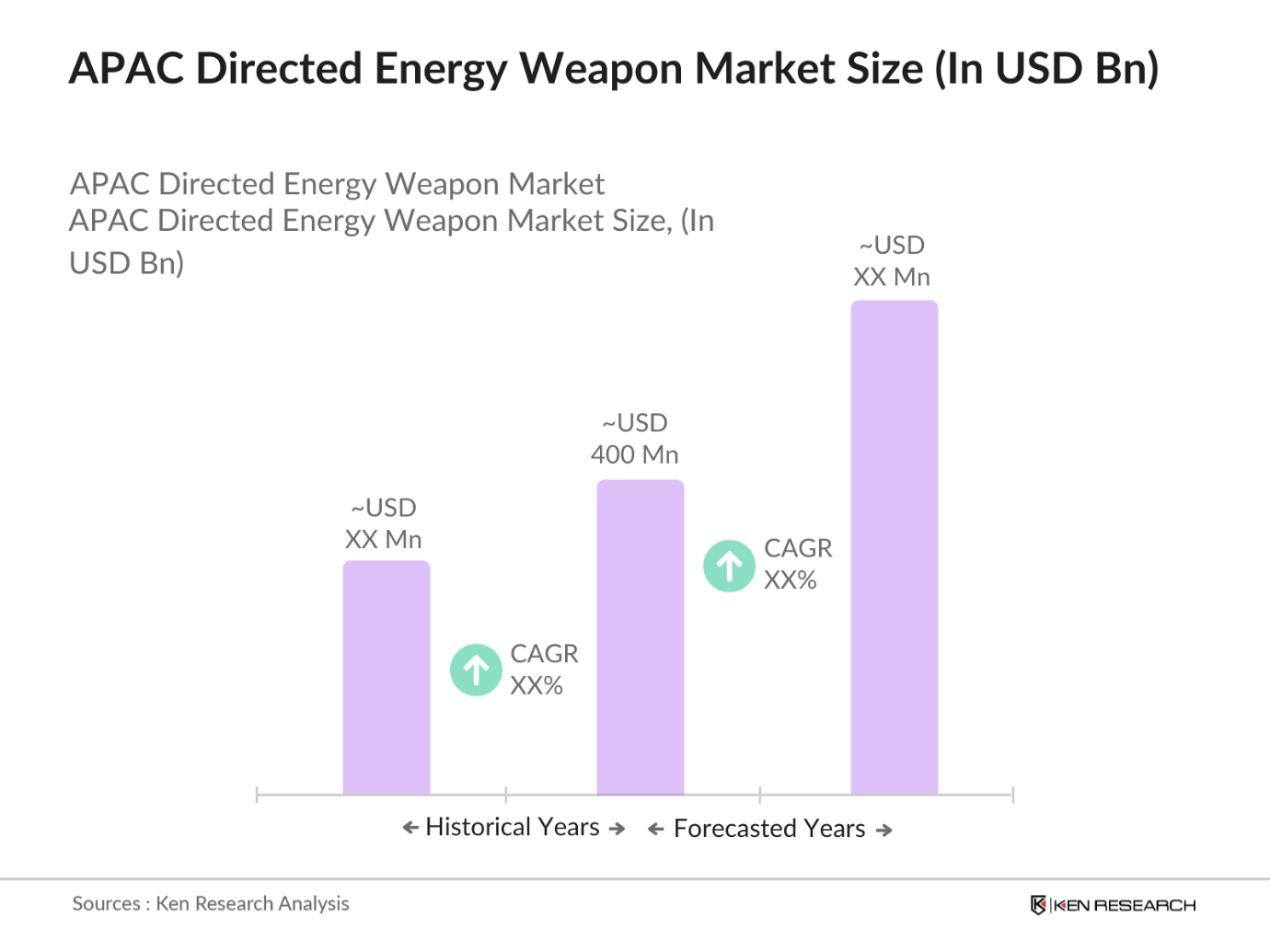
  • The APAC Directed Energy Weapon market, valued at USD 400 million, has shown significant growth fueled by defense modernization efforts, primarily in nations with strong defense spending like China, India, and South Korea. The rise in asymmetric warfare, combined with government investments in DEW technology for border security and surveillance, has bolstered demand. These investments are underpinned by each country's focus on technological advancement to enhance security capabilities.

market overviews

  • The APAC Directed Energy Weapon market is largely dominated by China, Japan, and South Korea, driven by their advanced manufacturing capabilities and substantial investments in defense. China leads due to its large defense budget and strategic focus on non-kinetic warfare. South Korea follows closely, with significant investments aimed at maintaining technological advantages over regional threats, making it a prominent player in DEW advancements.
  • APAC governments are paying increased attention to the ethical implications of DEWs. Japan's Ministry of Defense allocated $50 million in 2024 for research on DEWs human rights implications, with a focus on non-lethal applications. Similarly, South Korea invested $20 million to evaluate DEWs compliance with humanitarian principles, ensuring DEWs are developed responsibly and align with international human rights laws

APAC Directed Energy Weapon Market Segmentation

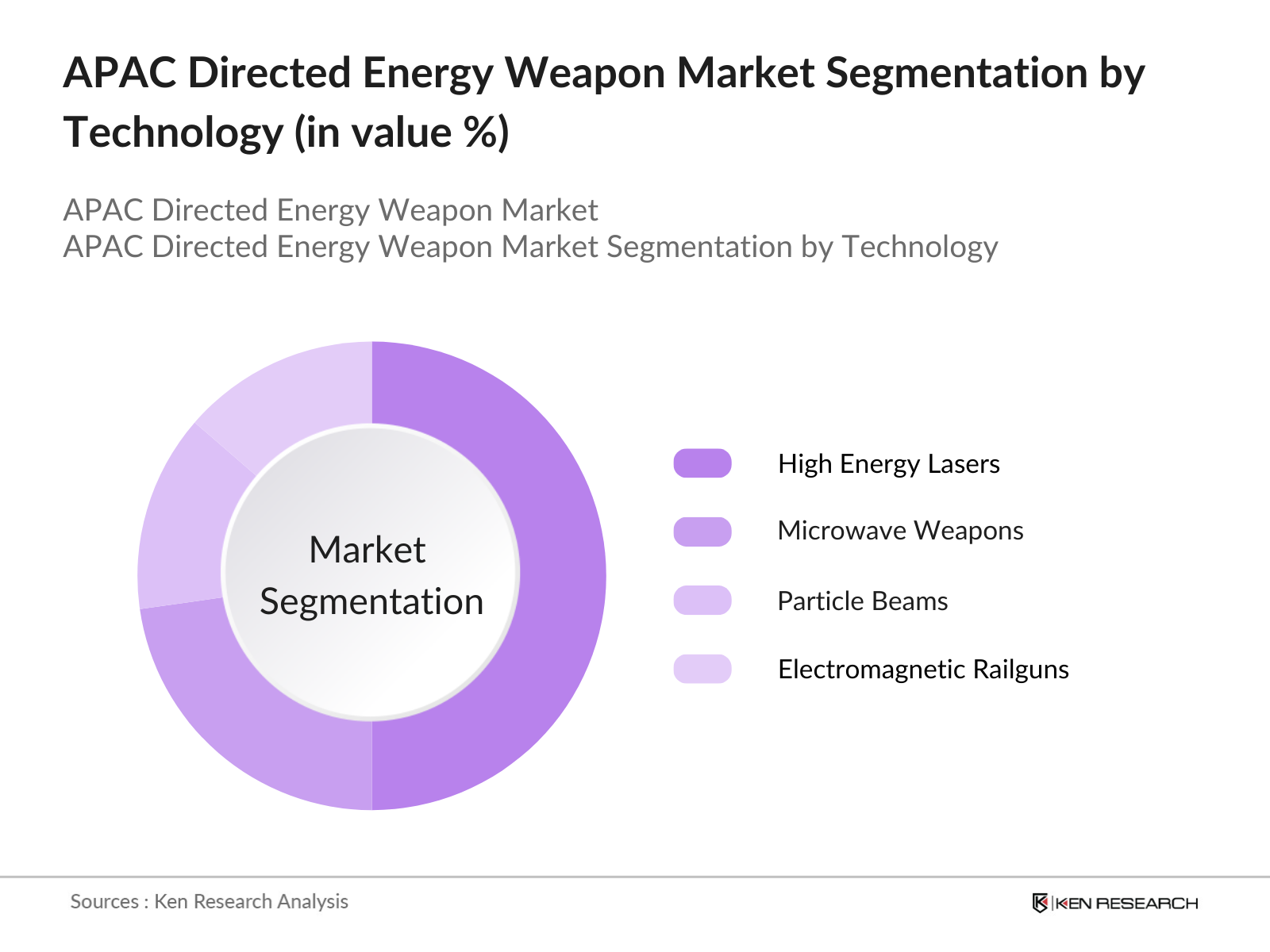
  • By Technology: The APAC Directed Energy Weapon market is segmented by technology into High Energy Lasers, Microwave Weapons, Particle Beams, Electromagnetic Railguns, and Non-lethal Directed Energy Systems. High Energy Lasers hold a dominant share due to their precision and effectiveness in various defense applications. Regional investments in laser research have amplified their use, particularly in surveillance and counter-drone operations, where accuracy and controlled impact are crucial.

market overviews

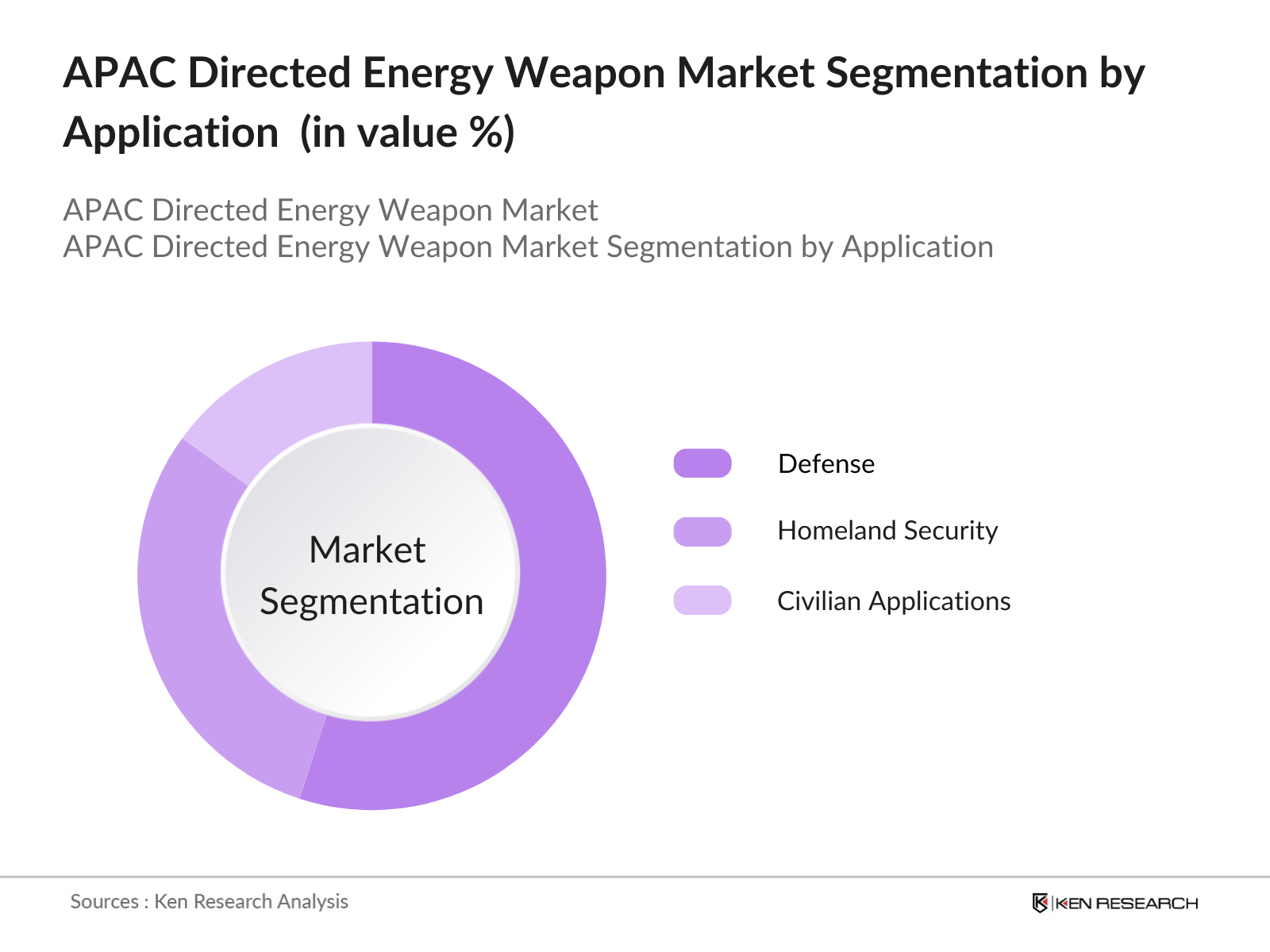
  • By Application: The APAC Directed Energy Weapon market is segmented by application into Homeland Security, Defense, and Civilian Applications. Defense applications dominate the market due to extensive government-backed projects in DEWs for national security. This is driven by the increasing need for efficient border surveillance, especially in sensitive regions, where these weapons can be used to maintain regional security without excessive manpower.

market overviews

  • By Region: The APAC Directed Energy Weapon market is segmented by region into East Asia, Southeast Asia, South Asia, Oceania, and Central Asia. East Asia, including China and Japan, holds the highest market share due to robust funding in military technology and government initiatives promoting advanced defense capabilities. Countries in East Asia have also fostered strong public-private partnerships to encourage innovation in DEWs.

APAC Directed Energy Weapon Market Competitive Landscape

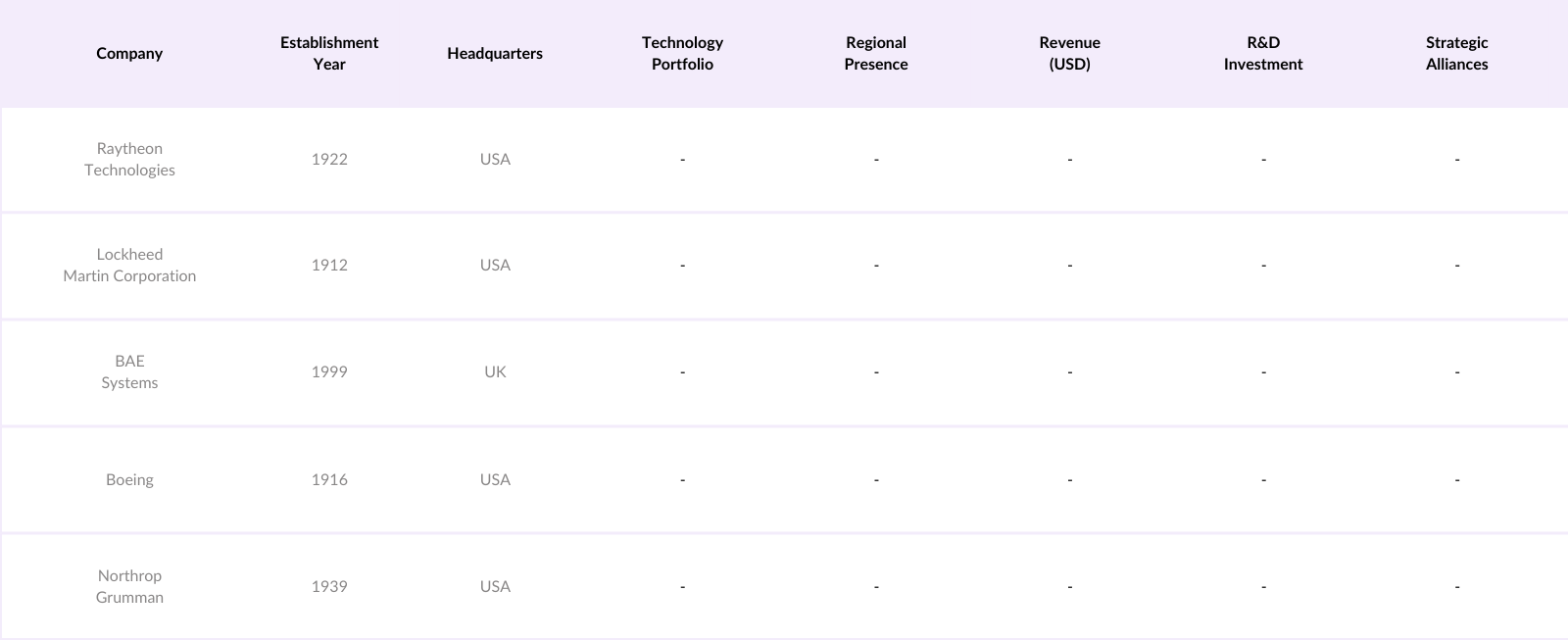
The APAC Directed Energy Weapon market is dominated by several key players that leverage advanced technology and strategic partnerships to maintain market influence.
market overviews

APAC Directed Energy Weapon Industry Analysis

Growth Drivers

  • Defense Modernization Initiatives (Defense Budgets, Government Initiatives): Defense budgets across the Asia-Pacific region have seen a steady increase as governments aim to enhance national security capabilities through modernization. In 2023, Japan allocated approximately $51 billion to its defense budget, marking one of its highest investments in recent years. Similarly, Australias defense expenditure reached $32 billion in 2023, with a focus on advanced weapon systems, including directed energy weapons (DEWs), to counter emerging threats. South Korea also dedicated $46 billion to defense in 2024, reinforcing its commitment to integrating modern DEW technologies in counter-missile defense systems.
  • Technological Advancements (Laser, Microwave Technologies): Technological advancements in laser and microwave weapon systems have fueled DEW market growth in the APAC region. The development of laser systems, which can deliver energy at the speed of light, has accelerated in nations like China, which invested over $2 billion in DEW research in 2023. This surge in R&D has spurred innovations like higher-powered lasers capable of disabling drones and small aircraft, as evidenced by China's successful 50kW laser tests. Similarly, Japan has been advancing microwave-based DEW systems, investing $500 million into microwave technology research to strengthen its counter-electronics capabilities.
  • Rise in Asymmetric Warfare (Counter-UAS, Area Denial Systems): The rising trend in asymmetric warfare has created a demand for DEWs across the APAC region, especially for counter-unmanned aerial systems (UAS) and area denial applications. In 2024, the Indian government allocated nearly $1 billion towards technologies aimed at enhancing anti-UAS capabilities to protect sensitive installations. Meanwhile, Australia allocated $800 million in the same year to strengthen border security with DEWs, focusing on counter-drone laser technologies for increased accuracy. Such investments underscore the region's pivot to DEW solutions for quick and cost-effective responses to unconventional threats.

Market Restraints

  • High Development and Implementation Costs: The high costs associated with DEW development pose significant financial challenges. For instance, a high-energy laser system can cost upwards of $200 million to develop, as seen with Japan's 2023 budget allocation for laser-based weaponry. Additionally, implementation requires substantial infrastructure, with South Korea spending approximately $50 million on infrastructure upgrades to support DEWs at key military bases. These costs limit widespread adoption, particularly among countries with constrained defense budgets.
  • Limited Operational Range and Effectiveness: DEWs, while innovative, face operational limitations, especially in terms of range and effectiveness under adverse weather conditions. Research from South Korea in 2023 showed that laser systems could lose over 30% effectiveness in high humidity environments, affecting targeting accuracy. Similarly, testing by Australias Department of Defence revealed range limitations in microwave systems, especially against high-speed drones, impacting their reliability in combat scenarios. These findings indicate that while DEWs hold promise, overcoming these limitations is crucial for optimal deployment.

APAC Directed Energy Weapon Market Future Outlook

The APAC Directed Energy Weapon market is set for growth, driven by increasing governmental focus on advanced technology adoption, continuous improvements in DEW technology, and rising investments in defense and security capabilities across the region. The integration of these systems with unmanned vehicles and surveillance platforms will be key to maintaining regional stability and enhancing national defense strategies.

Market Opportunities

  • Growing Demand in Border Security: Increasing border security needs have boosted demand for DEWs, particularly in counter-drone and area surveillance applications. In 2024, India allocated $700 million to improve border security through DEW technology, focusing on laser-based anti-drone systems. Australia has similarly invested $600 million in DEWs for coastal security to combat illegal fishing and potential airspace violations. These investments reflect a growing focus on DEWs as a strategic tool for enhancing national security and mitigating cross-border threats.
  • Strategic Partnerships and Alliances: Strategic collaborations are enhancing DEW capabilities within APAC. Japan and the U.S. recently entered a $1.2 billion partnership to advance laser DEW technology, enabling knowledge transfer and technology sharing. South Korea has also partnered with Israel for joint R&D, contributing $300 million in 2024 towards shared DEW development initiatives. These alliances allow countries to accelerate DEW innovation and improve defense readiness, positioning APAC as a key player in the global DEW market.

Scope of the Report


By Technology

High Energy Lasers

Microwave Weapons

Particle Beams

Electromagnetic Railguns

Non-lethal Directed Energy Systems

By Application

Homeland Security

Defense (Land, Naval, Aerial Platforms)

Civilian Applications

By End-User

Military

Law Enforcement

Research Institutions

By Range

Short Range

Medium Range

Long Range

By Region

East Asia

Southeast Asia

South Asia

Oceania

Central Asia

Products

Key Target Audience

  • Investor and Venture Capitalist Firms

  • Government and Regulatory Bodies (Ministry of Defense, Border Security Agencies)

  • Defense Manufacturers

  • Technology and Systems Integrators

  • Defense Research and Development Organizations

  • Homeland Security Agencies

  • Defense Procurement Departments

  • Autonomous Systems and Robotics Developers

Companies

Players Mentioned in the Report:

  • Raytheon Technologies

  • Lockheed Martin Corporation

  • Northrop Grumman

  • BAE Systems

  • Boeing

  • Rheinmetall AG

  • Leonardo S.p.A

  • Thales Group

  • Israel Aerospace Industries

  • Mitsubishi Electric Corporation

  • Bharat Electronics Limited

  • QinetiQ Group plc

  • Textron Inc.

  • Rafael Advanced Defense Systems

  • Hanwha Defense

Table of Contents

1. APAC Directed Energy Weapon Market Overview

1.1 Definition and Scope

1.2 Market Taxonomy

1.3 Market Growth Rate

1.4 Market Segmentation Overview

2. APAC Directed Energy Weapon Market Size (In USD Mn)

2.1 Historical Market Size

2.2 Year-On-Year Growth Analysis

2.3 Key Market Developments and Milestones

3. APAC Directed Energy Weapon Market Analysis

3.1 Growth Drivers

3.1.1 Defense Modernization Initiatives (Defense Budgets, Government Initiatives)

3.1.2 Technological Advancements (Laser, Microwave Technologies)

3.1.3 Rise in Asymmetric Warfare (Counter-UAS, Area Denial Systems)

3.2 Market Challenges

3.2.1 High Development and Implementation Costs

3.2.2 Limited Operational Range and Effectiveness

3.2.3 Environmental and Safety Concerns

3.3 Opportunities

3.3.1 Growing Demand in Border Security

3.3.2 Strategic Partnerships and Alliances

3.3.3 Expansion in Civilian Applications

3.4 Trends

3.4.1 Integration with Autonomous Systems

3.4.2 Shift from Conventional to Non-Kinetic Warfare

3.4.3 Miniaturization and Enhanced Portability

3.5 Government Regulation

3.5.1 Compliance with International Laws on DEWs

3.5.2 Funding and Subsidy Programs

3.5.3 Regional Defense Agreements

3.5.4 Ethical and Human Rights Considerations

3.6 SWOT Analysis

3.7 Stakeholder Ecosystem

3.8 Porters Five Forces Analysis

3.9 Competition Ecosystem

4. APAC Directed Energy Weapon Market Segmentation

4.1 By Technology (In Value %)

4.1.1 High Energy Lasers

4.1.2 Microwave Weapons

4.1.3 Particle Beams

4.1.4 Electromagnetic Railguns

4.1.5 Non-lethal Directed Energy Systems

4.2 By Application (In Value %)

4.2.1 Homeland Security

4.2.2 Defense (Land, Naval, Aerial Platforms)

4.2.3 Civilian Applications

4.3 By End-User (In Value %)

4.3.1 Military

4.3.2 Law Enforcement

4.3.3 Research Institutions

4.4 By Range (In Value %)

4.4.1 Short Range

4.4.2 Medium Range

4.4.3 Long Range

4.5 By Region (In Value %)

4.5.1 East Asia

4.5.2 Southeast Asia

4.5.3 South Asia

4.5.4 Oceania

4.5.5 Central Asia

5. APAC Directed Energy Weapon Market Competitive Analysis

5.1 Detailed Profiles of Major Companies

5.1.1 Raytheon Technologies

5.1.2 Lockheed Martin Corporation

5.1.3 Northrop Grumman

5.1.4 BAE Systems

5.1.5 Boeing

5.1.6 Rheinmetall AG

5.1.7 Leonardo S.p.A

5.1.8 Thales Group

5.1.9 Israel Aerospace Industries

5.1.10 Mitsubishi Electric Corporation

5.1.11 Bharat Electronics Limited

5.1.12 QinetiQ Group plc

5.1.13 Textron Inc.

5.1.14 Rafael Advanced Defense Systems

5.1.15 Hanwha Defense

5.2 Cross-Comparison Parameters (Headquarters, Inception Year, Revenue, Market Share, Technology Portfolio, R&D Investment, Regional Presence, Alliances)

5.3 Market Share Analysis

5.4 Strategic Initiatives

5.5 Mergers and Acquisitions

5.6 Investment Analysis

5.7 Venture Capital Funding

5.8 Government Grants

5.9 Private Equity Investments

6. APAC Directed Energy Weapon Market Regulatory Framework

6.1 Defense Standards and Certifications

6.2 Import-Export Restrictions on Military Hardware

6.3 Compliance with International Defense Treaties

6.4 Guidelines for Civilian Use

7. APAC Directed Energy Weapon Future Market Size (In USD Mn)

7.1 Projected Market Growth and Trends

7.2 Key Drivers for Future Growth

8. APAC Directed Energy Weapon Future Market Segmentation

8.1 By Technology (In Value %)

8.2 By Application (In Value %)

8.3 By End-User (In Value %)

8.4 By Range (In Value %)

8.5 By Region (In Value %)

9. APAC Directed Energy Weapon Market Analysts Recommendations

9.1 TAM/SAM/SOM Analysis

9.2 Customer Segment Analysis

9.3 Market Penetration Strategies

9.4 Opportunity Mapping and Unaddressed Needs

Disclaimer Contact Us

Research Methodology

Step 1: Identification of Key Variables

The research begins with mapping the APAC Directed Energy Weapon market ecosystem, identifying stakeholders like manufacturers, government agencies, and R&D organizations. This step relies on comprehensive desk research, accessing a range of proprietary databases to map critical market variables.

Step 2: Market Analysis and Construction

In this phase, historical data on market dynamics is analyzed, including defense spending and DEW product adoption rates, supported by reliable financial statistics. This analysis validates revenue patterns and application-based demand.

Step 3: Hypothesis Validation and Expert Consultation

To validate market trends and gather insights on strategic growth, industry experts are engaged through telephonic and email interviews. Insights from these discussions are instrumental in refining data accuracy and aligning with industry practices.

Step 4: Research Synthesis and Final Output

The final phase entails interactions with key market players for insights into consumer behavior, purchase preferences, and sales performance. This phase confirms the market statistics and complements the bottom-up research approach, ensuring a precise, comprehensive market analysis.


Frequently Asked Questions

01. How big is the APAC Directed Energy Weapon market?

The APAC Directed Energy Weapon market is valued at USD 400 million, driven by investments in defense technology and demand for modernized national security solutions.

02. What are the challenges in the APAC Directed Energy Weapon market?

Challenges include high initial costs of DEWs, limited operational range, and regulatory hurdles concerning non-lethal applications, which restrict market expansion in certain regions.

03. Who are the major players in the APAC Directed Energy Weapon market?

Key players include Raytheon Technologies, Lockheed Martin Corporation, Northrop Grumman, BAE Systems, and Boeing, which dominate due to their strong technological foothold and strategic alliances.

04. What are the growth drivers of the APAC Directed Energy Weapon market?

Growth drivers include increasing government investments in non-kinetic defense, heightened interest in autonomous weapons integration, and strategic partnerships for technological advancement.


Why Buy From Us?

RRR
Refine Robust Result (RRR) Framework

What makes us stand out is that our consultants follows Robust, Refine and Result (RRR) methodology. i.e. Robust for clear definitions, approaches and sanity checking, Refine for differentiating respondents facts and opinions and Result for presenting data with story

Our Reach Is Unmatched

We have set a benchmark in the industry by offering our clients with syndicated and customized market research reports featuring coverage of entire market as well as meticulous research and analyst insights.

Research
Shifting the Research Paradigm

While we don't replace traditional research, we flip the method upside down. Our dual approach of Top Bottom & Bottom Top ensures quality deliverable by not just verifying company fundamentals but also looking at the sector and macroeconomic factors.

Insite
More Insights-Better Decisions

With one step in the future, our research team constantly tries to show you the bigger picture. We help with some of the tough questions you may encounter along the way: How is the industry positioned? Best marketing channel? KPI's of competitors? By aligning every element, we help maximize success.

Trust
Transparency and Trust

Our report gives you instant access to the answers and sources that other companies might choose to hide. We elaborate each steps of research methodology we have used and showcase you the sample size to earn your trust.

support
Round the Clock Support

If you need any support, we are here! We pride ourselves on universe strength, data quality, and quick, friendly, and professional service.

Why Client Choose Us?

400000+ Reports in repository
150+ Consulting project a year
100+ Analysts
8000+ Client Queries in 2022