
APAC Hyper-Converged Infrastructure Market Outlook to 2030
Region:Asia
Author(s):Shubham Kashyap
Product Code:KROD3057
November 2024
98
About the Report
APAC Hyper-Converged Infrastructure Market Overview
- The APAC hyper-converged infrastructure (HCI) market is experiencing robust growth, reaching a market size of USD 7400 Bn, due to the increasing demand for cloud and edge computing solutions across key economies such as China, Japan, India, and South Korea. Hyper-converged systems, which integrate computing, storage, and networking into a single solution, are becoming the backbone for enterprises and data centers in APAC, allowing them to manage workloads more efficiently and cost-effectively. The rise in digital transformation initiatives, coupled with a surge in data generation, is driving the demand for HCI systems in the region.
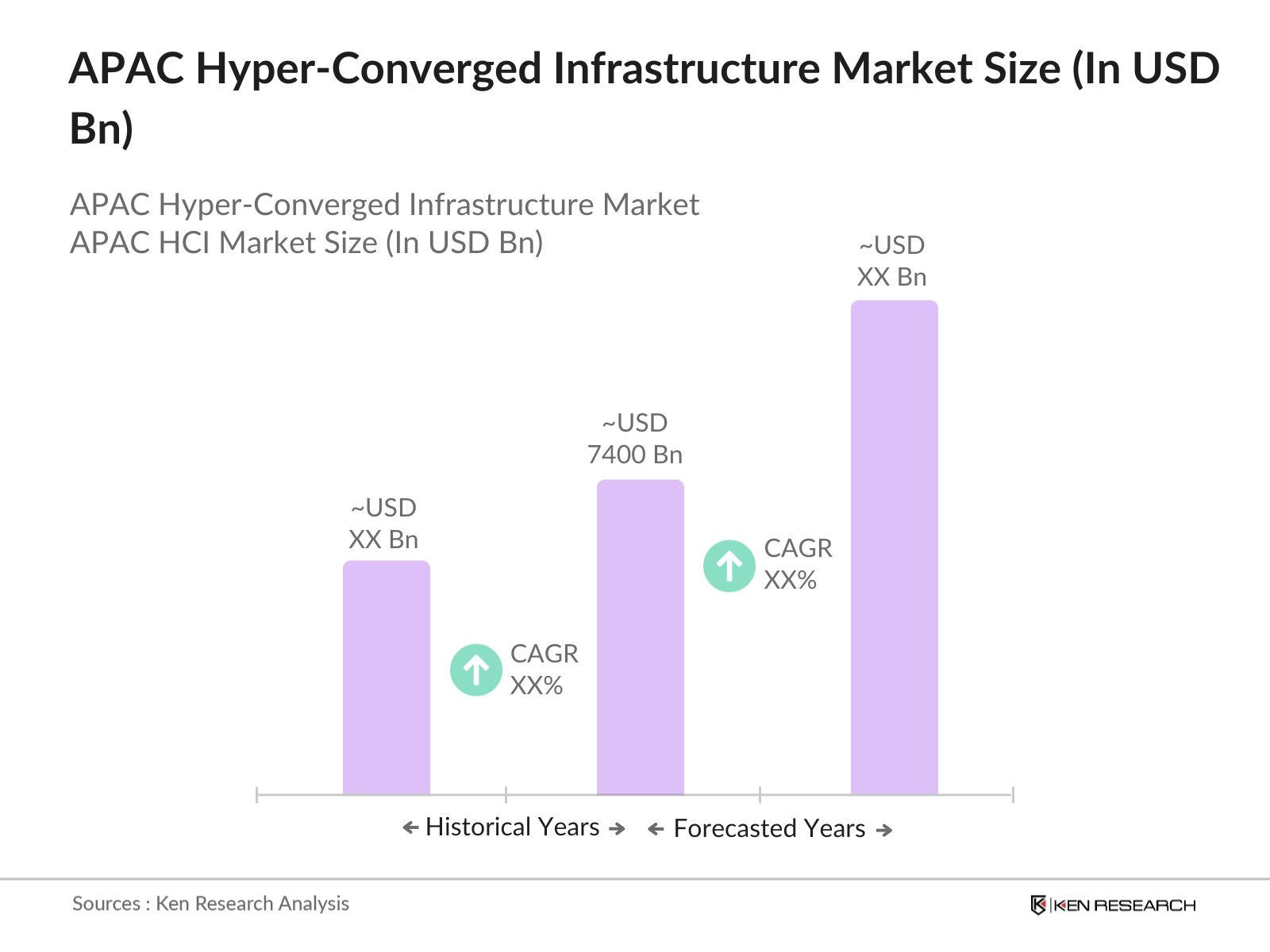
- Key markets such as China and Japan dominate the APAC HCI market. Chinas large-scale adoption of cloud services and data centers is supported by strong government initiatives such as the "New Infrastructure Plan," which prioritizes data center development. Japans mature technology infrastructure, combined with its advanced telecom sector, is pushing the adoption of HCI solutions for 5G and IoT applications. Meanwhile, India and Southeast Asian markets, including Indonesia and Thailand, are witnessing rapid adoption of hyper-converged systems due to the proliferation of digital services and the rise of e-commerce platforms.
- Governments across the APAC region is promoting digital transformation and infrastructure modernization, leading to the adoption of HCI solutions. Chinas 14th Five-Year Plan (2021-2025) emphasizes the need for next-generation IT infrastructure, including hyper-converged systems, to support industrial digitalization. Indias push toward cloud adoption under the Digital India initiative has boosted the demand for scalable and cost-effective infrastructure like HCI. Additionally, government policies in Southeast Asia aimed at enhancing digital infrastructure are expected to fuel market growth.
APAC Hyper-Converged Infrastructure Market Segmentation
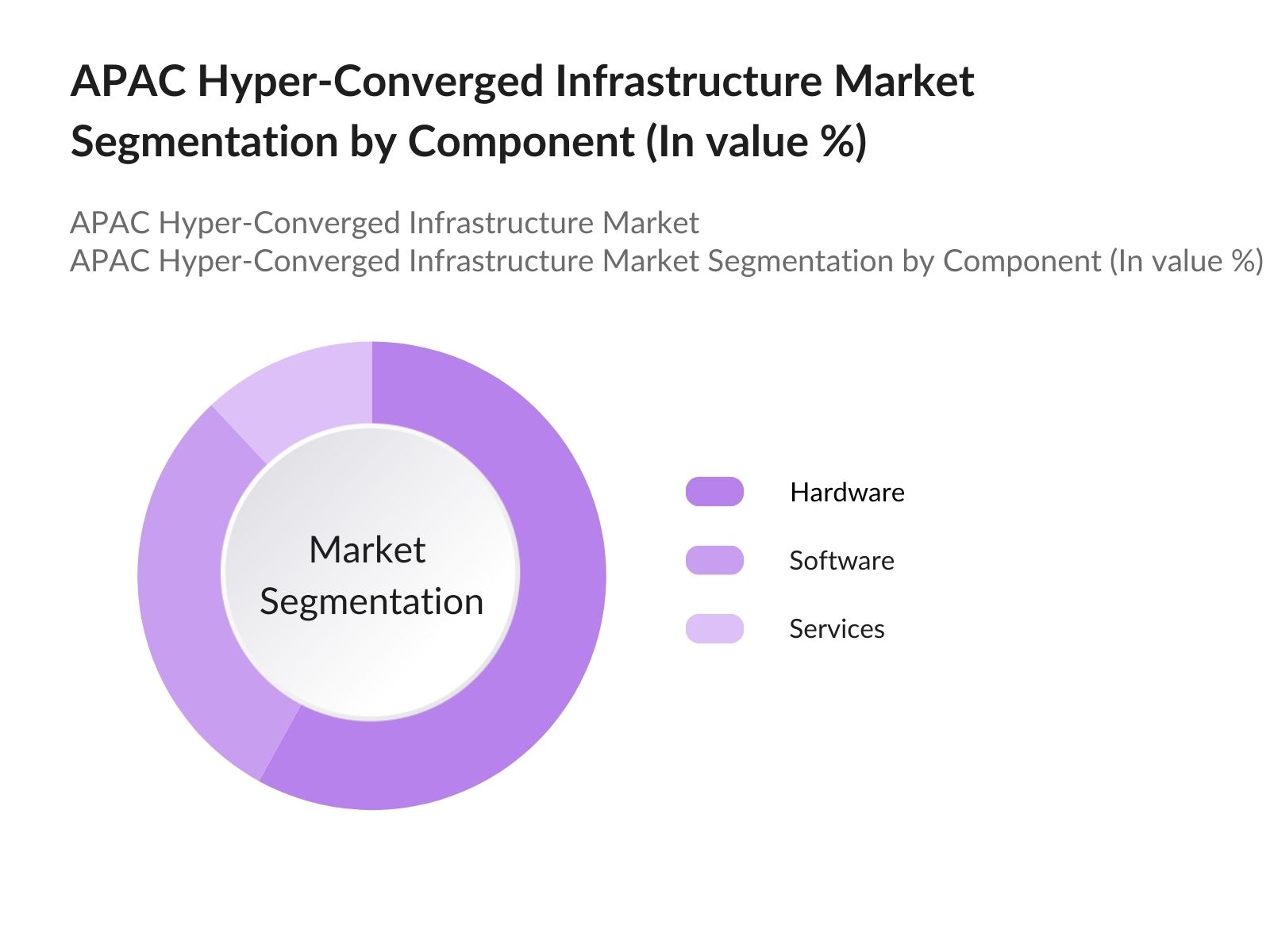
- By Component: The market is segmented by component into hardware, software, and services. Hardware holds the largest market share, as enterprises across APAC are investing in physical HCI appliances to consolidate their IT environments. However, the software segment is experiencing rapid growth due to increasing demand for virtualization solutions that integrate with HCI. Services, which include consulting, deployment, and managed services, are also gaining traction as enterprises seek external expertise to optimize their infrastructure.
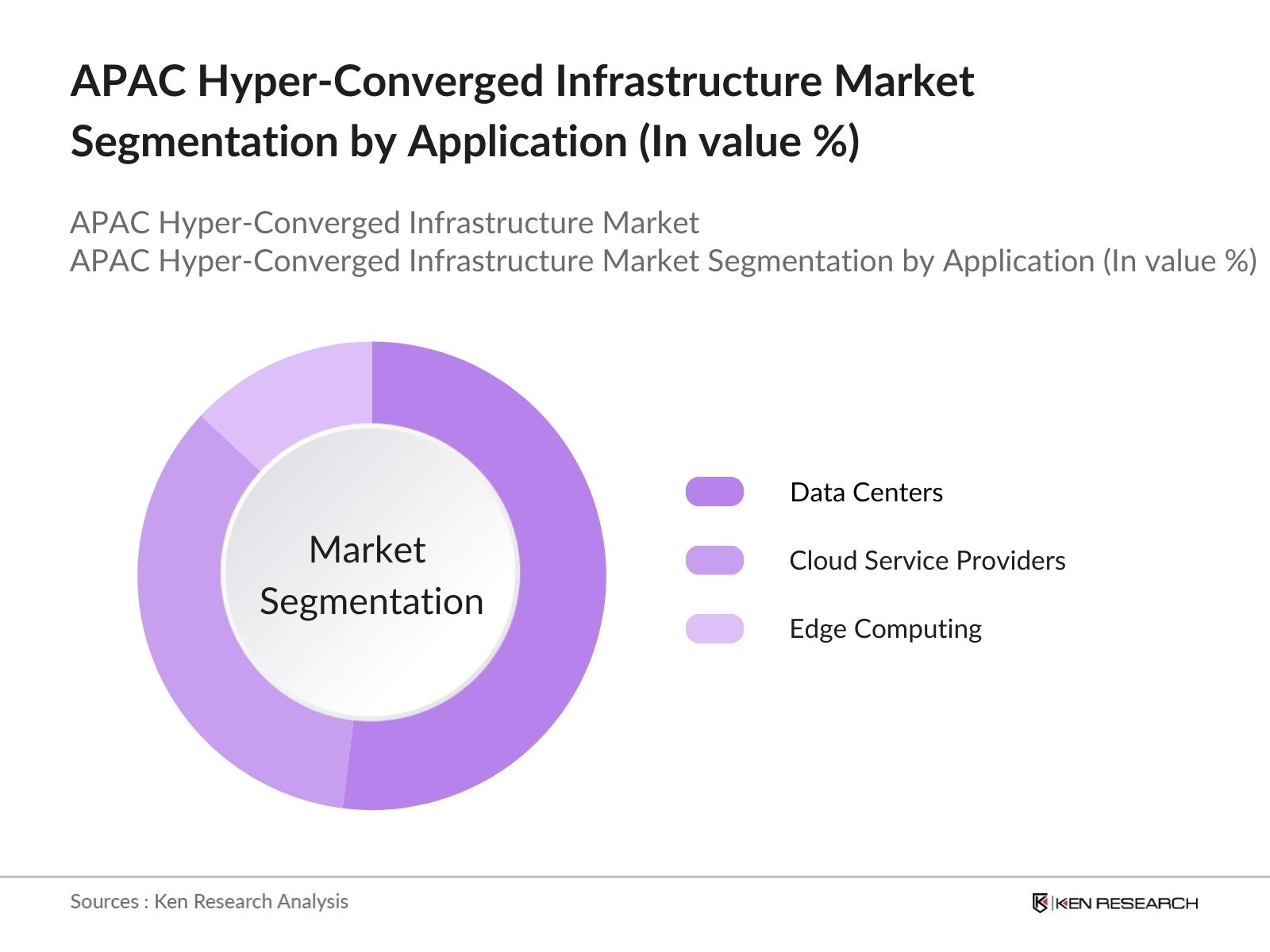
- By Application: The market is further segmented by application into data centers, cloud service providers, and edge computing. Data centers dominate the APAC HCI market, driven by the need for scalable, efficient, and flexible IT infrastructure solutions. Cloud service providers are also key users of HCI systems as they offer cost-effective solutions to customers. Edge computing, though still in its early stages, is witnessing rapid growth due to the expansion of 5G networks and IoT applications, which require low-latency processing at the networks edge.
APAC Hyper-Converged Infrastructure Market Competitive Landscape
The APAC hyper-converged infrastructure market is highly competitive, with global and regional players vying for market share. Key companies include Dell Technologies, Nutanix, Hewlett Packard Enterprise (HPE), Cisco Systems, and VMware. These companies are focusing on innovations in hyper-converged solutions, expanding their product portfolios, and forming strategic partnerships with cloud service providers and telecom operators to enhance their market presence.
|
Company Name |
Establishment Year |
Headquarters |
Key Products |
Revenue (2023) |
Key Clients |
Partnerships |
|
Dell Technologies |
1984 |
Round Rock, USA |
||||
|
Nutanix |
2009 |
San Jose, USA |
||||
|
Hewlett Packard Enterprise |
2015 |
Houston, USA |
||||
|
Cisco Systems |
1984 |
San Jose, USA |
||||
|
VMware |
1998 |
Palo Alto, USA |
APAC Hyper-Converged Infrastructure Industry Analysis
Growth Drivers
- Surge in Cloud Adoption: Cloud computing has been a major growth driver in the APAC region, with public and private cloud usage expanding across various industries. According to the World Bank, by 2024, Asia-Pacific will see a increase in internet users, is expected to grow from 1.4 billion (51% penetration) in 2023 to about 1.8 billion (61% penetration) by 2030. This demand for flexible and scalable cloud solutions directly supports hyper-converged infrastructure (HCI), which helps businesses scale rapidly and optimize resource utilization. Governments in countries like Japan, India, and South Korea are investing in cloud-based digital economies, encouraging cloud adoption in both public and private sectors.
- Digital Transformation Initiatives: Countries in the APAC region are pushing digital transformation efforts, with governments driving modernization in key sectors. The Indian governments Digital India initiative, is expected to bring more than 800 million people online by 2025. China and Singapore have introduced ambitious digital infrastructure policies to enhance their global competitiveness, promoting hyper-converged infrastructure to streamline IT operations. The IMF reports that the Asia-Pacific region's GDP has witnessed substantial growth in 2023, with heavy investments in IT infrastructure to boost digital transformation across all sectors.
- 5G Rollout and Edge Computing: The 5G rollout in key APAC markets, including China, Japan, and South Korea, is driving the demand for HCI, as it offers a scalable architecture to support the low-latency and high-performance requirements of edge computing. By 2024, South Korea alone is expected to achieve 100% 5G penetration. Governments and telecom companies are heavily investing in 5G infrastructure, increasing the need for HCI to integrate edge devices with central data systems efficiently. The Asia-Pacific region has been experiencing growth in mobile technologies and services, with projections indicating that the mobile economy could reach USD 1 trillion by 2030., further highlighting the surge in demand for HCI solutions.
Market Challenges
- High Implementation Costs: The adoption of hyper-converged infrastructure comes with upfront costs, often limiting its accessibility for small and medium-sized enterprises (SMEs) in the APAC region. Deploying a mid-range HCI solution requires considerable investment, and this can be a substantial challenge, particularly in developing markets such as Indonesia and Vietnam. Smaller enterprises in these regions may struggle with the financial requirements needed to adopt and implement hyper-converged systems, making it harder for them to stay competitive in a rapidly digitalizing economy.
- Data Security Concerns: The rapid adoption of cloud and edge technologies in the APAC market introduces data security challenges. As companies increasingly rely on hyper-converged infrastructure to manage large volumes of sensitive data, the importance of a robust cybersecurity framework becomes critical. While governments are actively introducing regulations aimed at safeguarding data, the risks remain high, particularly in sectors such as finance and healthcare, where security breaches could result in severe consequences. Developing comprehensive security strategies within HCI systems is essential to mitigate these growing threats.
APAC Hyper-Converged Infrastructure Market Future Outlook
The APAC hyper-converged infrastructure market is expected to continue its growth trajectory, driven by the increasing adoption of cloud computing, the expansion of 5G networks, and government-led digital transformation initiatives. The demand for efficient and scalable IT infrastructure will remain high as enterprises look to streamline their operations and improve data management capabilities.
Future Market Opportunities
- Adoption of Hyper-Automation (Automation): Hyper-automation, the application of AI, ML, and robotic process automation (RPA) to streamline IT operations, is gaining momentum in APACs hyper-converged infrastructure landscape. According to the IMF, enterprises in countries like Japan and South Korea have begun implementing hyper-automation to improve data center management and reduce operational costs. This trend allows for real-time system monitoring, predictive maintenance, and increased overall efficiency. IDC indicates that total ICT spending in the APAC region surpassed USD 1.3 trillion in 2023, hyper-automation is becoming a key factor in driving HCI adoption across sectors such as manufacturing, healthcare, and finance.
- Integration with IoT and Edge Devices: The integration of IoT and edge devices with hyper-converged infrastructure is a growing trend in APAC, driven by the need for low-latency data processing. Telenor IoT anticipates that by 2030, there will be over 38.9 billion IoT devices in action across the APAC region, leading to an increased demand for edge computing solutions that require scalable infrastructure like HCI. Countries such as China and Singapore are investing heavily in IoT ecosystems, further propelling the demand for hyper-converged systems that can handle large amounts of real-time data from edge devices.
Scope of the Report
|
By Component |
Hardware Software Services |
|
By Application |
Data Centers Cloud Service Providers Edge Computing |
|
By Organization Size |
Large Enterprises Small and Medium Enterprises (SMEs) |
|
By Industry Vertical |
IT & Telecom BFSI Healthcare Retail Government |
|
By Region |
China Japan South Korea India Rest of APAC |
Products
Key Target Audience
IT & Data Center Managers
Cloud Service Providers
Telecom Operators
Hyper-Converged Infrastructure Solution Providers
Government and Regulatory Bodies (Chinas Ministry of Industry and Information Technology, Japan's Ministry of Internal Affairs and Communications)
Large Enterprises in Healthcare, BFSI, Retail
Edge Computing Solution Providers
Banks and Financial Institutions
Companies
Major Players Mentioned in the Report
Dell Technologies
Nutanix
Hewlett Packard Enterprise (HPE)
Cisco Systems
VMware
Huawei Technologies
Lenovo Group
Fujitsu
Sangfor Technologies
IBM Corporation
Microsoft Corporation
Hitachi Vantara
Scale Computing
Inspur
Pivot3
Table of Contents
1. APAC Hyper-Converged Infrastructure Market Overview
1.1. Definition and Scope
1.2. Market Taxonomy
1.3. Market Growth Rate
1.4. Market Segmentation Overview
2. APAC Hyper-Converged Infrastructure Market Size (In USD Bn)
2.1. Historical Market Size
2.2. Year-On-Year Growth Analysis
2.3. Key Market Developments and Milestones
3. APAC Hyper-Converged Infrastructure Market Analysis
3.1. Growth Drivers
3.1.1. Surge in Cloud Adoption (Cloud Computing)
3.1.2. Digital Transformation Initiatives (Digital Transformation)
3.1.3. 5G Rollout and Edge Computing (Telecom and Edge Infrastructure)
3.1.4. Data Center Expansion (Data Center Modernization)
3.2. Market Challenges
3.2.1. High Initial Costs (Cost of Infrastructure)
3.2.2. Data Security Concerns (Cybersecurity Risks)
3.2.3. Lack of Skilled IT Workforce (Talent Shortage)
3.3. Opportunities
3.3.1. Integration of AI/ML with HCI (Artificial Intelligence)
3.3.2. Expansion into Emerging Markets (Emerging Market Opportunities)
3.3.3. Adoption of Hybrid and Multi-Cloud Environments (Cloud Migration)
3.4. Trends
3.4.1. Adoption of Hyper-Automation (Automation)
3.4.2. Integration with IoT and Edge Devices (IoT Expansion)
3.4.3. Focus on Sustainability and Energy Efficiency (Green Data Centers)
3.5. Government Regulations
3.5.1. Data Privacy Regulations (GDPR, APAC-Specific Regulations)
3.5.2. Government Initiatives for Digital Infrastructure (Public Investments)
3.5.3. Policies for Cloud and Data Localization (Data Sovereignty)
3.6. SWOT Analysis
3.7. Stakeholder Ecosystem
3.8. Porters Five Forces
3.9. Competition Ecosystem
4. APAC Hyper-Converged Infrastructure Market Segmentation
4.1. By Component (In Value %)
4.1.1. Hardware
4.1.2. Software
4.1.3. Services
4.2. By Application (In Value %)
4.2.1. Data Centers
4.2.2. Cloud Service Providers
4.2.3. Edge Computing
4.3. By Organization Size (In Value %)
4.3.1. Large Enterprises
4.3.2. Small and Medium Enterprises (SMEs)
4.4. By Industry Vertical (In Value %)
4.4.1. IT & Telecom
4.4.2. BFSI
4.4.3. Healthcare
4.4.4. Retail
4.4.5. Government
4.5. By Region (In Value %)
4.5.1. China
4.5.2. Japan
4.5.3. South Korea
4.5.4. India
4.5.5. Southeast Asia (Indonesia, Thailand, Vietnam)
5. APAC Hyper-Converged Infrastructure Market Competitive Analysis
5.1. Detailed Profiles of Major Companies
5.1.1. Dell Technologies
5.1.2. Nutanix
5.1.3. Hewlett Packard Enterprise (HPE)
5.1.4. Cisco Systems
5.1.5. VMware
5.1.6. Huawei Technologies
5.1.7. Lenovo Group
5.1.8. Fujitsu
5.1.9. Sangfor Technologies
5.1.10. IBM Corporation
5.1.11. Microsoft Corporation
5.1.12. Hitachi Vantara
5.1.13. Scale Computing
5.1.14. Inspur
5.1.15. Pivot3
5.2. Cross Comparison Parameters (Revenue, Product Portfolio, Market Share, Innovation Capabilities, Service Support, Cloud Integration, Client Base, Regional Presence)
5.3. Market Share Analysis
5.4. Strategic Initiatives
5.5. Mergers And Acquisitions
5.6. Investment Analysis
5.7. Venture Capital Funding
5.8. Government Grants
5.9. Private Equity Investments
6. APAC Hyper-Converged Infrastructure Market Regulatory Framework
6.1. Data Privacy Standards
6.2. Compliance Requirements for Cloud Providers
6.3. Certification Processes
7. APAC Hyper-Converged Infrastructure Future Market Size (In USD Bn)
7.1. Future Market Size Projections
7.2. Key Factors Driving Future Market Growth
8. APAC Hyper-Converged Infrastructure Future Market Segmentation
8.1. By Component (In Value %)
8.2. By Application (In Value %)
8.3. By Organization Size (In Value %)
8.4. By Industry Vertical (In Value %)
8.5. By Region (In Value %)
9. APAC Hyper-Converged Infrastructure Market Analysts Recommendations
9.1. TAM/SAM/SOM Analysis
9.2. Customer Cohort Analysis
9.3. White Space Opportunity Analysis
9.4. Marketing Strategies
Research Methodology
Step 1: Identification of Key Variables
The initial phase involves identifying key market variables, such as adoption rates of HCI solutions, cloud infrastructure growth, and data center expansion trends in the APAC region. Extensive desk research is conducted using secondary databases and proprietary market data to define the market's critical components and influencing factors.
Step 2: Market Analysis and Construction
In this phase, historical data from 2018 to 2023 is analyzed to evaluate the penetration of hyper-converged systems across various industries. A thorough examination of market trends, including the adoption of edge computing and hybrid cloud infrastructure, is conducted to generate accurate revenue estimates for the market.
Step 3: Hypothesis Validation and Expert Consultation
Hypotheses related to market growth drivers, such as cloud adoption and the influence of 5G, are validated through expert consultations. These consultations involve engaging with industry professionals, cloud service providers, and HCI solution vendors to gain insights into operational and financial aspects of the market.
Step 4: Research Synthesis and Final Output
The final phase synthesizes the research data, focusing on validating key findings through direct engagement with IT and data center professionals across the APAC region. The output includes detailed insights into market segmentation, competitive landscape, and future growth prospects for the APAC hyper-converged infrastructure market.
Frequently Asked Questions
01. How big is the APAC Hyper-Converged Infrastructure Market?
The APAC hyper-converged infrastructure market was valued at USD 7400 billion, driven by the increasing demand for cloud computing, edge computing, and digital transformation initiatives.
02. What are the challenges in the APAC Hyper-Converged Infrastructure Market?
Challenges in the APAC hyper-converged infrastructure market include high implementation costs, data security concerns, and the lack of skilled IT professionals to manage HCI environments efficiently, which can deter small and medium enterprises from adopting these solutions.
03. Who are the major players in the APAC Hyper-Converged Infrastructure Market?
Major players in the APAC hyper-converged infrastructure market include Dell Technologies, Nutanix, Hewlett Packard Enterprise, Cisco Systems, and VMware, which dominate the market due to their extensive product portfolios and strategic partnerships.
04. What are the growth drivers of the APAC Hyper-Converged Infrastructure Market?
Key growth in the APAC hyper-converged infrastructure market drivers include the adoption of cloud computing, the expansion of 5G networks, increasing demand for edge computing, and government-led digital transformation initiatives across key APAC economies.
Why Buy From Us?

What makes us stand out is that our consultants follows Robust, Refine and Result (RRR) methodology. i.e. Robust for clear definitions, approaches and sanity checking, Refine for differentiating respondents facts and opinions and Result for presenting data with story

We have set a benchmark in the industry by offering our clients with syndicated and customized market research reports featuring coverage of entire market as well as meticulous research and analyst insights.

While we don't replace traditional research, we flip the method upside down. Our dual approach of Top Bottom & Bottom Top ensures quality deliverable by not just verifying company fundamentals but also looking at the sector and macroeconomic factors.

With one step in the future, our research team constantly tries to show you the bigger picture. We help with some of the tough questions you may encounter along the way: How is the industry positioned? Best marketing channel? KPI's of competitors? By aligning every element, we help maximize success.

Our report gives you instant access to the answers and sources that other companies might choose to hide. We elaborate each steps of research methodology we have used and showcase you the sample size to earn your trust.

If you need any support, we are here! We pride ourselves on universe strength, data quality, and quick, friendly, and professional service.