Ken Research Logo

APAC Polysilicon Market Outlook to 2030

Region:Asia

Author(s):Shubham Kashyap

Product Code:KROD11315

Published On

November 2024

Total pages

94

About the Report

APAC Polysilicon Market Overview

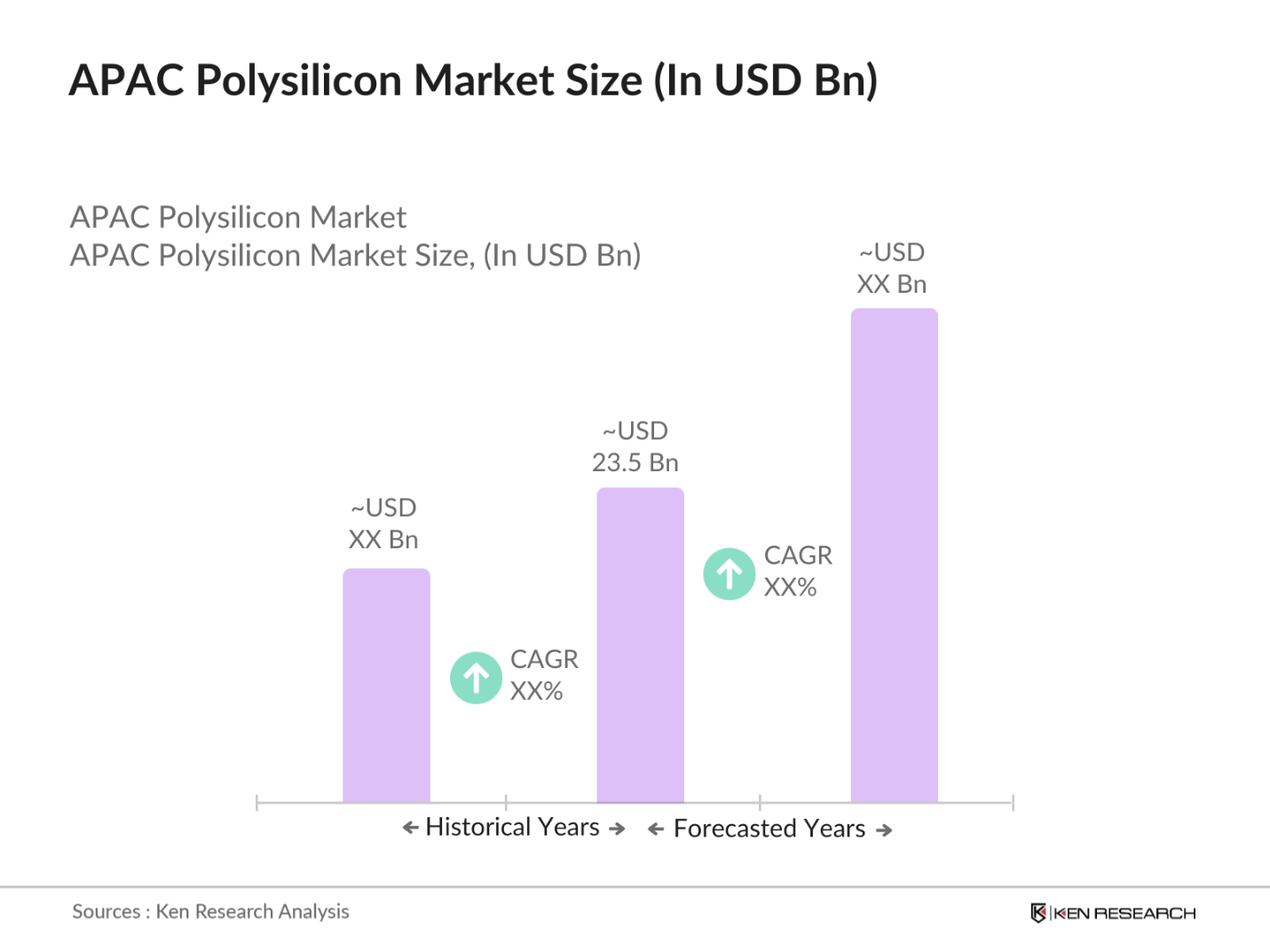
  • The APAC Polysilicon Market is valued at aroundUSD 23.5 billion, primarily driven by the rapid growth of the solar photovoltaic (PV) sector and the semiconductor industry. Significant demand stems from increased renewable energy adoption, with China and India leading solar PV installations. Additionally, technological advancements in manufacturing processes and government incentives are bolstering the market. High-purity polysilicon remains a crucial material in meeting the demand for efficient energy solutions and electronic components across the region. APAC Polysilicon Market Size
  • Key Demand Centersfor polysilicon production and consumption in APAC include countries like China, South Korea, and Japan. China dominates due to its extensive manufacturing capacity, low production costs, and government-backed incentives for renewable energy adoption. South Korea and Japan leverage their advanced semiconductor industries, ensuring a steady demand for high-purity polysilicon for electronic applications. Their strategic investments in research and development (R&D) also make them significant contributors to the regional market.
  • Governments across the Asia-Pacific region have established ambitious renewable energy targets to transition towards sustainable energy systems. China aims to achieve carbon neutrality by 2060, with a target of 1,200 gigawatts (GW) of installed solar and wind capacity by 2030, having already reached this milestone six years ahead of schedule.India plans to install 500 GW of renewable energy capacity by 2030, necessitating an investment of up to $385 billion to meet this goal.

APAC Polysilicon Market Segmentation

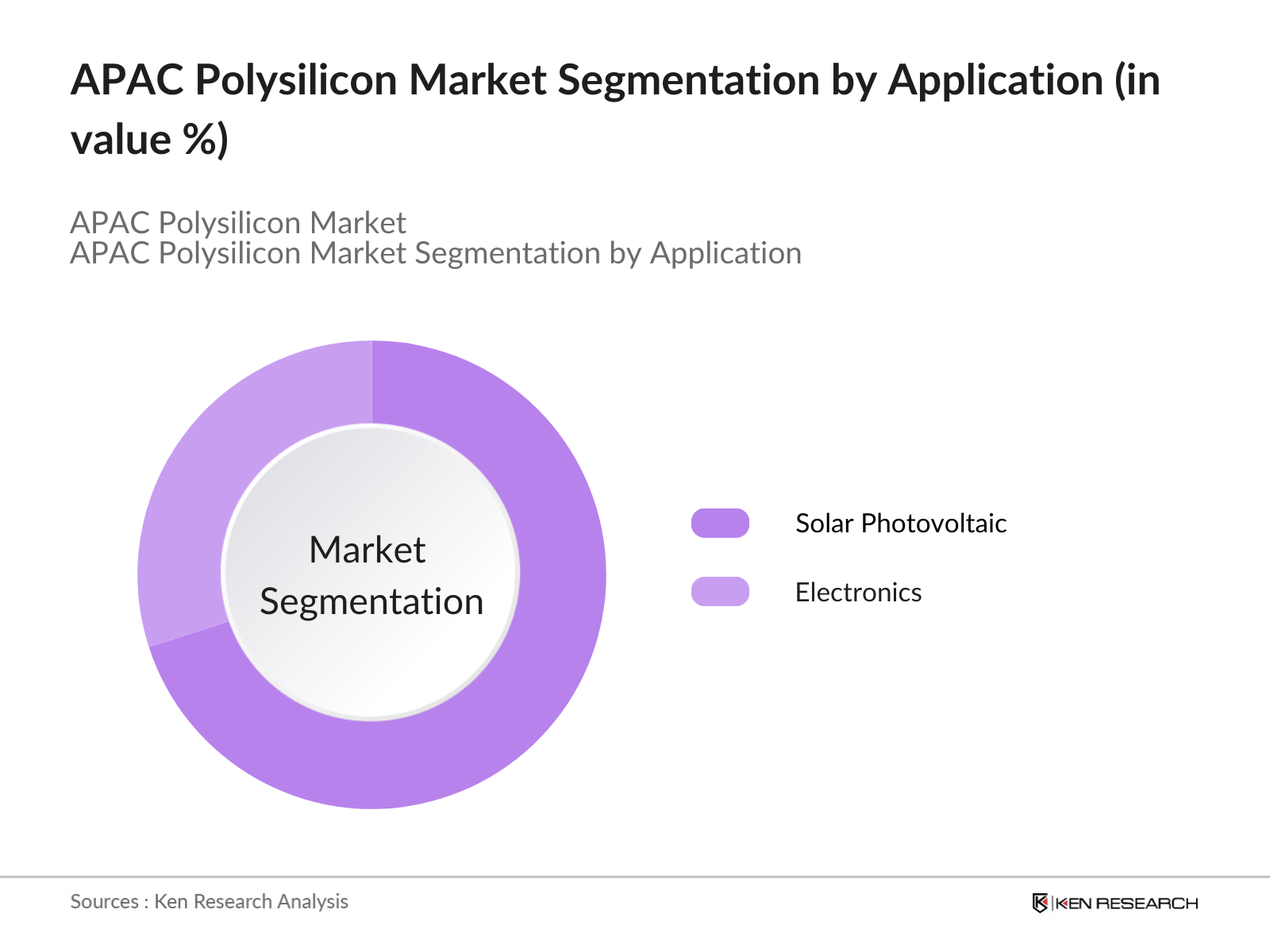
  • By Application: The Market is segmented by application intoSolar PhotovoltaicsandElectronics. Solar photovoltaics hold the dominant market share due to increasing solar panel installations in China and India, driven by government subsidies and aggressive renewable energy targets. Electronics also play a significant role, with the semiconductor industry's demand for high-purity polysilicon fueling this segment. Solar Photovoltaics dominate due to their role in powering renewable energy initiatives. Chinas extensive investment in solar farms and India's adoption of distributed solar systems contribute significantly.

APAC Polysilicon Market Segmentation by application

  • By Manufacturing Technology: The market is further segmented by manufacturing technology intoSiemens Process,Fluidized Bed Reactor (FBR) Process, andUpgraded Metallurgical Grade (UMG) Process. The Siemens Process leads, accounting for the majority share, due to its ability to produce high-purity polysilicon, meeting the stringent requirements of both solar PV and electronics sectors. Solar Photovoltaics dominate due to their role in powering renewable energy initiatives. Chinas extensive investment in solar farms and India's adoption of distributed solar systems contribute significantly. APAC Polysilicon Market Segmentation by tech

APAC Polysilicon Market Competitive Landscape

The APAC Polysilicon Market features several leading players, leveraging advanced manufacturing technologies and government partnerships to maintain a competitive edge. Chinese manufacturers dominate through large-scale production and export capabilities, while South Korean and Japanese companies focus on high-purity polysilicon for electronics.

APAC Polysilicon Market Competitive Landscape

APAC Polysilicon Market Analysis

Growth Drivers

  • Expansion of Solar Photovoltaic Installations: The Asia-Pacific region continues to see a rapid increase in solar photovoltaic (PV) installations, driven by the growing demand for renewable energy and energy security. China, India, and Japan are among the largest contributors to this growth, with China installing over 50 GW of solar capacity annually. As of 2022, China accounted for more than 70% of global PV production, highlighting the strong reliance on polysilicon for solar cells. India has set a target to install 500 GW of renewable energy capacity by 2030, with significant focus on solar power. This accelerated solar expansion drives polysilicon demand.
  • Advancements in Semiconductor Manufacturing: The semiconductor industry in the Asia-Pacific region has been experiencing notable advancements in production capabilities, with polysilicon being a key material in semiconductor fabrication. In 2023, Asia-Pacific's semiconductor witnessed remarkable growth, a major contributor to the increasing polysilicon demand. The demand for high-purity polysilicon used in semiconductors has been driven by the need for advanced electronic devices, IoT growth, and AI developments. China, Japan, and South Korea are among the leading producers of semiconductors, which in turn supports the polysilicon market growth.
  • Government Incentives for Renewable Energy: Governments across the Asia-Pacific region have been actively promoting renewable energy through incentives and regulatory support. In 2023, India increased its renewable energy budget to USD 1.24 billion, with a specific focus on solar power development, which is driving the polysilicon market. Japans "Green Growth Strategy" aims for net-zero emissions by 2050, targeting an increase in renewable energy usage, including solar power, which requires substantial polysilicon supply. These government incentives directly contribute to an increased demand for polysilicon, especially for solar PV installations.

Challenges

  • High Capital Expenditure for Production Facilities: The capital expenditure required to build polysilicon production facilities in Asia-Pacific remains a significant challenge. Establishing a new polysilicon production plant involves high upfront investments due to the complexity and scale of operations, including research, technology, and infrastructure. The significant financial burden created by these high investments makes it difficult for new market entrants to participate and expand, thereby limiting market competition. Ongoing costs related to maintaining high production standards and upgrading facilities to meet evolving industry regulations further increase the barriers to entry in the polysilicon market.
  • Volatility in Raw Material Prices: The raw materials required for polysilicon production, such as silicon metal, experience price volatility due to various factors like supply chain disruptions and fluctuations in global demand. Price instability affects the overall production cost of polysilicon and creates uncertainty in the market. These fluctuations are driven by multiple factors, including mining operations, geopolitical tensions, and disruptions in the global supply chain. Such volatility impacts the financial stability of polysilicon producers, complicating long-term planning and costing strategies, and potentially leading to higher market prices.

APAC Polysilicon Market Future Outlook

The APAC Polysilicon Market is poised for substantial growth, driven by expanding renewable energy projects and the increasing importance of semiconductors in consumer electronics and automotive applications. Technological advancements in production processes and growing investment in research and development are expected to further enhance market dynamics. The integration of AI and IoT in polysilicon applications presents additional opportunities for the industry.

Future Market Opportunities

  • Emerging Markets in Southeast Asia: Southeast Asia is increasingly becoming a hotspot for polysilicon demand, driven by the regions rapid urbanization and energy transition efforts. In 2023, Southeast Asia's solar energy capacity grew by 20 GW, and countries such as Vietnam and Thailand are expected to continue expanding their renewable energy capacity. The focus on solar energy generation in these markets has led to higher demand for polysilicon. As governments invest in renewable energy infrastructure, the demand for polysilicon is poised to increase, providing an opportunity for producers to expand their operations and meet the needs of this growing market.
  • Development of High-Purity Polysilicon for Electronics: The demand for high-purity polysilicon is expanding beyond the solar industry, driven by the increasing need for semiconductor devices and electronics. In 2022, Asia-Pacific accounted for over 60% of global semiconductor production, and the demand for high-purity polysilicon required for semiconductor wafers has been on the rise. Companies in Japan and South Korea are focused on developing advanced polysilicon for use in electronics and microelectronics. This growing trend presents an opportunity for polysilicon producers to diversify their product offerings and cater to the electronics sector.

Scope of the Report

By Application

Solar Photovoltaics

Electronics

By Manufacturing Technology

Siemens Process

Fluidized Bed Reactor (FBR) Process

Upgraded Metallurgical Grade (UMG) Process

By Purity Level

Electronic Grade

Solar Grade

By Geography

China

South Korea

Japan

By End-Use Industry

Renewable Energy

Semiconductor Manufacturing

Products

Key Target Audience

  • Polysilicon Manufacturers

  • Solar Panel Manufacturers

  • Semiconductor Companies

  • Renewable Energy Investors

  • Government and Regulatory Bodies (e.g., China National Energy Administration, Ministry of Trade, Industry, and Energy South Korea)

  • Venture Capital Firms

  • Banks and Financial Institutions

  • Environmental Agencies

Companies

Players Mentioned in the Report

  • GCL-Poly Energy Holdings Limited

  • OCI Company Ltd.

  • Wacker Chemie AG

  • Daqo New Energy Corp.

  • Tokuyama Corporation

  • Hemlock Semiconductor Operations LLC

  • REC Silicon ASA

  • East Hope Group

  • Xinte Energy Co., Ltd.

  • Sichuan Yongxiang Co., Ltd.

  • Asia Silicon (Qinghai) Co., Ltd.

  • Hanwha Solutions Corporation

  • Mitsubishi Materials Corporation

  • Qatar Solar Technologies

  • SunEdison Semiconductor Limited

Table of Contents

1. Asia-Pacific Polysilicon Market Overview

1.1. Definition and Scope

1.2. Market Taxonomy

1.3. Market Growth Rate

1.4. Market Segmentation Overview

2. Asia-Pacific Polysilicon Market Size (USD Billion)

2.1. Historical Market Size

2.2. Year-On-Year Growth Analysis

2.3. Key Market Developments and Milestones

3. Asia-Pacific Polysilicon Market Analysis

3.1. Growth Drivers

3.1.1. Expansion of Solar Photovoltaic Installations

3.1.2. Advancements in Semiconductor Manufacturing

3.1.3. Government Incentives for Renewable Energy

3.1.4. Technological Innovations in Polysilicon Production

3.2. Market Challenges

3.2.1. High Capital Expenditure for Production Facilities

3.2.2. Volatility in Raw Material Prices

3.2.3. Environmental and Regulatory Compliance

3.3. Opportunities

3.3.1. Emerging Markets in Southeast Asia

3.3.2. Development of High-Purity Polysilicon for Electronics

3.3.3. Integration of Polysilicon in Advanced Energy Storage Solutions

3.4. Trends

3.4.1. Shift Towards Monocrystalline Solar Panels

3.4.2. Adoption of Energy-Efficient Production Technologies

3.4.3. Strategic Partnerships and Joint Ventures

3.5. Government Regulations

3.5.1. Renewable Energy Targets and Policies

3.5.2. Import and Export Tariffs

3.5.3. Environmental Standards and Emission Norms

3.5.4. Subsidies and Tax Incentives

3.6. SWOT Analysis

3.7. Stakeholder Ecosystem

3.8. Porters Five Forces Analysis

3.9. Competitive Landscape

4. Asia-Pacific Polysilicon Market Segmentation

4.1. By Form (Value %)

4.1.1. Chunks

4.1.2. Granules

4.1.3. Rods

4.2. By Application (Value %)

4.2.1. Solar Photovoltaics

4.2.1.1. Monocrystalline Solar Panels

4.2.1.2. Multicrystalline Solar Panels

4.2.2. Electronics

4.2.2.1. Semiconductors

4.2.2.2. Integrated Circuits

4.3. By Manufacturing Technology (Value %)

4.3.1. Siemens Process

4.3.2. Fluidized Bed Reactor (FBR) Process

4.3.3. Upgraded Metallurgical Grade (UMG) Process

4.4. By Purity Level (Value %)

4.4.1. Electronic Grade

4.4.2. Solar Grade

4.5. By Country (Value %)

4.5.1. China

4.5.2. Japan

4.5.3. South Korea

4.5.4. India

4.5.5. Rest of Asia-Pacific

5. Asia-Pacific Polysilicon Market Competitive Analysis

5.1. Detailed Profiles of Major Companies

5.1.1. GCL-Poly Energy Holdings Limited

5.1.2. Wacker Chemie AG

5.1.3. OCI Company Ltd.

5.1.4. Daqo New Energy Corp.

5.1.5. Tongwei Co., Ltd.

5.1.6. Xinte Energy Co., Ltd.

5.1.7. Hemlock Semiconductor Operations LLC

5.1.8. REC Silicon ASA

5.1.9. Mitsubishi Materials Corporation

5.1.10. Tokuyama Corporation

5.1.11. Hanwha Solutions Corporation

5.1.12. East Hope Group

5.1.13. Sichuan Yongxiang Co., Ltd.

5.1.14. Asia Silicon (Qinghai) Co., Ltd.

5.1.15. Qatar Solar Technologies

5.2. Cross Comparison Parameters

5.2.1. Production Capacity (Metric Tons)

5.2.2. Revenue (USD Billion)

5.2.3. Market Share (%)

5.2.4. Number of Employees

5.2.5. Headquarters Location

5.2.6. Year of Establishment

5.2.7. R&D Investment (% of Revenue)

5.2.8. Key Clients and Partnerships

5.3. Market Share Analysis

5.4. Strategic Initiatives

5.5. Mergers and Acquisitions

5.6. Investment Analysis

5.6.1. Venture Capital Funding

5.6.2. Government Grants

5.6.3. Private Equity Investments

6. Asia-Pacific Polysilicon Market Regulatory Framework

6.1. Environmental Standards

6.2. Compliance Requirements

6.3. Certification Processes

7. Asia-Pacific Polysilicon Future Market Size (USD Billion)

7.1. Future Market Size Projections

7.2. Key Factors Driving Future Market Growth

8. Asia-Pacific Polysilicon Future Market Segmentation

8.1. By Form (Value %)

8.2. By Application (Value %)

8.3. By Manufacturing Technology (Value %)

8.4. By Purity Level (Value %)

8.5. By Country (Value %)

9. Asia-Pacific Polysilicon Market Analysts Recommendations

9.1. Total Addressable Market (TAM) Analysis

9.2. Serviceable Available Market (SAM) Analysis

9.3. Serviceable Obtainable Market (SOM) Analysis

9.4. Customer Cohort Analysis

9.5. Marketing Initiatives

9.6. White Space Opportunity Analysis

Disclaimer Contact Us

Research Methodology


Step 1: Identification of Key Variables

The first step involved mapping the key stakeholders in the APAC Polysilicon Market, focusing on manufacturers, end-users, and regulatory bodies. Secondary data sources, including industry reports and company publications, were extensively utilized.

Step 2: Market Analysis and Construction

Historical data on production volumes, revenues, and trade flows were analyzed to construct a robust market model. This process included evaluating cost structures and market dynamics influencing demand across key applications.

Step 3: Hypothesis Validation and Expert Consultation

Insights were validated through interviews with industry experts from leading companies like GCL-Poly and OCI Company Ltd. These discussions provided clarity on emerging trends and key operational challenges.

Step 4: Research Synthesis and Final Output

Comprehensive data analysis was conducted to deliver actionable insights. The findings were corroborated with primary data to ensure accuracy and relevancy in the final report.


Frequently Asked Questions


01. How big is the APAC Polysilicon Market?

The APAC Polysilicon Market is valued at USD 23.5 billion, driven by demand from the solar PV and semiconductor sectors.

02. What are the challenges in the APAC Polysilicon Market?

Challenges in the APAC Polysilicon Market include high initial investment costs, regulatory compliance for emissions, and fluctuating raw material prices.

03. Who are the major players in the APAC Polysilicon Market?

Key players in the APAC Polysilicon Market include GCL-Poly Energy, OCI Company Ltd., Wacker Chemie, Daqo New Energy, and Tokuyama Corporation.

04. What drives the APAC Polysilicon Market?

The APAC Polysilicon Market is propelled by government support for renewable energy, growth in the solar PV sector, and increasing semiconductor demand.


Why Buy From Us?

RRR
Refine Robust Result (RRR) Framework

What makes us stand out is that our consultants follows Robust, Refine and Result (RRR) methodology. i.e. Robust for clear definitions, approaches and sanity checking, Refine for differentiating respondents facts and opinions and Result for presenting data with story

Our Reach Is Unmatched

We have set a benchmark in the industry by offering our clients with syndicated and customized market research reports featuring coverage of entire market as well as meticulous research and analyst insights.

Research
Shifting the Research Paradigm

While we don't replace traditional research, we flip the method upside down. Our dual approach of Top Bottom & Bottom Top ensures quality deliverable by not just verifying company fundamentals but also looking at the sector and macroeconomic factors.

Insite
More Insights-Better Decisions

With one step in the future, our research team constantly tries to show you the bigger picture. We help with some of the tough questions you may encounter along the way: How is the industry positioned? Best marketing channel? KPI's of competitors? By aligning every element, we help maximize success.

Trust
Transparency and Trust

Our report gives you instant access to the answers and sources that other companies might choose to hide. We elaborate each steps of research methodology we have used and showcase you the sample size to earn your trust.

support
Round the Clock Support

If you need any support, we are here! We pride ourselves on universe strength, data quality, and quick, friendly, and professional service.

Why Client Choose Us?

400000+ Reports in repository
150+ Consulting project a year
100+ Analysts
8000+ Client Queries in 2022