
APAC Steam Turbine Market Outlook to 2030
Region:Afganistan
Author(s):Meenakshi Bisht
Product Code:KROD5902
Region:Afganistan
Author(s):Meenakshi Bisht
Product Code:KROD5902
December 2024
93
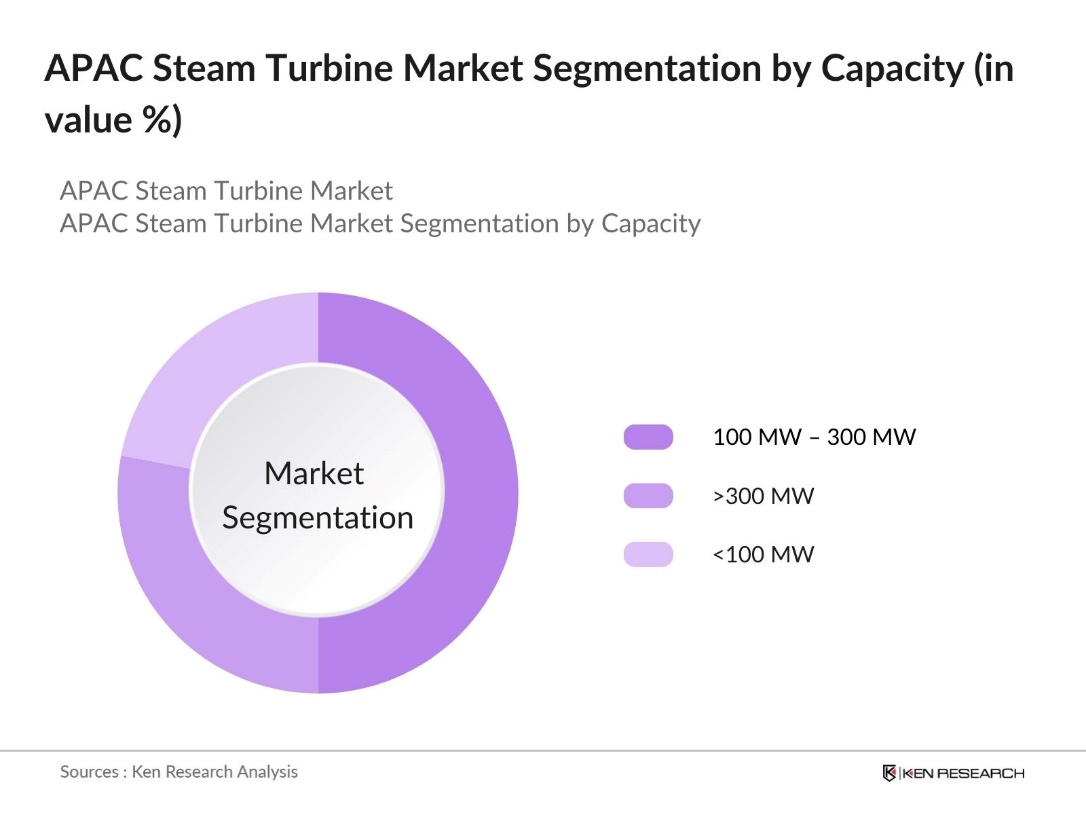
By Capacity: The APAC steam turbine market is segmented by capacity into three key sub-segments: <100 MW, 100 MW 300 MW, and >300 MW. Recently, the 100 MW 300 MW segment has held a dominant market share due to its widespread adoption in medium-sized power plants and industrial facilities. The flexibility and balance offered by turbines within this range make them a preferred choice for both private and public sector projects aimed at improving energy efficiency.
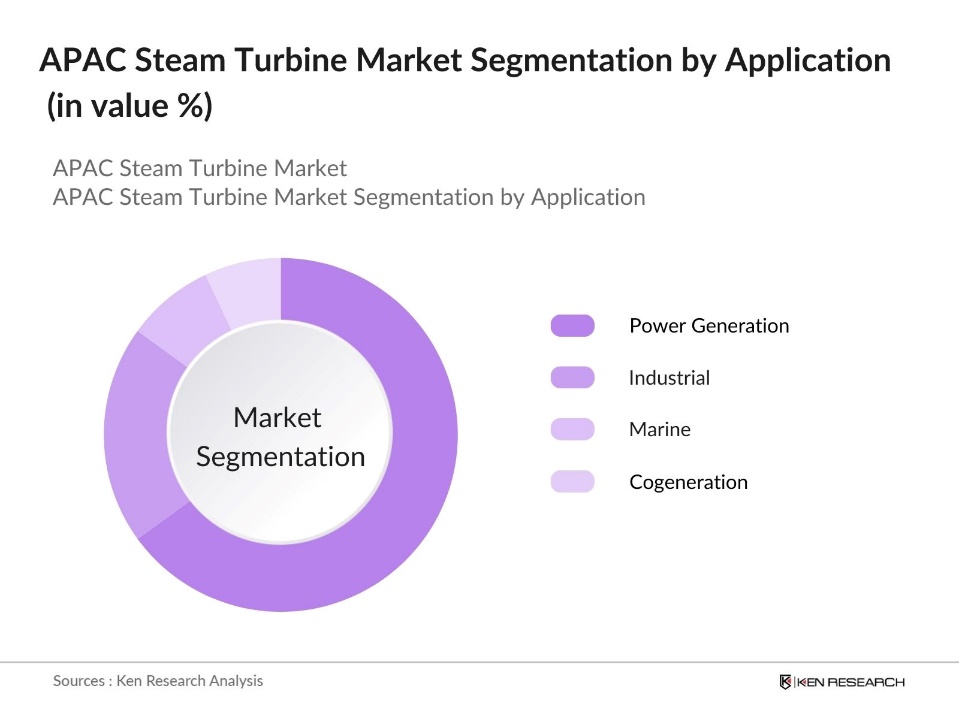
By Application: The APAC steam turbine market is segmented by application into power generation, industrial, marine, and cogeneration. Power generation continues to dominate this segment, as steam turbines remain the backbone of thermal power plants and renewable energy projects like biomass and geothermal energy. In particular, the demand for clean energy sources has pushed the integration of steam turbines into renewable energy projects, making this sub-segment the most significant contributor to the overall market.
The market is dominated by a combination of multinational giants and local manufacturers. The key players in this sector have established a strong foothold through a combination of technological advancements, large-scale manufacturing capabilities, and government-backed projects. The competition is characterized by strategic mergers, acquisitions, and collaborations aimed at enhancing operational efficiency and innovation.
|
Company |
Establishment Year |
Headquarters |
Annual Revenue (USD) |
Installed Capacity (MW) |
Product Line |
Number of Employees |
R&D Expenditure (USD) |
Global Presence |
|
General Electric (GE) |
1892 |
USA |
||||||
|
Siemens Energy |
1847 |
Germany |
||||||
|
Mitsubishi Power |
1870 |
Japan |
||||||
|
Toshiba Energy Systems |
1939 |
Japan |
||||||
|
Harbin Electric International |
1951 |
China |
Over the next five years, the APAC steam turbine market is poised for substantial growth, driven by increasing investments in power infrastructure and a shift towards cleaner energy sources. Countries such as China, India, and Japan will continue to dominate this market due to their focus on expanding power generation capacity, both in traditional thermal power and renewable energy projects. Additionally, technological advancements like digital twins, AI-powered maintenance solutions, and high-efficiency turbines will further shape the market landscape.
|
Capacity |
<100 MW 100 MW 300 MW >300 MW |
|
Application |
Power Generation Industrial Marine Cogeneration |
|
Technology |
Condensing Non-Condensing Extraction Condensing Reheat Turbines |
|
Fuel Type |
Coal Natural Gas Biomass Nuclear |
|
Region |
East Southeast South Oceania |
1.1. Definition and Scope
1.2. Market Taxonomy
1.3. Market Growth Rate
1.4. Market Segmentation Overview
2.1. Historical Market Size
2.2. Year-On-Year Growth Analysis
2.3. Key Market Developments and Milestones
3.1. Growth Drivers (Industrial Expansion, Renewable Energy Integration, Urbanization)
3.1.1. Industrial Power Needs (Heavy Industries, Manufacturing Plants)
3.1.2. Integration of Steam Turbines in Renewable Energy (Geothermal, Biomass)
3.1.3. Energy Efficiency Improvements
3.1.4. Government Energy Policies and Subsidies
3.2. Market Challenges (Technological Complexity, Supply Chain, Competition from Other Energy Sources)
3.2.1. High Initial Capital Investment
3.2.2. Technological Advancements in Competitor Energy Sources (Gas, Solar, Wind)
3.2.3. Geopolitical Factors Impacting Supply Chains
3.3. Opportunities (Technological Advancements, Green Energy Projects, Infrastructure Investments)
3.3.1. Rising Demand for Green Energy
3.3.2. Infrastructure Development in Emerging Economies
3.3.3. Technological Breakthroughs in Steam Turbines (Efficiency, Customization)
3.4. Trends (Digitalization, Efficiency Enhancements, Modular Turbines)
3.4.1. Increasing Use of Digital Twins and IoT in Turbine Management
3.4.2. Hybrid Systems Integrating Gas and Steam Turbines
3.4.3. Compact, Modular Turbines for Distributed Power Generation
3.5. Government Regulation (Environmental Policies, Efficiency Standards, Safety Regulations)
3.5.1. Emission Reduction Regulations
3.5.2. Government Policies for Power Sector Modernization
3.5.3. Energy Efficiency Mandates and Incentives
3.5.4. Regional Safety and Certification Requirements
3.6. SWOT Analysis (Strengths, Weaknesses, Opportunities, Threats)
3.7. Stakeholder Ecosystem (Developers, SaaS Providers, IT Consultants)
3.8. Porters Five Forces Analysis (Competitive Rivalry, Threat of New Entrants)
3.9. Competitive Landscape Analysis
4.1. By Capacity (In Value %)
4.1.1. <100 MW
4.1.2. 100 MW 300 MW
4.1.3. >300 MW
4.2. By Application (In Value %)
4.2.1. Power Generation (Thermal, Nuclear, Renewable)
4.2.2. Industrial (Chemical, Pulp & Paper, Oil & Gas)
4.2.3. Marine (Propulsion)
4.2.4. Cogeneration (Combined Heat and Power)
4.3. By Technology (In Value %)
4.3.1. Condensing
4.3.2. Non-Condensing
4.3.3. Extraction Condensing
4.3.4. Reheat Turbines
4.4. By Fuel Type (In Value %)
4.4.1. Coal
4.4.2. Natural Gas
4.4.3. Biomass
4.4.4. Nuclear
4.5. By Region (In Value %)
4.5.1. East Asia
4.5.2. Southeast Asia
4.5.3. South Asia
4.5.4. Oceania
5.1 Detailed Profiles of Major Companies
5.1.1. General Electric (GE)
5.1.2. Siemens Energy
5.1.3. Mitsubishi Power
5.1.4. Toshiba Energy Systems
5.1.5. Doosan koda Power
5.1.6. Bharat Heavy Electricals Limited (BHEL)
5.1.7. Hitachi Power
5.1.8. MAN Energy Solutions
5.1.9. Kawasaki Heavy Industries
5.1.10. Harbin Electric International
5.1.11. Shanghai Electric
5.1.12. Ansaldo Energia
5.1.13. Fuji Electric
5.1.14. Elliott Group
5.1.15. Dongfang Electric Corporation
5.2 Cross Comparison Parameters (Market Share, Installed Base, Revenue, Power Capacity Installed)
5.3. Market Share Analysis
5.4. Strategic Initiatives
5.5. Mergers And Acquisitions
5.6. Investment Analysis
5.7. Private Equity and Venture Capital Involvement
6.1. Environmental Standards (Emission Control, Carbon Footprint Reduction)
6.2. Compliance Requirements (Safety, Energy Efficiency)
6.3. Certification Processes (ISO Standards, Government Mandates)
7.1. Future Market Size Projections
7.2. Key Factors Driving Future Market Growth
8.1. By Capacity (In Value %)
8.2. By Application (In Value %)
8.3. By Technology (In Value %)
8.4. By Fuel Type (In Value %)
8.5. By Region (In Value %)
9.1. TAM/SAM/SOM Analysis
9.2. Customer Cohort Analysis
9.3. Market Expansion Strategies
9.4. New Investment Opportunities
Disclaimer Contact UsThe initial phase involves identifying key market drivers, restraints, and opportunities. This includes mapping the ecosystem by analyzing major players, market dynamics, and regulatory frameworks across the APAC steam turbine market. Secondary data from government publications, industry journals, and reports will form the backbone of this research.
The second phase entails analyzing historical market data for the APAC steam turbine industry. This step includes evaluating installed capacities, market penetration, and revenue generation. We will rely on company filings, annual reports, and industry databases to construct a comprehensive view of market performance.
In the third step, market hypotheses will be validated through expert consultations and industry stakeholder interviews. These interviews will provide insights into current market trends, future outlooks, and technological advancements.
The final phase will involve synthesizing the data collected from primary and secondary sources, ensuring accurate and validated market estimates. The results will be presented in a detailed report, providing key market insights for stakeholders.
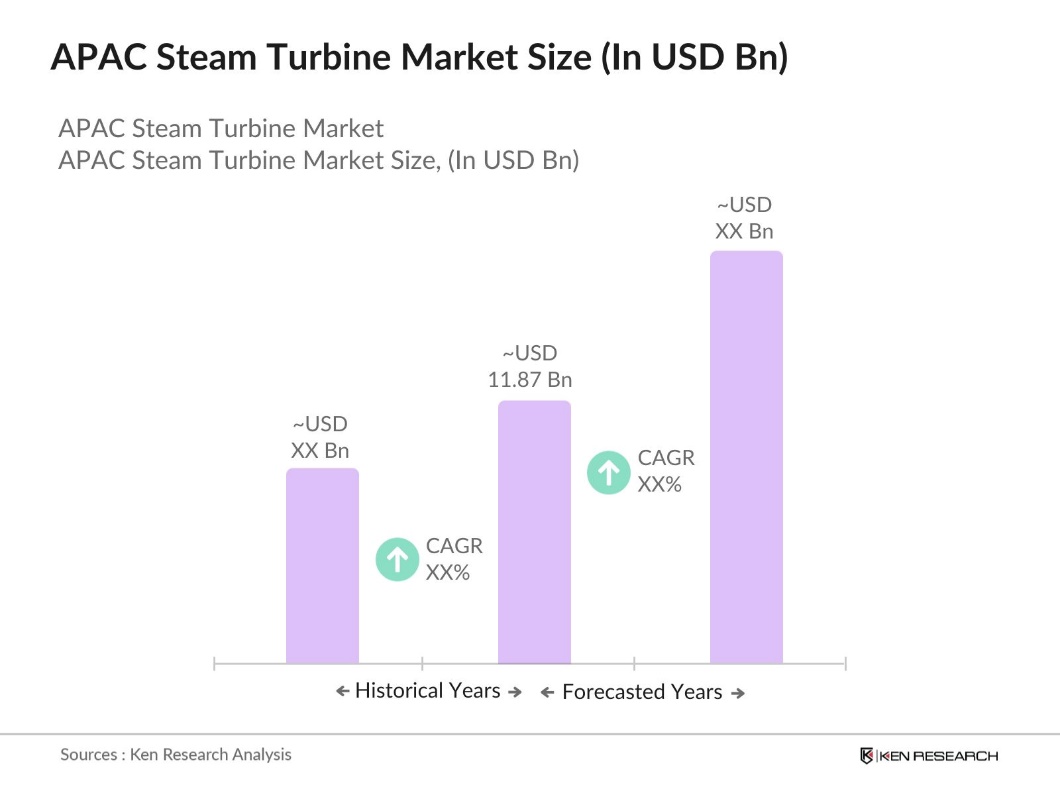
The APAC Steam Turbine Market is valued at USD 11.87 billion. This growth is driven by large-scale industrialization, increased power generation capacity, and government investments in renewable energy projects across the region.
Challenges in the APAC steam turbine market include high initial capital expenditure, evolving emission regulations, and competition from alternative energy sources like solar and wind. Technological advancements in other forms of power generation also pose a threat.
The major players in the APAC steam turbine market include General Electric (GE), Siemens Energy, Mitsubishi Power, Toshiba Energy Systems, and Harbin Electric International. These companies dominate due to their extensive manufacturing capabilities and focus on technological innovation.
The APAC steam turbine market is driven by industrial expansion, increasing demand for efficient power generation systems, and the integration of steam turbines into renewable energy projects like biomass and geothermal. Additionally, government policies supporting cleaner energy sources further boost market growth.

What makes us stand out is that our consultants follows Robust, Refine and Result (RRR) methodology. i.e. Robust for clear definitions, approaches and sanity checking, Refine for differentiating respondents facts and opinions and Result for presenting data with story

We have set a benchmark in the industry by offering our clients with syndicated and customized market research reports featuring coverage of entire market as well as meticulous research and analyst insights.

While we don't replace traditional research, we flip the method upside down. Our dual approach of Top Bottom & Bottom Top ensures quality deliverable by not just verifying company fundamentals but also looking at the sector and macroeconomic factors.

With one step in the future, our research team constantly tries to show you the bigger picture. We help with some of the tough questions you may encounter along the way: How is the industry positioned? Best marketing channel? KPI's of competitors? By aligning every element, we help maximize success.

Our report gives you instant access to the answers and sources that other companies might choose to hide. We elaborate each steps of research methodology we have used and showcase you the sample size to earn your trust.

If you need any support, we are here! We pride ourselves on universe strength, data quality, and quick, friendly, and professional service.