
Asia Pacific Carbon Nanotubes (CNT) Market Outlook to 2030
Region:Afganistan
Author(s):Meenakshi Bisht
Product Code:KROD4625
Region:Afganistan
Author(s):Meenakshi Bisht
Product Code:KROD4625
December 2024
81
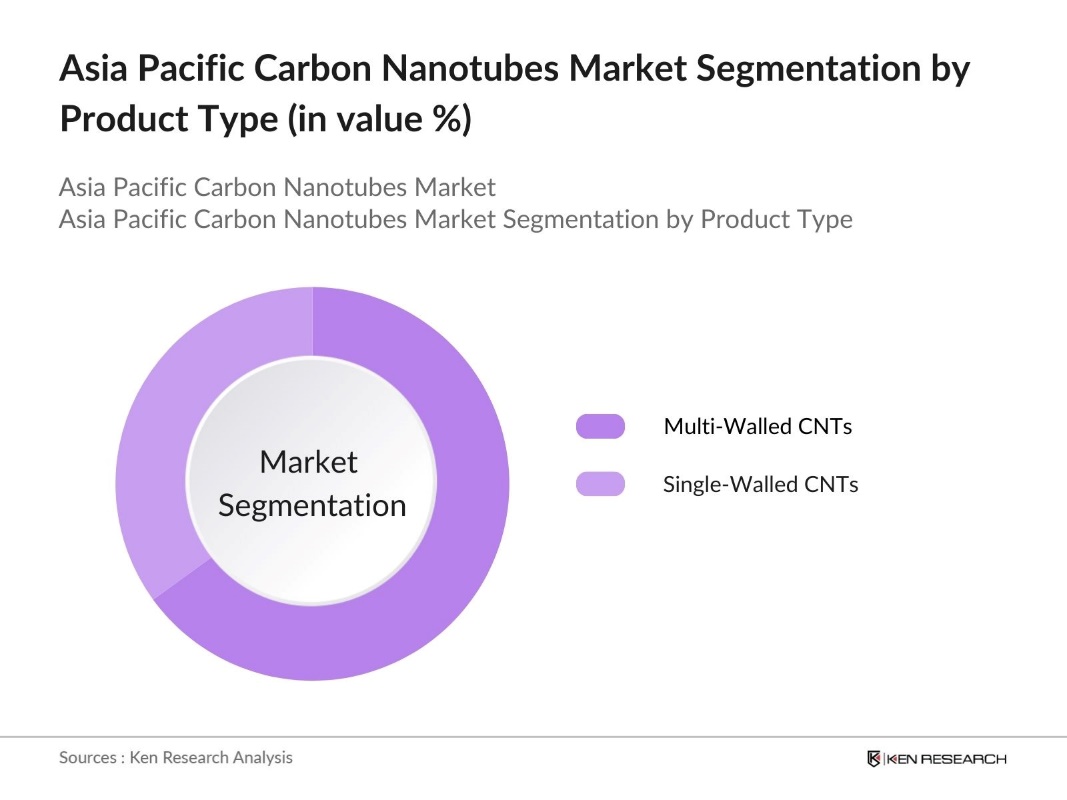
By Product Type: The Asia Pacific Carbon Nanotubes market is segmented by product type into Single-Walled CNTs (SWCNTs) and Multi-Walled CNTs (MWCNTs). Multi-Walled CNTs dominate the market due to their cost-effectiveness and ease of production compared to Single-Walled CNTs. These CNTs are widely used in structural reinforcement applications, electronics, and coatings due to their superior mechanical properties and conductive features. Their extensive use in automotive composites and aerospace industries is expected to continue driving demand.
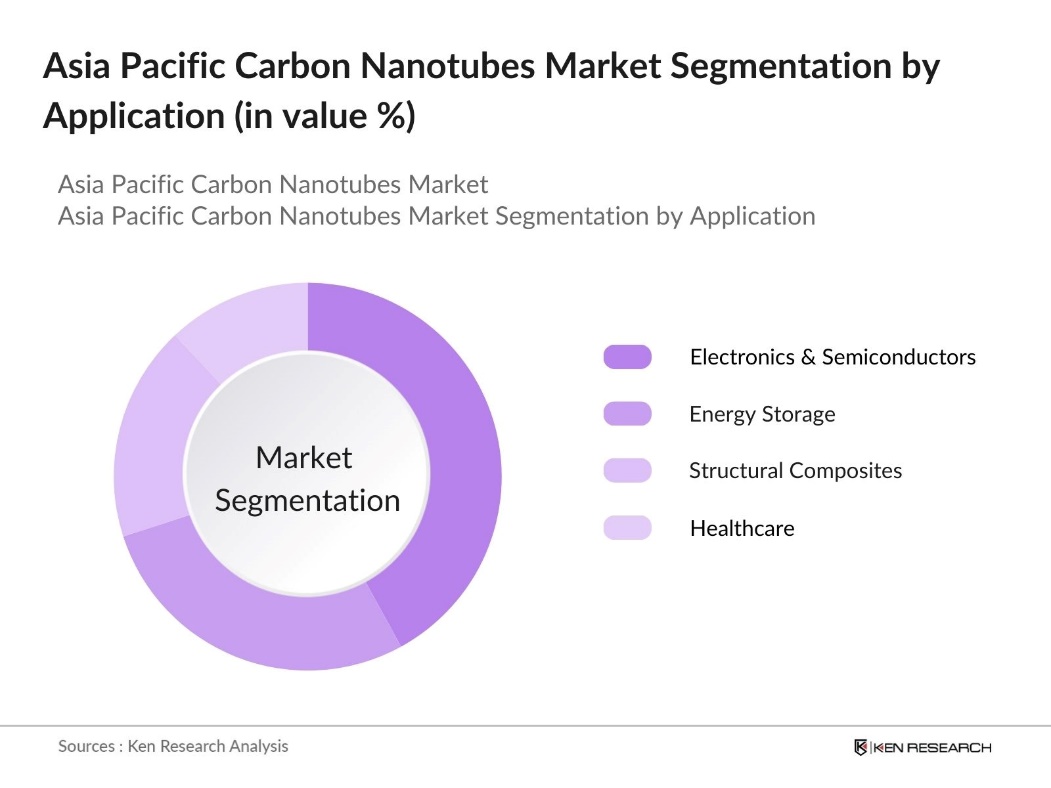
By Application: The Asia Pacific Carbon Nanotubes market is further segmented by application into Electronics and Semiconductors, Energy Storage, Structural Composites, and Healthcare. Among these, Electronics and Semiconductors hold the largest market share due to the high demand for CNTs in electronic devices, displays, and sensors. CNTs' excellent conductive properties make them suitable for creating more efficient electronic components, which are widely used in consumer electronics and advanced computing systems. The growing demand for flexible and wearable electronics has also fueled this segments growth.
The Asia Pacific Carbon Nanotubes market is highly competitive, with several key players driving innovation and research. The market is dominated by major manufacturers such as Showa Denko K.K. and LG Chem, which are leveraging their extensive production capacities and investments in research and development to maintain a competitive edge. These companies are increasing their footprint across major industries like automotive, electronics, and renewable energy, ensuring long-term growth.
|
Company |
Establishment Year |
Headquarters |
Production Capacity |
R&D Investment |
Patent Portfolio |
Global Market Penetration |
Supply Chain Integration |
Technological Advancements |
|
Showa Denko K.K. |
1939 |
Tokyo, Japan |
||||||
|
LG Chem Ltd. |
1947 |
Seoul, South Korea |
||||||
|
Arkema S.A. |
2004 |
Colombes, France |
||||||
|
Jiangsu Cnano Technology |
2007 |
Jiangsu, China |
||||||
|
Nanocyl S.A. |
2002 |
Sambreville, Belgium |
Over the next five years, the Asia Pacific Carbon Nanotubes market is expected to witness steady growth, driven by increasing R&D initiatives and expanding applications across various industries. The rise of electric vehicles and renewable energy systems, combined with advancements in flexible and wearable electronics, will bolster demand for CNTs. Moreover, supportive government policies, especially in China and South Korea, focusing on enhancing nanotechnology capabilities, will further drive market expansion.
|
By Product Type |
Single-Walled CNTs (SWCNTs) Multi-Walled CNTs (MWCNTs) |
|
By Application |
Electronics and Semiconductors Energy Storage Structural Composites Healthcare Sensors |
|
By Manufacturing Process |
Chemical Vapor Deposition (CVD) Arc Discharge Laser Ablation Others |
|
By End-Use Industry |
Electronics and Electrical Automotive Aerospace Energy Healthcare |
|
By Region |
China Japan South Korea India Australia Rest of Asia-Pacific |
1.1 Definition and Scope
1.2 Market Taxonomy
1.3 Market Growth Rate
1.4 Market Segmentation Overview
2.1 Historical Market Size
2.2 Year-On-Year Growth Analysis
2.3 Key Market Developments and Milestones
3.1 Growth Drivers
3.1.1 Increasing Demand in Electronics and Semiconductors
3.1.2 Growing Application in Energy Storage Systems (Batteries, Supercapacitors)
3.1.3 Expanding Utilization in Automotive and Aerospace Industries
3.1.4 Rising Government Initiatives for Nanotechnology Adoption
3.2 Market Challenges
3.2.1 High Production Costs of CNTs
3.2.2 Environmental and Health Concerns (Toxicity and Regulation)
3.2.3 Technical Limitations in Large-Scale Production
3.2.4 Lack of Standardization and Quality Control
3.3 Opportunities
3.3.1 Increasing R&D Investments in Nanocomposites
3.3.2 Collaborations between Research Institutes and Industry Players
3.3.3 Advancements in CNT Manufacturing Techniques (CVD, Arc Discharge)
3.3.4 Expanding Applications in Renewable Energy and Water Treatment
3.4 Trends
3.4.1 Integration with Flexible and Wearable Electronics
3.4.2 Adoption in 3D Printing Technology
3.4.3 Development of CNT-Based Sensors for IoT Applications
3.4.4 Advancements in Functionalized CNTs for Biomedical Applications
3.5 Government Regulations
3.5.1 National Nanotechnology Initiatives
3.5.2 Safety and Environmental Standards for Nanomaterials
3.5.3 Regulatory Approvals for Medical and Industrial Use of CNTs
3.5.4 International Trade Policies Impacting CNT Import/Export
3.6 SWOT Analysis
3.7 Stakeholder Ecosystem
3.8 Porters Five Forces Analysis
3.9 Competition Ecosystem
4.1 By Product Type (In Value %)
4.1.1 Single-Walled CNTs (SWCNTs)
4.1.2 Multi-Walled CNTs (MWCNTs)
4.2 By Application (In Value %)
4.2.1 Electronics and Semiconductors
4.2.2 Energy Storage and Conversion (Batteries, Supercapacitors, Fuel Cells)
4.2.3 Structural Composites (Automotive, Aerospace, Construction)
4.2.4 Healthcare and Biotechnology
4.2.5 Others (Sensors, Water Treatment)
4.3 By Manufacturing Process (In Value %)
4.3.1 Chemical Vapor Deposition (CVD)
4.3.2 Arc Discharge
4.3.3 Laser Ablation
4.3.4 Other Methods
4.4 By End-Use Industry (In Value %)
4.4.1 Electronics and Electrical
4.4.2 Automotive and Aerospace
4.4.3 Energy and Environment
4.4.4 Healthcare and Pharmaceuticals
4.4.5 Other Industrial Applications
4.5 By Region (In Value %)
4.5.1 China
4.5.2 Japan
4.5.3 South Korea
4.5.4 India
4.5.5 Australia
4.5.6 Rest of Asia-Pacific
5.1 Detailed Profiles of Major Companies
5.1.1 Showa Denko K.K.
5.1.2 LG Chem Ltd.
5.1.3 Arkema S.A.
5.1.4 Jiangsu Cnano Technology Co. Ltd.
5.1.5 Nanocyl S.A.
5.1.6 Cabot Corporation
5.1.7 OCSiAl
5.1.8 Ceylon Graphene Technologies
5.1.9 Hanwha Chemical Corporation
5.1.10 Nanoshel LLC
5.1.11 Continental Carbon Nanotechnologies
5.1.12 Raymor Industries
5.1.13 Thomas Swan & Co. Ltd.
5.1.14 Carbon Solutions Inc.
5.1.15 Kumho Petrochemical Co. Ltd.
5.2 Cross Comparison Parameters (Production Capacity, R&D Expenditure, Key Patents, Market Penetration, Partnership/Alliance, Carbon Footprint, Supply Chain Integration, CNT Grades Produced)
5.3 Market Share Analysis
5.4 Strategic Initiatives
5.5 Mergers and Acquisitions
5.6 Investment Analysis
5.7 Venture Capital Funding
5.8 Government Grants
5.9 Private Equity Investments
6.1 Environmental Regulations and Certifications for CNT Production
6.2 Compliance Requirements for Nanotechnology Applications
6.3 Export/Import Restrictions
6.4 Patent Laws and Intellectual Property Rights (IPR)
7.1 Future Market Size Projections
7.2 Key Factors Driving Future Market Growth
8.1 By Product Type (In Value %)
8.2 By Application (In Value %)
8.3 By Manufacturing Process (In Value %)
8.4 By End-Use Industry (In Value %)
8.5 By Region (In Value %)
9.1 TAM/SAM/SOM Analysis
9.2 Customer Cohort Analysis
9.3 Marketing Initiatives
9.4 White Space Opportunity Analysis
The initial step involved identifying and mapping key variables within the Asia Pacific Carbon Nanotubes Market. Through desk research and leveraging secondary databases, we collected comprehensive industry-specific data to define market dynamics, critical segments, and influencing factors.
This phase focused on analyzing historical data for the Asia Pacific CNT market, identifying key industry trends, and revenue generation across segments such as product type and application. This analysis helped construct a robust market framework to ensure accurate future projections.
To ensure the reliability of the data and validate market hypotheses, in-depth consultations with industry experts were conducted. These insights from leading market players provided operational and financial clarity, which was instrumental in refining market data and projections.
The final step synthesized all research data into a comprehensive market report. This phase included engagement with CNT manufacturers, ensuring a bottom-up approach was applied to validate the overall market analysis and segmental data accuracy.
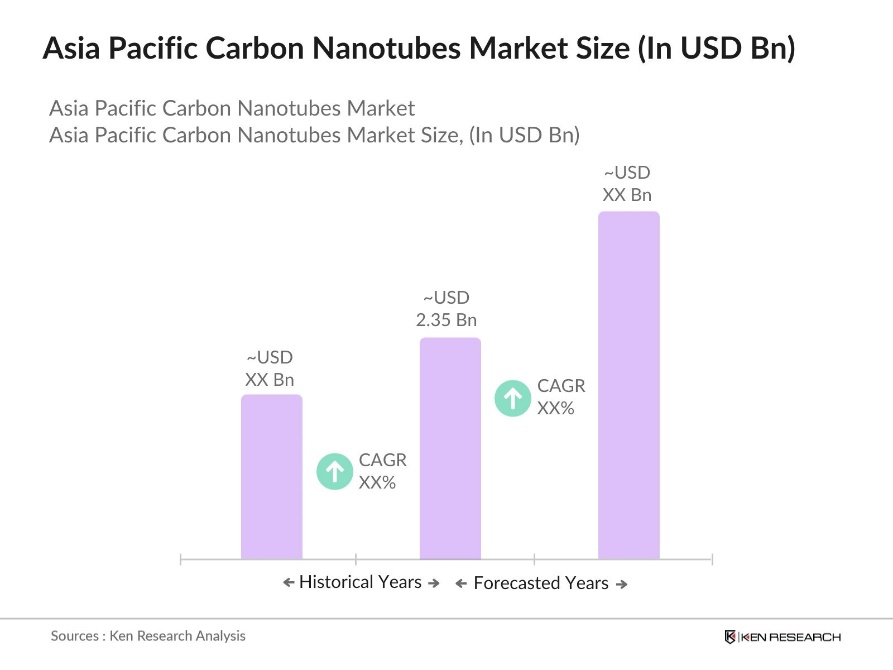
The Asia Pacific Carbon Nanotubes Market is valued at USD 2.35 billion, driven by its extensive application across sectors such as energy storage, electronics, and structural composites.
Challenges in Asia Pacific Carbon Nanotubes Market include high production costs, environmental and health concerns associated with CNTs, and the lack of standardization for quality control, which can affect mass adoption.
Key players in Asia Pacific Carbon Nanotubes Market include Showa Denko K.K., LG Chem Ltd., Arkema S.A., Jiangsu Cnano Technology, and Nanocyl S.A., which dominate the market through technological innovations and strong production capabilities.
04 What are the growth drivers of the Asia Pacific Carbon Nanotubes Market?
The Asia Pacific Carbon Nanotubes Market is propelled by the growing demand in electronics, energy storage solutions for electric vehicles, and structural composites in the aerospace and automotive industries.

What makes us stand out is that our consultants follows Robust, Refine and Result (RRR) methodology. i.e. Robust for clear definitions, approaches and sanity checking, Refine for differentiating respondents facts and opinions and Result for presenting data with story

We have set a benchmark in the industry by offering our clients with syndicated and customized market research reports featuring coverage of entire market as well as meticulous research and analyst insights.

While we don't replace traditional research, we flip the method upside down. Our dual approach of Top Bottom & Bottom Top ensures quality deliverable by not just verifying company fundamentals but also looking at the sector and macroeconomic factors.

With one step in the future, our research team constantly tries to show you the bigger picture. We help with some of the tough questions you may encounter along the way: How is the industry positioned? Best marketing channel? KPI's of competitors? By aligning every element, we help maximize success.

Our report gives you instant access to the answers and sources that other companies might choose to hide. We elaborate each steps of research methodology we have used and showcase you the sample size to earn your trust.

If you need any support, we are here! We pride ourselves on universe strength, data quality, and quick, friendly, and professional service.