
Asia Pacific Cloud Gaming Market Outlook to 2030
Region:Asia
Author(s):Sanjna Verma
Product Code:KROD2782
October 2024
96
About the Report
Asia Pacific Cloud Gaming Market Overview
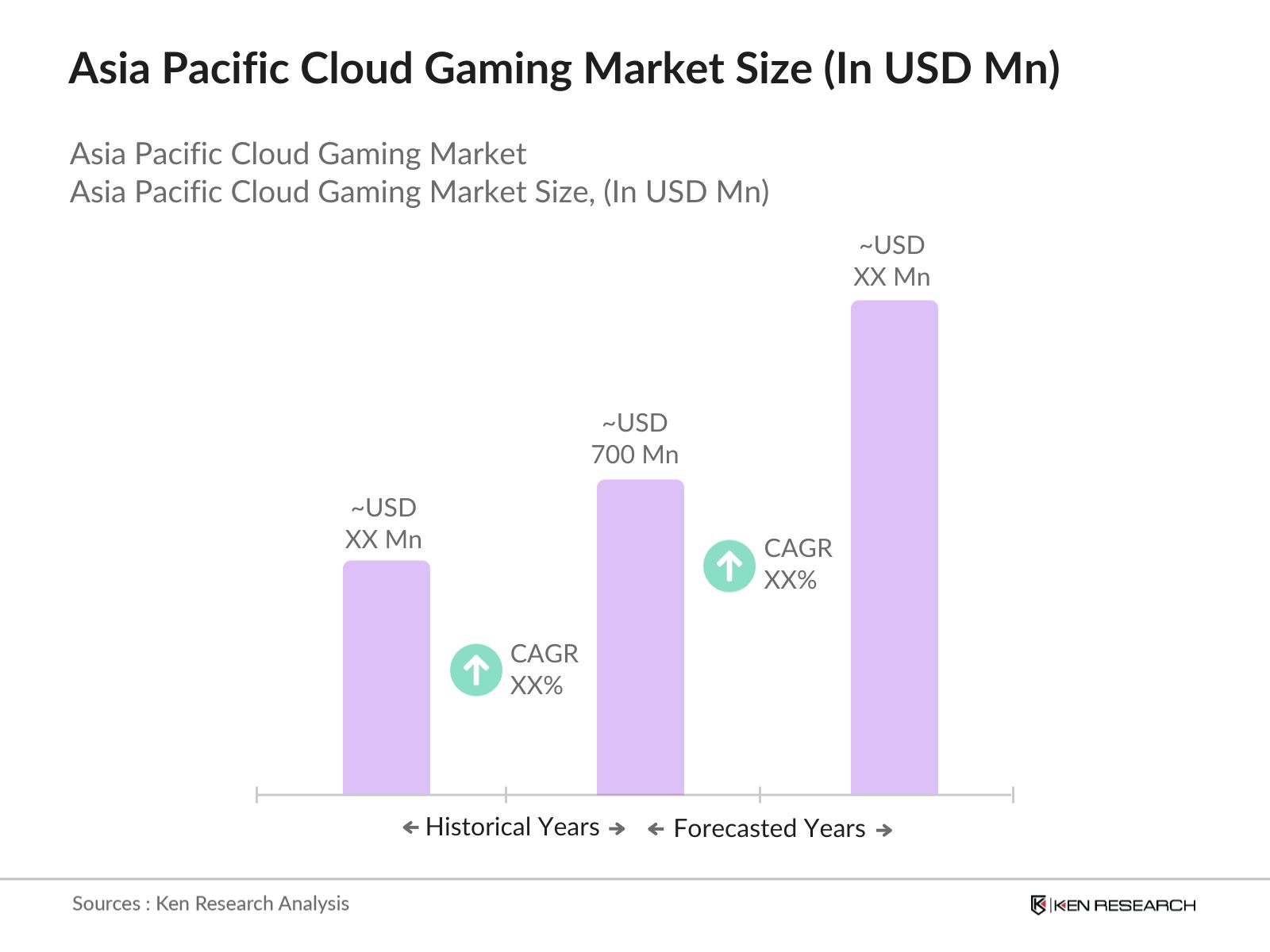
- The Asia Pacific Cloud Gaming Market is valued at USD 700 million, driven by increasing internet penetration, advancements in mobile technology, and the rising adoption of 5G networks. As cloud gaming removes the need for expensive hardware, more consumers are shifting towards cloud platforms, particularly in regions with strong broadband infrastructure.
- Countries like China, Japan, and South Korea dominate the market due to their robust digital infrastructure and high-speed internet connectivity. Additionally, these countries have a large base of gaming enthusiasts and well-established gaming industries, which further enhances their leadership in cloud gaming. The presence of key market players, along with favorable government policies to boost digital transformation, further drives the dominance of these countries in the Asia Pacific cloud gaming market.
- Many Asia-Pacific countries have specific regulations around gaming content, particularly in China, where the National Press and Publication Administration (NPPA) oversees game approvals. The National Press and Publication Administration (NPPA) is the primary body overseeing game approvals in China. In 2023, the NPPA approved a significant number of new games, including 1,075 licenses, which was more than double the approvals from the previous year.
Asia Pacific Cloud Gaming Market Segmentation
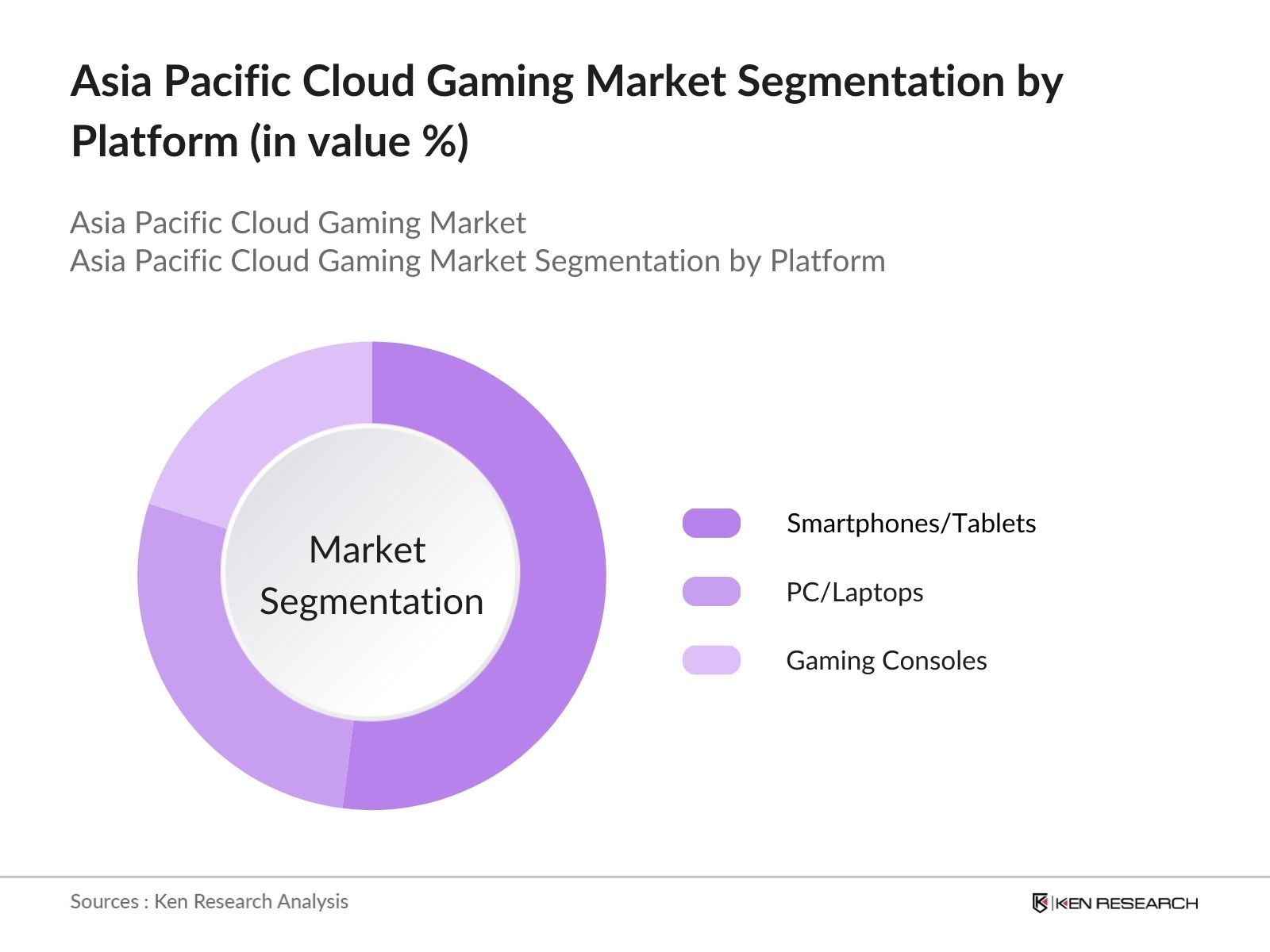
By Platform: The Asia Pacific cloud gaming market is segmented by platform into gaming consoles, PCs/laptops, and smartphones/tablets. Recently, smartphones and tablets have dominated the platform segment due to the high penetration of mobile devices and the increasing availability of mobile-friendly games. The ease of accessibility through cloud services on mobile platforms, combined with the rapid expansion of 5G networks in countries like China and Japan, has made smartphones the preferred gaming devices for many consumers. Moreover, the shift towards mobile gaming is also fueled by the affordability and portability of these devices compared to traditional gaming consoles and PCs.
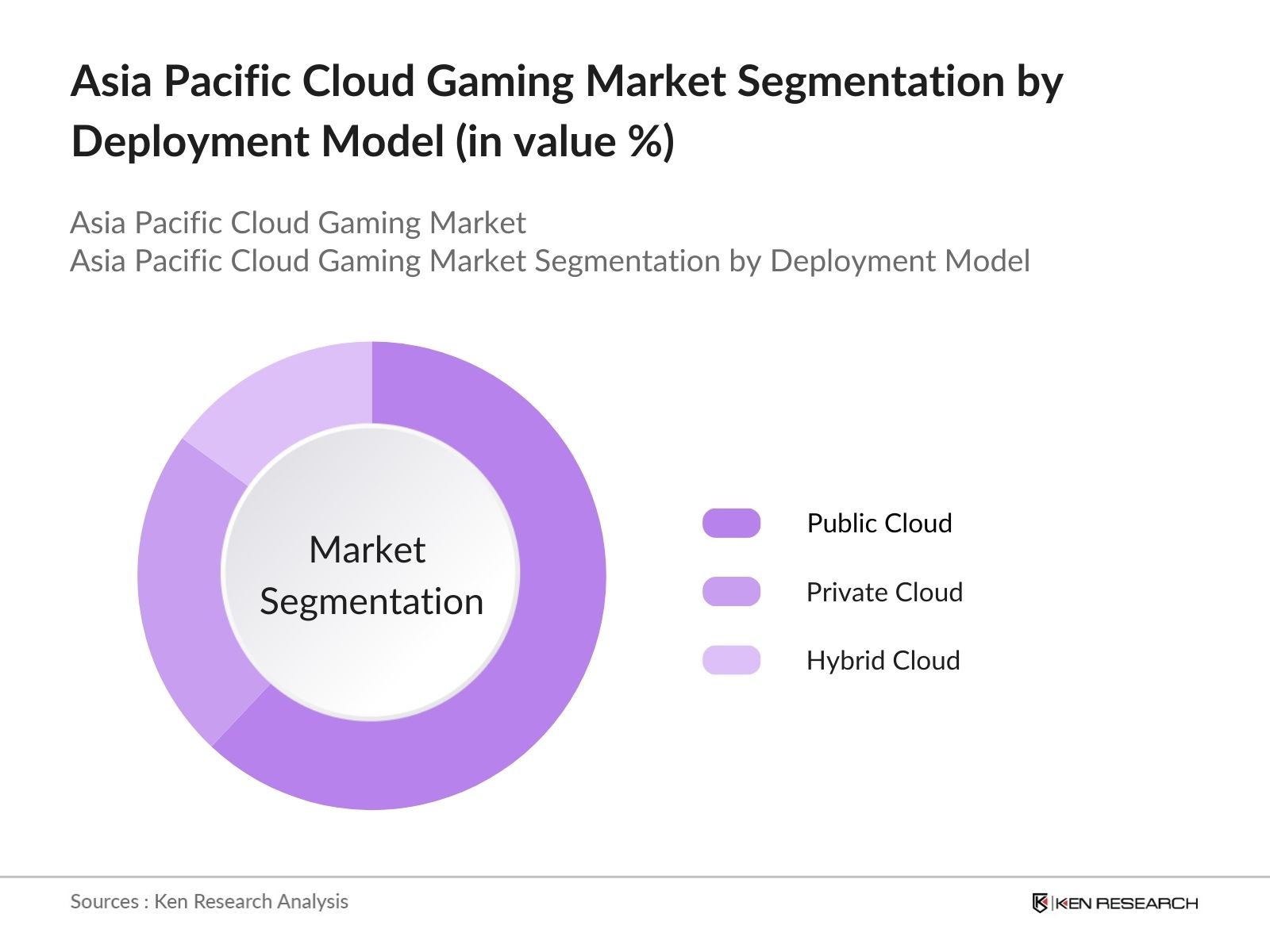
By Deployment Model: The market is also segmented by deployment model into public cloud, private cloud, and hybrid cloud. The public cloud has a dominant market share, driven by its cost-effectiveness and scalability. Cloud service providers like Amazon Web Services (AWS), Microsoft Azure, and Google Cloud have established strong partnerships with gaming companies, allowing seamless integration and rapid deployment of cloud gaming solutions. The public cloud offers flexibility and convenience to both consumers and developers, making it the most preferred deployment model. However, as data privacy concerns grow, the adoption of private and hybrid cloud models is also gaining traction among enterprise customers and gaming studios.
Asia Pacific Cloud Gaming Market Competitive Landscape
The Asia Pacific cloud gaming market is dominated by a combination of global giants and regional players, leading to a highly competitive environment. Major players have capitalized on partnerships with telecom companies, offering bundled services that attract a larger consumer base. Companies like Tencent and Sony are leveraging their regional dominance and content library to maintain leadership in the market, while emerging players are focusing on niche segments like virtual reality (VR) and augmented reality (AR) cloud gaming. This competitive consolidation highlights the strategic influence of these key companies across the region.
|
Company Name |
Established |
Headquarters |
No. of Subscribers |
Revenue (USD) |
Cloud Infrastructure |
Gaming Services Offered |
Supported Devices |
Geographical Coverage |
|
Tencent Cloud |
1998 |
Shenzhen, China |
- |
- |
- |
- |
- |
- |
|
NVIDIA Corporation |
1993 |
Santa Clara, USA |
- |
- |
- |
- |
- |
- |
|
Google Stadia |
2019 |
Mountain View, USA |
- |
- |
- |
- |
- |
- |
|
Sony Interactive Entertainment |
1993 |
Tokyo, Japan |
- |
- |
- |
- |
- |
- |
|
Microsoft Corporation |
1975 |
Redmond, USA |
- |
- |
- |
- |
- |
- |
Asia Pacific Cloud Gaming Market Analysis
Growth Drivers
- Increasing Mobile and Internet Penetration: The number of unique mobile subscribers in the Asia-Pacific region is projected to reach approximately 2.5 billion by the end of 2024. Countries like India and Indonesia have been leading this charge with affordable smartphones and rapidly improving internet infrastructure. Mobile internet access grew significantly, driven by projects like India’s BharatNet, which aims to connect rural areas to broadband services. This high penetration of mobile devices makes cloud gaming more accessible to a larger audience, reducing the dependency on high-end gaming consoles and PCs.
- Rising Adoption of 5G Networks: As of 2024, the Asia-Pacific region has seen an increase in 5G network coverage, with more than 35% of the region's population having access to 5G services. China has indeed made significant strides in 5G infrastructure, reportedly deploying nearly 1 million 5G base stations as of early 2023. This figure is substantial and reflects China's aggressive approach to enhancing its telecommunications capabilities. The ultra-low latency of 5G—around 1 millisecond in ideal conditions—reduces lag in gaming, enhancing user experience for multiplayer and immersive games.
- Lower Hardware Dependency: Cloud gaming eliminates the need for expensive hardware like consoles or gaming PCs, making gaming accessible to a broader population. In Asia-Pacific, where the average annual income is $12,883 per year in many developing countries, the affordability of cloud gaming has led to higher adoption. Gamers in India, the Philippines, and Vietnam prefer cloud gaming because it reduces upfront costs. This shift aligns with regional trends toward increased digital consumption, especially with the burgeoning mobile and internet markets.
Challenges
- High Latency Issues: Despite the rollout of 5G networks, many areas in the Asia-Pacific region, particularly in rural or remote locations, still face significant latency issues. As of 2024, only 30% of internet connections in rural Asia have speeds conducive to cloud gaming, making latency a key barrier. Data from the ITU indicates that average latency in these regions exceeds 100 milliseconds, which affects real-time gaming experiences. This lag disrupts user engagement in multiplayer and cloud-based gaming environments, impacting market growth.
- Network Bandwidth Limitations: Bandwidth constraints are a significant hurdle in markets like India and Indonesia, where internet infrastructure is still developing. In 2024, the average internet speed in India was around 30 Mbps, compared to the required minimum of 50 Mbps for smooth cloud gaming experiences, as stated by the International Telecommunications Union. Southeast Asian nations such as the Philippines and Malaysia face similar challenges, with average internet speeds lagging behind developed countries.
Asia Pacific Cloud Gaming Future Market Outlook
Over the next five years, the Asia Pacific cloud gaming market is expected to experience substantial growth, driven by advancements in 5G technology, increasing adoption of cloud-based services, and the growing interest in immersive gaming experiences. The continuous development of virtual and augmented reality applications in gaming, coupled with the expansion of broadband infrastructure, particularly in developing markets like India and Southeast Asia, is anticipated to drive further market expansion.
Market Opportunities
- Integration of Cloud Gaming with Smart TVs and Consoles: The advent of cloud-based gaming services compatible with consoles, such as the PlayStation Network and Xbox Cloud Gaming, further strengthens this integration. This represents a lucrative opportunity for both hardware manufacturers and cloud gaming service providers.
- Strategic Collaborations between Cloud Providers and Game Developers: Collaborations between cloud service providers and gaming studios are creating new opportunities for innovative gaming experiences in Asia-Pacific. For example, Tencent’s partnerships with cloud providers in China have led to new game releases optimized for cloud platforms. These collaborations help developers reach wider audiences by utilizing the vast server networks and AI capabilities offered by cloud providers.
Scope of the Report
|
Segment |
Sub-Segments |
|
By Platform |
Gaming Consoles PC and Laptops Smartphones Tablets |
|
By Device Type |
Smartphones Smart TVs Consoles Laptops/Desktops Tablets |
|
By Gamer Type |
Casual Gamers Professional Gamers |
|
By Deployment Model |
Public Cloud Private Cloud Hybrid Cloud |
|
By Region |
China Japan India Australia & New Zealand South Korea Southeast Asia |
Products
Key Target Audience
- Cloud Service Providers
- Game Developers and Publishers
- Telecom Operators (e.g., NTT Docomo, Telstra)
- Technology Hardware Manufacturers (e.g., Asus, Samsung)
- Virtual Reality (VR) and Augmented Reality (AR) Gaming Companies
- Investors and Venture Capitalist Firms
- Government and Regulatory Bodies (e.g., Ministry of Communications and Information Technology, China Telecom Regulatory Authority)
Companies
List of Major Players
- Tencent Cloud
- Sony Interactive Entertainment
- NVIDIA Corporation
- Microsoft Corporation
- Google Stadia
- Amazon Luna
- Ubitus Inc.
- Parsec
- Shadow Tech
- LiquidSky
- Playkey
- Vortex.gg
- Blacknut
- Antstream Arcade
- Paperspace
Table of Contents
1. Asia Pacific Cloud Gaming Market Overview
1.1. Definition and Scope
1.2. Market Taxonomy
1.3. Market Growth Rate (in % CAGR, Growth by Value & Volume)
1.4. Market Segmentation Overview
2. Asia Pacific Cloud Gaming Market Size (in USD Mn)
2.1. Historical Market Size
2.2. Year-On-Year Growth Analysis
2.3. Key Market Developments and Milestones
3. Asia Pacific Cloud Gaming Market Analysis
3.1. Growth Drivers
3.1.1. Increasing Mobile and Internet Penetration
3.1.2. Rising Adoption of 5G Networks
3.1.3. Growing Interest in Online Multiplayer Gaming
3.1.4. Lower Hardware Dependency
3.2. Market Challenges
3.2.1. High Latency Issues
3.2.2. Network Bandwidth Limitations
3.2.3. Data Privacy and Security Concerns
3.2.4. Subscription Model Saturation
3.3. Opportunities
3.3.1. Integration of Cloud Gaming with Smart TVs and Consoles
3.3.2. Strategic Collaborations between Cloud Providers and Game Developers
3.3.3. Emerging Markets Adoption (Southeast Asia, India)
3.3.4. Expansion of Augmented and Virtual Reality (AR/VR)
3.4. Trends
3.4.1. Adoption of AI and Machine Learning in Gaming Experiences
3.4.2. Use of Blockchain for In-Game Transactions
3.4.3. Cross-Platform Playability
3.4.4. Cloud Gaming Services Bundled with Telecom Subscriptions
3.5. Regulatory Environment
3.5.1. Data Protection Laws
3.5.2. Gaming Content Regulations
3.5.3. Cloud Service Licensing
3.5.4. Net Neutrality Policies
3.6. SWOT Analysis
3.7. Stakeholder Ecosystem
3.8. Porter’s Five Forces Analysis
3.9. Competition Ecosystem
4. Asia Pacific Cloud Gaming Market Segmentation
4.1. By Platform (in Value %)
4.1.1. Gaming Consoles
4.1.2. PC and Laptops
4.1.3. Smartphones and Tablets
4.2. By Device Type (in Value %)
4.2.1. Smartphones
4.2.2. Smart TVs
4.2.3. Consoles
4.2.4. Laptops/Desktops
4.2.5. Tablets
4.3. By Gamer Type (in Value %)
4.3.1. Casual Gamers
4.3.2. Professional Gamers
4.4. By Deployment Model (in Value %)
4.4.1. Public Cloud
4.4.2. Private Cloud
4.4.3. Hybrid Cloud
4.5. By Region (in Value %)
4.5.1. China
4.5.2. Japan
4.5.3. India
4.5.4. Australia & New Zealand
4.5.5. South Korea
4.5.6. Southeast Asia
5. Asia Pacific Cloud Gaming Market Competitive Analysis
5.1. Detailed Profiles of Major Competitors
5.1.1. NVIDIA Corporation
5.1.2. Google Stadia
5.1.3. Microsoft Corporation
5.1.4. Amazon Luna
5.1.5. Sony Interactive Entertainment
5.1.6. Tencent Cloud
5.1.7. Shadow Tech
5.1.8. Parsec
5.1.9. Blacknut
5.1.10. Ubitus Inc.
5.1.11. Playkey
5.1.12. Vortex.gg
5.1.13. Paperspace
5.1.14. Antstream Arcade
5.1.15. LiquidSky
5.2. Cross Comparison Parameters (No. of Employees, Revenue, Subscribers, Cloud Infrastructure, Number of Supported Devices, Supported Countries, Number of Games, Latency Rates)
5.3. Market Share Analysis
5.4. Strategic Initiatives (Partnerships, Joint Ventures, Acquisitions)
5.5. Mergers and Acquisitions
5.6. Investment Analysis
5.7. Venture Capital Funding
5.8. Private Equity Investments
5.9. Government Grants
6. Asia Pacific Cloud Gaming Market Regulatory Framework
6.1. Data and Privacy Laws
6.2. Compliance Requirements
6.3. Gaming Content Restrictions
6.4. Cloud Service Provider Regulations
7. Asia Pacific Cloud Gaming Future Market Size (in USD Mn)
7.1. Future Market Size Projections
7.2. Key Factors Driving Future Market Growth
8. Asia Pacific Cloud Gaming Future Market Segmentation
8.1. By Platform (in Value %)
8.2. By Device Type (in Value %)
8.3. By Gamer Type (in Value %)
8.4. By Deployment Model (in Value %)
8.5. By Region (in Value %)
9. Asia Pacific Cloud Gaming Market Analysts’ Recommendations
9.1. TAM/SAM/SOM Analysis
9.2. Customer Cohort Analysis
9.3. Marketing Initiatives
9.4. White Space Opportunity Analysis
Disclaimer
Contact Us
Research Methodology
Step 1: Identification of Key Variables
The research process starts by identifying the major stakeholders within the Asia Pacific cloud gaming market. Extensive desk research is conducted using secondary data sources, such as industry reports and proprietary databases, to map the ecosystem and identify key variables impacting the market.
Step 2: Market Analysis and Construction
Historical data on market size, platform penetration, and player engagement is collected to assess revenue generation. This phase includes an analysis of cloud gaming adoption rates, geographical preferences, and service quality to estimate the market's current performance.
Step 3: Hypothesis Validation and Expert Consultation
Initial market insights are validated through interviews with industry experts, gaming professionals, and cloud service providers. These consultations help refine our market assumptions and ensure data accuracy, providing a comprehensive understanding of market dynamics.
Step 4: Research Synthesis and Final Output
The final research synthesis involves cross-verifying findings with primary data sources from cloud gaming providers. Detailed insights into game genres, customer preferences, and future trends are integrated into the analysis to create an accurate market forecast.
Frequently Asked Questions
01. How big is the Asia Pacific Cloud Gaming Market?
The Asia Pacific cloud gaming market is valued at USD 700 million, driven by increasing internet penetration, the expansion of 5G networks, and rising demand for mobile gaming.
02. What are the challenges in the Asia Pacific Cloud Gaming Market?
The main challenges of Asia Pacific Cloud Gaming Market include high latency issues, network bandwidth limitations, and concerns over data privacy and security. Additionally, the high cost of 5G infrastructure rollout may pose short-term hurdles to market growth.
03. Who are the major players in the Asia Pacific Cloud Gaming market?
Major players in Asia Pacific Cloud Gaming market include Tencent Cloud, Sony Interactive Entertainment, NVIDIA Corporation, Microsoft Corporation, and Google Stadia. These companies leverage their technological infrastructure and large user bases to dominate the market.
04. What are the growth drivers for the Asia Pacific Cloud Gaming Market?
Growth drivers of Asia Pacific Cloud Gaming Market include the rapid expansion of 5G networks, increasing mobile device penetration, and the rising popularity of multiplayer gaming. The ability to stream games without expensive hardware is also propelling the market.
Why Buy From Us?

What makes us stand out is that our consultants follows Robust, Refine and Result (RRR) methodology. i.e. Robust for clear definitions, approaches and sanity checking, Refine for differentiating respondents facts and opinions and Result for presenting data with story

We have set a benchmark in the industry by offering our clients with syndicated and customized market research reports featuring coverage of entire market as well as meticulous research and analyst insights.

While we don't replace traditional research, we flip the method upside down. Our dual approach of Top Bottom & Bottom Top ensures quality deliverable by not just verifying company fundamentals but also looking at the sector and macroeconomic factors.

With one step in the future, our research team constantly tries to show you the bigger picture. We help with some of the tough questions you may encounter along the way: How is the industry positioned? Best marketing channel? KPI's of competitors? By aligning every element, we help maximize success.

Our report gives you instant access to the answers and sources that other companies might choose to hide. We elaborate each steps of research methodology we have used and showcase you the sample size to earn your trust.

If you need any support, we are here! We pride ourselves on universe strength, data quality, and quick, friendly, and professional service.