
Asia Pacific Fertilizer Market Outlook to 2030
Region:Asia
Author(s):Sanjna
Product Code:KROD10898
December 2024
83
About the Report
Asia Pacific Fertilizer Market Overview
- The Asia Pacific Fertilizer Market is valued at USD 162 billion, driven by agricultural expansion and government policies promoting sustainable practices. Rapid population growth and food demand have significantly increased the need for fertilizers, especially in highly agricultural regions like India and China. The focus on improving crop yields through nutrient-rich fertilizers has contributed to this market growth, supported by favorable government incentives to stabilize fertilizer prices.
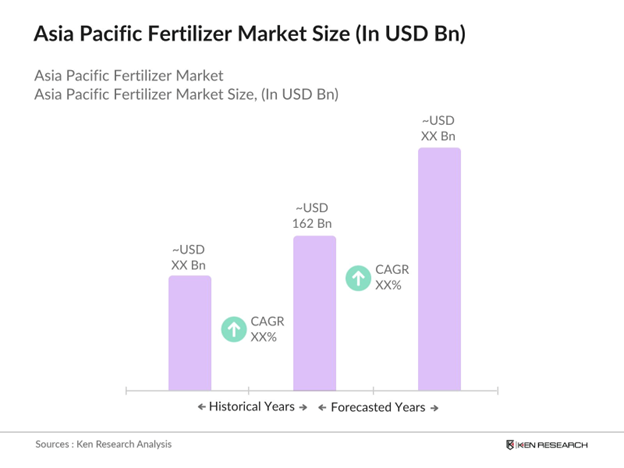
- China and India dominate the fertilizer market due to extensive agricultural land and high demand for food production. China's advanced infrastructure and government-driven initiatives to boost domestic fertilizer production solidify its leading position, while India benefits from heavy government subsidies and a large agrarian population that drives the markets growth. These countries' focus on self-sufficiency and increasing crop productivity reinforces their market dominance.
- Nutrient management policies in the Asia-Pacific aim to reduce excessive nitrogen and phosphate application. China, for instance, set nitrogen application limits in 2023 to reduce agricultural runoff, aiming to cut excess usage by 20,000 tons annually (Ministry of Agriculture and Rural Affairs, China). These policies support environmental sustainability while encouraging balanced fertilizer use, impacting fertilizer demand for nitrogen-based products.
Asia Pacific Fertilizer Market Segmentation
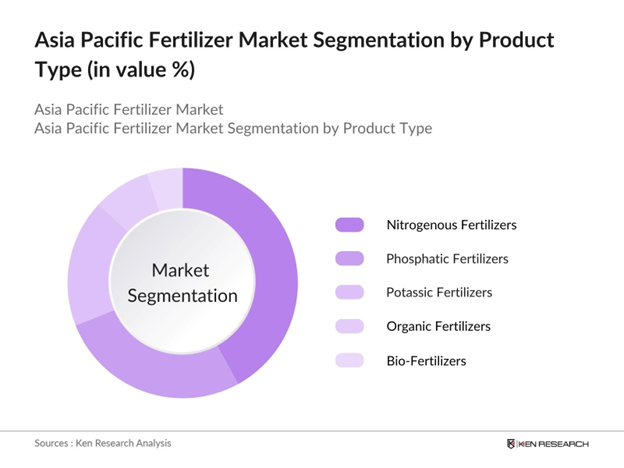
By Product Type: The Asia Pacific Fertilizer Market is segmented by product type into nitrogenous fertilizers, phosphatic fertilizers, potassic fertilizers, organic fertilizers, and bio-fertilizers. Among these, nitrogenous fertilizers have a dominant market share, primarily due to their widespread application in staple crop production. Nitrogen is essential for plant growth, and crops like rice and wheat benefit significantly from these fertilizers, making them indispensable in the Asia Pacific region.
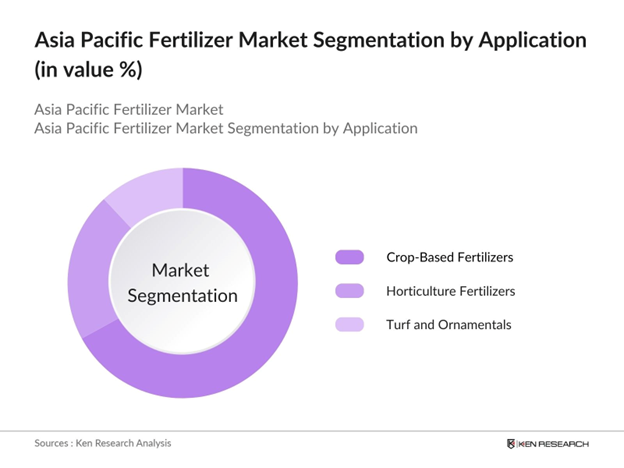
By Application: The market is segmented by application into crop-based fertilizers, horticulture fertilizers, and turf and ornamental fertilizers. Crop-based fertilizers dominate the market due to their critical role in food production, especially in countries like India and China where agriculture is essential to the economy. This sub-segments dominance is driven by continuous demand for food security and the need to maintain high crop productivity levels.
Asia Pacific Fertilizer Market Competitive Landscape
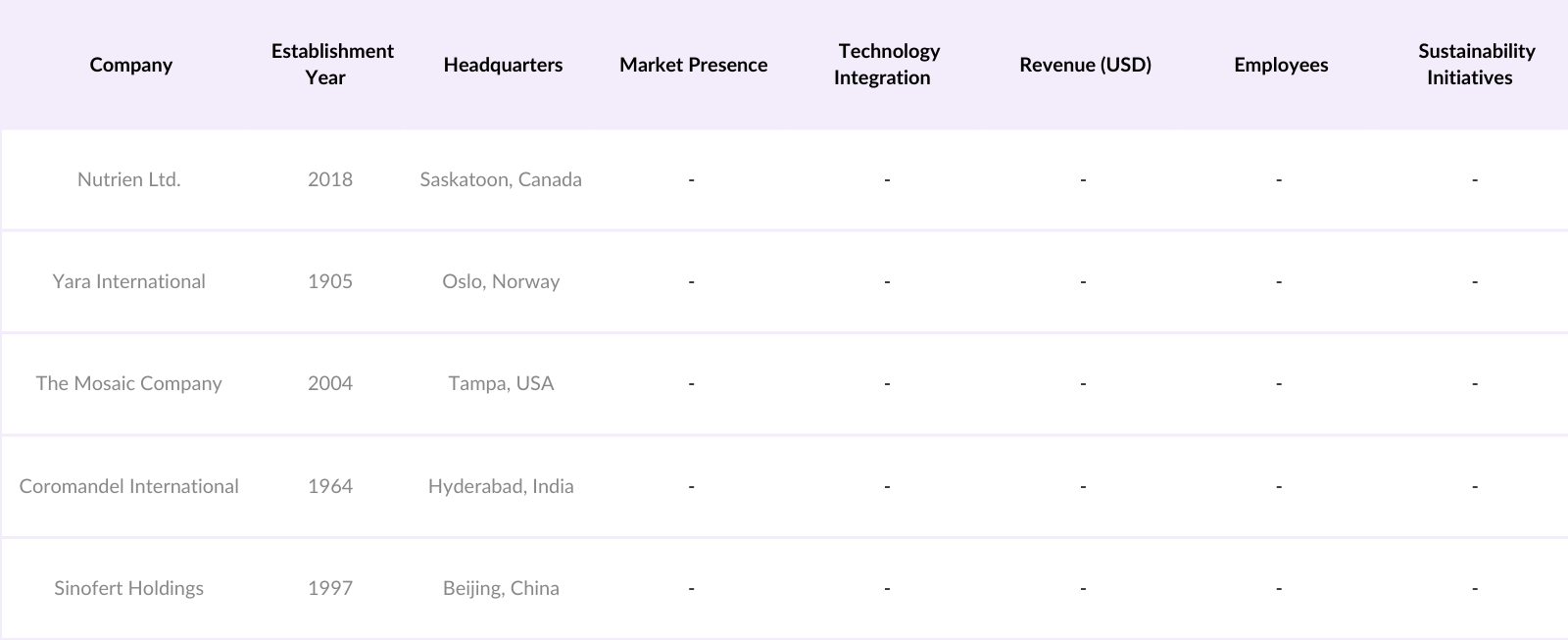
The Asia Pacific Fertilizer Market is shaped by both domestic and international players, with key players like Nutrien Ltd., Yara International, and The Mosaic Company leading the market. This consolidation indicates the influence of established companies with a broad market reach and robust distribution networks across the region.
Asia Pacific Fertilizer Market Analysis
Growth Drivers
- Increased Agricultural Activities: Asia-Pacific countries, particularly India and China, are driving up fertilizer demand due to extensive agricultural production. India alone cultivated approximately 162 million hectares of arable land in 2023, as per the Ministry of Agriculture & Farmers Welfare, which significantly amplifies the demand for fertilizers to maintain crop yields. Similarly, China, managing over 120 million hectares, encourages a high fertilizer demand to meet national food security goals (China Agricultural Outlook, 2023). Increased agricultural output is further projected to support food self-sufficiency in the region, making fertilizer a critical resource.
- Government Subsidies and Policies: Governments in the Asia-Pacific region have bolstered fertilizer demand through subsidy programs. For instance, the Indian government allocated USD 20.81 billion in subsidies for urea and complex fertilizers in the fiscal year 2024. This initiative aims to reduce the burden on farmers while ensuring soil fertility. Similarly, Chinas Ministry of Agriculture introduced subsidies promoting the use of efficient nitrogen fertilizers to optimize output. These incentives have improved fertilizer affordability for farmers, directly supporting yield enhancement goals.
- Technological Advancements (Precision Agriculture Adoption): Precision agriculture has gained traction in the Asia-Pacific, boosting fertilizer efficiency and reducing waste. By 2023, approximately 8 million hectares across the region employed GPS-enabled equipment for optimized fertilizer application (Food and Agriculture Organization, FAO). This technological integration minimizes environmental impact while maximizing crop yield per unit of input. Precision tools also enable site-specific nutrient management, crucial for high-intensity cropping in regions like Southeast Asia. This trend is likely to increase with further adoption of technology across farming sectors in India, China, and other emerging economies.
Challenges
- Volatile Raw Material Prices: Asia-Pacific fertilizer manufacturers face rising raw material prices due to global supply chain fluctuations. Potash and phosphate prices, influenced by geopolitical factors, saw substantial increases in 2023, affecting production costs across major fertilizer producers in China and India (International Fertilizer Association, IFA). Such price volatility impacts the affordability and availability of fertilizers, creating challenges for small-scale farmers reliant on consistent pricing structures. This instability has led some producers to limit output temporarily.
- Environmental Concerns: Environmental concerns are prompting regulatory restrictions on chemical fertilizers. In 2023, China implemented new nitrogen emission standards, targeting a reduction in agricultural pollution by 15%, affecting the nitrogen-based fertilizer market (Ministry of Ecology and Environment, China). This regulatory push reflects a shift toward minimizing water pollution and soil degradation caused by over-application of synthetic fertilizers, with similar initiatives underway in South Korea and Japan. These regulations pressure producers to innovate eco-friendly options, impacting conventional fertilizer sales.
3.3.3 Strategic Partnerships and Mergers (Collaborations for Distribution)
Collaborative ventures in the fertilizer sector are enabling companies to expand distribution networks. For instance, in 2023, an alliance between Indias IFFCO and Saudi Arabias SABIC aimed to enhance distribution channels across the Asia-Pacific (Department of Commerce, India). Such strategic partnerships streamline fertilizer supply chains, improving market access in remote areas while lowering logistical costs. These collaborations also support technology transfer, helping local companies access advanced production methods. .
3.4 Trends
3.4.1 Rising Use of Water-Soluble Fertilizers (High Yield Requirements)
Water-soluble fertilizers are gaining popularity in the Asia-Pacific region, particularly in greenhouse and horticulture sectors, due to their high nutrient efficiency. The FAO reported a 30% increase in water-soluble fertilizer usage in East Asia in 2023, driven by yield optimization needs. This type of fertilizer supports the intensive cultivation of high-value crops, meeting rising food demand while minimizing nutrient wastage. Their use is prominent in areas with water scarcity, as efficient nutrient delivery conserves resources. .
3.4.2 Growth in Customized Fertilizer Products (Crop-Specific Formulations)
There is a growing trend in customized fertilizers tailored for specific crops in the Asia-Pacific market. Japans agriculture sector saw a notable 15% increase in demand for customized fertilizers in 2023 to optimize crop yields and soil health (Japan Fertilizer and Ammonia Association). Custom formulations cater to diverse soil types and climatic conditions in the region, particularly for rice and wheat cultivation in India, enhancing productivity and sustainability. Source.
3.4.3 Digital Transformation in Agriculture (Smart Farming Solutions)
Digital agriculture tools, including fertilizer management apps, are transforming Asia-Pacifics agriculture landscape. In 2023, around 5 million farmers in India adopted mobile-based soil testing kits to optimize fertilizer usage, supported by the Indian governments Digital Agri Mission (Ministry of Agriculture & Farmers Welfare). Such digital solutions reduce fertilizer wastage, improve crop yield, and promote precision farming techniques, driving efficient fertilizer usage and reducing environmental impact. .
3.5 Government Regulation
3.5.1 Nutrient Management Policies (Nitrogen and Phosphate Limits)
Nutrient management policies in the Asia-Pacific aim to reduce excessive nitrogen and phosphate application. China, for instance, set nitrogen application limits in 2023 to reduce agricultural runoff, aiming to cut excess usage by 20,000 tons annually (Ministry of Agriculture and Rural Affairs, China). These policies support environmental sustainability while encouraging balanced fertilizer use, impacting fertilizer demand for nitrogen-based products. .
3.5.2 Fertilizer Quality Standards (Certification Processes)
Several Asia-Pacific countries are tightening fertilizer quality standards, ensuring the efficacy and safety of products sold. In India, the Fertilizer Control Order mandates quality checks for all imported and manufactured fertilizers to ensure they meet national standards, with approximately 85% compliance observed in 2023 (Department of Fertilizers, India). This regulatory push improves product reliability, supporting sustainable farming practices while ensuring farmer confidence in product efficacy. Source.
3.5.3 Import/Export Regulations (Tariffs and Quotas)
Governments are implementing tariffs and quotas to manage fertilizer trade flows within Asia-Pacific. Japan, for instance, imposed a quota on nitrogen fertilizer imports in 2023 to protect domestic industries, allowing a controlled annual import of 500,000 tons (Ministry of Economy, Trade, and Industry, Japan). Such policies aim to balance supply-demand dynamics, protect local industries, and stabilize fertilizer pricing amid global market fluctuations. Source.
Asia Pacific Fertilizer Market Future Outlook
Over the next five years, the Asia Pacific Fertilizer Market is expected to expand further, propelled by technological advancements in fertilizer formulations, a focus on sustainable agricultural practices, and growing demand for food production. Government initiatives to support fertilizer subsidies and improve soil health will continue to drive the market's development.
Market Opportunities
- Adoption of Bio-Fertilizers: The Asia-Pacific region is witnessing rising adoption of bio-fertilizers as eco-friendly alternatives. Bio-fertilizers comprised about 3 million tons in production by 2023, with significant contributions from countries like India and Indonesia (FAO). Governments support bio-fertilizer usage to enhance soil health and reduce chemical dependency, creating a viable market opportunity for producers. For instance, Indias Paramparagat Krishi Vikas Yojana promotes bio-fertilizer use across 200,000 hectares to sustain soil fertility.
- Expansion into Emerging Markets: Asia-Pacifics rural areas offer untapped potential for fertilizer companies. According to the World Bank, agricultural land across countries like Vietnam and Myanmar saw expansion to over 15 million hectares by 2023, increasing fertilizer demand. Rural development programs are encouraging fertilizer penetration in these regions, where traditional farming methods are prevalent. These emerging markets provide growth opportunities for both domestic and international fertilizer suppliers seeking to expand market reach.
Scope of the Report
Scope Table
|
Segment |
Sub-Segments |
|
Product Type |
Nitrogenous Fertilizers Phosphatic Fertilizers Potassic Fertilizers Organic Fertilizers Bio-Fertilizers |
|
Application |
Crop-Based Fertilizers Horticulture Fertilizers Turf and Ornamentals |
|
Form |
Liquid Fertilizers Granular Fertilizers Powdered Fertilizers |
|
Distribution Channel |
Retail Stores Direct Sales Online Platforms |
|
Region |
China India Japan Australia Southeast Asia |
Products
Key Target Audience
Fertilizer Manufacturers
Agricultural Cooperatives
Distributors and Retailers of Agrochemicals
Sustainable Farming Advocates
Large Scale Agricultural Producers
Agricultural Research and Development Institutions
Government and Regulatory Bodies (e.g., Ministry of Agriculture and Rural Affairs of China, Ministry of Agriculture & Farmers Welfare of India)
Investors and Venture Capitalist Firms
Companies
Players Mentioned in the Report
Nutrien Ltd.
Yara International
The Mosaic Company
Coromandel International
Sinofert Holdings
IFFCO (Indian Farmers Fertilizer Cooperative)
Haifa Group
Potash Corporation of Saskatchewan
Zuari Agro Chemicals Ltd.
Japan Plant Growth Ltd.
Table of Contents
1. Asia Pacific Fertilizer Market Overview
1.1 Definition and Scope
1.2 Market Taxonomy
1.3 Market Growth Rate
1.4 Market Segmentation Overview
2. Asia Pacific Fertilizer Market Size (In USD Mn)
2.1 Historical Market Size
2.2 Year-On-Year Growth Analysis
2.3 Key Market Developments and Milestones
3. Asia Pacific Fertilizer Market Analysis
3.1 Growth Drivers
3.1.1 Increased Agricultural Activities (Fertilizer Demand Increase)
3.1.2 Government Subsidies and Policies (Incentive Programs)
3.1.3 Technological Advancements (Precision Agriculture Adoption)
3.1.4 Sustainable Farming Practices (Organic Fertilizer Demand)
3.2 Market Challenges
3.2.1 Volatile Raw Material Prices (Production Cost Fluctuations)
3.2.2 Environmental Concerns (Regulations on Chemical Fertilizers)
3.2.3 Limited Awareness of Organic Alternatives (Consumer Education)
3.3 Opportunities
3.3.1 Adoption of Bio-Fertilizers (Eco-Friendly Product Development)
3.3.2 Expansion into Emerging Markets (Rural Agriculture Growth)
3.3.3 Strategic Partnerships and Mergers (Collaborations for Distribution)
3.4 Trends
3.4.1 Rising Use of Water-Soluble Fertilizers (High Yield Requirements)
3.4.2 Growth in Customized Fertilizer Products (Crop-Specific Formulations)
3.4.3 Digital Transformation in Agriculture (Smart Farming Solutions)
3.5 Government Regulation
3.5.1 Nutrient Management Policies (Nitrogen and Phosphate Limits)
3.5.2 Fertilizer Quality Standards (Certification Processes)
3.5.3 Import/Export Regulations (Tariffs and Quotas)
3.6 SWOT Analysis
3.7 Stakeholder Ecosystem (Distributors, Farmers, Government Bodies)
3.8 Porters Five Forces Analysis (Market Entry Barriers, Competitive Rivalry)
3.9 Competition Ecosystem (Local and International Players)
4. Asia Pacific Fertilizer Market Segmentation
4.1 By Product Type (In Value %)
4.1.1 Nitrogenous Fertilizers
4.1.2 Phosphatic Fertilizers
4.1.3 Potassic Fertilizers
4.1.4 Organic Fertilizers
4.1.5 Bio-Fertilizers
4.2 By Application (In Value %)
4.2.1 Crop-Based Fertilizers
4.2.2 Horticulture Fertilizers
4.2.3 Turf and Ornamentals
4.3 By Form (In Value %)
4.3.1 Liquid Fertilizers
4.3.2 Granular Fertilizers
4.3.3 Powdered Fertilizers
4.4 By Distribution Channel (In Value %)
4.4.1 Retail Stores
4.4.2 Direct Sales
4.4.3 Online Platforms
4.5 By Region (In Value %)
4.5.1 China
4.5.2 India
4.5.3 Japan
4.5.4 Australia
4.5.5 Southeast Asia
5. Asia Pacific Fertilizer Market Competitive Analysis
5.1 Detailed Profiles of Major Companies
5.1.1 Nutrien Ltd.
5.1.2 Yara International
5.1.3 CF Industries Holdings, Inc.
5.1.4 The Mosaic Company
5.1.5 Potash Corporation of Saskatchewan
5.1.6 Sinofert Holdings Limited
5.1.7 IFFCO (Indian Farmers Fertilizer Cooperative)
5.1.8 Coromandel International Limited
5.1.9 Haifa Group
5.1.10 Zuari Agro Chemicals Ltd.
5.2 Cross Comparison Parameters (Revenue, Market Share, Product Portfolio, R&D Investments, Distribution Network, Key Strategies, Environmental Compliance, Workforce Size)
5.3 Market Share Analysis
5.4 Strategic Initiatives and Partnerships
5.5 Mergers and Acquisitions
5.6 Investment Analysis
5.7 Private Equity and Venture Capital Funding
5.8 Government Grants and Subsidies
6. Asia Pacific Fertilizer Market Regulatory Framework
6.1 Environmental and Quality Standards (Compliance and Certifications)
6.2 Import/Export Policies (Trade Tariffs and Restrictions)
6.3 Sustainable Agriculture Regulations (Chemical Fertilizer Restrictions)
7. Asia Pacific Fertilizer Future Market Size (In USD Mn)
7.1 Projected Market Size and Growth Drivers
7.2 Key Factors for Future Market Expansion
8. Asia Pacific Fertilizer Market Analysts Recommendations
8.1 Customer Cohort Analysis
8.2 Product Innovation Recommendations
8.3 Market Entry Strategy for New Entrants
8.4 Geographic Expansion Opportunities
Research Methodology
Step 1: Identification of Key Variables
The initial step involves mapping the ecosystem of the Asia Pacific Fertilizer Market, covering major stakeholders like manufacturers, distributors, and government agencies. Comprehensive desk research and proprietary databases support this analysis to identify influential variables impacting market dynamics.
Step 2: Market Analysis and Construction
This phase involves collecting historical data and assessing factors like market penetration, adoption rates across segments, and financial trends. An analysis of fertilizer demand by type and application is performed to ensure accuracy in revenue estimates and growth potential
Step 3: Hypothesis Validation and Expert Consultation
To validate market assumptions, interviews are conducted with industry experts using computer-assisted interviews. This expert input refines the market data, providing insights into key operational and market challenges within the Asia Pacific Fertilizer Market.
Step 4: Research Synthesis and Final Output
In the final stage, insights from major fertilizer manufacturers are compiled to understand segment performance, sales trends, and consumer preferences. This process ensures a well-rounded, validated analysis of the Asia Pacific Fertilizer Market.
Frequently Asked Questions
01. How big is the Asia Pacific Fertilizer Market?
The Asia Pacific Fertilizer Market is valued at USD 162 billion, supported by extensive agricultural activities and government incentives across major economies in the region.
02. What are the primary challenges in the Asia Pacific Fertilizer Market?
Key challenges in Asia Pacific Fertilizer Market include fluctuating raw material prices, stringent environmental regulations, and limited awareness around organic alternatives. These factors influence both production costs and market penetration.
03. Who are the major players in the Asia Pacific Fertilizer Market?
Leading players in Asia Pacific Fertilizer Market include Nutrien Ltd., Yara International, The Mosaic Company, Coromandel International, and Sinofert Holdings. These companies hold strong due to their extensive distribution networks and advanced production facilities.
04. What drives the Asia Pacific Fertilizer Market's growth?
Growth in Asia Pacific Fertilizer Market is driven by rising food demand, technological advancements in fertilizer formulations, and government support through subsidies and programs focused on agricultural productivity.
Why Buy From Us?

What makes us stand out is that our consultants follows Robust, Refine and Result (RRR) methodology. i.e. Robust for clear definitions, approaches and sanity checking, Refine for differentiating respondents facts and opinions and Result for presenting data with story

We have set a benchmark in the industry by offering our clients with syndicated and customized market research reports featuring coverage of entire market as well as meticulous research and analyst insights.

While we don't replace traditional research, we flip the method upside down. Our dual approach of Top Bottom & Bottom Top ensures quality deliverable by not just verifying company fundamentals but also looking at the sector and macroeconomic factors.

With one step in the future, our research team constantly tries to show you the bigger picture. We help with some of the tough questions you may encounter along the way: How is the industry positioned? Best marketing channel? KPI's of competitors? By aligning every element, we help maximize success.

Our report gives you instant access to the answers and sources that other companies might choose to hide. We elaborate each steps of research methodology we have used and showcase you the sample size to earn your trust.

If you need any support, we are here! We pride ourselves on universe strength, data quality, and quick, friendly, and professional service.