
Asia-Pacific Gas Turbine Market Outlook to 2030
Region:Global
Author(s):Abhinav kumar
Product Code:KROD3810
December 2024
91
About the Report
Asia-Pacific Gas Turbine Market Overview
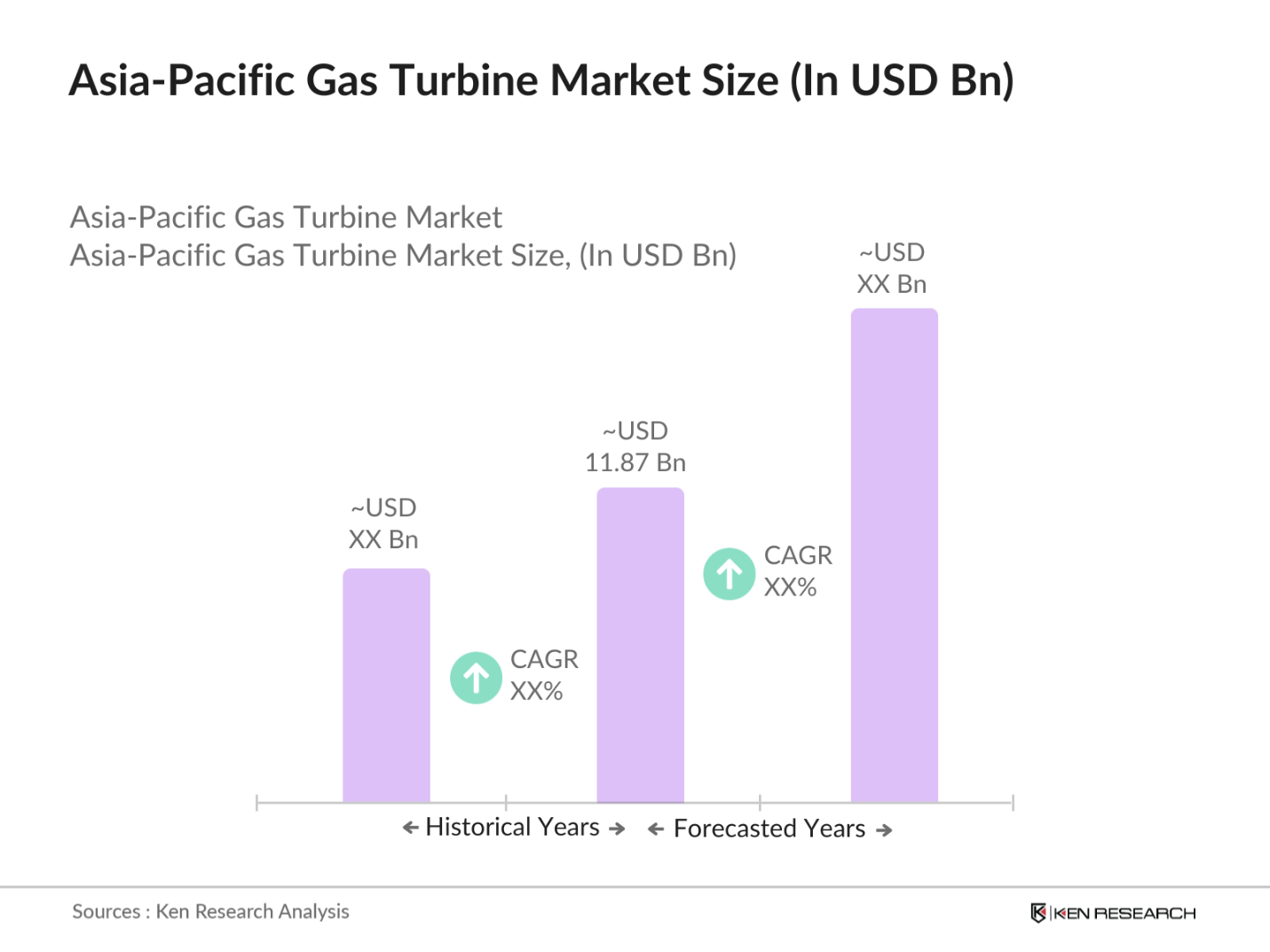
- The Asia-Pacific Gas Turbine market is valued at USD 11.87 billion, driven by the increasing demand for cleaner energy sources and advancements in turbine technology. The sector is significantly influenced by government initiatives aimed at reducing carbon emissions and promoting renewable energy integration. These factors are fostering a robust market environment, attracting investments from various stakeholders. This market growth aligns with global trends emphasizing sustainability and energy efficiency, underscoring the vital role of gas turbines in the region's energy landscape.
- Dominant countries in this market include China, India, and Japan, primarily due to their substantial energy requirements and ongoing infrastructure development. China leads with its ambitious renewable energy targets and rapid industrialization. India follows closely, leveraging government support for gas-based power projects to meet its growing electricity demands. Japan's strategic investments in advanced turbine technology further solidify its market presence. These countries collectively shape the dynamics of the Asia-Pacific Gas Turbine market through their policy frameworks and economic activities.
- Countries in the Asia-Pacific region are tightening emissions standards to align with global climate goals. In 2023, South Korea introduced stringent NOx and SOx limits for gas turbine power plants, setting the threshold at 25 mg/m for NOx emissions. These regulations are part of the country's efforts to reduce its carbon footprint and promote cleaner energy alternatives. Gas turbine manufacturers must continuously innovate to ensure compliance with these evolving emission standards.
Asia-Pacific Gas Turbine Market Segmentation
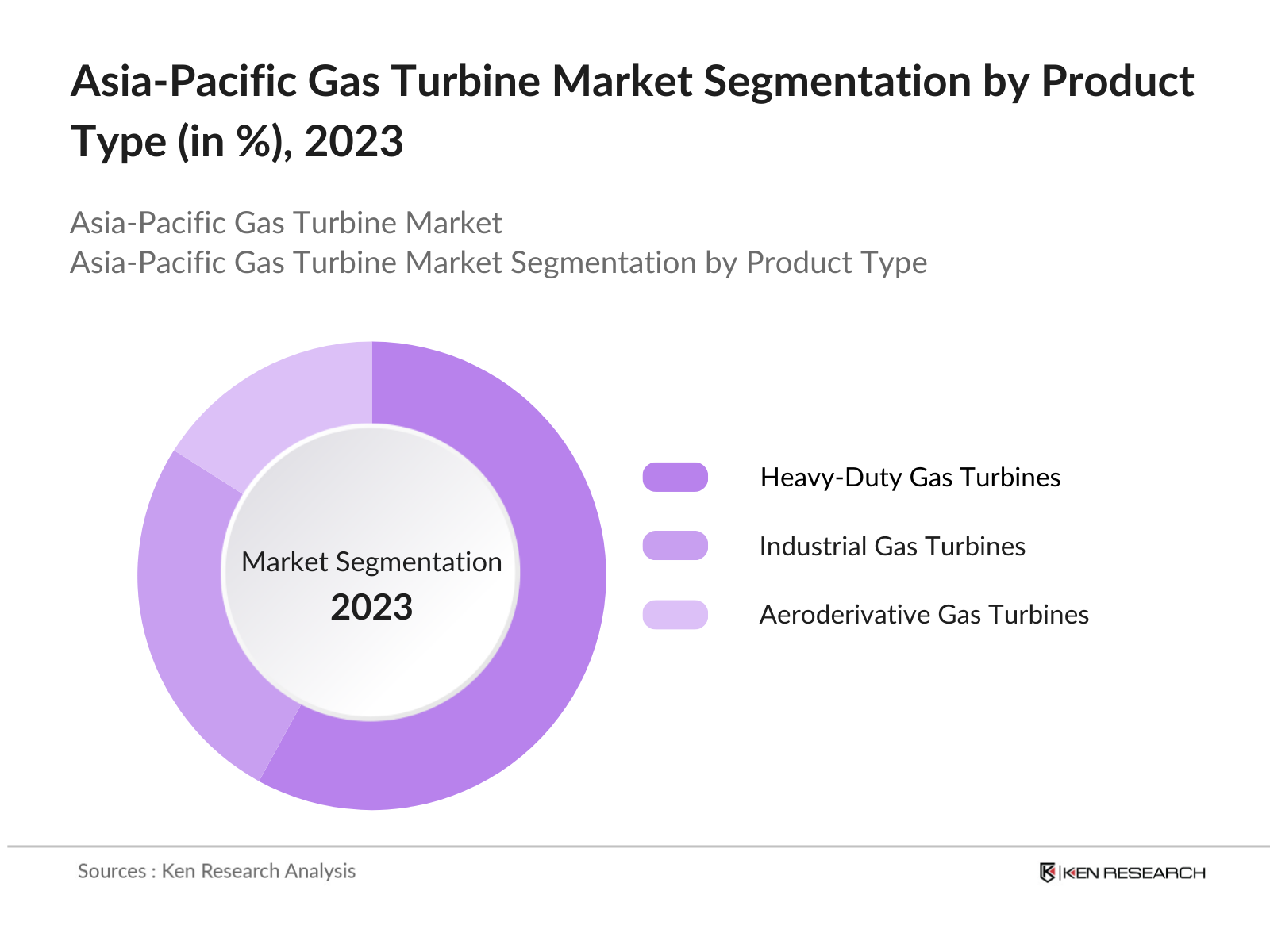
By Product Type: The Asia-Pacific Gas Turbine market is segmented by product type into heavy-duty gas turbines, industrial gas turbines, and aeroderivative gas turbines. Among these, heavy-duty gas turbines hold a dominant market share due to their efficiency and capability to handle large-scale power generation. These turbines are preferred for their reliability and high performance, making them ideal for utility and large industrial applications. Leading manufacturers have also focused on enhancing the operational efficiencies of these turbines, contributing to their widespread adoption across the region.
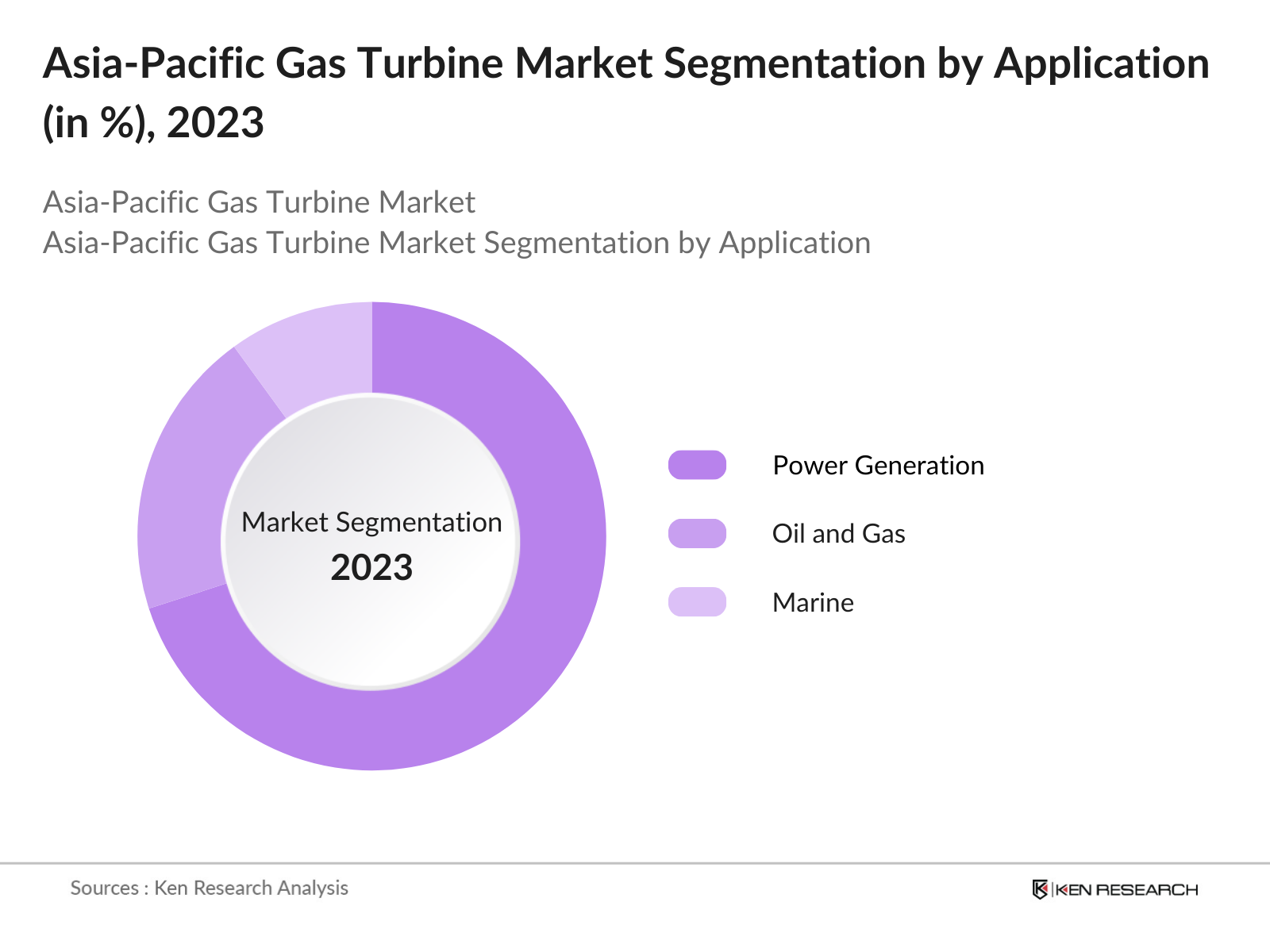
By Application: The market is also segmented by application into power generation, oil and gas, and marine. Power generation dominates the market as the primary application for gas turbines, driven by the rising need for efficient and reliable energy sources. The shift towards natural gas for electricity generation has bolstered the demand for gas turbines in power plants, enabling utilities to reduce emissions and transition towards cleaner energy solutions. This shift, along with increased investments in infrastructure, positions power generation as the leading application segment in the Asia-Pacific Gas Turbine market.
Asia-Pacific Gas Turbine Market Competitive Landscape
The Asia-Pacific Gas Turbine market is dominated by several key players, including General Electric Company, Siemens AG, Mitsubishi Heavy Industries, Rolls-Royce Holdings PLC, and Ansaldo Energia. These companies leverage their technological expertise and robust distribution networks to maintain competitive advantages. The consolidation of these market leaders highlights the influence of established brands in shaping industry trends and driving innovation.
|
Company |
Establishment Year |
Headquarters |
Number of Employees |
Revenue (USD Bn) |
Market Focus |
R&D Expenditure (USD Bn) |
Key Partnerships |
Product Portfolio |
|
General Electric Company |
1892 |
Boston, USA |
- |
- |
- |
- |
- |
- |
|
Siemens AG |
1847 |
Munich, Germany |
- |
- |
- |
- |
- |
- |
|
Mitsubishi Heavy Industries |
1884 |
Tokyo, Japan |
- |
- |
- |
- |
- |
- |
|
Rolls-Royce Holdings PLC |
1904 |
London, UK |
- |
- |
- |
- |
- |
- |
|
Ansaldo Energia |
1853 |
Genoa, Italy |
- |
- |
- |
- |
- |
- |
Global Solid State Cooling Market Analysis
Asia-Pacific Gas Turbine Market Growth Drivers
- Increasing Energy Demand: The Asia-Pacific region's energy demand is projected to grow significantly due to industrialization and population expansion. In 2022, the region consumed approximately 8,500 TWh of electricity, with countries like China and India accounting for more than 60% of this demand, according to the International Energy Agency (IEA). The rise in demand for power has accelerated the need for efficient energy production systems like gas turbines, which offer a balance between power generation and cleaner fuel use. This increased energy demand directly supports the deployment of gas turbines, especially in power-hungry economies.
- Shift Towards Cleaner Fuels: With over 44% of energy consumption in Asia-Pacific coming from coal in 2022, there is a regional shift towards cleaner fuel sources to reduce carbon emissions. Natural gas, which powers gas turbines, is considered a cleaner alternative to coal and oil. The Asian Development Bank (ADB) reported that natural gas consumption in Asia-Pacific reached 890 billion cubic meters in 2023, up by 12% from 2022. This transition toward cleaner fuels is driving investments in gas turbine technologies, which are essential for utilizing natural gas for power generation.
- Government Initiatives for Renewable Energy: Countries like India and China have set ambitious targets to transition towards cleaner energy. India aims to achieve 500 GW of renewable energy capacity by 2030, while China continues to invest in reducing its reliance on coal. In 2023, the Indian government allocated $6 billion to energy projects focusing on hybrid systems incorporating gas turbines for natural gas and renewables integration. Gas turbines are a crucial part of this transition, as they offer flexible power solutions that complement intermittent renewable sources like wind and solar.
Asia-Pacific Gas Turbine Market Challenges
- High Initial Capital Costs: The installation of gas turbines involves significant upfront costs. For instance, the cost of installing a combined cycle gas turbine (CCGT) system ranges between $800 to $1,200 per kW of capacity, according to the Energy Information Administration (EIA) data from 2023. These costs can deter investment, especially in developing nations within the Asia-Pacific region, where infrastructure funding is often constrained. Despite the operational efficiency, the high capital requirement is a substantial barrier to the widespread adoption of gas turbine technology.
- Regulatory Compliance Issues: The gas turbine sector faces regulatory challenges, particularly concerning emissions standards. Governments across the Asia-Pacific region are tightening regulations to meet the Paris Agreement targets. In 2023, the Chinese government mandated that new power plants using gas turbines must adhere to NOx emissions below 50 mg/m. Compliance with such stringent environmental standards increases operational costs and requires continuous upgrades to turbine technologies, creating further challenges for companies in this market.
Asia-Pacific Gas Turbine Market Future Outlook
Over the next five years, the Asia-Pacific Gas Turbine market is expected to show significant growth driven by continuous government support, advancements in gas turbine technology, and increasing consumer demand for energy-efficient solutions. The shift towards cleaner energy sources, such as natural gas, will further bolster the market, alongside investments in renewable energy integration. Additionally, regional players are likely to enhance their R&D efforts to innovate and meet evolving energy demands, fostering a competitive landscape conducive to sustained market expansion.
- Expansion into Emerging Markets: Emerging economies in Southeast Asia, such as Vietnam and the Philippines, are experiencing rapid urbanization and industrial growth, leading to increased energy demands. In 2023, Vietnam saw a 9% rise in energy consumption compared to the previous year, as reported by the Vietnam Electricity Corporation (EVN). This surge creates a significant opportunity for gas turbine manufacturers to expand their market presence in these regions, capitalizing on the demand for more reliable and cleaner energy generation systems.
Source - Innovative Technological Solutions: The integration of hybrid power systems combining gas turbines with renewable energy is an emerging trend. In 2023, Mitsubishi Power introduced a gas turbine that operates in combination with hydrogen fuel, reducing emissions to near zero. These innovations provide an opportunity for the Asia-Pacific region to adopt advanced, low-emission gas turbines, especially as governments introduce policies favoring low-carbon technologies. The flexibility of these hybrid systems ensures their viability in markets where renewable energy alone is insufficient to meet rising energy demands.
Scope of the Report
|
Product Type |
Heavy-Duty Gas Turbines Industrial Gas Turbines Aeroderivative Gas Turbines |
|
Application |
Power Generation Oil and Gas Marine |
|
Technology |
Open Cycle Gas Turbines Combined Cycle Gas Turbines |
|
End-User Industry |
Utility Manufacturing Aerospace |
|
Region |
China India Japan Australia Southeast Asia |
Products
Key Target Audience Organizations and Entities Who Can Benefit by Subscribing to This Report:
Investments and Venture Capitalist Firms
Government and Regulatory Bodies (e.g., Ministry of Energy, Environmental Protection Agency)
Energy Producers and Utilities Industry
Industrial Companies
Engineering and Construction Firms
Renewable Energy Companies
Oil and Gas Companies
Companies
Players Mentioned in the Report:
General Electric Company
Siemens AG
Mitsubishi Heavy Industries
Rolls-Royce Holdings PLC
Ansaldo Energia
Solar Turbines
Pratt & Whitney
Alstom S.A.
Baker Hughes Company
MAN Energy Solutions
Table of Contents
1. Asia-Pacific Gas Turbine Market Overview
1.1. Definition and Scope
1.2. Market Taxonomy
1.3. Market Growth Rate
1.4. Market Segmentation Overview
2. Asia-Pacific Gas Turbine Market Size (In USD Bn)
2.1. Historical Market Size
2.2. Year-On-Year Growth Analysis
2.3. Key Market Developments and Milestones
3. Asia-Pacific Gas Turbine Market Analysis
3.1. Growth Drivers
3.1.1. Increasing Energy Demand
3.1.2. Shift Towards Cleaner Fuels
3.1.3. Government Initiatives for Renewable Energy
3.1.4. Technological Advancements
3.2. Market Challenges
3.2.1. High Initial Capital Costs
3.2.2. Regulatory Compliance Issues
3.2.3. Limited Availability of Skilled Workforce
3.3. Opportunities
3.3.1. Expansion into Emerging Markets
3.3.2. Innovative Technological Solutions
3.3.3. Public-Private Partnerships
3.4. Trends
3.4.1. Integration of Smart Grid Technology
3.4.2. Rise of Distributed Energy Resources
3.4.3. Increasing Investments in R&D
3.5. Government Regulation
3.5.1. Emission Standards and Policies
3.5.2. Renewable Energy Targets
3.5.3. Incentives for Clean Technology Adoption
3.6. SWOT Analysis
3.7. Stake Ecosystem
3.8. Porters Five Forces
3.9. Competition Ecosystem
4. Asia-Pacific Gas Turbine Market Segmentation
4.1. By Product Type (In Value %)
4.1.1. Heavy-Duty Gas Turbines
4.1.2. Industrial Gas Turbines
4.1.3. Aeroderivative Gas Turbines
4.2. By Application (In Value %)
4.2.1. Power Generation
4.2.2. Oil and Gas
4.2.3. Marine
4.3. By Technology (In Value %)
4.3.1. Open Cycle Gas Turbines
4.3.2. Combined Cycle Gas Turbines
4.4. By End-User Industry (In Value %)
4.4.1. Utility
4.4.2. Manufacturing
4.4.3. Aerospace
4.5. By Region (In Value %)
4.5.1. China
4.5.2. India
4.5.3. Japan
4.5.4. Australia
4.5.5. Southeast Asia
5. Asia-Pacific Gas Turbine Market Competitive Analysis
5.1. Detailed Profiles of Major Companies
5.1.1. General Electric Company
5.1.2. Siemens AG
5.1.3. Mitsubishi Heavy Industries
5.1.4. Ansaldo Energia
5.1.5. MAN Energy Solutions
5.1.6. Rolls-Royce Holdings PLC
5.1.7. Solar Turbines
5.1.8. Pratt & Whitney
5.1.9. Alstom S.A.
5.1.10. Capstone Turbine Corporation
5.1.11. Baker Hughes Company
5.1.12. Doosan Group
5.1.13. Wood Group PLC
5.1.14. Cummins Inc.
5.1.15. Eneos Corporation
5.2. Cross Comparison Parameters (No. of Employees, Headquarters, Inception Year, Revenue, Market Share, R&D Expenditure, Key Partnerships, Product Portfolio)
5.3. Market Share Analysis
5.4. Strategic Initiatives
5.5. Mergers and Acquisitions
5.6. Investment Analysis
6. Asia-Pacific Gas Turbine Market Regulatory Framework
6.1. Environmental Standards
6.2. Compliance Requirements
6.3. Certification Processes
7. Asia-Pacific Gas Turbine Future Market Size (In USD Bn)
7.1. Future Market Size Projections
7.2. Key Factors Driving Future Market Growth
8. Asia-Pacific Gas Turbine Future Market Segmentation
8.1. By Product Type (In Value %)
8.2. By Application (In Value %)
8.3. By Technology (In Value %)
8.4. By End-User Industry (In Value %)
8.5. By Region (In Value %)
9. Asia-Pacific Gas Turbine Market Analysts Recommendations
9.1. TAM/SAM/SOM Analysis
9.2. Customer Cohort Analysis
9.3. Marketing Initiatives
9.4. White Space Opportunity Analysis
Disclaimer
Contact Us
Research Methodology
Step 1: Identification of Key Variables
The initial phase involves constructing an ecosystem map encompassing all major stakeholders within the Asia-Pacific Gas Turbine market. This step is underpinned by extensive desk research, utilizing a combination of secondary and proprietary databases to gather comprehensive industry-level information. The primary objective is to identify and define the critical variables that influence market dynamics.
Step 2: Market Analysis and Construction
In this phase, we will compile and analyze historical data pertaining to the Asia-Pacific Gas Turbine market. This includes assessing market penetration, the ratio of marketplaces to service providers, and the resultant revenue generation. Furthermore, an evaluation of service quality statistics will be conducted to ensure the reliability and accuracy of the revenue estimates.
Step 3: Hypothesis Validation and Expert Consultation
Market hypotheses will be developed and subsequently validated through computer-assisted telephone interviews (CATIs) with industry experts representing a diverse array of companies. These consultations will provide valuable operational and financial insights directly from industry practitioners, which will be instrumental in refining and corroborating the market data.
Step 4: Research Synthesis and Final Output
The final phase involves direct engagement with multiple gas turbine manufacturers to acquire detailed insights into product segments, sales performance, consumer preferences, and other pertinent factors. This interaction will serve to verify and complement the statistics derived from the bottom-up approach, thereby ensuring a comprehensive, accurate, and validated analysis of the Asia-Pacific Gas Turbine market.
Frequently Asked Questions
01. How big is the Asia-Pacific Gas Turbine market?
The Asia-Pacific Gas Turbine market is valued at USD 11.87 billion, driven by the increasing demand for cleaner energy sources and advancements in turbine technology.
02. What are the challenges in the Asia-Pacific Gas Turbine market?
Challenges include high initial capital costs, regulatory compliance issues, and a limited availability of skilled workforce, which may hinder the growth of the gas turbine market in the region.
03. Who are the major players in the Asia-Pacific Gas Turbine market?
Key players in the market include General Electric Company, Siemens AG, Mitsubishi Heavy Industries, Rolls-Royce Holdings PLC, and Ansaldo Energia, known for their technological expertise and extensive product offerings.
04. What are the growth drivers of the Asia-Pacific Gas Turbine market?
The market is propelled by factors such as government initiatives for cleaner energy, increasing energy demands, and significant advancements in turbine technology enhancing operational efficiency.
05. What applications dominate the Asia-Pacific Gas Turbine market?
Power generation is the dominant application in the Asia-Pacific Gas Turbine market, fueled by the rising need for efficient and reliable energy sources amid growing electricity demands across the region.
Why Buy From Us?

What makes us stand out is that our consultants follows Robust, Refine and Result (RRR) methodology. i.e. Robust for clear definitions, approaches and sanity checking, Refine for differentiating respondents facts and opinions and Result for presenting data with story

We have set a benchmark in the industry by offering our clients with syndicated and customized market research reports featuring coverage of entire market as well as meticulous research and analyst insights.

While we don't replace traditional research, we flip the method upside down. Our dual approach of Top Bottom & Bottom Top ensures quality deliverable by not just verifying company fundamentals but also looking at the sector and macroeconomic factors.

With one step in the future, our research team constantly tries to show you the bigger picture. We help with some of the tough questions you may encounter along the way: How is the industry positioned? Best marketing channel? KPI's of competitors? By aligning every element, we help maximize success.

Our report gives you instant access to the answers and sources that other companies might choose to hide. We elaborate each steps of research methodology we have used and showcase you the sample size to earn your trust.

If you need any support, we are here! We pride ourselves on universe strength, data quality, and quick, friendly, and professional service.