
Asia Pacific Hydrogen Fuel Gas Station Market Outlook to 2030
Region:Asia
Author(s):Sanjna
Product Code:KROD7076
November 2024
88
About the Report
Asia Pacific Hydrogen Fuel Gas Station Market Overview
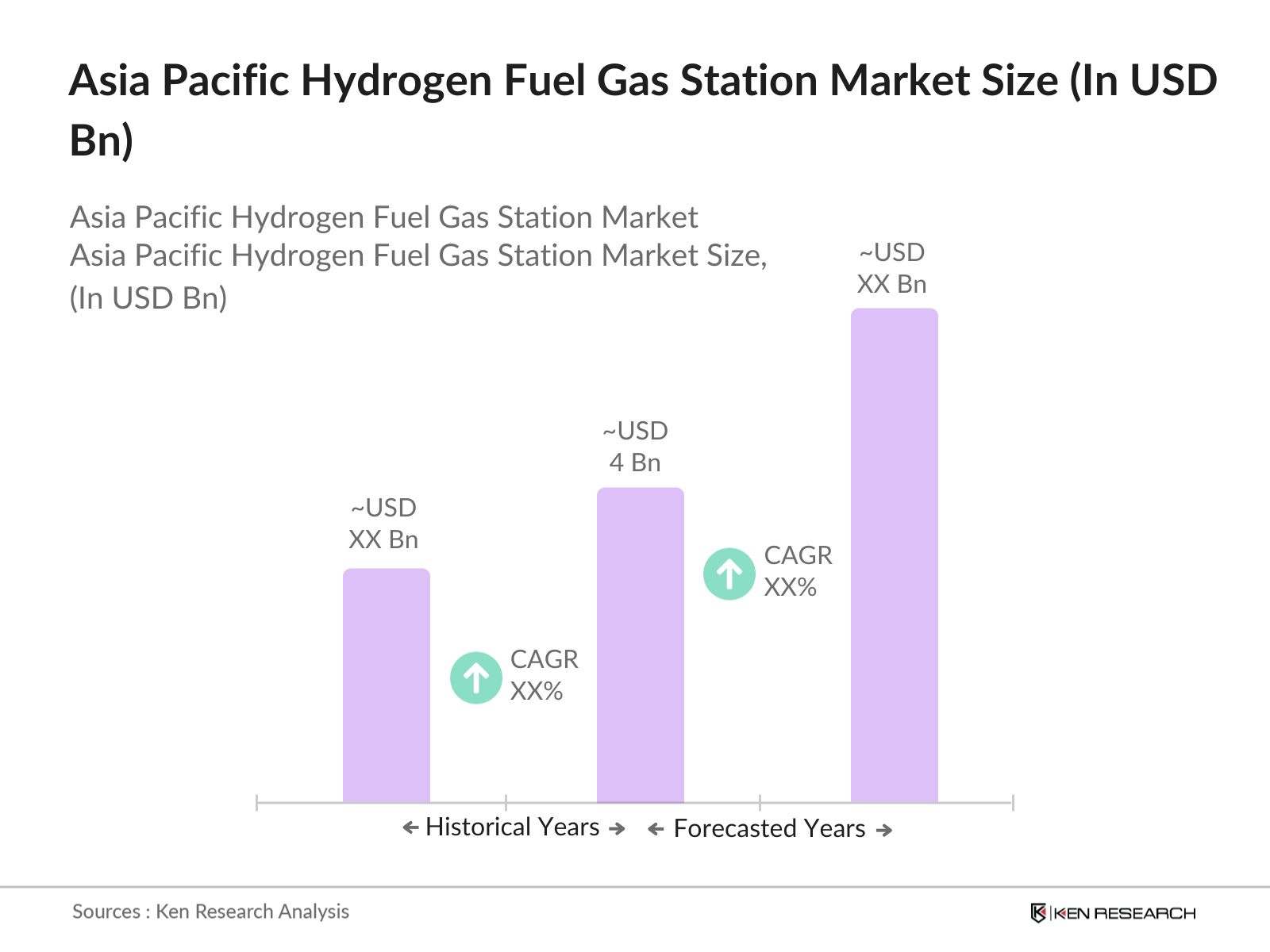
- The Asia Pacific Hydrogen Fuel Gas Station market is valued at USD 4 billion, driven by increasing investments in clean energy infrastructure and the region's strong commitment to achieving carbon neutrality. Major economies like China, Japan, and South Korea are spearheading this growth, focusing on hydrogen as a key component of their energy transition strategies. The development of large-scale hydrogen projects, coupled with government subsidies for hydrogen stations, is significantly boosting market growth.
- Japan and South Korea dominate the Asia Pacific Hydrogen Fuel Gas Station market due to their advanced hydrogen policies and early adoption of hydrogen technologies. Japan's government has set a vision for a "Hydrogen Society," with strong support for both fuel cell vehicles (FCVs) and hydrogen infrastructure. Meanwhile, South Korea has heavily invested in hydrogen production and distribution, further enhancing its leadership in this sector.
- Governments across the Asia-Pacific region are implementing stringent standards for hydrogen fueling infrastructure to ensure safety and compliance. Japan has introduced comprehensive safety standards for hydrogen stations, mandating regular inspections and compliance with fire safety regulations. In South Korea, hydrogen refueling stations must meet detailed operational guidelines, with a focus on mitigating the risks associated with hydrogen storage and transportation. These regulations are critical to ensuring the safe expansion of hydrogen infrastructure.
Asia Pacific Hydrogen Fuel Gas Station Market Segmentation
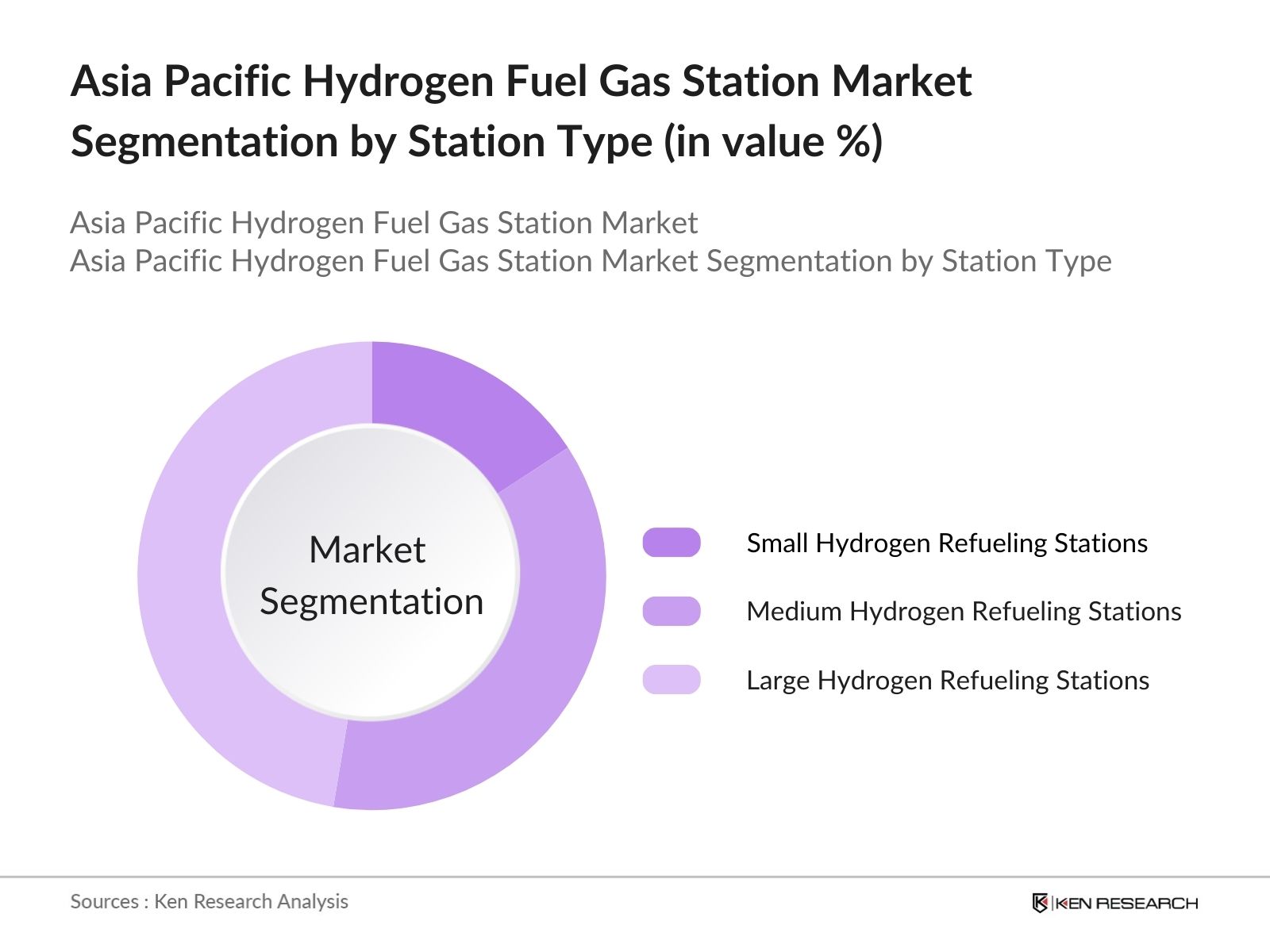
By Station Type: The Asia Pacific Hydrogen Fuel Gas Station market is segmented by station type into small, medium, and large hydrogen refueling stations. Recently, large hydrogen refueling stations have seen a dominant market share due to their capacity to serve both light-duty and heavy-duty vehicles, particularly in commercial hubs such as Japan and China. The higher fuel storage capacity and ability to handle multiple refueling events have driven investments in large-scale infrastructure, making this segment a key player in supporting commercial fleet transitions to hydrogen.
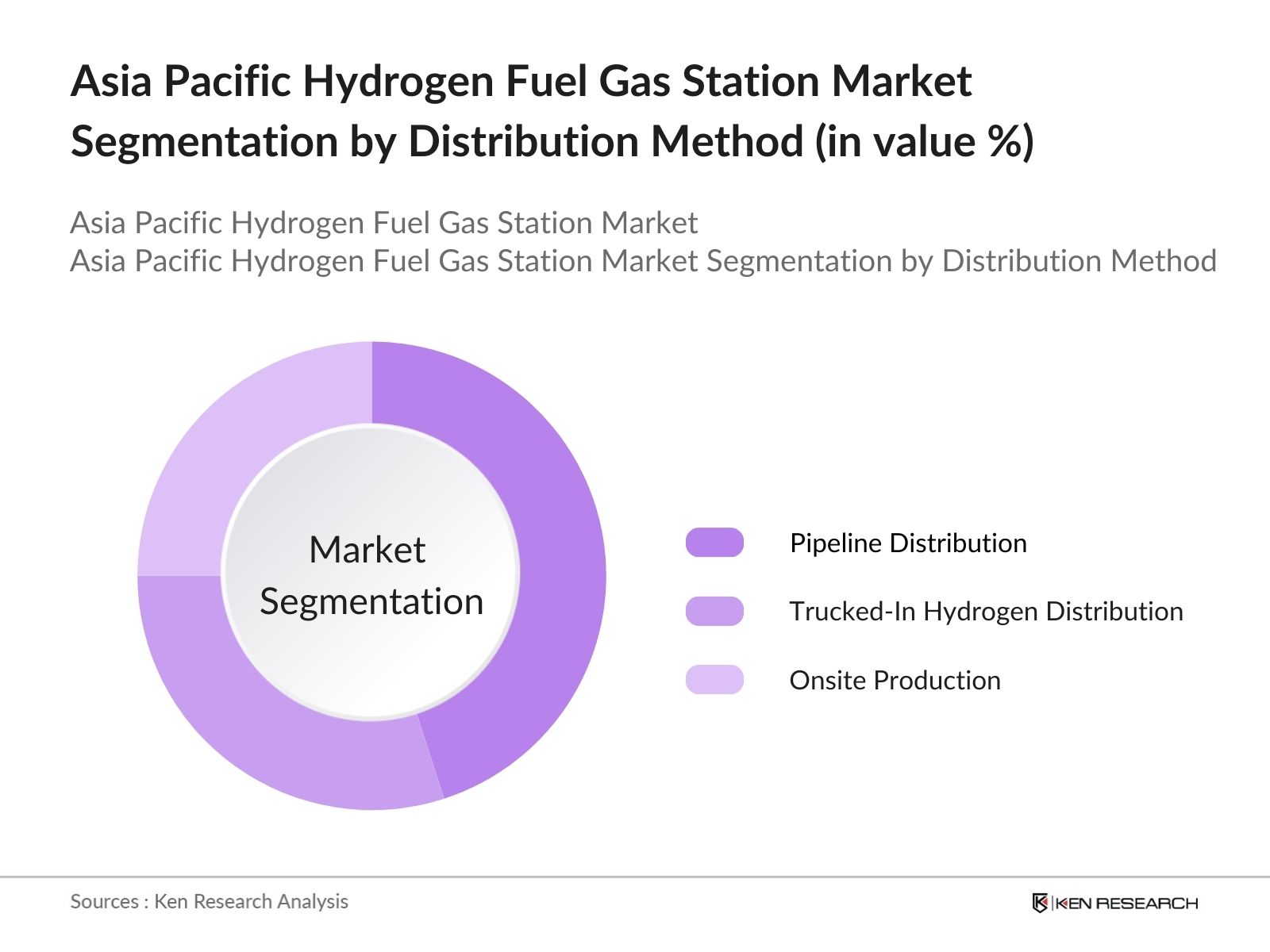
 By Distribution Method: The market is further segmented by distribution methods into pipeline distribution, trucked-in hydrogen distribution, and onsite production. Pipeline distribution holds the largest market share due to its efficiency in delivering hydrogen to refueling stations across urban areas in Japan and South Korea. These regions have well-developed pipeline infrastructure, allowing for continuous and cost-effective hydrogen supply, reducing dependence on transportation-based hydrogen delivery, and ensuring consistent availability at stations.
 Asia Pacific Hydrogen Fuel Gas Station Market Competitive Landscape
The Asia Pacific Hydrogen Fuel Gas Station market is characterized by the presence of global leaders and regional players who are focused on hydrogen production, distribution, and infrastructure development. The market is dominated by a few major companies with strong regional influence and technological advancements.
The competitive landscape is dominated by: Air Liquide, Iwatani Corporation, Nel ASA, Hyundai Hydrogen Mobility, and Toyota Tsusho Corporation. These companies benefit from strong governmental backing and strategic investments in hydrogen-related technologies and infrastructure.
|
Company Name |
Establishment Year |
Headquarters |
Hydrogen Production Capacity |
Regional Presence |
Technological Advancements |
Revenue |
Refueling Station Network |
Investments in Hydrogen |
|
Air Liquide |
1902 |
Paris, France |
- |
- |
- |
- |
- |
- |
|
Iwatani Corporation |
1930 |
Tokyo, Japan |
- |
- |
- |
- |
- |
- |
|
Nel ASA |
1927 |
Oslo, Norway |
- |
- |
- |
- |
- |
- |
|
Hyundai Hydrogen Mobility |
2019 |
Seoul, South Korea |
- |
- |
- |
- |
- |
- |
|
Toyota Tsusho Corporation |
1948 |
Nagoya, Japan |
- |
- |
- |
- |
- |
- |
Asia Pacific Hydrogen Fuel Gas Station Market Analysis
Growth Drivers
- Government Incentives for Hydrogen Infrastructure: In 2023, Japan committed over $1.5 billion for the development of hydrogen fuel stations as part of its Green Growth Strategy. Similarly, South Korea has established a national goal of building 310 hydrogen refueling stations by 2025, aiming to deploy 200,000 hydrogen-powered vehicles. Australia's "Hydrogen Strategy" also includes incentives such as grants and subsidies for the hydrogen infrastructure, with over $300 million allocated for hydrogen projects to support clean energy solutions.
- Transition to Clean Energy in Transportation: Countries like Japan, South Korea, and Australia are transitioning from fossil fuels to cleaner hydrogen energy in transportation. In Japan, hydrogen-powered buses were deployed for the Tokyo 2020 Olympics, with more than 100 fuel cell buses already in operation by 2023. South Korea has initiated projects to build 450 hydrogen buses by 2025. This shift is driven by a need to reduce vehicle emissions, as the transport sector accounted for around 20% of CO2 emissions in South Korea in 2022.
- Decarbonization Targets: Asia-Pacific countries are setting ambitious carbon neutrality targets to combat climate change. Japan, for example, has committed to achieving net-zero emissions by 2050 and reducing its greenhouse gas emissions by 46% by 2030 compared to 2013 levels. South Korea has similar targets, aiming for carbon neutrality by 2050. These commitments have led to substantial investments in hydrogen projects, including the establishment of more hydrogen refueling stations, contributing to the decarbonization of the transportation sector.
Challenges
- High Initial Infrastructure Costs: The development of hydrogen fueling stations requires significant capital expenditure, with the cost of building a single station ranging from $1 million to $2 million, depending on the location and technology used. For instance, Japan's national hydrogen strategy highlights the high costs as a key barrier, despite substantial government subsidies. In Australia, the cost of developing hydrogen infrastructure is cited as one of the primary challenges to widespread adoption, necessitating ongoing financial support from public and private sectors to offset these costs.
- Hydrogen Storage and Distribution Issues: Storage and distribution of hydrogen remain technical challenges in the Asia-Pacific region due to the gas's low density and volatility. The lack of adequate pipelines and the high cost of hydrogen storage tanks complicate logistics. In 2023, South Korea reported that only 20% of its planned hydrogen distribution networks were operational, limiting hydrogens availability to end-users. Moreover, hydrogen transportation through conventional trucks adds to the cost, making it less economically viable compared to other fuel types.
Asia Pacific Hydrogen Fuel Gas Station Market Future Outlook
Asia Pacific Hydrogen Fuel Gas Station market is expected to show considerable growth, driven by ongoing government incentives, advancements in hydrogen production and storage technologies, and increased investment in hydrogen infrastructure. The push towards decarbonization across key markets like Japan, South Korea, and China will further bolster the markets expansion as these countries aim to reduce reliance on fossil fuels and meet ambitious environmental goals. Cross-sector applications of hydrogen in industries beyond transportation will also contribute to sustained growth.
Market Opportunities
- Expansion of Hydrogen Supply Chain: There is significant opportunity in expanding the hydrogen supply chain across the Asia-Pacific region. Countries like Australia are investing in hydrogen production facilities, with the Port of Newcastle Hydrogen Hub set to produce over 40,000 tons of hydrogen annually by 2024. This will bolster the distribution network across the region, reducing the dependence on imported fuels. The integration of domestic production, storage, and distribution creates new business opportunities for supply chain players across the region.
- Cross-Sectoral Adoption of Hydrogen: The use of hydrogen is expanding beyond the automotive sector, offering growth opportunities in industries such as manufacturing and aviation. South Korea plans to implement hydrogen in steel production to reduce industrial emissions by 40 million tons annually by 2030. In Japan, hydrogen-powered trains are being tested, and airlines like All Nippon Airways are exploring hydrogen for short-haul flights. This cross-sector adoption of hydrogen opens new revenue streams for infrastructure developers.
Scope of the Report
|
Segment |
Sub-Segments |
|
By Station Type |
Small Hydrogen Refueling Stations |
|
Medium Hydrogen Refueling Stations |
|
|
Large Hydrogen Refueling Stations |
|
|
By Distribution Method |
Pipeline Distribution |
|
Trucked-In Hydrogen Distribution |
|
|
Onsite Production |
|
|
By Pressure Level |
Low Pressure Hydrogen Refueling Stations |
|
High Pressure Hydrogen Refueling Stations |
|
|
By Application |
Light-Duty Vehicles |
|
Heavy-Duty Vehicles |
|
|
Industrial and Commercial Use |
|
|
By Region |
East Asia |
|
Southeast Asia |
|
|
Australasia |
|
|
South Asia |
Products
Key Target Audience
Hydrogen Production Companies
Hydrogen Fueling Station Operators
Vehicle Manufacturers (FCV producers)
Logistics and Transport Companies
Hydrogen Technology Providers
Investors and Venture Capitalist Firms
Government and Regulatory Bodies (Ministry of Economy, Trade, and Industry - Japan, Ministry of Trade, Industry and Energy - South Korea)
Companies
Players Mentioned in the Report
Air Liquide
Iwatani Corporation
Nel ASA
Hyundai Hydrogen Mobility
Toyota Tsusho Corporation
Shell Hydrogen
Engie Hydrogen
Horizon Fuel Cell Technologies
Sinopec
Kawasaki Heavy Industries
Table of Contents
1. Asia Pacific Hydrogen Fuel Gas Station Market Overview
1.1. Definition and Scope
1.2. Market Taxonomy
1.3. Market Growth Rate
1.4. Market Segmentation Overview
2. Asia Pacific Hydrogen Fuel Gas Station Market Size (In USD Mn)
2.1. Historical Market Size
2.2. Year-On-Year Growth Analysis
2.3. Key Market Developments and Milestones
3. Asia Pacific Hydrogen Fuel Gas Station Market Analysis
3.1. Growth Drivers
3.1.1. Government Incentives for Hydrogen Infrastructure
3.1.2. Transition to Clean Energy in Transportation
3.1.3. Decarbonization Targets (Carbon Neutrality Targets)
3.1.4. Development of Green Hydrogen Projects (Clean Energy Source)
3.2. Market Challenges
3.2.1. High Initial Infrastructure Costs (Capex for Hydrogen Stations)
3.2.2. Hydrogen Storage and Distribution Issues
3.2.3. Regulatory Hurdles and Compliance
3.3. Opportunities
3.3.1. Expansion of Hydrogen Supply Chain (From Production to Distribution)
3.3.2. Cross-Sectoral Adoption of Hydrogen (Beyond Automotive Industry)
3.3.3. International Partnerships in Hydrogen Projects (Collaborative Investments)
3.4. Trends
3.4.1. Rise of Hydrogen-Powered Commercial Fleets (Buses and Trucks)
3.4.2. Integration of Smart Technologies in Hydrogen Stations
3.4.3. Shift Towards Green Hydrogen Production
3.5. Government Regulation
3.5.1. Hydrogen Fueling Infrastructure Standards
3.5.2. Public-Private Partnerships (For Hydrogen Station Development)
3.5.3. National Hydrogen Strategies
3.6. SWOT Analysis
3.7. Stake Ecosystem
3.8. Porters Five Forces
3.9. Competition Ecosystem
4. Asia Pacific Hydrogen Fuel Gas Station Market Segmentation
4.1. By Station Type (In Value %)
4.1.1. Small Hydrogen Refueling Stations
4.1.2. Medium Hydrogen Refueling Stations
4.1.3. Large Hydrogen Refueling Stations
4.2. By Distribution Method (In Value %)
4.2.1. Pipeline Distribution
4.2.2. Trucked-In Hydrogen Distribution
4.2.3. Onsite Production
4.3. By Pressure Level (In Value %)
4.3.1. Low Pressure Hydrogen Refueling Stations
4.3.2. High Pressure Hydrogen Refueling Stations
4.4. By Application (In Value %)
4.4.1. Light-Duty Vehicles
4.4.2. Heavy-Duty Vehicles
4.4.3. Industrial and Commercial Use
4.5. By Region (In Value %)
4.5.1. East Asia
4.5.2. Southeast Asia
4.5.3. Australasia
4.5.4. South Asia
5. Asia Pacific Hydrogen Fuel Gas Station Market Competitive Analysis
5.1. Detailed Profiles of Major Companies
5.1.1. Air Liquide
5.1.2. Iwatani Corporation
5.1.3. Shell Hydrogen
5.1.4. Nel ASA
5.1.5. Toyota Tsusho Corporation
5.1.6. Hyundai Hydrogen Mobility
5.1.7. Engie Hydrogen
5.1.8. Horizon Fuel Cell Technologies
5.1.9. Sinopec
5.1.10. Kawasaki Heavy Industries
5.2. Cross Comparison Parameters (No. of Employees, Headquarters, Hydrogen Production Capacity, Regional Presence, Revenue, Refueling Station Network, Investments in Hydrogen, Technological Advancements)
5.3. Market Share Analysis
5.4. Strategic Initiatives
5.5. Mergers and Acquisitions
5.6. Investment Analysis
5.7. Venture Capital Funding
5.8. Government Grants
5.9. Private Equity Investments
6. Asia Pacific Hydrogen Fuel Gas Station Market Regulatory Framework
6.1. Safety and Environmental Standards for Hydrogen Infrastructure
6.2. Compliance Requirements for Hydrogen Fueling Stations
6.3. Hydrogen Certification Processes
7. Asia Pacific Hydrogen Fuel Gas Station Future Market Size (In USD Mn)
7.1. Future Market Size Projections
7.2. Key Factors Driving Future Market Growth
8. Asia Pacific Hydrogen Fuel Gas Station Future Market Segmentation
8.1. By Station Type (In Value %)
8.2. By Distribution Method (In Value %)
8.3. By Pressure Level (In Value %)
8.4. By Application (In Value %)
8.5. By Region (In Value %)
9. Asia Pacific Hydrogen Fuel Gas Station Market Analysts Recommendations
9.1. TAM/SAM/SOM Analysis
9.2. Customer Cohort Analysis
9.3. White Space Opportunity Analysis
9.4. Marketing Initiatives
Research Methodology
Step 1: Identification of Key Variables
The first phase includes constructing an ecosystem map that outlines all major stakeholders within the Asia Pacific Hydrogen Fuel Gas Station market. This step is based on rigorous desk research, leveraging secondary and proprietary databases to collect industry-level information. The objective is to identify key variables such as hydrogen production capacity, refueling station infrastructure, and distribution methods that drive market dynamics.
Step 2: Market Analysis and Construction
In this stage, historical data related to the Asia Pacific Hydrogen Fuel Gas Station market is compiled and assessed. Factors like station type adoption, distribution method preferences, and hydrogen consumption patterns are analyzed to determine revenue generation and market penetration. A quality assessment of service delivery will also be conducted to ensure data reliability.
Step 3: Hypothesis Validation and Expert Consultation
Market hypotheses will be tested through consultations with industry experts via computer-assisted telephone interviews (CATIs). These interviews with stakeholders in hydrogen production, distribution, and station operation will provide direct financial and operational insights, which will be used to refine market projections.
Step 4: Research Synthesis and Final Output
The last phase involves direct engagement with hydrogen fueling station operators to gather insights into station type dominance, distribution efficiency, and technological advancements. This data will complement statistics derived from the bottom-up approach, ensuring that the final report presents an accurate and validated view of the Asia Pacific Hydrogen Fuel Gas Station market.
Frequently Asked Questions
01. How big is the Asia Pacific Hydrogen Fuel Gas Station Market?
The Asia Pacific Hydrogen Fuel Gas Station market is valued at USD 4 billion, largely driven by the increasing investments in hydrogen infrastructure and government policies aimed at decarbonizing the transport sector.
02. What are the challenges in the Asia Pacific Hydrogen Fuel Gas Station Market?
Challenges in Asia Pacific Hydrogen Fuel Gas Station market include high initial infrastructure costs, regulatory hurdles regarding safety standards, and technical difficulties in hydrogen storage and distribution. These factors impact the widespread adoption of hydrogen refueling stations.
03. Who are the major players in the Asia Pacific Hydrogen Fuel Gas Station Market?
Key players in Asia Pacific Hydrogen Fuel Gas Station market include Air Liquide, Iwatani Corporation, Nel ASA, Hyundai Hydrogen Mobility, and Toyota Tsusho Corporation. These companies have made significant investments in hydrogen infrastructure, driving market growth.
04. What are the growth drivers of the Asia Pacific Hydrogen Fuel Gas Station Market?
Asia Pacific Hydrogen Fuel Gas Station market is driven by government incentives, the push towards carbon neutrality, advancements in hydrogen production technologies, and increasing demand for clean energy solutions in transportation.
Why Buy From Us?

What makes us stand out is that our consultants follows Robust, Refine and Result (RRR) methodology. i.e. Robust for clear definitions, approaches and sanity checking, Refine for differentiating respondents facts and opinions and Result for presenting data with story

We have set a benchmark in the industry by offering our clients with syndicated and customized market research reports featuring coverage of entire market as well as meticulous research and analyst insights.

While we don't replace traditional research, we flip the method upside down. Our dual approach of Top Bottom & Bottom Top ensures quality deliverable by not just verifying company fundamentals but also looking at the sector and macroeconomic factors.

With one step in the future, our research team constantly tries to show you the bigger picture. We help with some of the tough questions you may encounter along the way: How is the industry positioned? Best marketing channel? KPI's of competitors? By aligning every element, we help maximize success.

Our report gives you instant access to the answers and sources that other companies might choose to hide. We elaborate each steps of research methodology we have used and showcase you the sample size to earn your trust.

If you need any support, we are here! We pride ourselves on universe strength, data quality, and quick, friendly, and professional service.