
Asia Pacific Indium Market Outlook to 2030
Region:Asia
Author(s):Shreya Garg
Product Code:KROD10380
December 2024
96
About the Report
Asia Pacific Indium Market Overview
- The Asia Pacific Indium market, based on a five-year historical analysis, is valued at USD 250 billion. This market is driven by increasing demand from the electronics sector, particularly in applications such as touchscreens, flat panel displays, and solar panels. The widespread use of indium tin oxide (ITO) in transparent conductive coatings and the ongoing expansion of the semiconductor industry further propel the demand for indium. Advancements in renewable energy, like thin-film photovoltaics, continue to increase the need for indium, solidifying its relevance in various industries.
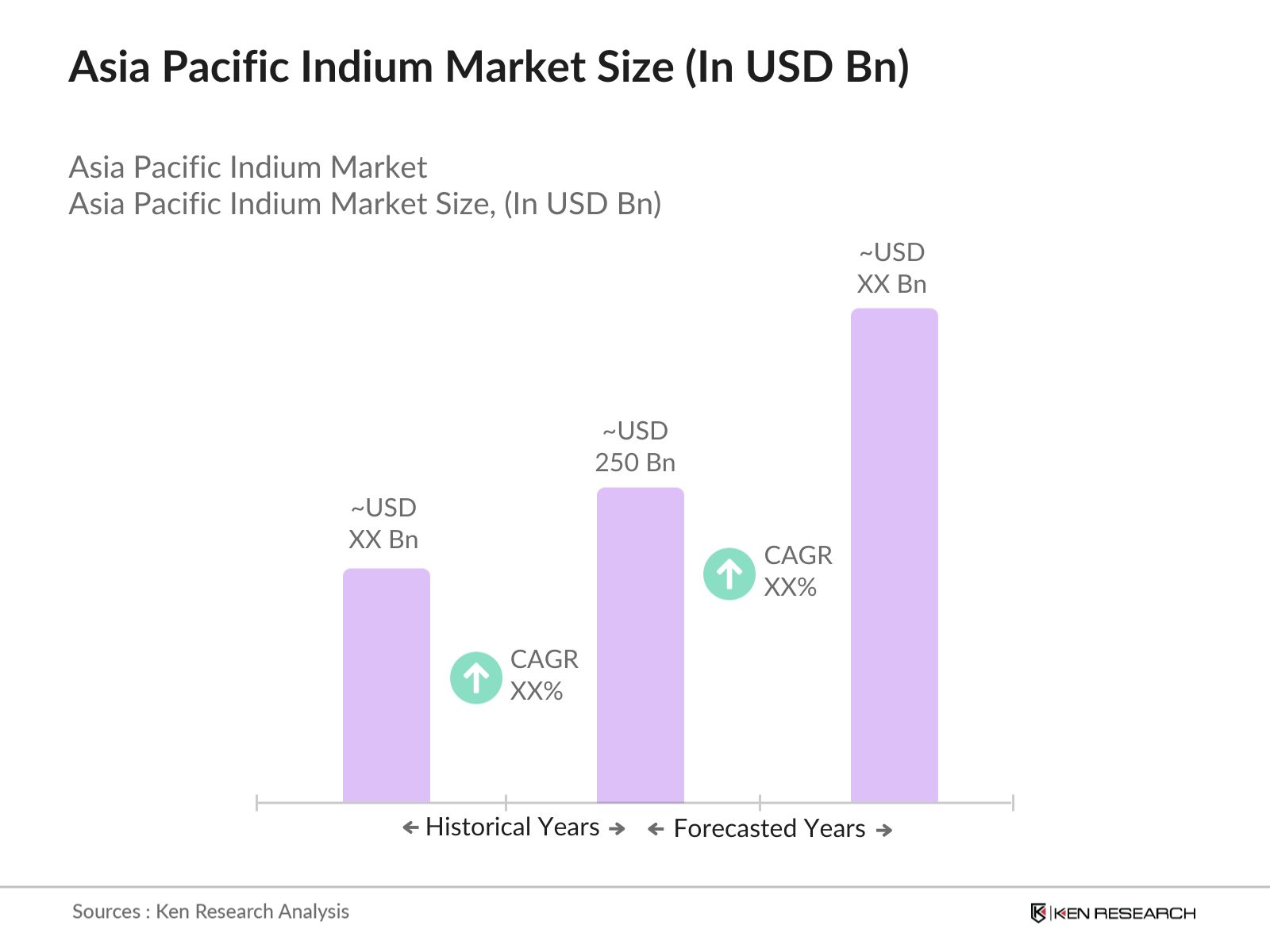
- China and Japan dominate the Asia Pacific Indium market due to their robust manufacturing capabilities and well-established supply chains for electronics and semiconductors. China's position as a major producer of primary indium, combined with extensive mining activities, ensures a steady supply of raw materials, which supports the local electronics and solar cell industries. Japans technological advancements in electronics and a strong focus on R&D in optoelectronics further contribute to its leading position in the market. Both countries benefit from favorable government policies that encourage technological innovation and export growth.
- China's National Mineral Policy, updated in 2023, placed stricter controls on indium extraction to minimize environmental impact, which affected the supply chain for several downstream industries. Japan has implemented policies to encourage indium recycling as part of its "Rare Metal Strategy," allocating $200 million for the development of recycling technologies. South Korea's Ministry of Trade, Industry, and Energy has similarly introduced measures to regulate indium mining activities, promoting sustainable practices. These policies reflect the region's effort to balance economic growth with environmental sustainability.
Asia Pacific Indium Market Segmentation
By Product Type: The market is segmented by product type into primary indium, secondary indium, and indium compounds. Among these, primary indium has a dominant market share due to its direct extraction from ores and its high purity levels, which make it suitable for critical applications like semiconductors and LCD production. The demand for primary indium is supported by the growing electronics industry in China and Japan, where high-purity materials are essential for manufacturing advanced devices and displays. 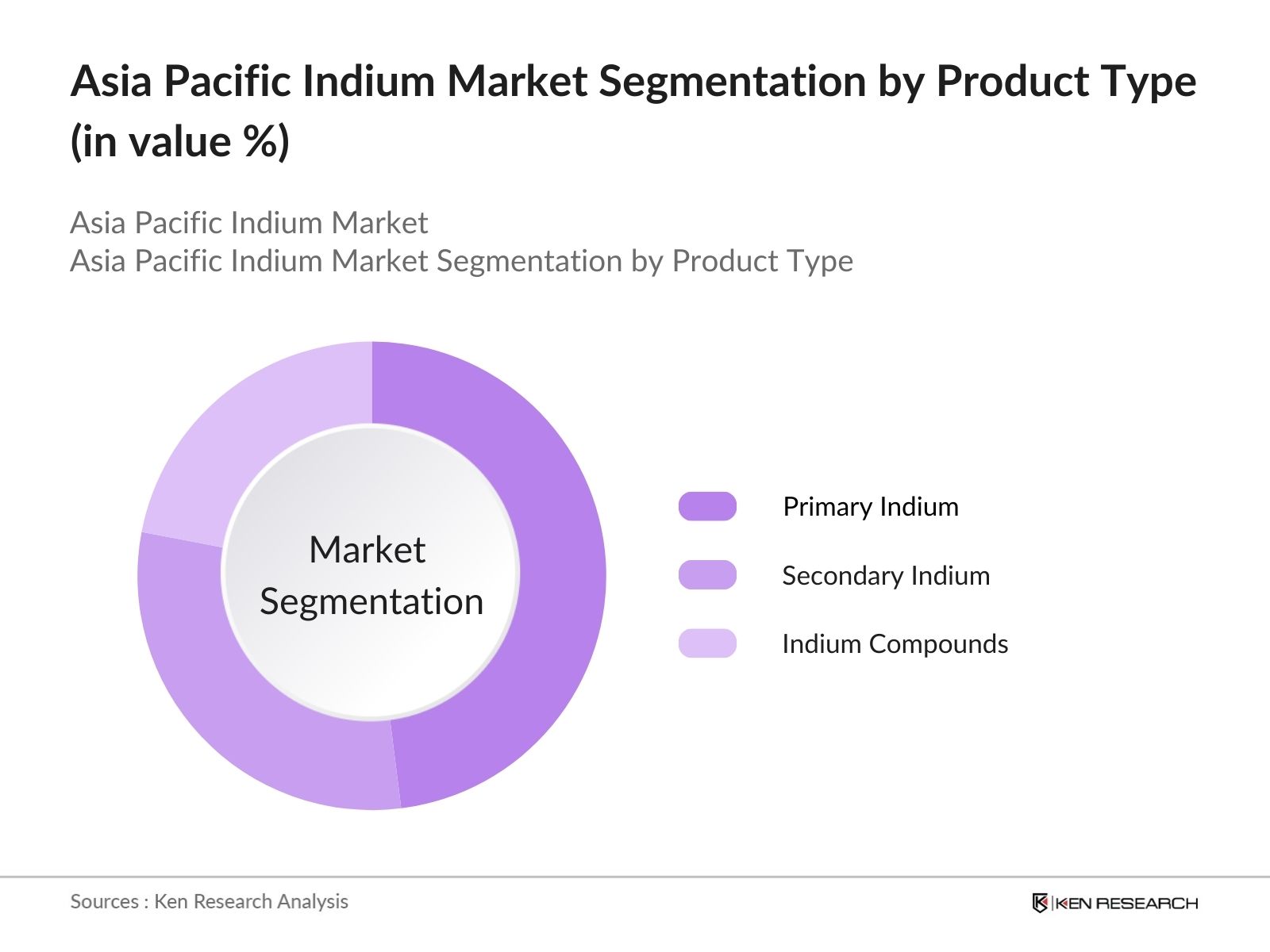
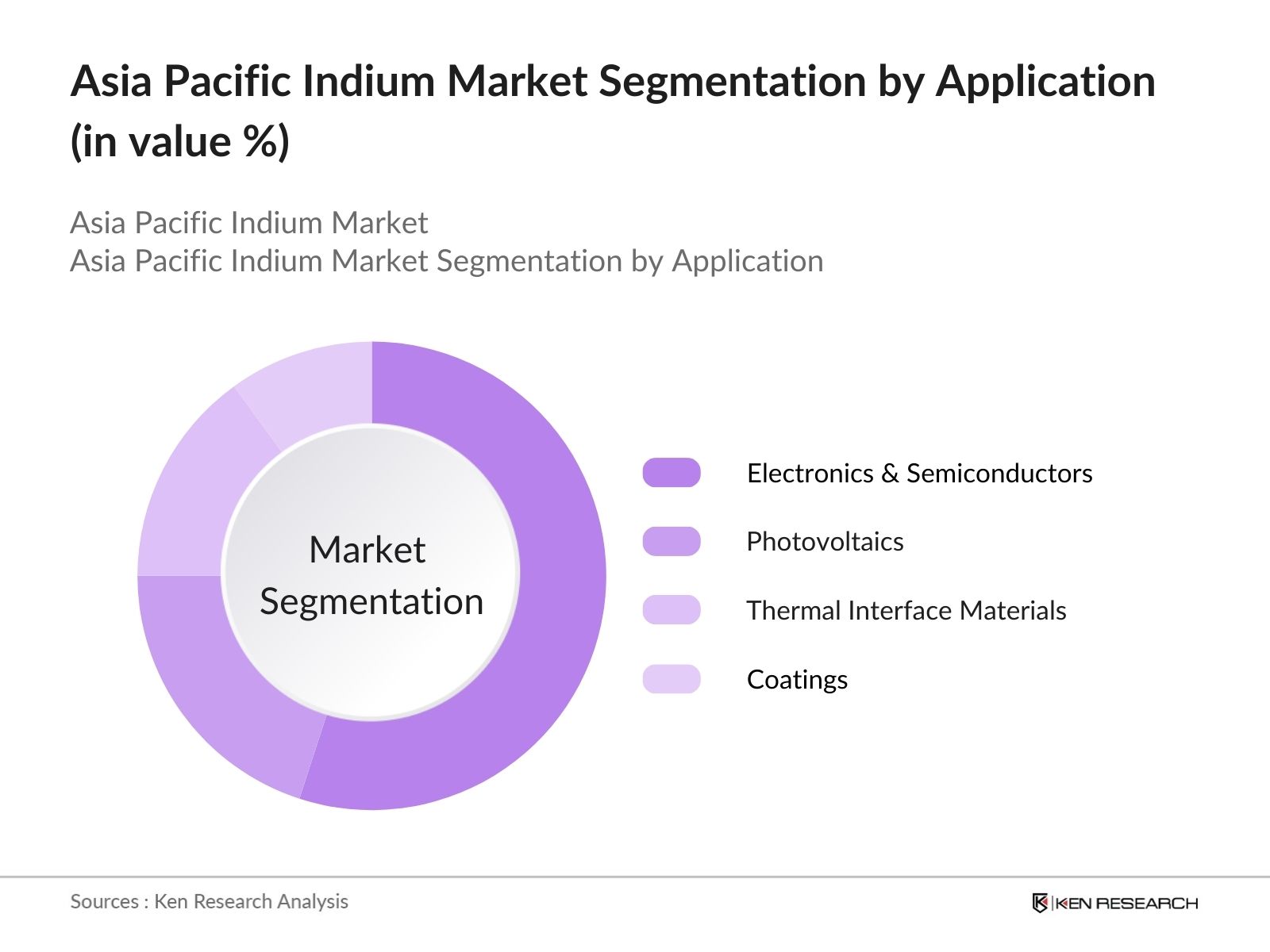
By Application: The market is segmented by application into electronics & semiconductors, photovoltaics, thermal interface materials, and coatings. Electronics & semiconductors hold the largest market share due to the widespread use of indium tin oxide in touchscreens and flat-panel displays. The increasing consumer demand for smartphones, tablets, and smart appliances in the Asia Pacific region fuels the growth of this segment, making it the largest consumer of indium.
Asia Pacific Indium Market Competitive Landscape
The Asia Pacific Indium market is characterized by the presence of several key players, who leverage their technological expertise and extensive production capabilities to maintain market leadership. The market is dominated by a few major companies like Umicore and Korea Zinc, which have integrated operations across the indium value chain. This consolidation enables these players to manage costs effectively and ensure a steady supply of indium to meet growing demand.
|
Company Name |
Establishment Year |
Headquarters |
Production Capacity (Tons/Year) |
R&D Expenditure (USD Mn) |
Key Clients |
Regional Presence |
Technological Innovations |
Sustainability Initiatives |
Key Markets Served |
|
Umicore |
1805 |
Belgium |
|||||||
|
Korea Zinc |
1974 |
South Korea |
|||||||
|
Indium Corporation |
1934 |
USA |
|||||||
|
Dowa Holdings Co., Ltd. |
1884 |
Japan |
|||||||
|
Teck Resources Limited |
1913 |
Canada |
Asia Pacific Indium Industry Analysis
Growth Drivers
- Expansion of Semiconductor Industry: The semiconductor industry in the Asia-Pacific region has seen significant growth, with a production value surpassing $800 billion in 2023, driven primarily by demand in China, Japan, and South Korea. Indium is a critical component in semiconductor manufacturing, particularly for applications in compound semiconductors like GaN and InP, used in power electronics and communication devices. In 2024, China remained the largest producer of semiconductors, with its exports contributing nearly $450 billion to the global semiconductor trade. The increased production and technological advancements in semiconductor manufacturing are directly driving indium consumption across the region.
- Demand from ITO Manufacturing: Indium Tin Oxide (ITO) is widely used in the production of display panels and touchscreens, with Asia-Pacific being a major manufacturing hub for consumer electronics. In 2023, Asia-Pacific accounted for over 70% of the global production of LCD panels, which are heavily reliant on ITO coatings for conductivity. The region's demand for indium in ITO manufacturing reached approximately 650 metric tons in 2023, driven by the continued expansion of the electronics industry in countries like South Korea and Japan. With the region's production capacity for OLED and LCD displays expanding, the need for indium remains strong in 2024.
- Rising Applications in Solar Cells and Photovoltaics: Indium is a crucial element in the production of Copper Indium Gallium Selenide (CIGS) solar cells, which offer higher efficiency in photovoltaic applications. Asia-Pacific's solar power capacity grew to over 450 GW in 2023, with China, India, and Japan being key markets. China alone added 100 GW of new solar capacity in 2023, driving demand for CIGS solar cells. As CIGS technology gains traction for its efficiency, the consumption of indium in photovoltaic applications has increased, especially in countries focusing on renewable energy integration.
Market Challenges
- Price Volatility of Raw Materials: Indium prices are highly volatile due to supply uncertainties and fluctuations in demand from electronics and solar industries. Between 2022 and 2024, the average price of indium fluctuated between $200 to $300 per kilogram, driven by varying demand and geopolitical factors affecting the supply chain. Supply constraints from key mining regions like China and geopolitical tensions have impacted prices, making it challenging for manufacturers to manage costs effectively. This volatility poses a significant risk for industries dependent on stable supply and pricing of indium for consistent production.
- Limited Availability and Supply Constraints: Indium is primarily a byproduct of zinc mining, and its availability is closely tied to the output of zinc mines. In 2023, global indium production was estimated at around 800 metric tons, with China accounting for over 50% of the total output. However, the limited number of indium-producing facilities in the Asia-Pacific region restricts the availability of this critical metal, leading to supply constraints. Additionally, production interruptions due to environmental regulations in China further exacerbate the supply issue, impacting downstream industries relying on indium.
Asia Pacific Indium Market Future Outlook
The Asia Pacific Indium market is expected to experience steady growth, driven by the continuous expansion of the electronics and semiconductor sectors. The rising adoption of advanced display technologies, along with the integration of indium in energy-efficient solutions like thin-film solar panels, positions the market for further development. Moreover, government initiatives promoting the adoption of renewable energy in countries like China, Japan, and India will provide additional growth avenues for indium, especially in the photovoltaic segment. The market's evolution will also benefit from ongoing research into recycling processes, which could help mitigate supply constraints and address environmental concerns.
Future Market Opportunities
- Increasing Demand for Electric Vehicles: The demand for electric vehicles (EVs) in the Asia-Pacific region has surged, with EV sales reaching 12 million units in 2023, led by China and South Korea. Indium is used in the production of thin-film solar cells that are integrated into certain EVs to extend battery life and efficiency. As automakers increasingly adopt solar integration in EVs, the consumption of indium is expected to grow in 2024. China's push for green transportation solutions and incentives for EV manufacturers have bolstered the demand for advanced materials like indium.
- Growing Adoption of Smart Devices: Smart device production in Asia-Pacific has expanded rapidly, with over 1.5 billion units manufactured in 2023, encompassing smartphones, tablets, and wearable devices. Indium is a key component in touchscreens and flexible displays used in these devices. The shift towards 5G technology and foldable smartphones has further driven the demand for indium in advanced display technologies. As countries like South Korea and Japan lead in 5G adoption, the integration of indium in display technologies is poised to grow, making this a critical opportunity for the indium market.
Scope of the Report
|
By Product Type |
Primary Indium Secondary Indium Indium Compounds |
|
By Application |
Electronics & Semiconductors Photovoltaics Thermal Interface Materials Coatings |
|
By Form |
Ingots Pellets Powders Wires |
|
By End-User Industry |
Consumer Electronics Automotive Aerospace Energy |
|
By Region |
China Japan South Korea India Southeast Asia |
Products
Key Target Audience
Indium Producers and Processors
Consumer Electronics Manufacturers
Photovoltaic and Solar Panel Manufacturers
Semiconductor and Display Manufacturers
Automotive Manufacturers (Electric Vehicle Batteries)
Investor and Venture Capitalist Firms
Government and Regulatory Bodies (Ministry of Industry and Information Technology, National Energy Administration)
Raw Material Suppliers and Distributors
Companies
Major Players
Umicore
Korea Zinc
Indium Corporation
Dowa Holdings Co., Ltd.
Teck Resources Limited
Nyrstar
Mitsubishi Materials Corporation
Zhuzhou Smelter Group Co., Ltd.
Young Poong Corporation
Asahi Holdings, Inc.
China Germanium Co. Ltd.
AXT, Inc.
East Hope Group
Avalon Advanced Materials
Santech Materials
Table of Contents
1. Asia Pacific Indium Market Overview
1.1. Definition and Scope
1.2. Market Taxonomy
1.3. Market Dynamics (Drivers, Restraints, Challenges, Opportunities)
1.4. Value Chain Analysis (Raw Material Suppliers, Manufacturers, Distributors, End Users)
1.5. Market Growth Rate
2. Asia Pacific Indium Market Size (In USD Mn)
2.1. Historical Market Size (Production Volume, Consumption Volume, Export-Import Value)
2.2. Year-On-Year Growth Analysis (Indium Consumption in Electronics, Optoelectronics, and Alloys)
2.3. Market Milestones and Key Developments (Investments, Partnerships, Technology Advancements)
3. Asia Pacific Indium Market Analysis
3.1. Growth Drivers
3.1.1. Expansion of Semiconductor Industry
3.1.2. Demand from ITO Manufacturing (Indium Tin Oxide)
3.1.3. Rising Applications in Solar Cells and Photovoltaics
3.2. Market Challenges
3.2.1. Price Volatility of Raw Materials
3.2.2. Limited Availability and Supply Constraints
3.2.3. Environmental Regulations on Mining Activities
3.3. Opportunities
3.3.1. Increasing Demand for Electric Vehicles
3.3.2. Growing Adoption of Smart Devices
3.3.3. Research in Recyclable Indium Technologies
3.4. Trends
3.4.1. Development of Indium-Free Transparent Conductive Oxides
3.4.2. Advancements in Thin-Film Photovoltaic Cells
3.4.3. Shift towards Circular Economy Practices
3.5. Government Regulations
3.5.1. Mining Policies in China, Japan, and South Korea
3.5.2. Environmental Standards and Emission Norms
3.5.3. Incentives for Renewable Energy Projects
3.6. SWOT Analysis
3.7. Porters Five Forces Analysis (Supplier Power, Buyer Power, Competitive Rivalry, Substitutes, New Entrants)
3.8. Stakeholder Ecosystem (Producers, Traders, End Users, Technology Providers)
4. Asia Pacific Indium Market Segmentation
4.1. By Product Type (In Value %)
4.1.1. Primary Indium
4.1.2. Secondary Indium
4.1.3. Indium Compounds
4.2. By Application (In Value %)
4.2.1. Electronics & Semiconductors
4.2.2. Photovoltaics
4.2.3. Thermal Interface Materials
4.2.4. Coatings
4.3. By Form (In Value %)
4.3.1. Ingots
4.3.2. Pellets
4.3.3. Powders
4.3.4. Wires
4.4. By End-User Industry (In Value %)
4.4.1. Consumer Electronics
4.4.2. Automotive
4.4.3. Aerospace
4.4.4. Energy
4.5. By Region (In Value %)
4.5.1. China
4.5.2. Japan
4.5.3. South Korea
4.5.4. India
4.5.5. Southeast Asia
5. Asia Pacific Indium Market Competitive Analysis
5.1. Detailed Profiles of Major Companies
5.1.1. Umicore
5.1.2. Indium Corporation
5.1.3. Teck Resources Limited
5.1.4. Nyrstar
5.1.5. Korea Zinc
5.1.6. Dowa Holdings Co., Ltd.
5.1.7. Asahi Holdings, Inc.
5.1.8. China Germanium Co. Ltd.
5.1.9. Mitsubishi Materials Corporation
5.1.10. AXT, Inc.
5.1.11. Zhuzhou Smelter Group Co., Ltd.
5.1.12. Young Poong Corporation
5.1.13. East Hope Group
5.1.14. Avalon Advanced Materials
5.1.15. Santech Materials
5.2. Cross Comparison Parameters (Market Share, Production Capacity, R&D Investments, Geographic Presence, Revenue Contribution from Indium, Partnerships, Technological Expertise, Sustainability Practices)
5.3. Market Share Analysis (Top 10 Companies)
5.4. Strategic Initiatives (Mergers & Acquisitions, Joint Ventures, Product Innovations)
5.5. Investment Analysis (Capex Trends, Facility Expansions)
5.6. Venture Capital Funding in Indium-based Startups
5.7. Private Equity Investments in Indium Market
6. Asia Pacific Indium Market Regulatory Framework
6.1. Compliance Requirements for Export-Import
6.2. Environmental Impact Assessments for Mining
6.3. Certification Processes for Purity Levels
7. Asia Pacific Indium Market Future Market Size (In USD Mn)
7.1. Key Factors Driving Future Market Growth (Increased Demand for Transparent Conductive Films, Energy Storage Applications)
8. Asia Pacific Indium Market Analysts' Recommendations
8.1. TAM/SAM/SOM Analysis (Total Addressable Market, Serviceable Available Market, Serviceable Obtainable Market)
8.2. Risk Assessment and Mitigation Strategies
8.3. Optimal Entry Strategies for Emerging Players
8.4. White Space Opportunity Analysis
Disclaimer Contact UsResearch Methodology
Step 1: Identification of Key Variables
The initial phase involves constructing an ecosystem map encompassing all major stakeholders within the Asia Pacific Indium Market. This step is underpinned by extensive desk research, utilizing a combination of secondary and proprietary databases to gather comprehensive industry-level information. The primary objective is to identify and define the critical variables that influence market dynamics.
Step 2: Market Analysis and Construction
In this phase, we compile and analyze historical data pertaining to the Asia Pacific Indium Market. This includes assessing market penetration, production-consumption balance, and the resultant revenue generation. Furthermore, an evaluation of production efficiency statistics will be conducted to ensure the reliability and accuracy of the revenue estimates.
Step 3: Hypothesis Validation and Expert Consultation
Market hypotheses are developed and subsequently validated through computer-assisted telephone interviews (CATIs) with industry experts representing a diverse array of companies. These consultations provide valuable operational and financial insights directly from industry practitioners, instrumental in refining and corroborating the market data.
Step 4: Research Synthesis and Final Output
The final phase involves direct engagement with multiple indium manufacturers to acquire detailed insights into product segments, sales performance, consumer preferences, and other pertinent factors. This interaction serves to verify and complement the statistics derived from the bottom-up approach, ensuring a comprehensive, accurate, and validated analysis of the Asia Pacific Indium Market.
Frequently Asked Questions
01. How big is the Asia Pacific Indium Market?
The Asia Pacific Indium Market is valued at USD 250 billion, driven by increasing demand from the electronics and photovoltaic sectors, particularly in China and Japan.
02. What are the challenges in the Asia Pacific Indium Market?
Challenges in the Asia Pacific Indium Market include price volatility due to supply constraints, environmental regulations on mining activities, and the limited availability of high-purity indium for advanced applications.
03. Who are the major players in the Asia Pacific Indium Market?
Key players in the Asia Pacific Indium Market include Umicore, Korea Zinc, Indium Corporation, Dowa Holdings Co., Ltd., and Teck Resources Limited, who dominate the market through advanced refining capabilities and strong regional presence.
04. What are the growth drivers of the Asia Pacific Indium Market?
The Asia Pacific Indium Market is propelled by rising demand from the semiconductor and solar energy industries, advancements in consumer electronics, and government policies supporting renewable energy projects.
05. Which applications dominate the Asia Pacific Indium Market?
The electronics and semiconductors segment hold the largest share in the Asia Pacific Indium Market, driven by the widespread use of indium tin oxide in touchscreens, flat-panel displays, and smart devices.
Why Buy From Us?

What makes us stand out is that our consultants follows Robust, Refine and Result (RRR) methodology. i.e. Robust for clear definitions, approaches and sanity checking, Refine for differentiating respondents facts and opinions and Result for presenting data with story

We have set a benchmark in the industry by offering our clients with syndicated and customized market research reports featuring coverage of entire market as well as meticulous research and analyst insights.

While we don't replace traditional research, we flip the method upside down. Our dual approach of Top Bottom & Bottom Top ensures quality deliverable by not just verifying company fundamentals but also looking at the sector and macroeconomic factors.

With one step in the future, our research team constantly tries to show you the bigger picture. We help with some of the tough questions you may encounter along the way: How is the industry positioned? Best marketing channel? KPI's of competitors? By aligning every element, we help maximize success.

Our report gives you instant access to the answers and sources that other companies might choose to hide. We elaborate each steps of research methodology we have used and showcase you the sample size to earn your trust.

If you need any support, we are here! We pride ourselves on universe strength, data quality, and quick, friendly, and professional service.