
Asia Pacific Power Generation Market Outlook to 2030
Region:Asia
Author(s):Shreya Garg
Product Code:KROD6569
December 2024
83
About the Report
Asia Pacific Power Generation Market Overview
- The Asia Pacific power generation market is valued at USD 830 billion, based on a five-year historical analysis, driven by robust energy demand across the region. Rapid industrialization and urbanization in countries like China and India have led to increased consumption of electricity, pushing energy infrastructure development. The region's push towards renewable energy, especially in nations committed to carbon neutrality, also plays a key role in expanding the market. The adoption of advanced power generation technologies such as combined-cycle gas turbines (CCGT) and smart grids further fuels growth.
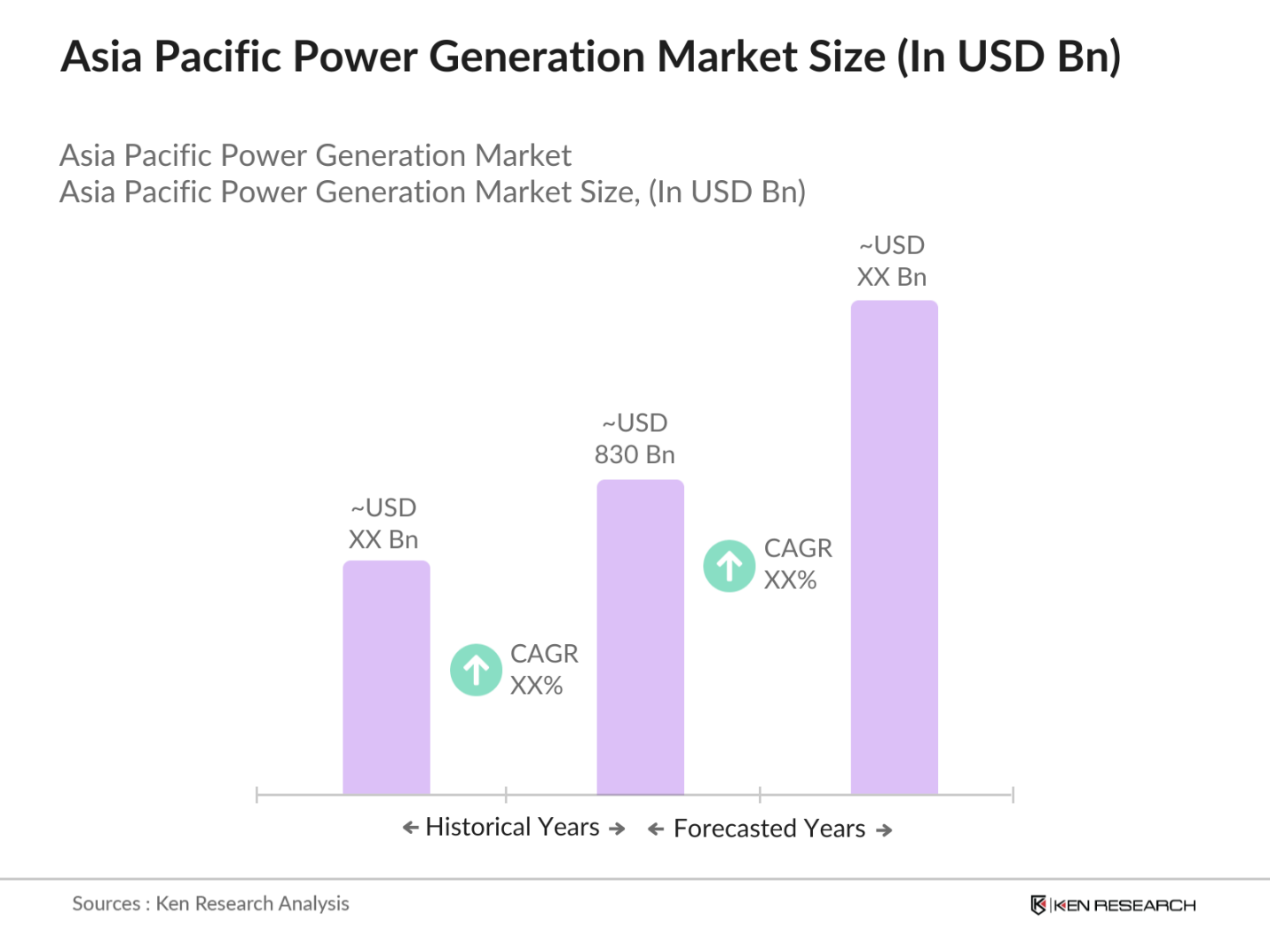
- China and India dominate the power generation market due to their large population bases and booming industrial sectors. In China, aggressive renewable energy targets and state investments in hydro, solar, and wind energy systems solidify its leadership in energy production. India, driven by both state and private investments in renewable energy and the modernization of its grid infrastructure, also holds a significant share. Additionally, Japan and Australia are key players, excelling in nuclear and solar energy generation, respectively, with a strong regulatory framework encouraging growth.
- Governments in the Asia Pacific region have introduced subsidies to promote renewable energy generation. In 2023, India extended its feed-in tariffs for solar power, offering developers long-term contracts to sell electricity at fixed rates. Similarly, Japan continues to provide tax credits for renewable energy projects, offering financial incentives for both domestic and foreign investors. These subsidies reduce the financial burden of renewable energy projects, encouraging widespread adoption and the growth of the sector across the region.
Asia Pacific Power Generation Market Segmentation
By Energy Source: The market is segmented by energy source into renewables, fossil fuels, and nuclear power. Recently, renewable energy has emerged as a dominant force, driven by global and national carbon reduction commitments. Countries like China and India have led large-scale investments in wind and solar farms, spurred by government incentives and falling costs of renewable technology. The renewable segment, which includes wind, solar, biomass, and hydro, holds a strong market position due to growing sustainability awareness and international support for green energy projects. 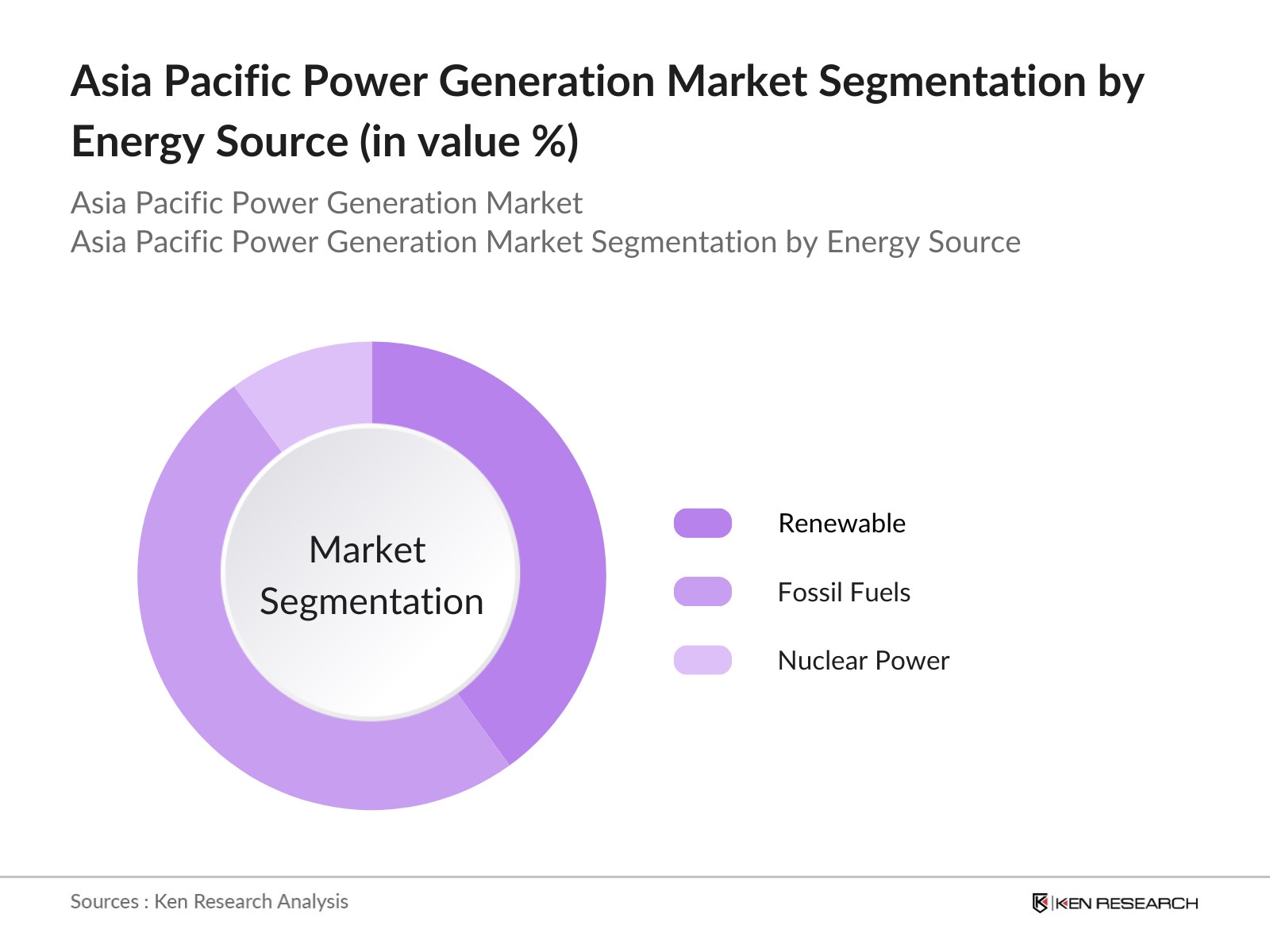
By Technology: The market is also segmented by technology into combined-cycle gas turbines (CCGT), supercritical and ultra-supercritical technologies, hydroelectric, wind turbines, and solar photovoltaics (PV). Combined-cycle gas turbines (CCGT) maintain a dominant market share, primarily due to their efficiency in utilizing natural gas and their ability to quickly ramp up generation in response to demand fluctuations. Countries like Japan, Australia, and South Korea rely on CCGT as a transitional technology while scaling up their renewable energy infrastructure. 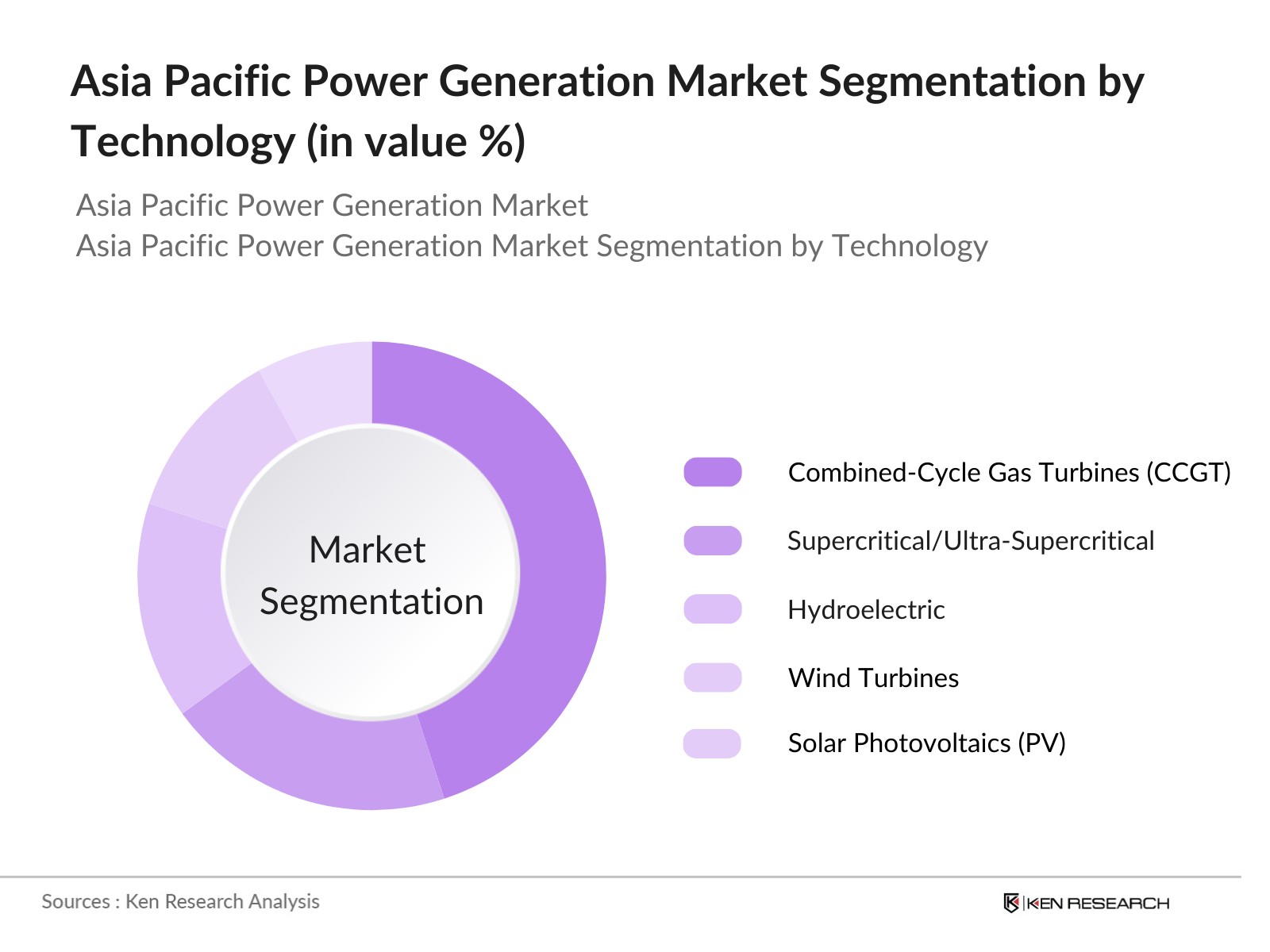
Asia Pacific Power Generation Market Competitive Landscape
The Asia Pacific power generation market is dominated by a few global and regional players with diverse portfolios, spanning across different technologies and energy sources. Major companies include leaders in fossil fuel generation, as well as renewables and nuclear energy. The consolidation of power generation assets by these key players underscores the influence they exert across the region. These companies leverage cutting-edge technology, government partnerships, and extensive distribution networks to maintain their competitive edge.
|
Company |
Establishment Year |
Headquarters |
Installed Capacity (GW) |
Key Markets |
Revenue (USD Bn) |
Number of Employees |
Energy Source Focus |
Geographic Footprint |
R&D Expenditure (USD Mn) |
|
Siemens AG |
1847 |
Germany |
|||||||
|
Mitsubishi Hitachi Power Systems |
2014 |
Japan |
|||||||
|
General Electric Company |
1892 |
United States |
|||||||
|
Tata Power |
1919 |
India |
|||||||
|
Vestas Wind Systems A/S |
1945 |
Denmark |
Asia Pacific Power Generation Industry Analysis
Growth Drivers
- Increasing Energy Demand: The Asia Pacific region has seen significant growth in energy demand, driven by rapid industrialization and increasing urbanization. Countries like China and India are leading this surge, contributing to a large portion of the region's GDP growth. In 2022, China's GDP reached $17.9 trillion, while India's GDP hit $3.4 trillion, both economies experiencing strong energy demands in alignment with their industrial sectors. According to the International Energy Agency (IEA), industrial energy use in Asia Pacific accounted for over 50% of total energy consumption, reflecting the region's strong industrial base and economic growth.
- Transition to Renewable Energy: The Asia Pacific region is progressively shifting from fossil fuels to renewable energy sources, driven by ambitious carbon reduction policies. For instance, China, the world's largest emitter, committed to carbon neutrality by 2060, implementing measures to reduce coal dependency and increase renewable capacity. In 2023, China added 125 gigawatts (GW) of solar and wind power capacity. Similarly, India's National Action Plan on Climate Change (NAPCC) aims to achieve 175 GW of renewable energy capacity by 2022, which has been achieved and surpassed. This transition is supported by numerous policies to reduce carbon footprints across the region.
- Technological Advancements: Technological advancements in grid integration and smart grids are transforming the power generation landscape in Asia Pacific. In 2023, Japan and South Korea made significant investments in smart grid technologies to improve energy efficiency. Japan invested over $10 billion in modernizing its electricity grid. Additionally, South Koreas $2.6 billion smart grid initiative aims to fully integrate renewables into its grid infrastructure by 2030. These advancements in technology enable better energy distribution and reduce losses, contributing to enhanced grid stability and improved integration of renewable energy sources.
Market Challenges
- High Capital Investment: High capital investment is a significant barrier to the expansion of power generation capacity, especially in renewable energy. For instance, building a large-scale solar power plant in the Asia Pacific region can cost between $500,000 and $700,000 per megawatt, depending on the location. Furthermore, developing advanced infrastructure, such as smart grids and energy storage systems, requires substantial upfront costs. The adoption of such technology is often hindered by financial constraints, particularly in developing economies like Indonesia and the Philippines, where GDP per capita remains relatively lower compared to developed countries in the region.
- Intermittent Supply from Renewables: The intermittency of renewable energy sources, such as solar and wind, poses significant challenges to grid stability in the Asia Pacific region. For instance, in 2022, Japan faced grid balancing issues due to a surge in renewable energy supply during peak sunlight hours, leading to over-generation. In India, the lack of adequate energy storage solutions has led to energy shortages despite having high solar generation capacity. Countries like South Korea are investing in advanced battery storage systems, with a plan to add 500 megawatts of storage capacity by 2025 to mitigate these challenges.
Asia Pacific Power Generation Market Future Outlook
Over the next five years, the Asia Pacific power generation market is poised for continued expansion, driven by the regions energy transition towards sustainability and the electrification of sectors such as transportation and industry. Countries are progressively adopting more stringent carbon reduction targets, fueling investments in renewable energy infrastructure. Technological advancements in energy storage, smart grids, and distributed generation will play a pivotal role in reshaping the market. Additionally, the availability of international financing, alongside regional partnerships, will support these developments, further solidifying the regions position as a global leader in power generation.
Future Market Opportunities
- Foreign Direct Investment: Foreign direct investment (FDI) in the Asia Pacific renewable energy sector has seen a substantial increase. In 2022, China received $10 billion in FDI for renewable energy projects, while India secured $8 billion, primarily in solar and wind energy projects. These investments are driven by government incentives, such as tax breaks and feed-in tariffs. Additionally, international energy collaborations, including partnerships between Chinese and European energy firms, have contributed to technology transfer and infrastructure development across the region, boosting the renewable energy capacity.
- Advancements in Battery Storage Solutions: The development of advanced battery storage solutions presents a critical opportunity for the Asia Pacific power generation market. Countries like Australia and South Korea have been investing heavily in enhancing the capacity and efficiency of energy storage systems. In 2023, South Korea unveiled its largest battery energy storage system (BESS), with a capacity of 500 megawatt-hours (MWh). These advancements in storage technology are expected to play a crucial role in mitigating the intermittency of renewable energy, ensuring a more stable and reliable power supply across the region.
Scope of the Report
|
Energy Source |
Renewable (Wind, Solar, Biomass, Hydro) Fossil Fuels (Coal, Gas, Oil) Nuclear Power |
|
Technology |
Combined Cycle Gas Turbines (CCGT) Supercritical and Ultra-Supercritical Technology Hydroelectric and Pumped Storage Wind Turbine Systems Solar Photovoltaics (PV) |
|
Application |
Commercial Power Generation (Utilities, IPPs) Industrial Power (On-site Generation, Cogeneration) Residential Off-Grid Solutions (Solar Home Systems, Battery Storage) |
|
Power Output |
Utility-Scale Generation Distributed Generation |
|
Region |
China India Japan Australia ASEAN |
Products
Key Target Audience
Government and Regulatory Bodies (Ministries of Energy, National Electricity Commissions)
Independent Power Producers (IPPs)
Renewable Energy Investors
Grid Infrastructure Developers
Technology Providers (Smart Grid Solutions, Power Management Systems)
Utility Companies
Private Equity and Venture Capital Firms
Energy Consultants and Engineers
Companies
Major Players
Siemens AG
General Electric Company
Mitsubishi Hitachi Power Systems
Tata Power
Vestas Wind Systems A/S
China Energy Engineering Group
State Grid Corporation of China
NTPC Limited
Adani Green Energy Limited
Shanghai Electric Group Co., Ltd.
KEPCO (Korea Electric Power Corporation)
EDF Energy
Reliance Power
ABB Ltd.
Toshiba Energy Systems & Solutions Corporation
Table of Contents
1. Asia Pacific Power Generation Market Overview
1.1 Definition and Scope
1.2 Market Taxonomy
1.3 Market Growth Rate (Market-specific metrics: Installed Capacity, Energy Output, Efficiency Rates)
1.4 Market Segmentation Overview (Specific to power generation, including traditional and renewable sources)
2. Asia Pacific Power Generation Market Size (In USD Mn)
2.1 Historical Market Size
2.2 Year-On-Year Growth Analysis
2.3 Key Market Developments and Milestones
3. Asia Pacific Power Generation Market Analysis
3.1 Growth Drivers
3.1.1 Increasing Energy Demand (GDP Growth, Industrialization)
3.1.2 Transition to Renewable Energy (Energy Mix Transition, Carbon Reduction Policies)
3.1.3 Government Regulations (Power Purchase Agreements, Renewable Energy Targets)
3.1.4 Technological Advancements (Grid Integration, Smart Grids)
3.2 Market Challenges
3.2.1 High Capital Investment (Infrastructure Costs, Technology Adoption Barriers)
3.2.2 Regulatory Complexity (Licensing, Environmental Approvals)
3.2.3 Intermittent Supply from Renewables (Grid Stability, Energy Storage Issues)
3.3 Opportunities
3.3.1 Expansion of Distributed Generation (Decentralized Power, Microgrids)
3.3.2 Foreign Direct Investment (FDI in Renewable Projects, International Energy Collaborations)
3.3.3 Advancements in Battery Storage Solutions (Capacity, Efficiency)
3.4 Trends
3.4.1 Shift Towards Decarbonization (Emissions Trading, Carbon Capture)
3.4.2 Rise in Private Participation (IPP Expansion, Foreign Investment in Power Sector)
3.4.3 Integration of Digital Technologies (AI in Grid Management, Predictive Maintenance)
3.5 Government Regulation
3.5.1 National Energy Policy (Renewable Portfolio Standards, Electricity Market Reforms)
3.5.2 Renewable Energy Subsidies (Tax Credits, Feed-In Tariffs)
3.5.3 Grid Modernization Initiatives (Smart Grid Programs, Infrastructure Upgrades)
3.5.4 Bilateral Trade Agreements for Energy Exchange
3.6 SWOT Analysis
3.7 Stake Ecosystem
3.8 Porters Five Forces
3.9 Competition Ecosystem (Market-specific: Independent Power Producers, Transmission Operators)
4. Asia Pacific Power Generation Market Segmentation
4.1 By Energy Source (In Value %)
4.1.1 Renewable (Wind, Solar, Biomass, Hydro)
4.1.2 Fossil Fuels (Coal, Gas, Oil)
4.1.3 Nuclear Power
4.2 By Technology (In Value %)
4.2.1 Combined Cycle Gas Turbines (CCGT)
4.2.2 Supercritical and Ultra-Supercritical Technology
4.2.3 Hydroelectric and Pumped Storage
4.2.4 Wind Turbine Systems
4.2.5 Solar Photovoltaics (PV)
4.3 By Application (In Value %)
4.3.1 Commercial Power Generation (Utilities, IPPs)
4.3.2 Industrial Power (On-site Generation, Cogeneration)
4.3.3 Residential Off-Grid Solutions (Solar Home Systems, Battery Storage)
4.4 By Power Output (In Value %)
4.4.1 Utility-Scale Generation
4.4.2 Distributed Generation
4.5 By Region (In Value %)
4.5.1 China
4.5.2 India
4.5.3 Japan
4.5.4 Australia
4.5.5 ASEAN (Indonesia, Vietnam, Philippines, etc.)
5. Asia Pacific Power Generation Market Competitive Analysis
5.1 Detailed Profiles of Major Companies
5.1.1 Siemens AG
5.1.2 General Electric Company
5.1.3 Mitsubishi Hitachi Power Systems, Ltd.
5.1.4 ABB Ltd.
5.1.5 Shanghai Electric Group Co., Ltd.
5.1.6 Tata Power
5.1.7 China Energy Engineering Group
5.1.8 Vestas Wind Systems A/S
5.1.9 Toshiba Energy Systems & Solutions Corporation
5.1.10 Adani Green Energy Limited
5.1.11 State Grid Corporation of China
5.1.12 NTPC Limited
5.1.13 EDF Energy
5.1.14 Reliance Power
5.1.15 KEPCO (Korea Electric Power Corporation)
5.2 Cross Comparison Parameters (No. of Employees, Installed Capacity, Power Output, Inception Year, Revenue, R&D Expenditure, Geographical Presence, Technology Adoption)
5.3 Market Share Analysis
5.4 Strategic Initiatives
5.5 Mergers and Acquisitions
5.6 Investment Analysis
5.7 Venture Capital Funding
5.8 Government Grants
5.9 Private Equity Investments
6. Asia Pacific Power Generation Market Regulatory Framework
6.1 Energy Efficiency Standards
6.2 Compliance Requirements (Grid Code Compliance, Environmental Approvals)
6.3 Certification Processes (Renewable Energy Certificates, Power Purchase Agreements)
7. Asia Pacific Power Generation Future Market Size (In USD Mn)
7.1 Future Market Size Projections
7.2 Key Factors Driving Future Market Growth
8. Asia Pacific Power Generation Future Market Segmentation
8.1 By Energy Source (In Value %)
8.2 By Technology (In Value %)
8.3 By Application (In Value %)
8.4 By Power Output (In Value %)
8.5 By Region (In Value %)
9. Asia Pacific Power Generation Market Analysts Recommendations
9.1 TAM/SAM/SOM Analysis
9.2 Customer Cohort Analysis
9.3 Marketing Initiatives
9.4 White Space Opportunity Analysis
Research Methodology
Step 1: Identification of Key Variables
The initial step involves building a comprehensive stakeholder map of the Asia Pacific Power Generation Market. This map covers utilities, regulators, technology providers, and investors. Extensive secondary research from industry databases is conducted to identify key variables such as energy demand growth, government policy shifts, and technology adoption rates.
Step 2: Market Analysis and Construction
Next, we analyze historical data to understand the current state of the power generation market. The data includes installed capacity, generation efficiency, and market penetration rates across various energy technologies. This stage focuses on quantifying the energy mix and assessing regional disparities in energy consumption and generation capacity.
Step 3: Hypothesis Validation and Expert Consultation
Industry hypotheses are formulated based on the initial findings and are validated through consultations with industry experts. Interviews are conducted with key players in the market, including power plant operators, energy policymakers, and technology providers, to refine market projections and insights.
Step 4: Research Synthesis and Final Output
In the final phase, detailed information is gathered from both primary and secondary sources to generate an in-depth market report. This includes final validations of installed capacity, energy output statistics, and market trends, with the input from regional experts providing context-specific insights.
Frequently Asked Questions
01 How big is the Asia Pacific Power Generation Market?
The Asia Pacific Power Generation Market is valued at USD 830 billion, driven by rising energy demand and increased investments in renewable energy projects.
02 What are the challenges in the Asia Pacific Power Generation Market?
The Asia Pacific Power Generation Market faces challenges such as high capital expenditure for infrastructure, regulatory complexities, and the intermittency of renewable energy sources.
03 Who are the major players in the Asia Pacific Power Generation Market?
Major players in the Asia Pacific Power Generation Market include Siemens AG, Mitsubishi Hitachi Power Systems, Tata Power, Vestas Wind Systems, and General Electric.
04 What are the growth drivers of the Asia Pacific Power Generation Market?
The Asia Pacific Power Generation Market is propelled by rapid industrialization, the transition to renewable energy, and advancements in energy generation technologies such as smart grids and energy storage solutions.
05 What are the dominant energy sources in the Asia Pacific Power Generation Market?
Fossil fuels remain dominant in the Asia Pacific Power Generation Market, but there is significant growth in renewables like solar and wind, driven by government incentives and technological improvements.
Why Buy From Us?

What makes us stand out is that our consultants follows Robust, Refine and Result (RRR) methodology. i.e. Robust for clear definitions, approaches and sanity checking, Refine for differentiating respondents facts and opinions and Result for presenting data with story

We have set a benchmark in the industry by offering our clients with syndicated and customized market research reports featuring coverage of entire market as well as meticulous research and analyst insights.

While we don't replace traditional research, we flip the method upside down. Our dual approach of Top Bottom & Bottom Top ensures quality deliverable by not just verifying company fundamentals but also looking at the sector and macroeconomic factors.

With one step in the future, our research team constantly tries to show you the bigger picture. We help with some of the tough questions you may encounter along the way: How is the industry positioned? Best marketing channel? KPI's of competitors? By aligning every element, we help maximize success.

Our report gives you instant access to the answers and sources that other companies might choose to hide. We elaborate each steps of research methodology we have used and showcase you the sample size to earn your trust.

If you need any support, we are here! We pride ourselves on universe strength, data quality, and quick, friendly, and professional service.