
Asia Pacific Racing Simulator Market Outlook to 2030
Region:Asia
Author(s):Yogita Sahu
Product Code:KROD8772
November 2024
89
About the Report
Asia Pacific Racing Simulator Market Overview
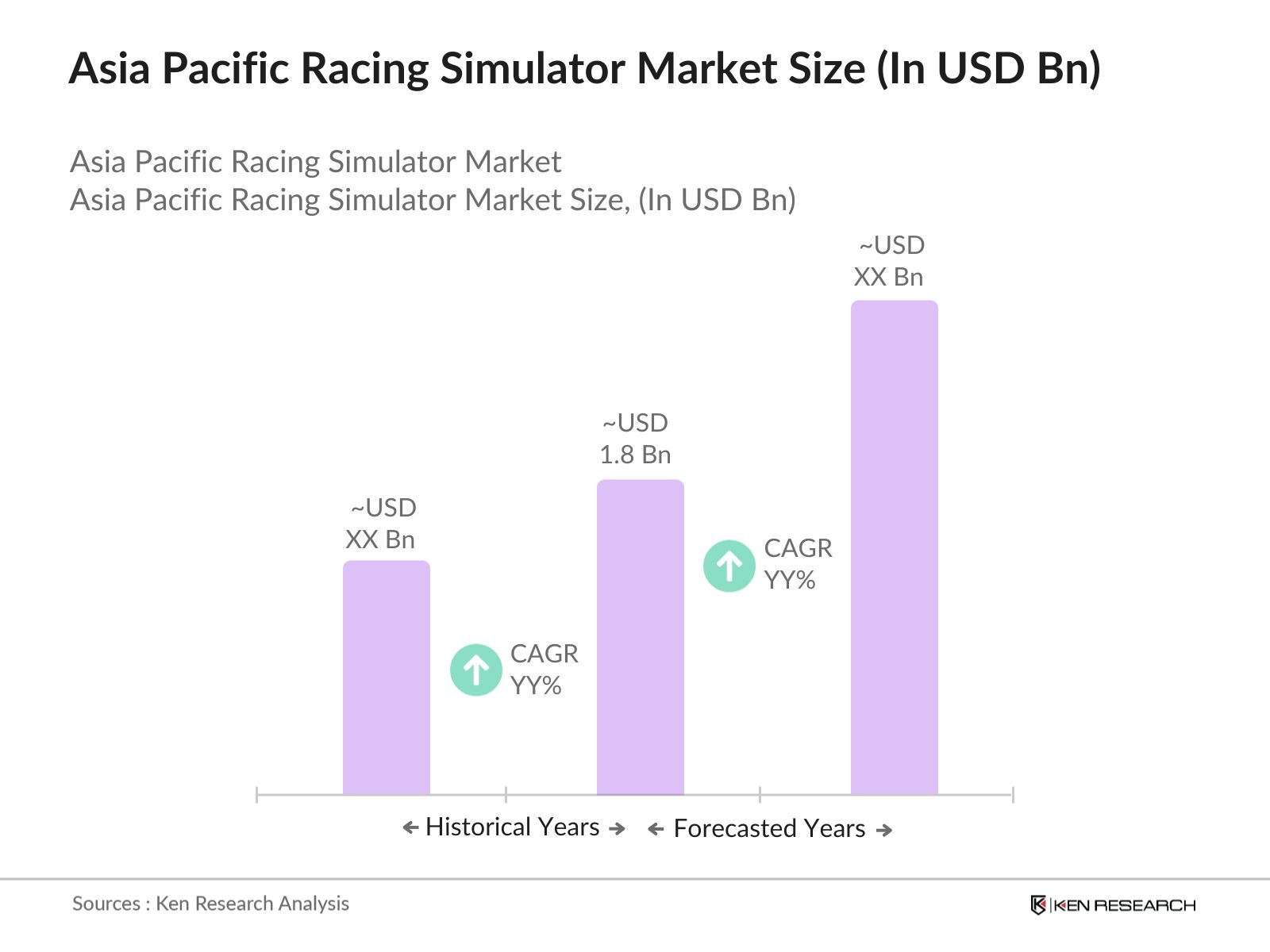
- The Asia Pacific Racing Simulator Market is valued at USD 1.8 billion, with growth primarily driven by the surge in esports popularity and advancements in VR and AR technologies. The market's five-year historical growth trajectory highlights an increasing consumer base, as demand escalates for immersive gaming and professional-grade simulation experiences in home setups and commercial arenas alike.
- Major urban centers such as Tokyo, Seoul, and Sydney lead the market due to their high penetration of advanced gaming technology, strong gaming culture, and affluent customer base. These cities also serve as hubs for esports events and racing leagues, driving demand for professional-grade simulators. Additionally, support from local governments for technological innovation and increased consumer spending on entertainment contribute to these regions market dominance.
- Countries like China and Japan have introduced tax incentives for manufacturers of gaming and simulation equipment in 2024, with China providing up to 15,000 units in tax deductions per unit produced domestically. These incentives aim to support local production and reduce reliance on imports, fostering the growth of the racing simulator market.
Asia Pacific Racing Simulator Market Segmentation
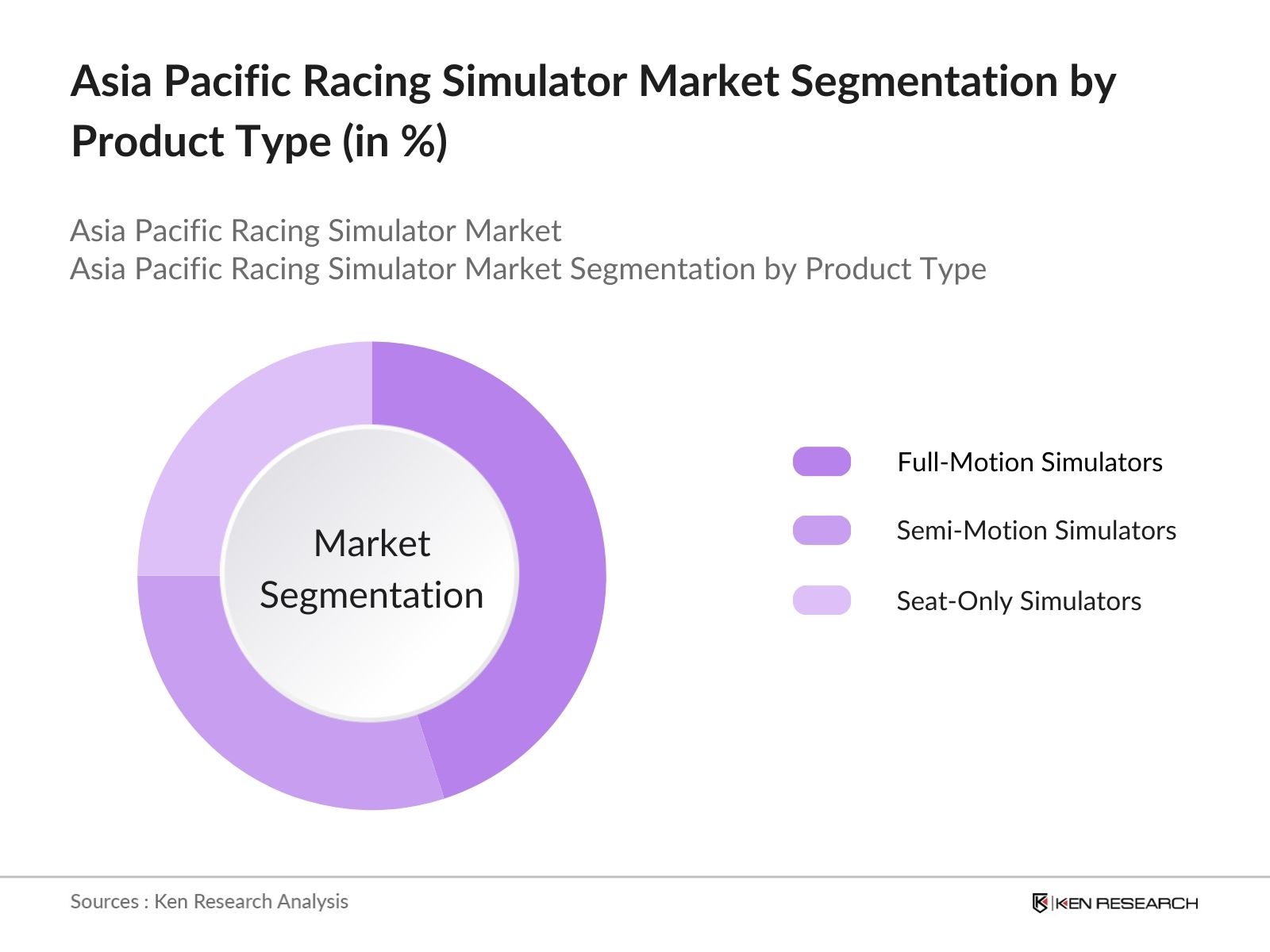
By Product Type: The market is segmented by product type into full-motion simulators, semi-motion simulators, and seat-only racing simulators. Full-motion simulators dominate due to their realistic driving experience, attracting both esports players and professional racers. Companies prioritize developing full-motion simulators with high customization, immersive feedback, and real-time analytics, making this segment the most appealing for serious racing enthusiasts.
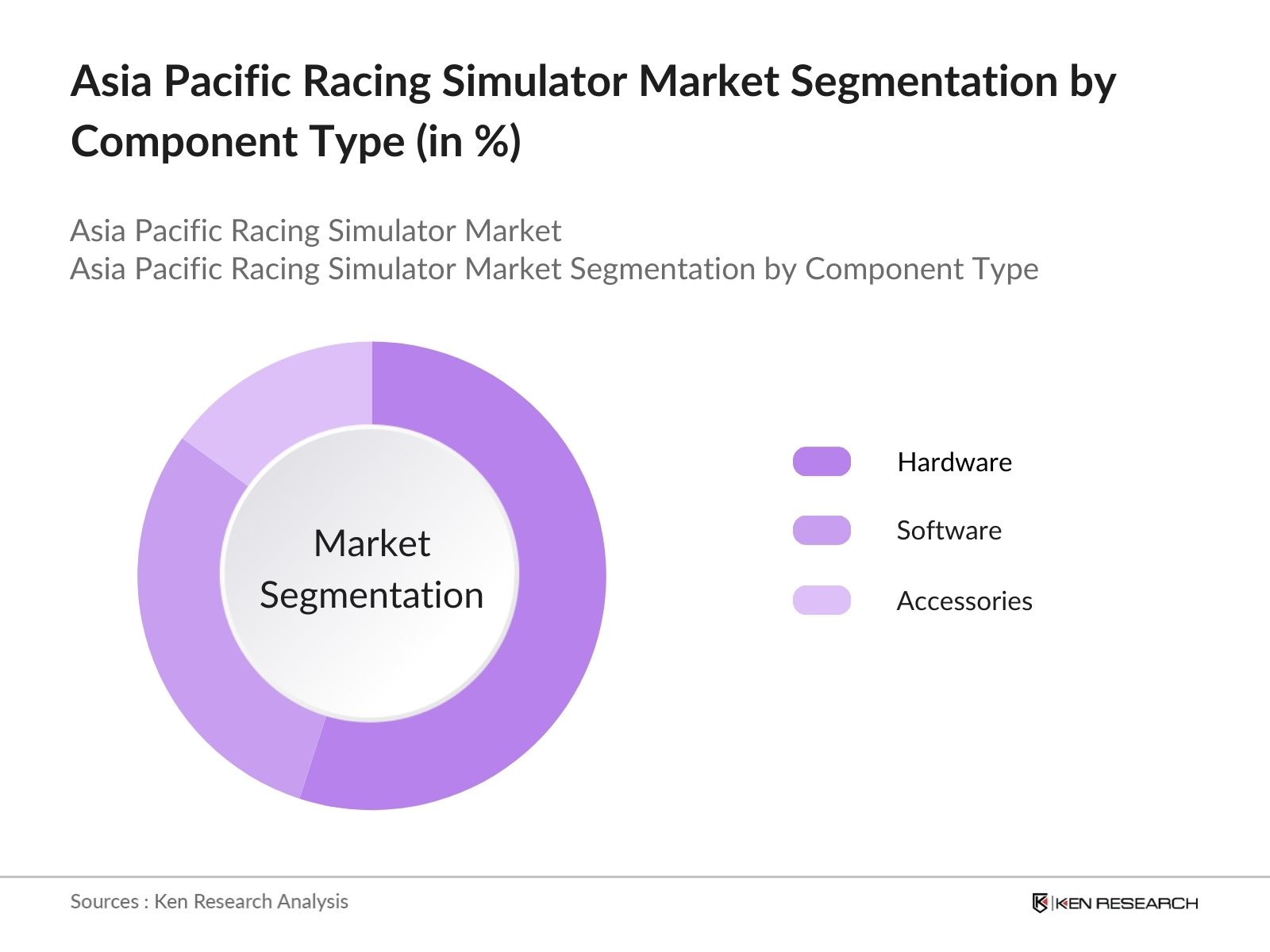
By Component Type: The component-based segmentation includes hardware (pedals, wheels, motion platforms), software (VR, AR, game engines), and accessories (seats, monitors). Hardware holds the dominant share due to its crucial role in delivering tactile feedback, enhancing the realism of racing simulators. Consumers and esports facilities invest significantly in high-quality pedals, steering wheels, and motion platforms, resulting in increased demand for advanced hardware solutions.
Asia Pacific Racing Simulator Market Competitive Landscape
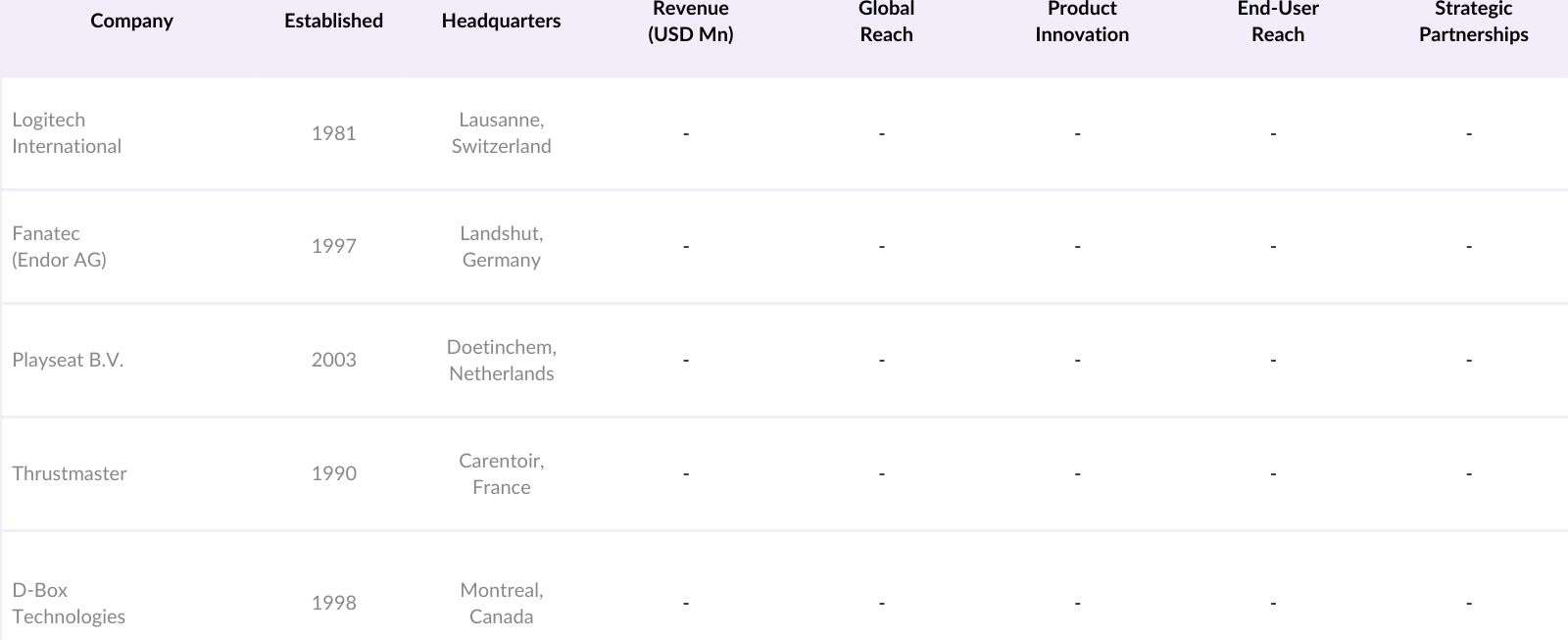
The market is led by both regional and global players, capitalizing on technological advancements and product development to gain competitive advantages.
Asia Pacific Racing Simulator Market Analysis
Market Growth Drivers
- Rising Demand for E-Sports and Virtual Competitions: The market is driven by a rising interest in e-sports and virtual competitions. The region saw nearly 32 million people actively participating in e-sports competitions in 2024, with virtual racing accounting for around 18 million. This surge, predominantly in Japan, South Korea, and China, is due to the high penetration of gaming communities and government-endorsed e-sports events, providing a robust platform for racing simulators to thrive.
- Investment Surge in Simulation Technology and Equipment: In 2024, investments in simulation technology in the Asia Pacific reached an estimated 2.6 billion units of local currency, with the racing simulator segment attracting over 700 million units. Countries like China, Singapore, and South Korea have incentivized tech firms to innovate in simulator technology, boosting high-fidelity simulation tools that closely replicate real-world racing, which has enhanced user experience and demand.
- Expanding Motorsport Fan Base with Youth Engagement: The Asia Pacific is home to a youthful demographic with a growing passion for motorsports. By 2024, around 45 million young individuals (ages 18-25) across the region expressed interest in motorsports, notably in India, China, and Japan. This fan base actively supports virtual racing and gaming, thus driving the demand for sophisticated racing simulators that offer immersive experiences, similar to real-life motorsport competitions.
Market Challenges
- High Costs of Advanced Racing Simulators: Racing simulators with high-end specifications cost over 20,000 units in local currency for professional setups, which remains prohibitively expensive for most consumers and hobbyists in emerging markets like Indonesia and the Philippines. This high initial cost is a barrier for wider adoption and has restricted growth in the consumer segment, impacting overall market penetration.
- Regulatory Compliance and Safety Standards: In countries such as Japan and South Korea, regulatory bodies have implemented strict safety standards on gaming equipment that simulate real-world scenarios. In 2024, there were over 150 reported delays in importing racing simulator parts due to stringent compliance checks, which complicates the production timelines and adds to operational costs for companies within the region.
Asia Pacific Racing Simulator Market Future Outlook
The Asia Pacific Racing Simulator industry is set for notable growth, driven by rising consumer interest in immersive gaming, esports popularity, and technological advancements in VR and AI-driven analytics.
Future Market Opportunities
- Integration of Haptic Feedback for Realistic User Experience: In the coming years, companies are projected to invest an estimated 3 billion units in haptic feedback technology for simulators, providing an enhanced level of realism. By 2029, around 20,000 simulators equipped with advanced haptic feedback are expected to be deployed in e-sports centers across the region, meeting the demand for immersive and lifelike experiences.
- Collaborations Between E-Sports Platforms and Automakers for Real-world Racing Replication: By 2029, partnerships between e-sports platforms and automotive manufacturers in Asia Pacific are projected to yield over 10,000 simulators that closely replicate actual race car dynamics. These collaborations are set to establish a new standard in realism, positioning the Asia Pacific racing simulator market at the forefront of innovation in simulation technology.
Scope of the Report
|
Product Type |
Full-Motion Simulators Semi-Motion Simulators Seat-Only Racing Simulators |
|
Component Type |
Hardware (Pedals, Wheels, Motion Platforms) Software (VR, AR, Game Engines) Accessories (Seats, Monitors) |
|
End-User |
Professional Training Centers Esports Arenas Home Entertainment |
|
Distribution Channel |
Online Offline (Retail, Specialty Stores) |
|
Region |
East Asia South Asia Southeast Asia Oceania |
Products
Key Target Audience Organizations and Entities Who Can Benefit by Subscribing This Report:
Investor and Venture Capitalist Firms
Gaming Equipment Manufacturers
Banks and Financial Institution
Private Equity Firms
Government and Regulatory Bodies (Ministry of Technology, Esports Federation)
Consumer Electronics Manufacturers
Companies
Logitech International S.A.
Fanatec (Endor AG)
Playseat B.V.
SimXperience
CXC Simulations
Next Level Racing
D-Box Technologies Inc.
Thrustmaster
Actuator Solutions GmbH
Sparco S.p.A.
Table of Contents
1. Asia Pacific Racing Simulator Market Overview
1.1 Definition and Scope
1.2 Market Taxonomy
1.3 Market Growth Rate
1.4 Market Segmentation Overview
2. Asia Pacific Racing Simulator Market Size (In USD Bn)
2.1 Historical Market Size
2.2 Year-On-Year Growth Analysis
2.3 Key Market Developments and Milestones
3. Asia Pacific Racing Simulator Market Analysis
3.1 Growth Drivers
3.1.1 Increasing Esports Popularity
3.1.2 Advancements in VR and AR Technologies
3.1.3 Rising Adoption of High-Performance Gaming Equipment
3.1.4 Shift Toward Professional Racing Simulations
3.2 Market Challenges
3.2.1 High Initial Investment in Simulator Setups
3.2.2 Limited Physical Experience vs. Traditional Racing
3.2.3 Regulatory Concerns in Online Gaming
3.3 Opportunities
3.3.1 Expansion of Racing Leagues in Virtual Platforms
3.3.2 Collaborations with Automobile Brands
3.3.3 Increasing Penetration of Simulation Training in Driving Schools
3.4 Trends
3.4.1 Growth in Multiplayer and Online Competitions
3.4.2 Realistic Simulator Hardware Integration
3.4.3 AI-driven Race Analysis Tools
3.5 Government Regulation
3.5.1 Licensing Standards for VR Games
3.5.2 Health and Safety Regulations in Esports
3.5.3 Data Privacy Compliance in Online Gaming
3.6 SWOT Analysis
3.7 Stakeholder Ecosystem
3.8 Porters Five Forces
3.9 Competitive Ecosystem
4. Asia Pacific Racing Simulator Market Segmentation
4.1 By Product Type (In Value %)
4.1.1 Full-Motion Simulators
4.1.2 Semi-Motion Simulators
4.1.3 Seat-Only Racing Simulators
4.2 By Component Type (In Value %)
4.2.1 Hardware (Pedals, Wheels, Motion Platforms)
4.2.2 Software (VR, AR, Game Engines)
4.2.3 Accessories (Seats, Monitors)
4.3 By End-User (In Value %)
4.3.1 Professional Training Centers
4.3.2 Esports Arenas
4.3.3 Home Entertainment
4.4 By Distribution Channel (In Value %)
4.4.1 Online
4.4.2 Offline (Retail, Specialty Stores)
4.5 By Region (In Value %)
4.5.1 East Asia
4.5.2 South Asia
4.5.3 Southeast Asia
4.5.4 Oceania
5. Asia Pacific Racing Simulator Market Competitive Analysis
5.1 Detailed Profiles of Major Companies
5.1.1 Logitech International S.A.
5.1.2 Fanatec (Endor AG)
5.1.3 Playseat B.V.
5.1.4 SimXperience
5.1.5 CXC Simulations
5.1.6 Next Level Racing
5.1.7 D-Box Technologies Inc.
5.1.8 Thrustmaster
5.1.9 Actuator Solutions GmbH
5.1.10 Sparco S.p.A.
5.1.11 Vesaro
5.1.12 Virtual GT
5.1.13 RS Simulation Systems
5.1.14 Cranfield Simulation
5.1.15 RealSimGear
5.2 Cross-Comparison Parameters (Revenue, Product Diversification, Global Reach, Market Share, Technological Innovation, Strategic Partnerships, Product Reliability, End-User Reach)
5.3 Market Share Analysis
5.4 Strategic Initiatives
5.5 Mergers and Acquisitions
5.6 Investment Analysis
5.7 Private Equity and Venture Funding
5.8 Government Subsidies
5.9 Industry Partnerships and Collaborations
6. Asia Pacific Racing Simulator Market Regulatory Framework
6.1 Licensing and Certifications
6.2 Compliance for Gaming Regulations
6.3 Health Standards in VR Applications
7. Asia Pacific Racing Simulator Future Market Size (In USD Bn)
7.1 Future Market Projections
7.2 Key Factors Driving Future Growth
8. Asia Pacific Racing Simulator Future Market Segmentation
8.1 By Product Type
8.2 By Component Type
8.3 By End-User
8.4 By Distribution Channel
8.5 By Region
9. Asia Pacific Racing Simulator Market Analysts Recommendations
9.1 Market Entry Strategies
9.2 Customer Demographic Analysis
9.3 Marketing Strategies for Expansion
9.4 Unaddressed Market Opportunities Analysis
Disclaimer Contact UsResearch Methodology
Step 1: Identification of Key Variables
The research initiates by mapping out major stakeholders across the Asia Pacific Racing Simulator Market ecosystem. Secondary sources and proprietary databases provide foundational data, enabling the identification of essential variables driving market dynamics.
Step 2: Market Analysis and Construction
This stage involves analyzing historical market data and assessing the penetration rate of racing simulators across consumer segments. Key metrics like simulator adoption, hardware sales, and software integration are scrutinized to ensure accurate revenue projections.
Step 3: Hypothesis Validation and Expert Consultation
Through structured interviews with industry experts, insights are gathered on market challenges, growth drivers, and future opportunities. Expert consultations are crucial in validating projections and refining the reports accuracy.
Step 4: Research Synthesis and Final Output
The concluding phase aggregates all findings into a cohesive report, drawing from both top-down and bottom-up approaches. This ensures a comprehensive, validated, and actionable overview of the Asia Pacific Racing Simulator Market.
Frequently Asked Questions
1. How big is the Asia Pacific Racing Simulator Market?
The Asia Pacific Racing Simulator Market is valued at USD 1.8 billion, fueled by the growth in esports, technological advancements in simulation, and the region's robust gaming ecosystem.
2. What are the challenges in the Asia Pacific Racing Simulator Market?
Key challenges in the Asia Pacific Racing Simulator Market include the high cost of initial setups, regulatory concerns around online gaming, and the ongoing need for technological enhancements to meet consumer expectations for realism.
3. Who are the major players in the Asia Pacific Racing Simulator Market?
Prominent players in the Asia Pacific Racing Simulator Market include Logitech International, Fanatec, Playseat B.V., Thrustmaster, and D-Box Technologies, with these companies leading in innovation and consumer reach across the market.
4. What drives growth in the Asia Pacific Racing Simulator Market?
The Asia Pacific Racing Simulator Market growth is propelled by the popularity of esports, consumer interest in immersive experiences, and the increasing demand for professional-grade simulators in both personal and commercial sectors.
Why Buy From Us?

What makes us stand out is that our consultants follows Robust, Refine and Result (RRR) methodology. i.e. Robust for clear definitions, approaches and sanity checking, Refine for differentiating respondents facts and opinions and Result for presenting data with story

We have set a benchmark in the industry by offering our clients with syndicated and customized market research reports featuring coverage of entire market as well as meticulous research and analyst insights.

While we don't replace traditional research, we flip the method upside down. Our dual approach of Top Bottom & Bottom Top ensures quality deliverable by not just verifying company fundamentals but also looking at the sector and macroeconomic factors.

With one step in the future, our research team constantly tries to show you the bigger picture. We help with some of the tough questions you may encounter along the way: How is the industry positioned? Best marketing channel? KPI's of competitors? By aligning every element, we help maximize success.

Our report gives you instant access to the answers and sources that other companies might choose to hide. We elaborate each steps of research methodology we have used and showcase you the sample size to earn your trust.

If you need any support, we are here! We pride ourselves on universe strength, data quality, and quick, friendly, and professional service.